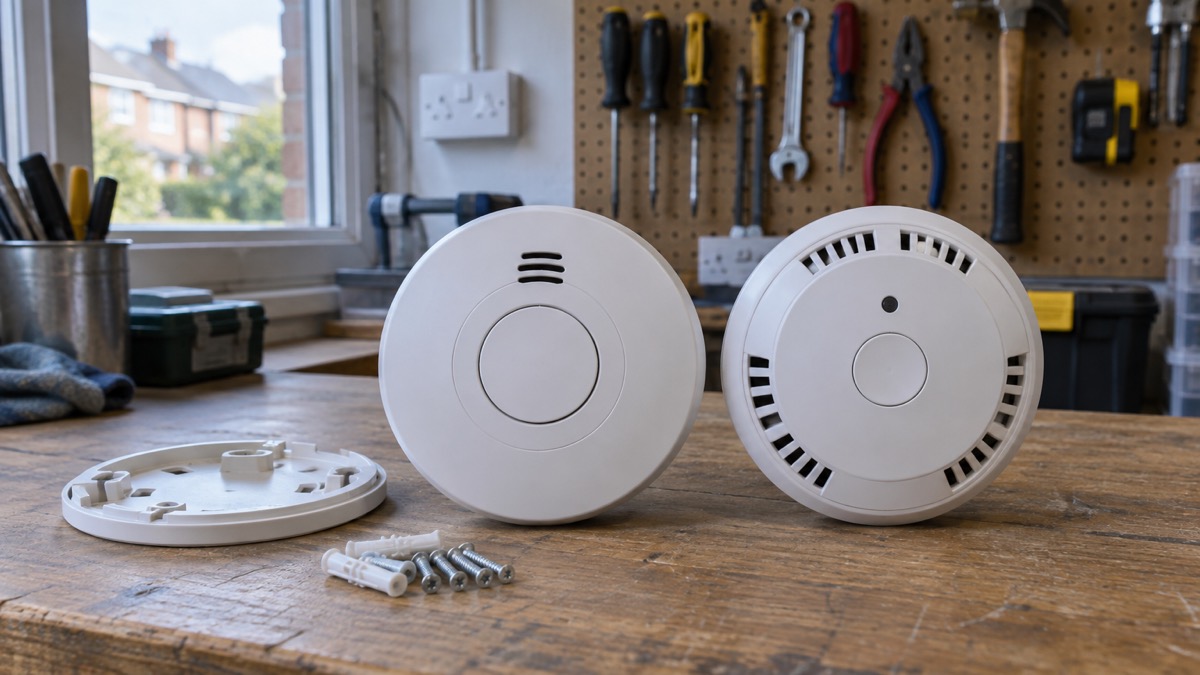
Most UK homes have a smoke alarm, but far fewer have the right mix of them. The choice between an optical and an ionisation alarm is not about which is better overall: the two sensors are built to catch different kinds of fire, and each suits different rooms. Optical alarms are typically more effective at detecting slow burning fires, such as smouldering foam-filled furniture or overheated wiring1. Ionisation alarms are typically more effective at detecting fast, flaming fires1.
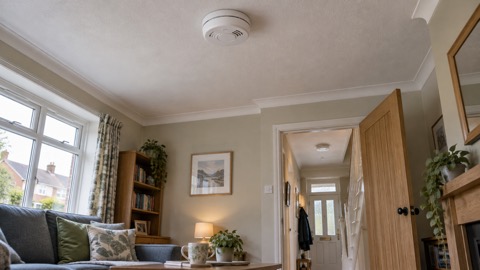
That single difference decides most of what you should fit. Fire and rescue services recommend smoke alarms in most areas of the home, including living rooms, hallways, landings and dining rooms3. Where a room produces steam, fumes or cooking moisture, a heat alarm is more suitable than a smoke alarm4. And whatever you fit, it should be ceiling mounted, interlinked, and marked with a current safety standard5.
This page sets out what each type does, where each belongs, when a combined or heat alarm is the better answer, and how to check an alarm is properly certified before you buy it.
Optical alarms: the choice for slow, smouldering fires
An optical alarm, sometimes called photoelectronic, uses an optical sensor to look for smoke. Fire services describe these as typically more effective at detecting slow burning fires1. In practice that means the fires that smoulder and build up smoke slowly: a cigarette or a faulty lead setting light to a sofa, or wiring overheating inside a wall or behind a socket. Oxfordshire Fire and Rescue Service puts it plainly, describing optical alarms as more effective at detecting slow-burning fires, such as smouldering foam-filled furniture or overheated wiring2.
That matters because smouldering fires are the ones that give a household the least warning. A flaming fire announces itself with light and heat; a fire inside foam furniture can fill a room with toxic smoke while the room still looks normal. An alarm that reacts to larger smoke particles from that kind of fire buys the household time to get out.
Optical alarms have a second practical advantage. Staffordshire Fire and Rescue Service notes that they are less likely than ionisation alarms to go off when toast is burned, and can be installed near, though not in, kitchens11. Fewer nuisance alarms means fewer households taking the battery out, which is the single most common way a working alarm stops working.
The trade-off is cost. Several fire services describe optical alarms as more expensive than ionisation models2. Set against that, the same services describe them as more effective at the fires most likely to trap a sleeping household, and fire services in England now commonly recommend an optical multi sensor alarm as the default choice for a home11.
Ionisation alarms: fastest on flaming fires
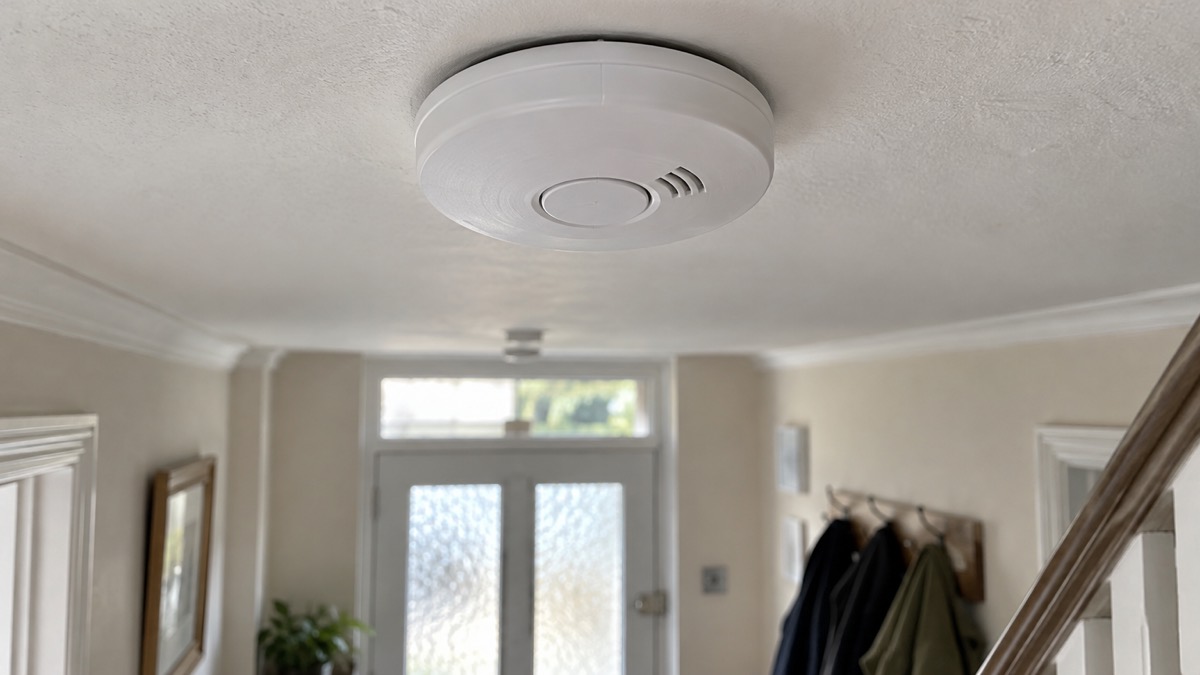
An ionisation alarm uses an ionisation sensor, and fire services describe these as typically more effective at detecting fast, flaming fires1. These are fires that take hold quickly and burn fiercely: a chip pan, a pan of oil, a waste bin, or a fire that has already reached a curtain or an item of clothing. Oxfordshire Fire and Rescue Service says an ionisation alarm will detect flaming fires before the smoke gets too thick2.
Ionisation alarms are very sensitive to fires that burn fiercely12. That combination explains why so many older homes have them: they were the standard fit for years. They are sensitive to free burning fires such as chip pan fires13.
The weakness is the mirror image of the optical alarm's strength. An ionisation alarm is less good at the slow, smouldering fire that produces lots of large smoke particles, and more prone to sounding when cooking burns. In a hallway or landing, where smoke from a downstairs fire will reach it, that is a reasonable trade. In a living room full of upholstered furniture, it is the wrong way round.
Where do they still earn a place? Warwickshire Fire and Rescue Service lists ionisation smoke alarms, or combined optical smoke and heat alarms, for landings5. If you already have working ionisation alarms on a landing and they are in date, they are doing a job. If you are buying new, the balance of official advice has moved towards optical and multi sensor models for most of the home11.
Where each type should go in your home
The type matters less than the coverage. Fire and rescue services recommend smoke alarms in most areas of the home, including living rooms, hallways, landings and dining rooms3. The minimum is at least one working smoke alarm on every floor of your home, tested regularly9. Households with someone using home oxygen therapy are advised to fit a minimum of one working smoke alarm on every level, preferably in a circulation space such as a hallway or landing14.
| Room | Alarm to fit | Why |
|---|---|---|
| Hallway and stairs | Optical smoke alarm | Catches smoke spreading from a fire elsewhere in the house3 |
| Landing | Ionisation smoke alarm, or combined optical smoke and heat alarm | Listed by fire services for landings5 |
| Living room | Optical smoke alarm | Suited to smouldering furniture and wiring2 |
| Dining room | Optical smoke alarm | Smoke alarms are recommended in most living areas3 |
| Bedroom | Optical smoke alarm | Early warning while people sleep3 |
| Kitchen | Heat alarm | Steam and fumes set smoke alarms off7 |
| Room with a fuel-burning appliance | Smoke alarm plus a carbon monoxide alarm | The two detect different things15 |
Two rules sit above the table. All smoke and heat alarms should be ceiling mounted and interlinked, so that one sounding sets off the rest17. And where fuel is burned, a carbon monoxide alarm belongs in the same room: fire services advise a carbon monoxide alarm in every room where fuel is burned, including gas cookers, open fires and log burners18.
Combined alarms: optical smoke and heat, or smoke and carbon monoxide
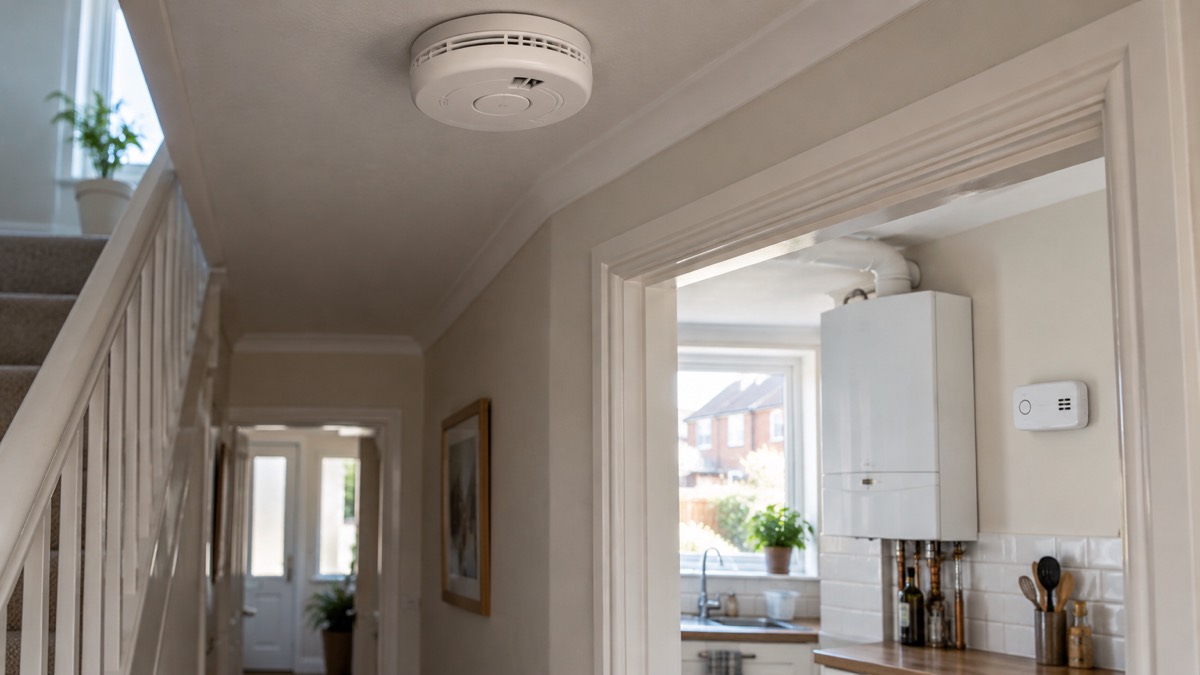
If you want one unit to do more than one job, there are two combinations worth knowing.
The first is a combined optical smoke and heat alarm. Fire services describe these as combinations of optical and heat alarms in one unit, designed to reduce false alarms while increasing the speed of detection13. Because the unit needs both a rise in temperature and smoke before it sounds, it is less easily triggered by steam or burnt toast, which makes it a candidate for a hallway outside a bathroom or a landing near a kitchen. Warwickshire Fire and Rescue Service lists combined optical smoke and heat alarms as an option for landings5.
The second is a combined smoke and carbon monoxide alarm. This is a genuine convenience, but it does not remove the need for separate detection. Fire services are explicit that carbon monoxide alarms detect carbon monoxide while smoke alarms detect smoke and fire, that they are not a substitute for one another, and that both types should be installed in your house15. The emergency services advise fitting both a carbon monoxide and a smoke alarm in the house19. If you fit a combined unit, check that it is certified for both functions and that it is sited where both jobs can be done: a carbon monoxide alarm needs to be near the appliance, while a smoke alarm needs to be in the circulation space.
Heat alarms: a thermistor instead of a smoke sensor
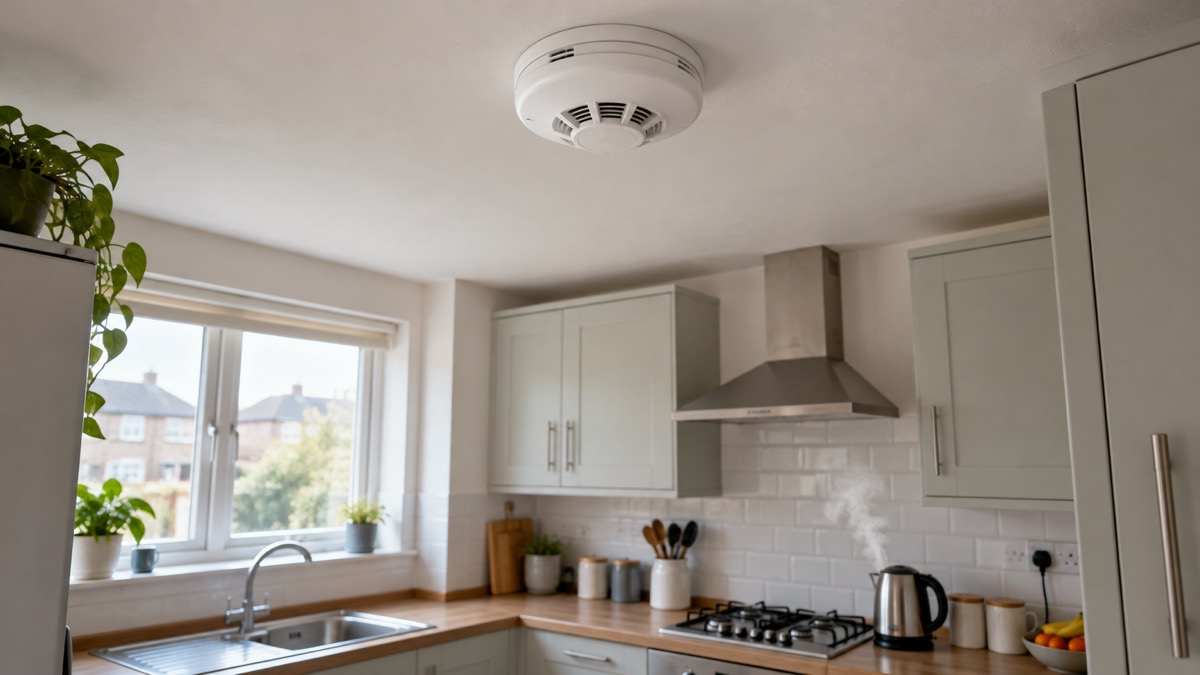
A heat alarm does not look for smoke at all. It uses a heat sensor, a thermistor, that activates when there is a change in temperature caused by a fire, unlike a standard smoke alarm which sounds when it detects smoke8. Heat alarms detect the increase in temperature from a fire and are insensitive to smoke21.
That insensitivity is the point. Heat alarms are more suitable than smoke alarms for detecting fires in kitchens or other rooms where steam, fumes or moisture could cause nuisance alarms in smoke alarms4. London Fire Brigade advises fitting a heat alarm rather than a smoke detector in the kitchen, as steam or fumes from cooking can damage a smoke alarm or unintentionally set it off7. A garage, a utility room or a workshop, where dust and fumes are common, is a similar case.
The limitation is real: a heat alarm will not warn you of a slow, smouldering fire that produces smoke but little heat until flames develop. That is why heat alarms are fitted alongside smoke alarms, not instead of them. A heat alarm in the kitchen linked to optical alarms in the hallway and landing gives the household both kinds of warning.
Certification, guarantees and getting support
Whatever type you choose, the certification is what tells you the alarm has been tested to do the job. Fire services advise looking out for the British Standard Kitemark and Loss Prevention Certification Board (LPCB) symbols, which show the alarm is approved and safe10. Smoke alarms should meet British Standard BS 5446 Part 1 and carry the Kitemark22. Carbon monoxide alarms should comply with British Standard BS EN 50291 and carry the BSI Kitemark logo23. Make sure any alarms you buy are marked with a current British Standards or European (CE) safety mark6.
On battery life, the advice is consistent. Ten-year sealed battery smoke alarms are described as the best option: slightly more expensive, but you save on the cost of replacing batteries10. Staffordshire Fire and Rescue Service recommends, if possible, fitting an optical multi sensor smoke alarm with a ten-year life span and a sealed battery compartment, which helps prevent tampering or removal of the battery11. For carbon monoxide, one service describes seven-year sealed battery detectors as the best option10.
If you would rather not fit alarms yourself, ask your local fire and rescue service about a home fire safety visit24. What you are given varies: Hampshire and Isle of Wight Fire and Rescue Service says the smoke alarms it supplies are sealed units with a ten-year battery life, and its carbon monoxide alarms sealed units with a seven-year battery25. If an alarm fitted by a fire service develops a fault while still under guarantee, contact the maker: FireAngel alarms can be supported on freephone 0800 141 2561, and FireHawk on freephone 0800 008 6568, or by text on 07885 831239 if you cannot call26.
Where to buy is straightforward. Smoke alarms are sold at DIY stores, hardware and electrical shops, and at some supermarkets22. Carbon monoxide alarms are sold in many retail outlets, including DIY and hardware stores, online sales, supermarkets and trade retail stores20. Wherever you buy, check the marks before you fit it.
Sources (25)
- Smoke and heat alarms, Greater Manchester Fire and Rescue Service, 2026
- Smoke alarms, Oxfordshire County Council, 2026
- Detectors, Surrey County Council, 2026
- Cooking fire safety devices, Greater Manchester Fire and Rescue Service, 2026
- Alarms and sprinklers, Warwickshire County Council, 2026
- Smoke alarms and heat alarms, London Fire Brigade, 2026
- Alarms, London Fire Brigade, 2026
- Equipment, Devon and Somerset Fire and Rescue Service, 2026
- Preparing for an emergency: be ready, stay safe, act now, Sussex Resilience Forum, 2025
- Fire alarms and carbon monoxide detectors, Lincolnshire County Council, 2026
- Smoke alarms, Staffordshire Fire and Rescue Service, 2026
- Smoke alarms - Cornwall Council, Cornwall Council
- Home oxygen, Greater Manchester Fire and Rescue Service, 2026
- Safe home heating, Warwickshire County Council, 2026
- Smoke alarms and CO detectors, Warwickshire County Council, 2026
- Chimney Fire Safety Advice, Scottish Fire and Rescue Service
- Think fire safety when saving money on your energy bills, Devon and Somerset Fire and Rescue Service, 2022
- Smoke and carbon monoxide alarms, Ask the Police, 2026
- Carbon monoxide alarms, Health and Safety Executive for Northern Ireland, 2026
- Smoke alarms, Warwickshire County Council, 2026
- Smoke alarms factsheet, Suffolk Fire and Rescue Service, 2014
- Carbon monoxide leaflet, Bedfordshire Fire and Rescue Service, 2026
- Home fire safety visits, Staffordshire Fire and Rescue Service, 2026
- Home fire safety visit booklet, Hampshire and Isle of Wight Fire and Rescue Service, 2023
- Problem with your smoke or heat alarm, Greater Manchester Fire and Rescue Service, 2026
 Heat Alarm or Smoke Alarm
 Combined vs Separate Alarms
 Sealed or Replaceable Alarms
 Battery or Mains Smoke Alarms
 Wireless or Wired Alarms
 CO2 vs Powder Extinguishers