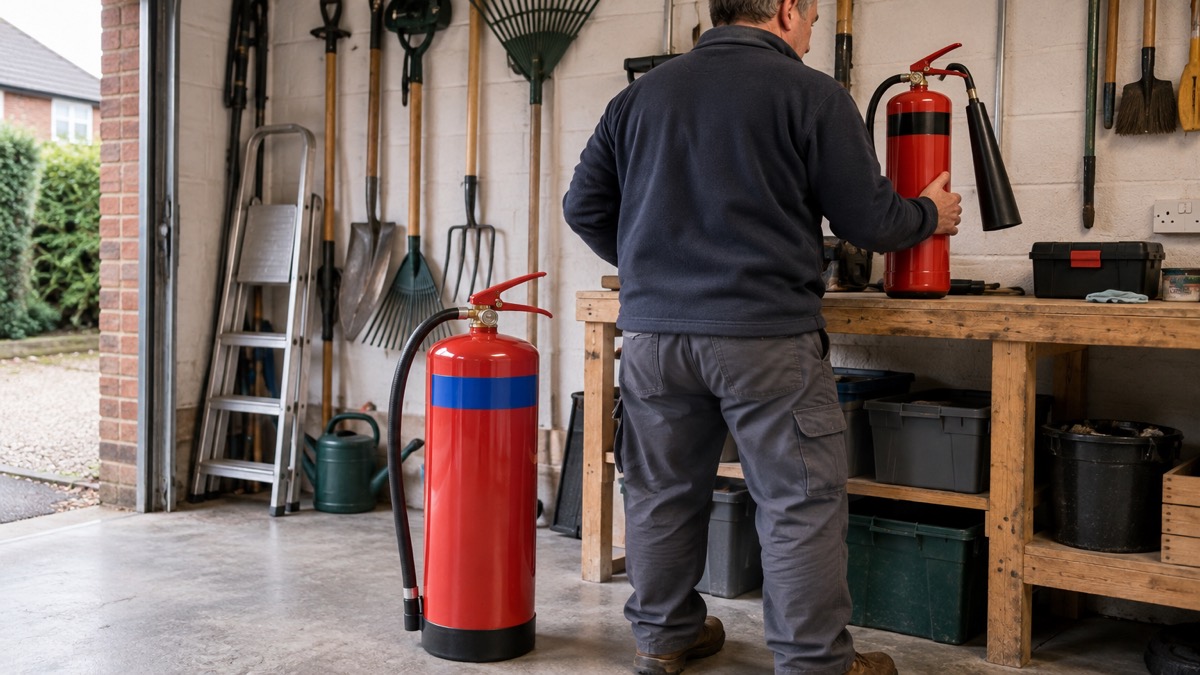
If you are choosing between a CO2 and a dry powder extinguisher for the house, the short answer is that they do different jobs. A CO2 extinguisher is the one for electrical equipment: fire services describe it as a good solution for fires involving computer equipment and other electrical appliances, and it leaves no residue behind1. A dry powder extinguisher covers more ground, being suitable for class A, B and C fires, but the powder does not soak into materials and does not have a good cooling effect on the fire1.
Neither one is a substitute for getting out and calling 999. Fire services are consistent that an extinguisher is for a small, contained fire you can tackle with your back to an exit, and that a fire that is spreading is a job for the fire and rescue service. The most important thing to know before you buy either type is what each one must never be used on: chip pans and lithium batteries both need a different approach entirely.
This page sets out which fires each type is for, how CO2 works, where it must never be used, and where an extinguisher sits in a household's wider fire plan. For the full range of extinguishers and fire blankets, see Fire Extinguishers and Fire Blankets: Types and Uses.
| CO2 | Dry powder | |
|---|---|---|
| Label colour | Black2 | Blue2 |
| Fires it suits | Flammable liquids, petrol, oil; computer equipment and electrical appliances1 | Class A, B and C fires1 |
| Cooling effect | None stated; fire may re-ignite while materials are hot1 | Powder does not soak in and has no good cooling effect1 |
| Residue | None1 | Difficult clean up; do not inhale the powder1 |
| Enclosed spaces | Gas can be harmful; ventilate well afterwards2 | Should not be used in enclosed spaces2 |
| Best household fit | Electrical equipment, a garage or workshop | A car, or a space where class A solids are the main risk5 |
CO2 or powder: which fires each one is for
The two types overlap on flammable liquids and diverge everywhere else. CO2 is listed by fire services as suitable for flammable liquids, petrol and oil, and as a good solution for computer equipment and other electrical appliances1. Dry powder is listed as suitable for class A, B and C fires, which takes in solids such as wood and paper as well as liquids and gases1.
That sounds as though powder wins on coverage, and in one sense it does. But the same official guidance adds two caveats that matter in a house. The powder does not soak into materials and does not have a good cooling effect on the fire, so a fire that is smouldering in soft furnishings or paper can carry on after the flames are knocked down1. And powder should not be used in enclosed spaces, because the powder can affect your breathing and reduce visibility for a safe evacuation2.
CO2 has its own limits. It is a gas that smothers the fire by pushing oxygen away, and once the smothering gas has dissipated, the fire may re-ignite if the materials are still hot1. It is also harmful if used in confined spaces for the same reason, so the area needs ventilating well afterwards2.
For a car, fire services say that if it is safe to do so, use a dry powder or foam fire extinguisher (BS EN3)5. That is a different setting from a kitchen or a living room, and it is worth keeping the two contexts apart when you decide what to keep at home.
The six fire classes, from paper to cooking oil
Fire services divide fires into six types, classes A to F, and an ABC extinguisher is one suitable for the A, B and C categories2. The classes exist so that the label on an extinguisher tells you at a glance whether it is the right tool for what is burning.
Class A fires involve solid materials such as wood, paper or textiles1. These are the ordinary household fires: a curtain against a lamp, a pile of paperwork, a sofa. Foam extinguishers are suitable for class A fires and for fires involving flammable liquids, because the foam creates a smothering film over the fire, starving it of oxygen and cooling the liquid1. Water extinguishers are also listed for class A materials2.
Class B covers flammable liquids, which is where CO2 and foam both come in2. Class C covers gases. Class F is the one that catches households out: fires involving burning oil and deep fat fryers, for which wet chemical extinguishers are especially designed1.
The practical lesson from the class system is that no single extinguisher is right for every room. A CO2 by the door of a home office and a fire blanket in the kitchen is a more sensible pairing than one extinguisher expected to do everything. The kitchen is where the class F risk lives, and it is the one place where the wrong extinguisher can make things worse.
A CO2 extinguisher has a black label and is made for electrical fires
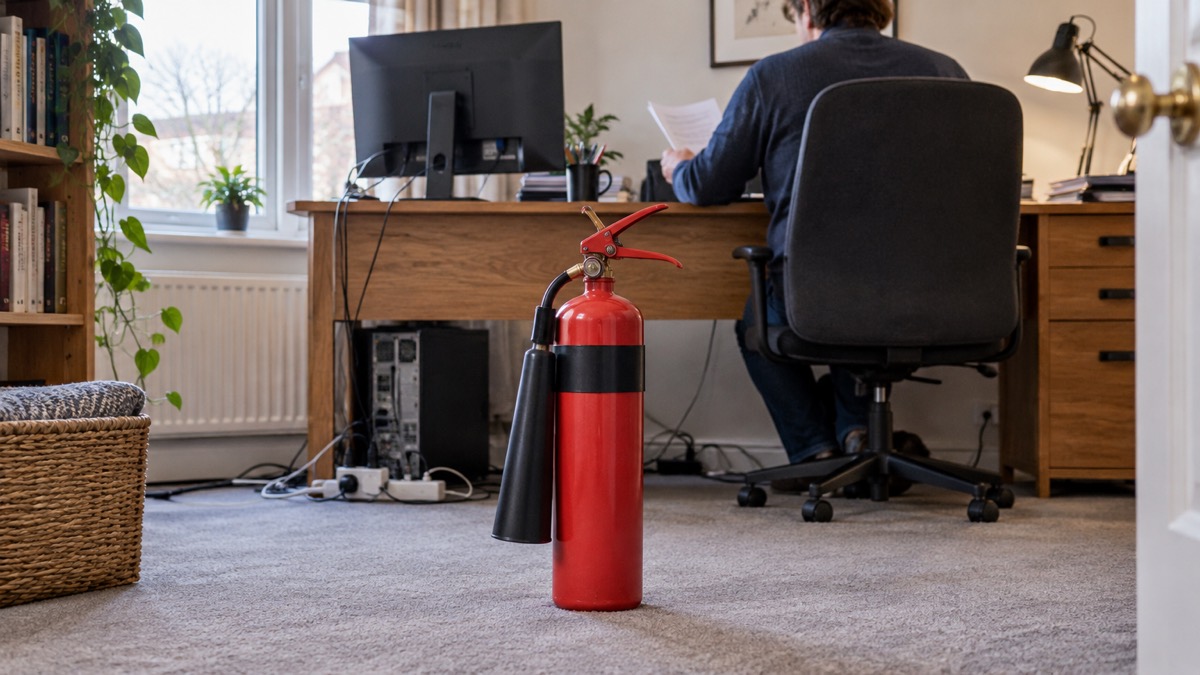
The quickest way to tell extinguishers apart is the colour code on the label. CO2 extinguishers carry a black label4. Dry powder extinguishers are identified by their blue label2. In a cupboard under stairs or a garage shelf, the label is what you will be looking at in a hurry, so it is worth knowing the code before you need it.
CO2 extinguishers contain pressurised carbon dioxide gas and are suitable for use on fires involving flammable liquids, and are also a good solution for tackling fires involving computer equipment and other electrical appliances1. That combination is why they turn up in offices, server rooms and anywhere with a lot of plugged-in equipment.
For a household, the case for CO2 rests on two things. It works on the electrical fires that are among the most common causes of home fires. It leaves nothing behind, so a device that survives the fire is not written off by the extinguisher itself1.
The case against is equally clear. CO2 is mainly used for live electrical fires and Class B fires, so it is not the right tool for class A fires in furnishings or paper8. And it must be used with the room in mind, because the gas displaces oxygen.
How CO2 puts a fire out by pushing away the oxygen
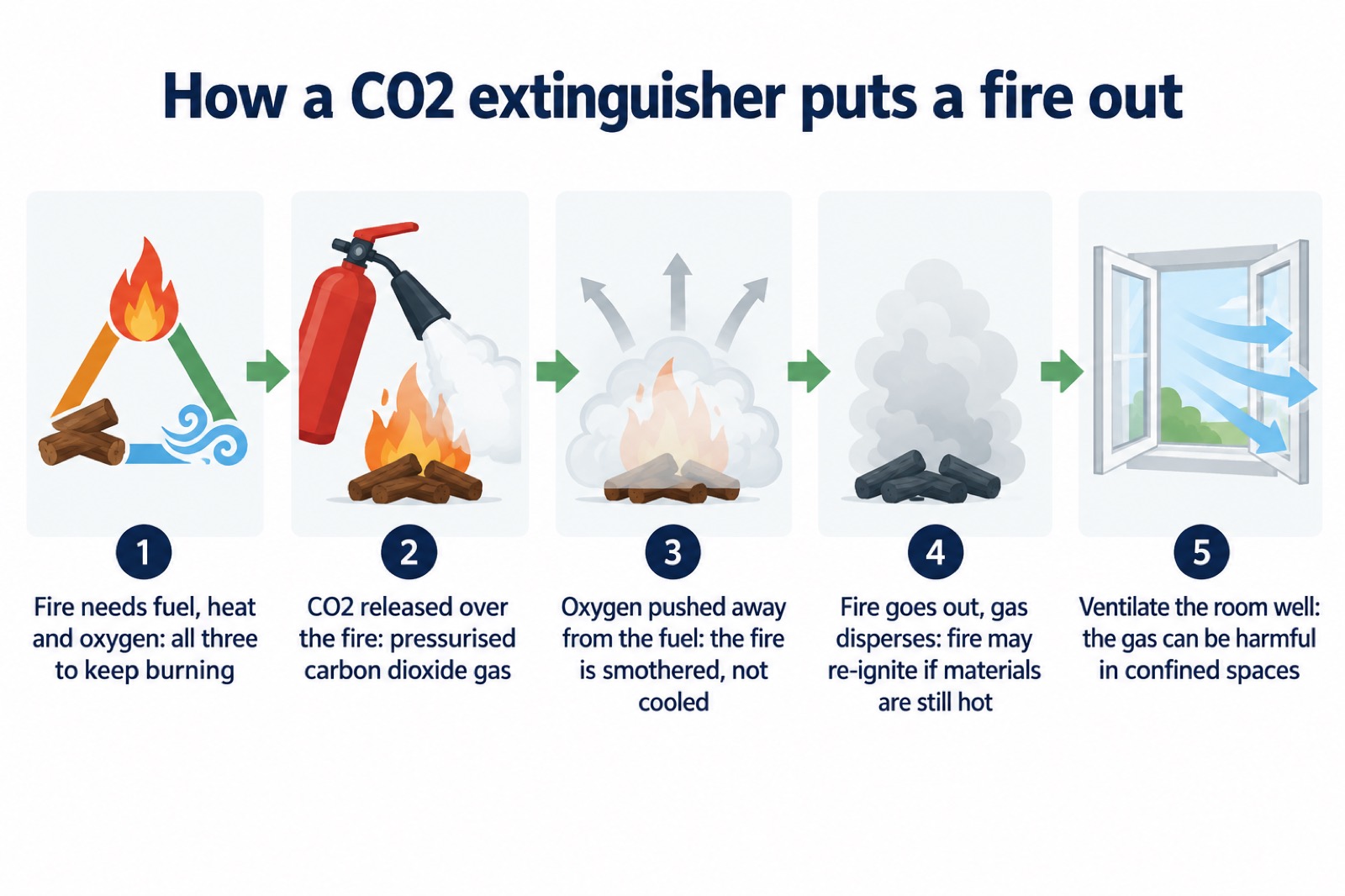
A fire needs three things: fuel, heat and oxygen. CO2 attacks the third. The extinguisher releases a cloud of carbon dioxide gas that settles over the fire and pushes the oxygen in the air away from the fuel, so the fire is smothered rather than cooled2.
This is why CO2 is so well suited to electrical equipment. You cannot safely spray water over a live appliance, and you do not want a powder that will coat circuit boards and settle into every vent. A gas that displaces oxygen and then disperses leaves the equipment as it was, apart from the fire damage itself1.
The same mechanism is the source of the risk. Fire services warn that gas from CO2 extinguishers can be harmful if used in confined spaces, as they displace oxygen in the air, and advise making sure to ventilate the area well after extinguishing the fire2. In a small room with the door shut, you are breathing the same air the fire was using.
There is a second reason to think about oxygen. Fire services note that extra oxygen in the air can make a fire burn more quickly9. A household where someone uses oxygen therapy needs to treat any fire risk with particular care, and the guidance on that is set out in Fire Safety When Someone Uses Oxygen Therapy.
CO2 leaves no residue, so electrics are not damaged
The residue question is the one that decides most household choices between these two types. A CO2 extinguisher leaves no residue, which is why fire services describe it as a good solution for computer equipment and other electrical appliances1. A dry powder extinguisher is the opposite: the clean up after discharging a powder extinguisher is difficult, and care must be taken not to inhale the powder1.
Think about what that means in practice. A small fire in a laptop, a games console or a wall socket is often caught early. With CO2, the fire is out, the room airs out, and the device can be inspected by someone competent. With powder, the room, the carpet, the soft furnishings and the inside of the device are coated in a fine dust that does not soak in and does not cool, and the clean up is a job in itself1.
That does not make CO2 the right extinguisher for every room. It makes it the right one for the rooms where electrical equipment is concentrated: a home office, a study, a workshop with power tools, a cupboard where the router and the chargers live. For the wider picture of how electrical fires start and how to prevent them, see Electrical Fires: Overloaded Sockets and Faulty Appliances.
Where a CO2 extinguisher must never be used
The list of places a CO2 extinguisher must not be used is short but firm, and each item on it has a reason behind it.
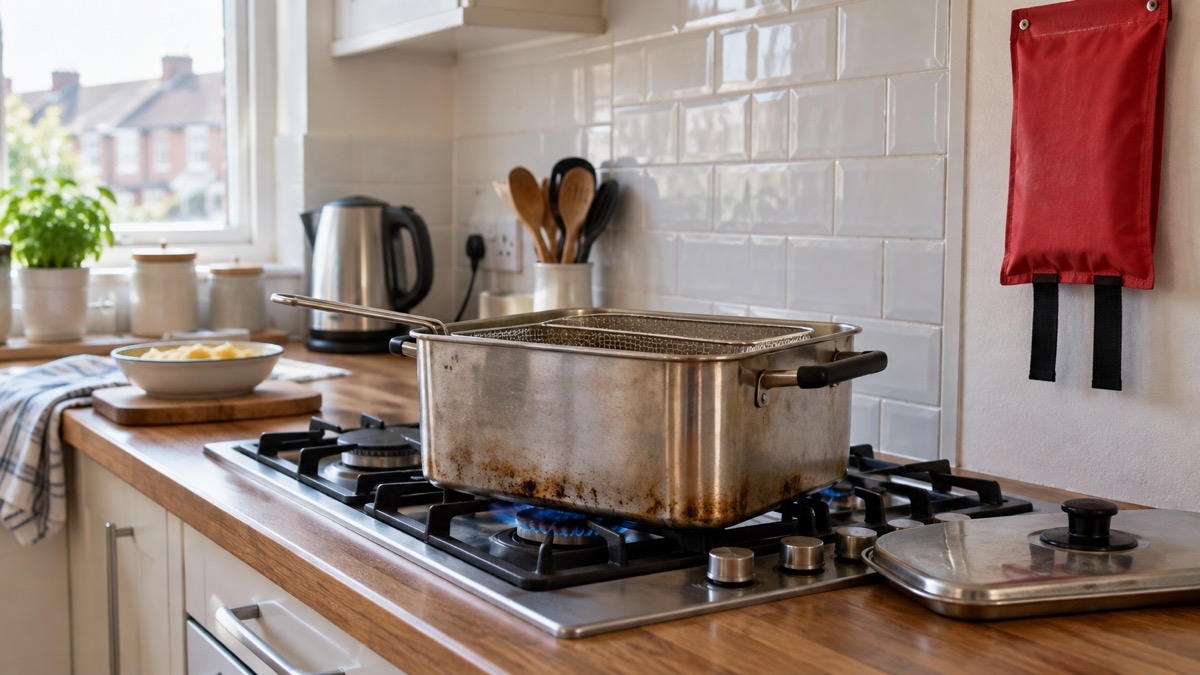
- On a chip pan or any pan of burning oil. Fire services state that you should never use a fire extinguisher for a chip pan fire, because the jet can force burning fat out of the pan and spread the fire2. Another service says never throw water over it or use a fire extinguisher, as the effects can be devastating and spread the fire further6. Switch off the hob, leave the room, close the door and call the fire brigade7.
- On a lithium-ion battery fire. Fire services are unanimous that you should not attempt to extinguish the fire; get out, stay out, call 9996. People should never try to extinguish lithium-ion battery fires themselves but leave the area or building as quickly as possible and call 9993.
- In a small, unventilated room where you intend to stay. The gas displaces oxygen and can be harmful in confined spaces2.
- On a fire involving a gas leak or a fuel-burning appliance that is malfunctioning. Carbon monoxide is a silent and deadly gas that can be emitted by malfunctioning or improperly vented fuel-burning appliances10. A fire near one is a matter for the fire and rescue service, not a household extinguisher.
The common thread is that these are fires where the extinguisher either cannot reach the fuel or makes the situation worse. A chip pan fire throws burning fat when disturbed. A lithium battery fire is one you should not try to fight at all: get out, stay out and call 9993. A gas fire can be fed by a supply you cannot shut off from the room.
Lithium battery and chip pan fires need a different approach
These two are worth treating as their own category, because they are the fires where a household extinguisher is most likely to be reached for and least likely to help.
Lithium-ion batteries can cause fires, and when they fail they can ignite quickly and produce intense fires that spread rapidly11. The electrolyte used in lithium-ion batteries is typically flammable, which means that if a fire occurs, it can be difficult to extinguish and may spread rapidly13. Fire services describe these fires as quickly spreading and hard to put out, causing a lot of damage8.
The instruction from every fire service is the same: do not attempt to extinguish the fire; get out, stay out, call 9996. Everyone should evacuate the building and someone should call 999, because lithium batteries are more difficult to extinguish than normal fires13. If you can raise the alarm on the way out, do so14.
Chip pans are the other classic case. The advice is to switch off the hob, leave the room, close the door and call the fire brigade7. A wet chemical extinguisher is the type especially designed for use on kitchen fires involving burning oil and deep fat fryers1, but that is a piece of kit for a commercial kitchen or a very deliberate household decision, not something to reach for once a pan has caught. The safer household answer is a fire blanket and a lid, and knowing when to walk away.
| Fire type | What to do | What not to do |
|---|---|---|
| Chip pan or pan of oil | Switch off the hob, leave the room, close the door, call the fire brigade7 | Never use a fire extinguisher; the jet can force burning fat out and spread the fire2 |
| Lithium-ion battery (e-bike, e-scooter, phone, laptop) | Get out, stay out, call 999; raise the alarm6 | Do not attempt to extinguish it yourself6 |
| Electrical appliance, small and contained | CO2 is a good solution for computer equipment and electrical appliances1 | Do not use water on live equipment |
| Flammable liquid, petrol, oil | CO2 is listed as suitable1 | Do not use in an enclosed space without ventilating afterwards2 |
For e-bikes and e-scooters specifically, the charging and storage guidance is set out in E-bikes and E-scooters: Charging and Storing Them Safely, and the chip pan procedure in full is in How to Put Out a Chip Pan or Saucepan Fire.
Where CO2 extinguishers are usually kept
Extinguishers are only useful if they are where the fire is and still in working order when you reach for them. Fire services advise keeping them stored away from cookers, heaters or other extreme heat sources2. A cupboard next to the oven or a shelf above a radiator is the wrong place.
In a home, the sensible pattern follows the risks:
- Home office or study: a CO2 extinguisher for the electrical equipment, mounted by the door rather than behind the desk1.
- Garage or workshop: a CO2 for flammable liquids and petrol, kept away from heat sources2. Fuels should be stored separately to reduce fire loading and prevent a fire from starting and spreading15.
- Kitchen: a fire blanket rather than an extinguisher, given the chip pan warning2. A wet chemical extinguisher is the type designed for oil fires if you decide to go further1.
- Hall or landing: the place you pass on the way out, not the place you have to reach past a fire to get to.
Whatever you keep, read the instructions on the unit before you need them, check the gauge or indicator as the maker instructs, and make sure everyone old enough to use it knows where it is and what it is for. An extinguisher you have to hunt for in a smoke-filled room is not an asset.
The wider household picture, including alarms, escape routes and the checks worth doing before bed, is in Fire Extinguishers and Fire Blankets: Types and Uses and Fire Safety Checklist for Your Home. If a fire does take hold, What to Do If a Fire Starts in Your House sets out the order of actions, and What to Do After a Fire in Your House covers the days that follow.
Sources (15)
- Fire extinguishers, Warwickshire County Council, 2026
- Fire safety equipment, Devon and Somerset Fire and Rescue Service, 2026
- E-bikes, e-scooters and mobility scooters, Greater Manchester Fire and Rescue Service, 2026
- The Different Types of Fire Extinguishers | Toolstation, Toolstation
- Car fires, Dorset and Wiltshire Fire and Rescue Service, 2020
- Kitchen, Devon and Somerset Fire and Rescue Service, 2026
- Baby and toddler safety, NHS, 2026
- Batteries, Dorset and Wiltshire Fire and Rescue Service, 2026
- Digital easy read fire safety booklet, London Fire Brigade, 2026
- Smoke alarms and CO detectors, Warwickshire County Council, 2026
- E-bikes and e-scooters, London Fire Brigade, 2026
- Battery safety flyer, Portsmouth City Council, 2026
- Product safety, East Sussex County Council, 2026
- What to do if there's a fire caused by an e-bike or e-scooter, London Fire Brigade, 2026
- Fire safety at home, Surrey County Council, 2026
 Heat Alarm or Smoke Alarm
 Combined vs Separate Alarms
 Sealed or Replaceable Alarms
 Battery or Mains Smoke Alarms
 Wireless or Wired Alarms
 Optical or Ionisation Alarms