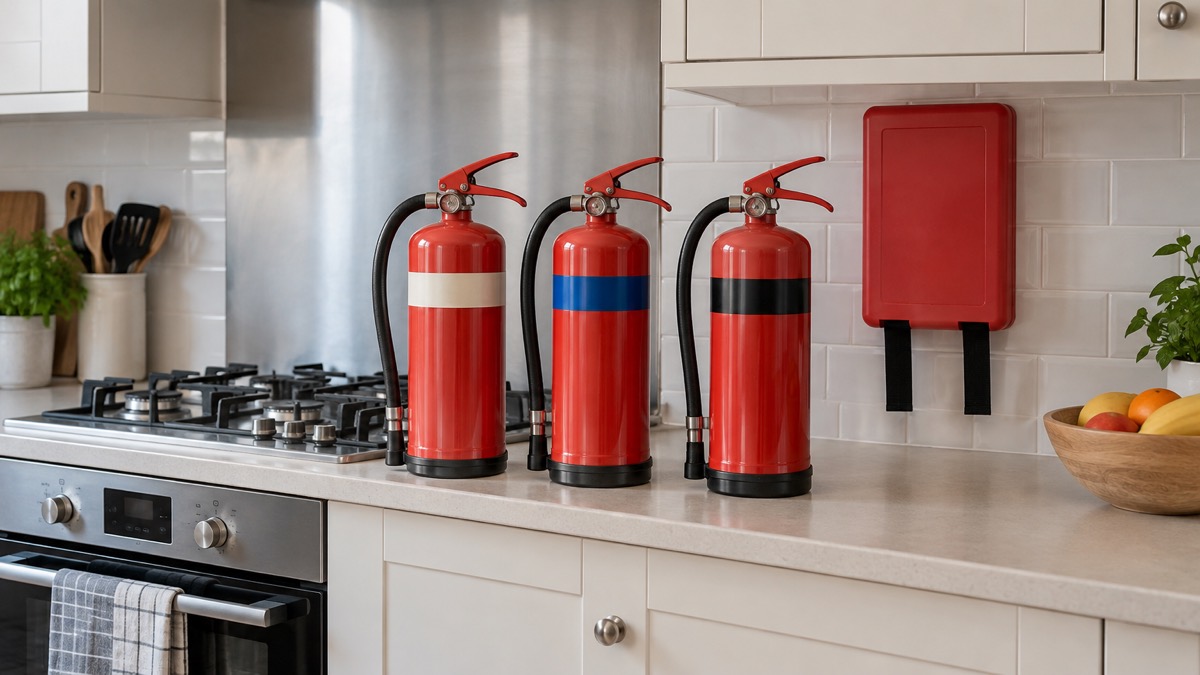
A home fire extinguisher or fire blanket is worth having, but only if it is the right one for the fire you might actually face. There is no single type of extinguisher that can deal with all types of fire, and using the wrong one can spread a fire rather than put it out1. For most UK households the practical answer is a fire blanket in the kitchen, plus at most one or two extinguishers chosen for the risks in your home, and a clear plan for when to leave the fire alone and get out.
The first thing to know is that fires are grouped into classes, from A to F, according to what is burning1. Extinguishers are labelled by colour so you can tell what is inside at a glance: red for water, pale cream for foam, French blue for dry powder and black for carbon dioxide2. A fire blanket to the British Standard is the tool fire services most often suggest for a kitchen, because it deals with the pan fires that start there without the risks an extinguisher jet brings1.
This page explains the fire classes, what each extinguisher type does and does not suit, what a fire blanket must meet to be worth buying, and how to use one on a pan or on a person. It also covers where to keep home fire equipment and how to dispose of it. If a fire has already started and you need to know what to do now, read What to Do If a Fire Starts in Your House first.
Fire classes A to F: what each one means
Fire services divide fires into six classes, A to F, according to the material burning1. The class matters because an extinguisher works by attacking the fire in a way that suits that material: water cools burning solids, foam smothers liquids, and so on. An "ABC" extinguisher is simply one suitable for fires in the A, B and C categories1.
The classes you are most likely to meet at home are:
| Class | What is burning | Typical example at home |
|---|---|---|
| A | Solid materials such as wood, paper or textiles | Furniture, curtains, a waste bin fire4 |
| B | Flammable liquids such as petrol, diesel or oils | Fuel stored in a shed or garage4 |
| F | Cooking oils, such as in deep-fat fryers | A chip pan or frying pan fire4 |
Class A covers the ordinary combustibles that fill a house, and it is the class most home extinguishers are aimed at. Class B fires involve flammable liquids such as petrol, diesel or oils2. Class F is the kitchen fire: fires involving cooking oils such as in deep-fat fryers2, and wet chemical extinguishers are the only ones rated to tackle these types of fire3.
Warwickshire Fire and Rescue Service advises that before buying a fire extinguisher it is vital to look carefully at what type of fire it has to be used on4. In practice that means looking around your home: a kitchen points to a fire blanket and possibly a wet chemical extinguisher, a garage with stored fuel points to foam or CO2, and a room full of electronics points to CO2. Fires involving metals and gases fall into the other classes, and specialist powders exist for metal fires, which we cover below.
The extinguisher types, and the fires each one suits
There are four main types of fire extinguisher, each containing different substances to deal with different types of fire1. All modern extinguishers made to the British Standard are coloured signal red, with a colour-coded indicator area on the body that tells you what is inside2.
| Type | Label colour | What it suits | What to watch |
|---|---|---|---|
| Water | Signal red | Class A: paper, wood, soft furnishings | Cools by soaking into the material4 |
| Foam (AFFF) | Pale cream | Class A and Class B: solids and flammable liquids | Smothers and cools4 |
| Dry powder | French blue | Class A, B and C fires | Not for enclosed spaces1 |
| CO2 | Black | Flammable liquids and electrical equipment | Ventilate after use; re-ignition risk1 |
Two further types matter for particular households. Wet chemical extinguishers are especially designed for kitchen fires involving burning oil and deep fat fryers, which is Class F4. And specialist L2 and M28 powder extinguishers exist for fires involving metals such as aluminium, magnesium, titanium and swarf, metal shavings1. For most homes the metal powders are irrelevant, but if someone in the house works with metal shavings or keeps flammable metal stock in a garage, they are the only type that works on those fires.
When you buy, the Caravan and Motorhome Club advises checking that the extinguisher is manufactured in accordance with BS EN 3 and has been tested and approved by BSI or LPCB, or approved by BAFE2. Those marks are the evidence the extinguisher has actually been tested to the standard rather than merely styled to look like one.
Water and foam: the general-purpose pair
Water extinguishers are good for tackling fires involving burning paper, wood and soft furnishings, Class A fires, because the water soaks into the materials and cools them4. They are simple and cheap to understand, but they are only for solids: used on a liquid fire they can spread the burning fuel, and they must never be used on electrical equipment.
Foam extinguishers, also called AFFF foam, are suitable for Class A fires and fires involving flammable liquids, Class B, because the foam creates a smothering film over the fire, starving it of oxygen and cooling the liquid4. That makes foam the most versatile choice for a garage or shed where you might face either a solid fire or a fuel spill. Devon and Somerset Fire and Rescue Service lists foam among the types suitable for wood, paper, plastics and soft furnishings1.
Dry powder: effective, but not indoors
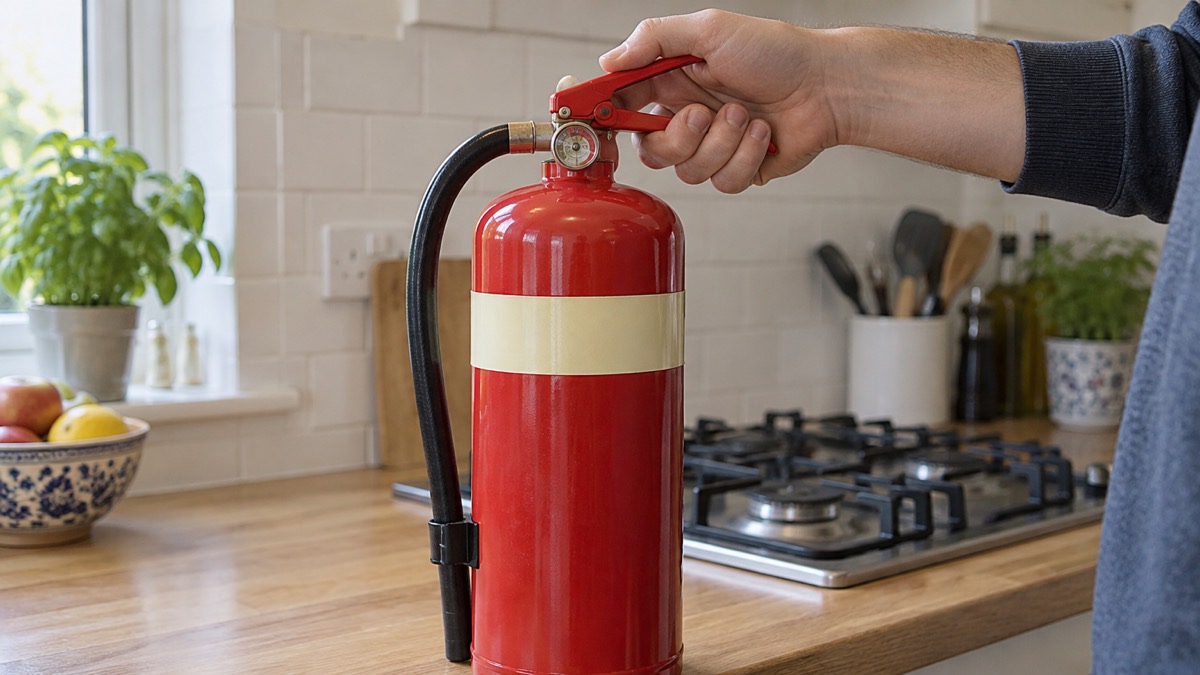
Dry powder extinguishers are suitable for fighting class A, B and C fires, but the powder does not soak into materials and does not have a good cooling effect on the fire4. That second point matters more than people expect: a powder extinguisher can knock the flames down, but because nothing is cooling the material, the fire can flare back up once the powder settles.
The bigger problem is the powder itself. Devon and Somerset Fire and Rescue Service advises that dry powder extinguishers should not be used in enclosed spaces, because the powder can affect your breathing and reduce visibility for a safe evacuation1. The Caravan and Motorhome Club likewise does not recommend them for confined spaces such as caravans2. In a small kitchen or hallway, a powder discharge can blind you on your own escape route, which is the opposite of what you want. If you are weighing powder against CO2 for a room with electronics, our CO2 or Powder Fire Extinguisher comparison goes deeper.
Wet chemical: the one built for cooking oil
Wet chemical extinguishers are especially designed for use on kitchen fires involving burning oil and deep fat fryers, Class F fires4. Where water and foam would spit burning oil and powder would not cool it, the wet chemical agent reacts with the hot oil to form a cooling layer over the surface. If you decide to keep an extinguisher in the kitchen at all, this is the type that matches the fire most likely to start there, alongside a fire blanket. Our Kitchen Fires page covers the prevention side, which matters far more than any kit.
CO2 extinguishers: black label, for electrical and liquid fires
CO2, carbon dioxide, extinguishers contain pressurised CO2 gas. Warwickshire Fire and Rescue Service describes them as suitable for use on fires involving flammable liquids, and also a good solution for tackling fires involving computer equipment and other electrical appliances4. Devon and Somerset Fire and Rescue Service likewise lists CO2 for flammable liquids, petrol and oil1.
The reason CO2 suits electricals is that the gas is not a conductor and leaves no residue: nothing soaks into a laptop or a fuse board, and nothing needs cleaning out of it afterwards. The gas works by displacing the oxygen the fire needs, which is effective but also the source of its two main cautions.
First, the gas from CO2 extinguishers can be harmful if used in confined spaces, as it displplaces oxygen in the air. Devon and Somerset Fire and Rescue Service advises making sure to ventilate the area well after extinguishing the fire1. Second, Warwickshire Fire and Rescue Service warns that once the smothering CO2 gas has dissipated, the fire may re-ignite if the materials are still hot4. A CO2 extinguisher puts the flames out but cools nothing, so treat the fire as out only when the fire and rescue service says it is.
For a household with a study full of computer equipment, or anyone who works on electricals at home, a small CO2 extinguisher is the type that matches. For everyone else it is an optional extra rather than a first purchase, and a fire blanket comes first.
Where an extinguisher must not be used
The most important section on this page is the list of fires you should not fight with an extinguisher at all, or not with the wrong one.
Chip pan and cooking oil fires. Devon and Somerset Fire and Rescue Service is blunt: never use a fire extinguisher for a chip pan fire, because the jet from the extinguisher can force burning fat out of the pan and spread the fire1. Lincolnshire's home fire safety advice for a chip pan fire is to turn off the heat if it is safe to do so, get out and call 9995. If the pan fire is small and you can reach the cooker safely, a fire blanket is the right tool, as we cover below. Our How to Put Out a Chip Pan or Saucepan Fire page walks through it step by step.
Lithium-ion battery fires. East Sussex Trading Standards advises that people should never try to extinguish lithium-ion battery fires themselves, but should leave the area or building as quickly as possible and call 9993. Portsmouth City Council's battery safety advice notes plainly that lithium batteries can cause fires6. These fires burn fiercely and can re-ignite, and no household extinguisher is designed for them. If you charge an e-bike or e-scooter at home, read our E-bikes and E-scooters page, because safe charging and storage do more than any extinguisher can.
Enclosed spaces and powder. As covered above, dry powder should not be used in enclosed spaces because it affects breathing and reduces visibility on your escape route1.
Partially used extinguishers. The Caravan and Motorhome Club advises never using an extinguisher that has been discharged, even partially2. Once the seal is broken you cannot rely on the pressure or the contents, so replace it.
The general rule. An extinguisher is for a small, contained fire in its early stages, with your escape route behind you and clear. If the fire is spreading, if smoke is filling the room, or if the fire involves oil, batteries or anything you cannot identify, get out, stay out and call 999. That is the consistent advice across every fire service source on this page, and it is why an escape plan matters more than any piece of kit.
Fire blankets: what to buy and what BS EN 1869 requires
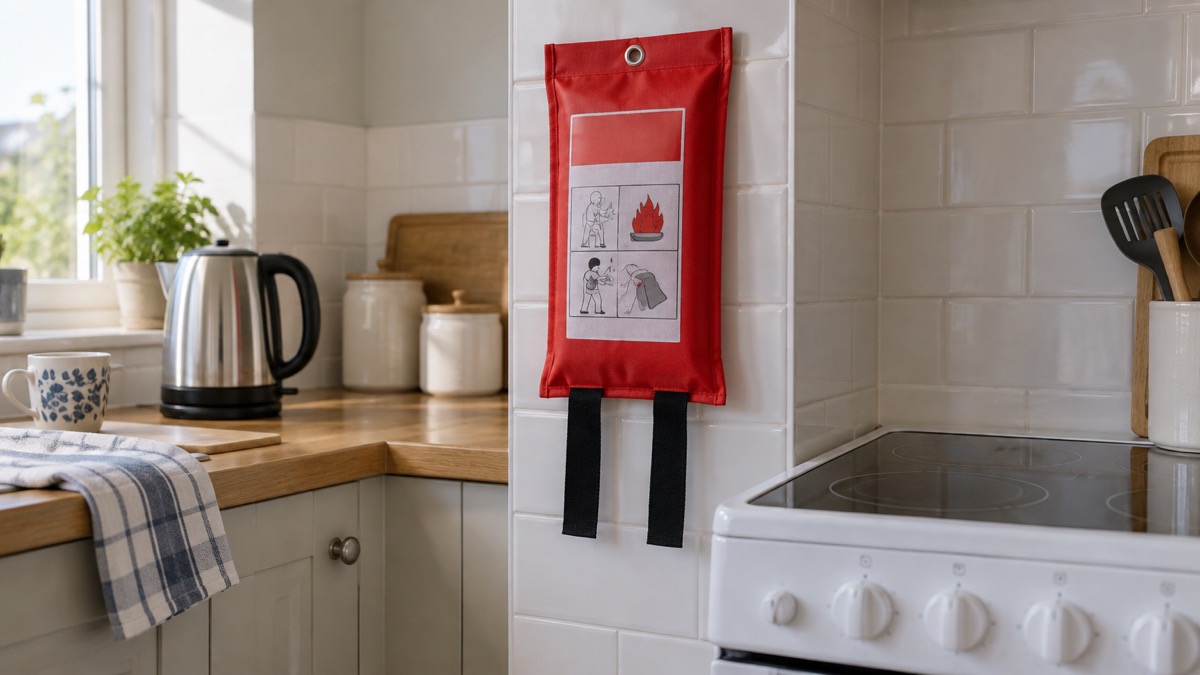
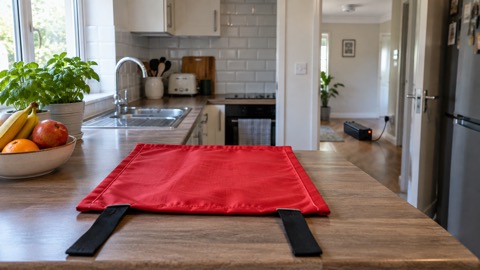
A fire blanket is a sheet of fire-resistant material designed to put out small fires by smothering them, cutting off the fire's oxygen. Devon and Somerset Fire and Rescue Service describes them as good for extinguishing chip pan fires and for wrapping around someone whose clothing is on fire1.
The single most important thing to check when buying is the standard. Devon and Somerset Fire and Rescue Service advises: "Always look for the British Standard mark (BS EN: 1869:1997 or BS 7944:1999)"1. A blanket without one of those marks has not been tested to smother a fire, and a cheap unmarked blanket may not withstand the heat of a burning pan.
As an example of what a compliant blanket looks like, FireAngel's FB100-FA-EUR 1m fire blanket is certified to EN 1869:2019, the successor to the 1997 standard, and measures 100 cm by 100 cm7. The maker states the material is approximately 0.43 mm thick and describes the size as ideal for waste bins and clothing fires7. In its retail packaging it measures 160 mm by 235 mm by 38 mm, so it takes up less room than a book and can sit in a drawer or hang on a wall7. That is the scale of the thing: small enough to keep anywhere, big enough to cover a pan or wrap a person.
Fire services consistently recommend keeping one in the kitchen. Northern Ireland Fire and Rescue Service advises students, and anyone else, to think about having a fire blanket in the kitchen for emergencies and to follow the instructions supplied with it8. Dorset and Wiltshire Fire and Rescue Service goes further for shared housing: there should be fire blankets and fire extinguishers in shared kitchens10. If you live in a shared or rented house, that is a reasonable thing to raise with your landlord, since it reflects what the fire service expects to find.
Fire blanket or extinguisher for a kitchen fire
For a kitchen, the fire blanket wins, and it is not close. Here is how the two compare for the fire that actually starts in a kitchen:
| Fire blanket | Fire extinguisher | |
|---|---|---|
| Chip pan fire | Designed for it: smothers the pan1 | Never: the jet can spread burning fat1 |
| Small bin or clothing fire | Suitable1 | Depends entirely on type and class |
| Clean-up | None: the blanket covers the fire | Powder or foam contaminates the room |
| Escape route | Stays clear | Powder can reduce visibility1 |
| Cost and size | Small pouch, fits a drawer7 | Larger, heavier, needs the right type |
The reason the blanket wins is the nature of kitchen fires. Cooking oil fires are Class F, and the only extinguisher built for them is the wet chemical type4. Every other type either fails to cool the oil or actively spreads it, and Devon and Somerset Fire and Rescue Service warns specifically against using an extinguisher on a chip pan fire because the jet can force burning fat out of the pan1. A blanket placed over the pan smothers it without disturbing the oil.
The technique matters as much as the tool. Lincolnshire's advice for a smoking pan, before it has even caught fire, is to turn off the heat and leave the oil to cool5. If it has caught fire and you can safely reach the cooker, turn off the heat if it is safe, place the blanket over the pan, and leave it there until everything has cooled. Follow the instructions supplied with your fire blanket5. Never move a burning pan, and never put water on burning oil.
One honest limit: a blanket only works if you can approach the fire safely. If the pan is already engulfing the extractor or the cupboards, the fire is beyond a blanket, and the answer is to leave and call 999. The blanket is for the first thirty seconds of a pan fire, not for a kitchen fire.
Using a fire blanket on someone whose clothes are on fire
The second use of a fire blanket is on a person, and here the advice from every UK fire service is remarkably consistent. Devon and Somerset Fire and Rescue Service: use it to put out fires on clothing by wrapping the blanket around the person on fire1. The Scottish Fire and Rescue Service and Cornwall Fire and Rescue Service both advise that if someone else's clothing catches light, you use a blanket, rug or thick coat to put out the flames11. The UK government's domestic fire guidance says the same: smother the flames with a heavy material, like a coat or blanket13.
The full sequence, drawn from that official advice, is:
- Tell or force the person to drop to the ground14
- Smother the flames with the fire blanket, or a rug, coat or other heavy material, wrapping it around them1
- Have them roll, to smother any remaining flames14
- Once the flames are out, cool the burn and call for medical help15
If your own clothing catches fire, London Fire Brigade advises covering yourself with a heavy fabric or a fire blanket to smother the fire if possible, and notes that even rolling on the ground alone can help16. Northern Ireland Fire and Rescue Service sums up the drill as STOP, DROP and ROLL, or using a blanket or rug to smother the flames17. Our What to Do If Your Clothes Catch Fire page covers this in full, including why loose clothing and emollient creams raise the risk.
A blanket kept in the kitchen serves both uses: the pan fire and the clothing fire, which most often starts at the cooker. That dual purpose, more than anything else, is why fire services keep pointing households to the kitchen blanket.
Storing, mounting and disposing of home fire equipment
Where you keep fire equipment decides whether it helps or just decorates a wall. The principles from the official guidance are simple.
Keep it near the risk, but not on the escape route past it. Mount the extinguisher by the door of the room it protects, so you can grab it on your way in and still have the door behind you. A blanket goes near the cooker, but not so close that you must lean over a burning pan to reach it; the wall a step to the side of the hob is the usual spot.
Follow the instructions supplied. Northern Ireland Fire and Rescue Service's advice on kitchen fire blankets is to follow the instructions supplied with it8. Read them when you buy it, not when you need it, and make sure everyone in the household knows where the blanket is and how the release tabs work.
Check it is still serviceable. An extinguisher that has been discharged, even partially, must never be used again2. Check the pressure gauge if it has one, and check the blanket's pouch is intact and the standard mark is legible.
Disposal. North Yorkshire Fire and Rescue Service advises that fire extinguishers can be disposed of at most household recycling centres, and suggests finding out more on council websites18. Do not put one in household rubbish: it is pressurised.
Beyond the kitchen. If you have a caravan, motor home or campervan, Northern Ireland Fire and Rescue Service advises considering a fire extinguisher and a fire blanket, and knowing how to use them properly19. The Scottish Government's emergency kit advice includes a blanket in a car emergency kit, though that is for warmth rather than firefighting20. And for households that include someone vulnerable, some fire services offer more than advice: North Wales Fire and Rescue Service, for example, fits equipment including an Ultraguard stand-alone misting system, a sprinkler-type device that protects a single room and operates automatically from two smoke detectors21. Ask your local fire service what it offers, because these interventions are not sold in shops.
When to leave rather than fight
Every fire service source on this page carries the same underlying message, and it deserves its own section because it is the one people skip. An extinguisher or blanket is for a small fire you can put out in seconds, from a position where your escape route is behind you and clear. Everything else belongs to the fire and rescue service.
Leave and call 999 if:
- The fire involves cooking oil and you cannot safely reach the cooker to smother it
- The fire involves a lithium-ion battery, in a phone, e-bike, scooter or power tool: never try to extinguish it yourself3
- Smoke is filling the room or the hallway, or you cannot see your way out
- The fire is spreading beyond the item that first caught, into cupboards, furniture or fittings
- You do not know what is burning, and so cannot know which extinguisher is safe
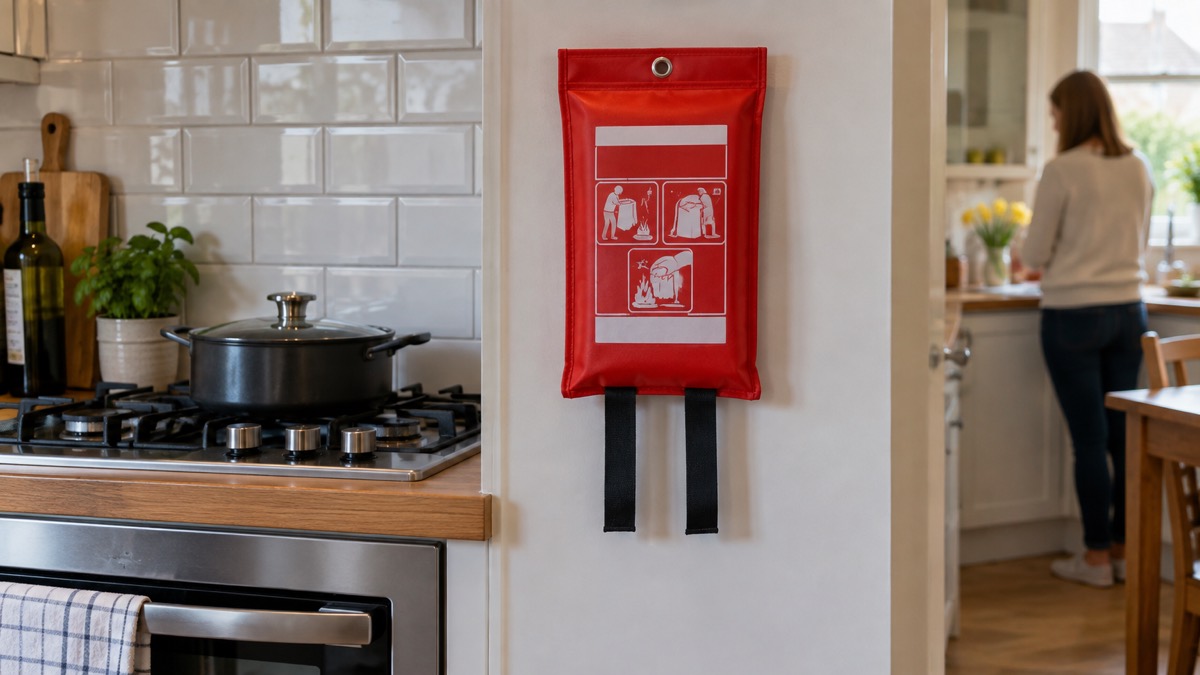
The government's domestic fire guidance is to get out, stay out and call 99913. Firefighters would rather arrive to a small fire you left than to a person overcome by smoke in a hallway. If you have not yet made an escape plan, do that before you buy any equipment, and pair the whole lot with working smoke alarms, because an alarm gives you the early warning that makes any of this kit usable at all. Our Fire Safety Checklist pulls the whole household picture together.
Sources (20)
- Fire safety equipment, Devon and Somerset Fire and Rescue Service, 2026
- Fire safety advice for beginners, The Caravan and Motorhome Club, 2026
- Product safety, East Sussex Trading Standards, 2026
- Fire extinguishers in the home, Warwickshire County Council, 2026
- Kitchen safety, Lincolnshire County Council, 2026
- Battery safety flyer, Portsmouth City Council, January 2026
- FB100-FA-EUR 1M Fire Blanket datasheet, FireAngel, May 2025
- Student fire safety, Northern Ireland Fire and Rescue Service, 2026
- Charge safely for your own safety, Northern Ireland Fire and Rescue Service, 21 September 2026
- Shared and rented accommodation, Dorset and Wiltshire Fire and Rescue Service, 24 June 2025
- Escape plan, Scottish Fire and Rescue Service, 2026
- Escape plan, Cornwall Fire and Rescue Service, 2026
- Domestic fire, UK Government, 12 October 2026
- Camping safety, North Wales Fire and Rescue Service, 2026
- Cooking safety, London Fire Brigade, 2026
- Home fire safety, Northern Ireland Fire and Rescue Service, 2026
- Safe at home: frequently asked questions, North Yorkshire Fire and Rescue Service, 2026
- Stay safe this summer, Northern Ireland Fire and Rescue Service, 2026
- Emergency kit, Scottish Government, 2026
- Support for vulnerable people: interventions, North Wales Fire and Rescue Service, 2026
 Home Fire Safety Checklist
 Bedtime Fire Safety Checks
 Fire Risk Checks for Carers
 What to Do If Fire Starts
 How to Make a Fire Escape Plan
 Fire in a Block of Flats
 Kitchen Fires and Cooking Safety
 Electrical Fires and Sockets
 Smoking, Matches and Lighters
 E-bike Charging Safety
 Hoarding and Fire Risk
 Thatched Properties Fire Risk
 Fireworks and Bonfire Safety
 What to Do After a House Fire
 How Fire Services Respond