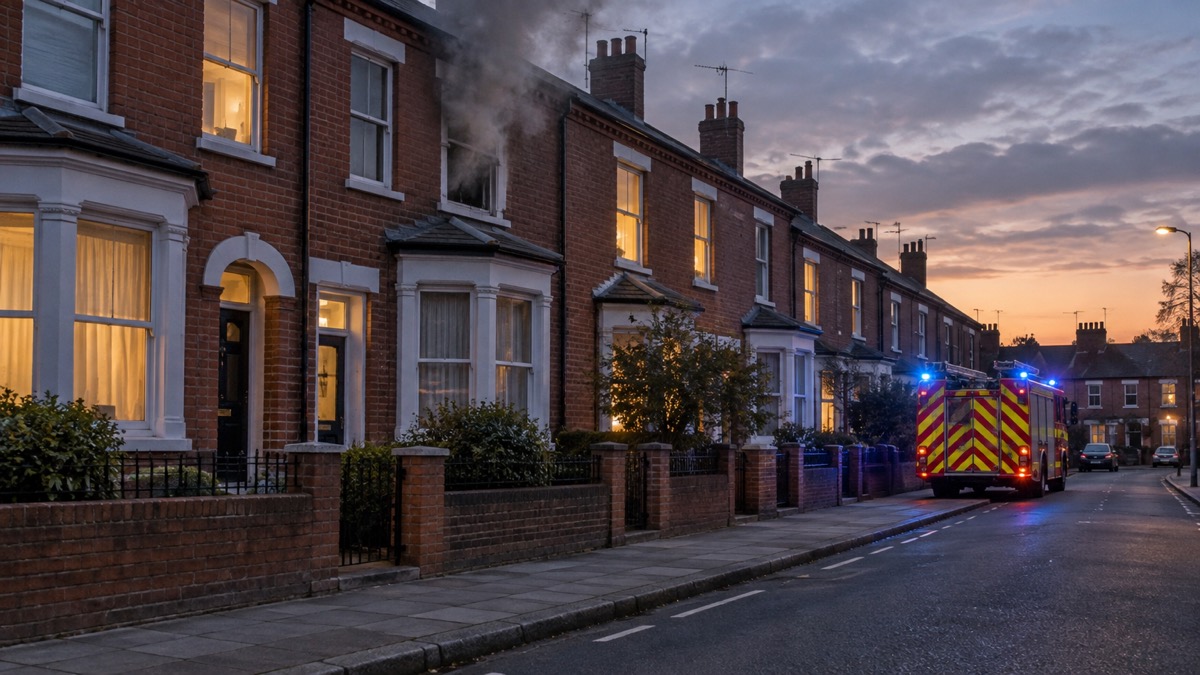
If a fire starts in your house, the instruction from every fire and rescue service in the UK is the same: get out, stay out and call 9991. Do not tackle the fire yourself, do not go back inside for belongings or pets, and do not wait to investigate what has happened. Get everyone out, close doors behind you if it is safe to do so, and ring 999 from outside, asking for the fire and rescue service2.
The order matters. People die because they delay: looking for the cause of the smoke, collecting a phone or a wallet, or going back in for a pet. Fire and rescue services are blunt about this. The Scottish Fire and Rescue Service's guide to fire safety tells households to remember "get out, stay out and dial 999"3, and Essex Prepared warns: "Don't waste time investigating what's happened or rescuing valuables"4. A fire that looks small can fill a home with smoke in minutes, and smoke, not flame, is what kills most people in house fires.
This page sets out the steps in the order you need them: how to raise the alarm and get everyone out, why you must not fight the fire, what to do if your way out is blocked, what happens when you ring 999, and how to make sure everyone in your household knows the plan before a fire ever starts. If you live in a flat or a high-rise block, some of the arrangements differ, and we flag those where they matter.
Get out, stay out, call 999
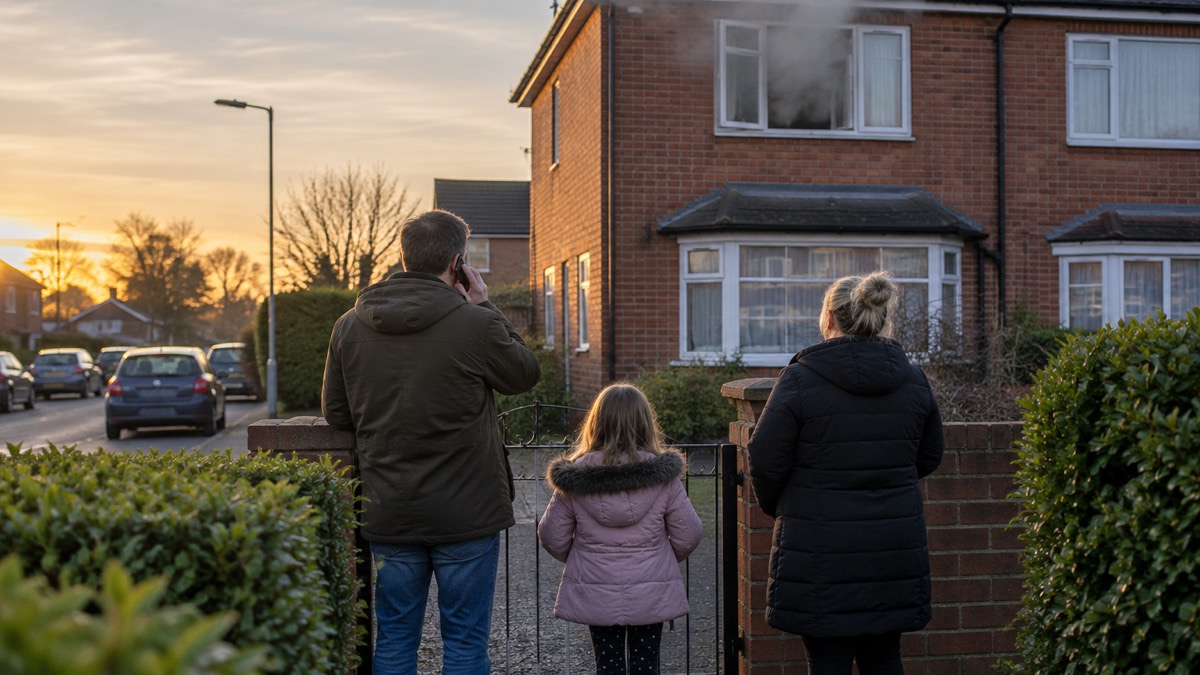
The three-part instruction is the national message, used by fire and rescue services across England, Scotland, Wales and Northern Ireland. The government's Fire Kills campaign states it in four words: "Get out, stay out, call 999"8. North Wales Fire and Rescue Service adds the detail of what to say: "Call 999 and ask for the fire and rescue service"5. Manchester Fire and Rescue Service completes the warning: if there is a fire in your home, get out, stay out and call 999, do not try to tackle the fire yourself, and never go back into a burning building2.
Each part of the instruction exists because of a specific, common mistake. "Get out" because people delay. "Stay out" because people go back, for a pet, a phone, a person, or a possession, and are overcome by smoke or trapped by a fire that has grown while they were outside. "Call 999" because people assume someone else has rung, or they try to find a non-emergency number first. Devon and Somerset Fire and Rescue Service's home fire advice is to get out of the building, closing any doors behind you, and then call the fire service9.
If you are not sure whether there is a fire, or whether it is serious enough to call, ring anyway. Dorset and Wiltshire Fire and Rescue Service, which runs one of the fire control centres that answer 999 calls, puts it directly: "Don't be afraid to dial 999 in an emergency, even if you're not sure if there is a fire, small or large. It's better to be safe than sorry"10. North Yorkshire Fire and Rescue Service's campaign guidance adds the first step: move to a safe location immediately, then call 999 and ask for the Fire and Rescue Service, giving clear details about the location and size of the fire11.
Raise the alarm and get everyone together
The first action, before anything else, is to let everyone in the house know. Devon and Somerset Fire and Rescue Service's step-by-step response begins: let everyone in the house know about the fire, shout, and get everyone together9. North Wales Fire and Rescue Service gives the same first step: shout and get everyone together before you leave5.
Shouting matters more than people expect, for one reason the government's domestic fire guidance states plainly: do not assume that everyone has heard the smoke alarm, particularly at night, because some children may not be woken by smoke alarms1. Essex Prepared and Suffolk Fire and Rescue Service's home fire safety guide repeat the same warning4. If a smoke alarm sounds at 3am, an adult in the bedroom next door may hear it clearly while a child sleeping down the landing sleeps through it. So the alarm is the starting signal for you, not for them: your job is to reach the children and anyone who may not have heard, and get them moving.
Numbered, the steps look like this:
- Shout to wake and warn everyone in the house5
- Go to children and anyone who may not have heard the alarm, and get them up and out1
- Get everyone together as you leave, so you know nobody is missing9
- Close doors behind you as you pass, if it is safe to do so13
- Once outside and safe, call 999 and ask for the fire and rescue service5
Getting everyone together as you leave is what tells you, once you are at the meeting point outside, whether anyone is still inside. If someone is missing, do not go back in for them. Essex Prepared's trapped-by-fire guidance is specific: if there is someone still inside, wait for the Fire and Rescue Service to arrive and tell them about the person, because firefighters will find them quicker than you14. They have breathing apparatus, protective clothing and training; you do not.
Don't tackle the fire or go back for belongings
Every fire and rescue service says the same thing here, and the reason is that members of the public who try to fight fires are injured and killed doing it. The government's domestic fire guidance states: "Don't tackle fires yourself. Leave it to the professionals. Get out, stay out, call 999"1. The Scottish Fire and Rescue Service warns that trying to tackle a fire or stopping to save goods could prove fatal6. The same message applies whatever kind of home you are in: get out, stay out and call 999, and never go back inside1.
The same rule covers going back in. The Fire and Rescue Service in Northern Ireland (NIFRS) instructs households: close the door of the room where the fire is, never attempt to tackle the fire, get everyone out as quickly as possible, phone 999 and ask for the Fire and Rescue Service, and never go back in until NIFRS says it is safe15. South Wales Fire and Rescue Service and Suffolk Fire and Rescue Service both add: do not stop to collect any valuables or possessions16. Surrey's action plan puts the whole thing in one line: do not waste time investigating what has happened or rescuing valuables, remember get out, stay out and shut the doors behind you18.
"Don't tackle fires yourself. Leave it to the professionals. Get out, stay out, call 999."
Pan fires and cooking fires
Cooking accidents are the main cause of fires in the home4, and a pan fire is the one situation where people are most tempted to act, because it starts small and looks manageable. London Fire Brigade's pan fire advice gives the steps: if a pan catches fire, leave the room, close the door, warn others, and call 999 for emergency services19. The NHS home fire safety guide adds the one thing you may do first, but only if you can do it safely: turn off the heat, then leave the room and close the door, shout to warn others to get out, stay out and call 99920. The Scottish Fire and Rescue Service gives the same sequence for a chip pan fire3.
What you must never do is throw water on it, or try to move the pan. Essex County Fire and Rescue Service's home fire safety booklet states: "If the pan does catch fire, do not tackle the fire yourself or try to move the pan. Never throw water or a damp tea towel onto it as this will create a dangerous fireball"21. Hot oil and water produce an eruption of burning fat that spreads the fire across the kitchen and onto anyone standing there. Prevention is simpler: never leave pans unattended when cooking20. Our page on kitchen fires covers cooking safety in full, and how to put out a chip pan or saucepan fire goes through the steps in detail.
Close doors behind you as you leave
Closing doors is the one thing you can do, on your way out, that measurably protects the household. The Scottish Fire and Rescue Service's escape plan guidance states that closing doors behind you will slow down the spread of the fire6, and its in-an-emergency guidance repeats the same instruction22. Devon and Somerset Fire and Rescue Service's escape plan advice says close doors behind you to slow down the spread of fire and smoke23. West Yorkshire Fire and Rescue Service adds the condition: close doors behind you as you leave, if safe to do so, to help contain the fire13.
The reason is simple physics. A closed door holds back smoke and heat, slows the fire's growth, and protects the escape route behind you. The Scottish Fire and Rescue Service's guide to fire safety puts it in practical terms: if there is a fire in your home, close the door where the fire is, because this will help protect your escape route and stop the fire spreading so quickly3. Suffolk Fire and Rescue Service's advice combines both: close the door to the room where the fire is located, and close all doors behind you as you leave, to delay the spread of fire and smoke17.
Two conditions apply. First, close the door of the room where the fire is as you leave: this helps protect your escape route and stops the fire spreading so quickly13. Second, closing doors matters most at night, which is why fire services ask households to close inside doors before going to bed as a matter of routine. That is covered in the bedtime section below, and our bedtime fire safety checks page lists the full routine.
If you can't get out: one room with a window and a phone
Sometimes the fire is between you and the way out. The advice for that situation is consistent across every service. Essex Prepared states it: "If you can't get out, get everyone into one room, ideally with a window and a phone"4. The Scottish Fire and Rescue Service's escape plan guidance says the same: get everyone into one room, and grab a mobile phone if you can6. Devon and Somerset Fire and Rescue Service's escape plan calls this the safe room: get everyone into it, close the door, and put bedding, cushions or towels along the bottom to seal the gap23.
Government guidance for people with sight, hearing or mobility difficulties adds a useful detail for choosing the room: if you cannot get out, stay in a room with a shut door, a window and a phone, ideally at the front of the house24. A room at the front is where arriving firefighters and neighbours will look first, and where shouting will be heard.
Once in the room, the sequence is:
- Get everyone into the room and shut the door23
- Call 999 if you have a phone with you4
- Block the bottom of the door with bedding, cushions or towels to keep smoke out23
- Open the window and shout "HELP FIRE"12
- Stay by the open window for fresh air until firefighters arrive3
Cheshire Fire and Rescue Service's guidance for flat dwellers who cannot leave adds the same steps: move to a room away from the fire, call 999, keep the door closed and use towels or bedding at the bottom of the door to stop smoke getting in25. South Wales Fire and Rescue Service frames the decision: if your escape route is blocked by fire or smoke, stay inside a room that is clear of smoke, ideally with a window that opens, and call 99916. Our page on what to do if you cannot escape a fire covers this situation in more depth.
Keeping smoke out of the room you are trapped in
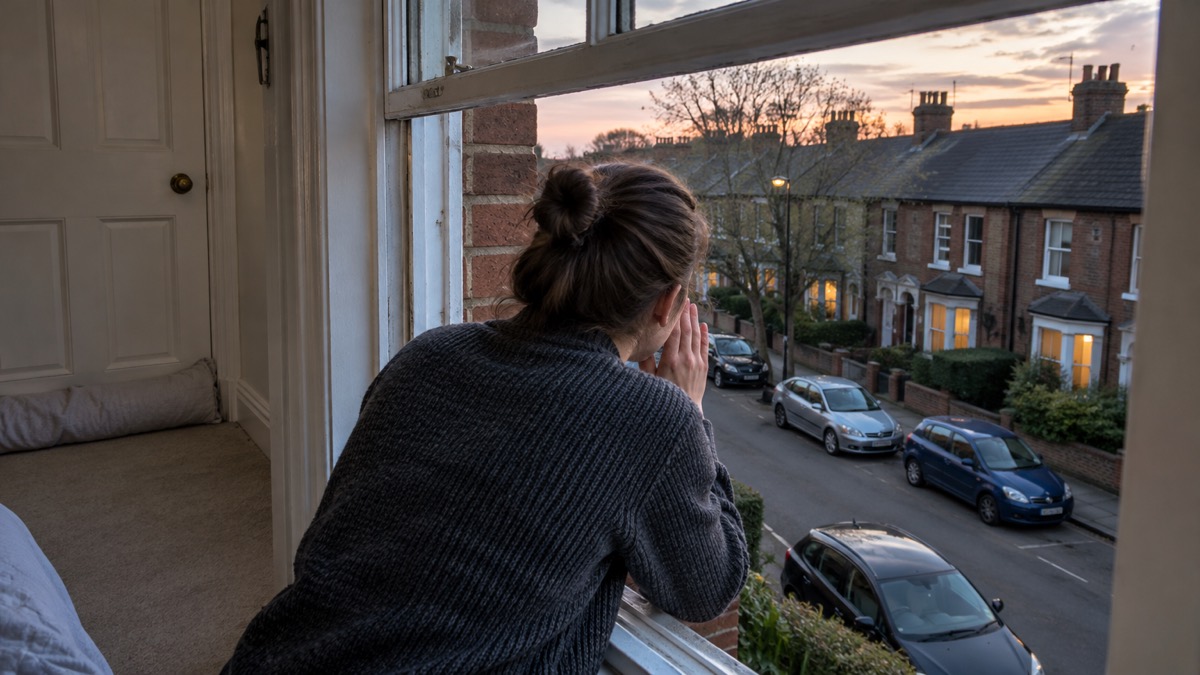
The door is your main defence, and the gap under it is where smoke comes in. The Scottish Fire and Rescue Service's guide describes the full technique: once everyone is together, pack clothes, cushions, pillows or towels around the door to keep smoke out, open a window and shout "Fire" until someone phones the Fire and Rescue Service, and keep leaning out of the open window for fresh air until the firefighters arrive3. Essex Prepared's trapped-by-fire page gives the first step: get everyone into one room and close the door14.
Suffolk Fire and Rescue Service's home fire safety guide sets out the same sequence for a blocked escape: call 999, then open the window and shout "HELP FIRE"12. Essex County Fire and Rescue Service's booklet adds a judgement worth knowing: if your escape is blocked by fire, it may be safer to stay put in that sealed room until the fire service arrives, rather than attempt to pass through smoke21. Cheshire Fire and Rescue Service's flat guidance agrees: stay by an open window if possible and block the bottom of the door to prevent smoke entering25.
The government's accessible guidance for people with sight, hearing or mobility difficulties is written for households where getting to a door or window quickly may be harder, and its advice is the same in substance: if you cannot get out, stay in a room with a shut door, window and phone24. If you or someone in your household would need extra time or help to escape, it is worth asking your local fire service about a home fire safety visit, and our page on fire risk checks for a vulnerable person's home explains what to look at.
What happens when you ring 999
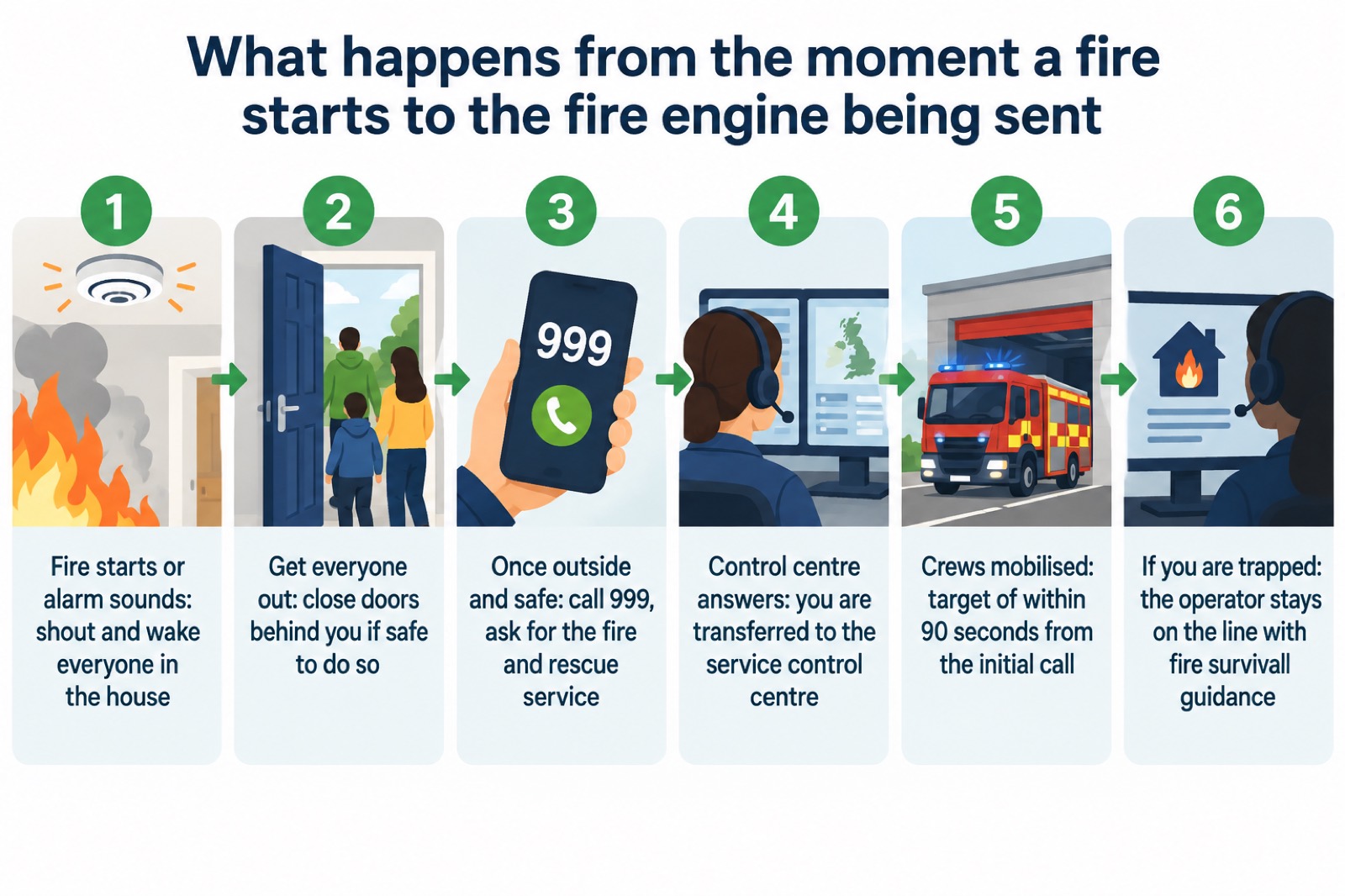
Knowing what happens on the call removes hesitation. Dorset and Wiltshire Fire and Rescue Service, which operates a fire control centre, explains the process: if you require the fire and rescue service, always dial 999, and you will be transferred to the service control centre, which dispatches the crews10. Do not attempt to contact your local fire station or any numbers listed in the telephone directory, because fire crews are only dispatched via control10. A station's office phone will not send a fire engine to your house; the 999 call will.
Once through, tell the operator what is on fire, for example "a two-storey house", and give the address14. North Wales Fire and Rescue Service advises that you can call from a mobile phone, a neighbour's phone or a phone box, and that you should give the address of the fire26. If you are calling about a fire elsewhere in your building and the procedure is to stay put, remain in your flat unless smoke or flames are entering, and if you need to escape, call 999 and wait for directions16.
Two practical points answer common worries. First, cost: 999 calls are free7. Second, withheld numbers: even if you have barred the calling line identity facility, your telephone number will be displayed to the telephone exchange operator, which is a safety feature to help ascertain an approximate location of the emergency10. Withholding your number does not hide you from the emergency services, and you should not try to.
Speed matters to the services too. Dorset and Wiltshire Fire and Rescue Service states that it endeavours to handle emergency calls to the service control centre within 90 seconds from receipt of the initial call to mobilising the fire appliance10. That is the target from the start of the call to the fire engine being sent, not the time it takes the engine to reach you. Our page on how fire and rescue services respond to a call explains what happens after that.
If you are trapped, the operator stays on the line
If you are trapped by fire and cannot get out safely, say so on the call. Dorset and Wiltshire Fire and Rescue Service explains why the operator needs to know: "We need to know if you and/or others are trapped inside a building to enable our highly trained operators to offer fire survival advice, this is only given if those trapped absolutely cannot get out"10. The same service describes what happens next: "our fire control operator will stay on the line with you and has been specifically trained to offer you fire survival guidance to help you until the fire engine arrives"10.
Cornwall Fire and Rescue Service describes the same arrangement from the caller's side: if there is a fire and the caller is in immediate danger, for example a fire in the building where they are making the call, they will be asked to leave the premises, and if this is not possible, they will be given appropriate fire survival guidance27. So the call is not just a report: if you are still inside, it becomes a live link to a trained operator who will talk you through staying alive until crews reach you. Keep the line open and follow what they say.
Make sure everyone in your home knows the plan
Everything above works better if it is decided before the fire. Suffolk Fire and Rescue Service states the requirement plainly: everyone in your house needs to know what to do if a fire occurs17. The government's domestic fire guidance goes further: plan and practise an escape route, and make sure everyone knows what to do in an emergency and how to escape1. Devon and Somerset Fire and Rescue Service's advice for parents and guardians gives the same instruction, to have an escape route planned and make sure everyone is familiar with it28.
For children, the government's fire safety guidance for parents and child carers sets out what to teach them: if you see smoke or flames, tell a grown-up straight away; get out of the building as quickly as you can; do not go back for anything, even toys or pets; find a phone; call 999 and ask for the fire and rescue service and tell them your address; and only call 999 in a real emergency29. It also teaches the trapped-room version: go into a room with a window if the way out is blocked, put bedding or towels along the bottom of the door to stop smoke getting in, open the window and shout "HELP FIRE"29. Practising the route matters because some children may not be woken by smoke alarms29, so an adult needs to be responsible for reaching them.
Our page on how to make a fire escape plan walks through building the plan, and the fire safety checklist for your home covers the rest of the preparation.
Fire at night: the bedtime routine
Fires at night are the ones that catch households asleep, so fire services ask for a short check before bed. Devon and Somerset Fire and Rescue Service's bedtime advice is to close internal doors at night to stop fire spreading and keep stairs free from smoke, check the cooker is turned off, turn off electrical appliances unless they are meant to be left on, and turn off heaters, extinguish open fires, stoves, candles and cigarettes properly, put up fireguards, keep exits and stairways clear of large items and trip hazards, and check door keys are easily accessible28.
NIFRS's home fire safety advice adds the detail of what to switch off: switch off and unplug all electrical appliances not designed to stay on, avoid leaving chargers on overnight, empty ashtrays with contents dampened, extinguish candles, switch off portable heaters, put a fireguard around open fires, close all doors, keep keys accessible, keep escape routes clear, and keep a phone in the bedroom15. Essex County Fire and Rescue Service's booklet adds a specific warning about appliances: do not leave your washing machine, tumble dryer or dishwasher on at night21. Government guidance for people with sight, hearing or mobility difficulties gives the simplest form of the door rule: if you can, close inside doors at night, because this will help prevent a fire from spreading24.
A phone in the bedroom is worth singling out. If a fire blocks your door in the night, a mobile within reach is what lets you call 999 from the trapped room and stay on the line with the control operator15. Our bedtime fire safety checks page turns the routine into a list you can work through.
Where to get help and more to read
If you have a fire, the only number you need is 999. After the fire, our page on what to do after a fire in your house covers the next steps. If you live in a flat or high-rise block, the arrangements can differ, including whether the building's procedure is to stay put, and what to do if there is a fire in your block of flats explains those. Households that include someone who is deaf or hard of hearing should also read about smoke and CO alarms for deaf and hard of hearing people, since a standard alarm may not be enough to wake everyone, and the wider subject of alarms is covered in smoke alarms: types and how to choose one. The rest of our home emergencies section covers carbon monoxide, gas leaks, burst pipes and the other emergencies a UK household should be ready for.
Sources (29)
- Domestic fire: be informed about hazards, UK government Prepare campaign, 2026
- Fire safety, Manchester Fire and Rescue Service
- Your guide to fire safety, Scottish Fire and Rescue Service, 2023
- Fire: protecting your family, Essex Prepared, 2026
- Get out, stay out and call 999, North Wales Fire and Rescue Service, 2026
- Escape plan, Scottish Fire and Rescue Service, 2026
- Bedtime route and escape plan, North Yorkshire Fire and Rescue Service, 2026
- Fire Kills campaign, UK government Fire Kills campaign, 2026
- If you have a fire, Devon and Somerset Fire and Rescue Service, 2026
- Making a 999 call, Dorset and Wiltshire Fire and Rescue Service, 2023
- Light nights campaign, North Yorkshire Fire and Rescue Service, 2026
- Fire safety in the home, Suffolk Fire and Rescue Service, 2021
- Medication and medical devices, West Yorkshire Fire and Rescue Service, 2026
- If you are trapped by fire, Essex Prepared, 2026
- Home fire safety, Northern Ireland Fire and Rescue Service, 2026
- In the event of a fire, South Wales Fire and Rescue Service, 2026
- In the event of fire in your house, Suffolk Fire and Rescue Service, 2026
- Home fire action plan, Surrey County Council Fire and Rescue Service, 2026
- Pan fires, London Fire Brigade, 2026
- Home fire safety guide, NHS Wirral Community Health and Care, 2025
- Fire safety in the home, Essex County Fire and Rescue Service, 2025
- In an emergency, Scottish Fire and Rescue Service, 2026
- Escape plan, Devon and Somerset Fire and Rescue Service, 2026
- Fire safety for people with sight, hearing or mobility issues, UK government, 2022
- High rise homes, flats and apartments, Cheshire Fire and Rescue Service, 2026
- Tân yn y cartref: diogelu eich cartref, Mid and West Wales Fire and Rescue Service, 2026
- Be prepared in case of an emergency, Cornwall Fire and Rescue Service, 2022
- Advice for parents and guardians, Devon and Somerset Fire and Rescue Service, 2026
- Fire safety for parents and child carers, UK government, 2022
 Home Fire Safety Checklist
 Bedtime Fire Safety Checks
 Fire Risk Checks for Carers
 How to Make a Fire Escape Plan
 Fire in a Block of Flats
 Kitchen Fires and Cooking Safety
 Electrical Fires and Sockets
 Smoking, Matches and Lighters
 E-bike Charging Safety
 Hoarding and Fire Risk
 Thatched Properties Fire Risk
 Fireworks and Bonfire Safety
 What to Do After a House Fire
 How Fire Services Respond
 Alarms for Deaf People