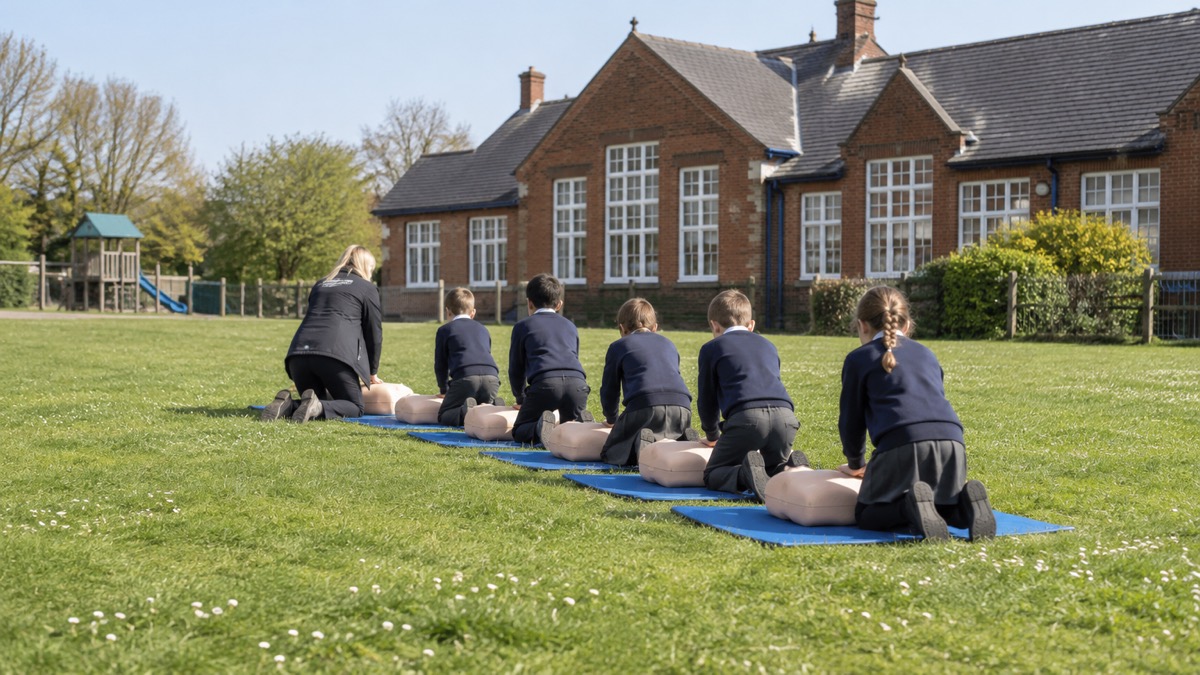
St John Ambulance's advice is plain: always remember to dial 999 as soon as possible in an emergency1. The charity, which has helped the public learn first aid for the last 150 years, reports that in its recent research 10% of people said they were unlikely to provide first aid to a relative or friend in a medical emergency, and 18% said they were unlikely to help a stranger2.
The good news is that none of this is complicated to teach. First aid is the immediate treatment given to anyone who is injured, stops breathing or needs assistance, and anyone can learn these skills3. This page sets out what to teach your children, in the order you will need it: when and how to ring 999, what to say on the call, what to do in a fire at home, the first aid skills children can learn at different stages, and the free courses and school resources available across England, Scotland, Wales and Northern Ireland.
When and how a child should ring 999
Start with the basics: what 999 is for, and what counts as an emergency. Teach your children about emergencies and how and when to call 9999. The key rule for children is simple: only call 999 in a real emergency9.
A real emergency, in terms a child can understand, is when someone could die or be seriously hurt unless help comes straight away. The NHS lists the situations where you should call 999 for a child: if they stop breathing, are struggling to breathe, are choking, are unconscious, will not wake up, have a seizure, have blue, grey, pale or blotchy skin, lips or tongue, have a cut that will not stop bleeding, have been severely injured, or have swallowed a poison or too much medicine10. You can translate that list into plain examples for your children: "if someone is not breathing", "if there is a fire", "if someone is bleeding a lot and it will not stop".
Alongside the number itself, every child should learn three pieces of information as part of your household emergency plan: how and when to call 999, their home address, and a trusted adult's phone number2. The Scottish Government's emergency plan guidance adds a useful principle for the way you teach it: explain what to do in an emergency in simple, reassuring language, and help children learn their home address and a parent or guardian's mobile number if possible11. Reassuring matters as much as accurate: you want a child who will act, not one who is frightened of the phone.
Practise it the way you would practise anything else, by doing it. Talk through a made-up scenario, have your child tell you the address out loud, and let older children physically dial the steps on a locked phone so the movements are familiar. Revisit it from time to time, in the same way fire services advise returning to fire safety talks more than once to make sure children have remembered and understood12.
What to say on a 999 call
A 999 call only needs a few things from the caller, and a child who has rehearsed them will manage even when frightened. Cornwall Fire and Rescue Service gives the core instruction: stay calm and speak slowly and clearly13. Teach your child that the person answering will ask questions and that it is all right to take a breath before answering.
What the caller needs to give depends on the emergency, but the essentials are the same:
- Which service is needed: fire, ambulance or police. In a fire, the child should ask for the fire and rescue service9.
- The address: tell them your address, and make sure your child can say it from memory9.
- What is happening: tell them what is on fire, for example "a two-storey house"14. The same idea works for any emergency: say what has happened and who is hurt.
- Whether anyone is trapped or hurt.
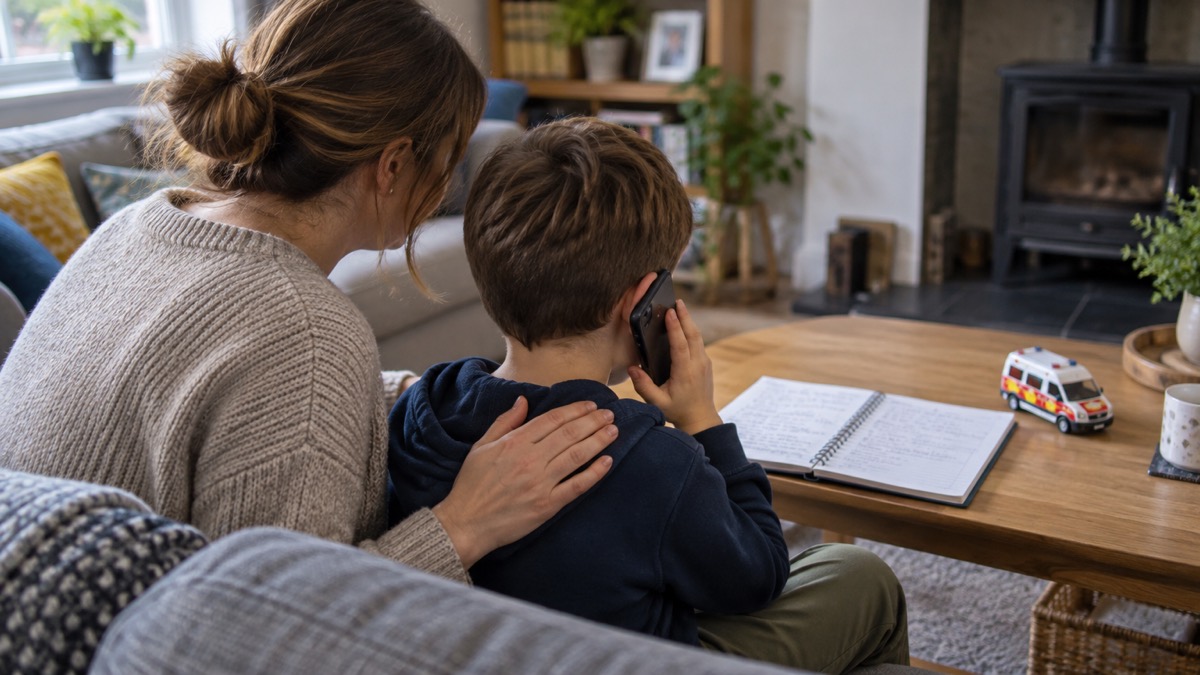
If you are ever cut off or unable to speak, the call handler will still be working to get help to you, so staying on the line matters. And if your child has a learning disability or autism, it is worth knowing that the Welsh Ambulance Service commits to using clear and simple language, repeating information if needed, giving extra time to answer questions, speaking calmly and clearly, and helping carers, family members or support staff provide information if needed15. Similar support exists across the emergency services, so a child who struggles with unfamiliar questions on the phone can still get help.
One more thing to teach clearly: 999 is not for practice. Only call 999 in a real emergency9, and make sure your child understands the difference before they ever pick up the phone.
What to do in a fire at home
Fire is the emergency children are most likely to face at home, and the UK government's fire safety campaign is direct about the priority: act quickly and get everyone out as soon as possible, and do not assume that everyone has heard the smoke alarm, particularly at night, because some children may not be woken by smoke alarms12. That last point changes what you teach: a child who sleeps through an alarm needs a plan in which a parent reaches them, and older children need to know to leave the moment they are alerted.
The national message for a fire at home is three words long: get out, stay out, and call 99916. Build your family's escape plan around it.
- Work out an escape plan for your family and tell your children what to do in case of a fire17.
- Practise the plan regularly, and make it feel like a game for young children so they remember it without fear18.
- Teach children never to hide from fire or from firefighters. Children hide, often under beds or in wardrobes, and it costs lives18.
- Make sure they know to get out and stay out, and never go back inside for toys or pets18.
- If clothing catches fire, teach your child to STOP, DROP and ROLL6.
- Once out, call 999, ask for the fire and rescue service, and give the address19.
Prevention is part of the same conversation. The UK government's domestic fire guidance says to teach children how to prevent a fire and what to do if there is one, and to expect to talk about fire safety with children more than once to make sure they have remembered and understood12. Practical prevention steps from the same body of official advice include not leaving children alone in the kitchen, keeping matches, lighters and saucepan handles out of reach of children, and fitting a safety catch on the oven door20. Warwickshire County Council's fire safety education team likewise advises parents to teach their children about the dangers of fire and how to respond if they encounter one19.
Basic first aid every child can learn
First aid is the immediate treatment given to anyone who is injured, stops breathing or requires assistance, and anyone can learn these skills3. That is the NHS's own framing, and it applies to children as much as adults. What varies is which skills suit which stage, so match the lesson to the child.
For young children, the useful skills are the ones that need no strength and no equipment:
- Recognising an emergency and knowing to shout for an adult
- Knowing their address and a trusted adult's phone number2
- Knowing how and when to call 9999
- Knowing to get out and stay out in a fire16
- Knowing to STOP, DROP and ROLL6
For older children, add the skills that involve helping directly. A full first aid course covers dealing with an emergency, how to do CPR and put someone in the recovery position, dealing with head injuries, severe bleeding, burns and broken or sprained bones, what to do in cases of seizures, heart attacks or strokes, what to do if someone chokes, has a severe allergic reaction or a diabetic emergency21. That is the adult syllabus, and teenagers can learn it; younger children can learn the ideas behind it, one at a time.
The most important early lesson is when to get help rather than how to give it. The NHS is explicit about the red flags: call 999 if a child stops breathing, is struggling to breathe, is choking, is unconscious, is limp and floppy, has a cut that will not stop bleeding or is gaping open, will not wake up, has a seizure, has a swollen mouth, lips, throat or tongue, has blue, grey, pale or blotchy skin, lips or tongue, seems suddenly confused, has been severely injured, has swallowed a poison, or is bleeding heavily10. A child who has absorbed that list in plain language knows more than most adults.
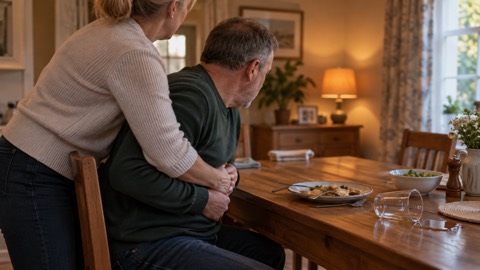
Choking is a good example of a skill children can both learn and witness. NHS guidance on choking in babies and children describes shouting for help, getting the child out of the high chair, supporting their chest and chin with one hand, and giving 5 sharp blows between the shoulder blades with the heel of your hand22. An older sibling who has seen that done, or practised the idea on a doll, will not stand frozen if it happens at the table.
CPR and defibrillators: what children can learn
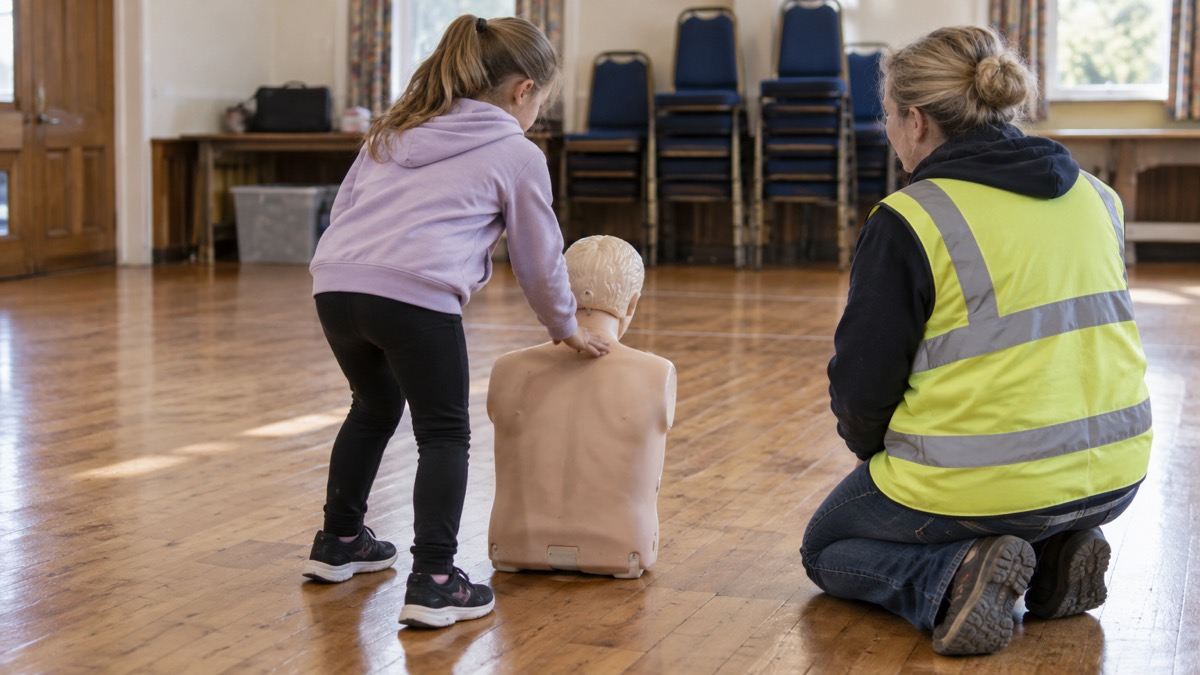
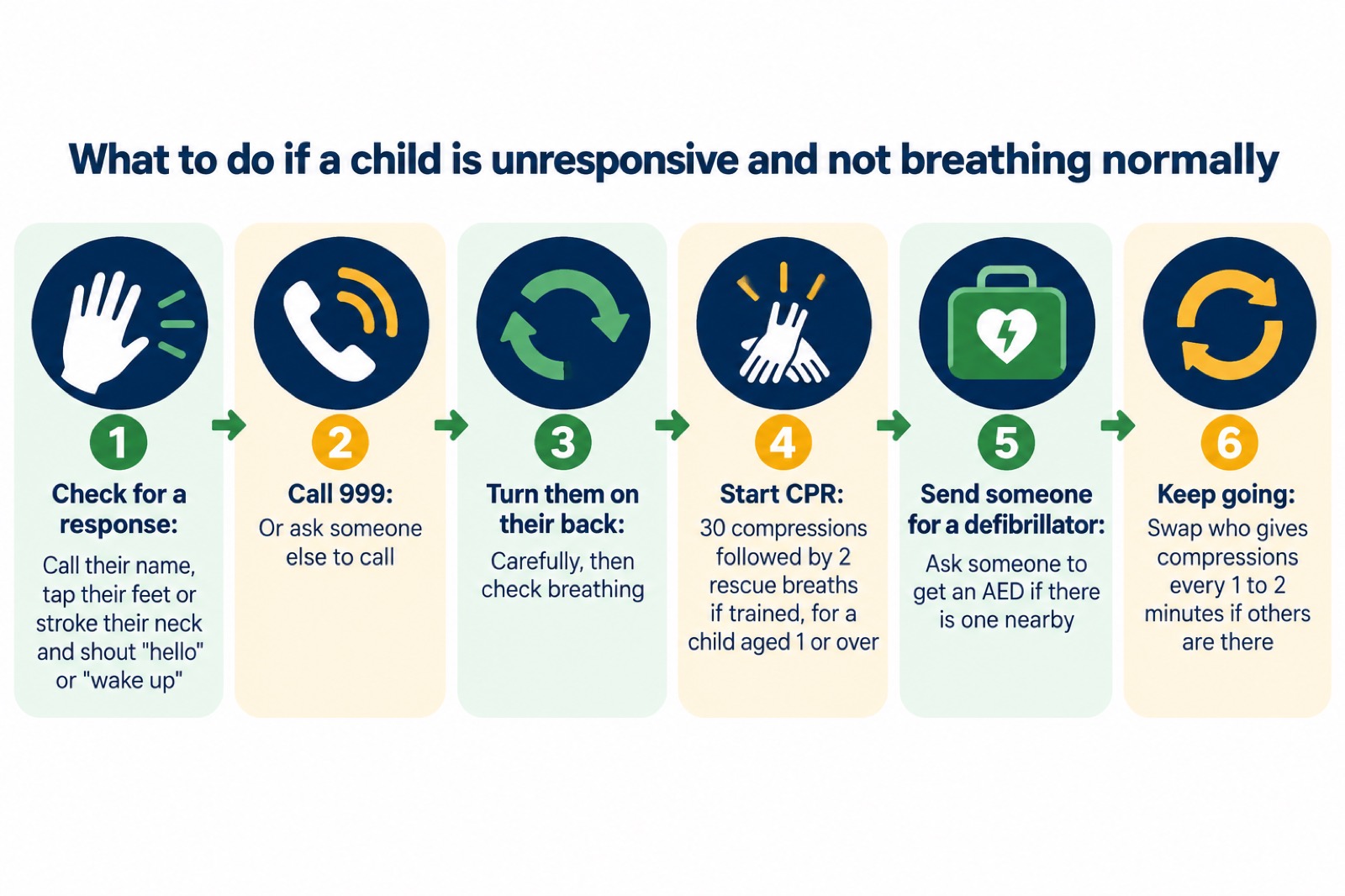
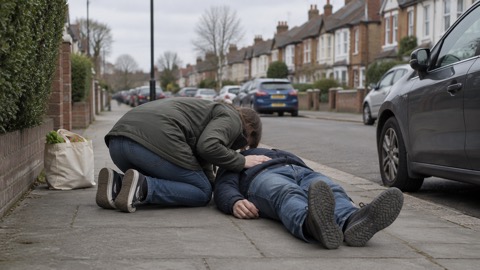
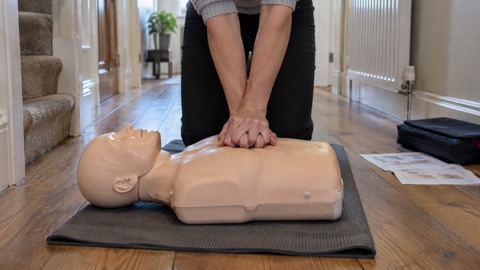
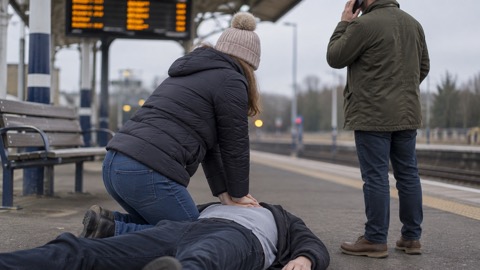
CPR is the one skill where the teaching needs to be exact, because the technique differs between adults, children and babies. The headline rule from the NHS: if a baby or child is unresponsive and not breathing normally, call 999 and start CPR straight away7. If the child does not respond when you call them, call 999 or ask someone else to call, then carefully turn the child on their back7.
For a child aged 1 or over, NHS inform in Scotland sets out the sequence: give 2 rescue breaths after 30 chest compressions if you are trained to do so, repeating 30 compressions followed by 2 rescue breaths, with each full breath taking 1 second23. You can also ask someone to get an automated external defibrillator (AED) if there is one nearby23. If there are other people around, change who is giving the chest compressions every 1 to 2 minutes with little disruption23. North West Ambulance Service teaches the same shape: carry out CPR with five rescue breaths on a child aged 1 to 8 years old24.
For babies and infants the technique changes again. For a child younger than 1 year old, place 2 fingers in the middle of their chest to deliver chest compressions25, and give five initial rescue breaths with your mouth over the infant's mouth and nose24. The NHS page on resuscitating a child gives the same starting point: give 5 initial rescue breaths, mouth to mouth7. If your child is older than 1 year, place your hand on their forehead and gently tilt their head back, and gently lift the chin25.
What can children themselves learn here? The core actions: recognising that someone is unresponsive, calling 999, and chest compressions. Save a Life Cymru, the Welsh Ambulance Service's programme, offers short, interactive learning packages designed to build your confidence to recognise a cardiac arrest, perform CPR, and use a defibrillator26. Those packages are free and suit teenagers well; younger children can learn the concepts and practise the rhythm of compressions on a cushion.
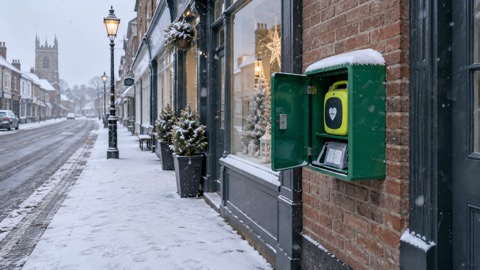
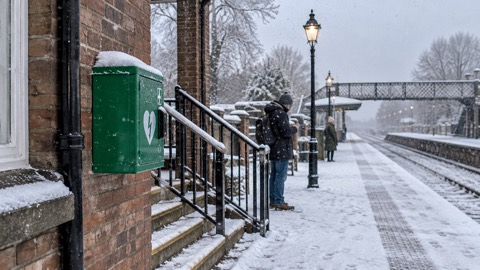
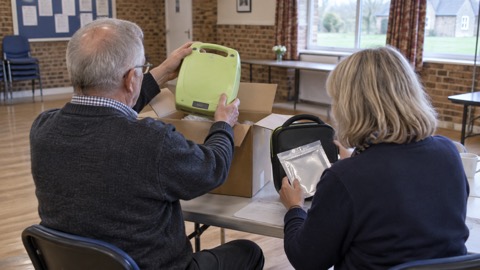
Defibrillators deserve a mention in the same lesson, because a child who knows what an AED is will fetch one rather than stand around. The devices are designed to be used by members of the public, and the instruction to ask someone to get one if it is nearby is part of the official child CPR sequence23. You can read more about how they work and where to find them on our pages about defibrillators and public access defibrillators, and about the technique itself in how to do CPR and how to do CPR on a child.
Why it matters: many people hold back from helping
The reason to teach all this early is that adults frequently fail to act. A child raised knowing what to do becomes an adult who does not hesitate.
There are, of course, limits, and teaching them is part of keeping a child safe. The East of England Ambulance Service's guidance on first aid during a terrorist incident states a rule that applies in any dangerous scene: you should only give first aid to others if it is safe for you to do so, and when the emergency services arrive, follow their instructions if they tell you to leave the area27. Teach your children the same order of priorities you would follow yourself: check for danger first, then help. Our page on the primary survey walks through that sequence.
The same caution applies to supporting people emotionally after an emergency. There is an online course in psychological first aid, as well as a specialised course to deliver psychological first aid to children, and the official guidance is clear that before attempting to deliver it, it is important to complete training to develop relevant knowledge and skills28. That is adult territory, but it is worth knowing that the training exists if your family is ever involved in a distressing incident such as a flood.
Free tools and lessons for schools
Schools do not have to build this teaching from nothing. The British Red Cross provides curriculum information and free resources to teach life-saving first aid skills to students and test their knowledge, with resources also available in Welsh29.
The biggest date in the school calendar is Restart a Heart, an annual event held in October and dedicated to teaching as many people as possible the vital skill of CPR29. South Western Ambulance Service runs free CPR and AED training sessions at venues across the South West through October29. If you are a parent, ask your school whether it is taking part; if you are a teacher, the ambulance service resources are the place to start.
For families teaching at home, the British Red Cross offers free first aid workshops, online or face-to-face, for individuals as well as schools29. These free workshops do not give you a first aid qualification, but equip you with basic skills to help in a first aid emergency29.
First aid courses for families across the UK
When you are ready for structured teaching, many organisations run first aid courses30. A simple first aid course can provide basic skills that could help save the life of a family member or friend, and local courses are provided by St John Ambulance (www.sja.org.uk/courses) or British Red Cross (www.redcrossfirstaidtraining.co.uk)31. St John Ambulance delivers certified training courses to companies, local authorities, schools, community groups and individuals32, and in Northern Ireland the Red Cross and St John Ambulance both offer first aid training courses21.
The NHS goes further for parents and carers: it is highly recommended that every parent or carer goes on a first aid course, as it makes the process much easier to understand7. If you have a young child, you can also ask your health visitor about available first aid courses30. Learning first aid and CPR is described by the East of England Ambulance Service as one of the most useful things you can do, with training provided by a number of charities and commercial organisations, and you can find the right training by searching online for "first aid training"27. Our page on first aid courses sets out the types, lengths and where to find one.
Arrangements are broadly the same across the four nations, with local variations in who runs what:
| Nation | Where to find family first aid training |
|---|---|
| England | St John Ambulance and British Red Cross local courses31; ask your health visitor if you have a young child30 |
| Scotland | NHS inform publishes child CPR guidance23; Restart a Heart events run in October29 |
| Wales | Save a Life Cymru free interactive learning packages on CPR and defibrillators26 |
| Northern Ireland | The Red Cross and St John Ambulance offer first aid training courses21 |
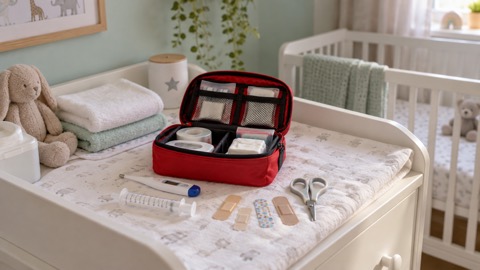
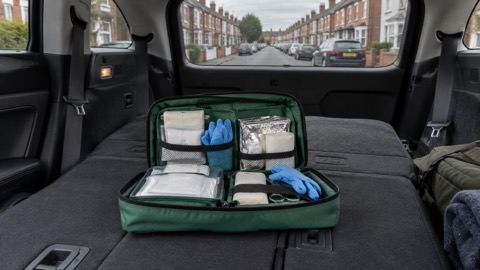
Finally, keep a household first aid kit so the skills have something to work with. The Northern Ireland direct government service suggests a kit could include plasters, bandages, safety pins or tape, pain relievers, antiseptic lotion or saline for cleaning wounds, cotton wool, a thermometer, tweezers for splinters, sharp scissors, sun block of factor 25 or higher for children, and child insect repellent30. Our page on first aid kits for the home goes through the contents in detail.
Sources (32)
- Be informed about hazards, UK government Prepare campaign, 2026
- Be ready for emergencies, Cheshire Fire and Rescue Service, 2026
- Basic life support, Sheffield Children's NHS Foundation Trust, 2023
- Be prepared: public safety advice, West Midlands Ambulance Service NHS Foundation Trust, 2026
- Encouraging students to stay safe, North Yorkshire Fire and Rescue Service, 2024
- Stay safe this Halloween, Wiltshire and Swindon Prepared, 2026
- How to resuscitate a child, NHS, 2026
- Prepare yourself, Greater Manchester Combined Authority, 2026
- What children should know about fires, Wiltshire and Swindon Prepared, 2026
- What to do if your child has an accident, NHS, 2025
- Emergency plan, Scottish Government Ready campaign, 2026
- Domestic fire, UK government Prepare campaign, 2026
- Be prepared in case of an emergency, Cornwall Council, 2022
- If you are trapped by fire, Essex Prepared, 2026
- Learning disabilities zone, Welsh Ambulance Service NHS Trust, 2026
- Student safety campaign, Manchester Fire and Rescue Service, 2026
- Baby and toddler safety, NHS, 2026
- Fire escape plan, Fire Kills campaign, 2026
- Fire safety advice for parents, Warwickshire County Council, 2026
- Christmas safety tips, Warwickshire County Council, 2026
- Household emergency kit, nidirect (Northern Ireland government), 2026
- Choking and gagging on food, NHS, 2026
- How to give a child CPR, NHS inform, 2026
- How to do CPR, North West Ambulance Service NHS Foundation Trust, 2025
- Paediatric cardiac arrest first aid guide, North East Ambulance Service NHS Foundation Trust, 2024
- Save a Life Cymru, Welsh Ambulance Service NHS Trust, 2026
- Staying safe from a terrorist incident, East of England Ambulance Service NHS Trust, 2026
- Flooding and health: mental health, Wiltshire and Swindon Prepared, 2026
- Restart a Heart, South Western Ambulance Service NHS Foundation Trust, 2026
- First aid, nidirect (Northern Ireland government), 2025
- Are You Ready booklet, Culham Parish Council, 2025
- First aid, NHS, 2026
 Baby and Child Kit Checklist
 Bleeding Control Kit Checklist
 Car Kit Checklist
 Danger, Response, Airway
 CPR Steps for Adults
 2025 Resuscitation Guidelines
 Defibrillators (AEDs)
 Public Access Defibrillators
 Choosing a Defibrillator
 The Recovery Position
 Choking First Aid
 Cuts, Grazes and Wounds
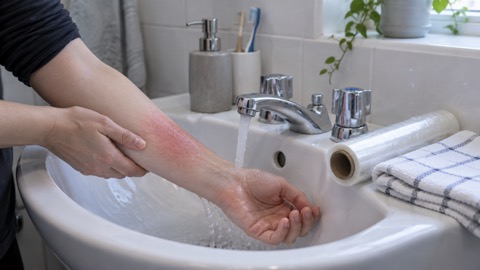 Burns and Scalds
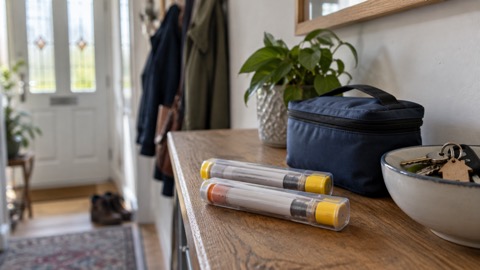 Adrenaline Auto-Injectors
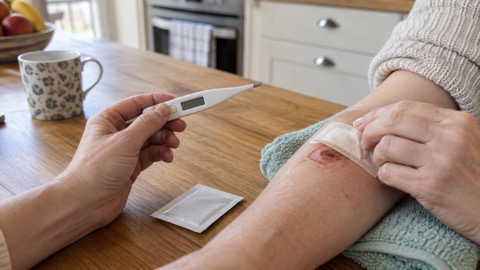 Sepsis Signs to Act On