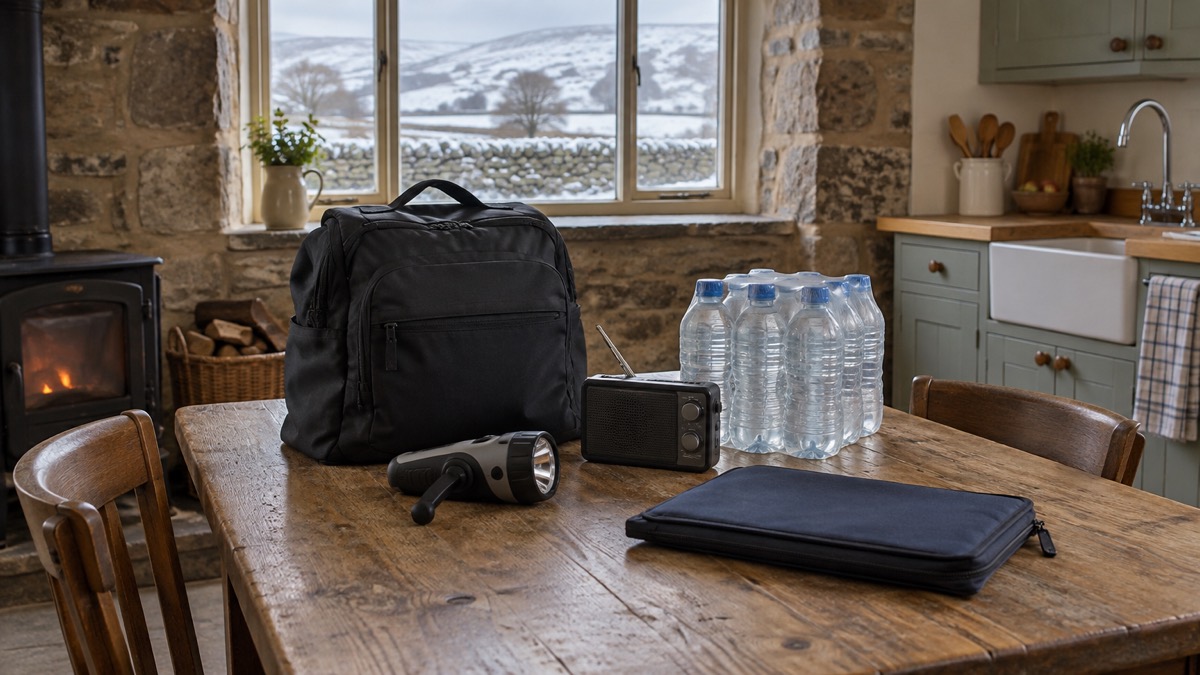
Preparing for an emergency in Scotland starts in the same place as anywhere in the UK: a household plan, a grab bag and a way of staying informed. But Scotland has its own official advice service, its own hazards and its own arrangements for flooding, winter roads and wildfire, and several of these work differently from England and Wales.
The Scottish Government runs the Ready Scotland campaign, which encourages individuals, families, communities and businesses to think about what they can do to prepare for unexpected events, all year round1. Its website offers a home emergency plan you can fill in, and it sets out the numbers every Scottish household should keep to hand: 999 for the emergency services, 101 for police, 111 for NHS 24, 0345 988 1188 for Floodline Scotland and 0800 111 999 for gas emergencies2.
One point of Scottish advice shapes everything else: personal and household resilience is essential, because even traditional responders such as local authorities and emergency services can be affected during a crisis, so households should be ready to cope by themselves until support arrives or the situation improves3.
Ready Scotland: the Scottish Government's advice for your household
Ready Scotland is the public information website for Safer Scotland, part of the Scottish Government, and its aim is to help make Scotland more resilient to emergencies3. The campaign is co-ordinated by the Scottish Government1, and the website is provided by the Scottish Government to help you prepare for and deal with emergencies7.
What you will find there falls into three broad areas: practical tips to prepare your home, family and business for unexpected events; guidance on how to respond safely when emergencies happen; and advice on how to support others in your community during difficult times3. The campaign encourages individuals, families, communities and businesses to think about what they can do to prepare for unexpected events, all year round, rather than only when a storm is forecast1.
Ready Scotland is not just for households. The website also has information on supporting communities to prepare for emergencies, including resources, templates and online training8. If you want to go further than your own front door, the Scottish Government's Community Emergency Planning Guide, published in March 2026, advises groups that want to help their communities cope better in an emergency and become more resilient by making a Community Emergency Plan together9. A plan of that kind helps communities prepare for, respond to and recover from emergencies using their own strengths, skills, knowledge and resources, while complementing official efforts9. Our community resilience guide covers that route in more detail.
For most households, the practical starting point on Ready Scotland is the home emergency plan, covered next. If you are new to all of this, our getting started guide walks through the whole process step by step.
An emergency plan keeps your household safe until help arrives
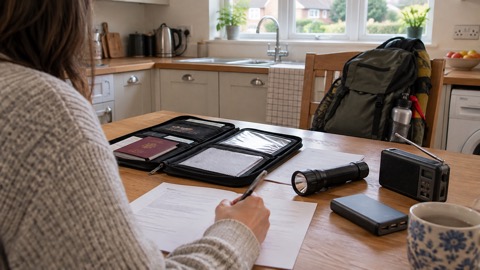
Ready Scotland publishes a Home Emergency Plan you can download, fill in and keep. The plan can be agreed by a family or household in advance and kept safe for use in the future, so that in the middle of an emergency nobody is trying to remember phone numbers or work out who collects the children10. Dumfries and Galloway Council, which publishes similar advice, describes it as a Household Emergency Lifesaving Plan10.
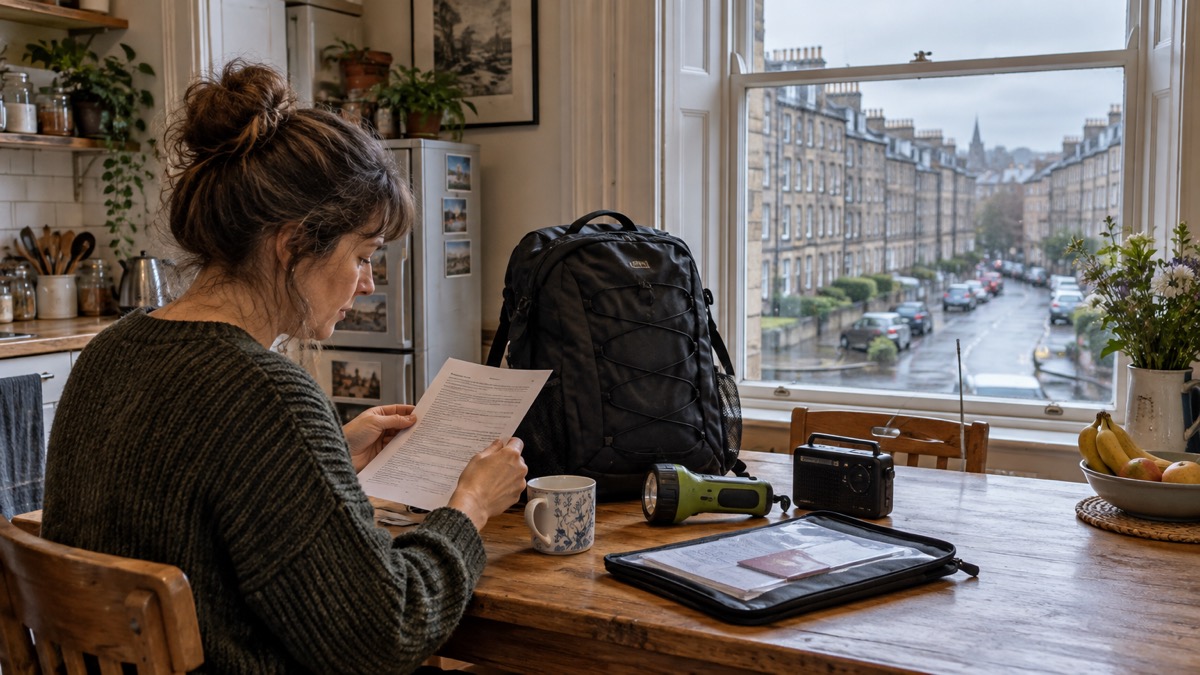
The core of the plan is simple. It records who to contact, including the emergency services on 999, the police on 101, NHS 24 on 111, Floodline Scotland on 0345 988 1188 and the gas emergency service on 0800 111 9992. It records where your household would meet, who would pick up children or check on relatives, and where your emergency kit is kept. For more advice, Ready Scotland points readers to ready.scot, which also has further emergency kit suggestions2.
General UK guidance on plan-writing applies equally in Scotland. West Yorkshire Prepared, an official resilience body, advises households to prepare a simple household emergency plan, involve everyone in the house in developing it, keep it in a safe and memorable place and review it regularly11. The same guidance applies wherever you live in Scotland: agree the plan with your household in advance, keep it somewhere safe you can easily find it in an emergency, and make sure everyone in your home knows where it is11.
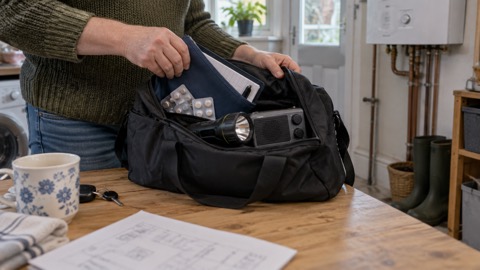
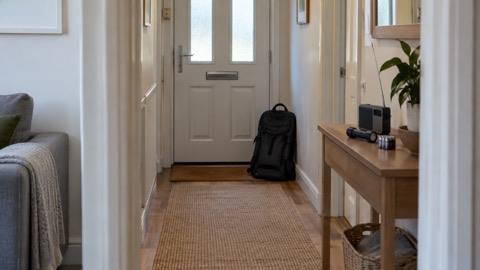
What to put in the grab bag follows the same principles across the UK. Dumfries and Galloway Council's emergency pack advice includes a first aid kit10, and our emergency kit guide lists the rest, from torches and batteries to water and a wind-up or battery radio. Our plan template page shows exactly what to fill in, line by line.
The reason a written plan matters more in Scotland than many people expect is the point made earlier: responders themselves can be stretched or affected in a crisis, so household resilience is what carries you through the first hours3. A plan is also the simplest preparedness step there is, because it needs nothing more than an evening's conversation with everyone in your household.
The hazards Scottish households plan for
Scotland's own official guidance names the hazards the country regularly experiences: severe winter weather, flooding, fuel shortages, animal diseases and pandemic viruses9. That list is worth reading carefully, because it comes from the Scottish Government's own community planning guide and reflects what actually happens in Scotland rather than a generic UK list.
Two of those hazards, winter weather and flooding, are covered in their own sections below, because in both cases what the authorities do and do not do differs from what many households assume. Fuel shortages and pandemics are shared risks across the UK, and our guides on health emergencies and which emergencies to prepare for cover the household response.
Scotland's climate is also changing in ways that shift the hazard picture. Scotland is a water-rich country, especially compared to other parts of the world, but UK climate projections indicate that Scotland will likely have hotter, drier summers, and this will increase how severe droughts are and how often they occur12. Hotter, drier conditions feed directly into the wildfire risk covered later in this page, and into the heatwaves and drought risks that were historically associated mainly with southern England.
Resilient communities, in the Scottish Government's framing, are aware of risks that may affect them and how those risks might impact local people, and they use their existing skills, knowledge and resources to prepare for and deal with the consequences of emergencies9. Households can apply the same idea: know which of the listed hazards apply to your street, and prepare for those first. Our community risk registers guide explains how to find the published risk assessment for your area.
Go in, stay in, tune in: when it is not safe to go out
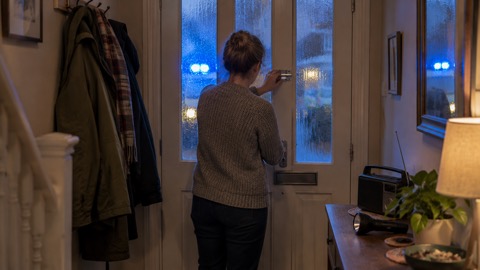
For most emergencies where going outside is dangerous, the advice across the UK is the same three words: go in, stay in, tune in. Scottish Borders Council sets it out as: go in (go indoors and close all windows and doors), stay in (stay indoors), and tune in (to local radio, TV or the internet)4. The Ready Scotland home emergency plan gives the same instruction: go indoors and close all windows and doors, stay indoors, and stay up to date using radio, TV or online2.
Northumberland's Local Resilience Forum puts the same advice in capitals: "GO IN, STAY IN AND TUNE IN: go indoors, close doors and windows, stay indoors until you know more, tune in to local radio or television for updates"13. The reason this is the default for so many scenarios, from chemical releases to smoke plumes, is that a closed-up house gives real protection while the danger passes, while moving through it outside does not.
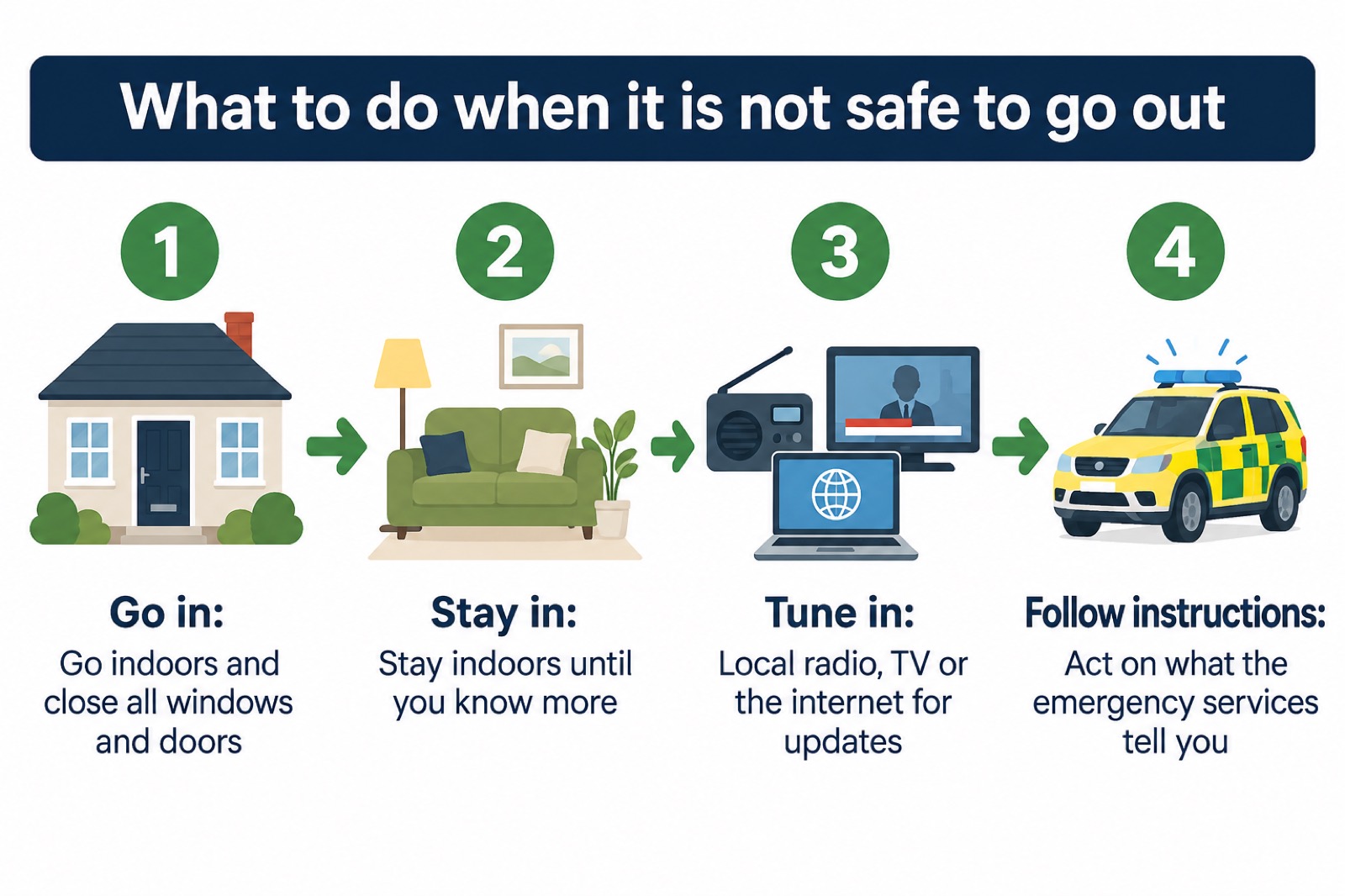
The main exception is fire: if your own home is on fire, you get out, stay out and call 999. The other exception is when you are told to evacuate, in which case the emergency services will give a specific instruction and, in flooding, can co-ordinate evacuations14. Our guides on sheltering in place, staying put or leaving and evacuation cover those decisions in detail.
While you are indoors, use the time well. One official plan template suggests you stay indoors and take the time to check your emergency kit when it is not safe to go out15: confirm your torch works, your radio has batteries and your water is where you expect it.
Flooding: you protect your own home, councils help only where resources allow
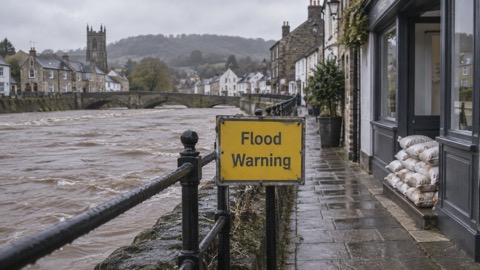
Flooding is where Scottish arrangements most often surprise people. The Scottish Government makes it clear that individual property owners have primary responsibility for the prevention of flooding to their property5. Somerset Council, giving the equivalent position in England, puts it plainly: if your property is in an area that often floods, it is up to you as the owner to take steps to protect it16. The same principle applies across Britain.
Around that individual responsibility sits a shared system. Your local council is responsible for the construction and maintenance of any flood defences in your area, and it is the responsibility of your local authority to implement and maintain flood protection actions14. The emergency services provide emergency relief when flooding occurs and can co-ordinate evacuations14. Scottish Borders Council, for example, is the lead authority for the Tweed area and has produced the Tweed Local Flood Risk Management Plan, including flood studies in Peebles, Innerleithen, Broughton, Earlston and Newcastleton to understand flood mechanisms and appraise mitigation options18.
What councils will not do is guarantee sandbags to every home. Highland Council states that where resources allow, it will aim to provide filled sandbags to those in greatest need, with support prioritised for those most at risk, including vulnerable members of the community19. That is a help of last resort, not a service you can rely on. Dorset and Wiltshire Fire and Rescue Service advises households at risk of flooding to get sandbags in advance to block doors and airbricks, from a builders' merchant or possibly the local council, or to make their own using old pillow cases or carrier bags filled with sand or earth20.
| Who | What they do | What they do not do |
|---|---|---|
| You, the property owner | Primary responsibility for protecting your own property5 | Cannot rely on others to protect your home |
| Your council | Builds and maintains flood defences; implements flood protection actions14 | Does not guarantee sandbags to every household19 |
| SEPA | Runs Floodline and flood warnings21 | Does not protect individual properties |
| Emergency services | Provide emergency relief and co-ordinate evacuations14 | Do not supply routine flood protection |
| Scottish Flood Forum | Independent advice, support and insurance guidance17 | Not an emergency responder |
Some councils go further. Scottish Borders Council sells flood protection products at discounted prices22, so it is worth checking what your own council offers before buying at full price. The Scottish Flood Forum, a Scottish-based organisation funded by the Scottish Government that supports and represents those affected by or at risk of flooding, provides information on flood protection products, offers independent advice to communities affected by flooding, and can advise on finding insurance5.
The warning side is strong in Scotland. Sign up to Floodline to receive messages when flooding is forecast in your area14. If your property is within an area covered by a SEPA flood monitoring system, you will be able to sign up to receive a targeted Flood Warning message for your local area21, with free flood messages sent direct to your mobile phone or landline when problems are predicted5. When a flood warning is issued, immediate action is required: take measures to protect yourself and your property17. Our flooding guide covers the whole sequence, from checking your risk to drying out afterwards.
Severe winter weather and gritting: what the council covers
Winter weather is the most regular hazard on Scotland's list9, and the roads are where household expectations most often meet council reality. Responsibility is split. On trunk roads, which include major A roads and motorways, Transport Scotland runs the winter service: there are 92 Precautionary Treatment routes and 51 Winter Patrol routes, and forecasts arriving around midday allow daily winter action plans to be prepared by 3.00 pm, outlining pre-treatment arrangements for the next 24 hours23. Mutual aid is offered between road authorities when possible, including the sharing of plant, facilities, labour and salt23.
On other public roads, your council is responsible. Scottish Borders Council, for example, is responsible for gritting routes on public roads in the Scottish Borders during low temperatures24. What councils do not cover is pavements as a rule. Carmarthenshire Council in Wales states the position that many councils share: "We don't routinely salt footpaths or pavements. We have to prioritise major roads rather than pavements to prevent the most serious accidents"25. Treat every pavement as unsalted unless you know otherwise.
Grit from public grit bins is provided for use only on public roads and pavements and should not be used or transported anywhere else25. And if you are hoping to hold the council liable for ice on an untreated road, Devon County Council's published position is that a claim would have to show loss or damage caused by negligence, and that loss or damage due to situations beyond its control, such as severe weather, is not normally something the council can be held responsible for26. The practical lesson is the same either way: in severe weather, assume nothing has been treated and drive only if you must.
Before you travel in winter, check the Traffic Scotland website, which provides current and future travel information for drivers using the Scottish trunk road and motorway network; its route planner lets you enter your location and destination to identify the best route to take27. To report a problem on trunk roads, contact BEAR Scotland on 0800 028 141424.
At home, Scottish Borders Council's winter advice is to find out how you can prepare your home for severe weather on the Ready Scotland website, and during severe weather to tune into local radio and press for more information and advice28. Our storms and snow guide covers the household side: pipes, heating, supplies and when not to travel.
Wildfires and drier summers
Wildfire is a hazard many Scottish households have only recently begun to take seriously, but the Scottish Fire and Rescue Service issues warnings for it regularly. In August 2026 it issued a wildfire warning for the Eastern Highlands, Eastern and Southern Scotland, warning that these fires place a huge drain on resources and pose a threat to the safety of firefighters and members of communities29. An earlier warning, in March 2023, covered Southwest and Central Eastern Scotland, noting that with dry conditions wildfires could burn and spread with very high intensity in high-risk areas30.
The seasonal mechanism matters for understanding when the risk peaks. In early March, the Scottish Fire and Rescue Service explains, there is a lot of dead grass and heather left over from the previous year which can dry very quickly due to a combination of frost, low relative humidity, sunshine and wind, and when ignited it acts as fuel which can spread wildfires over a wide area30. That is why warnings cluster in late winter and early spring, before new growth greens the hills, and again in dry summer periods.
For households, the official advice is about behaviour in rural areas. Human behaviour can significantly lower the chances of a wildfire starting, so the Scottish Fire and Rescue Service urges people to act safely and responsibly in rural environments and always follow the Scottish Outdoor Access Code29. Forestry and Land Scotland, which manages national forests, is equally direct: do not start fires in its woodlands, following the Scottish Outdoor Access Code's advice31.
On the land it manages, Forestry and Land Scotland uses mitigation measures including the design and maintenance of road networks and fire breaks, fuel load management through thinning, grazing or mowing, diversification of species and age structure, and peatland restoration31. None of that protects a rural house on its own, so if you live near moorland or forestry, the same household basics apply: know your evacuation route, keep a grab bag ready and follow any "go in, stay in, tune in" instruction if smoke is moving through your area4.
The longer trend points one way. With Scotland likely to have hotter, drier summers that increase how severe droughts are and how often they occur12, wildfire and water scarcity are hazards to plan for rather than rare events. SEPA's water scarcity work explains the background12, and our heatwaves and drought guide covers the household side.
Electrical and fire safety at home
Scotland has a fire safety rule that differs from the rest of the UK, and it applies to every home. Every home in Scotland must have interlinked fire alarms, a requirement in force since February 20226. The standard, as set out in the Scottish Government's home fire safety policy, is a smoke alarm in the living room and in circulation spaces such as hallways and landings, with all alarms ceiling mounted and interlinked32. The Scottish Fire and Rescue Service confirms that the requirement is to have all smoke and heat alarms interlinked, so if your existing alarms are not linked, they need replacing33.
Interlinking means that when one alarm sounds, they all sound, so a fire starting in a kitchen wakes someone sleeping upstairs. That is the whole point of the rule, and it is why a partial retrofit does not comply.
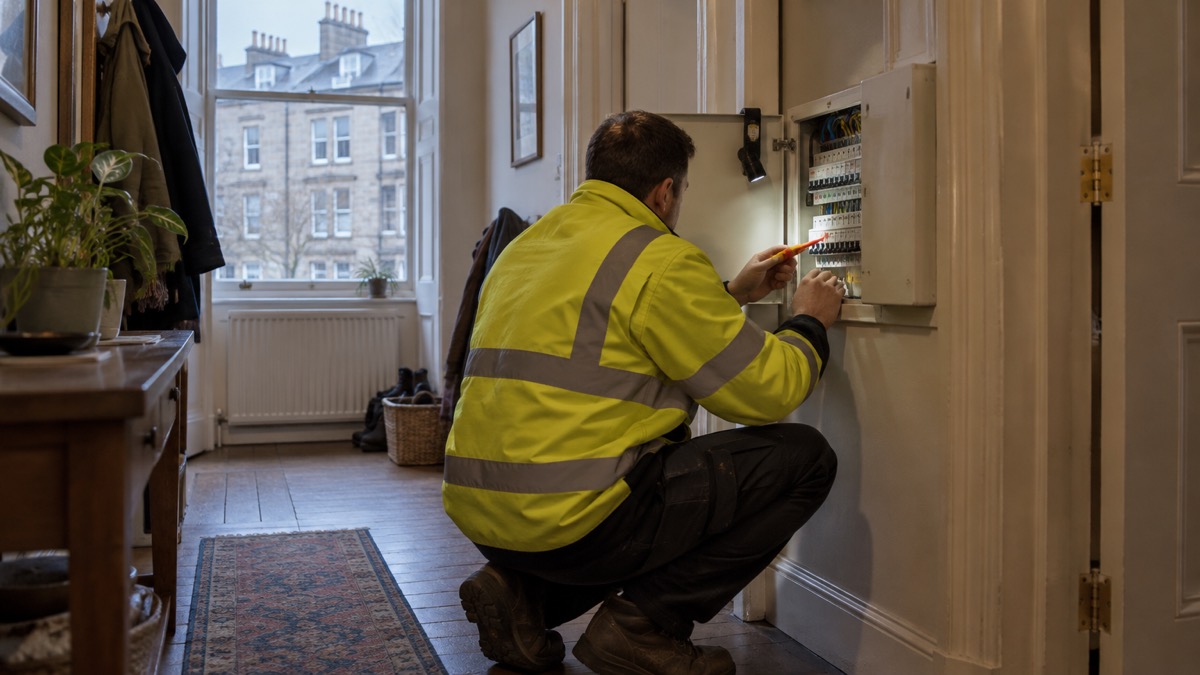
On electrical work, the Scottish Fire and Rescue Service advises anyone thinking of booking an electrician to work in their home to visit www.findanelectricianscotland.com, because poorly installed electrical work can put you at risk33. Use a registered electrician from that site rather than an unverified trader.
After flooding, electrical safety becomes urgent before you switch anything back on. Dorset and Wiltshire Fire and Rescue Service advises households in a flood-damaged home to get an Electrical Installation Condition Report (EICR) done by a registered electrician to check the condition of the electrical wiring, and to ask the electrician to check any electrical equipment or appliances affected by floodwater20. Do not assume equipment that looks dry is safe.
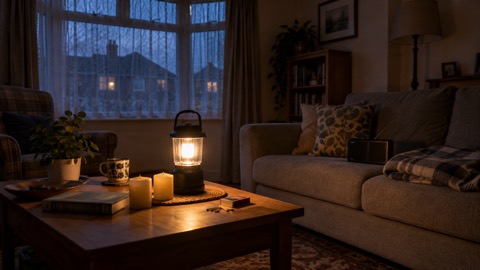
During power cuts, candle use rises, and with it fire risk. Argyll and Bute Council notes that during a power cut it is common to use candles and tea lights, and that the Scottish Fire and Rescue Service has put together guidance on using them to help make sure you stay safe7. Follow that guidance, and prefer torches as your first source of light. Our lighting and power cuts guides cover the safer options in full, and our home emergencies guide covers fire, carbon monoxide and gas leaks.
Staying informed during an emergency
Every piece of advice on this page ends with the same instruction: tune in. Scottish Borders Council advises tuning into local radio and press for more information and advice during severe weather28, and the go in, stay in, tune in instruction applies to most emergencies where going out is unsafe4. A battery or wind-up radio that works when the power and mobile networks are down is therefore part of the basic kit, not an optional extra.
Before an emergency, the information task is different: find out what risks apply to you. You can check the risks where you are through the UK government's preparedness campaign34, and in Scotland the Ready Scotland website includes useful information on preparing for and dealing with emergencies across the country35. For flooding specifically, Floodline registration means warnings reach you directly rather than waiting for you to look for them14.
During an emergency, keep your plan to hand, follow instructions from the emergency services, and use the numbers on it: 999 in an emergency, 101 for police, 111 for NHS 24, 0345 988 1188 for Floodline and 0800 111 999 for gas emergencies2. Our staying informed guide covers radios, phone backup and keeping devices charged.
Council emergency contacts in Scotland
Your council is a Category 1 responder under the Civil Contingencies Act 2004, with a statutory duty to plan for and respond effectively to emergencies or disruption that affect its communities, and to maintain, where reasonably practicable, a consistent level of service to the community during an emergency4. That is who is behind the local advice, gritting and flood support described on this page.
Each council publishes its own emergency contacts, and the details differ. Scottish Borders Council can be reached on 0300 100 180022. Highland Council publishes an out-of-hours list: 01349 886690 for roads, parks, flooding and street lighting emergencies, 01349 886691 for housing and homelessness emergencies, 0808 175 3646 for social work, and 07818 588203 for births, deaths and marriages emergencies, with its flooding team available Monday to Friday, 9am to 5pm, on 01349 88660119.
| Service | Number | When to use it |
|---|---|---|
| Emergency services | 999 | Any immediate danger to life2 |
| Police (non-emergency) | 101 | Non-urgent police matters2 |
| NHS 24 | 111 | Health advice out of hours2 |
| Floodline Scotland | 0345 988 1188 | Flooding information and warnings2 |
| Gas emergencies | 0800 111 999 | Gas leaks and gas emergencies2 |
| BEAR Scotland | 0800 028 1414 | Problems on trunk roads24 |
| Scottish Borders Council | 0300 100 1800 | Council emergencies in the Borders22 |
| Highland Council (roads, flooding) | 01349 886690 | Out of hours, Highland area36 |
Find and save your own council's equivalent numbers before you need them. Households that need extra support can also check our extra help guide.
If you are reading this from elsewhere in the UK, the arrangements differ: in Northern Ireland, the equivalent of Local Resilience Forums are Emergency Preparedness Groups34, and NI Direct's Be ready as a community page has information and resources on how communities can plan for emergencies8. Our UK preparedness guide explains how the system fits together across all four nations.
Sources (36)
- Ready Scotland campaign purpose, Met Office, 2026-10-29
- Home Emergency Plan, Ready Scotland, 2026
- Prepared for personal resilience, Scottish Borders Council, 2026-10-29
- What to do in an emergency, Scottish Borders Council, 2026-10-29
- Flood advice, Argyll and Bute Council, 2026
- Fire and smoke alarms in Scottish homes, Scottish Government, 2024-08-14
- Useful information for you and your community, Argyll and Bute Council, 2026
- Information for communities and community groups, UK Prepare Campaign, 2026-10-16
- Community Emergency Planning Guide: why, Ready Scotland, 2026-03
- Prepare for emergencies, Dumfries and Galloway Council, 2026
- Advice for households, West Yorkshire Prepared, 2026-10-29
- What is water scarcity, SEPA, 2026-10-29
- Northumbria Local Resilience Forum, Northumberland County Council, 2026-10-28
- Responsibilities for flooding, SEPA, 2026-10-29
- Your Home Emergency Plan, Royal Borough of Windsor and Maidenhead, 2025-10
- Preparing for flooding, Somerset Council, 2026-10-28
- Flooding FAQs, SEPA, 2026-10-29
- Flood protection, Scottish Borders Council, 2026-10-29
- Flooding, Highland Council, 2026-02-04
- Flooding safety, Dorset and Wiltshire Fire and Rescue Service, 2023-11-20
- Floodline, SEPA, 2026-10-29
- Sandbag stores, Scottish Borders Council, 2026-10-29
- Winter service, Transport Scotland, 2026-10-29
- Gritting and grit bins, Scottish Borders Council, 2026-10-29
- Gritting, Carmarthenshire County Council, 2026-08-04
- Gritting frequently asked questions, Devon County Council, 2026-09-28
- Drive safely in winter weather, Met Office, 2026-10-28
- Preparing for winter, Scottish Borders Council, 2026-10-29
- Wildfire warning in place for Eastern Highlands, Eastern and Southern Scotland, Scottish Fire and Rescue Service, 2026-08-12
- Wildfire warning across Southwest and Central Eastern Scotland, Scottish Fire and Rescue Service, 2023-03-10
- Wildfire prevention, Forestry and Land Scotland, 2026-10-29
- Home fire safety, Scottish Government, 2026-10-29
- Your guide to fire safety, Scottish Fire and Rescue Service, 2023-11-03
- Check the risks where you are, UK Be Ready Campaign, 2026-10-20
- Check the risks where you are, UK Prepare Campaign, 2026-10-20
- Contact emergency services, Highland Council, 2026-01-30
 30-Day Household Checklist
 Emergency Plan Template
 Supply Interruption Checklist
 Household Emergency Plan
 Emergencies to Prepare For
 Community Risk Registers
 What to Do in an Emergency
 Sheltering in Place
 Staying Put or Leaving
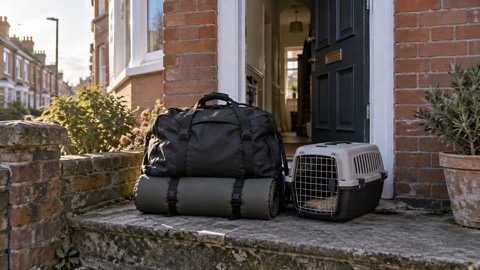 If You Are Asked to Evacuate
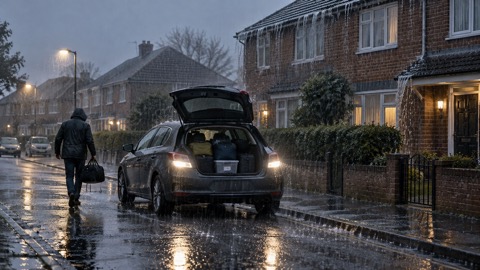 Planning Your Evacuation
 Rest Centres
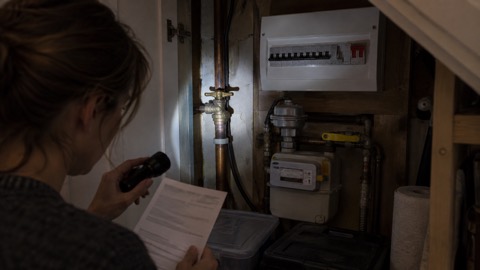 Stopcock, Gas Valve and Fuse Box
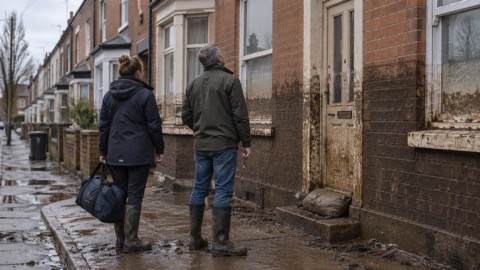 Returning Home
 Recovering After an Emergency