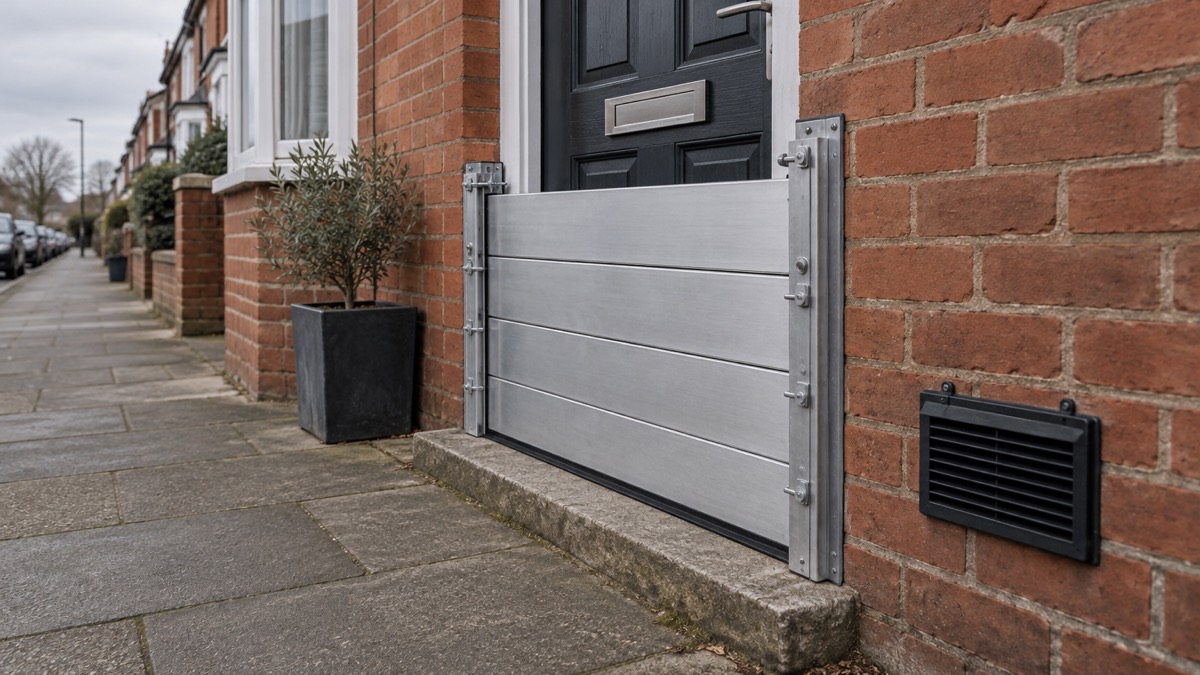
You cannot make a house completely flood-proof, but you can sharply reduce how much water gets in, how much damage it does, and how long you are out of your home afterwards. Government guidance is clear on this point: "You cannot completely protect your home or business against flooding, but there is a lot you can do to reduce" the water entering, the damage it causes, and the cost and time of cleaning up1. That is the whole idea behind property flood resilience, and this page sets out what it involves for an ordinary household.
The work falls into two halves. Resistance measures stop or slow water getting in at all: flood doors, barriers across openings, airbrick covers, sealed walls and non-return valves in drains. Resilience measures accept that some water may get in and make the house easier and cheaper to dry out and repair: raised sockets, tiled floors instead of fitted carpets, lime plaster and synthetic window frames. Derbyshire County Council sets out four strategies that cover both: prevent water getting in, delay its entry, limit damage to furniture, electricals, walls and floors, and make clean-up faster and cheaper2.
Help with paying exists. Councils in England run Property Flood Resilience grant schemes offering up to £5,000 per property towards a survey and measures3, Northern Ireland's Homeowner Flood Protection Grant pays 90 per cent of survey and installation costs up to a maximum of £9,0004, and some insurers offer Build Back Better, which allows up to £10,000 of resilience measures to be installed while repairing your home after a flood5.
Keeping water out and limiting the damage: what property flood resilience means
Property flood resilience, usually shortened to PFR, means installing measures on an individual property to reduce the impact of flooding10. Cornwall Council describes it as an approach that identifies products appropriate to the type of flooding, the property and the needs of the owners, rather than a single off-the-shelf fix10. The same set of ideas appears under several names, including Property Level Resilience (PLR) and Property Level Protection (PLP)11, so do not be confused if a council leaflet uses a different term.
The aim is not just a dry house. Derbyshire County Council describes personal flood resilience as protecting your home so that if a flood happens, damage is limited and you can get back to living in your home in the shortest possible time12. The benefits it lists are practical: less damage and disruption, less time out of your home after a flood, reduced insurance costs or continued insurability, and greater peace of mind during heavy rainfall12. Argyll and Bute Council, which runs a PFR question-and-answer service for its residents, adds that PFR can bring improved resilience against river and surface water flooding, reduced recovery time, increased self-sufficiency during a flood, and peace of mind13.
Official guidance sets out four key strategies for defending your property: preventing water getting in, delaying its entry, limiting damage to furniture, electricals, walls, floors and fittings, and making clean-up and recovery faster and cheaper10. The measures advised include installing flood barriers on doors and windows, using non-return valves on drains, and elevating electrical sockets10. Suffolk's PFR case study material describes a scheme in which consultants survey entry points and recommend measures, with funding for installations such as flood doors and non-return valves14.
When flooding is imminent: switch off the power, gas and water
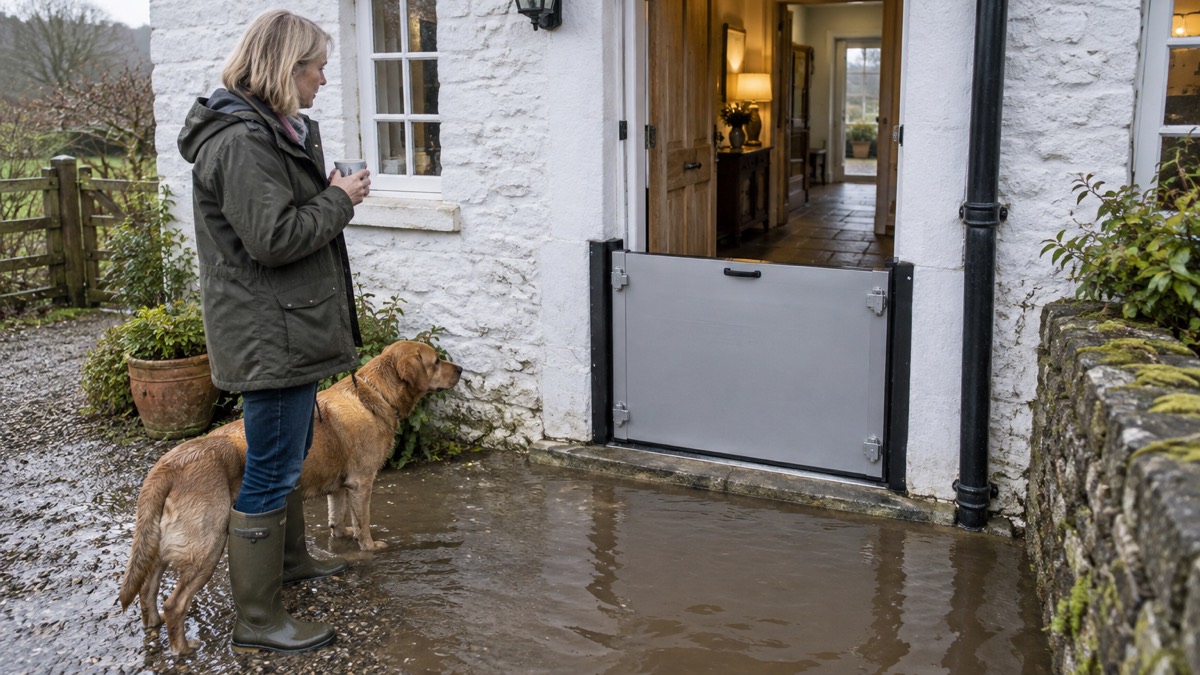
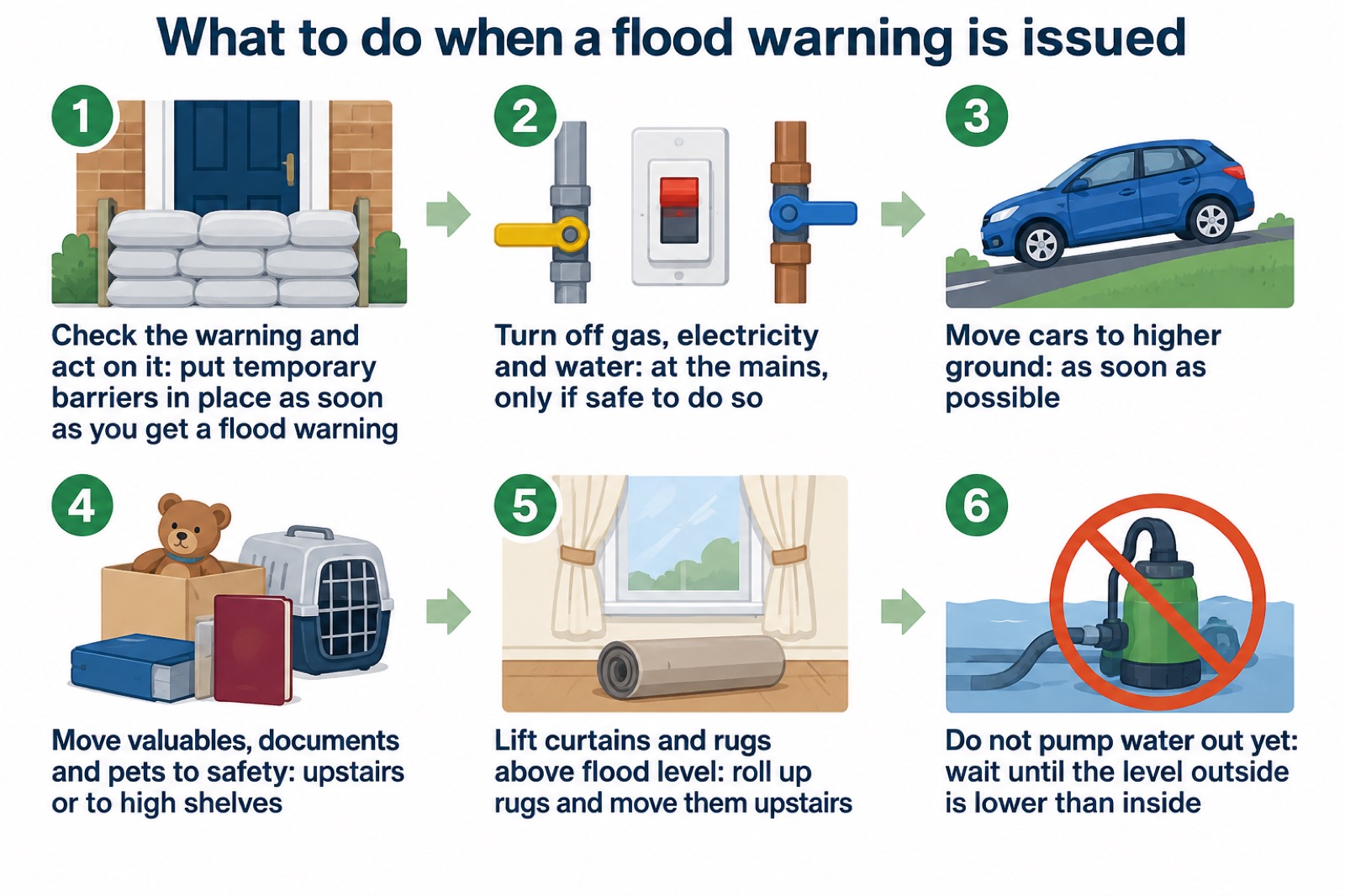
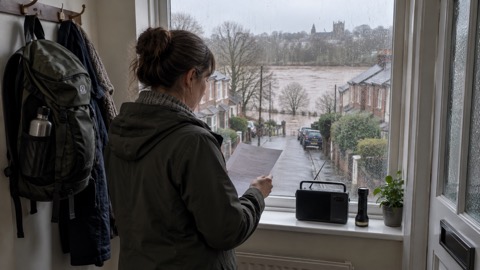
When a flood warning is issued or water is clearly on its way, the first actions protect life and then the building. Mid and West Wales Fire and Rescue Service advises that you should already know how to turn off your gas, electricity and water before a flood ever happens, and that during a flood you turn all three off at the mains15. West Midlands Ambulance Service NHS Foundation Trust gives the same instruction for households at risk: turn off gas, water and electricity supplies16.
Every official source adds the same condition: only if it is safe to do so. West Yorkshire Prepared puts it plainly, "Turn off gas, electricity and water (if safe to do so!)"17, and the Greater London Authority's flash flooding advice says the same for the fast floods that surface water causes11. The Environment Agency leaflet used by Nottinghamshire County Council adds a rule that matters once water is inside: do not touch sources of electricity when standing in floodwater18. If in doubt, leave the supplies alone and get to safety.
Alongside the utilities, move what you can. Northern Ireland's official guidance for a flood in progress is to move cars, pets, food, valuables and important documents to safety19. Its preparation guidance goes further for households at risk: place valuables on high shelves, keep documents upstairs, wall-mount TVs, and move vehicles to higher ground as soon as possible4. Suffolk's flood booklet adds the smaller items people forget: lift curtains and light fittings above flood level, and roll up rugs and move them upstairs7.
Flood doors, barriers and air brick covers
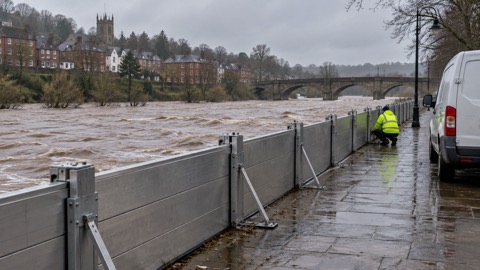
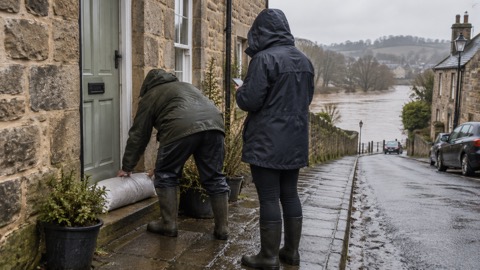
Openings are where water gets in first, and there are more of them than most people realise: doors, windows, airbricks, and the gaps around all of them. West Yorkshire Prepared lists the main options as flood gates, flood sacks, specialist doors and seals for airbricks17. Northern Ireland's preparation guidance suggests keeping sandbags, floodboards or plastic covers ready to block doorways and airbricks if your property is at risk20, and Derbyshire County Council notes that sandbag walls on doorways can prevent water entry, with other products often more effective12.
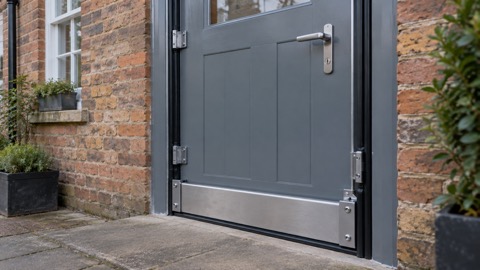
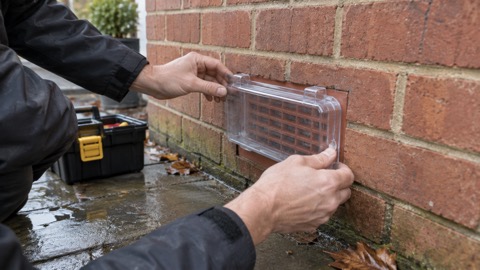
The most basic barrier, described in Dover District Council's damage limitation guide, is a strong wooden or metal board secured flat against the wall or frame surrounding a door or window, with the pressure of the floodwater itself helping to seal it6. Purpose-made products go further. Government guidance on adapting your home suggests three approaches for external doors: put in a flood resistant front door, buy temporary removable flood barriers, or raise the threshold of your doors1. Airbrick covers are singled out in Suffolk's flood booklet as able to stop floodwater coming in through your airbricks7, and Northern Ireland's guidance recommends installing service vent covers, seals and automatic airbricks4.
Temporary equipment has rules of its own. Suffolk's guidance is to put temporary flood protection measures in place as soon as you get a flood warning, or before if you are not likely to be home at the time, and always to remove them once the floodwater has gone, to help the property dry out7. Devon's PFR funding scheme lists flood doors and gates, temporary demountable barriers, pumps, airbrick covers and water resilient flooring among the products its grants can cover21.
| Opening | What you can fit | What it does |
|---|---|---|
| Front and back doors | Flood resistant door, removable barrier, or raised threshold1 | Stops or slows water at the doorway |
| Windows | Floodboard or barrier secured to the frame6 | Covers the opening against pressure |
| Airbricks | Clip-on covers, or self-closing water-resilient airbricks7 | Blocks a common low-level entry point |
| Doorways in a hurry | Sandbag walls, flood sacks or plastic covers20 | A last-minute barrier when no fitted product exists |
For more detail on choosing between these, see the guides to door flood barriers, flood doors and flood windows, airbrick covers and self-closing airbricks and sandbags and sandless alternatives.
Non-return valves and sewage defences for drains and toilets
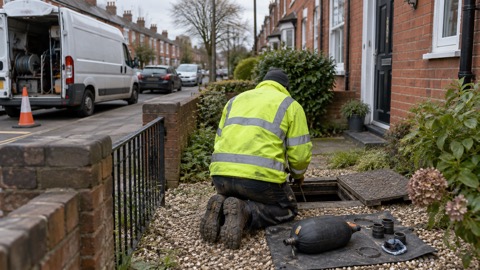
Water does not only come through the front door. Floodwater can back up through the drains and enter your property through sinks, washing machines and toilets, and it may contain sewage. Dover's damage limitation guide is direct about the fix: install anti-backflow valves to drains and sewers6. Government guidance describes how they work: flood resistant valves fitted to drains and water pipes close under pressure and stop sewage and dirty water flooding into your home22. The same wording appears in the government's prepare-your-property publication1.
Several councils give the same instruction for all drains and water inlet pipes. Cotswold District Council's preparing-your-home guidance says to fit non-return valves to all drains and water inlet pipes23, and the Environment Agency leaflet used by Nottinghamshire says the same18. Natural Resources Wales includes non-return valves on all drains and water inlet pipes among the property changes that ease clean-up8.
If you do not have non-return valves fitted and flooding is imminent, Northern Ireland's guidance offers an emergency substitute: plug water inlet pipes with towels or cloths, and turn off any equipment that uses water, such as washing machines and dishwashers19. It is a stopgap, not a substitute for the fitted valve.
Real installations show how this works in practice. Derbyshire's PFR case studies describe a Lancashire bungalow with a non-return valve in pipework to prevent backflow, a second non-return valve on the sewer pipe, waterproofing sprayed on external brickwork, flood resilient doors throughout, and a concrete-type fence shared with a neighbour to slow the flow24. The same case studies describe a detached house whose owner bought 100 absorbent packs that swell up and block water, placed around the home24. See non-return valves and toilet bungs and sewer flooding for more.
Sealing walls, doors and window frames
Water also enters through the fabric of the building itself: cracks in brickwork, gaps around frames, and the joints where pipes pass through walls. Derbyshire's case studies describe brickwork sealed with special cement as part of one property's measures24. Surrey County Council's recovery guidance recommends choosing water resistant door and window frames and using silicone sealant5, and Northern Ireland's guidance suggests replacing wooden window frames and doors with man-made ones such as UPVC4.
Maintenance matters as much as fitting. Somerset Council describes property flood protection as ranging from making sure you have adequate insurance to doing maintenance on the exterior of the property, investing in a stock of gel and sandbags, or installing flood doors25. Central Bedfordshire Council reminds homeowners that they are responsible for safeguarding their own home from flooding, including property-level protection measures and private drainage upkeep26. In practice that means checking the outside walls each year: repointing, sealing gaps around pipes, and clearing the ground-level openings before the winter rather than during a warning.
Resilient repairs: raised sockets and water-resistant materials
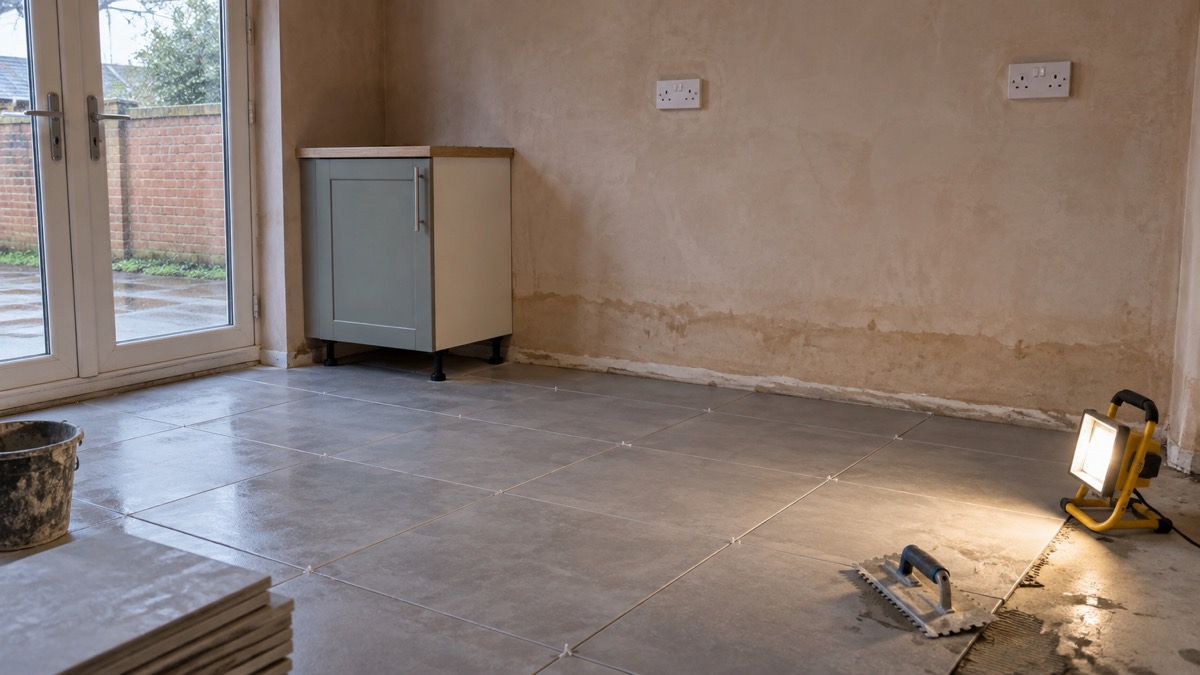
If water will get in anyway, the second half of PFR is making the house recover quickly. Anglesey's flood guidance describes this as having the ability to recover quickly if floodwater has entered your property, and notes it is more difficult and expensive to achieve, because it involves impervious floor coverings such as tiles, plastic skirting boards and architraves, special plaster on the walls, raised electric sockets and stainless steel kitchen units27.
The most consistent figure across official guidance concerns sockets. Natural Resources Wales and Suffolk's flood booklet both say to raise the height of electrical sockets to at least 1.5 metres above ground floor level8. Surrey's guidance puts the same principle more generally: fit plug sockets, boilers and service meters higher up on walls5, and Cornwall describes recoverability PFR as using flood resilient building materials and raising sockets further up walls10.
The measures advised for resilient repairs include fitting plug sockets, boilers and service meters higher up on walls, choosing water-resistant door and window frames sealed with silicone sealant, and considering non-return valves in waste water and sewage pipes8:
- Ceramic tiles on the ground floor with waterproof adhesive, and rugs instead of fitted carpets
- Lime plaster instead of gypsum plaster on walls
- Stainless steel, plastic or solid wood kitchens, or freestanding units
- The boiler and main parts of the heating system upstairs, or raised well above the ground floor
- Synthetic window frames and doors instead of wooden ones
- Non-return valves on all drains and water inlet pipes
Northern Ireland's guidance adds further measures worth considering in a wider refit: separate electrical circuits for upper and lower floors, closed-cell insulation in the cavity, lightweight internal doors with rising butt hinges so they can be lifted off quickly, white goods on raised plinths, and replacing the bottom two steps of the staircase with concrete4. For homes at risk from groundwater flooding, government guidance points to different floors that can reduce the damage: a dampproof reinforced concrete floor, a suspended floor, or a raised floor22. See repairing a home so it recovers faster for the full picture.
Where water-resistant coatings must not go: older buildings and deep water
There is a hard limit to resistance, and it comes from physics rather than product design. Dover District Council's damage limitation guide warns that in cases of very severe flooding, where the floodwater is more than one metre deep, keeping water out of your property can do more harm than good: hydrostatic pressures can cause long-term structural damage and undermine foundations. Its instruction is not to aim to prevent water entering more than one metre above the level of the ground surrounding the property6.
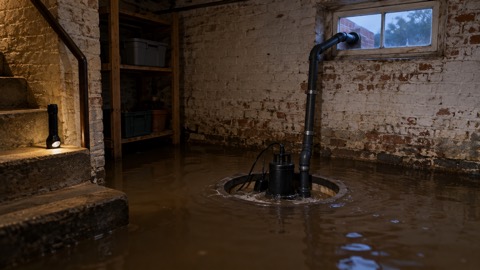
The same caution applies to pumping. Suffolk's flood booklet states it in capitals: "DO NOT pump out water until levels outside your property are lower than inside. This reduces the risk of structural dama[ge]"7. Government guidance agrees: to reduce damage to your home you should start pumping when the water outside is lower than inside22, and the same rule appears in the Cotswold guidance23 and in the Northern Ireland household flood plan, which adds that this reduces the risk of structural damage28.
One further safety point: if you are trapped in a building by rising water, do not go into attic spaces, because you can then be trapped by the rising water with no way out29. Go upstairs only if it is safe, and call for help. See pumping water out of a home or cellar and what to do during a flood at home.
Is property flood resilience right for your home?
PFR is not for every house, and official guidance is specific about where it fits. Cornwall Council says it is most suitable for properties in locations that are vulnerable to flooding, but where a large scale flood protection scheme is not viable10. In other words, PFR is the answer when a community defence scheme is not coming, or will not protect your street, and the measure has to be taken house by house.
Suffolk's case study material describes how a scheme works in practice, and the stages tell you what to expect: understanding the risk in a location and confirming PFR is suitable and cost-effective; establishing the properties most at risk and inviting them; appointing consultants to survey entry points and recommend measures; sharing survey results with owners and seeking agreement; appointing contractors and arranging manufacture and installation; and final surveys to sign off, ensuring owners know how to use and maintain the products14. Suffolk works with the Environment Agency to obtain funding where there is a known significant risk of flooding to property, established through flood risk modelling or because a property has flooded in the past14.
That last point matters for your application: a documented flood, reported to your council, is evidence. Suffolk asks residents to report every flood, whether it affects the garden, the house, or both14, and the Northern Ireland household flood plan likewise tells households to call their local council to let it know floodwater has entered the home28. If you have not yet established whether your home is at risk, start with checking your home's flood risk and the types of flooding. A professional survey is the route to a proper measure list: see property resilience surveys and professional installation.
Funding schemes: up to £5,000 for a survey and measures
Grants differ across the UK, and the schemes change name and detail over time, so check with your own council before assuming anything.
In England, Devon County Council's Property Flood Resilience Funding Scheme, previously known as the Property Level Resilience Grant Scheme, allows homeowners to apply for up to £5,000 per property to carry out a property survey identifying the required resilience measures and to purchase the recommended measures3. Its second edition guidance adds the eligibility test: you must have been affected by internal flooding or be considered to be at very high risk of flooding21. It also sets out owner responsibilities: store any PFR securely, protect it from damage, conduct maintenance, and transfer ownership of the equipment if the property changes hands21.
Suffolk County Council's grant scheme, set up after Storm Babet, pays grants of up to £5,000 including VAT, including survey costs, retrospectively to the property owner once the council receives proof of completed installation and invoicing for approved measures, with owners sourcing their own surveyor; up to £800 of the grant can be used to contribute towards survey costs9. Lincolnshire County Council offers a PFR grant for households whose home has been affected by flooding, to help install measures that reduce future flood damage30.
In Northern Ireland, the Homeowner Flood Protection Grant pays 90 per cent of the survey and estimated installation costs, up to a maximum of £9,0004.
Separately, some insurance companies offer Build Back Better, which gives homeowners the opportunity to install flood resilience measures up to the value of £10,000 when repairing their properties after a flood5. Natural Resources Wales describes the same scheme for Welsh householders8.
| Scheme | Where | Amount | Key conditions |
|---|---|---|---|
| PFR Funding Scheme | Devon, England | Up to £5,000 per property3 | Internal flooding or very high risk; owner stores and maintains the measures21 |
| Storm Babet PFR grant | Suffolk, England | Up to £5,000 incl. VAT, up to £800 towards survey costs9 | Paid retrospectively on proof of installation; owner sources the surveyor |
| PFR grant | Lincolnshire, England | Help with measures that reduce future flood damage30 | Home affected by flooding |
| Homeowner Flood Protection Grant | Northern Ireland | 90 per cent of costs, up to £9,0004 | Survey and estimated installation costs |
| Build Back Better | UK, via some insurers | Up to £10,000 of measures5 | Installed while repairing the property after a flood |
Suffolk notes that PFR is traditionally funded through a combination of national and local government funding14, so availability depends on what your council has secured. See property flood resilience grants and recovery grants and help if you are not insured.
Your household flood plan, your flood kit and insurance
Measures on the building work best alongside a plan for the household. Nottinghamshire's emergency preparedness guidance starts with finding out whether your home is subject to any specific risks, such as flooding, and what you can do to help protect it31. Somerset's guidance frames the plan as a list of things to do before a flood happens, for example turning off gas and electricity or moving important items to a safe place25. The full process is set out in making a household flood plan, and the immediate actions when a warning arrives are listed in the checklist when a flood warning is issued.
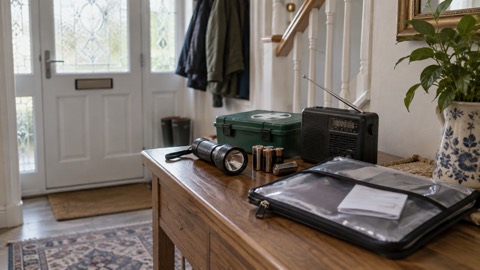
Keep a flood kit packed and ready. Natural Resources Wales lists what it should contain: copies of your home insurance documents, a phone charger and battery pack, a list of important telephone numbers, a torch with spare batteries, a radio, warm waterproof clothing and blankets, a first aid kit and prescription medication, bottled water and non-perishable food, baby food and baby care items, pet supplies, rubber gloves and wellington boots, and face masks and hand sanitiser8. The Greater London Authority's flash flooding guidance adds the purpose: the kit should contain items you must have if you need to leave your home11.
Insurance is part of protection, not separate from it. Somerset includes adequate insurance among the basic steps of property flood protection25, and Central Bedfordshire notes that some insurers offer reduced premiums for properties that implement PFR measures26. If you are repairing after a flood, ask your insurer about Build Back Better before work starts5, and see home insurance in a flood risk area and making an insurance claim after a flood.
Finally, keep your warnings current. Sign up for free flood warnings and check them during heavy rain28. The details are in flood alerts, flood warnings and severe flood warnings and how to sign up for free flood warnings.
Sources (31)
- Adapting your home or business to the risk of flooding, GOV.UK
- Personal responsibility for flooding, Derbyshire County Council
- Property flood resilience funding scheme, Devon County Council
- How to protect your home from flooding, nidirect
- Getting back into your home following flooding, Surrey County Council
- Damage limitation guide, Dover District Council
- Before, during and after a flood booklet, May 2021, Suffolk County Council
- Preparing for a flood, Natural Resources Wales
- Storm Babet, Suffolk County Council
- Property flood resilience projects, Cornwall Council
- How to prepare for flash flooding, Greater London Authority
- Personal flood resilience, Derbyshire County Council
- Property flood resilience questions and answers, Argyll and Bute Council
- PFR website case study, Suffolk County Council
- Flooding advice, Mid and West Wales Fire and Rescue Service
- Staying safe in flooding, West Midlands Ambulance Service NHS Foundation Trust
- Flooding, West Yorkshire Prepared
- What to do in a flood, Environment Agency leaflet, Nottinghamshire County Council
- What to do if a flood happens, nidirect
- Preparing for a flood, nidirect
- Property flood resilience funding, 2nd edition, July 2023, Devon County Council
- Prepare your property for flooding, GOV.UK
- Preparing your home for flooding, Cotswold District Council
- Property flood resilience case studies, Derbyshire County Council
- Preparing for flooding, Somerset Council
- Homeowner flood protection responsibilities and prevention tips, Central Bedfordshire Council
- Flood risk in Anglesey: be prepared, Isle of Anglesey County Council
- Household flood plan, December 2018, nidirect
- 5 tips for staying safe in heavy rain - Met Office, Met Office
- Apply for a property flood resilience grant, Lincolnshire County Council
- Preparing for an emergency, Nottinghamshire County Council
 Flood Warning Checklist
 First Steps After a Flood
 Insurance Claim Records
 Checking Flood Risk by Postcode
 Types of Flooding
 Flood Alerts and Flood Warnings
 Flood Guidance Statement
 Wales Flood Warnings and Maps
 Making a Household Flood Plan
 Door Flood Barriers
 Sandbags and Alternatives
 Flood Doors and Windows
 Airbrick Covers
 Non-Return Valves and Bungs
 Sump and Submersible Pumps