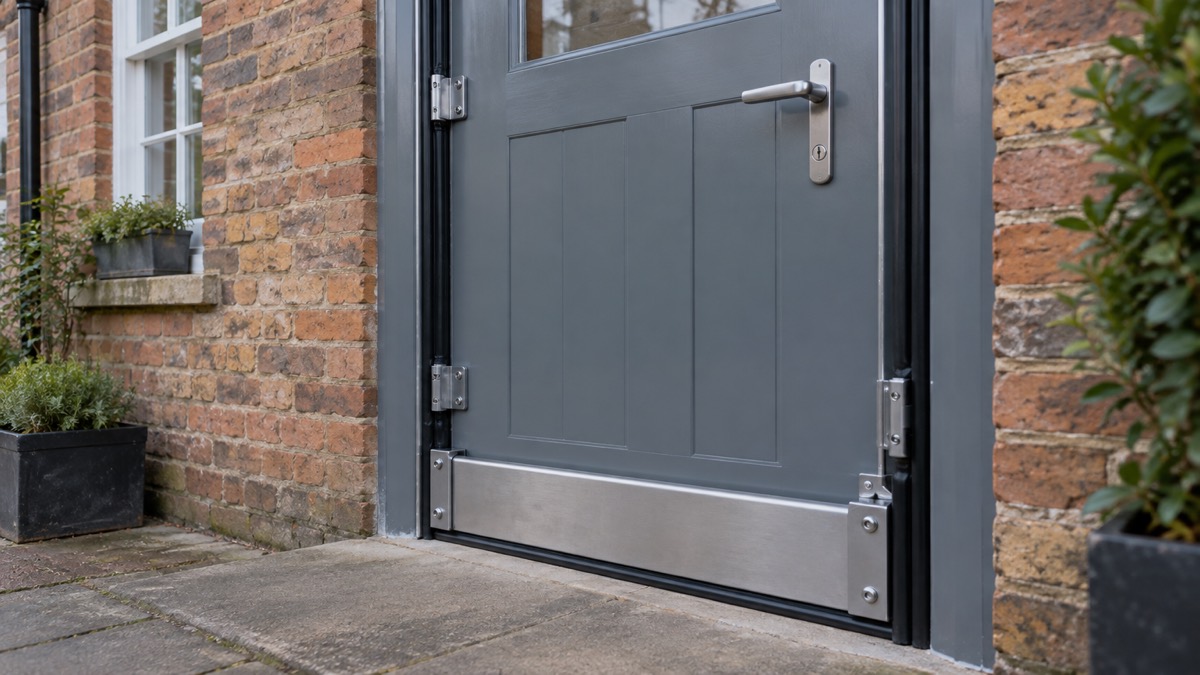
A flood door is a permanent replacement for an ordinary external door, built so that it seals shut against floodwater and stays in place as your everyday front or back door. Nothing has to be carried out of the garage and fitted when a warning arrives: the protection is in the door and its frame all year round. Getting flood protection products, for example flood doors or self-closing air bricks, reduces flood damage, according to the government's Prepare for flooding guidance1. Flood windows and water resistant window frames work on the same principle, holding back water where standard frames and seals would let it through.
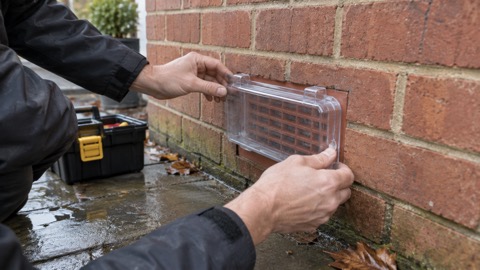
Water usually enters a property through doorways, windows, air bricks, or as groundwater through floors, Derbyshire County Council notes2. In very severe flooding it may also enter through vents, drains, walls and even through the ground floor itself, Dover District Council's damage limitation guide warns3. A flood door and flood windows deal with the first two of those routes, and they work best as part of a wider set of measures, alongside airbrick covers and non-return valves on drains and pipes.
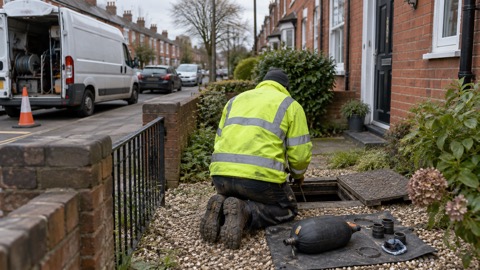
One limit matters before anything else: official health guidance states that resistance measures such as flood doors are generally only effective where flood depths are less than one metre, because keeping out floodwater above that depth may affect the structural integrity of the property4. A flood door is protection against the shallow, frequent floods that cause most of the damage in this country, not against deep water pressing on your walls.
What a flood door does: a barrier where water gets in first
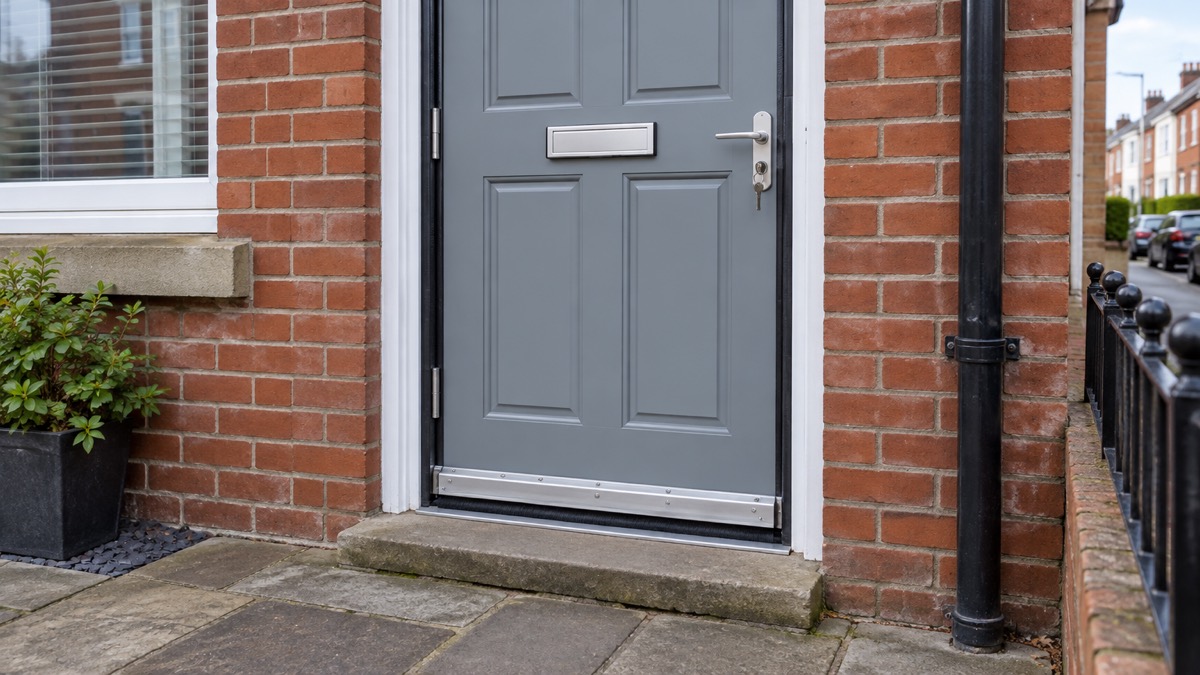
Flood protection splits into two ideas, and it helps to be clear about them before spending money. Flood resistance is the ability to prevent flood water entering your property, using anything from sandbags and homemade flood boards to more permanent measures, as Isle of Anglesey Council's flooding guidance puts it9. Flood resilience is the ability to recover quickly if water does get in, using impervious floor coverings, plastic skirting boards, special plaster, raised sockets and stainless steel kitchen units9. A flood door is a resistance measure: its job is to stop the water crossing the threshold at all.
The reason doors are the usual starting point is simple. Water can enter a property via doorways, windows, air bricks or as groundwater through floors2, and the doorway is the lowest, largest and most used opening in most homes. Every external door has a threshold, and a standard threshold is designed to keep out rain and draughts, not standing water. Even a few centimetres of water in the street will find the gaps.
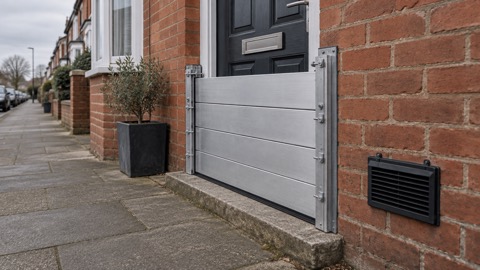
A flood door works by replacing both the door leaf and, normally, the frame, so that the whole assembly closes onto continuous seals. Argyll and Bute Council's property flood resilience guidance describes the range plainly: some features are demountable, such as barriers for doors and windows, while others are permanent, for example a watertight PVC flood door5. The permanent door is the option for households that want the protection to exist whether or not anyone is home, and whether or not there is time to act.
It is worth repeating the limit from the opening. Resistance measures, including flood doors, barriers, gates and walls, are generally only effective where flood depths are less than one metre; keeping out water above that depth may impact the structural integrity of the property4. If your area floods deep, the aim shifts from keeping water out to recovering quickly, and you should read our page on resilient repairs alongside this one.
How the seal between frame and door holds water back
The working part of any flood door is the seal. Water does not need a hole; it needs a gap, and a door that is watertight against rain will still pass standing water through the gap under the latch side, along the threshold, and around any letterbox or glazing cut-out. A flood door closes onto compressible seals running continuously around the frame and across the threshold, so that when the door is shut and locked, those gaps are closed under pressure.
The principle is the same one that makes simpler barriers work. Dover District Council describes the most basic flood board as a strong wooden or metal barrier secured flat against the wall or frame surrounding a door or window, with the pressure of floodwater itself helping to seal the barrier3. The deeper the water, the harder the water presses the barrier onto its seal. A flood door borrows that idea but builds it into the door itself, so the seal is made by closing the door rather than by fitting anything.
Two everyday habits support the seal. Devon and Somerset Fire and Rescue Service notes that using duct tape around the exterior of a door can prevent water getting between the door and the frame10, a useful stopgap on an ordinary door when nothing else is to hand. And the Met Office advises fitting draught proofing to seal any gaps around windows and doors11, which matters for heat retention in winter and reduces the smaller gaps water can exploit.
For the same reason, check the other openings near the threshold. Our pages on meter boxes and cable holes and on door flood barriers cover the gaps that a door alone does not.
Certification: look for the kitemark and the British standard
Because a flood door is a safety product whose failure means water in your home, buy one that has been tested rather than one that is merely described as waterproof. Natural Resources Wales advises households preparing for a flood to choose BSI kitemark certified flood protection products that meet the British standard for quality and safety6. The kitemark is the BSI's own mark, shown on products and documentation that have passed testing to that standard.
Certification also matters for money as well as for water. SEPA's flooding FAQs note that some insurers may require flood defence products to be industry-approved and certified12. If your insurer expects certified products and your door is not, you may find the protection you paid for does not count towards your cover. Keep the certificate with your household flood plan and insurance documents.
When you buy, ask the installer or retailer three things: which British standard the door is certified to, whether the certification covers the door and frame as an assembly, and for a copy of the certificate. Our page on kitemarked flood products explains what the testing involves and what the marks look like. If you are having the door fitted professionally, our page on property resilience surveys and professional installation covers how to choose someone competent.
Choosing the material: uPVC, composite or synthetic frames
The pack of official guidance points most directly at one material: Argyll and Bute Council gives a watertight PVC flood door as its example of a permanent property flood resilience feature5. PVC, usually sold as uPVC, suits flood protection because the frame and leaf do not swell, rot or take up water as timber does, and the seals can be formed into the profile of the frame itself.
The wider official advice on materials is consistent with that. The Environment Agency leaflet on what to do about flooding recommends replacing wooden window frames and doors with synthetic ones as part of flood-resilient repair13. Surrey County Council, setting out how to get back into your home following flooding, advises choosing water resistant door and window frames and using silicone sealant14. Whichever material you choose, the frame must be water resistant and the joints sealed, because a door leaf alone does not keep water out.
| Material | What the official guidance says | What to check |
|---|---|---|
| uPVC (PVC) | Given as the example of a permanent watertight flood door5 | Certification, continuous frame and threshold seals |
| Synthetic frames generally | Recommended as replacements for wooden frames and doors13 | Water resistance of the frame, sealed joints |
| Any frame | Choose water resistant frames and use silicone sealant14 | Sealant condition at corners and joints |
Composite and steel doors can also be made as flood doors, and the choice between them is mostly about the rest of the house: matching existing windows, the exposure of the doorway, and how the door is used day to day. What decides whether the door works in a flood is not the leaf material but the certified seal assembly, so treat material as a preference and certification as the requirement. For double doors, both leaves and the meeting stile between them must seal, which is why certified double flood doors are usually supplied and fitted as a complete set rather than adapted from standard pairs.
Flood windows and water resistant frames
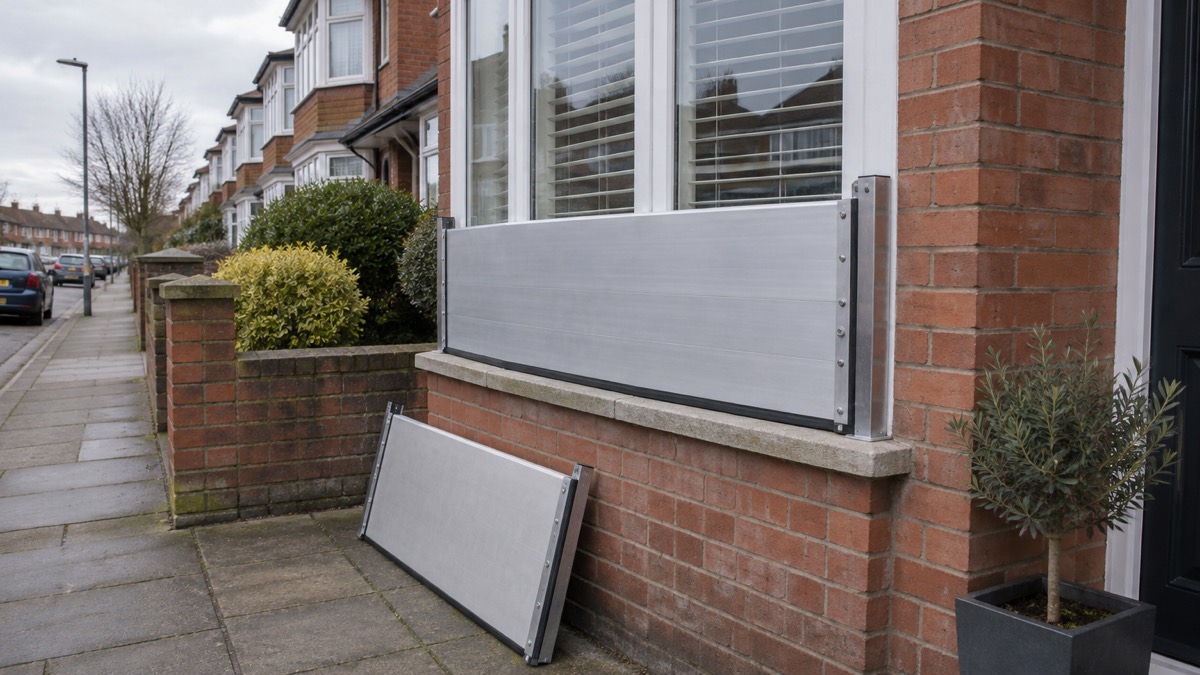
Windows are the second route in, and the same logic applies. Surrey County Council advises choosing water resistant door and window frames and using silicone sealant14, and the Met Office lists floodboards among products that can be fixed to your doors and windows15. Devon and Somerset Fire and Rescue Service describes floodboards as fixed to window and door frames, washable, storable and usable again10.
There are therefore two ways to protect a window. The first is permanent: replace the frame with a water resistant one, sealed with silicone, so that the frame itself resists water in the same way a flood door does. The second is demountable: a floodboard fixed across the window opening when a warning arrives, stored the rest of the time. Argyll and Bute Council sets the two side by side, with barriers for doors and windows as the demountable option and the watertight PVC flood door as the permanent one5.
The Environment Agency leaflet adds a rule for the demountable kind: floodboards should always be removed once the flood water has gone, to help the property dry out13. That is the trade-off in one sentence. Permanent water resistant frames need no handling and no storage; floodboards need someone at home, with time, and remembering to take them down afterwards.
Locking everything in place when a flood is coming
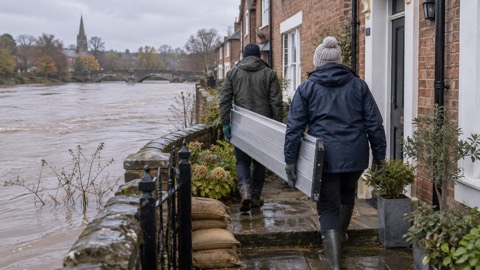
How much notice you get decides how much you can do. A flood alert is used two days in advance of flooding, and a flood warning is used half an hour to one day in advance, according to the North Yorkshire Community Risk Register7. Half an hour is enough to close and lock a flood door. It is not comfortably enough to find, carry and fit floodboards to every door and window, which is the strongest practical argument for the permanent door.
When a warning is issued, the government's help during a flood guidance says to use flood protection products if you have them, for example flood barriers or air brick covers16. Mid and West Wales Fire and Rescue Service advises blocking doors, with floodboards if available, and air vents with plastic sheeting and sandbags17. If you have a flood door, the sequence is short:
- Close the door fully and lock it, so the seals are compressed5
- Fit or close airbrick covers and any window floodboards16
- Block vents with plastic sheeting and sandbags where you have no covers17
- Move to an upstairs room with a window that can be used as an escape route, or find a safe place if you do not have an upstairs, and contact your local authority for emergency accommodation if you need to18
- Keep a key upstairs if you have window locks, and plan your escape route, particularly in a bungalow19
Two safety points from the fire and rescue service and official guidance. London Fire Brigade warns that flood water can come in through toilets, so be prepared to sandbag bathroom doors or block your toilet20. And SEPA's guide for older communities advises putting a flood kit together and storing it somewhere you can easily get to it if your home is flooded19. Our checklist for when a flood warning is issued runs through the whole sequence.
Where flood doors and windows are used
Flood doors and windows are used in homes and in commercial and community buildings, and the official guidance covers both. Belfast City Council notes that damage caused by storms and flooding is covered by most standard home insurance and commercial business policies21, and the Derby and Derbyshire flood warden handbook describes flood warnings as applying to flooding of homes and businesses, roads and rail infrastructure22. The products themselves are the same in either setting; a shop or gallery simply has larger or more numerous openings to protect.
A Derbyshire case study of the Heart Gallery in Hebden Bridge shows the commercial version in practice. After flooding, the gallery's floor was rebuilt in concrete with steel supports and insulation below, finished with porcelain tiles; walls were taken back to bare stone or brick, sealed and given resilient concrete render; the counter base and shelves were marine ply with sealant; electrics were raised; non-return valves were fitted on all outgoing pipework including handbasins; and a 1.2m flood barrier fits into the doorway, to deal with low level floods or to buy time for moving stock in more severe events, with a raised storage area for stock in future floods8.
The same case study collection records a household example: Karen and Ken's property has self-closing airbricks, flood barriers to both doors, non-return valves to the washing machine and dishwasher, and plug sockets higher up the wall8. Note that this household chose barriers rather than a permanent flood door, which is a genuine choice: both appear throughout the official guidance. Cornwall Council lists flood gates on doors, waterproof air bricks and non-return valves on water outlets among resistance measures23, and Derbyshire County Council lists sandbags, water-resistant barriers and doors, and special valves on drains24.
When a flood door is worth fitting
The first step is knowing your risk. Central Bedfordshire Council advises checking your property's flood risk using the Environment Agency's flood risk checker, which provides information on the likelihood of flooding in your area25. Our page on checking your home's flood risk by postcode walks through the checkers for each nation.
Then weigh three things. Cornwall Council's guidance on property flood resilience says it is most suitable for properties in locations that are vulnerable to flooding, but where a large scale flood protection scheme is not viable23. That describes a great many homes: too flood-prone to ignore, too scattered for a community defence scheme. For those households, individual measures such as flood doors are the practical route.
The second consideration is depth. Below one metre of flood water, resistance measures such as flood doors are generally effective4. Above it, they are not, and money is better spent on resilience measures that speed recovery, from solid flooring to raised electrics. Dover District Council notes that solid flooring is much more resistant to flood damage than floor boards3, and the Environment Agency leaflet lists ceramic tiles with rugs instead of fitted carpets, lime plaster instead of gypsum, stainless steel or plastic kitchens instead of chipboard, and boilers positioned upstairs or raised well above the ground floor13.
The third is timing and people. A flood door protects the house whether anyone is home, asleep, at work or away, and needs half a minute to deploy. Barriers need someone present with perhaps an hour. Households where everyone works away, or where mobility is limited, get more from the permanent door.
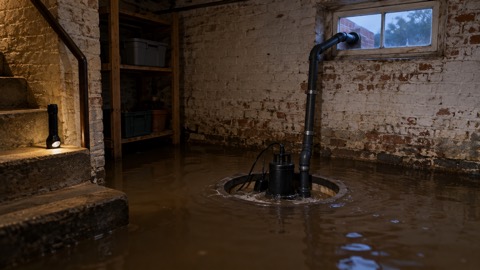
Money help exists in some places. Lincolnshire County Council runs a property flood resilience grant scheme, covering practical changes to your home that help reduce the impact of future flooding, including flood doors, air brick covers, sump pumps and non-return valves26. Our pages on property flood resilience grants and on home insurance in a flood risk area and Flood Re set out what is available; the flood warden handbook notes that the Flood Re insurance scheme helps keep home insurance for flood risk residents affordable22.
If you rent, the Greater London Authority's flash flooding advice is direct: speak to your landlord or housing association about how they can better protect you from flooding27. Installation is normally the owner's decision and expense, so start that conversation with your flood risk check in hand.
Looking after the seals: care and maintenance
A flood door that is not maintained is a door with an untested promise. The Derbyshire case studies record the advice from Susan's ground floor flat in Berkshire: have pumps tested each year, and take out a maintenance contract for flood doors and flood barriers, so that the gaskets get checked annually8. The gasket is the compressible seal itself, and it is the part that degrades: grit wears it, sunlight perishes it, and a door that slams for years compresses it unevenly.
Between professional checks, the upkeep is simple. Keep the frame, threshold and seals clean and free of grit and leaves, and check that the door still closes firmly onto its seals. For demountable floodboards, the Environment Agency leaflet advises that they can be washed, stored and used again, and should always be removed once the flood water has gone to help the property dry out13. Our checklist for storing and checking flood barriers covers the routine.
After a flood, treat the door and its seals as part of the clean-up. Isle of Anglesey Council advises using ordinary household cleaning products, opening windows and doors if you are drying your property naturally, and closing them if you are drying with dehumidifiers9. Northern Ireland's thunderstorm advice adds a health precaution for the clean-up itself: use rubber gloves when cleaning up28. Our pages on cleaning up safely after floodwater and floodwater and your health go further.
Finally, keep the paperwork with the door. Hold on to the fitting instructions, receipts and any inspection records so they are to hand if you ever need them, and our insurance claim records checklist shows where they belong.
Sources (28)
- Protect your property, Prepare for flooding, GOV.UK, 2026
- Personal flood resilience, Derbyshire County Council, 2026
- Damage limitation guide, Dover District Council, 2001
- How to prepare for flooding, Flooding and health advice for frontline responders, GOV.UK, 2023
- Property flood resilience questions and answers, Argyll and Bute Council, 2026
- Preparing for a flood, Natural Resources Wales, 2026
- Community Risk Register 2025, North Yorkshire Local Resilience Forum, 2025
- Property flood resilience case studies, Derbyshire County Council, 2024
- Flood risk in Anglesey: be prepared, Isle of Anglesey Council, 2013
- Safety in severe weather conditions, Devon and Somerset Fire and Rescue Service, 2026
- Keeping your home warm in winter, Met Office, 2026
- Flooding FAQs, Scottish Environment Protection Agency, 2026
- What to do about flooding, EA leaflet, Environment Agency via Nottinghamshire County Council, 2010
- Getting back into your home following flooding, Surrey County Council, 2026
- Protecting your property from flooding, Met Office, 2026
- Help during a flood, GOV.UK, 2026
- Flooding advice, Mid and West Wales Fire and Rescue Service, 2026
- What to do in a flood, Natural Resources Wales, 2026
- Flooding guide for older communities, Scottish Environment Protection Agency, 2026
- Preparing for a flood, London Fire Brigade, 2026
- Emergency planning and community safety advice, Belfast City Council, 2026
- Derby and Derbyshire flood warden handbook, Derby and Derbyshire, 2019
- Property flood resilience projects, Cornwall Council, 2025
- Resilience and sandbags, Derbyshire County Council, 2026
- Homeowner flood protection responsibilities and prevention tips, Central Bedfordshire Council, 2026
- Apply for a property flood resilience grant, Lincolnshire County Council, 2026
- How to prepare for flash flooding, Greater London Authority, 2026
- Thunderstorms weather warning - advice and information | nidirect, nidirect (Northern Ireland government)
 Flood Warning Checklist
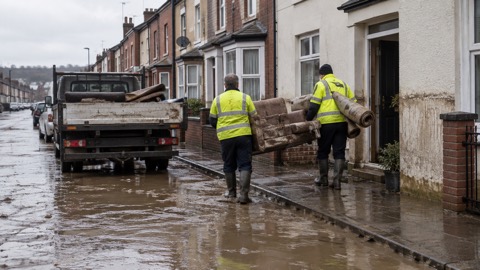 First Steps After a Flood
 Insurance Claim Records
 Checking Flood Risk by Postcode
 Types of Flooding
 Flood Alerts and Flood Warnings
 Flood Guidance Statement
 Wales Flood Warnings and Maps
 Making a Household Flood Plan
 Protecting Your Home
 Door Flood Barriers
 Sandbags and Alternatives
 Airbrick Covers
 Non-Return Valves and Bungs
 Sump and Submersible Pumps