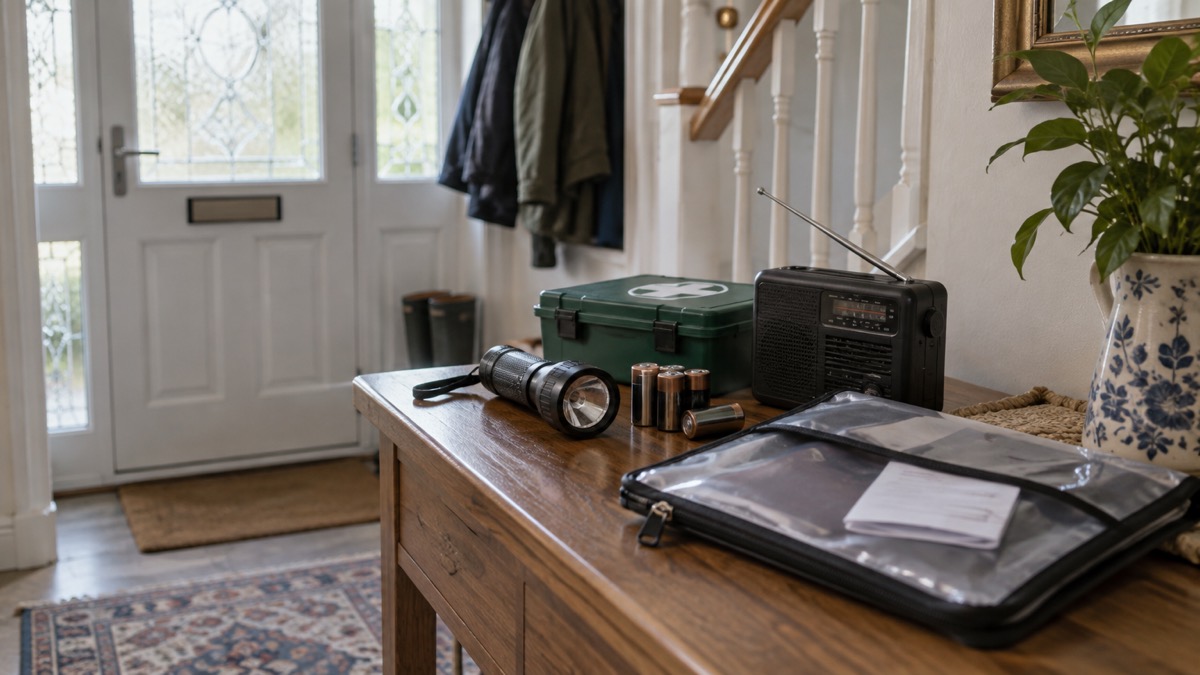
A flood plan is a short written document that says what your household will do before, during and after a flood: who to call, where the shut-off points are for gas, electricity and water, what you would move upstairs, and when you would leave. The Environment Agency publishes a free personal flood plan template on GOV.UK, an 8-page PDF you can fill in, last updated on 15 November 20231. Natural Resources Wales gives the same advice in simpler terms: write a flood plan so you, your family or your workforce know what to do during a flood2.
The reason to do it now, rather than when a warning arrives, is time. Derbyshire County Council puts it plainly:
"Please don't wait until a flood happens to make these plans as there may not be enough time to prepare fully."
Derbyshire County Council3
A plan takes an evening to write. This page covers what to put in it, the three steps to take before you write a word, and how household plans connect to community flood plans and flood wardens.
Start with three steps: check your risk, sign up for warnings, know what to do
Before you write anything, do the three things that every flood authority in the UK repeats. Natural Resources Wales framed its #BeFloodReady campaign around them: check your flood risk by postcode, sign up for warnings, and know what to do to prepare for flooding5.
First, check whether your home is actually at risk. You can find out by entering your postcode on the government website, as Suffolk County Council advises8, or by searching the flood maps for planning and contacting your council for site-specific information on surface water flood risk, as Derbyshire County Council suggests3. Our page on checking your home's flood risk by postcode walks through this in detail. The point of checking is not just a yes or no: it tells you which of the types of flooding threaten you, which changes what goes in your plan. Natural Resources Wales also cautions that risk is not a one-off question: "This chance is always there, this year, next year and in the future"9.
Second, sign up for free flood warnings. Devon and Somerset Fire and Rescue Service describes the same pairing: check your flood risk using the government's postcode search, then sign up for free flood warnings10. Our page on how to sign up for free flood warnings covers the process, and Floodline numbers for England, Scotland and Wales lists the contacts for each nation.
Third, know what to do when a warning arrives. That is what the rest of your written plan is for. The Met Office's heavy rain advice ties the three steps together: check if your property is at risk, and if it is, prepare a flood plan and an emergency flood kit11.
What a household flood plan should include
A personal flood plan should detail the practical actions you will take before and during a flood, which will help to reduce the damage flooding could cause, according to Derbyshire County Council3.
At its heart, a household flood plan answers six questions:
- Who do we call? Write down the Floodline number, 0345 988 11884, plus your insurance details, and the numbers of family, neighbours and anyone who would need to know you had left.
- Where do we turn things off? The locations of the gas, electricity and water shut-off points, and how to use them (covered below).
- What do we move, and where? Which items go upstairs or to a high place, and who moves them.
- What do we take if we leave? The flood kit, documents, pets, medication.
- Where would we go? Where you would stay, and how you would get there without driving through flood water.
- Who does what? Which household member handles which task, so nothing is decided in the moment.
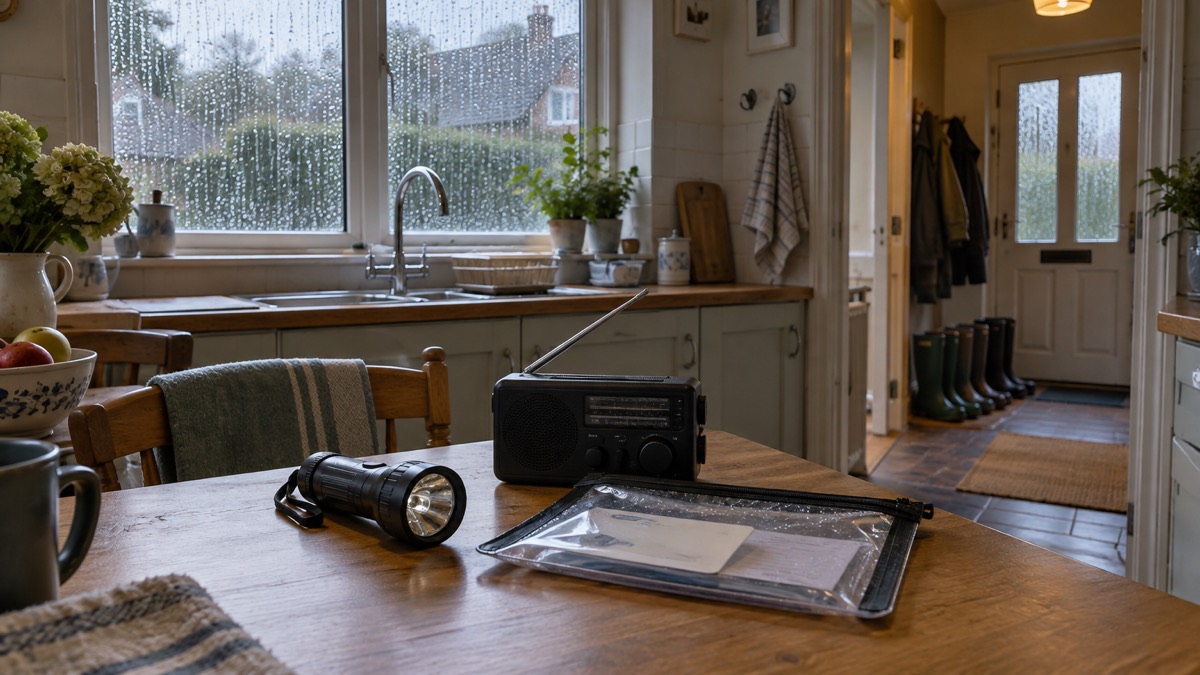
Orkney Islands Council suggests putting together a family flood plan alongside a flood kit, including a battery or wind-up radio, torches, blankets, waterproof clothing, plastic gloves, a first aid kit, a camera for recording damage, and any important personal documents12. The camera matters more than people expect: a photographic record of damage supports an insurance claim afterwards. Our emergency kit page covers the general kit, and what to do during a flood at home covers the actions themselves.
Store the finished plan with your flood kit, as the fire and rescue service advises13, and talk it through with everyone in the household. Mid and West Wales Fire and Rescue Service recommends discussing possible flooding with your family or those you live with before writing the plan down13. A plan only one person knows is half a plan.
Turning off gas, electricity and water: write down where and how
One instruction appears in almost every official flood source: turn off your gas, electricity and water supplies if it is safe to do so. GOV.UK's help during a flood page says exactly that6, and the Prepare campaign advice says the same when a flood warning or severe flood warning is in force14. Mid and West Wales Fire and Rescue Service is more specific still: turn off gas, electricity and water at the mains13. Lancashire County Council adds the trigger point: turn off the supplies if flood water is about to enter your home15.
The reason your plan must record this in advance is that people do not know where their shut-off points are, and a flood is the worst possible moment to find out. The London Resilience Partnership advises that if you leave your home during a flood you will need to turn off your mains water, gas and electricity if it is safe to do so, and that you should find out in advance how to do this16. That is the task for a quiet afternoon, not a flood warning.
For each of the three, write in your plan:
- Gas: where the meter and isolation valve are, and which way the handle turns to shut off the supply.
- Electricity: where the consumer unit or fuse box is and how to switch off the main switch.
- Water: where the internal stopcock is and how to close it.
Our page on turning off gas, electricity and water before a flood gives step-by-step instructions for each. If in any doubt about the gas supply, do not attempt it yourself: treat that as a job for the gas emergency service, and say so in your plan.
Keeping documents and contacts safe from flood water
Flood damage to paperwork causes problems long after the water has gone: birth certificates, insurance documents, passports and property deeds are all slow and stressful to replace, and an insurance claim moves faster when you can produce your policy details. The Prepare campaign gives the practical routine. Move sentimental or valuable items upstairs or keep them in a high place such as the top shelf or drawer of a cabinet, and store important documents, for example birth certificates, in resealable water-tight plastic bags to help protect them from water damage14.
Derbyshire County Council's resilience advice makes securing important documents one of the practical actions to decide in advance when you prepare a flood plan17. Two habits follow from that:
- Keep the documents you would need in an evacuation, such as insurance details and identification, in one sealable bag you can grab without searching.
- Keep a copy of your flood plan itself, and your key contacts, somewhere dry and reachable, including in the flood kit.
Our insurance claim records checklist sets out what evidence to keep for a claim.
Never walk or drive through flood water
Every flood plan needs one rule written in bold, because it is the rule people break most often and it is the one that kills. GOV.UK's guidance under a severe flood warning is direct: do not walk, cycle or drive through flood water6. The Environment Agency's personal flood plan template says the same, and gives the reason: "do not walk or drive through flood water, as it may conceal hidden dangers"18. Lancashire Prepared's storms and gales advice compresses it to "Never walk or drive through flood water"19.
Lancashire County Council gives the one figure that helps you judge: never drive through flowing water that is more than 10cm deep15.
Write your alternative route into the plan now: where you would go, and which roads stay out of the flood plain. Our page on whether it is safe to walk or drive through floodwater covers the reasoning in depth.
Community flood plans and flood wardens
A household plan protects your home. A community flood plan protects a street, village or parish, and the two work best together. A community flood plan sets out the local community procedures and actions to prepare for, respond to and recover from a flood event, as the Merton community flood plan template puts it20. Natural Resources Wales lists what one should include: details about the flood risk in your area, a list of contacts including the community flood lead and flood volunteers, how to report an incident, actions to take before, during and after a flood, when you should take action, how to share information within the community, and how often the plan will be tested and reviewed21.
The government publishes a community flood plan template for England, aimed at people active in the local community, leaders of community groups, local responders, people working in the voluntary sector, and any other interested members of the community22. The plan includes a list of things you should do in advance of a flood22. Cambridgeshire County Council publishes a step-by-step guide to creating a flood action group aimed at anyone thinking of starting one, along with government-developed checklists to help you prepare for flooding if you support a community or group23.
What flood wardens do, and what they must not do
Flood wardens are local volunteers who help their communities prepare for, respond to, and recover from flooding, as Harborough District Council's flood warden guidance defines them24. Cheltenham Borough Council notes that if you live in a parish council area, your community may have a Community Emergency Plan which may document specific actions for the flood warden25. The Derby and Derbyshire flood warden handbook adds a personal-preparedness point that applies to any volunteer: if you are at risk of flooding yourself, ensure you are personally well prepared, so that you can quickly implement your own flood plan before helping others26.
The limits are stated firmly by every source. Natural Resources Wales warns that being part of a community flood group is not an emergency service role, and that you should not undertake any activities which could put your life or others in danger21. Cheltenham Borough Council is specific: flood wardens should not rescue residents from flood water, and should leave that to the emergency services25. The Derby and Derbyshire handbook adds that a flood warden is there to provide advice and co-ordinate the response effort, not to get physically involved, and should refuse to lift anything too large, awkward or heavy26. Harborough's guidance states that flood wardens are not first responders, that personal safety comes first, and that wardens should escalate to the authorities if there is danger to life24.
Personal information in a community plan
Community plans often want to record who in the area needs extra help. That is legitimate, but it is regulated. Natural Resources Wales is clear: personal information in the plan must be stored securely with people's permission, and it should only be shared with the emergency services during a flood, not passed to any other people or organisations21. The government's community flood plan guidance for England, which applies to England, says you must comply with GDPR regulations when gathering personal information from people27. The Derby and Derbyshire flood warden handbook gives the practical case: identify properties with disabled, elderly or infirm residents, and hold that information in the community flood plan in line with data protection guidelines26.
Who leads during a flood
The division of responsibility is worth writing into both household and community plans. The government's community flood plan guidance states that the emergency services are responsible for making sure the public are safe and co-ordinating the incident response27. At community level, if your community has volunteer flood wardens, they are responsible for leading the community response, with a single overall lead co-ordinating wardens for specific neighbourhoods, as the Merton template sets out20. Your household plan should assume the emergency services lead the incident, and use the community plan to know who locally is co-ordinating information.
Finding or joining a group near you
In Wales, contact Natural Resources Wales at befloodready@cyfoethnaturiolcymru.gov.uk to find out if there is a community flood group in your area, and to ask about a simulated flooding event. Tell them your name, your postcode, and whether you give permission for your details to be passed on21. Our community resilience page covers neighbourhood preparedness more broadly.
Templates for each nation
The Environment Agency's personal flood plan template applies to England18. It is published on GOV.UK as a PDF, 308 KB, 8 pages, published on 1 July 2009 and last updated on 15 November 20231. If you use assistive technology and need the document in a different format, email enquiries@environment-agency.gov.uk1.
| Nation | Personal plan | Community plan |
|---|---|---|
| England | Environment Agency personal flood plan template, applies to England18 | GOV.UK community flood plan template, applies to England27 |
| Wales | Natural Resources Wales advises writing a flood plan covering what to do with valuable items, where you would go and who to call2 | Natural Resources Wales community flood plans, 65 in place as of April 20257 |
| Scotland | SEPA advises it is your responsibility to manage your own flood risk and protect yourself, your family, property or business28 | Contact Floodline on 0345 988 1188 and use quick dial codes for your area4 |
In Scotland, SEPA's position is that individuals have a personal responsibility to be aware of the level of flood risk where they live and to effectively plan to protect themselves and their property from flooding damage28. Floodline in Scotland runs on the same number, 0345 988 1188, and when you call you can enter your quick dial code to hear flood messages for your area directly4. An older fire and rescue service page lists an 0845 988 1188 number13; the 0345 number is the one given by Floodline itself and by current GOV.UK guidance4, so use that.
A community example worth reading is Aberaeron Town Council's community emergency plan, which shows what a worked plan looks like, including the instruction at Flood Alert stage to be prepared to act on your flood plan, prepare a flood kit of essential items, and monitor local water levels and the flood forecast29.
Putting the plan together: a working order
If you are starting from nothing, this is the sequence the official advice supports:
- Check your flood risk by postcode on the government website, and contact your council for site-specific surface water information8.
- Sign up for free flood warnings by text, phone or email30.
- Download the personal flood plan template and fill in your contacts, including Floodline on 0345 988 11881.
- Find your gas, electricity and water shut-off points and write down where they are and how to use them16.
- Move valuable and sentimental items to a high place, and put important documents in resealable water-tight plastic bags14.
- Assemble a flood kit, including a battery or wind-up radio, torches, blankets, waterproof clothing, plastic gloves, a first aid kit, a camera and your important personal documents12.
- Write in your alternative route, and the rule never to walk, cycle or drive through flood water6.
- Store the plan with the flood kit, and talk it through with everyone in the household13.
- Ask around for a community flood group or flood wardens in your area, and offer what help you can within the limits above21.
Once written, a plan is not finished forever. Natural Resources Wales includes in its community plan contents how often the plan will be tested and reviewed21, and the same habit is worth borrowing at home: re-read it when the clocks change, check the shut-off points still work, and update the contacts.
Sources (30)
- Personal flood plan: accessible version details, GOV.UK, 15 November 2023
- Preparing for a flood, Natural Resources Wales
- Personal responsibility for flooding, Derbyshire County Council
- Floodline live flood information and quick dial codes, SEPA Floodline
- Flood risk management annual report 2024 to 2025, Natural Resources Wales, 2025
- Help during a flood, GOV.UK
- Flood risk management annual report 2025 to 2026, Natural Resources Wales, 2026
- Flood management in Suffolk, Suffolk County Council
- Check your flood risk by postcode, Natural Resources Wales
- Safety in severe weather conditions, Devon and Somerset Fire and Rescue Service
- Stay safe in heavy rain, Met Office
- Flooding: preparing for emergencies, Orkney Islands Council
- Flooding advice, Mid and West Wales Fire and Rescue Service
- Flooding: be informed about hazards, Prepare Campaign, GOV.UK
- Flooding support, Lancashire County Council
- Preparing yourself for flooding incidents, London Resilience Partnership
- Resilience and sandbags, Derbyshire County Council
- Personal flood plan, GOV.UK, 15 November 2023
- Storms and gales, Lancashire Prepared
- Community Flood Plan Template, London Borough of Merton, 2026
- Community flood plan, Natural Resources Wales
- Community flood plan template, GOV.UK
- Community flood group resources, Cambridgeshire County Council
- Be Flood Ready: guidance for flood wardens, Harborough District Council
- Flood wardens, Cheltenham Borough Council
- Derby and Derbyshire flood warden handbook, Derby and Derbyshire, 2019
- Community flood plan, GOV.UK
- Developing our knowledge: flooding, SEPA
- Aberaeron Community Emergency Plan 2024, Aberaeron Town Council, 2024
- Staying safe in flooding, West Midlands Ambulance Service NHS Foundation Trust
 Flood Warning Checklist
 First Steps After a Flood
 Insurance Claim Records
 Checking Flood Risk by Postcode
 Types of Flooding
 Flood Alerts and Flood Warnings
 Flood Guidance Statement
 Wales Flood Warnings and Maps
 Protecting Your Home
 Door Flood Barriers
 Sandbags and Alternatives
 Flood Doors and Windows
 Airbrick Covers
 Non-Return Valves and Bungs
 Sump and Submersible Pumps