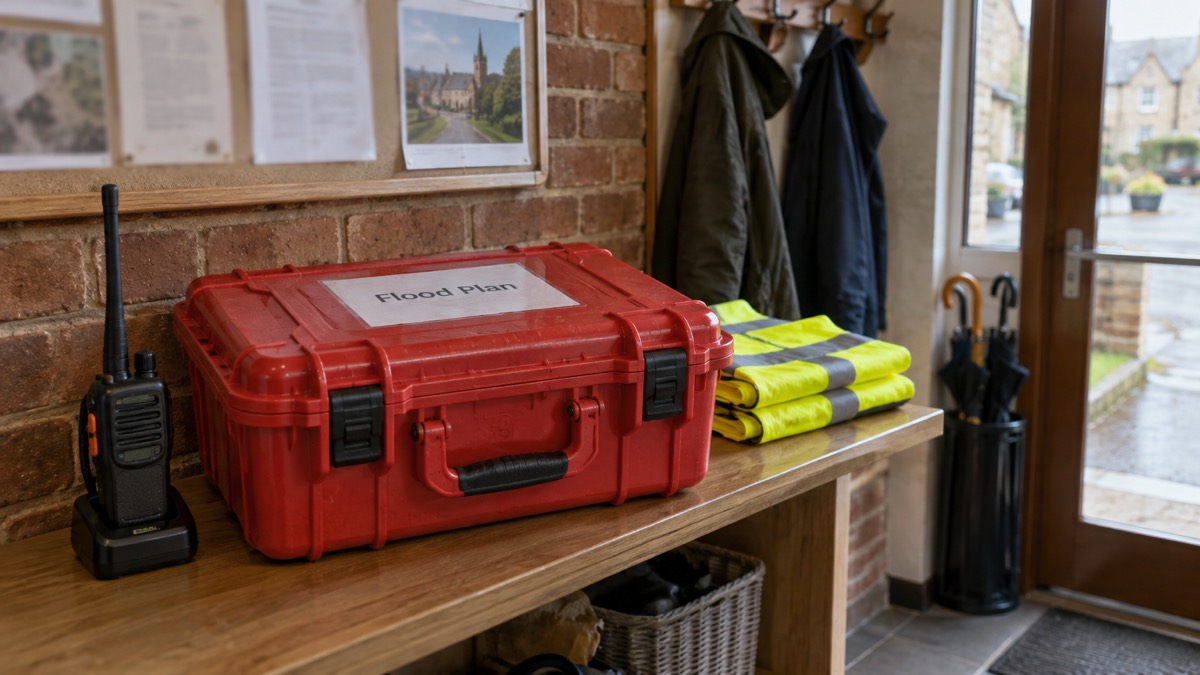
When flooding threatens a street, village or town, the households that cope best are the ones that already know what they will do, and the communities that cope best are the ones that have written it down. A community flood plan sets out the local procedures and actions to prepare for, respond to and recover from a flood event1. It names who leads the response, who checks on which neighbours, what each warning stage triggers, and who calls whom at the council and the Environment Agency.
The plan does not replace the emergency services, and it does not ask volunteers to take risks. What it does is fill the gap in the first hours: the period when official warnings have been issued, water is rising, and neighbours who know each other can act quickly and in an agreed order. The UK government publishes a community flood plan template for England2, Natural Resources Wales publishes guidance for communities in Wales3, and many councils publish their own versions1. This page sets out what goes into one, how the three flood warnings work, and where a community's role stops.
What a community flood plan is for, and who writes it
A community flood plan is a written document, usually a few pages, that a street, residents' association, parish council or flood group agrees in advance of any flood. It exists so that when a warning arrives, nobody has to work out what to do from scratch. The government's guidance is written for anyone involved in supporting communities or groups: people active in the local community, leaders of community groups, local responders, people working in the voluntary sector, and any other interested members of the community2. In practice, most plans are started by a small group of neighbours, often after a flood has already happened nearby, and are then shared with the parish or town council and the local authority.
The plan covers three phases: preparing for a flood, responding to it, and recovering afterwards1. That shape matters, because the work is not evenly spread. Most of a plan's value is in the preparation section, agreed in calm weather: who holds the list of vulnerable residents, where the sandbags or flood boards are stored, and which warning level triggers which action. The response section is short and blunt, because it will be read under pressure. The recovery section covers how the community shares information and coordinates help after the water has gone.
If you are starting from nothing, you do not have to write the plan alone. The government developed checklists to help you prepare for flooding if you support a community or group7, and Cambridgeshire County Council publishes a set of community flood group resources including webinars on preparing a plan, warning triggers, equipment and insurance, and reviewing, updating and testing the plan7. A testing document helps community flood groups test their plans, identifying what works, what does not, and what needs strengthening7. If your community wants to go further, our pages on setting up a local emergency group and starting a flood action group cover the groundwork.
What to include: flood risk, contacts and the flood lead
Natural Resources Wales sets out the core contents plainly. A plan should include details about the flood risk in your area, a list of contacts including the community flood lead and flood volunteers, how to report an incident, actions to take before, during and after a flood, when you should take action, how to share information within the community, and how often the plan will be tested and reviewed3. Those eight elements are the skeleton of almost every community flood plan, and each one earns its place.
Flood risk means writing down what actually floods where you are: which properties, which roads, which low spots, and whether the source is a river, the coast, surface water or a combination. A flood alert is issued for all sources of flooding, including river, coastal and surface water flooding8, so your plan should not assume the risk comes only from the nearest river. Contacts should include the community flood lead and the flood volunteers, and the plan should say how each is reached out of hours. If your community has volunteer flood wardens, they are responsible for leading the community response, with a single overall lead coordinating wardens for specific neighbourhoods1. Our page on flood wardens covers that role in detail.
When to act is the heart of the plan: the trigger levels. Each of the three official warning levels should map to a specific set of community actions, so that a named person hears the warning and knows exactly what to start. The sections below set out what each level means and what households and the community should do. Reporting an incident matters too: SEPA's guidance on responsibilities for flooding advises households and communities to know who to contact if flooding happens9. Testing and review should be written into the plan itself, with a stated frequency, so it does not drift out of date3.
Alongside the community plan, encourage every household to write its own. A personal flood plan should include steps to keep valuable and sentimental items safe from floodwater, how to limit the amount of water that may come into the home, and details of insurance and arrangements for evacuation and for pets10. A household plan should list useful contact numbers including the local council, utility providers and the insurance company, how to shut off electricity or gas, what would need moving to safety, who could be asked for help, and whether the household could help vulnerable friends or neighbours11. Somerset's guidance adds insurance and utility companies, your bank, and medical and veterinary facilities to the contact list12.
The three warning levels, and what each means for your household
Three types of warning are issued when flooding is forecast: flood alerts, flood warnings and severe flood warnings13. The Environment Agency in England, Natural Resources Wales in Wales and SEPA in Scotland constantly monitor rainfall, river levels and sea conditions to forecast the possibility of flooding13, and each nation's body issues the warnings for its own area. The levels are the same in name across Britain, and the actions they call for are broadly the same, though the wording and the coverage differ by nation.
| Warning | What it means | What to do | Where it applies |
|---|---|---|---|
| Flood alert | Flooding is possible; be prepared8 | Prepare a bag with medicines and insurance documents, check flood warnings, make early preparations6 | |
| Flood warning | Flooding is expected for a defined local area5 | Act now: protect yourself and your property14 | |
| Severe flood warning | Severe flooding expected; danger to life8 | Survive: call 999 if in immediate danger, follow emergency services advice, keep yourself and your family safe6 |
West Yorkshire Prepared compresses the three levels into three words that are worth putting on the front of any community plan: flood alert means prepare, flood warning means act, and severe flood warning means survive6. That is the whole system in three instructions, and it is how the trigger levels in your plan should be labelled.
In Wales, the wording is the same in substance: flood alert means be prepared, and severe flood warning means danger to life17. In Scotland, SEPA describes the same three levels: flood alert means flooding is possible, be prepared; a severe flood warning means severe flooding is expected and there is a danger to life8. The differences that matter between the nations are practical ones, covered later in this page: who can sign up for targeted warnings, how much notice is given, and what the warnings do not cover.
Flood alert: flooding is possible, so get ready
A flood alert means flooding is possible, so you should be prepared8. It is issued for larger geographical areas, usually the boundaries of local authorities15, so an alert tells you the risk is somewhere across your district, not necessarily at your door. Alerts are issued for all sources of flooding, including river, coastal and surface water flooding8, and they can be triggered by forecasts indicating that flooding from rivers may be possible, forecast intense rainfall for rivers that respond very rapidly, or forecasts of high tides, surges or strong winds16.
If a flood alert is issued for your area, you should remain alert and vigilant and make early preparations for potential flooding15. For a household, that means preparing a bag that includes medicines and insurance documents, and checking flood warnings6. Natural Resources Wales adds: prepare a flood kit of essential items, monitor local river levels, and check the five day flood risk; farmers should consider moving livestock and equipment away from areas likely to flood17.
For the community, the alert stage is when the plan wakes up. This is the moment for the flood lead to confirm volunteers are reachable, for anyone holding equipment to check it is where the plan says it is, and for the community's river watchers, if it has them, to start checking levels. In South Woodham Ferrers in Essex, local yacht and sailing clubs run a River Watch scheme to check river levels in a flood alert situation, providing an enhanced warning to the town, with a procedure agreed with the local fire station to make small boats available, and a primary emergency rest centre established18. Not every community can arrange that, but every community can decide in advance who looks at the river and who they tell.
The community flood plan includes a list of things you should do in advance of a flood2, and the alert stage is when that list is worked through. Write the alert-stage actions as a checklist in the plan itself, so they can be ticked off rather than remembered.
Flood warning: act now to protect people and property
A flood warning is issued when flooding is expected for a defined local area5. Unlike an alert, it is targeted: in Scotland, SEPA's flood monitoring scheme issues targeted flood warnings for properties located in affected areas, if the residents are signed up15. The impacts that trigger a warning include flooding of homes and businesses, flooding of roads with major impacts, flooding of rail infrastructure, significant waves and spray on the coast, and extensive flood plain inundation including caravan parks or campsites16.
At this level, immediate action is required: take measures to protect yourself and your property14. West Yorkshire Prepared's action list is the clearest summary: turn off gas, water and electricity, move things upstairs or to safety, and move family, pets and car to safety6. Natural Resources Wales gives the same actions in more detail: move family, pets and valuables to a safe place; turn off gas, electricity and water supplies if it is safe to do so; and put flood protection equipment in place17.
Note the condition in that advice: turn off supplies if it is safe to do so. The government's help during a flood guidance is blunt about the limit: do not touch an electrical switch if you're standing in water19. Put that warning in the community plan verbatim, because it is the one instruction people get wrong when water is already in the house.
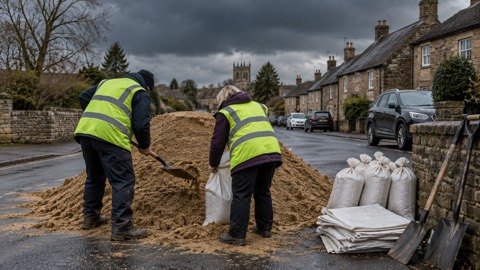
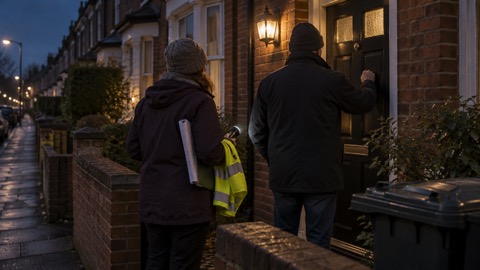
For the community, the warning stage is when the plan's phone tree or calling list goes into action, checking on neighbours who may need help. Our page on neighbourhood phone trees and calling lists covers how to build one, and checking on vulnerable neighbours in an emergency covers what to ask when you call. Volunteers at this stage help with moving belongings, putting flood boards in place and getting people and pets to safety, all on dry ground and all within the limits set out later on this page.
Severe flood warning: danger to life
A severe flood warning means severe flooding is expected and there is a danger to life8. It is issued when flooding will pose a significant risk to life8, and in Scotland it is issued in consultation with local authorities and other responders8. The conditions behind it are serious: deep and fast flowing water, debris in the water causing danger, potential or observed collapse of buildings and structures, communities isolated by flood waters, critical infrastructure for communities disabled, a large number of evacuees, and military support16. A severe flood warning may also follow a breach in defences or the failure of a tidal surge barrier or dam that is likely to cause a significant risk to life16.
At this level the instruction is survive: call 999 if in immediate danger, follow advice from the emergency services, and keep yourself and your family safe6. The government's guidance adds two firm rules: leave the area if the emergency services tell you to evacuate, and do not walk, cycle or drive through flood water19.
"do not walk, cycle or drive through flood water"
For the community, the severe flood warning stage is mostly a handover. The plan should say that volunteers stop entering affected areas, that the community's role becomes sharing official information and supporting neighbours who have evacuated, and that everything else belongs to the emergency services. If a rest centre has been agreed with the local authority, this is when it opens. The plan should name who liaises with the responders, so the community speaks with one voice.
How much notice each warning gives
The notice you get depends on the level and on where you are. SEPA's current guidance gives the clearest figures. A flood alert can be 2 to 48 hours in advance, and SEPA aims to issue alerts around 24 hours in advance of expected flooding. A flood warning is aimed to be issued 3 to 6 hours in advance of expected flooding5. Argyll and Bute Council's flood advice gives the same figure for Scotland: SEPA's messages are sent out three to six hours before potential flooding20. Because of the exceptional nature of severe flood warnings, SEPA does not provide a service level for issuing them, as timing depends on external factors and expected impacts5.
The documents differ on England. Older Environment Agency guidance states that the Environment Agency usually issues a flood warning 30 minutes to 2 hours before flooding4, while Wiltshire and Swindon Prepared describe flood warnings as coming half an hour to one day in advance of flooding16. The government's flooding and health guidance notes that households that have prepared are more likely to receive flood warnings 12 hours in advance10. Treat the shorter figures as the ones to plan around: assume a flood warning may give you well under an hour, and build the plan so the alert stage does the heavy lifting.
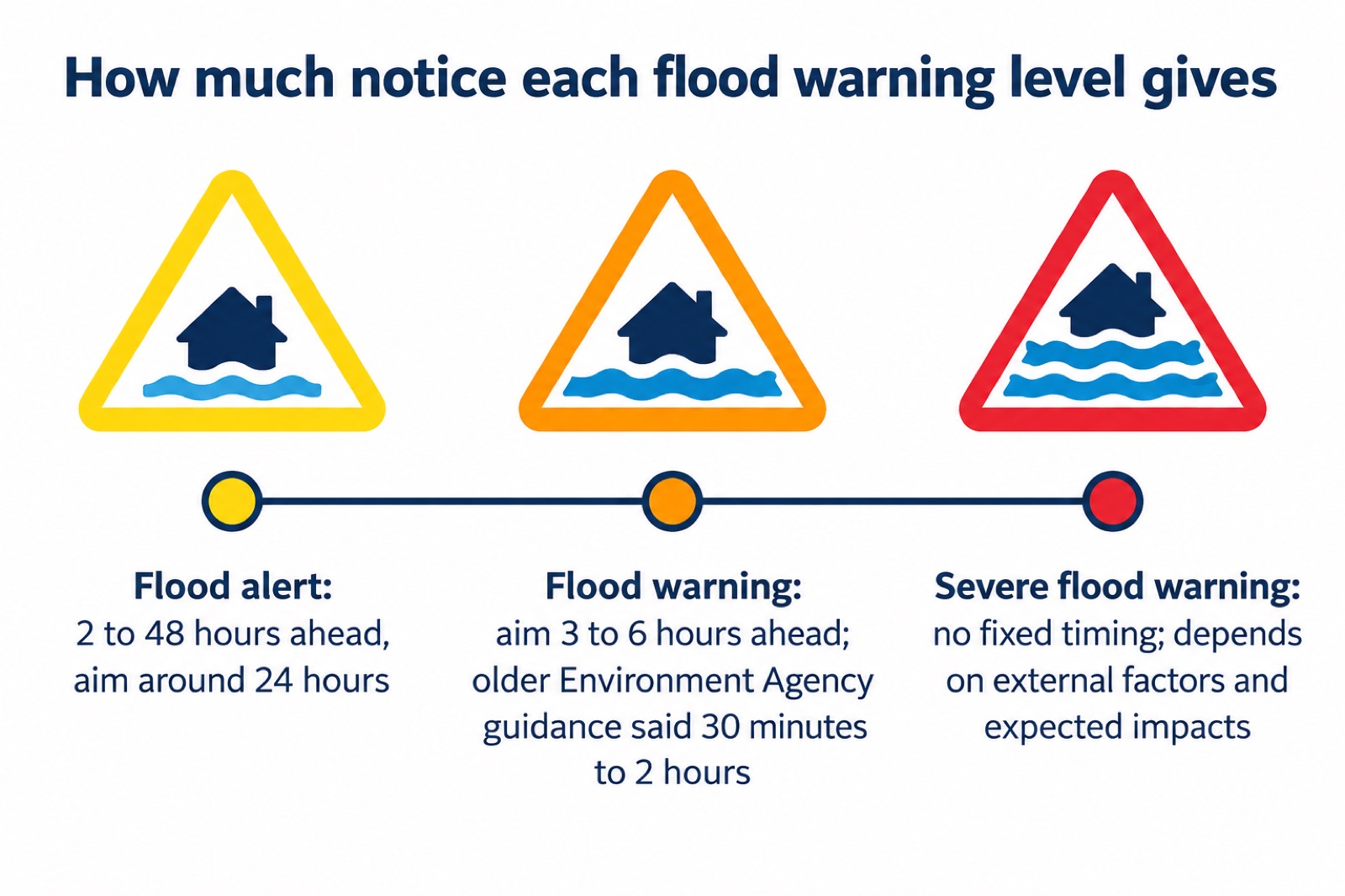
Two timing details are worth writing into the plan. First, flood alerts are usually issued between 7am and 9pm, though there may be occasions where alerts are issued at any time of the day, for example when there is a change in forecast; flood warnings and severe flood warnings are issued at any time of the day5. Second, the information on the Met Office flood warnings block is updated every 15 minutes13, and the Flood Warning Service is automatically updated every 15 minutes, 24 hours a day, 7 days a week21, so checking again in quarter of an hour is always worthwhile.
For longer notice, a five day flood forecast can be viewed on the Environment Agency's flood warning information service website22, and Natural Resources Wales makes forecasts of potential river and coastal flooding up to 5 days ahead at a community level using Met Office rainfall forecasts21. These are risk outlooks, not warnings: use them to prompt a check of the plan and kit, not to trigger community action.
Where volunteers must stop: the emergency services' role
This is the section of the plan that keeps people alive, and it should be printed in bold. Being part of a community flood group is not an emergency service role, and you should not undertake any activities which could put your life or others in danger3. The emergency services are responsible for making sure the public are safe and coordinating the incident response23. In Scotland, the emergency services have a duty to save lives in the event of serious flooding, which means rescuing people trapped, or likely to become trapped, by water and protecting them from serious harm20.
The line is not always obvious in the moment, so the plan should draw it in advance. Safe volunteer activities include checking on neighbours by phone or in person on dry ground, helping move belongings before water arrives, putting flood boards in place, sharing official warnings, and supporting evacuated residents at a rest centre. Unsafe activities include entering flood water on foot or in a vehicle, attempting rescues, and entering properties or areas the emergency services have closed off. Our page on what volunteers can safely do, and where to stop sets out the general limits.
The same principle applies after the flood. Help that isn't coordinated can sometimes inadvertently impact on the response and recovery effort and can be detrimental to those affected by the incident24. Well-meant spontaneous volunteering after a flood can get in the way of recovery teams; the plan should say that offers of help are routed through the flood lead or the local authority rather than acted on directly. Flood wardens are local volunteers who help their communities prepare for, respond to, and recover from flooding25, and their training, where a scheme exists, reinforces exactly these boundaries.
Keeping residents' personal details safe
Most community flood plans include a list of residents who may need help: disabled, elderly or infirm residents, and others who would struggle to evacuate or to act on a warning alone. That list is the plan's most sensitive content, and the rules around it are strict. Personal information in the plan must be stored securely, with people's permission, and it should only be shared with the emergency services during a flood, not passed to any other people or organisations3. The government's template is equally clear: make sure you comply with GDPR regulations when gathering personal information from people23.
Practical guidance for flood wardens keeps it simple: maintain a simple, GDPR aware list of residents who may need help, with consent, minimal personal data and secure storage, and the parish council can help25. The Derby and Derbyshire flood warden handbook says the same: identify properties with disabled, elderly or infirm residents, and store this information in the community flood plan adhering to data protection guidelines22.
In practice, that means the plan should hold the minimum: which properties have residents who may need help, and what help they have agreed to receive. It should not hold medical details, next-of-kin contacts or anything else not strictly needed, unless the resident has specifically agreed. Personal information must be stored securely with people's permission and only shared with the emergency services during a flood, not passed to any other people or organisations3. Review the consents when the plan is reviewed, because consent goes stale.
Signing up for warnings, and getting help
The single most useful thing any household can do is sign up for flood warnings. Devon's flood recovery guidance puts it simply: create a household flood plan and sign up for flood warnings if you have them in your area26. Who you sign up with depends on where you live.
England. The Environment Agency issues warnings and runs Floodline. Devon's guidance lists Floodline for flood warnings and information on 0345 988 118826; Nottinghamshire's support pages list the Environment Agency on 0845 988 118824. The two documents disagree on the prefix, so check the current number on the government's flood warning pages before printing it in your plan. The Environment Agency also has national and regional social media accounts which provide timely and accurate information; the Southwest regional feed is @EnvAgencySW12. For concerns about river or stream water quality or flooding information, you can contact your local Environment Agency office on 03708 50650627.
Scotland. If your property is within an area covered by a SEPA flood monitoring system, you can sign up to receive a targeted flood warning message for your local area; if it is not within a warning area, you can sign up to receive a more general flood alert message for the wider geographical area, usually representing local authority boundaries28. Scotland has 19 flood alert areas covering the whole country, and 326 flood warning areas, 207 of them for rivers5.
Wales. Natural Resources Wales' warning service covers around 90% of the properties at risk of flooding from rivers or the sea in Wales29. The warning service tells you the type of flood warning, the location affected, the expected timing and the action to take29. One gap matters: NRW does not issue warnings for surface water and small watercourses, which can occur very quickly and are often very localised, so there is not time to issue advance warnings17. Communities at risk of flash flooding from drains or small streams should plan for acting on weather warnings rather than flood warnings.
Whatever the nation, in an emergency where life is in danger, call 9996. For the wider picture of what help exists and how long it may take, see how long you might wait for help in a major flood and our flooding guide for households.
Making the plan real: sirens, river watch and testing
A plan on a shelf is a document; a plan that has been rehearsed is a capability. Some communities add their own warning methods on top of the official ones. Following the 2007 floods, the village of Sedgeberrow in Worcestershire appointed a flood warden, developed a flood emergency plan, and obtained an emergency warning siren activated on receipt of a flood warning, with volunteers from dry properties helping those in at-risk properties18. A siren only works if everyone knows what it means, so any local method like this should be written into the plan with its trigger level and its meaning, and agreed with the community in advance.
River watching is another example. The South Woodham Ferrers River Watch scheme, described above, pairs local knowledge of river levels with an agreed procedure with the fire station18. Your community's version might be as simple as two named people who walk to the gauge or the bridge at each alert stage and report to the flood lead. What matters is that the arrangement is written down, the people have agreed to do it, and the flood lead knows to expect their report.
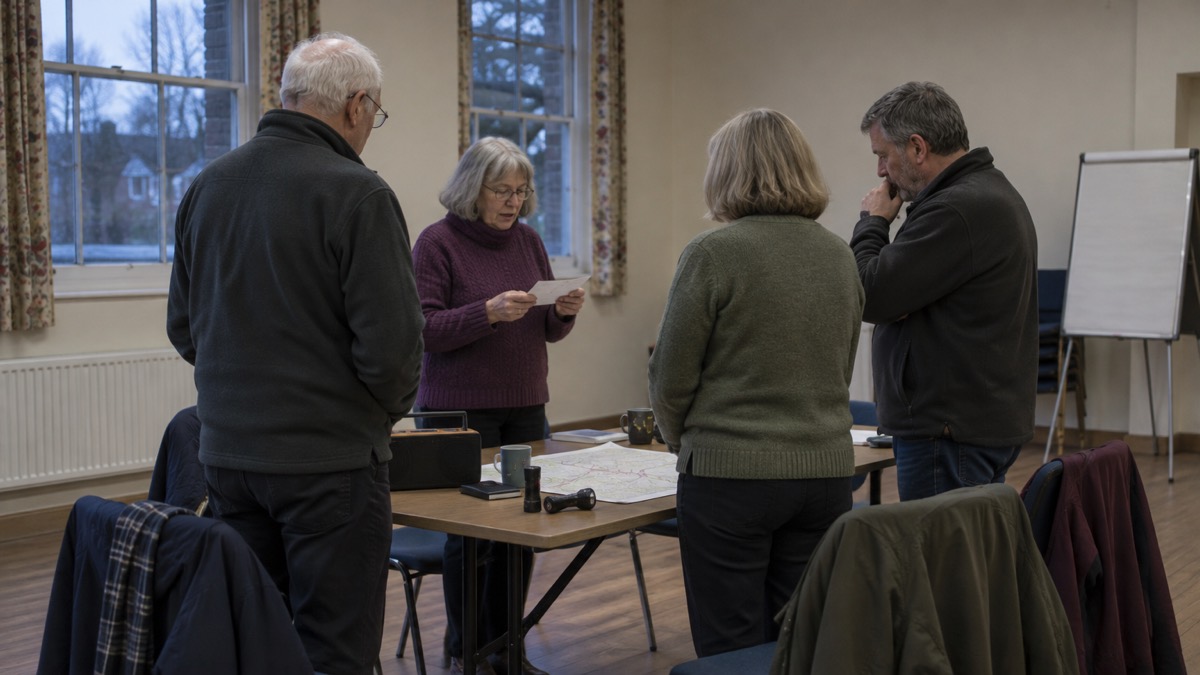
Finally, test the plan and review it on the schedule the plan itself sets3. Cambridgeshire's testing document exists to help community flood groups do exactly this: identify what works, what does not, and what needs strengthening7. A test can be a tabletop exercise on a wet evening: read out a flood warning, and ask each named person what they do next. Our page on how to test and review a community emergency plan walks through the process, and when to activate a community emergency plan covers the trigger decisions in more depth.
Sources (29)
- Community Flood Plan Template, London Borough of Merton, 2026
- Community flood plan template, GOV.UK, 2012-11-02
- Community flood plan, Natural Resources Wales, 2026-10-29
- Flood alerts and warnings: what they are and what to do, GOV.UK, 2010-11-01
- About flood alerts and warnings, SEPA, 2026-10-29
- Flooding, West Yorkshire Prepared, 2026-10-29
- Community flood group resources, Cambridgeshire County Council, 2026-10-29
- About flood alerts and warnings, SEPA, 2026-10-29
- Responsibilities for flooding, SEPA, 2026-10-29
- How to prepare for flooding, GOV.UK, 2023-12-19
- Protecting your property from flooding, Met Office, 2026-10-25
- Preparing for flooding, Somerset Council, 2026-10-28
- Flood warnings guide, Met Office, 2026-10-29
- Flooding FAQs, SEPA, 2026-10-29
- Flooding FAQs, SEPA, 2026-10-29
- Know your flood warnings, Wiltshire and Swindon Prepared, 2026-10-25
- What to do in a flood, Natural Resources Wales, 2026-10-29
- A guide for communities, Environment Agency, 2016-09
- Help during a flood, GOV.UK, 2026-10-25
- Flood advice, Argyll and Bute Council, 2026
- Wales flood response framework, Welsh Government, 2016-12
- Derby and Derbyshire flood warden handbook, Parwich Parish Council, 2019-11
- Community flood plan, GOV.UK, 2023-11-15
- Further support after a flood, Nottinghamshire County Council, 2026-10-29
- Be flood ready: guidance for flood wardens, Harborough District Council, 2026-10-29
- Flood recovery information, Devon County Council, 2026-01-29
- Private water supplies, Cornwall Council, 2026-10-29
- Floodline register, SEPA, 2026-10-29
- Sign up to receive flood warnings, Natural Resources Wales, 2026-10-29
 Emergency Hub Kit Checklist
 Severe Weather Tasks for Groups
 Flood Warden Checklist
 Setting Up an Emergency Group
 Volunteering in Emergencies
 What Volunteers Can Safely Do
 Flood Wardens
 Starting a Flood Action Group
 Clearing Snow and Ice
 Community Emergency Hubs
 Checking Vulnerable Neighbours
 Neighbourhood Phone Trees
 Registering and Looking After a Village Defibrillator on The Circuit
 Funding Resilience Groups
 Voluntary Organisations