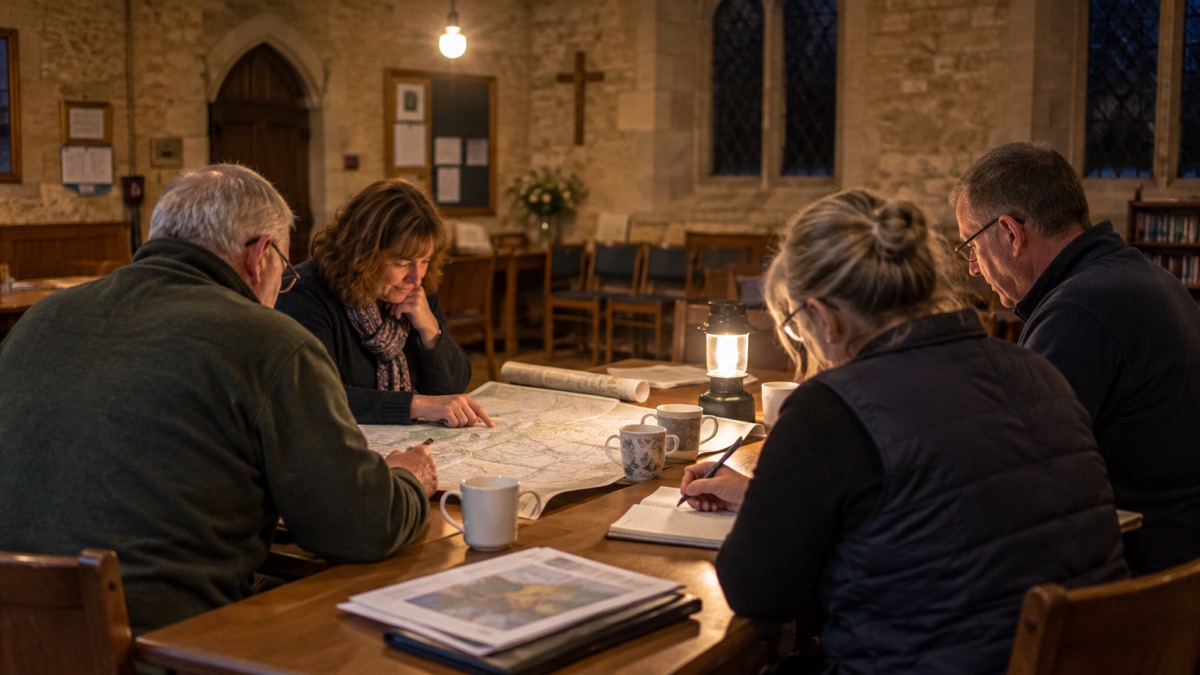
A community emergency plan is a written answer to a simple question: when something goes wrong here, who does what? It sets out the risks your area faces, the skills and equipment your neighbours can offer, and how you will support people who need extra help while the emergency services are stretched. But a plan that has never been tried is only a set of good intentions. Testing it is what turns it into something you can rely on.
The standard to aim for is an annual exercise. The North Yorkshire Local Resilience Forum template describes an annual exercise as a great way to test your plan, either as a tabletop discussion or a live run through, with the aims of testing your assumptions, keeping people familiar with their roles and seeing whether updates are needed1. Communities have run tabletop exercises or physical exercises to test their own emergency or flood plan and their emergency contact hubs, from a simple discussion to setting the hub up with a scenario such as flooding2.
This page takes you through what the plan is for, how to practise it before you need it, who to keep in touch with while you test, and how to review and update it after it has been used for real. If you have not yet written a plan, start with Setting Up a Local Emergency Group and come back here when you have a draft.
What a community emergency plan is for
A plan helps communities prepare for, respond to and recover from emergencies using their own strengths, meaning skills, knowledge and resources, while complementing official efforts6. It is not a replacement for the emergency services. It is what a community can do for itself and its neighbours in the hours before outside help arrives, and alongside it once it does.
The content follows from that purpose. Argyll and Bute Council's guidance takes a group through deciding who the plan is for, getting advice, thinking about the risks to the community and its local skills, knowledge and resources, involving people who can help, and writing and testing the plan7. In Dorset, the community emergency response plan is described as helping identify what risks your community may face, what you can do to manage them, who has useful skills and training, what equipment is available, how to support vulnerable people safely and how to look after and utilise volunteers8.
It is good practice for a community to identify local hazards and make plans on how to assist the emergency services and other responding agencies9. The plan is therefore built around local knowledge: the road that floods, the cul-de-sac with one access point, the sheltered housing scheme, the person with a generator who is willing to share a charge.
A plan also needs people behind it. Scottish guidance is blunt about this: you need to have support from your community for a plan to work, and people need to be prepared to sign up and offer to help if an emergency happens10. Testing is how you find out whether that support is real. An exercise shows you who turns up, who has moved away, and which phone numbers no longer work, while there is still time to fix it.
Practising the plan before an emergency
An exercise does not need to be elaborate. The point is to walk through the plan with the people who would carry it out, in a setting where mistakes cost nothing. The North Yorkshire template sets out the aims plainly: test assumptions, keep people familiar with their roles, and see if updates are needed1.
There are two broad forms, and most groups should start with the first.
| Exercise type | What it involves | When it suits |
|---|---|---|
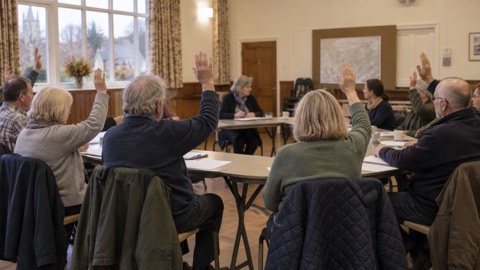
| Tabletop discussion | People sit round a table and talk through a scenario step by step | A first test, a small group, or refreshing roles1 |
| Live run through | People carry out their roles as if the emergency were happening | Checking equipment, timings and the hub set-up1 |
| Hub exercise | Setting up the emergency contact hub with a scenario such as flooding | Groups running an emergency contact hub2 |
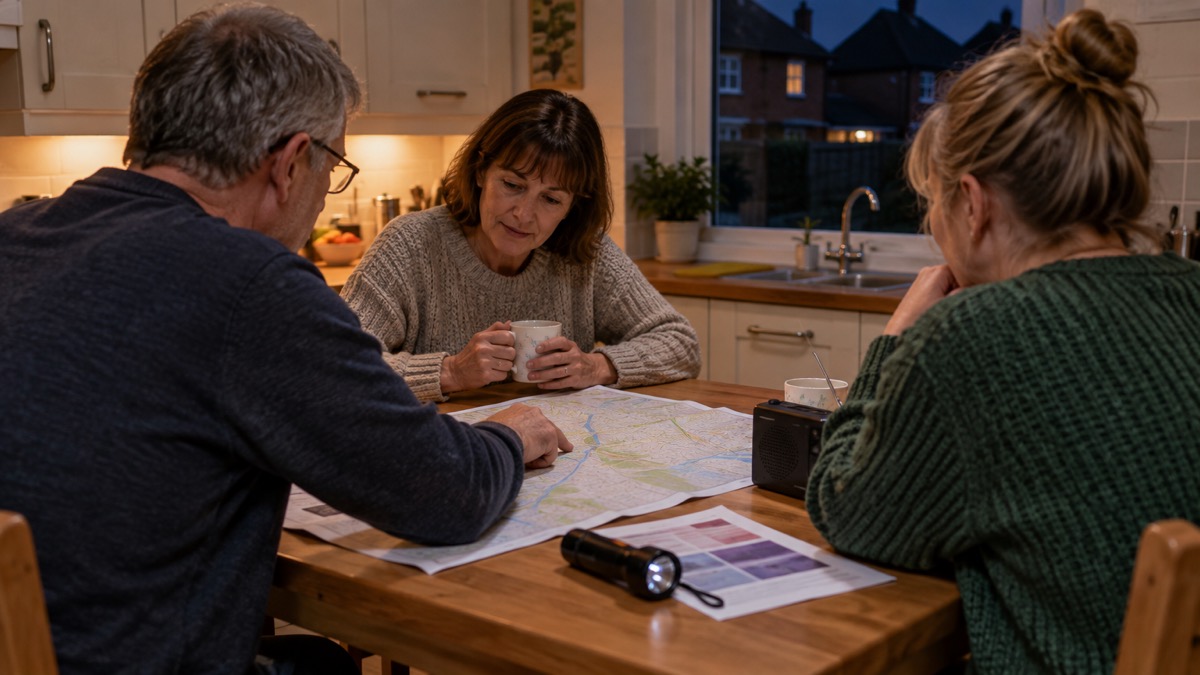
Choose the scenario from the risks your area actually faces. West Yorkshire's community resilience guide advises working with other community members to think about risk scenarios that may affect your area, and what you might do if there was an emergency or major incident11. If your area's risk register lists flooding, test flooding. If it lists severe weather, test a snow event. The exercise is only useful if it rehearses the thing that is likely to happen.
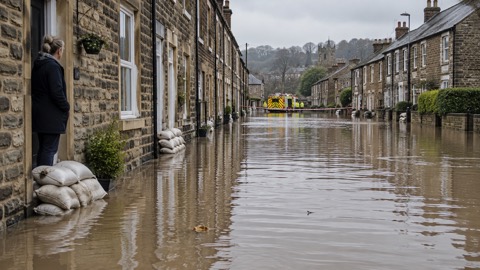
For a flood plan specifically, Cambridgeshire County Council publishes a document that aims to help community flood groups test their flood plans, identifying what works, what does not and what, if anything, needs strengthening3. In Wales, Natural Resources Wales invites groups to email befloodready@cyfoethnaturiolcymru.gov.uk to ask about doing a simulated flooding event to test the plan12. Our guide to Community Flood Plans covers what to put in the plan itself.
Households can rehearse their own part too. Fire and rescue services advise testing your ability to respond to the sound of the smoke alarm and practising leaving in the dark to simulate a real emergency13. Once you have your escape plan, go through it and practise it with everyone who lives in your home, which you could do at the same time as you test your smoke alarms, at least once a month14. A community exercise is a good moment to remind households to do the same.
Who to keep in touch with while you test it
Testing is not a private activity. Argyll and Bute's guidance covers how to practise and check the plan, and who to keep in touch with when you are doing this7. The people to tell fall into a few groups.
- Your council's emergency planning team. Find out whether your community already has an emergency plan by contacting your district, borough, city or unitary authority or your community group leader, and if not, think about developing one15. Tell them when you are exercising, and ask whether anyone from the council would like to observe.
- The wider community. Scottish guidance suggests raising awareness by talking about the idea at meetings of your community groups and with other community groups in the area, delivering leaflets to local households, putting leaflets in local shops, pubs or other services, using community websites, newsletters, papers and social networking, including information in letters sent home with school children, and making use of social contacts to spread the word10. An exercise is a natural moment to do several of these at once.
- Your own members. Keep an emergency contacts list for your group so you can keep in touch during an emergency event16. Check it before the exercise, not during it.
- Neighbours who may be affected. A household emergency plan should include considering contacting neighbours or those who may be affected by the situation17. Build the same step into your exercise.
Contact details for the council vary. In Ceredigion, you can email ccu@ceredigion.gov.uk to complete your own community or family emergency plans18. In West Yorkshire, you click the link on the community response planning page, fill in your contact details, and the Community Resilience Officer will send you a plan to fill in, in your own time19. If you are unsure who to ask, start with the council's main switchboard and ask for emergency planning.
Reviewing the plan after it has been used
The most valuable review happens after the plan has been used for real. Argyll and Bute's guidance covers assisting you to decide on your actions after your plan is used in an emergency situation, and how to learn from the experience7. That review should happen quickly, while memories are fresh, and it should be structured.
Scottish guidance points to an example of a draft agenda you can use for the first meeting after the plan is activated, found in the Community Emergency Plan template, and notes that it is a guide only4. Use it as a starting point and adapt it to what actually happened.
A review meeting should cover:
- What was activated and when. Which parts of the plan were used, and which were not.
- What worked. The phone tree that held, the volunteer who knew where the keys were, the hub that opened on time.
- What did not. Numbers that failed, roles nobody filled, equipment that was missing or broken.
- What people needed that the plan did not anticipate. This is often the most useful part.
- Actions, with names and dates. A review without owners is a conversation, not a review.
The wider emergency planning world works the same way. Greater Manchester Resilience Forum says plans are regularly tested through exercises and workshops, allowing agencies to practise their roles, enhance their skills, identify improvements and ensure arrangements work effectively in real-life situations21. West Midlands Ambulance Service says it regularly reviews its major incident plans and uses what it learns from exercises and real incidents, both locally and across the country22. A community group reviewing its own plan is doing what the professionals do, at its own scale.
Learning from the experience and updating actions
A review produces a list of changes. The next step is to make them, and to tell people you have. The voluntary and community sector is advised to complete an audit of organisational Community Emergency Plans and hot weather plans to ensure these are up to date, as part of pre-summer readiness23. An annual audit, timed before the season your area is most at risk, keeps the plan from drifting.
Updates usually fall into a few categories:
- People. New coordinators, departed volunteers, changed phone numbers. Check once in a while that details such as emergency phone numbers for family and medical providers are still up to date5.
- Risks. Has the risk register changed? The community risk register is generated through a six-stage process as recommended in the document Emergency preparedness24. If the register has been revised, your scenarios should follow.
- Contacts. Record emergency contacts in an easy-to-find place, keep a phone or alarm within reach, and discuss a safe emergency access plan with someone you trust25. The same discipline applies to the group's list.
- Household circumstances. Review your emergency plan every time your circumstances change, for example after moving home, changes to equipment or medication, changes in care arrangements, or changes in your health or mobility26. Ask members to tell you when theirs change.
There is a formal rhythm you can borrow from. A building emergency evacuation plan must be reviewed no later than 12 months after the plan is first prepared, and before the end of every period of 12 months thereafter, and also if there is reason to believe it needs amending27. A community plan is not under that duty, but the same 12-month cycle is a sensible default, with an earlier review whenever something significant changes.
Finally, tell people what changed. A short note to members and to the council saying what the exercise found and what you have done about it closes the loop, and makes the next exercise easier to organise. If your group is starting from scratch, our guide to how councils and emergency services work with local groups explains who to approach, and Funding for Local Resilience Groups covers where grants may be available.
Sources (27)
- Community Emergency Plan template, North Yorkshire Local Resilience Forum, 2025
- Spotlight on Emergency Contact Hubs, Wiltshire and Swindon Prepared, 2026
- Community flood group resources, Cambridgeshire County Council, 2026
- Respond and recover, Ready Scotland, 2026
- Emergency kits and grab bags, Central Bedfordshire Council, 2026
- Why plan, Ready Scotland, 2026
- How to make a community emergency plan, Argyll and Bute Council, 2026
- Community involvement, Dorset Prepared, 2026
- Community resilience, Nottinghamshire County Council, 2026
- Who to work with, Ready Scotland, 2026
- Community resilience guide, West Yorkshire Prepared, 2026
- Community flood plan, Natural Resources Wales, 2026
- Fire escape plan, Warwickshire County Council, 2026
- Escape plan, Dorset and Wiltshire Fire and Rescue Service, 2026
- Community resilience, Essex Prepared, 2026
- Community resilience, Herefordshire Council, 2026
- Your home emergency plan, Royal Borough of Windsor & Maidenhead
- Community resilience, Ceredigion County Council, 2026
- Community response planning, West Yorkshire Prepared, 2026
- Emergency alerts, Denbighshire County Council, 2026
- Our risks and plans, Greater Manchester Combined Authority, 2026
- Major incidents, West Midlands Ambulance Service, 2026
- Heat health alert action card for the voluntary and community sector, GOV.UK, 2024
- Warwickshire Resilience Forum, Warwickshire County Council, 2026
- Local emergency arrangements, Office for Nuclear Regulation, 2026
- Disabled people and carers, Ready Scotland, 2026
- Residential PEEPs factsheet, GOV.UK, 2026
 Emergency Hub Kit Checklist
 Severe Weather Tasks for Groups
 Flood Warden Checklist
 Activating an Emergency Plan
 Emergency Volunteer Insurance
 How Long to Wait for Help
 RAYNET Emergency Radio
 Volunteer Shopping Delivery
 Local Group Constitution
 GoodSAM Responder Alert App