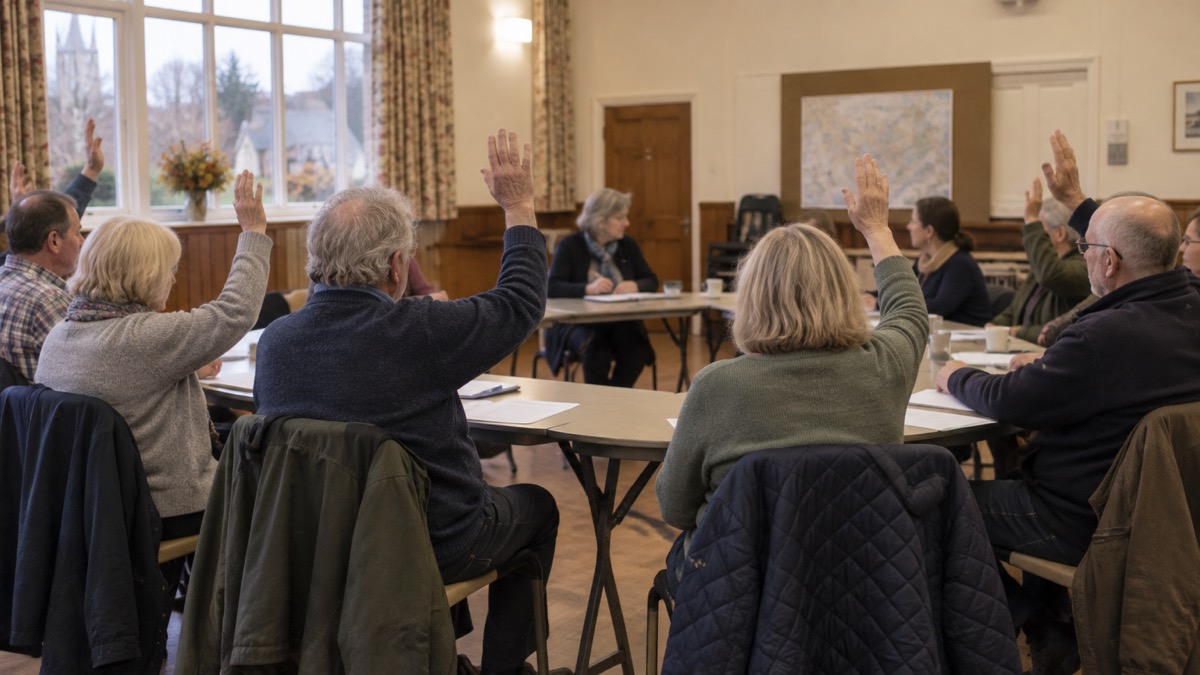
If you are part of a group of neighbours who want to help each other through floods, power cuts or snow, you may be wondering whether you need a formal constitution. The short answer is no: it is not necessary to adopt a constitution to be identified as a legitimate community body, but it does help and can have many benefits1. A constitution shows the outside world that the group has a mandate and elected officers to represent their community2.
Where it becomes necessary is when money is involved. If you are going to apply for funding or raise monies, it is usually necessary to adopt a constitution and open a bank account1. Many funders will ask for evidence that you meet their eligibility criteria, and a constitution is the document that proves your group is properly set up3.
The rest of this page sets out what a constitution should cover, how an informal group compares with an elected committee, and how to run regular meetings and a community emergency plan once you are established. If you are starting from scratch, our guide to setting up a local emergency group covers members, roles and first steps.
A constitution is not required, but it helps your group be taken seriously
A community resilience group is usually made up of local people acting in a voluntary capacity to promote and represent the interests of a particular community1. Nothing in that definition requires a constitution. The Orkney Islands Council guidance is explicit that it is not necessary to adopt one to be identified as a legitimate community body, but that it does help and can have many benefits1.
The Scottish Flood Forum makes the case more directly: adopting a constitution shows the outside world that the group has a mandate and elected officers to represent their community2. That matters when you approach a council, a local resilience forum or a funder. They need to know who speaks for the group and who can sign on its behalf.
A constitution also gives the group a stable shape as people come and go. It sets out how decisions are made, who holds the money and what happens if the group needs to change or wind up. Without one, a group can still function, but it relies on the goodwill and memory of whoever is currently involved.
The Lancashire Resilience Forum defines a community resilience group as an identifiable and contactable group of people living in a discrete geographic area, who together plan and train, gather resources, and develop partnerships to be able to respond to emergencies affecting their community6. Being identifiable and contactable is the practical test, and a constitution is one way to demonstrate it.
You will usually need one to apply for funding or open a bank account
The point at which a constitution stops being optional is usually the point at which money arrives. The Orkney guidance states that if you are going to apply for funding or raise monies it is usually necessary to adopt a constitution and open a bank account1. A bank will want to see who is authorised to operate the account, and a funder will want to see that the group is properly constituted.
Grants for community emergency planning do exist. The Devon Community Resilience Forum, for example, offers grants for community engagement and for equipment to communities preparing or implementing community emergency plans5. Applicants will need to provide evidence to show that they meet the eligibility criteria3. A constitution and a bank account are the usual way to do that.
It is also worth checking whether you need insurance to cover the group's activities by contacting your local authority7. Insurance is a separate question from a constitution, but the two often come up together when a group starts handling money or organising events.
What a group constitution should cover
The Orkney guidance lists the main points of any constitution1. They are practical rather than legalistic, and a group can draft them in plain English.
- Name of group: what the group is called.
- Aims of group: what it is for.
- Membership: who can join.
- Committee structure: how the committee is made up.
- Roles and responsibilities: who does what.
- Financial arrangements: how money is handled.
- Annual general meetings: when and how they are held.
- What happens if changes need to be made: how the constitution can be amended.
- What happens if it wishes to dissolve: how the group would wind up.
- How the group will be run: the day-to-day arrangements.
- Internal arrangements for meetings: how meetings are conducted1.
Beyond the constitution itself, a community emergency plan is a separate document. A Community Response Plan contains all the necessary information, resources, knowledge, skills and contacts in one place, allowing easy access for group members8. A community flood plan sets out the local community procedures and actions to prepare for, respond to and recover from a flood event9. The constitution governs the group; the plan governs the emergency response.
A plan can cover an entire town or village, or just one street, depending on who is involved in the Community Resilience Group and the resources available to mitigate against identified risks10. The Gavinton, Fogo and Polwarth Community Council Resilient Community Plan, for example, contains a community profile, community area maps, flood maps, risk assessment, asset register, insurance information, and general guidance for individuals or the community11.
Informal group or elected committee: how each one works
The Orkney guidance draws a clear distinction between two ways of organising1. An informal group is a group of interested residents working in their community to prevent or reduce flood risks or increase resilience, normally with no structure, but it can be a subgroup of an existing community body. A formal group is an elected group of interested residents working in their community for the same purposes, normally with structure, aims, a committee and a constitution, and it can also be a subgroup of an existing community body1.
| Feature | Informal group | Elected committee |
|---|---|---|
| Structure | Normally none | Committee with aims and constitution1 |
| Officers | Not required | Elected officers2 |
| Bank account | Usually not needed | Usually needed for funding1 |
| Decision making | By those present | Through meetings and votes1 |
| Best suited to | A few neighbours acting quickly | Groups seeking funding or working with councils1 |
Neither is better in every case. An informal group can move quickly and needs no paperwork. An elected committee is slower to set up but is the form that funders, councils and banks recognise.
A community emergency group will usually build on an existing community group such as a Community Council, Residents Association, Neighbourhood Watch or Rotary Club, but it could be a new group set up for this purpose12. If you are building on an existing body, check whether its constitution already covers the activities you plan, or whether it needs amending.
The Carmarthenshire County Council guidance suggests beginning by considering who your community is and which communities you belong to; people living close to you are the obvious choice, and other communities such as those sharing an interest in a particular topic or sport are valid groups to prepare13. It also notes that you do not have to establish a new group and may instead build on existing community groups13.
Setting up regular meetings and a community emergency plan
Once the group exists, regular meetings keep it alive. The Orkney guidance advises setting dates for regular meetings several months in advance, which reduces the chance of double booking yourself1. A fixed rhythm, whether monthly or quarterly, makes it easier for members to plan and for the group to respond when something happens.
The Warwickshire Fire and Emergency Support Service, for example, asks volunteers to attend a peer group meeting one evening each month14. That is a specific commitment for a specific service, but it illustrates the kind of rhythm a group might adopt.
An annual general meeting is the natural point to review the plan. The North Yorkshire Local Resilience Forum template advises reviewing your plan on an annual basis and checking all the details are still correct4. A community flood plan should remain a live document to be reviewed and updated regularly9.
When an emergency happens, it is best to have a plan in place so you know who to contact and how your group will support your community; a community emergency plan template provides an outline of the key information plans should include15. The Community Emergency Plan Toolkit provides a step by step guide to help you fill out the Community Emergency Plan Template6.
It is important to remember that you need to have support from your community for a plan to work. People need to be prepared to sign up and offer to help if an emergency happens12. A plan written by a committee without the community behind it will not function when it is needed.
A plan helps communities prepare for, respond to, and recover from emergencies using their own strengths, including skills, knowledge and resources, while complementing official efforts16. Templates can be changed to suit the community, including adding your community name and logo15.
What counts as a community resilience group?
A community resilience group is an identifiable and contactable group of people living in a discrete geographic area, who together plan and train, gather resources, and develop partnerships to be able to respond to emergencies affecting their community6. The government generally defines community resilience as a community's capacity to withstand, adapt to, and recover from adversity, including emergencies and crises6.
Community resilience is often described as individuals, households, and families working together to create stronger neighbourhoods, able to support vulnerable people, share resources, and support the work of emergency responders18. If there is not already a group for your community, the Essex Prepared guidance suggests thinking about forming one19.
A resilient community is one that has a community emergency plan20. The plan is the practical expression of the group's purpose, and the constitution is the framework that lets the group sustain it.
Who can be a member?
Membership is usually open to local people acting in a voluntary capacity to promote and represent the interests of a particular flood risk community1. The group can be a subgroup of an existing community body, which means members of that body may form the core of the new group1.
The guidance can be used by any network or group, especially if you do not have a resilience plan20. That means a group does not need to be a formal committee to start using the available templates and advice.
When allocating roles, recognise everyone's own skills and abilities so people are allocated the correct roles21. Everyone has their own skills and abilities and can make a valuable contribution to the group21. A constitution should set out who is eligible to join and how new members are admitted.
What role can our group play in an evacuation?
The police normally coordinate the evacuation of people from their homes to a safe place22. The police or the fire and rescue service will normally request the evacuation of an area in consultation with other responding agencies23. Your group should speak to those coordinating the response to see what role it can play22.
That role is likely to be supportive rather than directive. Helping neighbours account for all family members is a practical task that groups can undertake24. If evacuation is recommended, a rendezvous point for evacuees will normally be established and a rest centre set up; anyone who chooses not to use the rest centre should advise rest centre staff of alternative arrangements25.
Our guide to how councils and emergency services work with local groups explains the coordination arrangements in more detail.
Can our group run a temporary rest centre?
A rest centre is a building, with potential overnight facilities, taken over by the council for the temporary accommodation of affected individuals, with more suitable overnight accommodation sourced whenever possible26. The council runs the centre, not the community group.
The Nottinghamshire emergency accommodation plan details how the council will work with other agencies including the police, fire, ambulance, district and borough councils and voluntary agencies where a rest centre needs to be set up27. Voluntary agencies are part of the picture, and a community group may be able to offer a venue, volunteers or local knowledge.
If your group wants to help, the practical step is to contact your local council's emergency planning team and ask what role community volunteers can play. Our guide to community emergency hubs covers setting one up and running it.
Are there grants for community emergency planning?
Yes. The Devon Community Resilience Forum offers grants for community engagement and for equipment to communities preparing or implementing community emergency plans5. The fund is aimed at groups that want to help their communities cope better in an emergency and become more resilient by making a Community Emergency Plan together16.
Applicants will need to provide evidence to show that they meet the eligibility criteria3. A constitution and a bank account are usually part of that evidence1. Our guide to funding for local resilience groups sets out the grants and where to apply.
Sources (27)
- Starting a Community Resilience Group, Orkney Islands Council, 2026
- Community Resources, Scottish Flood Forum, 2026-10-27
- Crisis and Resilience Fund, Somerset Council, 2026-10-28
- Community Emergency Plan Template, North Yorkshire Local Resilience Forum, 2025-02
- Devon Community Resilience Forum | Devon Communities Together, Devon Communities Together
- Protect Your Community, Lancashire Prepared, 2026-10-29
- Information for communities and community groups - Be Ready, Be Ready (UK Government, prepare.campaign.gov.uk)
- Community Resilience Guide, West Yorkshire Prepared, 2026-05
- Community Flood Plan Template, Merton Council, 2026-05
- Community Resilience Toolkit, British Red Cross, 2025
- Gavinton, Fogo and Polwarth Resilient Community Plan, Scottish Borders Council, 2018
- Who can you work with - Ready Scotland, Ready Scotland
- Emergency Planning, Carmarthenshire County Council, 2026-10-28
- Fire and Emergency Support Service, Warwickshire County Council, 2026-10-29
- Prepare Your Community, Greater Manchester Combined Authority, 2026-10-29
- Why, Ready Scotland, 2026-03
- Online Community Resilience Training Prospectus, Met Office, 2026-02
- Prepared Personal Resilience, Scottish Borders Council, 2026
- Developing Community Resilience, Essex Prepared, 2026-10-29
- Community Resilience, Buckinghamshire Council, 2026
- Teamwork Roles, Wiltshire and Swindon Prepared, 2026-10-25
- Responding and Recovering, Argyll and Bute Council, 2026
- Emergency Plan, Reigate and Banstead Borough Council, 2026-10-29
- Evacuating Your Home, Nottinghamshire County Council, 2026-10-29
- Northumbria Local Resilience Forum, Northumberland County Council, 2026-10-28
- Reception Centres, Cornwall Council, 2026-10-29
- Council Emergency Plans, Nottinghamshire County Council, 2026-10-29
 Emergency Hub Kit Checklist
 Severe Weather Tasks for Groups
 Flood Warden Checklist
 Testing an Emergency Plan
 Activating an Emergency Plan
 Emergency Volunteer Insurance
 How Long to Wait for Help
 RAYNET Emergency Radio
 Volunteer Shopping Delivery
 GoodSAM Responder Alert App