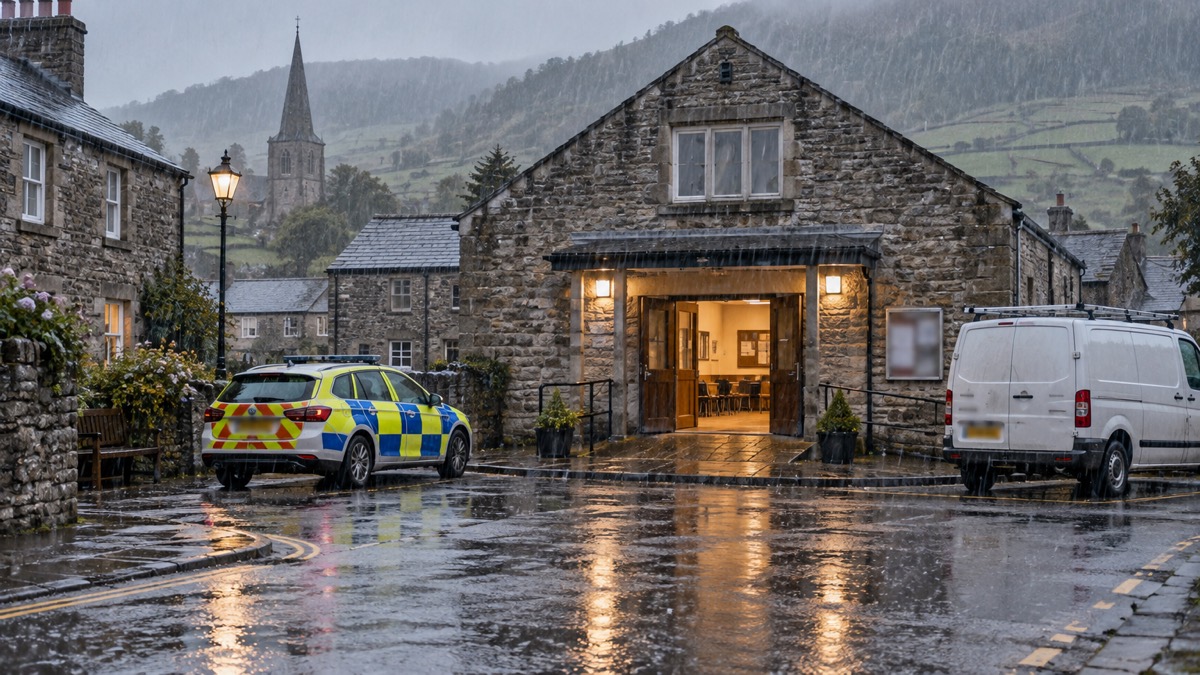
Most emergencies in the UK are handled at the local level by the emergency services, local authorities and other relevant organisations such as utility companies and transport operators1. There is no single body that takes over your street when something goes wrong: instead, a defined set of organisations has legal duties under the Civil Contingencies Act 2004 to assess risks, plan, and warn and inform the public, and they work together through partnerships that cover every part of the country1.
If you run or belong to a local group, a parish council or an informal neighbours' network, you are not part of that legal structure, but you are close to it. Councils and responder partnerships increasingly plan with community groups in mind, and the single most useful thing your group can do is make contact with your council's emergency planning team before an emergency, not during one. If you are a community group that is experiencing or responding to an emergency, official advice is to contact your local council, which may be able to provide advice and assistance3.
Who responds: Category 1 and Category 2 responders
The Civil Contingencies Act 2004 splits the organisations involved in emergencies into two groups. Category 1 responders are the core responders: police, fire and rescue services, ambulance services, NHS bodies, local authorities and the Environment Agency1. Greater Manchester describes them as "a dedicated working group of emergency services, local authorities and NHS organisations"2. In Scotland the list is similar but reflects its own public bodies: Local Authorities, Police Scotland, British Transport Police, the Scottish Fire and Rescue Service, the Scottish Ambulance Service, Health Boards, the Scottish Environment Protection Agency (SEPA), the Maritime and Coastguard Agency and Integration Joint Boards4.
Category 2 responders are the organisations whose services matter in an emergency but which are not in the lead. They can be public or private sector bodies regulated by additional legislation, and are described as "co-operating bodies"4. They include utility companies covering water, gas and electricity, telecommunications providers, transport operators such as airports and railways, and the Health and Safety Executive1. In Scotland the list also names Scottish Water, Network Rail, Transport Scotland, harbour authorities, Public Health Scotland, NHS National Services Scotland and the Met Office4.
| Category 1 responders | Category 2 responders | |
|---|---|---|
| Who they are | Police, fire and rescue, ambulance, NHS bodies, local authorities, Environment Agency1 | Utilities (water, gas, electricity), telecoms providers, transport operators, Health and Safety Executive1 |
| Their role | Provide vital services in an emergency; assess risk and maintain plans7 | Co-operate with Category 1 responders and share information7 |
| Legal duties | Six duties under the Civil Contingencies Act 2004, including warning and informing the public6 | Statutory duties to co-operate and share information with Category 1 responders6 |
| Examples in Scotland | Police Scotland, Scottish Fire and Rescue Service, SEPA, Health Boards4 | Scottish Water, electricity operators, gas suppliers, railway operators, the Met Office4 |
Cheshire's resilience forum gives a concrete local example: its Category 1 responders are the fire and rescue service, police, local authorities and NHS organisations, while its Category 2 organisations include the Health and Safety Executive, transport providers and utility companies8. The practical point for your group is simple: if you want to know who is officially responsible for planning in your area, you are looking for the Category 1 responders, and your council is the one of them you can most easily phone.
The six legal duties on Category 1 responders
Category 1 responders are subject to six duties6. Knowing them helps you understand what you can reasonably ask your council for, because each duty is something the council is already required to do.
- Risk assessment: carry out a risk assessment and contribute to the development of a community risk register6. This duty sits under Section 2 of the Civil Contingencies Act 2004, which requires responders to assess the risk of emergencies occurring and use this to inform contingency planning9.
- Emergency planning: plan for emergencies, including training and exercising6.
- Business continuity: ensure robust business continuity arrangements are in place to maintain service delivery6.
- Warning and informing: ensure arrangements are in place to warn and inform the public both before and during emergencies6.
- Co-operation: co-operate with partner agencies6.
- Information sharing: share information with partner agencies6.
Cumberland Council, a Category 1 responder itself, sets out what this means in practice: risk assessments, business continuity management, emergency planning, maintaining public awareness and arrangements to warn, inform and advise the public, provision of advice and assistance to the commercial sector and voluntary organisations, and co-operation and information sharing10. Note that phrase "advice and assistance to the commercial sector and voluntary organisations": it is part of a council's duty, which is why a well-prepared community group can legitimately ask its council for help10.
For your group, the two duties that matter most are warning and informing, because they are the channel through which official information reaches your street, and co-operation, because Category 1 responders are required to co-operate with partner agencies11, and it is the legal basis for the multi-agency partnerships described below.
What Category 2 responders must do
Category 2 responders have statutory duties to co-operate and to share information with Category 1 responders in the planning for and response to major emergencies6. The Commons Library confirms the arrangement from the parliamentary side: Category 2 responders must cooperate with Category 1 responders7. In England and Wales, the 2005 Regulations require Category 1 responders to co-operate under the Act to assess, plan and advise in relation to emergencies, with Category 2 responders co-operating with them12.
This matters during floods in particular. Category 2 responders include the utilities: Scottish Water, gas and electricity distributors and telecommunications companies13. So if your street floods and the electricity supply is endangered, the network operator is part of the responder structure, and it is reached through that structure rather than by your group phoning it directly.
The water sector has had to learn the same lesson about sharing. Ofwat's report on the 2018 freeze and thaw, when burst pipes left households without water, found that better sharing of contact information between wholesalers and retailers in emergency situations is necessary14. Local resilience forums are themselves described as made up of public bodies, agencies and utilities which co-ordinate responses to emergencies14. The message for community groups is that information does not always flow smoothly even between the big organisations, so a group that has established contacts in advance can be genuinely useful.
Local Resilience Forums: how your area plans together
The body that brings all of this together where you live is the Local Resilience Forum (LRF). An LRF is a multi-agency partnership that brings together Category 1 and Category 2 responders under the Civil Contingencies Act 2004 to coordinate planning, preparation and response for emergencies and major incidents within a specific geographical area1. Its membership is made up of representatives from local public services, including the emergency services, local authorities, the NHS, the Environment Agency and other organisations involved in emergency preparedness, such as utilities providers15.
LRFs identify potential risks and produce emergency plans to either prevent or lessen the impact of any incident on their local communities15. Based on these risk assessments, the LRF helps develop joint emergency plans and contingency plans that outline how different agencies will respond to specific types of incidents1. They are also set up to warn, inform and advise the public in the event of an emergency16.
The structure differs across the four nations:
| Nation | Planning partnership | How many |
|---|---|---|
| England | Local Resilience Forums | 381 |
| Wales | Local Resilience Forums | 41 |
| Scotland | Regional Resilience Partnerships | 31 |
| Northern Ireland | Emergency Preparedness Groups | as listed1 |
In Scotland, Police, fire, ambulance, local authorities, with other public services and voluntary groups, work together in Resilience Partnerships17. So if you are looking for your area's plans, search for your LRF in England or Wales, your Regional Resilience Partnership in Scotland, or Emergency Preparedness Groups in Northern Ireland.
LRFs also have a duty to think about who in the population needs most help. Official guidance for Local Resilience Forums in England says LRFs should identify local organisations who engage with vulnerable persons, including voluntary and community sector organisations, faith groups, advocacy groups, residents' interest groups and community resilience groups12. That is a direct invitation: your group, if it is known to the LRF, is part of how responders find out who needs help first.
The Community Resilience Development Framework, published by government in 2019, sets out six steps for Local Resilience Forums and emergency responders to develop community resilience9. It exists precisely because the official system is expected to build relationships with communities before emergencies, not after them.
Emergency plans and community risk registers you can read
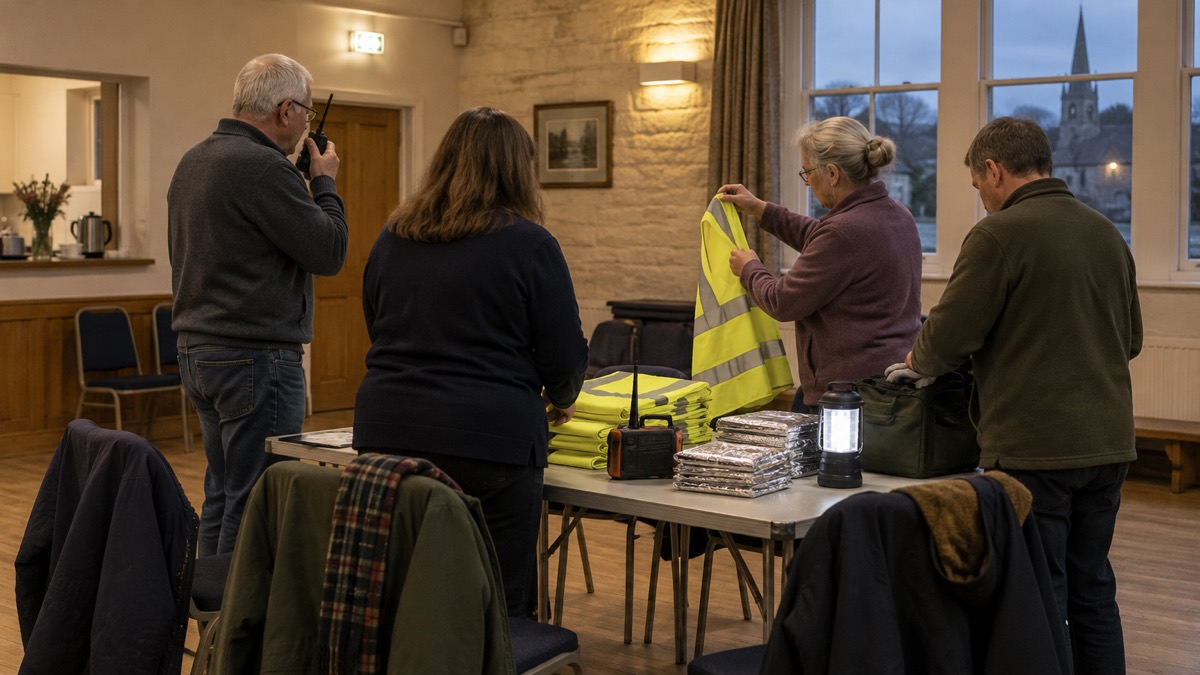
You do not have to guess what your area is preparing for. To plan for emergencies you need to know what risks you face, how likely they are to happen, what their impact would be, and whether any people in your community are particularly at risk15. Reading your local community risk register is the fastest way for a group to align its own plan with the official one, and you should use that information in conjunction with local knowledge and advice from the emergency services agencies, local health boards and your local authority, rather than preparing for risks the responders consider unlikely.
For community groups, Nottinghamshire County Council's advice is to start with four things: being aware of the risks your community might face; having an emergency contacts list for your group so you can keep in touch during an emergency event; identifying which members of your community might be vulnerable in an emergency and being prepared to offer assistance if required; and developing, or helping to develop, an emergency plan for your organisation or community18. The council adds that it is good practice for a community to identify local hazards and make plans on how to assist the emergency services and other responding agencies18.
When an emergency happens, it is best to have a plan in place so you know who to contact and how your group will support your community and the emergency response3. The Scottish community emergency planning guide breaks the knowledge you need into four questions: what risks you face; how likely they are to happen; if they happen, what their impact would be; and if any people in your community are particularly at risk19. It also advises focusing on those risks that are important to your community and that you can do something about19, which keeps a small group from trying to plan for everything.
For the fuller process of building and testing a plan, see our guides on setting up a local emergency group, what to include in a community flood plan and how to test and review a community emergency plan.
How the services work together at an incident
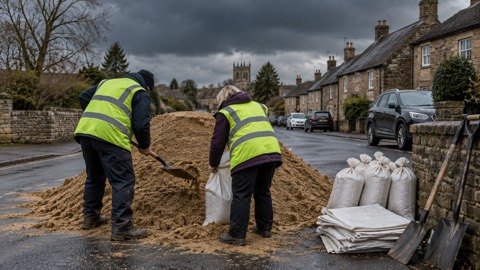
When an emergency is actually happening, the responders work to a shared structure rather than each service acting alone. The emergency services provide emergency relief when flooding occurs and can co-ordinate evacuations20. Local authorities will be working closely with emergency services to provide on-the-ground support21. During severe flooding, local authorities work with the emergency services and co-ordinate shelter for people evacuated from their homes20.
The public has a role at this stage too. The National Risk Register's supporting material states that in the event of an emergency the public can play a vital role by alerting the emergency services (dialling 999) and by providing first aid, comfort and support while waiting for the emergency services to arrive22. Community and local businesses can help by sharing trusted information with each other through available communication methods, such as word of mouth, phone groups, social media or online, and contacting emergency services for support21.
Community and voluntary organisations fit into an incident in one of three ways, according to the Scottish partnership working guidance: working with responders and helping the community directly, supporting the emergency services, or coordinating with emergency services to help those in danger21. Health and social care staff and volunteers will be responding to emergency calls and treating people in hospitals, and considering the needs of the most vulnerable people within a community21.
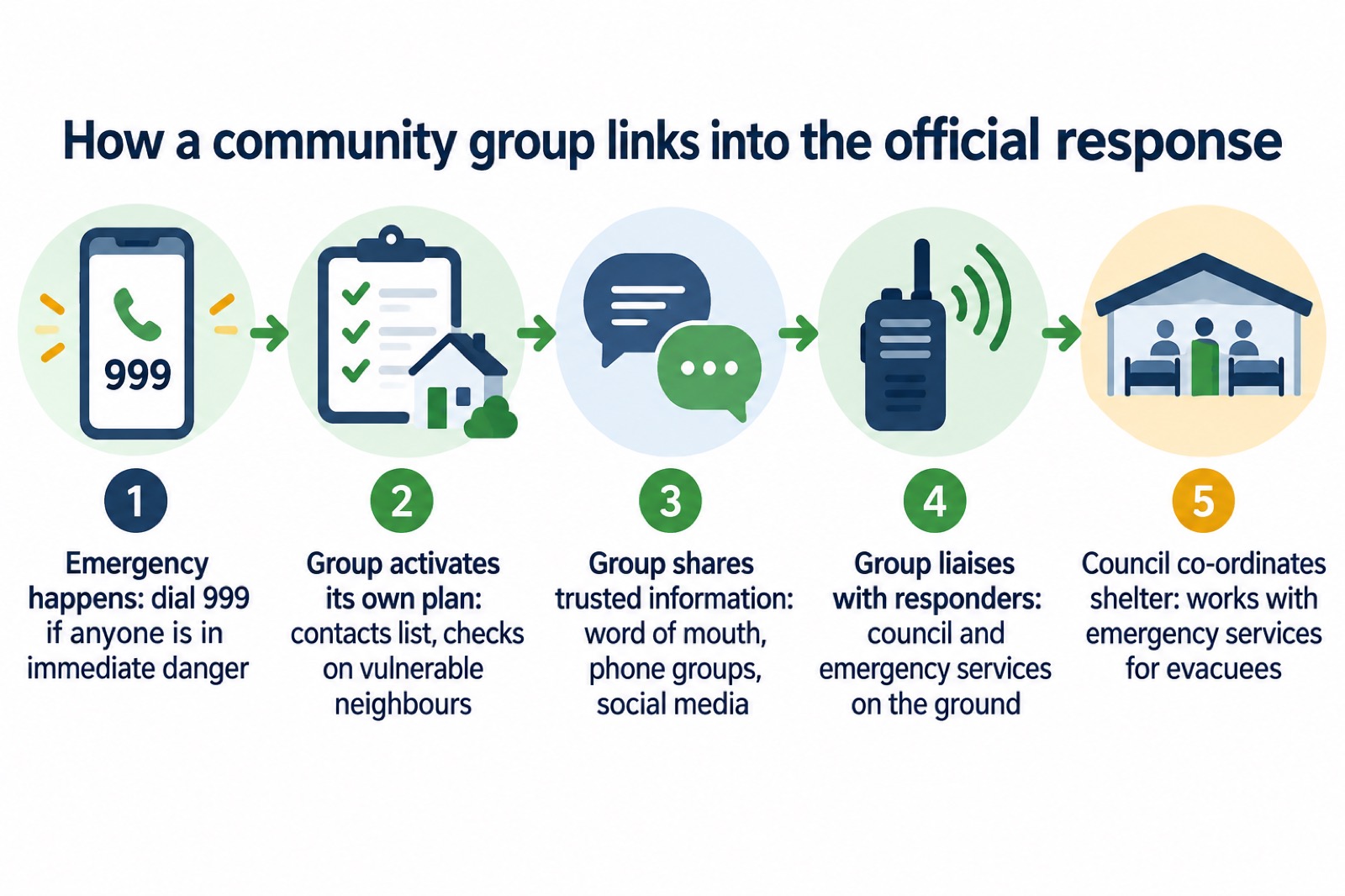
What your group should not do is insert itself into the response uninvited. The official model is complement, not replace: resilient communities work together to complement the work of the local emergency responders before, during and after an emergency17. For more on the boundaries, see what volunteers can safely do, and where to stop.
Community emergency hubs and local group plans
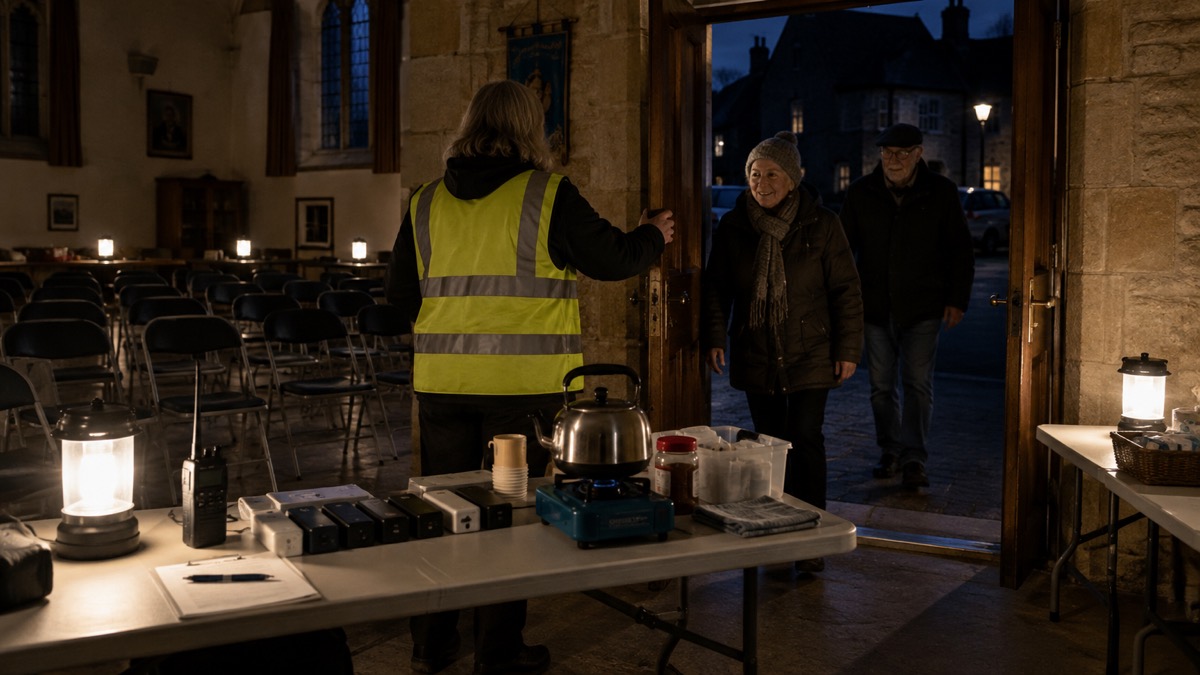
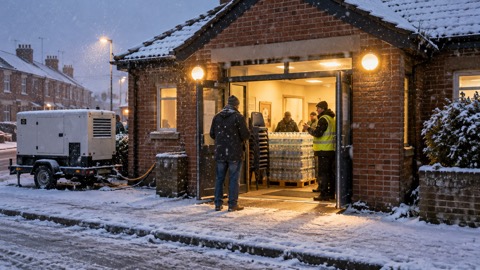
The most developed model for linking a community to the responders is the emergency hub. An Emergency Contact Hub is your community's place to go and help one another in an emergency23. It is designed so that community members can help themselves, but also have a linkage into the emergency services and other responding agencies in the local area23. Buckinghamshire Council describes a Community Emergency Hub as a group of people with roles and responsibilities that can be used during an emergency or disruption, and notes that such hubs cooperate with the council and emergency services and usually operate out of a chosen location24.
Two features of the Wiltshire and Swindon model are worth knowing. First, the hub is run by the community for the community, using community venues and predominantly staffed by community volunteers25. Second, the hubs are only opened when the community feels the need in an emergency, and no authorisation from emergency responders is needed26. You do not have to wait for permission to open your own hub.
The scheme's case studies show what this looks like in practice. In a flooding response, the community collates issues, communication is fed into the Local Authority or Environment Agency via phone call, email or visit, and information, assistance and resources are passed down into the hub25. In a power outage, the community can use the hub to help identify and assist vulnerable people, share out any torches and lights to the most vulnerable, use any heating resources to keep as many warm as possible, work together to solve local issues deemed appropriate for community response, and liaise with the power company and responders on site26. A hub can even act as a focus point to report medical emergencies if 999 is not operational25. The scheme's purpose is that people really do know where to go in an incident where they may get information or need support27.
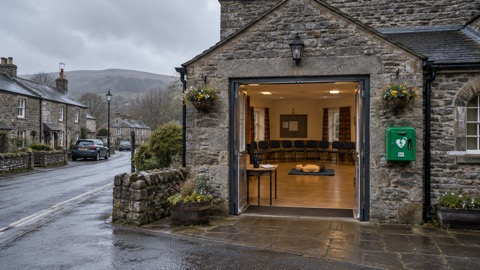
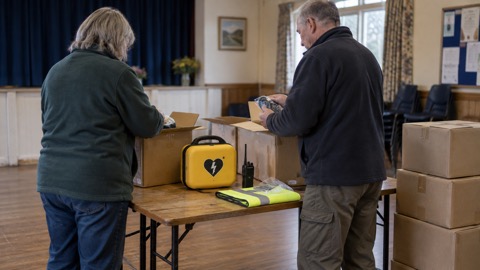
*A community venue opened as a hub, staffed by local volunteers.
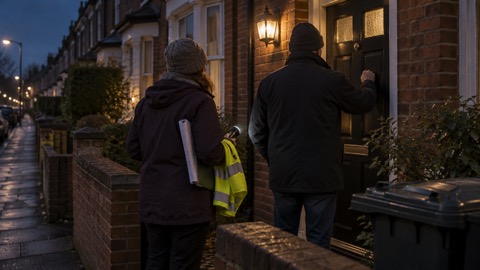
If you are starting a group rather than a hub, the Scottish guide advises forming a community emergency group that will lead your preparations and coordinate the action you take with the emergency responders in your area28. As well as your local authority, you may want to talk to your Community Council or local councillors, as well as local organisations like the Police, Fire and Rescue Service, Ambulance Service, and voluntary organisations active in your area such as mountain rescue teams, St Andrews First Aid, the Royal Voluntary Service or the British Red Cross28. Argyll and Bute Council's planning guide walks groups through deciding who the plan is for, getting advice, thinking about the risks to your community and your local skills, knowledge and resources, involving people who can help, and writing and testing the plan29. It also covers how to practise and check the plan, who to keep in touch with when doing this, and how to decide on your actions after the plan is used in an emergency and learn from the experience29.
Communities in the Wiltshire scheme can run table top exercises or physical exercises to test their own emergency or flood plan and their hub, from a simple discussion to setting the hub up with a scenario such as flooding27. For the practical side, see our pages on setting up and running a community emergency hub and the emergency hub kit and facilities checklist.
Safeguarding and vulnerable people: what the official material covers
The strongest theme across the official guidance is not formal safeguarding rules for volunteer groups, which the available sources do not set out, but the identification and support of vulnerable people. The government guidance for Local Resilience Forums in England is built around identifying and supporting persons who are vulnerable in an emergency, and instructs LRFs to identify the local organisations who engage with vulnerable persons, including voluntary and community sector organisations, faith groups, advocacy groups, residents' interest groups and community resilience groups12.
The Scottish community planning guide makes the community side of this explicit: think about how you could share your local knowledge of vulnerable people with the emergency responders if an emergency happens, as responders cannot always know straight away what people need, or who in your community might be vulnerable in an emergency19. This is the clearest statement in the official material of what a local group is actually for: you know things the responders do not, and a pre-existing relationship lets that knowledge reach them quickly.
Nottinghamshire's advice to groups includes identifying which members of your community might be vulnerable in an emergency and being prepared to offer assistance if required18. Health and social care staff and volunteers are described as considering the needs of the most vulnerable people within a community21. For practical guidance on the neighbour level, see checking on vulnerable neighbours in an emergency.
On the volunteering side, the official advice is to join or support a local volunteering or community group before an emergency happens, such as a local charity, a flood action group or a Neighbourhood Watch30. Joining before the emergency is the consistent message, because it is the difference between being a known partner and being an unknown volunteer at a cordon. See also volunteering in emergencies: roles you can train for.
Getting urgent help out of hours: the Emergency Duty Team
Councils do not switch off at 5pm. Each runs an Emergency Duty Team providing out-of-hours advice and support on a range of urgent issues, working with children, adults and families31. The sorts of emergencies these teams handle include suspecting a child is being abused, suspecting a vulnerable adult is being abused, coming across someone who seems to be having a mental health crisis, or a home care worker not arriving when help is needed to get someone into bed5.
The hours and numbers are set locally. Nottinghamshire County Council's Emergency Duty Team is available 5pm to 8.30am Monday to Thursday, and 4.30pm Friday to 8.30am Monday, or on Bank Holidays, and can be contacted on 0300 456 45465. Surrey County Council's Emergency Duty Team handles out-of-hours adult social care concerns on 01483 517898, with an email address, edt.ssd@surreycc.gov.uk, for the same purpose32. These are examples, not national numbers: search for your own council's name together with "Emergency Duty Team" and save the number before you need it.
For households that need extra help generally, see our guide to extra help in an emergency for older, disabled and medically dependent households.
Emergency Alerts and your group
Emergency Alerts are sent to compatible 4G and 5G mobile phones within an area of risk. They don't need your location or phone number, and only the government and emergency services can send them16. The technology allows a message to be broadcast to a defined area, meaning any compatible device in or entering that area immediately receives the message detailing the emergency and actions to take, with a loud siren-like sound and vibration; alerts may include a URL or helpline number and are always replicated on gov.uk/alerts22.
The system works alongside the responder structure rather than replacing it. When emergency services arrive at an incident, the Joint Emergency Services Interoperability Programme (JESIP) doctrine will apply, and those attending will agree which agency assumes the 'lead service' role22. For your group, an emergency alert is a signal to check the official information channels and put your own plan into action, not to act independently of the responders.
For a community group, two points matter. First, Emergency Alerts are just one of many tools the government has to communicate with the public about emergency situations; the media, community organisations and local emergency services also alert people, so those without a mobile will still be made aware, for example through the media and local emergency services33. Second, your group can be one of those channels: passing an alert's content on to neighbours who may have missed it, and pointing people to gov.uk/alerts to confirm it, is exactly the trusted-information role the responder guidance describes21.
"Emergency Alerts are sent to compatible 4G and 5G mobile phones within an area of risk. They don't need your location or phone number. Only the government and emergency services can send them."
For the household side of staying informed, see staying informed and in touch in an emergency.
Making contact before the emergency: a short checklist
Everything on this page points to one action: build the relationship now. A group that first phones the council during a flood is a caller in a queue; a group the council already knows is a partner.
- Find your Local Resilience Forum (England and Wales), Regional Resilience Partnership (Scotland) or Emergency Preparedness Group (Northern Ireland) and read its community risk register1
- Contact your council's emergency planning team and ask what advice and assistance it offers to community groups, which is part of its Category 1 duties10
- Form a community emergency group to lead your preparations and coordinate with responders28
- Talk to your Community Council or local councillors, and to local organisations such as mountain rescue, St Andrews First Aid, the Royal Voluntary Service or the British Red Cross where active in your area28
- Keep an emergency contacts list for your group so you can stay in touch during an event18
- Identify which members of your community might be vulnerable, and plan how you would share that local knowledge with responders18
- Write, test and review a community emergency plan, and consider a hub so people know where to go29
- Save your council's Emergency Duty Team number, and know that 999 is for immediate danger5
For the wider picture of how the UK prepares for emergencies, see how the UK prepares for emergencies: a household guide, and for everything on building a group, start at community resilience: a guide for neighbours and local groups.
Sources (33)
- What is a Local Resilience Forum?, Essex Prepared
- Our risks and plans, Greater Manchester Combined Authority
- Information for communities and community groups, Prepare (UK government campaign)
- Lesson 3: Who responds in Scotland, Ready Scotland, March 2026
- Emergency contacts, Nottinghamshire County Council
- Civil contingencies, Argyll and Bute Council
- The Civil Contingencies Act 2004, research briefing CBP-8016, House of Commons Library
- Be ready for emergencies, Cheshire Fire and Rescue Service
- Community Resilience Development Framework, HM Government, June 2019
- How we plan for emergencies, Cumberland Council
- Emergency planning, Scottish Borders Council
- Identifying and supporting persons who are vulnerable in an emergency, HM Government, April 2025
- Derby and Derbyshire flood warden handbook, Derby and Derbyshire, November 2019
- Thaw report, Ofwat, June 2018
- Check the risks where you are, Prepare (UK government campaign)
- National Emergency Alerts, Warwick District Council
- Community emergency planning guide: why, Ready Scotland, March 2026
- Community resilience, Nottinghamshire County Council
- Community emergency planning guide: risks, Ready Scotland, March 2026
- Flooding: developing our knowledge, Scottish Environment Protection Agency
- Lesson 2: Partnership working in a real emergency, Ready Scotland, March 2026
- National Risk Register supporting annex, HM Government, 2023
- Emergency contact hubs, Wiltshire and Swindon Prepared
- Community resilience, Buckinghamshire Council
- Emergency contact hubs: how they work, Wiltshire and Swindon Prepared
- Emergency Contact Hub leaflet, Wiltshire and Swindon Prepared, 2025
- Spotlight on Emergency Contact Hubs (ECHs), Wiltshire and Swindon Prepared
- Community emergency planning guide: who to work with, Ready Scotland, March 2026
- How to make a community emergency plan, Argyll and Bute Council
- Prepare your community, Greater Manchester Combined Authority
- Norfolk First Response, Norfolk County Council
- Getting back into your home following flooding, Surrey County Council
- Emergency Alerts factsheet, Saltford Parish Council, April 2023
 Emergency Hub Kit Checklist
 Severe Weather Tasks for Groups
 Flood Warden Checklist
 Setting Up an Emergency Group
 Volunteering in Emergencies
 What Volunteers Can Safely Do
 Community Flood Plans
 Flood Wardens
 Starting a Flood Action Group
 Clearing Snow and Ice
 Community Emergency Hubs
 Checking Vulnerable Neighbours
 Neighbourhood Phone Trees
 Registering and Looking After a Village Defibrillator on The Circuit
 Funding Resilience Groups