A Neighbourhood Watch is a group of local residents who agree to keep an eye out for anything suspicious and tell one another or the police. That simple arrangement is the whole idea: it helps reduce crime and the opportunities for crime, and it costs nothing to be part of1. If you are wondering whether your street could have one, the answer is almost certainly yes, and the first step is a conversation with the people either side of you.
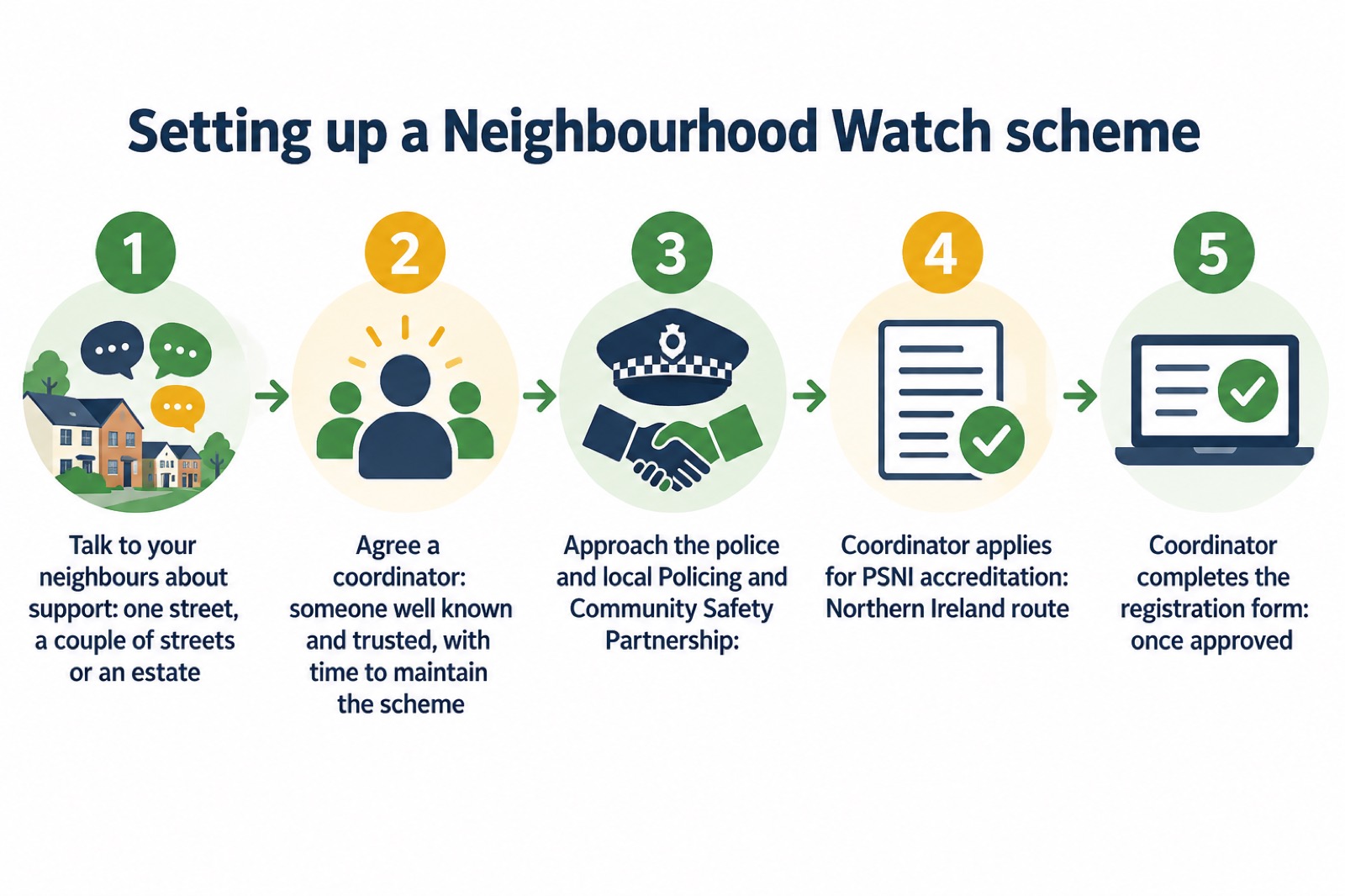
Setting one up is deliberately low-key. You talk to your neighbours and see whether there is support for a scheme in your area, then approach the police and your local Policing and Community Safety Partnership2. A scheme can cover just one street, a couple of streets, or part or all of an estate, and larger areas can have more than one coordinator2. Once a coordinator has been approved, they complete an application form to register the scheme2.
What you get for that effort is a street where people notice things and know who to tell. Police guidance is clear that local schemes help when you are on holiday, by increasing the surveillance of your property and encouraging neighbours to report suspicious activity3. The same habit of looking out for one another carries into power cuts, bad weather and flooding, where official advice repeatedly comes back to checking on neighbours4.
What a Neighbourhood Watch scheme does for your street
The core of a scheme is mutual watching. Residents agree to keep an eye out for anything suspicious and to tell one another or the police, which in turn helps reduce crime and the opportunities for crime1. It is not a patrol, a private security service or a substitute for calling the police when something is happening. It is a standing arrangement about who notices what, and who tells whom.
That arrangement earns its keep in ordinary circumstances as much as dramatic ones. Police guidance says local Neighbourhood Watch schemes can help when you are on holiday by increasing the surveillance of your property and encouraging neighbours to report suspicious activity3. Fire and rescue services give the same advice in plainer terms: ask a trusted neighbour to keep an eye on your property, and perhaps to park on your drive occasionally so the house looks occupied6. If you go away, get a neighbour to check inside your home occasionally, which also catches frozen or burst pipes before they become a repair7.
Schemes also sit alongside other volunteer efforts that councils run. A Snow Warden Scheme, for example, lets an individual or a group of community volunteers sign up to help clear snow and ice from public footpaths in their local area, backed with advice, online training and salt8. A Feel Safe Scheme, run as a Neighbourhood Watch and police initiative, carries out small jobs for vulnerable people such as fitting a security light, a door chain, a spyhole, a strong bolt on a gate or a window lock; most jobs are free, though a donation may sometimes be requested9. These are separate schemes, but they draw on the same pool of people who are already willing to look out for their street.
The wider value is in everyday resilience. Official advice on power cuts tells households to check in on neighbours, particularly anyone who might live alone or need extra support, and to make sure they know what is happening and have the help they need4. In snow or bad weather, Surrey County Council advises keeping an eye on vulnerable neighbours, shopping for them or offering to clear paths and driveways so they stay safe and avoid falls10. A watch scheme gives that instinct a structure, so it does not depend on someone happening to notice.
One street, a few streets or a whole estate
The size of a scheme is a choice, not a rule. You can set up a watch to cover just one street, a couple of streets or part or all of an estate2. That flexibility matters, because the right answer depends on the shape of where you live: a single terrace, a cul-de-sac, a new estate with several closes, or a rural lane with houses spread out.
| Coverage | What it suits | What to think about |
|---|---|---|
| One street | A terrace, a cul-de-sac, a short residential road | Easiest to run and to keep everyone informed |
| A couple of streets | A small estate or a road with side turnings | More than one coordinator may help share the work |
| Part or all of an estate | Larger developments, shared entrances, mixed housing | Needs several coordinators and a clear way to pass messages between them |
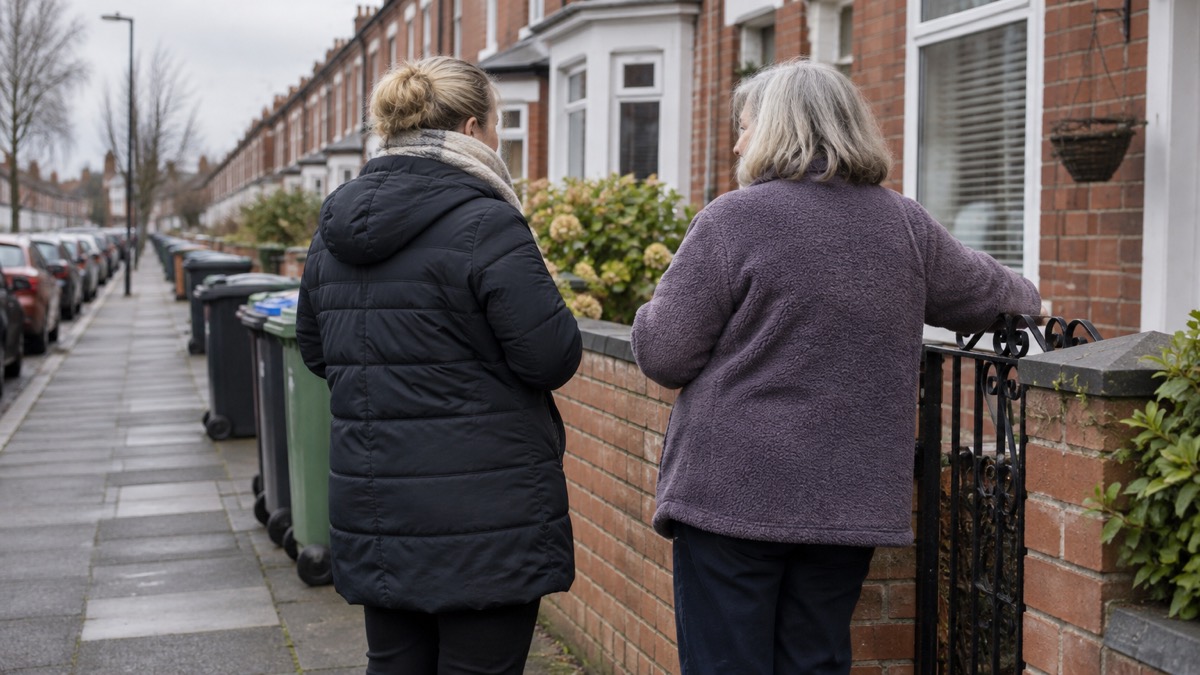
Bigger is not automatically better. The more households involved, the more coordination the scheme needs, and the more important it is that messages reach everyone. If your area has shared features such as a communal entrance or a rear alley, it is worth reading around those subjects separately, starting with flats and shared entrances and terraced houses and rear alleys, because the watching arrangements differ from a street of detached houses.
Wherever the boundary falls, write it down and tell people. A scheme whose members are unsure whether a particular house is in or out will not work well, and the police contact who registers it will want to know what area it covers.
Starting a scheme begins with talking to your neighbours
The first step is not a form or a phone call. It is a conversation. Guidance is explicit that you will need to talk to your neighbours and see if there is support for setting up a neighbourhood watch scheme in your area2. That conversation does two things: it tests whether people will actually take part, and it usually turns up the person who has the time and the standing to run it.
A practical way to go about it:
- Talk to the households nearest you first. Ask whether they would support a scheme and whether they would be willing to keep an eye out2.
- Widen it out gradually. Once a few are interested, extend to the rest of the street or streets you have in mind, remembering that a scheme can cover one street, a couple of streets or part or all of an estate2.
- Find your coordinator. Ideally this should be someone well known and trusted in your community, who also has the time to maintain the scheme2.
- Agree how you will keep in touch. A register of members and a way to pass messages are the basics a coordinator is expected to maintain2.
- Approach the police and your local partnership once you have support and a coordinator (see the next section).
If you are doing this as part of a wider effort, the same pattern appears in other community schemes. Guidance on setting up a community flood warden scheme suggests organising and advertising a meeting, discussing aims at the first meeting, and choosing a chairperson or secretary to take and share notes11. The Household Emergency Plan suggests that if you are able to offer help to your community and it is safe to do so, you could start by checking on others such as your neighbours and recording their details12. Both are useful models for the first meeting of a watch scheme.
Who to contact to set up a scheme: the police and your local partnership
Once there is support and a coordinator, the formal step is to speak to the police and your local Policing and Community Safety Partnership (PCSP)2. In Northern Ireland the coordinator must apply for accreditation from the Police Service of Northern Ireland before an application for a new scheme can be made, and once approved they complete an application form to register the scheme2. That sequence, accreditation first and registration second, is the Northern Ireland route; elsewhere the police and the local partnership are the bodies to approach2.
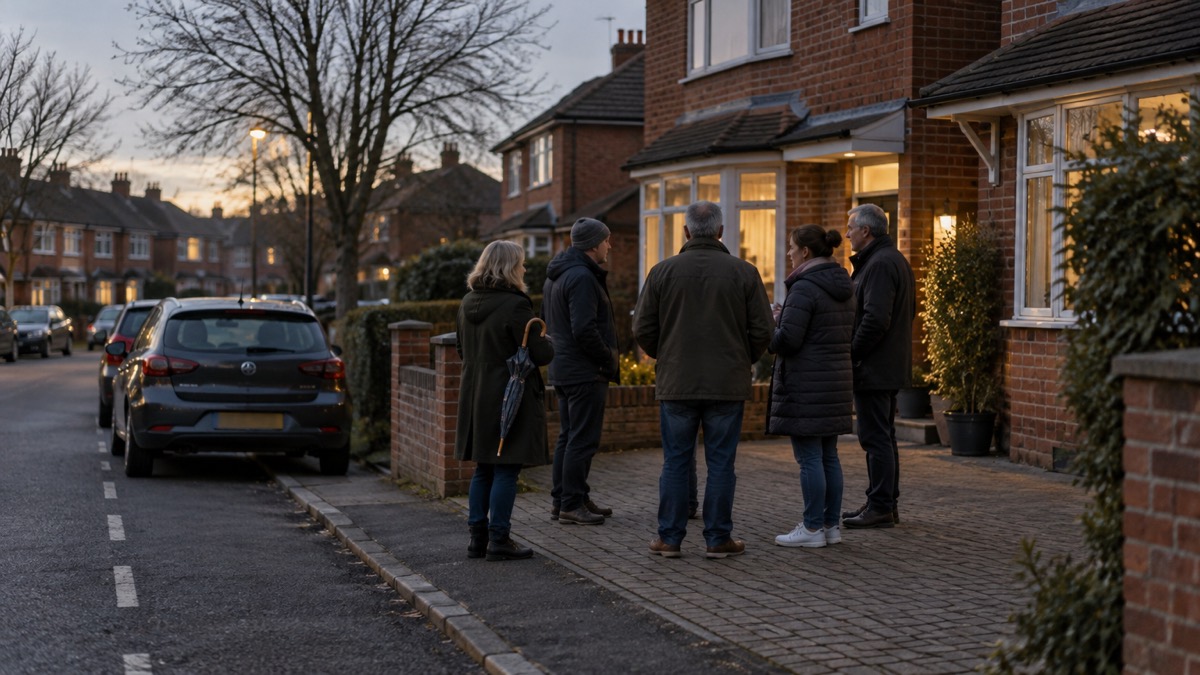
It helps to arrive at that conversation prepared. Know the area you want to cover, roughly how many households are involved, and who has agreed to coordinate. If your scheme will sit alongside other local groups, say so: Carmarthenshire County Council's emergency planning guidance advises getting in touch with existing local networks you can work with, naming flood wardens, Scout groups, town or community councils, residents associations and Neighbourhood Watch groups13. Councils themselves work in partnership with others on contingency planning, with Argyll and Bute Council describing close work with neighbouring local authorities, partner and third sector organisations in writing, testing and reviewing plans14, and Derbyshire County Council working closely with district and borough councils and the East Midlands Combined County Authority on a joint approach15.
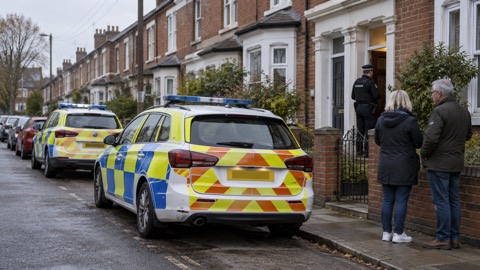
For a non-urgent police matter, such as a welfare concern about someone you have not seen for a while and have not been able to contact, Suffolk Fire and Rescue Service advises getting in touch with your local police force on 10116. That is the number for concerns that need a police response but not an emergency. For anything happening now, the police are reached on 999, and guidance for householders facing flooding is that a neighbour who sees or hears anything suspicious should inform the police by the 999 system17. Our page on when to call 999 or 101 sets out the difference.
Coordinators: when a scheme needs more than one
A coordinator is the hinge the scheme turns on. The role is best held by someone well known and trusted in your community, who also has the time to maintain the scheme2. You could have more than one coordinator if your scheme covers a few streets or an estate2, and for anything larger than a single street that is usually the sensible arrangement.
The duties are practical rather than dramatic. A coordinator is expected to talk to residents, keep a register of all scheme members, keep in contact with the police, be the first point of contact, meet other coordinators, attend police meetings and help maintain the scheme2. In Northern Ireland they also apply for PSNI accreditation before a new scheme can be registered, and complete the application form once approved2.
| Situation | Coordinators needed | Why |
|---|---|---|
| One street | One is usually enough2 | A single register and a single point of contact keep it simple |
| A few streets | More than one may help2 | Shares the visiting, the register and the police contact |
| Part or all of an estate | More than one2 | Several coordinators can cover their own parts and meet to keep messages consistent |
Good coordination is mostly about records and handovers. Neighbourhood Watch guidance suggests downloading and printing a neighbourhood watch observation card to help record sightings and incidents2. Keep the member register up to date, and write down important phone numbers for anyone the scheme is looking out for, which Scotland's Ready campaign advises so that people have them to hand18. If a coordinator steps down, the register and the contact list are what let someone else pick the scheme up without starting again.
It is worth being honest about the time involved before someone takes the role on. A scheme that depends on one willing person with no deputy is fragile; a scheme with two or three coordinators, each covering their own streets, survives holidays, house moves and changes of circumstance.
Using the scheme when you are away, and keeping records straight
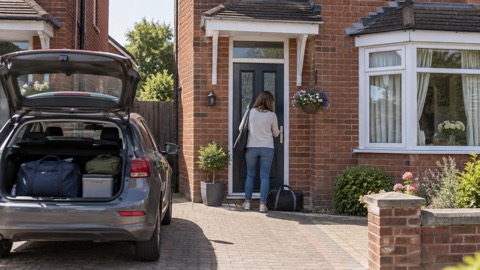
The most common reason people first value a watch scheme is a holiday. Police guidance says local Neighbourhood Watch schemes can help when you are on holiday by increasing the surveillance of your property and encouraging neighbours to report suspicious activity3. Fire and rescue services add the practical touches: ask a trusted neighbour to keep an eye on your property and perhaps park on your drive occasionally6, and get a neighbour to check inside your home occasionally while you are away7. Our guide to leaving your home while you are on holiday covers the rest of the routine.
Records make the difference between a scheme that works and one that fades. Beyond the observation card, the member register, the contact list and a note of who is away and when are the documents a coordinator actually uses. Keep them somewhere sensible and hand them over properly when the role changes hands.
Where to get help and local contacts
Most of the help you need is local. Your police force and local Policing and Community Safety Partnership are the route to setting up a scheme2, and your council may be able to point you towards existing networks worth working with13. Warwickshire County Council, for example, runs its network of voluntary snow wardens in partnership with parish and town councils and residents associations19, which is the kind of arrangement a watch scheme can plug into.
Some contacts are specific to an area. Torbay and South Devon NHS Foundation Trust lists the Neighbourhood Watch Office at Torquay Police Station on (01803) 218180, and separately gives Speaking Out in Torbay (SPOT) on 07703 9633589. These are local numbers for the Torbay area, not a national service. For the Nominated Neighbour Scheme, Citizens Advice can be contacted on 0808 223 113320. For a non-urgent police matter such as a welfare concern, call 10116; for anything happening now, call 99917.
If your interest in a scheme comes from a wider worry about being ready for an emergency, the community resilience guide covers how neighbours and local groups can organise together, and extra help in an emergency explains support for older, disabled and medically dependent households. For the security side of the same subject, start with our home security guide.
Sources (20)
- Protect Yourself Booklet (English), Police Service of Northern Ireland, 2024
- Neighbourhood Watch, nidirect, 2025-09-09
- Pre-holiday routine, Avon and Somerset Police, 2026-11-02
- Phone and broadband outages, UK Government Prepare campaign, 2026-10-12
- During a flood, Nottinghamshire County Council, 2026-10-29
- While you are away, Mid and West Wales Fire and Rescue Service, 2026-10-29
- Frozen or burst pipes, Met Office, 2026-10-26
- Snow Warden Scheme - Devon Highways, Devon County Council (Devon Highways)
- Keeping safe and warm at home, Torbay and South Devon NHS Foundation Trust, 2023-11
- Help and advice for older and vulnerable people in bad weather and winter - Surrey County Council, Surrey County Council
- Community flood planning, Thurrock Council, 2026-10-29
- Be Ready Household Emergency Plan (English), UK Government Be Ready campaign, 2026
- Emergency planning, Carmarthenshire County Council, 2026-10-28
- Preparing for civil emergencies in Argyll and Bute, Argyll and Bute Council, 2026
- Adapting to extreme weather, Derbyshire County Council, 2026-10-29
- Seasonal winter safety advice, Suffolk Fire and Rescue Service, 2026-10-29
- Be prepared: civil contingency guidance, Lancaster City Council, 2026-10-26
- Hot weather, Ready Scotland, 2026-03-24
- Snow wardens, Warwickshire County Council, 2026-10-29
- Safety advice for older people (easy read), Nottinghamshire County Council, 2025-10-02
 After a Break-In Checklist
 Holiday Security Checklist
 Moving Home Locks Checklist
 When to Call 999 or 101
 Reporting a Burglary Anonymously
 Doorstep Caller Will Not Leave
 Car Running While De-Icing
 Checking a Doorstep Caller
 Burglary at Christmas
 Cash in a Fire Safe
 Heating Oil Tank Theft
 Making a House Look Occupied
 Police Approved Products
 Reporting a Bogus Caller