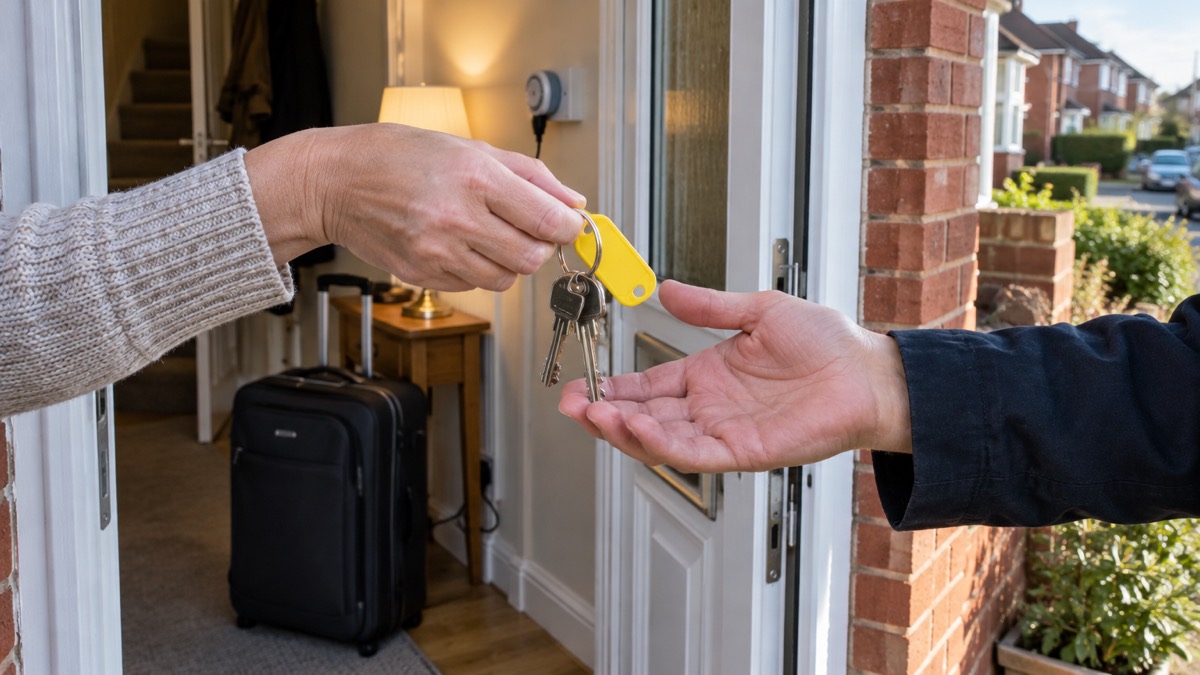
The single most useful thing you can do before a holiday is put your lights on timer switches so they come on when it goes dark, and leave the curtains in their normal position so the house does not look stripped and waiting1. Opportunistic burglars look for signs that nobody is home, and a dark house with the curtains drawn in every room is one of the clearest3. Police guidance for Northern Ireland puts the same advice plainly: give your property an occupied look by using timer switches for lights when your home is empty4.
Around that core, a handful of other habits matter. Deal with the things that pile up: bins left out for days and post mounting behind the door are, in the words of one official guide, "a sure sign there's no one home"2. Lock doors when you leave and when you return5. Keep gifts and expensive items out of view, and mark valuables with your postcode and house number4. If you have a public social media profile, remember that announcing your holiday tells an opportunistic burglar the house will be empty for a couple of weeks2.
Motion-sensing lights have a place, but a smaller one than people expect. This page sets out what to do now, how to set lighting up so it helps, where it can give you away, and what to do about the practicalities while you are gone.
Set the lights before you go
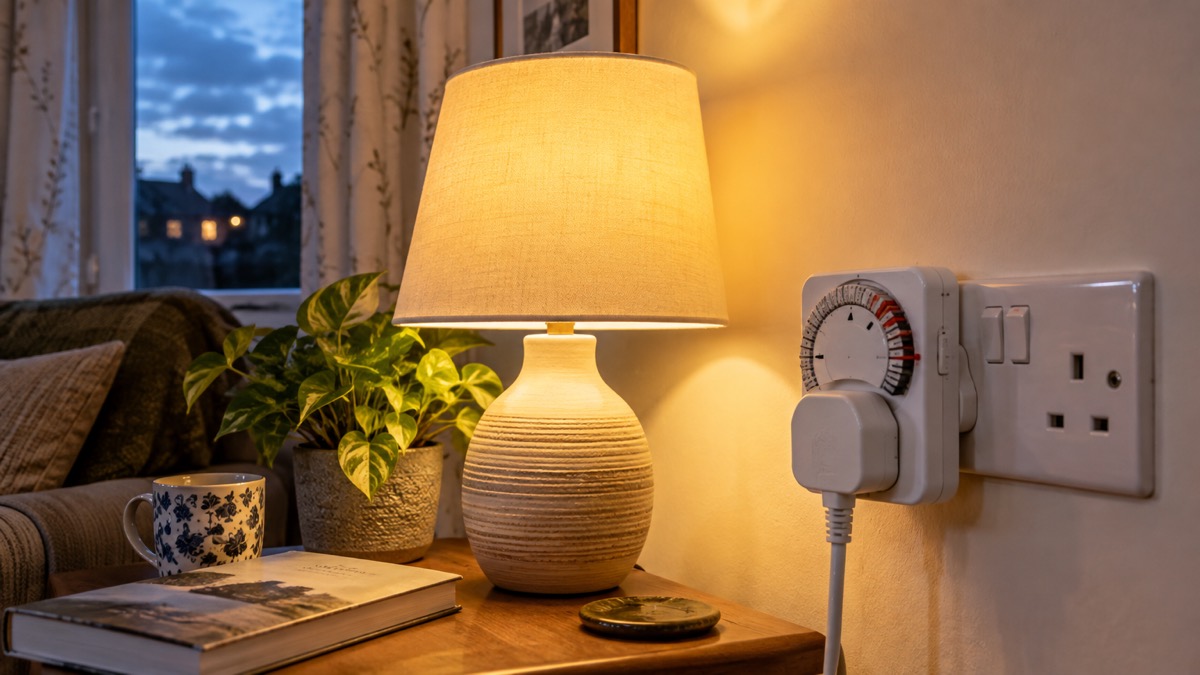
Timers do the work that a lived-in house does naturally: they put light in the rooms you would be using at the hours you would be using them. Police guidance is to use timer switches to turn on some lights when it goes dark1, and fire and rescue services in England and Wales give the same instruction alongside keeping curtains in a normal position3. The Welsh-language version of the Mid and West Wales Fire and Rescue Service guidance makes the reasoning explicit: leaving the home empty carries a higher risk that burglars will target it, and timers plus ordinary curtains are good ways to keep it looking lived in3.
Set the timers a few days before you travel and watch them. A lamp that fails to come on, or a timer that has lost its time after a power blip, is worse than useless because you will have stopped thinking about it. Check the condition of the lights themselves before you rely on them, and replace any failed bulbs6. If you use decorative or festive lights, check they are in good working order and replace blown bulbs, and switch them off at the socket when you go out or go to bed6.
Think about which rooms you light. A single lamp in the hall for a fortnight is a pattern, and patterns are what an observant burglar reads. Vary the rooms and the hours across the evening, and consider a radio or a second lamp on a separate timer so the house has some variety.
Security lights that switch on when someone moves
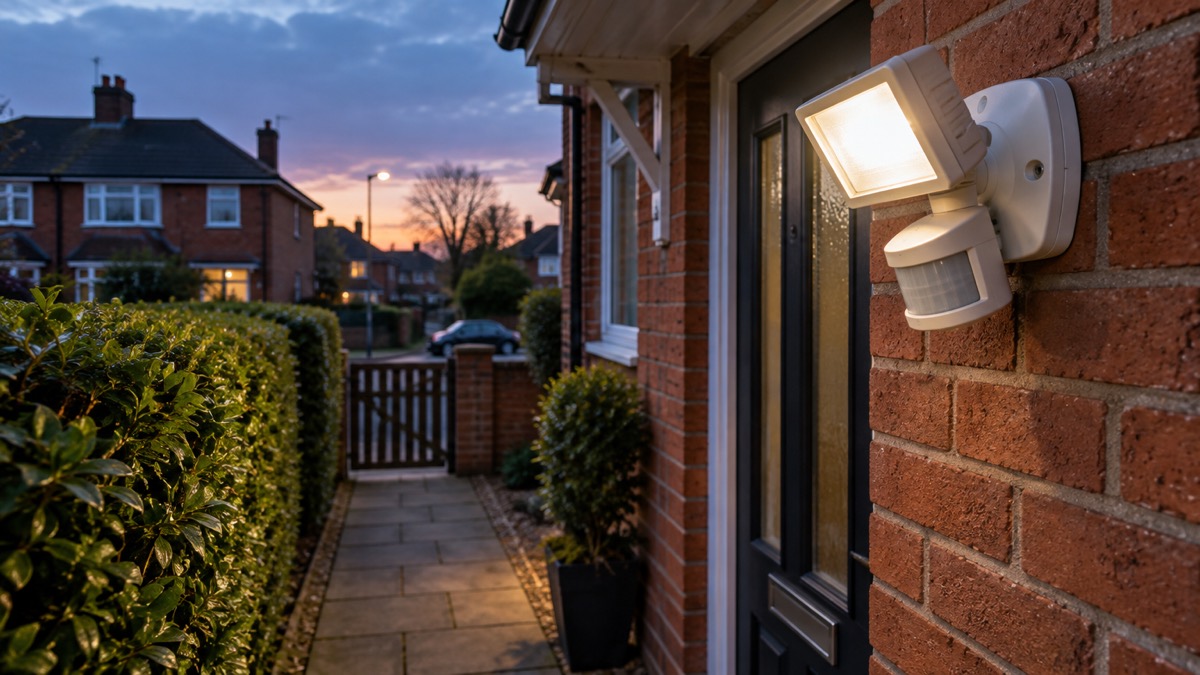
A motion-sensing light, often called a PIR light, switches on when something warm moves in front of its sensor. Fire and rescue services recommend considering external lighting to help deter intruders and alert you to activity around your home9. That is the honest case for it: it is a deterrent and an early warning, not a barrier. It does not stop anyone entering, and it cannot tell you who is there.
The same technology appears indoors in a different role. Motion-activated night lights are recommended for anyone who gets up in the night, so they can see where they are going10. That is worth knowing if you are fitting sensors anyway: the same kind of unit that lights a path outside can light a landing inside, and both are about safe movement in the dark rather than about burglars.
What a PIR light will not do is make an empty house look occupied on its own. A light that fires at every passing animal through the night is a light that has stopped responding to people, and neighbours notice. Official guidance is that automatic lighting should not disturb neighbours2, so the aim and the sensitivity matter as much as the fitting.
| Type | What it does while you are away | What it cannot do |
|---|---|---|
| Plug-in lamp on a timer | Puts light in a room at set hours, mimicking an evening at home1 | React to anything; stops in a power cut7 |
| Mains PIR floodlight | Switches on when someone approaches, deterring and alerting9 | Tell a person from an animal; stop entry |
| Indoor motion night light | Lights a hallway or landing for safe movement10 | Look like occupancy from outside |
| Manual switch left on | Keeps one light burning, useful as a power-cut indicator7 | Vary, or respond to anything |
Where to place motion-sensing lights around the house
Put lighting at the front and the back of the house, manual or automatic, and make sure automatic lighting does not disturb neighbours2. That is the whole of the official placement advice, and it is worth taking literally: the front and back are where an approach happens, and a light that covers a side passage nobody uses is decoration.
Aim the sensor at the route a person would take, not at the wall. A sensor pointed along a path or across a drive uses its range on the approach; one pointed at a hedge or a fence spends it on foliage moving in the wind. Check the detection range and angle the maker states for your unit before you buy, and test the coverage after fitting by walking the approach after dark.
Indoors, the same logic applies to safety rather than security. Good lighting is essential, especially in hallways, on stairs, and when moving around at night12, and a night light near the bed helps you see where you are going11. If anyone in the house has sight or hearing impairment, place helpful indicators along the escape routes and make sure they are comfortable following them, even when tired in the middle of the night14. Keep exits clear as part of the same check15.
When security lighting gives you away
Lighting can work against you in three ways. The first is the obvious one: a light that triggers constantly, night after night, with nobody there, tells anyone watching that the response is automatic and the house is empty. The second is a light left burning in a room you would never use at that hour, which reads as a mistake rather than as occupancy. The third is the pattern itself: the same lamp, the same window, the same hour for a fortnight.
The risk you are managing is real and seasonal. Housebreaking is more likely during holidays because thieves know it is more likely that valuables will be inside17. Police in Northern Ireland remind households to ensure the safekeeping of houses, sheds and other outbuildings, especially when away on day trips or staying in holiday homes or caravans18. A house that looks occupied is the countermeasure, and lighting is one part of it.
The other giveaway is not lighting at all. If you have a public profile, talking about your holiday on social media could tell an opportunistic burglar that your home will be empty for a couple of weeks2. Save the photographs for when you are back, or at least keep the dates vague and the audience private. Our guide to posting about your holiday on social media covers the settings in more detail.
Check the house over before you leave
A short walk-round on the day you go catches most of what goes wrong. Lock doors when you leave and when you return5, and check windows too. Keep gifts and expensive items out of view, and mark valuables with your postcode and house number so they can be returned if they are recovered4. If you are away over Christmas, the same police advice applies with more force, because there is more in the house to take4.
Ask a neighbour to look in. Official guidance on frozen pipes recommends getting a neighbour to check inside your home occasionally if you go away21. Tell them when you are back so they are not surprised by you.
- Bins: put them out on the normal day, not days early, and ask a neighbour to bring them in2
- Post: have it held or collected rather than piling up behind the door2
- Curtains: leave them in their usual position rather than drawing them all3
- Lights: timers set and tested, bulbs checked1
- Valuables: out of view and marked4
- Neighbour: asked to check inside occasionally21
If you are going away for a long period, or the property will be empty for probate or between owners, the considerations change and our guide to empty homes and long absences sets out what else to think about. For the full sequence, the before you go away checklist puts every step in order, and leaving your home while you are on holiday covers the wider picture beyond lighting.
What to do about animals, neighbours and power cuts
Animals setting the light off. A PIR reacts to any warm body, and cats, foxes and dogs are a common cause of a light firing with nobody there. Keep the sensor away from low shrubs and bins where animals climb, and angle it down so it looks at people rather than at ground level. If you have an alarm with pet-friendly sensors, our guide to alarm sensors and pets explains how those differ from a simple light.
Sensor range. The range and angle are properties of the unit you have, and the maker's stated figures are the ones to work from. What you control is the aim: a sensor pointed along the approach uses its range well, one pointed at a wall wastes it. Test the coverage after fitting rather than trusting the box.
Power cuts. Timer switches and mains lights stop when the supply does. Leave one light switched on so you know when power is back7, and if the cut happens in daylight, switch a light on in case it continues into the evening8. For light during an outage, see our guides to keeping your home protected in a power cut and to emergency lighting at home.
Neighbours and light nuisance. Automatic lighting should not disturb neighbours2. Angle it away from their windows, shorten the time it stays on if the unit allows, and talk to them before you go. A light that annoys the street is a light someone may switch off or complain about while you are away.
Checking before you leave. Set the timers early, watch them at dusk and in the morning, and look at the house from the street after dark. Check the condition of the lights themselves before you rely on them, and replace any failed bulbs6. If you use decorative or festive lights, check they are in good working order and replace blown bulbs, and switch them off at the socket when you go out or go to bed6.
Sources (22)
- House Security, Police Service of Northern Ireland, 2026-11-02
- Securing your home, nidirect, 2024-01-23
- While You Are Away, Mid and West Wales Fire and Rescue Service, 2026-10-29
- Christmas safety advice, Police Service of Northern Ireland, 2026-11-02
- Christmas safety advice, North Yorkshire Fire and Rescue Service, 2025-12-15
- Celebrate safely | Humberside Fire, Humberside Fire and Rescue Service
- Stay safe in a thunderstorm, Met Office, 2026-10-25
- 12 tips to prepare for a power cut, Horsted Keynes Parish Council, 2026
- Reducing arson risk, Devon and Somerset Fire and Rescue Service, 2026
- Stay Steady and Safe Home Safety Checklist, NHS Norfolk and Suffolk ICB, 2026
- Stay Well this Winter, NHS England, 2025
- Slips, trips and falls, Cheshire Fire and Rescue Service, 2026-05-20
- Judo-inspired programme prevents falls this winter, NHS Lanarkshire, 2026-01-19
- Hearing and sight impairments, North Wales Fire and Rescue Service, 2026-10-29
- Escape plan, Devon and Somerset Fire and Rescue Service, 2026
- Plan your escape, Staffordshire Fire and Rescue Service, 2026-10-29
- Break-in and housebreaking, Police Scotland, 2026-11-02
- Summer safety advice, Police Service of Northern Ireland, 2026-11-02
- Halloween safety, Dorset and Wiltshire Fire and Rescue Service, 2026-04-30
- Strong winds and heavy rain warning, nidirect, 2026-01-27
- Frozen or burst pipes, Met Office, 2026-10-26
- Fire safety checklist, Devon and Somerset Fire and Rescue Service, 2026
 After a Break-In Checklist
 Holiday Security Checklist
 Moving Home Locks Checklist
 When to Call 999 or 101
 Reporting a Burglary Anonymously
 Doorstep Caller Will Not Leave
 Car Running While De-Icing
 Checking a Doorstep Caller
 Burglary at Christmas
 Cash in a Fire Safe
 Heating Oil Tank Theft
 Police Approved Products
 Reporting a Bogus Caller