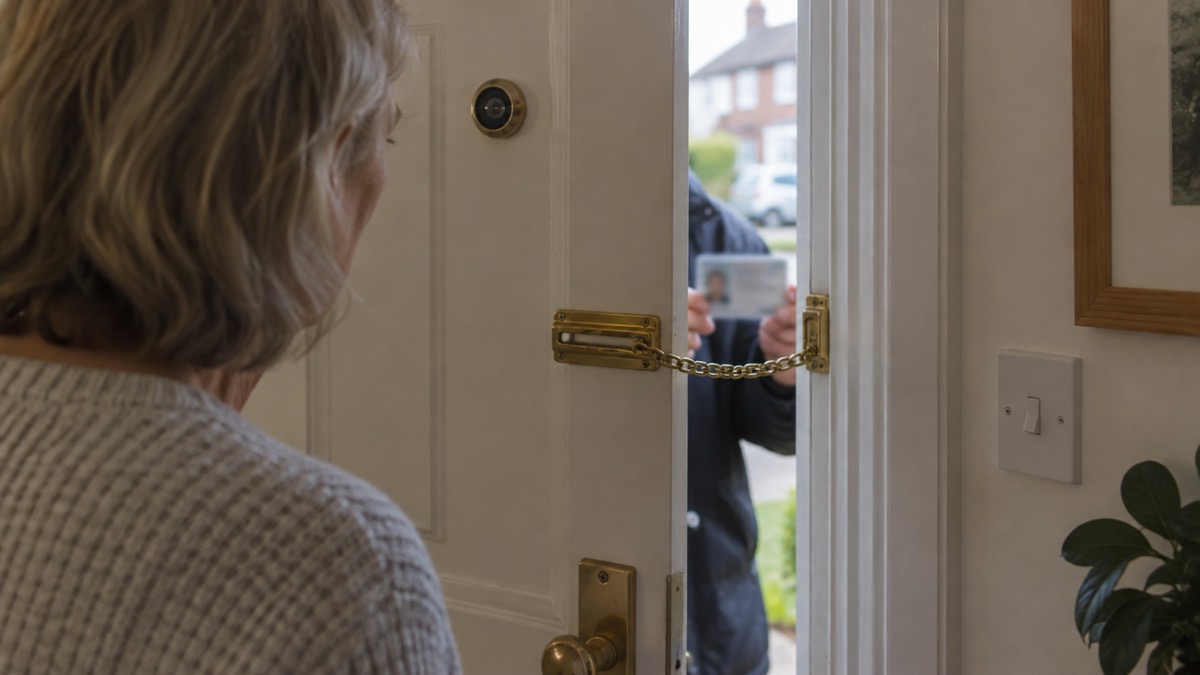
If a suspicious caller will not leave, call 999. That is the police's own advice, and it applies whether the person is a stranger asking to come in, someone claiming to be from a utility company, or a face you have seen before1. You do not have to wait for the situation to become violent, and you do not have to be sure of anything before you pick up the phone.
While you call, keep the door shut. Ask the caller for identification, check it carefully, ask them to wait outside and close the door2. If you have already opened it, close it now and lock it. The police in Scotland sum the routine up as LOCK, STOP and CHECK: keep front and back doors locked, check through a viewer or window before opening, and only let someone in who has an appointment and confirmed ID3.
This page sets out what to do in the first minutes, what to tell the 999 operator, when a caller's refusal to leave crosses into an emergency, and how to help an older neighbour who may be too polite to shut the door. It also covers the harder case, where the person is already inside.
Call 999 if a suspicious caller will not leave
The trigger is simple. Police Scotland's doorstep crime guidance says that if someone suspicious will not leave, you should call 9991. The same force's housebreaking advice says to call 999 if you think an intruder is still there5. A person standing on your step refusing to go is not a nuisance to be managed politely; it is a situation the police want to hear about while it is happening.
Why call rather than wait it out? Because the call is how you get a response moving, and because the operator can talk you through the next few minutes. The call taker will stay on the line and explain step by step what you will need to do7. That matters when your instinct is to argue with the person through the letterbox or to open the door to move them along.
There is a second reason to call early. A 999 call does not always mean a trip to your local emergency department; you may be able to stay at home or use a different local service or facility8. In other words, calling for help is not an overreaction that commits you to anything. It starts a conversation with someone trained to decide what response is needed.
If you are in any doubt about whether the situation is serious enough, remember that patients with life-threatening emergencies should continue to call 999 or attend A&E as normal9. The principle is the same: the emergency line exists for situations that are unfolding now, and a caller who will not leave is unfolding now.
Keep the door shut while you call
The single most useful thing you can do is not open the door. Police Scotland's doorstep crime campaign sets out three steps: LOCK, keep front and back doors locked; STOP, check through a viewer or window before opening; and CHECK, only let callers in who have an appointment and confirmed ID3. The Police Service of Northern Ireland puts it just as plainly: callers should always be asked for proof of identity, and no access given until it is verified2.
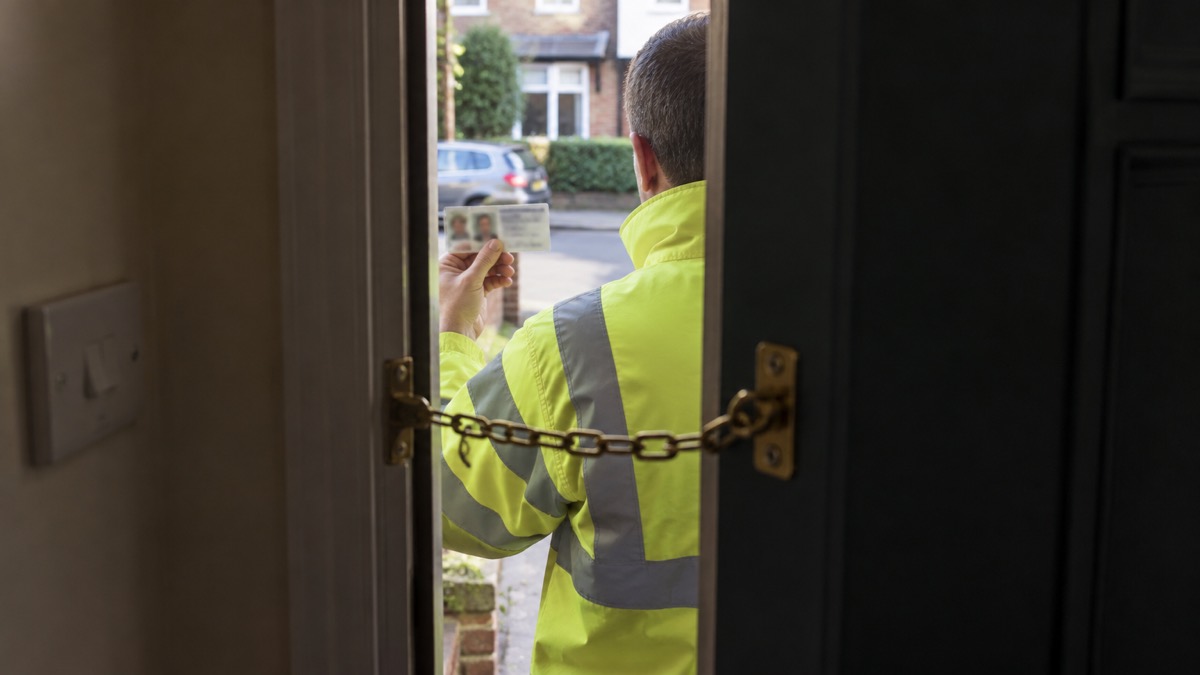
If you have already opened the door, the move is to close it again. Ask the caller for their identification and check it carefully, ask them to wait outside and close the door2. Genuine callers will be only too happy to provide this information2. A person who becomes angry at being asked to wait outside has told you something useful.
Verifying identity is where most people go wrong. Check the identity of the caller by calling the company they claim to be from, using the number provided on an official website, in a phone book or on a utility bill. Do not use any phone number provided by the caller, as this may be bogus4. Genuine callers will normally make an appointment first and will carry identification with their photograph on it, so always ask to see their ID4.
This is also where doorstep passwords help. Some water and energy companies run schemes where a caller quotes a password you have agreed with them, which is a quick way to tell a real employee from an impostor. Our guide to doorstep password schemes from water and energy companies explains how they work.
If the person is trying to sell you work, or offering to fix a roof or clear a gutter, the doorstep selling rules apply. Our pages on rogue traders and doorstep selling and on what to do if someone knocks offering roof repairs cover your rights and who to tell.
What to tell the 999 operator
A good 999 call is short, factual and stays connected. Fire and rescue services give the same structure for any emergency call: stay calm, say if someone is still inside the property, and make sure the address you give is correct, especially if access is from a different road10. For a doorstep incident, add a description of the person and any vehicle.
If you are calling from a flat, the operator needs more than the street address. Give them the building name, address and postcode and then the flat number and floor of your flat. Tell them if there are people who have not been able to leave the flat, and stay on the line until the control operator ends the call11. The same detail helps if you are calling about a caller at a communal entrance: say which door, which floor and how the responder gets in.
Here is what to have ready before you dial, so the call is quick:
- Your address, including the postcode and any access detail such as a rear lane or a shared entrance10
- Where you are in the building, if you are in a flat: flat number and floor12
- A description of the caller, and of any vehicle, if you can see one safely
- Whether anyone is still inside the property13
- Whether the caller is still there, and what they are doing
Stay on the line until the control operator ends the call6. Do not hang up to go and deal with the person at the door. If the situation changes while you wait, say so; ambulance services advise calling back if a patient's condition changes or your location changes14.
"Make sure the address you give is correct, especially if access is from a different road."
Give the control operator the building name, address and postcode, then the flat number and floor, and tell them if anyone has not been able to leave11. If you cannot leave your flat, move to a room where you think you will be safe, call 999, say that you cannot leave and why, keep the door closed and use towels or bedding at the bottom of the door to stop smoke getting in10. The call taker will stay on the line and explain step by step what you need to do7.
When a caller's refusal to leave counts as an emergency
The line between rudeness and an emergency is not about how annoyed you feel. It is about whether a crime may be happening or about to happen, and whether someone is at risk. A caller who will not leave after being asked, who tries the handle, who refuses to give ID, or who you believe is trying to get in, meets that test. The police advice is to call 9991.
The official household emergency plan takes the same view of anything happening inside the home: if the emergency is inside the home, get out, stay out and ring 99915. That plan is written for fires, gas leaks and similar, but the principle carries over. If you feel unsafe in your own home because of who is at the door or who has got in, you are in an emergency, not a social awkwardness.
If you have to leave, leave. Find somewhere safe to wait14. Do not go back into the building for anything16. If a friend calls round while something is happening, make sure they stay at your house until the danger has passed rather than walking into it17.
If the caller is already inside your home
This is the case people most often get wrong, because the instinct is to reason with the person or to escort them out. If you can leave safely, leave, and call 999 from outside. If you cannot, get to a room you can close and lock, keep the door shut, and call 999. Tell the operator that someone is inside and where you are.
The fire and rescue services have well-developed advice for the closely related situation of being trapped in a building, and it transfers: if your escape is blocked, it may be safer to stay put until the fire service arrives; close the door and use soft materials to block any gaps, and if you have a phone, call 99919. For a flat, if you cannot get out, move to a room away from the danger and call 999, keep the door to the room closed and use towels or bedding at the bottom of the door6. The point is the same: a closed, locked door between you and the person buys you time and a phone call.
If someone else is still inside, wait for the emergency service and tell them about the person, as they will find them quicker than you can14. Do not go back in yourself18.
Once the immediate danger has passed, the practical questions change: what was taken, what the insurer needs, what to repair first. Our guide to coming home to a break-in and the step-by-step after a break-in checklist cover that ground. If you are in Scotland or Northern Ireland, reporting routes and support differ; see Scotland and Northern Ireland: reporting crime and getting support.
Helping an older neighbour or relative
Older people are targeted precisely because they are often at home during the day and reluctant to seem rude. The practical help you can give is a shared understanding before anything happens. Check up on elderly relatives or neighbours who might need help13, and watch for signs that something could be wrong, such as milk not being taken in or curtains remaining closed20.
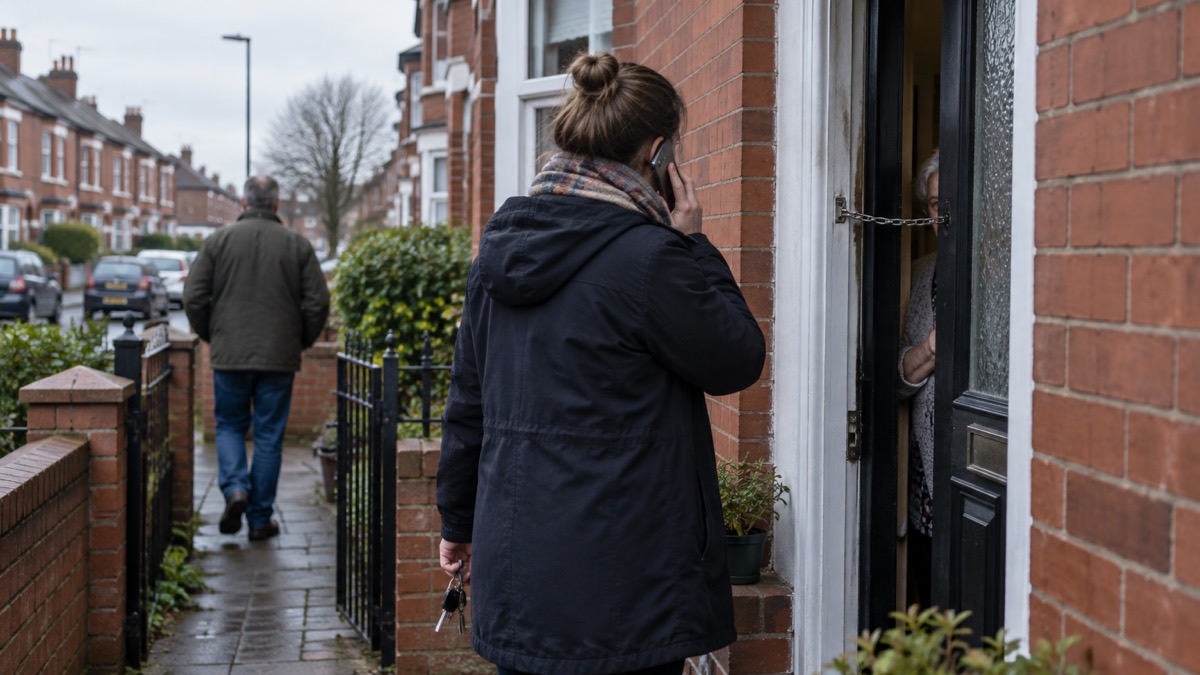
If calling 999 is difficult, for example because of hearing loss, the person can ask a trusted neighbour to assist in an emergency21. Agree now who that neighbour is, and make sure the person knows they can knock at any hour. A phone kept by the bed is worth arranging too: fire services suggest considering keeping a phone by your bed to call 999 if you cannot get out22.
For the wider picture, our guide to extra help in an emergency covers older, disabled and medically dependent households, and community resilience covers what a street or village can organise together. A Neighbourhood Watch scheme is one way to make sure a suspicious caller is reported by more than one household.
If the caller comes back later
A caller who returns is not starting from scratch, and neither are you. Keep front and back doors locked and check through a viewer or window before opening3. If the person is suspicious or will not leave, call 999 again1. If you have already reported them, say so, and give the earlier reference if you have one.
Report what happened even if they have gone. Our guide to how to report a bogus caller sets out the routes, and bogus callers: spotting and turning away doorstep crime covers the patterns to watch for. For non-emergency reporting, see when to call 999 or 101 about a crime at home.
A video doorbell or a peephole camera lets you see who is there and record what happened without opening the door. Our guides to video doorbells and to the EZVIZ HP3 Pro peephole camera explain what they do and what to check. If you record beyond your boundary, the data protection rules apply; see filming beyond your boundary.
Finally, think about the door itself. A door that is locked, with a viewer fitted and a chain or limiter, gives you the time to make the call. Our guides to doors and locks and to checking a doorstep caller is genuine go into the detail.
Sources (22)
- Doorstep crime and bogus callers, Police Scotland, 2026
- Bogus callers, Police Service of Northern Ireland, 2026
- Shut Out Scammers: more information, Police Scotland, 2020
- Doorstep crime, Avon and Somerset Police, 2026
- Break-in and housebreaking, Police Scotland, 2026
- Fire safety information for residents living in flats operating a stay safe policy, Greater Manchester Fire and Rescue Service, 2026
- Written statement: additional £0.5 million funding to improve access to defibrillators, Welsh Government, 2022
- Urgent and emergency care: 999 responders, North West Ambulance Service, 2026
- NHS urges public not to delay seeking medical help ahead of difficult strike, NHS England, 2026
- What to do if there's a fire, Devon and Somerset Fire and Rescue Service, 2021
- Fire safety information for residents living in flats operating a ‘Stay Safe’ policy - Greater Manchester Fire Rescue Service, Greater Manchester Fire and Rescue Service
- Fire safety information for residents living in flats operating an evacuation strategy, Greater Manchester Fire and Rescue Service, 2026
- Keeping warm, Cumberland Council, 2026
- If you have a fire, Devon and Somerset Fire and Rescue Service, 2026
- Be Ready: Household Emergency Plan, UK Government, 2026
- If you are trapped by fire, Essex Prepared
- Young People and Schools - Hampshire & Isle of Wight Fire & Rescue Service, Official website of Hampshire & Isle of Wight Fire & Rescue Service, Hampshire & Isle of Wight Fire & Rescue Service
- Preparing yourself for emergencies, London Resilience Partnership, 2026
- Fire safety in the home, Essex County Fire and Rescue Service, 2025
- Stay warm at winter, Belfast City Council, 2026
- For people with disabilities, Tyne and Wear Fire and Rescue Service, 2026
- Escape, Fire Kills, 2026
 After a Break-In Checklist
 Holiday Security Checklist
 Moving Home Locks Checklist
 When to Call 999 or 101
 Reporting a Burglary Anonymously
 Car Running While De-Icing
 Checking a Doorstep Caller
 Burglary at Christmas
 Cash in a Fire Safe
 Heating Oil Tank Theft
 Making a House Look Occupied
 Police Approved Products
 Reporting a Bogus Caller