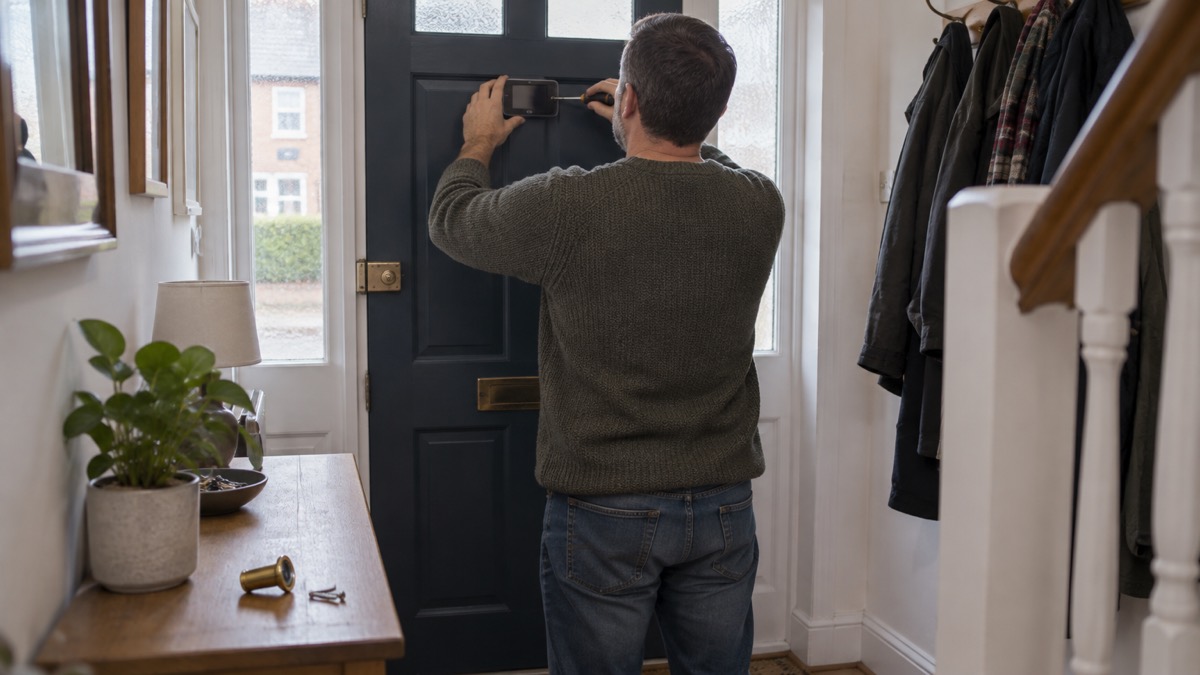
The EZVIZ HP3 Pro is a battery-powered video doorbell with a 2K camera, a 162° view and a built-in battery that can be topped up by an optional solar panel. It records to 32GB of storage inside the unit, and the maker states there is no subscription fee, so footage stays with you rather than in a paid cloud plan1. For a household that wants to see and speak to whoever is at the door without signing up to a monthly service, that combination is the reason to look at it.
The practical points are these. It sees 162° across the doorstep, records at 2K (2048 × 1296) and gives up to 6 m of night vision1. Its built-in 32GB storage holds up to 6 months of video history if it records 10 minutes of activity a day, according to the maker1. It is rated IP65 and works between -20°C and 50°C, so it is built for a British front door rather than a sheltered porch1. It connects on 2.4 GHz Wi-Fi only1.
This page sets out what the doorbell is, what its specifications mean in use, how recording works without a subscription, what the weather ratings allow, and how to fit, charge and secure it. It is one option among several kinds of door camera; if you are still deciding what sort of device suits your door, start with Video Doorbells: What They Do and How to Choose One.
What the EZVIZ HP3 Pro is and who it suits
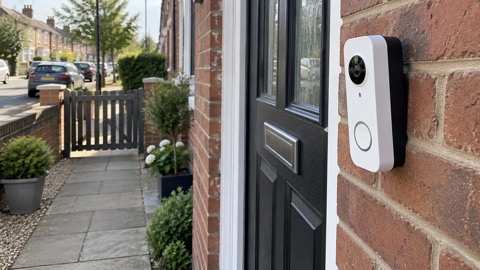
The maker describes the HP3 Pro as a "2K Battery-Powered Video Doorbell with Solar Panel"1. In plain terms it is a doorbell-shaped camera that fixes beside or in place of your door furniture, runs on its own battery rather than mains wiring, and talks to your phone over Wi-Fi. Because it does not need a mains feed at the door, it suits a rented flat, a solid brick wall or a hallway where running a cable would be awkward. The trade-off is that you have to keep the battery charged, or fit the solar panel to trickle power into it.
It is a camera and intercom first, and a security device second. The maker lists AI-powered human shape detection, so alerts are triggered by people rather than by moving branches, and a sound and light anti-dismantling alarm that can send an alert to your smartphone if someone tries to take it off the wall1. It also has a built-in high-power speaker and a high-sensitivity microphone for two-way conversation1. The maker states that the doorbell "prohibits unauthorized use after theft, thanks to the account binding restriction", so a stolen unit is tied to your account1.
It is not a substitute for a burglar alarm, and it will not call the police. If your concern is the whole house rather than the doorstep, read Burglar Alarm or CCTV Camera: Which Suits Your Home? before you buy. If you are weighing a doorbell against a separate outdoor camera, Video Doorbell or Outdoor Camera? sets out the difference.
Specifications: 2K video, 162° view and 6 m night vision
The headline figures decide what the doorbell can and cannot show you. A 162° diagonal view from a 2.3mm lens at F2.2 takes in a wide sweep of the doorstep, which is what you want for parcels left to one side and for seeing a caller's hands as well as their face1. The 1/2.8 inch progressive scan CMOS sensor is listed as supporting low light sensitivity, and the infrared cut filter gives night vision to a maximum of 6 m1. Six metres covers a path and the near edge of a drive; it will not light up a long garden.
| Specification | Figure |
|---|---|
| Maximum resolution | 2K (2048 × 1296)1 |
| Field of view | 162° diagonal1 |
| Lens | 2.3mm at F2.21 |
| Night vision | Up to 6 m1 |
| Frame rate | 15fps, fixed1 |
| Video compression | H.265 / H.2641 |
| Motion detection | AI-powered human shape detection1 |
| PIR sensing | 120° angle, up to 5 m, adjustable1 |
| Size | 50 × 31 × 147 mm1 |
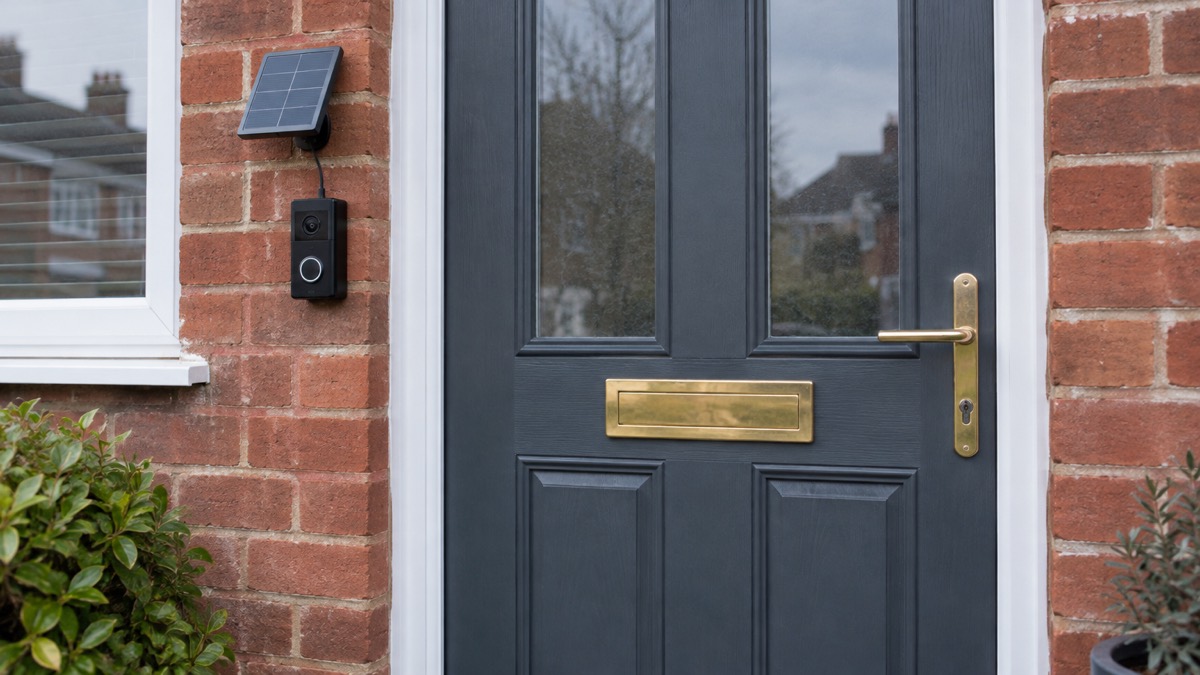
The passive infrared sensor that wakes the camera has its own limits: a 120° sensing angle and a maximum range of 5 m, adjustable so that high sensitivity reaches 5 m, medium 4 m and low up to 3 m1. That adjustment matters on a busy pavement, where a high setting will alert you to everyone who walks past. Turning it down to 3 m keeps alerts to people actually at your gate.
The fixed 15fps frame rate and H.265 or H.264 compression are ordinary for a doorbell and keep file sizes manageable on the built-in storage1. The 2D and 3D digital noise reduction helps in poor light1. None of this makes it a number plate reader or a face recognition system; it is a clear view of the doorstep, day and night, within 6 m.
Recording without a subscription: 32GB built-in storage for up to 6 months
The HP3 Pro records to built-in 32GB eMMC storage, and the maker states plainly: "No Subscription Fee"1. That is the feature most households care about, because it means the doorbell works as a recorder from the day you fit it, with no monthly plan and no cloud account needed to keep footage. The maker's own estimate is that it "can store up to 6 months of video history if it records 10 minutes of activities every day"1.
That six-month figure is a maker's estimate tied to a specific amount of activity, so treat it as a guide rather than a guarantee. A door on a quiet cul-de-sac that records a few callers a day will hold months of clips. A door on a main road where the sensor fires constantly will fill 32GB far sooner, and older clips will be overwritten. If you need longer retention, the answer is to review and export clips you want to keep, not to expect the card to hold everything forever.
For comparison, subscription services exist: one monitoring plan listed by a security firm offers "Unlimited camera recordings & 30-day cloud storage"2. The HP3 Pro takes the other approach, keeping recordings local and free of a recurring charge. Neither is wrong; they suit different households. What matters is knowing which you have bought.
Weather limits: IP65 and -20°C to 50°C
The HP3 Pro is rated IP65 and specified to work between -20°C and 50°C at humidity of 95 per cent or less, non-condensing1. IP65 means it is protected against dust and against water jets, which is the right rating for a device screwed to an outside wall in British weather. It is not a submersible rating. To see how that distinction works in practice, a maker of weatherproof kit describes its own IP65 pocket as "foul weather and spray proof", able to handle rain, splashes and spray but not submersible, with water able to enter if fully submerged3. The same logic applies here: rain and hose spray are fine, a doorstep that floods to above the unit is not.
The temperature range covers a hard frost and a hot south-facing wall. What it does not cover is the battery's behaviour in the cold. The maker gives the operating range for the unit, not a separate figure for how much capacity the 5200 mAh battery loses at -20°C, so plan on the basis that a cold snap may mean charging more often1.
Fitting it out of direct sun and driving rain helps twice over: it keeps the lens clear and it keeps the passive infrared sensor from cooking in summer heat, which is a common cause of false triggers on any outdoor sensor. The maker rates the unit for operation from -20°C to 50°C, with humidity of 95% or less and non-condensing, so siting it where it is not soaked or baked keeps it inside the conditions it is built for1.
Fitting, charging and keeping it secure
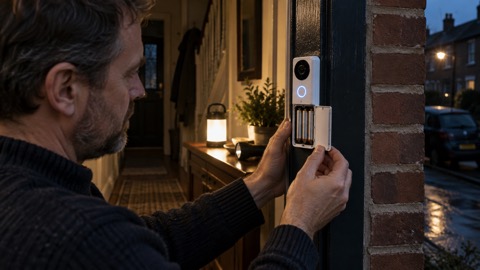
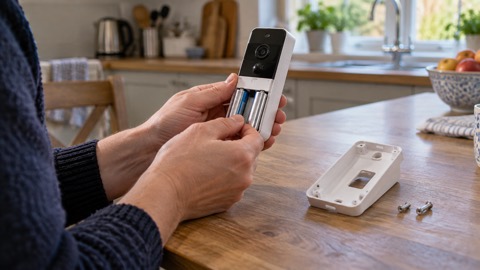
The box contains the battery doorbell, a mounting bracket, an inclined mounting bracket, a drill template for the solar panel, a power cable, a pin, two standard screw kits, a special screw kit, two U-shaped wires, two wire connectors, two regulatory information sheets and a quick start guide1. You get the doorbell and its fixings; the solar panel is a separate power option, not part of the box.
The maker lists three ways to power it: existing doorbell wiring at 8 to 24V AC, a USB type-C supply at 5V plus or minus 10 per cent, or the EZVIZ Doorbell Solar Panel1. The battery is a 5200 mAh rechargeable lithium unit and the device draws 3W maximum1. In order:
- Check your Wi-Fi reaches the door on 2.4 GHz before you drill anything; the doorbell does not use 5 GHz1.
- Fix the bracket using the drill template and the screw kits supplied, choosing a height that puts callers' faces within the 6 m night vision range1.
- Connect the power source you have chosen, whether existing chime wiring, a type-C supply or the solar panel1.
- Set the PIR sensitivity to suit your door, from 5 m on high down to 3 m on low, to cut false alerts1.
- Draw up to four privacy zones in the app to mask anything you should not be filming1.
On security of the device itself, the maker lists AES data encryption, TLS transmission encryption and end-to-end encryption, and certifies the product to CE, REACH, WEEE and RoHS1. EZVIZ states it has been awarded certification by DNV for information security (ISO/IEC 27001:2013), personal data protection (ISO/IEC 27701:2019) and cloud security (CSA STAR)4. Those are the maker's own statements about its systems. Your part is to use a strong, unique password on the EZVIZ account and keep the app updated; Camera and Doorbell Accounts: Stopping Strangers Getting In walks through that.
The maker states that Ezviz will support its products for at least four years from launch5, and Ezviz has been awarded by DNV for information security (ISO/IEC 27001:2013), personal data protection (ISO/IEC 27701:2019) and cloud security (CSA STAR) among others6. Check how long the model you are considering has been on sale, and keep your phone updated.
Support, updates and where to get help
The maker gives the model number as CS-HP3 Pro, which is what to quote to EZVIZ support or a retailer if you need warranty help1. On how long the doorbell will keep receiving software updates, EZVIZ has not published a figure for this model. Independent guidance states that "Ezviz will support its products for at least four years from launch"5. Treat four years as the floor to expect, not a promise specific to the HP3 Pro, and check the app for firmware updates periodically so the doorbell keeps working with your phone and stays patched.
If you want to understand how update support works across brands before you commit, How Long Do Cameras and Doorbells Get Software Updates? explains what to look for. If you are worried about the doorbell being tampered with or hacked, How to Stop Your Security Camera Being Hacked covers the practical steps.
Two limits are worth knowing before you rely on it. First, Google Assistant integration is partial: the maker states that users "can enable live streaming on their supported devices, but cannot receive incoming video calls or use the chime function"1. For chimes, the maker lists Amazon Alexa and existing mechanical or electric chimes at 8 to 24V AC1. Second, filming beyond your boundary brings data protection duties; Filming Beyond Your Boundary: CCTV, Doorbells and Data Protection sets out what that means for a doorbell that overlooks a pavement or a neighbour's garden.
For the wider picture on choosing, fitting and living with door cameras, the Home Security: A Household Guide section is the place to start. And if you are fitting a camera because of a break-in or a spate of doorstep crime, Bogus Callers: Spotting and Turning Away Doorstep Crime and After a Burglary: Crime Numbers, Insurers, Repairs and Support cover what to do alongside the technology.
Sources (6)
- EZVIZ HP3 Pro product page, EZVIZ, 2026-11-03
- Choose monitoring, SimpliSafe, 2026
- Original waterproof backpack user guide, OverBoard, 2026-10-28
- EZVIZ H8c 2K product page, EZVIZ, 2026-11-03
- Best indoor security cameras, Which?, 2026-08-18
- Latest on the KRACK Wi-Fi flaw, Get Safe Online, 2017-10-17

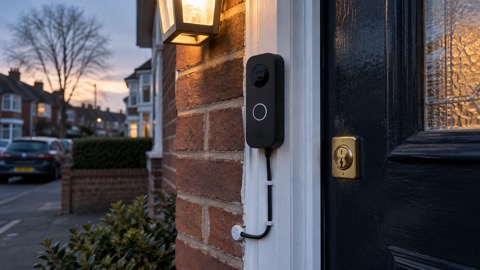 Ajax DoorBell
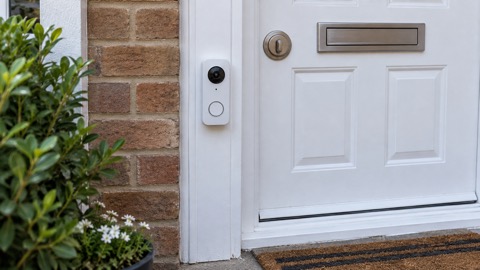 Arlo Essential 2K Doorbell
 Blink Battery Doorbell 2K+
 Blink Video Doorbell
 Google Nest Doorbell Battery
 Ring Battery Video Doorbell
 Ubiquiti UniFi Doorbell Lite
 Ubiquiti UniFi G4 Doorbell Pro