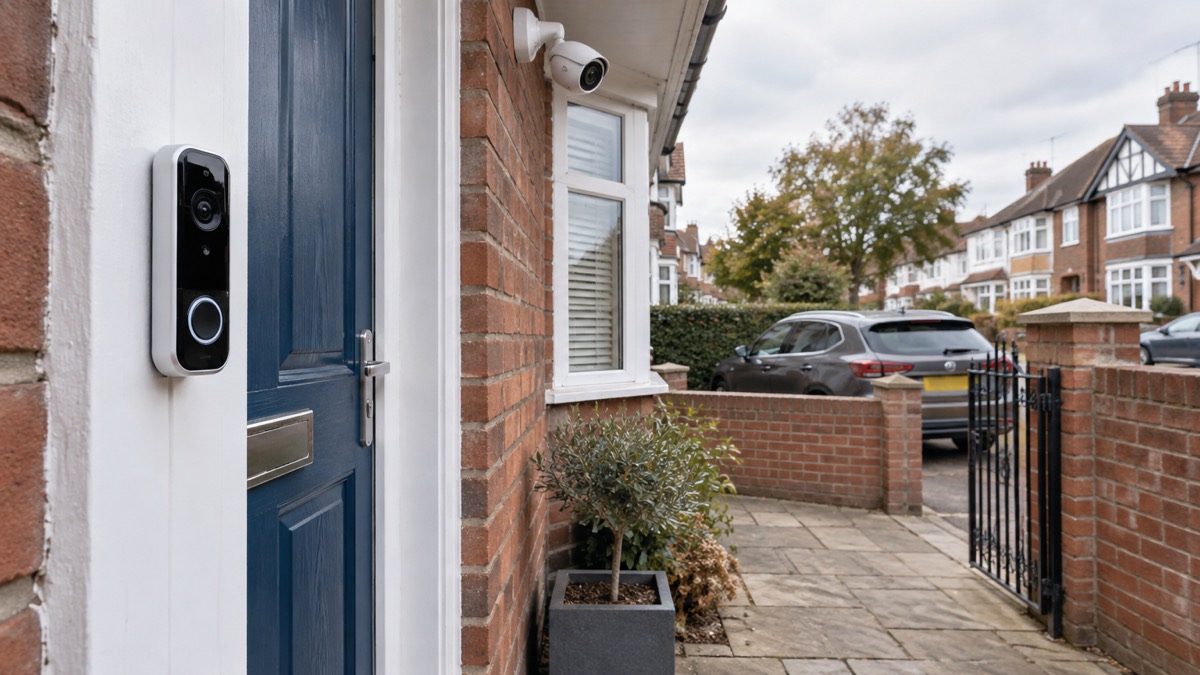
A video doorbell and an outdoor camera do different jobs at the front of a house, and most households only need one of them. A doorbell is for the moment someone knocks: it lets you see and speak to a caller before you open the door, and it records the doorstep. An outdoor camera is for watching a wider area, such as a drive, garden or side path, over longer periods.
The choice usually comes down to three things. What do you want to see: the person at the door, or the whole front of the property? How will it get power: a battery you recharge, existing doorbell wiring, or a plug? And what happens when the power or broadband goes off, which in the UK can last for a number of days after severe weather1?
Start with the doorstep. Official police advice is to fit a safety chain, intercom or video doorbell and viewer where possible, and always use it before opening the door to strangers2. A doorbell answers that need directly. A camera answers a different one: it captures evidence, and police forces note that burglars do not want to be seen3.
Doorbell or camera: what each one does for the household
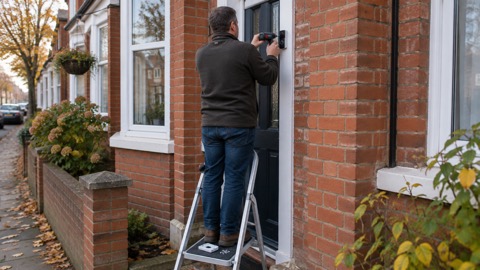
A video doorbell is a Wi-Fi-enabled smart doorbell that lets you see, hear and speak to visitors from your phone8. It is mounted at the door, at roughly the height of a caller's face, and it does two jobs at once: it lets you check who is there without opening up, and it records the few seconds around a knock. Charities advising older people recommend a peephole or video doorbell so you can see visitors without opening the door9. Northern Ireland's official home security guidance makes the same point in different words: a peephole or door viewer lets you see who is at the door, a chain or bar lets you open it a little way, and an intercom lets you speak to the caller10.
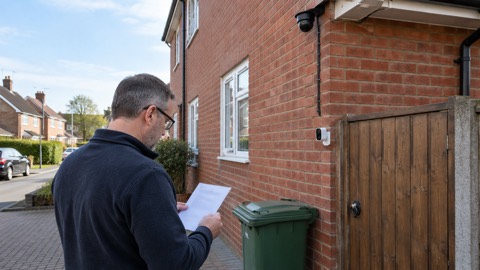
An outdoor camera is mounted to watch an area rather than a person. It is the right tool for a driveway, a garden gate, a side return or a back door, and it can be set to record continuously or when it detects movement. Some households combine the two, and alarm systems sold as smart packages may include a Wi-Fi CCTV camera, a video doorbell and an app to control the system together11.
The practical difference for an ordinary household is this. A doorbell changes what you do at the moment of a knock: you look, you speak, you decide whether to open. A camera changes what you know afterwards: who came up the drive, when the parcel was left, what happened while you were out. If your worry is bogus callers and doorstep crime, the doorbell is the closer fit. If your worry is the side gate or the car on the drive, the camera is.
What a video doorbell covers at the front door
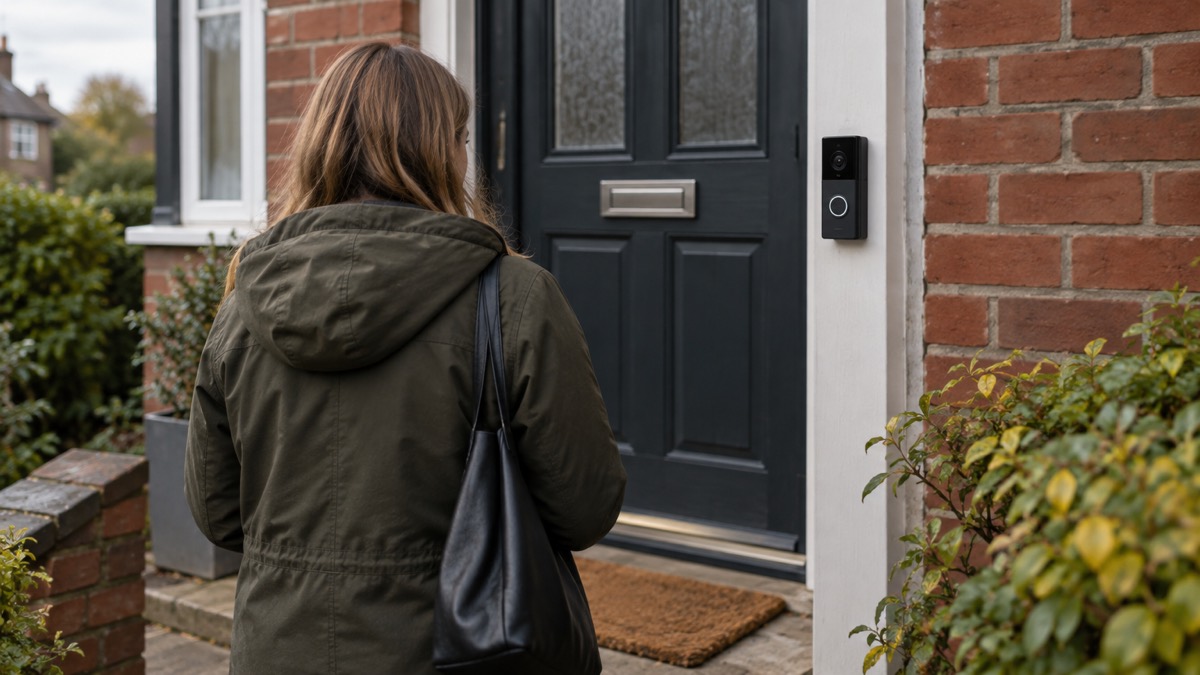
A doorbell's useful field is narrow and close. Independent testing found that good doorbells will spot someone up to 2.5 metres away4, which is roughly the depth of a front path. That is deliberate: the job is the person on the step, not the street.
Field of view varies a lot between models, and wider is not automatically better. One maker lists a 150° field of view on its current doorbell and 135° on the earlier version8, another lists 135°12, and a third quotes 176° diagonal13. A very wide lens takes in more of the path and any parcels left to the side, but faces at the edge of the frame can be distorted.
Night vision is where doorbells differ most, and the maker's label tells you what to expect. Some quote colour night vision, some low-light vision, some adaptive night vision that adjusts as light falls, and some plain infrared with a stated range: one maker gives up to 10 metres14, another up to 5 metres13. Motion detection range can be far longer than the range at which a face is recognisable. One wired model is quoted as detecting motion up to 31 metres away but recognising faces or objects only up to 6.3 metres14. Treat the recognition figure as the one that matters for identifying a caller.
Two other features are worth knowing about. A built-in siren lets you make a noise at the door from your phone; one maker describes its doorbell as a 4-in-1 device with a built-in siren15. And a doorbell can ring your existing indoor chime if it is wired to it; if it is not, the maker may offer a plug-in chime or a compatible smart speaker instead8.
Where an outdoor camera fits better
An outdoor camera earns its place when the thing you want to watch is not the doorstep. A drive, a garden, a rear alley, a shed or a side gate are all beyond the reach of a doorbell's 2.5 metre detection4, and a camera mounted to cover them will record movement across a much larger area.
The first decision is wired or wireless, and one maker sets the trade-off out plainly: wired CCTV is generally better for 24/7 recording, dependable power and stable video, making it suitable for larger homes, while wireless cameras are easier to install and reposition16. If you want continuous recording and never want to think about a battery, wired is the simpler answer. If you are renting, or the cable run is awkward, wireless gets you coverage without an electrician.
The second decision is what the camera does with what it sees. Some cameras are built to record continuously to a memory card, some to a recorder, and some only when they detect motion. A camera that records only on motion uses far less power, which matters on a battery, but it can miss the start of an event. A camera on mains power can record all the time.
Outdoor cameras also need to be weatherproof, and the IP rating is the figure to look for. IP65 appears across doorbells and cameras from several makers17, and means protection against dust and against water jets. Mount cameras under an eave where you can, keep the lens clean, and check the rating before you buy.
If you are weighing up the wider question of cameras against alarms, our guide to home cameras and CCTV sets out the types, and burglar alarms covers the alternative approach of detecting entry rather than filming it.
What happens in a power cut or broadband outage
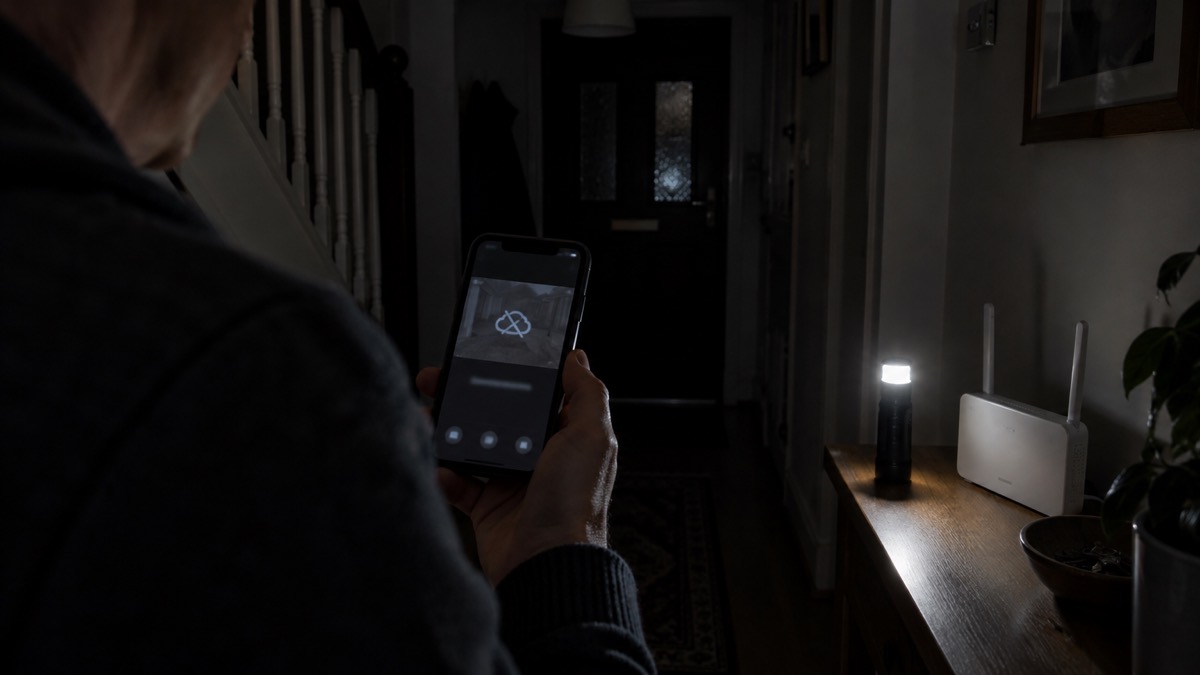
This is the section most households skip, and it is the one that decides whether the kit is any use on the night it matters. In a power cut, gas boilers and heating, electrical appliances and your home's internet and landline connections will stop working, and you might also lose mobile phone signal19. Your home broadband services, including any digital landline, will not work during a power cut unless you have an additional power source20. Internet services, landline phones, heat pumps, electric boilers and some mobile phone networks may not work5.
For a doorbell or camera, that means the app on your phone may show nothing at all, even though the device itself is fine. A battery doorbell will keep watching and recording locally, but you may not be able to see the live view until the connection returns. A mains-powered camera will simply stop.
Outages are usually short or localised, but after severe weather disruption can last for a number of days1. If your mobile, broadband or landline is unavailable after a severe weather event, report it to your provider if you can, which helps faults get fixed sooner20.
To report a power cut, call 1056. During a planned outage, equipment such as solar panels, heat pumps, EV chargers and batteries switches off automatically to protect the home and engineers, and should not be damaged23. Our guide to keeping your home protected in a power cut covers the wider preparations, and backup power at home explains what can keep a router or a camera running.
Battery or wired: how power affects reliability
The power question is the one that decides how much maintenance you take on. Wired doorbells require existing doorbell wiring, along with a standard 18-volt AC supply to power the camera4. Makers vary the specification: one wired model needs 8-24VAC and is compatible with standard doorbell wiring14, and a premium wired model needs either PoE+ or a standard doorbell system at 16 to 24VAC, 10 to 40VA24. Check the requirement against what is already at your door before buying.
Battery models suit homes without existing doorbell wiring, while wired Wi-Fi and PoE models provide continuous power for households with compatible wiring or Ethernet connections7. One maker states that if you want easy installation, recording during power outages and portability, a battery-powered doorbell is the better fit7. Another offers a battery doorbell that can also be hardwired for continuous power17, and a third sells a battery model that automatically switches to battery mode during a power cut to keep the front door protected18.
| What you have at the door | Sensible choice | What to expect |
|---|---|---|
| Existing doorbell wiring and a chime | Wired doorbell | Always-on power, rings the indoor chime8 |
| No wiring, renting, or a listed frontage | Battery doorbell | Recharge or replace batteries; keeps recording in a power cut7 |
| Ethernet to the door or a PoE switch | PoE doorbell or camera | Power and data down one cable24 |
| A peephole but no wiring | Peephole camera | Fits renters and owners with a peephole25 |
Battery life depends on settings and use, and the maker's figure is the one to trust for its own product. One maker states its three AA lithium batteries last up to two years under default settings and typical use8. Cold weather shortens that, so check the charge before winter and before you go away. Police pre-holiday advice is blunt: make sure any video doorbells are fully charged and operating before you leave26.
If you want the fuller comparison, our page on battery or wired video doorbells goes through it in more depth.
Pointing a camera beyond your property and data protection rules
You can legally install cameras outside your house in the UK, and you should aim them mainly at your own property16. The rules change when the lens takes in more than that. If you record within the boundaries of your own property for purely personal and household use, it does not come under data protection laws; if the doorbell records any area outside the property, such as a neighbour's property, a shared area or public property, complying with the UK's data protection laws is essential7.
In practice that means four things when you record beyond your boundary: display proper signage, respect others' privacy, handle data securely, and provide or delete footage of individuals when requested7. Point the camera down and inwards where you can, use privacy zones if the model has them, and think about the angle before you drill.
The same rules protect you. It is not automatically illegal for a neighbour to use CCTV for home security, but cameras covering your garden, windows, shared areas or the street must be used fairly and follow UK data protection rules; raise the concern with the neighbour first, and the Information Commissioner's Office provides guidance and a complaints process16.
Our guide to filming beyond your boundary covers the data protection side in full, and camera and doorbell accounts explains how to lock down the account that holds your footage.
Setting up and storing recordings safely
Where the footage lives decides what you can do with it, and whether you pay every month. The options fall into three groups.
- Local storage on the device. Some doorbells record to a microSD card inside the unit. One maker states that 24/7 recordings are stored only on the doorbell's microSD card, while motion recordings are kept on a recorder or hub if you have one18.
- Local storage on a hub or recorder. Some systems need a separate module and a USB drive before they can store anything; one maker states its doorbell has no way to store clips by itself and requires a sync module with a recognised USB drive, sold separately12.
- Cloud storage on a subscription. Some doorbells have no local storage and rely on a cloud plan, others offer free local storage with cloud storage on a subscription, and some need no subscription unless you want cloud services4.
Check what you get without paying. One maker states that without a subscription you can still live stream video, receive doorbell calls and motion notifications, and use two-way audio, with local storage through its hub or base station15. Another requires a paid plan for cloud video history, package and person detection, custom detection zones, smart alerts and voicemail15. If you record outside your property, remember the data protection duty to handle footage securely and to provide or delete footage of individuals when requested7.
Set-up itself is usually a phone job. One maker describes three steps: connect by syncing to the app, mount by screwing the bracket and clicking the doorbell in, and recharge by inserting a removal tool and detaching it from the wall25. Wired models are different: one maker strongly recommends professional installation for its wired doorbell even though DIY setup is possible14. If you rent, ask your landlord before drilling or changing wiring, since tenants may need permission to make changes to the premises28, and leaseholders should check the lease and consult the landlord29.
Finally, treat the camera as one part of home security, not the whole of it. Fire services advise keeping entry points secure and considering security systems such as CCTV, alarms and security lighting28. Our guide to how burglars choose a home explains what puts them off, and doors and locks covers the physical side.
Sources (29)
- Phone and broadband outages, Prepare (UK Government), 2026-10-12
- Doorstep crime, Avon and Somerset Police, 2026-11-02
- Burglary, Gloucestershire Constabulary, 2026-11-02
- How to buy the best smart video doorbell, Which?, 2026-10-16
- Power cut, British Red Cross, 2026-10-25
- Be winter ready, SGN, 2026
- Reolink video doorbells, Reolink, 2026-11-03
- Blink Video Doorbell (2nd Gen) FAQ, Blink, 2026-11-03
- Staying safe and secure at home, Alzheimer's Society, 2026-10-29
- Securing your home, nidirect, 2024-01-23
- Protecting your home: alarm systems, SSAIB, 2026-11-02
- Blink Video Doorbell FAQ, Blink, 2026-11-03
- EZVIZ DB2 Pro Video Doorbell, EZVIZ, 2026-11-03
- Ring Wired Video Doorbell 2K (2nd Gen), Ring, 2026-11-03
- Arlo video doorbells, Arlo, 2026
- eufy outdoor security cameras, eufy, 2026-11-03
- Arlo Essential 2K Wireless Video Doorbell, Arlo, 2026
- Reolink Battery Video Doorbell (2nd Gen), Reolink, 2026-11-02
- Storms and bad weather, Energy Networks Association, 2026-10-25
- Stay connected in severe weather, Mobile UK (Ofcom), 2026-10-23
- Disabled people and carers, Ready Scotland, 2026-10-25
- Power cuts, Prepare (UK Government), 2026-10-21
- Planned outage, SSEN, 2026-10-29
- Ring Wired Video Doorbell Elite (2nd Gen), Ring, 2026-11-03
- Ring Battery Video Doorbell 2K (2nd Gen), Ring, 2026-11-03
- Pre-holiday routine, Avon and Somerset Police, 2026-11-02
- Best indoor security cameras, Which?, 2026-08-18
- Fire safety in the home, Essex Fire and Rescue Service, 2025-02
- Fire doors, London Fire Brigade, 2026-10-25
 Alarm vs Camera
 Battery vs Wired Doorbell
 Wired or Battery Cameras