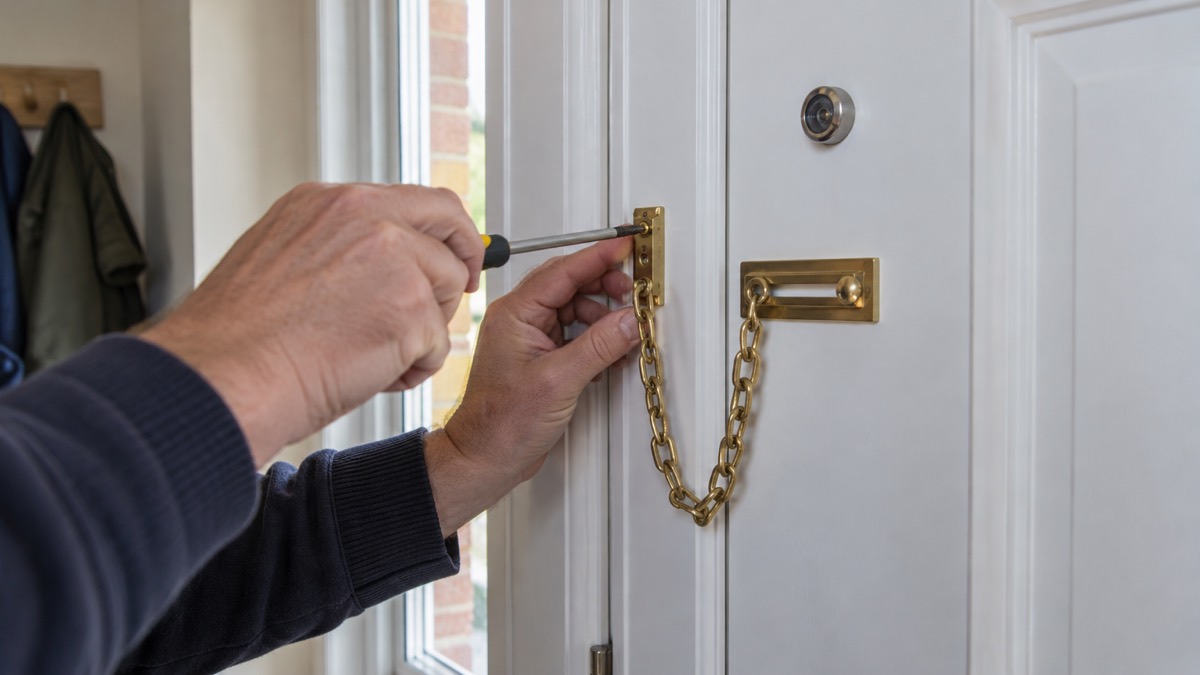
When someone knocks at your door that you were not expecting, the police advice is simple and it works in three words: lock, stop and check. Keep your front and back doors locked, stop and look through a door viewer or window before you open anything, and check that the caller has both an appointment you can verify and identification you have confirmed yourself1. Only then consider letting them in.
You never have to open your door to anyone. Callers should always be asked for proof of identity, and no access should be given until you have verified it yourself, by phone, using a number you look up rather than one the caller gives you. Genuine callers will be only too happy to provide this information2. If you feel scared or threatened at any point, call 999 and ask for the police1.
This page sets out what a bogus caller is, the warning signs police and water companies say to watch for, how to check a caller without letting them in, how to protect an older relative, and how to report what happened.
What a bogus caller is
A bogus caller is a person who visits or calls someone under false pretences, typically for the purpose of theft or fraud4. They may pretend to be from utility suppliers and other reputable organisations in order to gain access to a property, and once inside they steal money and valuables2. This is what is often called distraction burglary: one caller keeps you talking at the door or in one room while the point of the visit is to take things from another.
Bogus callers and rogue traders can be persuasive, and they deliberately target vulnerable members of society2. They usually target elderly or vulnerable people7. That does not mean everyone else is safe: anyone can be caught out by a confident stranger with a plausible story, a uniform or a clipboard. What makes this crime work is not force, it is the caller's ability to sound official and to create a reason why you should act now rather than check.
Bogus callers are one part of a wider pattern of scams, which include emails, social media, fake websites, fake online advertisements, romance scams, holiday-let scams, ticketing scams, and scammers pretending to be a family member or friend requesting money8. The same rule runs through all of them: be aware of the warning signs and report any concerns you may have4. If a message or a call makes you suspicious, stop, break the contact, and consider the language it uses9. If you receive a call you believe to be fraudulent, hang up10.
Lock, stop, check: what to do when someone unexpected knocks
Police Scotland's advice for dealing with bogus callers and rogue traders is built around three words, and it is worth a household knowing them before the knock comes rather than during it1.
- Lock. Keep front and back doors locked. A bogus caller working in pairs will sometimes knock at the front while an accomplice tries the back, so an unlocked back door is as much of a risk as an open front one1.
- Stop. Before you open anything, look through a door viewer or window and see who is there. If you do not recognise them and were not expecting them, you can decide not to open the door at all1.
- Check. Only let callers in when they have an appointment you were expecting and identification you have confirmed yourself. If either is missing, keep the door shut1.
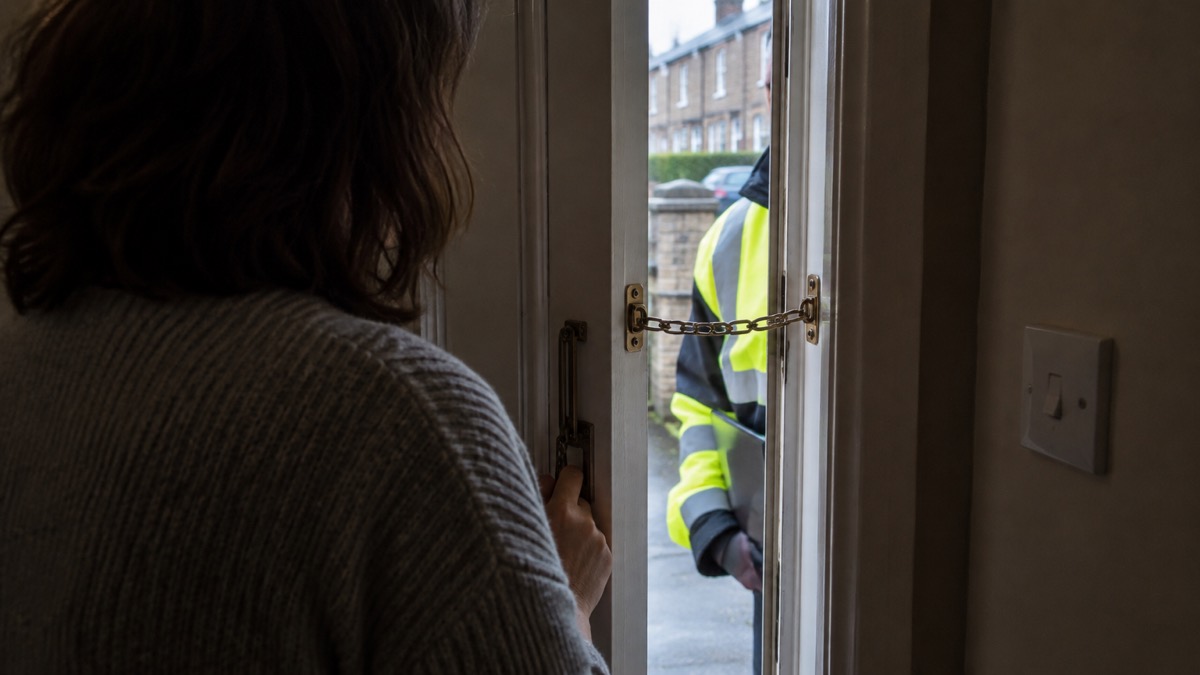
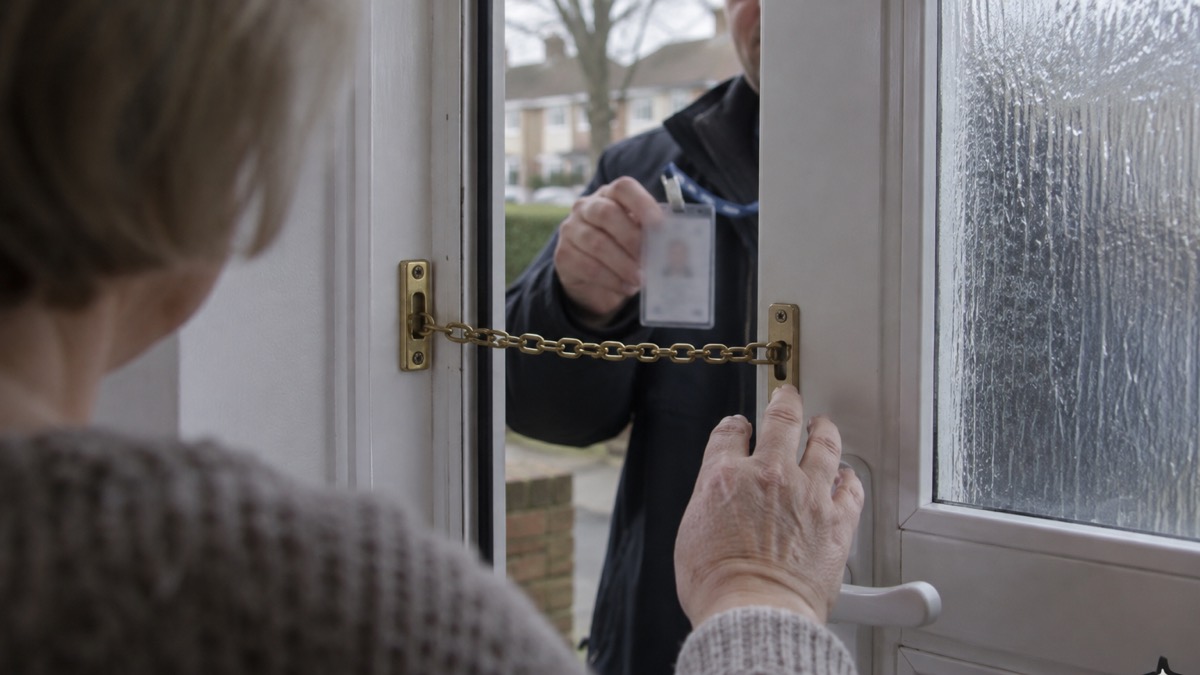
Two habits make this easier in practice. The first is a door chain or limiter, fitted so you can open the door a few centimetres to talk and take an ID card without the door being openable. The second is a door viewer, so you can see who is calling without them knowing whether you are in. Both are covered in more detail in our guide to doors and locks, and a video doorbell lets you see and speak to a caller without going to the door at all.
If you are in any doubt, do not open the door. Police advice following reports of unsolicited callers is blunt: do not permit them into your home, and report any activity that raises your suspicions to police immediately6. You are not being rude by refusing. A genuine caller will wait, and will not mind being checked.
"Not all cold callers are rogue traders or fraudsters however those intent on committing crime, will employ any tactic to engage you and lower your guard."
Ask for identity and keep them outside until you have checked it
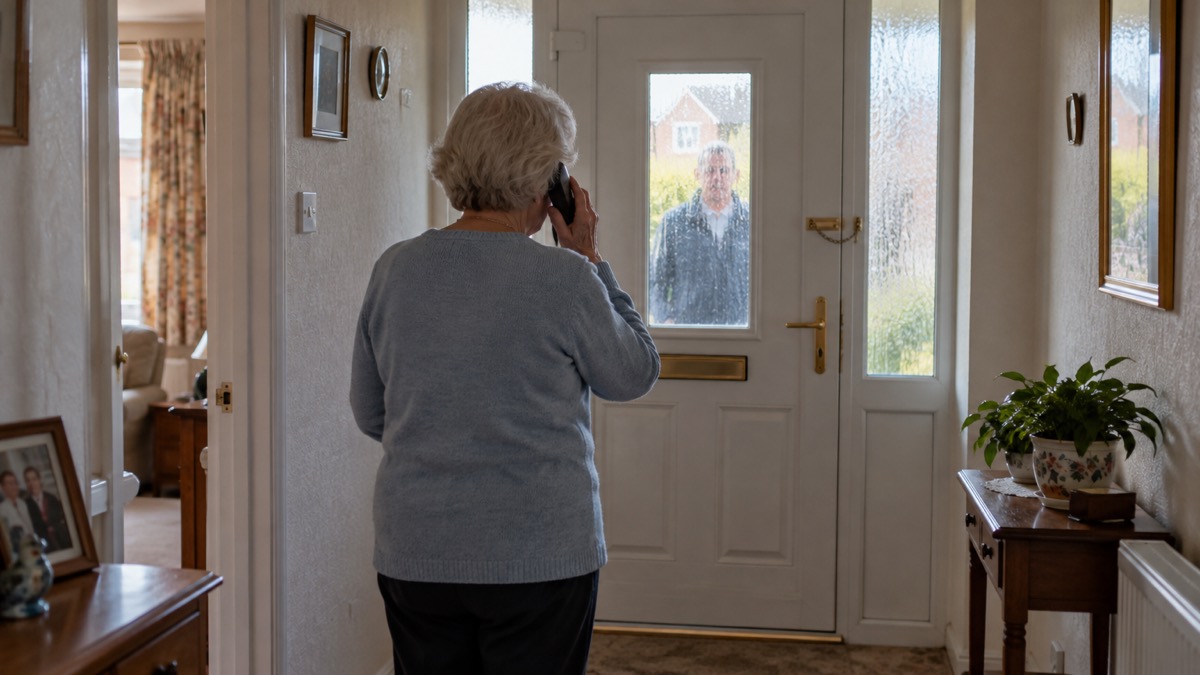
Ask the caller for their identification and check it carefully. Ask them to wait outside, and close the door while you verify it2. That last step is the one people skip, and it is the one that matters: the check has to happen with the door shut and the caller out of earshot, because a common trick is to give you a number to ring that goes straight back to an accomplice.
Verify the caller by looking up the organisation's own number independently, for example from a recent bill, and calling that. For callers who claim to work for an energy or water network company in Northern Ireland, there is a dedicated scheme for exactly this: Quick Check 101. You can phone 101, the police non-emergency number, to check the identity of callers to your home who claim to work for an energy or water network company, and the scheme exists to help stop bogus callers3. Water companies elsewhere run their own arrangements: Dŵr Cymru Welsh Water publishes doorstep password schemes so a customer and the company agree a word in advance that any genuine caller will know, which is covered in our guide to doorstep password schemes from water and energy companies.
If in doubt, call the police2. That applies to callers claiming to be from heating supply or other companies too: official winter guidance warns people, particularly older people, to keep an eye out for bogus officials who may call door-to-door without an appointment, and to always check the identity of callers11.
A genuine caller will not rush you, will not object to the door being closed on them, and will not mind you phoning to confirm them. Anyone who does object to being checked has answered the question for you.
Warning signs: no appointment, pressure, and working in pairs
Dŵr Cymru Welsh Water lists the warning signs to look for when someone knocks on your door. A bogus caller will typically7:
- not have an appointment
- not be willing for you to study their identity card, if they have one
- often work in pairs
- try to make you feel under pressure
- ask for money
Each of these is a reason to keep the door shut, and together they are close to conclusive. The pressure element deserves particular attention, because urgency is the signature of a scam in every channel, not just the doorstep. National Cyber Security Centre guidance on scam messages lists being urged to act immediately or within a limited timeframe as a warning sign12, and the same psychology is used face to face: a burst pipe, a gas smell, an urgent problem with your roof that must be fixed today.
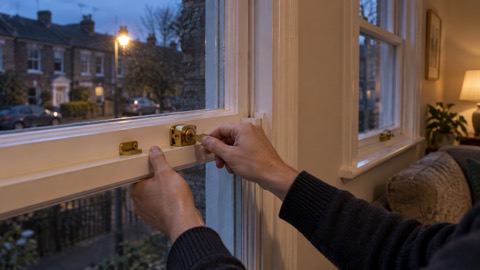
The pair working together is the classic distraction burglary set-up. One caller engages you at the front door, often with an official-sounding story about water or gas, while the second slips in through an unlocked back door or an open ground-floor window. This is why the "lock" in lock, stop, check covers both doors, and why you should lock the back door before answering the front, not after. Our guide to windows: locks, glazing and ground-floor risks covers the other half of that risk.
If you are persistently receiving silent phone calls, do not say anything when you answer: legitimate callers will identify themselves13. Silent calls are sometimes used to find out when a home is occupied before a doorstep visit.
Callers posing as water, energy and utility workers
Bogus callers may pretend to be from utility suppliers and other reputable organisations in order to gain access to a property and steal money and valuables2. The utility impersonation works because it comes with a built-in reason to come inside: a leak, a meter, a safety check. It also comes with a built-in urgency, which supplies the pressure the caller needs.
The defence is the same as for any other caller, with one addition. Ask for identification, check it carefully, ask them to wait outside and close the door2. Then verify them by phone. In Northern Ireland, Quick Check 101 exists precisely for this: phone 101 to check the identity of callers who claim to work for an energy or water network company3. Elsewhere, call the company's own published number, or the number on a recent bill, and ask them to confirm the visit and the caller's name. Never use a number the caller hands you.
Water companies also offer extra protection for households that need it. Dŵr Cymru Welsh Water's guidance for its priority services customers includes a Bogus Caller Helpline on 0800 281 141, which you can call if you are in any doubt, and the company can tell you whether your caller is genuine7. Households that may qualify for water companies' priority services, including older and disabled customers, can read more in our guide to extra help in an emergency.
Doorstep traders and urgent "repairs" to your roof or driveway
A different kind of doorstep scam does not aim to get inside your home, it aims to get your money. A cold-caller may offer you a service you do not really need, claiming to have noticed something about your property that needs doing, and offering to fix it for cash or an inflated price5. The classic version is an unexpected caller warning of a problem with your roof or driveway that needs urgent fixing5.
Police describe these rogue traders as trying to talk householders into paying for services. They will often be unqualified to carry out these services and will either do a poor job or may take the payment and not do the job at all2. The work, if it happens, can leave a roof or drive in a worse state than before, and the caller will be long gone.
The consequences can be severe. Police Scotland recount the case of an 80-year-old man, Rod, who was charged £4,800 by a cold-calling roofer for dislodged roof tiles, and was told to tell bank staff the money was for his son. Bank staff used the Banking Protocol, police spoke to him, and his money was saved5. Two things stand out. First, the sum involved: this is not petty theft. Second, the instruction to lie to the bank: any caller who coaches you on what to say to bank staff is committing fraud, and the bank staff are trained to spot exactly this.
The rules for doorstep traders are therefore the same as for bogus officials, plus one more: never agree work on the spot, never pay cash up front, and never take a stranger's word for the condition of your roof. If you are told something is urgent, that urgency is the warning sign, not the reason to act. Your rights when someone sells to you at the door, and who to tell about a rogue trader, are covered in our guide to rogue traders and doorstep selling.
Never hand over your PIN, bank card or cash
Never disclose your PIN, and never let anyone persuade you to hand over your bank card, financial information or cash5. This applies whatever the story: a courier collecting a card, a utility worker who needs a deposit, a trader who needs cash today to start tomorrow.
Official guidance is consistent across every agency that has written on this. Never give your bank card or PIN number to a stranger14. Never provide bank or card details to anyone who has contacted you unannounced14. If in doubt, end the conversation: a genuine caller will not mind you checking who they are before you say anything14.
If a caller asks you to withdraw cash, that request alone tells you they are not genuine. If they tell you what to say to bank staff, as the roofer told Rod, they are coaching you to help them commit fraud5. Bank staff are trained to question unusual withdrawals, and answering their questions honestly is what saved Rod's money.
If you believe a call or visit is fraudulent, break off contact. If you receive a call you believe to be fraudulent, hang up10. If you have received nuisance, suspicious or unwanted phone calls, hang up and contact your phone provider12. Some areas also offer technical help: Buckinghamshire and Surrey Trading Standards issue and fit free call blockers for eligible residents, which block up to 95% of nuisance calls15, reducing the phone calls that so often precede a doorstep visit.
Who bogus callers target, and how to protect an older relative
Bogus callers usually target elderly or vulnerable people7, and police confirm that they will target vulnerable members of society2. If you have an older relative, neighbour or friend, the most useful things you can do are practical and small.
- Talk through lock, stop, check with them, so the routine is familiar before it is needed: doors locked, look before opening, appointment and ID confirmed before entry1.
- Agree that no uninvited caller comes in, ever, and that anything to do with money, cards or the roof is discussed with family first, not with the person at the door6.
- Help them set up verification: a doorstep password with their water company, the Quick Check 101 scheme if they are in Northern Ireland3, and the Bogus Caller Helpline on 0800 281 141 if they are a Dŵr Cymru customer7.
- Check their door hardware: a chain, a viewer, and locks they can operate easily. Our guides to doors and locks and key safes for carers and responders cover the options.
- Look out for them between visits. Official winter guidance asks neighbours and communities to keep an eye out for bogus officials calling door-to-door without an appointment11.
- Know the warning signs of pressure, and be ready to report concerns: police guidance on protecting vulnerable adults says that if you feel in immediate danger, call 999 immediately16, and that applies to a relative you are worried about too.
Police forces also ask anyone supporting a vulnerable adult to report suspicious approaches rather than assume nothing can be done. A caller who gets no money from one address will try the next, so a report protects other households as well.
Keeping doors and keys secure
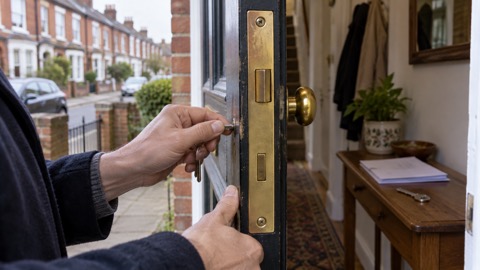
Good home security, such as using window and door locks, is the best way to reduce your chances of being burgled17. Against bogus callers specifically, the police advice is never to leave doors unlocked, and not to leave keys in an unsafe place such as under doormats or flower pots2. A key hidden outside defeats every lock it opens, and a caller who has watched a house once knows where to look.
The habits that matter day to day:
- Keep front and back doors locked, including when you are in and when you answer the door1.
- Never leave keys under doormats, flower pots or other obvious places2.
- Use window and door locks routinely, not just when you go away17.
- Keep a spare key with a trusted neighbour or family member rather than hidden at the property; our guide to keys: spares, hiding places and lost sets sets out the options.
The same caution extends to the digital doorstep. Hackers may target outdated software with weaker security, so keep all software and systems up to date, including mobile phones, and use strong passwords18. The UK government's fraud advice service, Stop! Think Fraud, offers advice and tools to protect yourself from fraud18. A scam that begins with a phone call or a message often ends at your door, and vice versa, so treat an unexpected caller and an unexpected message with the same rule: stop, break the contact, and check independently9.
Report it: 101, or 999 if you feel threatened
Call 101 to report any suspicious activity. If you feel scared or threatened, call 999 and ask for the police1. That is the core of it, and it applies whether the caller got in, got money, or simply knocked and left.
What to do, in order:
- If you feel threatened or in immediate danger, call 999 immediately16. Do not wait, and do not go back to the door.
- If it is not an emergency, call 101 and report what happened1. In Northern Ireland, call the PSNI on 101, or 999 if it is an emergency, and describe the caller as best you can8.
- Describe the caller: appearance, clothing, accent, what they said, any vehicle including a registration if you saw one safely, and whether anyone was with them8.
- If you prefer to report anonymously, call Crimestoppers on 0800 555 1114. In Scotland, you can also report scammers and fraudsters anonymously through Crimestoppers1.
- If you have been burgled, call the police immediately on 99917. Our guides on coming home to a break-in and after a burglary cover what follows.
Report even approaches where nothing was taken. Police guidance is to be aware of the warning signs and report any concerns you may have4, and a pattern of reports is often what lets police connect one caller to several addresses. If you receive a visit from someone you believe is a bogus caller, the description you give is what officers will work from, so note details down while they are fresh rather than afterwards.
For anyone who wants to go further, our guide to how to report a bogus caller sets out the full process, and how to check a doorstep caller is genuine covers verification in detail.
Sources (18)
- Shut Out Scammers: more information, Police Scotland
- Bogus callers, Police Service of Northern Ireland
- Dealing with a caller at my home, Utility Regulator for Northern Ireland
- Bogus callers: community safety advice, Belfast City Council
- Doorstep scam: Take Five personal advice, Police Scotland
- Police issue advice following cold caller reports, Police Service of Northern Ireland
- Protect yourself from bogus callers, Dŵr Cymru Welsh Water
- Scams and bogus callers, Belfast City Council
- Phishing scams: how to spot and report them, National Cyber Security Centre
- Docs and cops warn on COVID-19 cons, NHS England
- Keep warm in winter, Derbyshire County Council
- Data breaches guidance, National Cyber Security Centre
- Protect Yourself booklet, Police Service of Northern Ireland
- COVID-19 and scams, Nottinghamshire County Council
- Prepare for emergencies: risks, Surrey County Council
- Protecting vulnerable adults, Avon and Somerset Police
- House security, Police Service of Northern Ireland
- Hacked accounts advice, Police Scotland
 After a Break-In Checklist
 Holiday Security Checklist
 Moving Home Locks Checklist
 After a Burglary
 Coming Home to a Break-In
 Catalytic Converter Theft
 Riots and Disorder Near Home
 Securing a Damaged Home
 Dogs as a Burglar Deterrent
 Doorstep Selling and Your Rights
 Empty Homes and Long Absences
 Leaving Home on Holiday
 How Burglars Choose a Home
 Home Insurance Conditions
 Keyless Car Theft