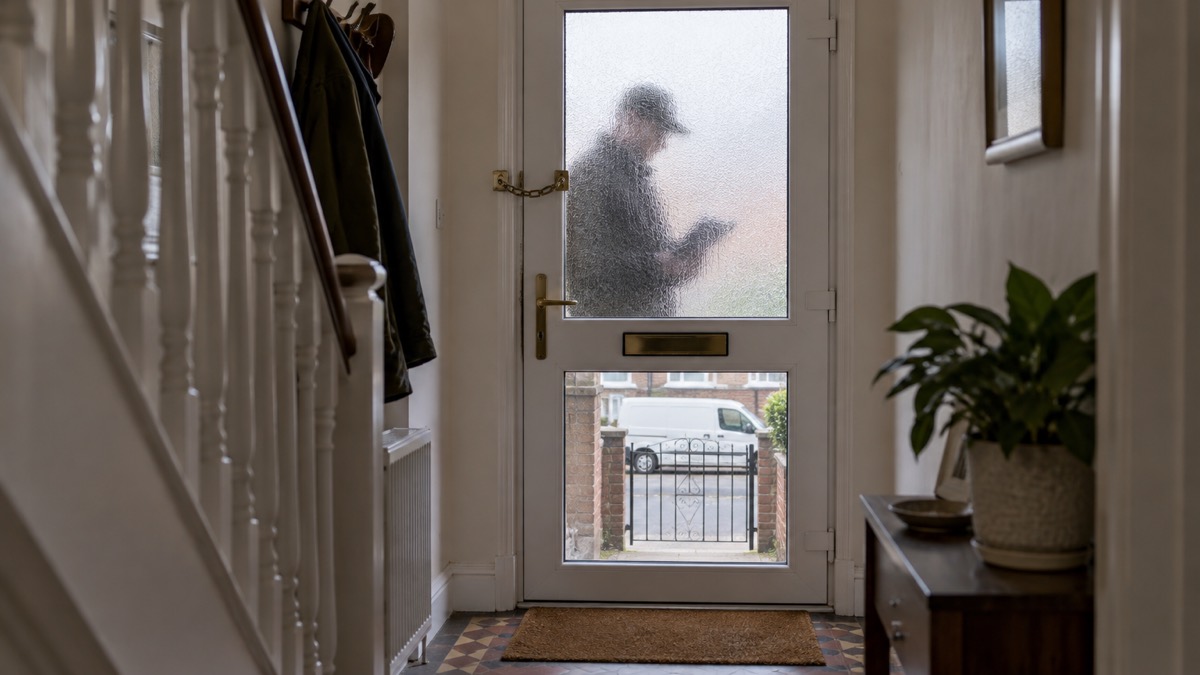
Someone knocking at your door offering to do work on your home is one of the most common ways households lose money to fraud. The advice from police forces and councils is consistent: do not let someone who appears at your door unannounced carry out the work, always use reputable building contractors, and do not pay in advance1. If a caller makes you suspicious, stop, break the contact, and take time to think about any offer, even if it turns out to be genuine2.
The rules to hold on to are simple. Keep your front and back doors locked, check who is there before you open, and only let a caller in when you were expecting them and have confirmed their identity3. Never hand over money, sign anything or give bank details on the doorstep. If you feel scared or threatened, call 999 and ask for the police; to report suspicious activity that is not an emergency, call 1013. To report a rogue trader to Trading Standards, call 0808 164 60003.
What to do when someone offers work at your door
The immediate answer is: say no, or say you need time, and close the conversation. Police Scotland's doorstep scam advice is to take the time to think about any offer, even if it is genuine, and not to be embarrassed to say "No" or ask the caller to leave5. A genuine trader will accept that you want to think it over. A rogue trader will not, and that pressure is itself a warning sign.
A cold-caller may offer you a service you do not really need, claiming to have noticed something about your property that needs doing, and offering to fix it for cash or at an inflated price5. A clear warning sign is being asked to make an upfront payment before any work is carried out5. Councils that deal with the aftermath of floods and fires give the same warning: be wary of anyone who knocks on your door offering building or repair work, and check their credentials first6; be cautious of anyone offering services at excessive prices or demanding upfront payment7.
The steps to take, in order:
- Do not open the door fully, or open it on a chain, and do not let the caller in3.
- Do not agree to any work, and do not discuss price as if the job is settled5.
- Do not pay anything upfront, and do not hand over cash5.
- Say you need to think about it, or ask them to leave5.
- Talk it through with someone you trust before making any decision.
- If the caller is suspicious or will not leave, call 101; if you feel scared or threatened, call 9993.
If you have already agreed something on the doorstep, do not pay any more money, and contact the consumer advice lines in the reporting section below before the caller returns. Never provide bank or card details to anyone who has contacted you unannounced9.
Lock, stop and check before you open the door
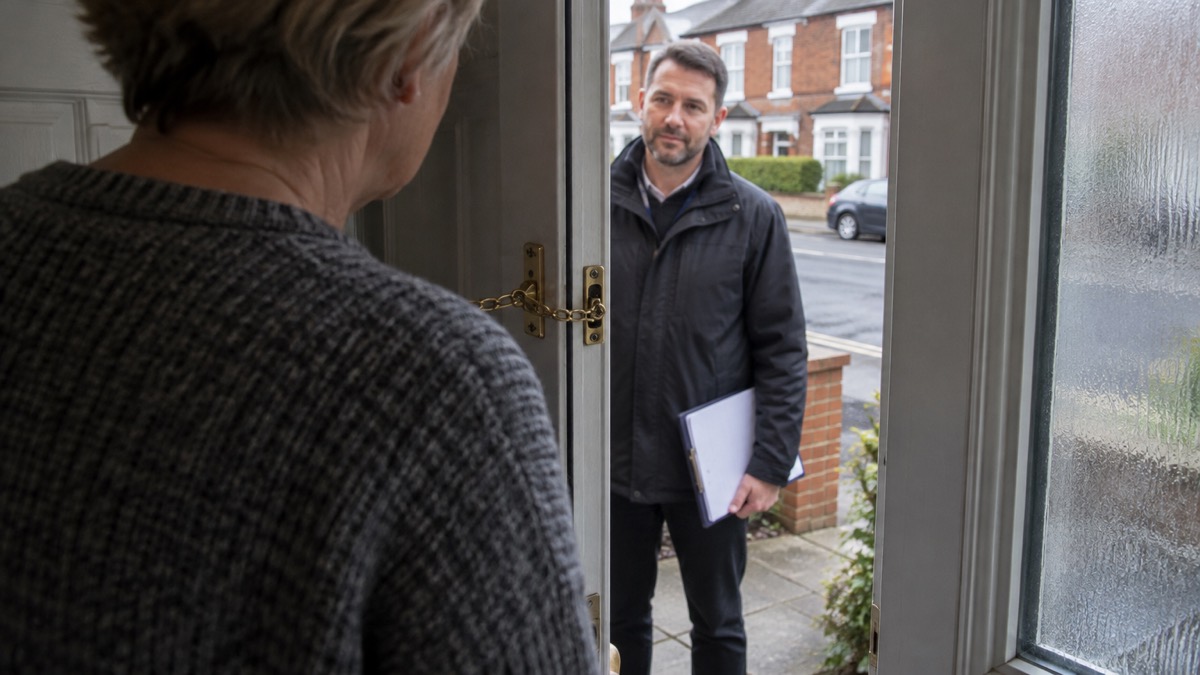
Police Scotland's campaign against doorstep crime gives the routine a name: LOCK, STOP, CHECK. Keep front and back doors locked; check who is at the door through a viewer or window before opening; and only let callers in when you were expecting them and they have confirmed ID3. The Police Service of Northern Ireland puts the same rule plainly: do not let anyone into the property until you are satisfied as to who they are8.
This matters because many burglaries are opportunistic. A good many are committed by opportunistic criminals, and open or unlocked doors and windows are used to gain quick entry10. The same habit that protects you from a rogue trader protects you from a sneak thief who follows the caller in, or from a bogus caller whose real aim is to get inside.
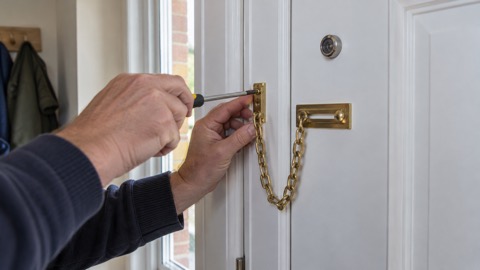
Door hardware helps. Door viewers or restrictor chains are recommended so that a visitor can be identified before the door opens11. A viewer or a chain means you can hold a conversation, take a card, or refuse, without ever being in a position where the caller can push past you. If your door has neither, they are inexpensive additions, and you can read more about door security standards and hardware in our guide to doors and locks. A video doorbell can also let you see and speak to a caller without opening the door at all.
Keep the habit up even when a visit seems routine. Opportunists look for the moment a door is left on the latch while someone carries shopping in or takes a call. Lock the door behind you, and keep it locked whenever you are not actively using it3.
How to check a caller is genuine
A caller's own paperwork, card or uniform proves nothing: bogus callers may pretend to be from utility suppliers and other reputable organisations in order to gain access, and then steal money and valuables8. A bogus caller is a person who visits or calls someone under false pretences, typically for the purpose of theft or fraud12.
The safe way to verify a caller is to check them independently:
- Expect them. Only let in callers you have an appointment with, whose identity you have confirmed3.
- Use your own numbers. Look up the company's official number yourself, from a bill or its official website, rather than any number the caller gives you.
- Do not trust a caller-arranged "verification". In one courier fraud case investigated by police, the fraudster offered the victims methods to verify his identity, including getting them to call the police directly to confirm the details, but stayed on the line so the phone reconnected to him13. The lesson applies at the door as much as on the phone: a check arranged by the person being checked is not a check.
- In Northern Ireland, use Quick Check. A trained operator will check with the company that the person at your door is genuine, and can send the police directly if they are not, or if something seems suspicious8.
Many water and energy companies run doorstep password schemes, where you set a password in advance and only callers who know it are admitted. Our guide to doorstep password schemes from water and energy companies explains how they work, and our page on how to check a doorstep caller is genuine goes through the checks step by step.
Never agree, sign or pay until you have talked to someone you trust
The single rule that stops most doorstep losses: nothing is agreed, signed or paid until you have discussed it with someone you trust. That pause is exactly what rogue traders work to prevent, with urgency, charm and pressure.
Recognise the pressure for what it is. If a message, call or visit makes you suspicious, stop, break the contact, and consider the language being used: tell-tale signs are appeals to authority, urgency, emotion, scarcity and current events2. "I'm in the area today only", "I noticed your roof from the road", "cash now or the price goes up" are all versions of the same trick, designed to stop you checking.
Protect your details as firmly as your money. Never provide bank or card details to anyone who has contacted you unannounced9. Do not give personal information, such as your name, address, bank details, or email or phone number, to organisations or people who contact you out of the blue14. If a caller claims to be from your bank or a company you deal with, do not use the contact details they provide or act on anything they hand you; always contact the organisation yourself using official websites or phone numbers15.
If you have lost money, tell your bank straight away, using the number on your card or its official website. People who live in Scotland can also call Advice Direct Scotland on 0808 196 8660 or use their online webchat15.
How rogue traders work and who they target
Rogue traders try to talk householders into paying for services. They are often unqualified to carry out those services, and will either do a poor job or take the payment and not do the job at all8. The work they offer tends to be visible, external and easy to invent a reason for: roofing, driveways, guttering, gardening. The claim that they "noticed" a problem with your property is a standard opening, not evidence that a problem exists5.
Bogus callers and rogue traders can be persuasive, and they deliberately target vulnerable members of society8. That targeting is not random. In a courier fraud case studied by police, the victims were often elderly; many lived alone and suffered age-related illnesses13. Some criminals who exploit vulnerable people begin by befriending them, and organised crime groups often select charming and manipulative members to build a rapport with the victim quickly17. A trader who becomes a "helpful friend" who calls in regularly, does small jobs, and gradually takes control of decisions or money is a recognised pattern, not a coincidence.
The common threads in how they operate:
- The invented problem. A fault you cannot easily see from the ground, claimed to have been spotted from the street5.
- The upfront payment. Money demanded before work starts, after which the job is done badly or not at all8.
- The inflated or shifting price. A price that rises once work has "started", or a cash-only offer5.
- The pressure and charm. Urgency, friendliness and flattery used to stop you checking or consulting anyone8.
- The access attempt. An offer to "come in and look at something", or a claim to be from a utility company, used to get inside8.
If you or a relative has been targeted, you are not the only one, and there is nothing to be embarrassed about. These approaches work on intelligent people because they are designed to. The response is the same every time: break the contact, talk to someone you trust, and report it.
Bogus callers often claim to be from utility companies
One route into a home is a uniform and a clipboard. Bogus callers may pretend to be from utility suppliers and other reputable organisations in order to gain access, and then steal money and valuables8. The claim is hard to challenge on the spot because water, gas and electricity companies do genuinely send people to doors, and after storms and floods their networks, and the people claiming to represent them, are busier than usual.
Treat every unannounced utility caller by the LOCK, STOP, CHECK routine: doors locked, check through a viewer or window, and only admit someone with an appointment and confirmed ID3. If you did not call them out, you do not have to let them in, and a genuine employee will wait while you phone the company on its official number. Quick Check in Northern Ireland will do that phone check for you and can send the police directly if the caller is not genuine8.
A specific warning applies to gas work. If you suspect someone is working on gas illegally, report them to Gas Safe; if an organisation advertises as Gas Safe registered but is not on the register, report it to Trading Standards18. Anyone working on your gas boiler or appliances should be on the Gas Safe Register, and you can check that yourself rather than taking a laminated card at face value.
Our page on bogus callers covers spotting and turning away doorstep crime in more depth, including the tricks used to get a door open.
Use reputable builders, not doorstep callers
The alternative to the doorstep offer is the approach every official source recommends: always use reputable building contractors, and do not pay in advance1. A contractor you have chosen, checked and agreed a written price with is a different proposition from a stranger who chose you.
How to go about it:
- Get recommendations and check credentials before agreeing anything, not after6.
- Do not be tempted by convenience or a "special price" to let someone who appeared unannounced carry out the work1.
- Be wary after an emergency in particular. Councils advising residents returning home after floods and fires warn repeatedly about people knocking on doors offering building or repair work1.
- Look out for uninvited doorstep callers in your area generally, and warn neighbours when you see them19.
The period after a flood, fire or storm is when doorstep approaches peak, because damage is visible and households are stressed and in a hurry. Our guide to avoiding rogue traders after a flood covers that situation specifically, and making a damaged home safe from intruders after a storm, fire or flood deals with securing a property before repairs begin.
Call 999 if you feel scared or threatened, 101 for suspicious callers
The police guidance is direct: call 101 to report any suspicious activity; if you feel scared or threatened, call 999 and ask for the police3. Police Scotland's doorstep scam advice says the same: call 999 if you feel threatened or in danger5. More generally, call 999 if you or someone else is in immediate danger20. If you have been burgled, call the police immediately on 99910.
Which number to use:
| Situation | What to do |
|---|---|
| You feel scared or threatened by a caller | Call 999 and ask for the police3 |
| Someone is in immediate danger | Call 99920 |
| A caller was suspicious but has left | Call 101 to report it3 |
| You have been burgled | Call the police immediately on 99910 |
| You want to report anonymously | Call Crimestoppers on 0800 555 11112 |
You can also call Crimestoppers on 0800 555 111 if you prefer to speak to someone anonymously12. Reporting a suspicious caller on 101 even when nothing was stolen helps the police build a picture of who is working your area, and may protect a neighbour who is less able to refuse.
Report a rogue trader to Trading Standards
Trading Standards is the service that investigates rogue traders and dishonest traders generally. To report a matter to Trading Standards, call 0808 164 60003. Scams can also be reported to Trading Standards through the Citizens Advice Consumer Service on 0808 223 1133, or via its online reporting service4; the same route is recommended for reporting suspicious activity and problem traders9.
If money has been lost to fraud, report it as well:
- Action Fraud: call 0300 123 2040, or report online at www.actionfraud.police.uk21.
- Your bank: tell your bank straight away, always using official websites or phone numbers15.
- Crimestoppers: 0800 555 111, anonymously12.
For general consumer advice, Citizens Advice runs a dedicated helpline on 0808 250 5050, and you can also talk to someone online2. Consumers resident in England can call the Consumer Advice and Information Phoneline on 0800 098 7950 for advice on available grants and support14.
Keep whatever the caller left with you: a card, a flyer, a "quote" or a receipt. Note what they said, any vehicle and registration you saw, and the time of the call. That detail is what makes a report useful to Trading Standards and the police.
Help in Scotland: Advice Direct Scotland
In Scotland, the consumer advice route is Advice Direct Scotland. For advice on your consumer rights, contact Advice Direct Scotland on 0808 164 60003. To report a matter to Trading Standards in Scotland, the same number, 0808 164 6000, is used3. Scammers and fraudsters can be reported anonymously to Crimestoppers3.
If you are in Scotland and you have lost money because of a scam or fraud, report the crime to Police Scotland16. Tell your bank straight away as well15.
For energy problems, Advice Direct Scotland also runs a line for prepayment meter customers on 0808 196 8660, open Monday to Friday, 9am to 5pm22. If a prepayment meter fault leaves you without supply, guaranteed standards apply: the supplier must send someone out to repair or replace the meter within 3 hours on a working day and 4 hours on a non-working day, or £30 compensation is payable14. The network operator for Central and Southern Scotland is SP Energy Networks22. Local advice tailored to people living in Scotland is on the Ready Scotland website20.
Our page on Scotland and Northern Ireland: reporting crime and getting support covers the differences in reporting across the nations in more detail.
Elderly and vulnerable relatives who get targeted
Because rogue traders and bogus callers deliberately target vulnerable members of society8, the protection of relatives and neighbours is part of the same subject. The practical advice is to check on elderly or vulnerable relatives, friends and neighbours, and help out where possible to ensure they are safe and well19, and to look out for uninvited doorstep callers in your area19.
What to do for a relative:
- Help them set up a doorstep password with their water and energy companies, so a genuine caller can be identified (doorstep password schemes).
- Make sure their door has a viewer or restrictor chain so a caller can be identified before the door opens11.
- Watch for a "helpful friend" who has appeared suddenly and is often present: befriending is a recognised opening move by criminals who exploit vulnerable adults17.
- If they feel in immediate danger, they should call 999 immediately17.
If a relative has already paid a rogue trader, do not treat it as a private embarrassment. People who live in Scotland can call Advice Direct Scotland on 0808 196 8660 or use their online webchat for advice on what to do next15. A key safe fitted for carers can also reduce the need for anyone to open the door to unannounced callers.
Sources (22)
- Flooding support, Lancashire County Council
- Cyber security: protecting your family, Essex Prepared
- Shut Out Scammers: more information, Police Scotland
- Winter Matters, Suffolk County Council
- Doorstep scam: Take Five, Police Scotland
- Are You Ready booklet, Culham Parish Council, September 2025
- Dealing with the aftermath of a fire, Warwickshire County Council
- Bogus Callers, Police Service of Northern Ireland
- COVID-19 and scams, Nottinghamshire County Council
- House security, Police Service of Northern Ireland
- Door security, Avon and Somerset Police
- Bogus callers: community safety, Belfast City Council
- Spotlight on Wiltshire Police: courier fraud, Wiltshire and Swindon Prepared, August 2024
- England and Wales energy domestic consumer advice, Ofgem, November 2024
- Citizen shopping online: respond and recover, National Cyber Security Centre, 2026
- Report suspicious emails, websites and phishing, GOV.UK
- Protecting vulnerable adults, Avon and Somerset Police
- Gas safety, Argyll and Bute Council
- Stay well this winter, Nottinghamshire County Council
- Preparing for emergencies, GOV.UK
- Preparing for an emergency - Be Ready, Stay Safe, Act Now, Sussex Resilience Forum
- Loss of utilities: respond, Ready Scotland, May 2026
 After a Break-In Checklist
 Holiday Security Checklist
 Moving Home Locks Checklist
 After a Burglary
 Bogus Callers
 Coming Home to a Break-In
 Catalytic Converter Theft
 Riots and Disorder Near Home
 Securing a Damaged Home
 Dogs as a Burglar Deterrent
 Empty Homes and Long Absences
 Leaving Home on Holiday
 How Burglars Choose a Home
 Home Insurance Conditions
 Keyless Car Theft