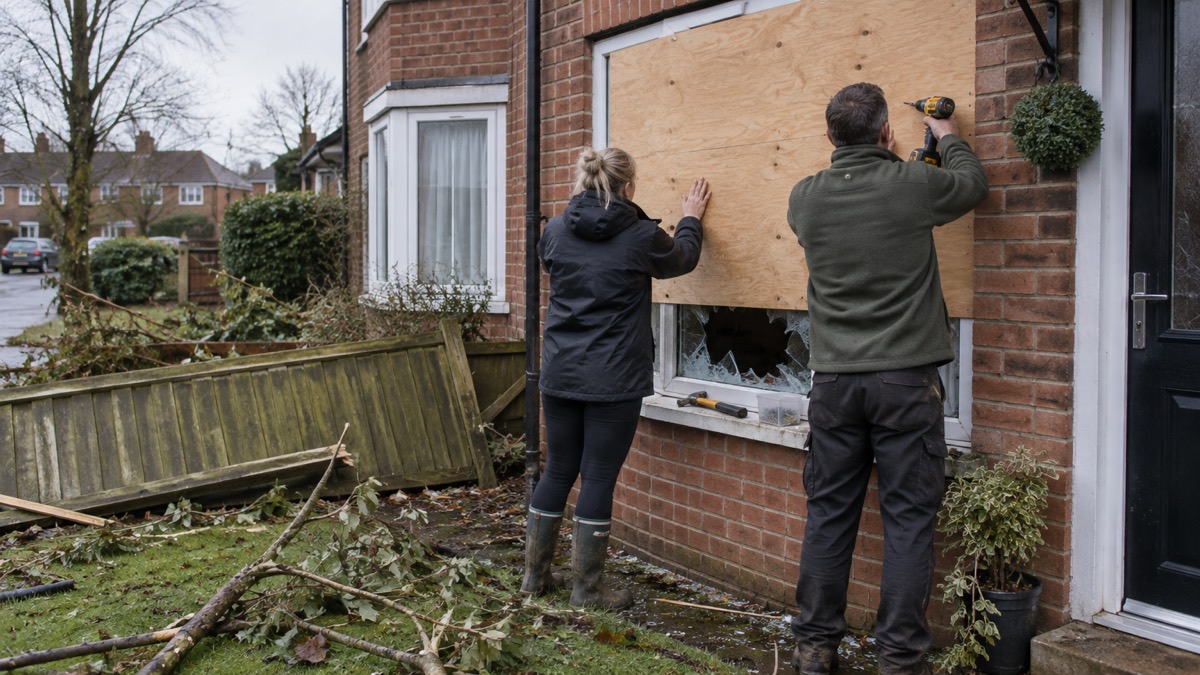
A storm that has taken out a window, a fire that has breached a wall, or a flood that has forced you out of your home all leave the same problem: a building that is damaged, possibly unsafe, and open to anyone who walks past. The work falls into two parts. First, make the building safe to enter and protect your insurance claim. Second, secure what is broken, with boarding if needed, so the home is not an easy target while repairs wait.
The order matters. Do not enter a flood-damaged property unless you are sure it is structurally safe, and have it professionally checked if in doubt1. Take photos of all damage before you tidy or clean anything, because your insurer may need that evidence2. Tell your insurer before you arrange repairs, including emergency ones3, and do not dispose of damaged items until they have been inspected4. If windows or doors need boarding up, a contractor can do this for you and your buildings insurance will normally pay5.
If you rent, most of this is not your job. It is your landlord's responsibility to secure the building after a fire5 and to repair damage to the structure and exterior, including walls, roof, windows and doors6. If you own the home and have no insurance, you are responsible for the costs yourself, though your local authority or charities may be able to help7.
Check the building is safe before you go back in
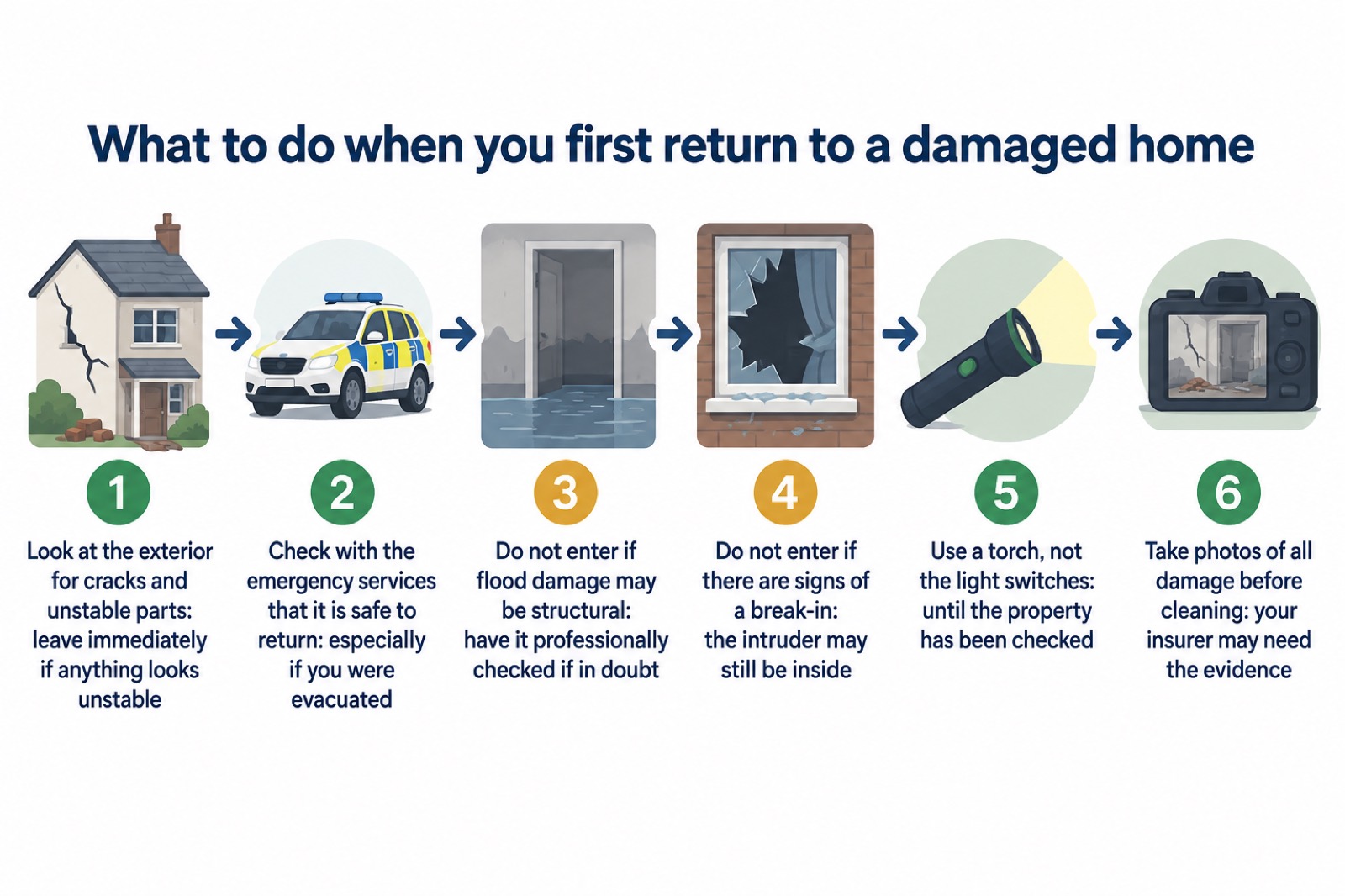
Before anyone goes inside, walk around the outside and look at the structure. Official guidance from the Greater London Authority is to check the exterior of the property for cracks, and if any part of the building looks unstable, leave immediately8. Debris can be dangerous, so wear protective clothing and footwear8. The same advice appears in local resilience guidance across England: check for cracks, leave if anything looks unstable, and treat debris as hazardous11.
Flood damage needs particular caution. Wiltshire and Swindon Prepared advise checking a flood-damaged property is safe to enter before entering, because structurally it may be unsafe11. The Greater London Authority's flash flooding guidance is blunt about it:
"Do not enter a property that has been flooded unless you are sure it is structurally safe, if in doubt it should be professionally checked"1
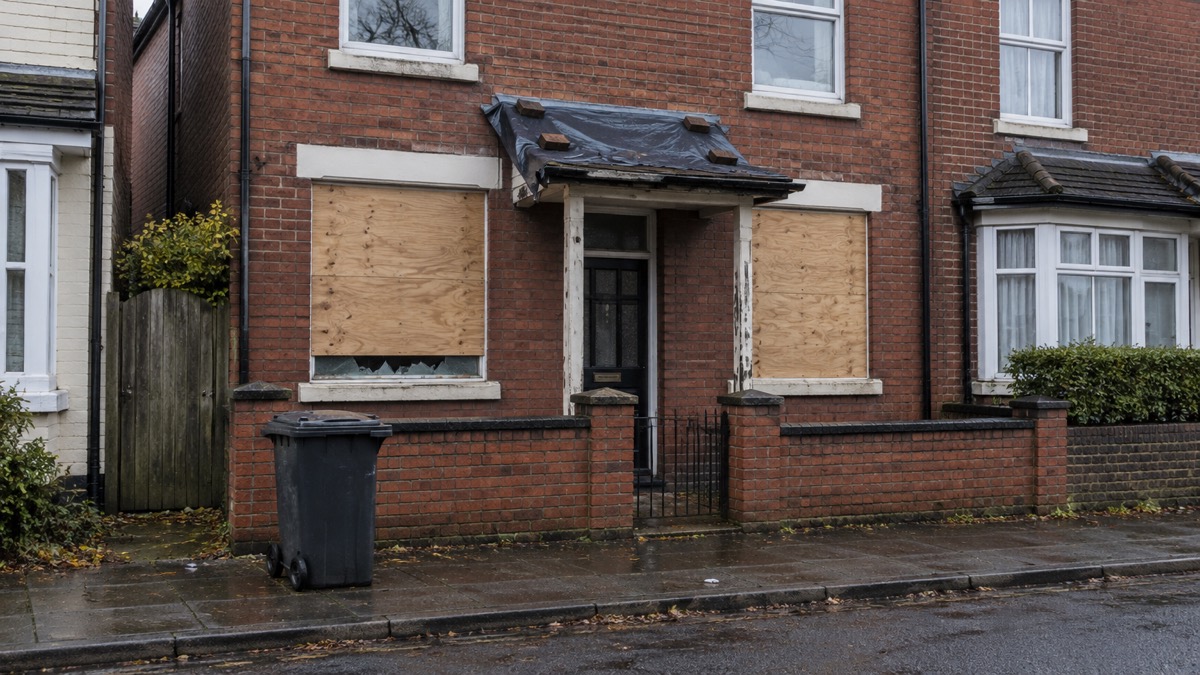
If you were evacuated, do not simply return when the water drops or the smoke clears. Before entering a property that has been flooded, make sure the building has been checked for signs of damage, because structurally it may be unsafe to enter12. If you have had to leave your property due to flooding, the flood recovery guidance is to check with the emergency services that it is safe to return before you go back12.
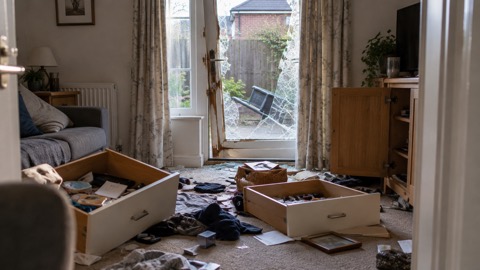
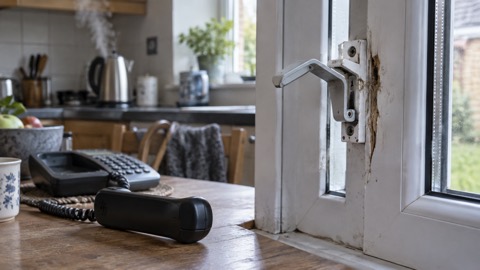
One further check belongs here because it is about intruders rather than structure. If you arrive at the property and find signs that someone has broken in, Police Scotland's advice is that you should not go inside in case the intruder is still there13. Report it instead, online, by phone or in person13. Our page on coming home to a break-in covers what to do first in that situation.
Returning home safely after a flood
Once the building is safe to enter, flood recovery has its own hazards. Cornwall Fire and Rescue Service advises that you only return to evacuated buildings if told it is safe, avoid electricity sources, and get an approved service engineer to check gas, electricity and water before turning them back on16. Beware of contaminated water and sharp objects lying in flood water, take extra care with candles and open fires, and contact your insurance company for advice before starting to clean up16.
Dorset and Wiltshire Fire and Rescue Service add the practical points that catch people out: make sure the property is safe before you enter, use a torch, and do not try to switch on the lights15. Once inside, open the doors and windows to ventilate the property, remove any sandbags across airbricks, and watch out for broken glass or nails while cleaning up15. Broken glass and nails matter doubly here: they are both an injury risk to you and a sign of where the building's security has failed.
Do not plan to move back in the moment the water has gone. Derbyshire County Council recommends that you only return to live in your home once cleaning has been completed, and that your insurance company, housing officer, landlord or builder will advise on any additional work needed17. The same guidance stresses that essential cleaning, drying and repair work should not be rushed, as this could lead to problems later on17.
If the flood follows a storm rather than a river bursting its banks, the same recovery steps apply, but check the rest of our flooding guide for preparing before the next one, and storms and snow for what to do while the weather is still dangerous.
What to do after a house fire
Fire damage creates a different set of problems from flooding, and North Yorkshire Fire and Rescue Service's steps-after-a-fire guidance covers them directly. Because firefighters may have to breach walls and ceilings to check for hidden fires, the damage can appear excessive afterwards, and you may need to wear protective clothing and a hard hat to enter the property10.
Before you spend anything, seek advice. North Yorkshire Fire and Rescue Service advise seeking advice before you commit yourself to any expense, such as the bill for staying in a hotel or getting your property boarded up by a contractor10. The reason is your insurance claim: costs you commit to before speaking to your insurer may not be covered, and the insurer's loss adjuster may need to see the damage as the fire left it.
Two practical points from the fire service about property protection. First, if a salvage sheet or tarpaulin has been left over your roof or windows by the fire service and needs to remain at the property after they have left, there could be a charge to the occupier to replace it10. Second, the British Red Cross offers an emergency response support service designed to meet the needs of people who have suffered damage to their home following a fire, flood or similar incident10; ask at the scene or through the fire service how to make contact.
Devon and Somerset Fire and Rescue Service's after-an-incident guidance sets out the sequence for owners: if you have to leave the property unattended, close all the windows and doors if possible, and if windows or doors need boarding up, a contractor can do this for you5. Do not dispose of anything or carry out any repair work until the loss adjuster or claims advisor has inspected, and you may also need to inform your mortgage company about the incident5. For the immediate fire safety side, see home emergencies.
Tell your insurer before you make repairs
This is the step that protects everything else, and it comes before boarding up, before cleaning and before throwing anything away. The Association of British Insurers' advice, carried in Belfast City Council's emergency planning guidance, is to tell your insurer if you need to arrange emergency or temporary repairs to stop damage getting worse3. Emergency work to prevent further damage is normally expected; the risk is going further than that without approval.
Nottinghamshire County Council's advice for homeowners affected by flooding is firmer still: speak to your insurance company before engaging any companies offering to repair flood damage, keep damaged items, and avoid undertaking repair works until you have made contact with your insurance company, as you may invalidate your claim4. London Fire Brigade's after-a-flood guidance explains why: contact your insurance company, and they may require evidence of damage before clean-up begins18.
The evidence you gather now is what the claim is built on:
- Take photographs or video footage of all damage9
- Mark the water levels on the wall before they recede, if flooding is the cause9
- Take photos before you start to tidy and clean up, as this is important for insurance purposes19
- Keep damaged items and do not dispose of anything until the insurer or loss adjuster has inspected4
- Keep records of repairs and cleaning costs8
- Compile lists of damaged or lost items, record the tide mark on walls, keep a diary or log of activity, and record the contact details of everyone you speak to4
In almost all cases the insurance company will send a loss adjuster to look at your property20. Always ensure the insurance company has given approval before going ahead with any repair work9. If you rent, contact your landlord and your own contents insurer as soon as possible20. If you do not have insurance, your local district council may provide information on hardship grants or charities20.
One warning that belongs here: damage after a flood or storm attracts companies offering repairs at the doorstep. Speak to your insurer before engaging any such company4, and see our page on avoiding rogue traders after a flood and on rogue traders and doorstep selling before you agree to anything.
Boarding up broken windows and doors
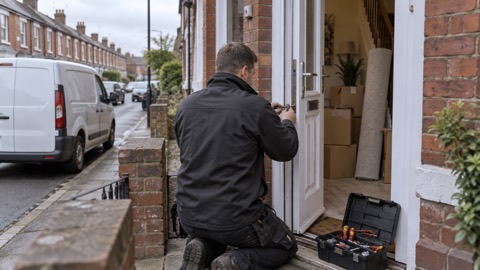
Boarding up is the emergency repair that makes a damaged home secure. Devon and Somerset Fire and Rescue Service's guidance is that if windows or doors need boarding up, a contractor can do this for you, and your buildings insurance will normally pay for this work5. Cheshire Fire and Rescue Service similarly advise boarding up windows or doors if needed, and note that a contractor can be found online to fulfil this service21. Council tenants requiring a boarding-up service should contact their local housing department or direct works department21.
Before the contractor arrives, close all the windows and doors if possible if you have to leave the property unattended5. Every closed and locked opening is one fewer that needs covering, and it reduces the number of boards needed.
Boarding up is not only a response after damage. If a flood warning is in force and water is coming, Mid and West Wales Fire and Rescue Service advise blocking doors, with floodboards if available, and airvents with plastic sheeting and sandbags22. Floodboards fix to frames around windows and doors, and can be washed, stored and used again23. Suffolk's flood booklet adds that they should always be removed once the flood water has gone, to help the property dry out23. A household that has fitted floodboards once has a reusable barrier that also makes the openings harder to force.
| Situation | What to use | Who does it | Notes |
|---|---|---|---|
| Window or door broken by storm, fire or intrusion | Plywood boarding over the opening | A contractor; buildings insurance normally pays5 | Close and lock all other openings first5 |
| Council or housing association tenant | Boarding-up service | Local housing department or direct works department21 | Contact them directly |
| Flood warning in force | Floodboards on frames, plastic sheeting and sandbags on doors and airvents22 | Householder | Wash, store and reuse floodboards23 |
| Flood water gone | Remove floodboards | Householder | Helps the property dry out23 |
Securing a damaged roof or wall
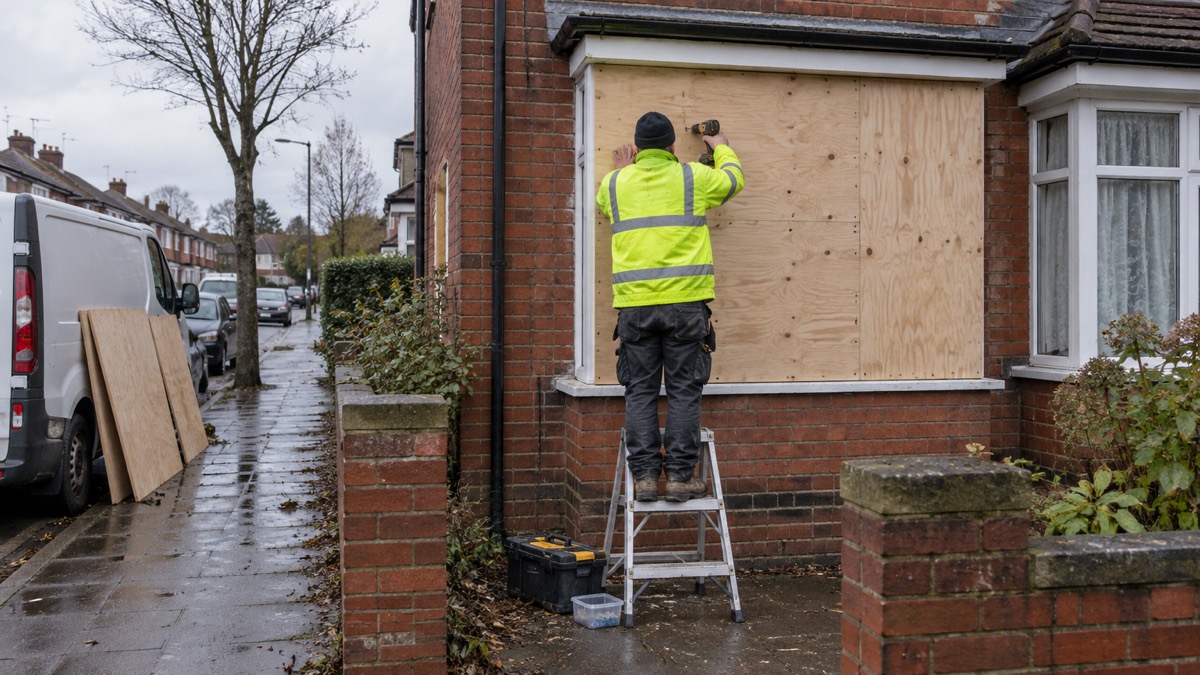
A damaged roof is both a security problem and a safety problem, and the safety problem comes first. Lancaster City Council's preparedness guidance for households facing high winds sets out what to look for: loose, chipped or missing tiles, corroded nails, and cracked or eroded mortar joints on ridge or hip tiles24. If you find any of these, contact a reputable builder or roofing contractor for repairs, because it can be dangerous to undertake repairs yourself24.
That warning applies doubly after a storm or fire has already damaged the roof. Working at height on a compromised structure is a job for a professional, not a householder with a ladder. What you can safely do from the ground is assess and record: photograph missing tiles, holes and sagging from outside, and note them for your insurer and your contractor. If the fire service has left a salvage sheet or tarpaulin over the roof, remember that there could be a charge to the occupier to replace it if it needs to remain after they have left10.
A hole in a roof or an unstable wall is also an entry route, and not only for people: water getting in after the initial damage will make the repair bill larger. This is exactly the kind of emergency or temporary repair your insurer expects you to arrange to stop damage getting worse, so tell them you are doing it3. A tarpaulin properly fixed by a contractor over a damaged roof keeps weather out and closes off the opening until permanent repairs can be done.
Where boarding up must not block a way out
Emergency boarding has one rule that overrides convenience: everyone inside must still be able to get out. Manchester Fire and Rescue Service's guidance for landlords and buildings is to ensure there is adequate means of escape25, and the principle applies to any household doing its own emergency boarding. A board screwed over a door that is the only way out of a room, or over a ground-floor window that serves as an escape route from an upper floor, turns a security measure into a fire trap.
Before any boarding goes up, work out which doors and windows are the escape routes from each room, and leave those openings unboarded or board them in a way that can be opened from inside. If the only sound exit is a door that must be boarded because it is broken, arrange to stay elsewhere until it is repaired rather than sleeping behind a sealed opening. Our page on leaving your home locked when you have to evacuate covers the same balance from the other direction.
The same thinking applies to floodboards and sandbags. They are fitted to keep water out, but once the flood water has gone they should always be removed to help the property dry out23, which also restores your normal ways in and out.
Keeping valuables and documents safe while the home is empty
A damaged, partly boarded house advertises that no one is living in it, so what is worth taking should not be in it. If flooding is still a risk, Mid and West Wales Fire and Rescue Service advise moving all portable, prized possessions such as photographs and valuables upstairs in plastic bags or on top of heavy furniture22. If you live in a house, move valuables upstairs; if you live in a ground floor flat or bungalow, make arrangements to stay with a neighbour or relative24. The Met Office's flood plan advice is the same in one line: move your valuable belongings to a safe place12.
The best protection is preparation done before any emergency. Suffolk's flood booklet advises keeping important documents and irreplaceable items of personal value in a safe place now, not waiting for a flood, and knowing what you would move to safety: pets, cars, electrical equipment, garden pot plants, furniture and garden equipment20. A grab bag with copies of key documents means the originals can stay somewhere secure; see our emergency kit guide for what a household grab bag should hold.
If the home must be left empty, take with you:
- Originals of insurance policies, deeds, passports and other important documents
- Photographs and small irreplaceable items of personal value
- Small high-value portable items, which are what an opportunist intruder takes first
- A written or photographic record of what remains in the property
For the longer term, our pages on how to keep your valuables safe from thieves, home safes and property marking and keeping a record of valuables cover storing and identifying what you own.
Leaving a damaged home empty overnight
Sometimes the home cannot be occupied while it is secured and dried out. North Yorkshire Fire and Rescue Service's advice for leaving a home unoccupied after a fire is to inform your local police station and ask neighbours to keep an eye on your property10. Neighbours who know the house should be empty are the simplest and most effective watch there is, and they can report anything unusual while you are away.
Police advice on housebreaking notes that homes are more at risk in winter, because houses look empty if the lights are off13. Timer lighting on a battery or independent supply, or lights a neighbour can switch, makes the property look less empty. Our page on how to make your house look occupied when you're away covers this in detail, and leaving your home while you are on holiday and empty homes cover longer absences.
Two safety points if anyone does stay in a partly damaged home. Cornwall Fire and Rescue Service warn that there is an increased risk of fire from wet electrics after a flood, so ensure you have a working smoke alarm16. And use a torch rather than trying to switch on the lights until the property has been checked15. Battery-powered smoke alarms and torches work regardless of whether the mains supply has been disconnected.
For accommodation itself, ask your insurance company or landlord if they will provide temporary accommodation, such as a nearby bed and breakfast, a static caravan or a rented house, and remember that you do not have to accept the first place you are offered7. If your property is damaged and not fit to live in, re-housing is the responsibility of your landlord or housing association if you rent, or your insurance company if you own the property26.
Renters: what your landlord must do
If you rent, the division of responsibility is clear and it is mostly not yours. Somerset Council's housing guidance states that your landlord is responsible for repairs if flooding from rain affects your rented home, including fixing damage to the structure and making sure water, gas, electricity, sanitation and heating are working6. Landlords must repair damage to the structure and exterior, such as walls, roof, windows and doors; repair plumbing, heating, gas, electricity and water supply systems; and repair fixtures and fittings they provided, such as carpets, curtains and appliances6. After a fire, it is the landlord's or building owner's responsibility to repair any damage to gas, electricity or water supplies5, and if you are a tenant it is your landlord's responsibility to secure the building5.
In England, landlords have a legal obligation to keep your home in repair, fit for human habitation and free from serious hazards27. Your landlord is always responsible for repairs to the structure and exterior of your home, including the drains, gutters and external pipes27. With something serious or dangerous, like a boiler failure or electricity outage, it might be reasonable to expect the landlord to arrange for a technician to attend within 24 hours to carry out an initial inspection27.
Tell your landlord as soon as possible if the home has flooded and needs repairs; they must complete repairs within a reasonable time6. It is the landlord's responsibility to insure the building, so contact them in the first instance14, and you may have a separate contents insurance policy of your own14. The landlord will deal with the structure of your home; for contents claims, contact your own insurer28. Drying and clearing up is the responsibility of the homeowner or landlord, though firefighters will pump out water and do some salvage work where possible18.
One exception: a tenant may have to pay the cost of repairing damage they themselves caused, for example water leaking into another flat from an overflowing bath27.
Getting help with emergency repairs and security
Help exists at several levels, and the right door depends on your tenure and your insurance. If your home is flood damaged and you are not able to live there, contact your local council for help getting emergency accommodation9. If you are uninsured, you will be responsible for covering the cost of the damage, and your local authority or charities may be able to help with practical things such as skips or grants7; your district council may also be able to help with temporary accommodation14. Contact your local council if you need emergency housing because of flooding, particularly if you are legally homeless or about to become homeless2.
| Who | What they can help with |
|---|---|
| Your insurer | Emergency repairs, boarding up, loss adjuster, temporary accommodation5 |
| Your landlord or housing association | Repairs, securing the building, re-housing6 |
| Local council | Emergency accommodation if you cannot live at home9; hardship grants and charity information if uninsured20 |
| Council housing department | Boarding-up service for council tenants21 |
| British Red Cross | Support service for people whose home is damaged by fire, flood or similar incident10 |
| Police | Reporting break-ins, online, by phone or in person13 |
In a wider major incident, councils support the emergency services and then help return life to normal as soon as possible. Basingstoke and Deane Borough Council, for example, works with Hampshire County Council to set up rest centres providing transport, shelter, food and information to people evacuated19. Belfast City Council provides health and safety advice on cleaning up after major flooding or pollution3. If you are supporting vulnerable neighbours who have been evacuated, alert the local council if further help is needed, such as transport, medication, temporary accommodation and medical attention26.
Reporting a flooded property to the council also has a purpose beyond your own home: it helps the council investigate why the flood occurred and look for ways to reduce the risk of it happening again29. Finally, seek support if you need it once you are home; recovering from an emergency is a process, not a single day30. Our extra help guide covers support for older, disabled and medically dependent households, and after a burglary covers crime numbers, insurers, repairs and support if the worst happens.
Sources (30)
- How to prepare for flash flooding, Greater London Authority
- What to do after a flood, GOV.UK
- Emergency planning and community safety advice, Belfast City Council
- Advice for homeowners affected by flooding, Nottinghamshire County Council
- After an incident: fire, Devon and Somerset Fire and Rescue Service, 2026
- Housing help if your home is flooded, Somerset Council, 2026-06-04
- Flood recovery leaflet, Nottinghamshire County Council, 2025
- After an emergency: advice for Londoners, Greater London Authority
- Flooding: be informed about hazards, Prepare Campaign, 2026-10-12
- Steps after a fire, North Yorkshire Fire and Rescue Service, 2026-06-17
- What to do in a flood, Wiltshire and Swindon Prepared
- Protecting your property from flooding, Met Office
- Break-in and housebreaking advice, Police Scotland, 2026-11-02
- Flood Recovery Information leaflet, Devon County Council, 2026-01-29
- Flooding safety, Dorset and Wiltshire Fire and Rescue Service, 2023-11-20
- Flooding safety advice, Cornwall Fire and Rescue Service
- Cleaning up and returning home after flooding, Derbyshire County Council
- After a flood: flooding advice, London Fire Brigade
- Emergency advice, Basingstoke and Deane Borough Council
- Before, during and after a flood booklet, Suffolk County Council, 2021-05
- How to protect your property after a fire, Cheshire Fire and Rescue Service, 2023-06-22
- Flooding advice, Mid and West Wales Fire and Rescue Service, 2026-10-29
- What to do in a flood leaflet, Nottinghamshire County Council, 2010-11
- Be Prepared booklet, Lancaster City Council
- Landlord responsibilities: flat safety, Manchester Fire and Rescue Service
- Are You Ready booklet, Culham Parish Council, 2025-09
- How to rent a safe home, GOV.UK, 2020-12-10
- Thunderstorms: weather warning advice and information, nidirect, 2026-08-30
- Storm Ciaran: prepare for potential disruption, Somerset Council, 2023-11
- Step 3: recovering from an emergency, Essex Prepared
 After a Break-In Checklist
 Holiday Security Checklist
 Moving Home Locks Checklist
 After a Burglary
 Bogus Callers
 Coming Home to a Break-In
 Catalytic Converter Theft
 Riots and Disorder Near Home
 Dogs as a Burglar Deterrent
 Doorstep Selling and Your Rights
 Empty Homes and Long Absences
 Leaving Home on Holiday
 How Burglars Choose a Home
 Home Insurance Conditions
 Keyless Car Theft