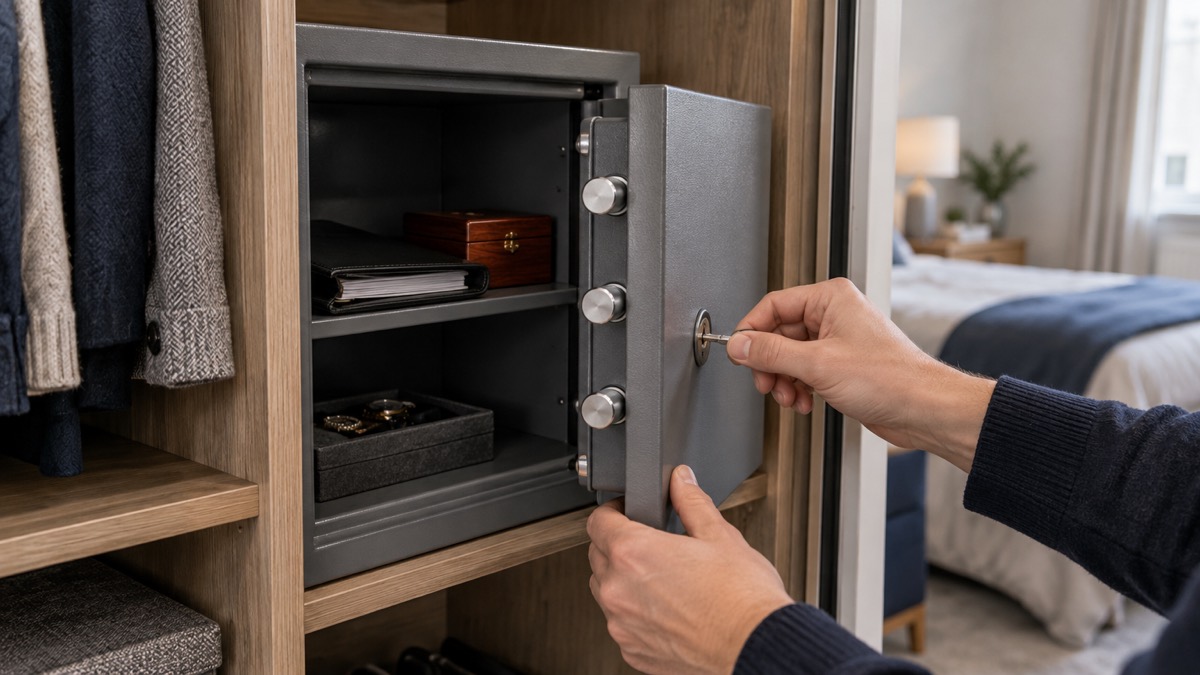
A home safe is a steel box with a rating attached, and the rating is the whole story. A safe certified against burglary is one that has been independently tested and certified to resist burglary attempts: it is attacked with a set list of tools, the time taken to break in is recorded, and a score is given based on the tools used and the time taken to gain entry1. Its grade tells an insurer how much cash it is reasonable to keep inside. A fire safe is tested differently: it is heated in a furnace to simulate a house fire and must keep the temperature inside low enough, for long enough, that paper or data survives. Safes that combine fire and security protection are sold as a distinct product type, so a household can look for one rated for both jobs rather than assuming any certified safe covers both1.
The reason to think about fire at all is that house fires are not rare. Cheshire Fire and Rescue Service puts your chance of experiencing a serious fire in your lifetime at around one in five2, and Dorset and Wiltshire Fire and Rescue Service reports some 7,000 house fires a year in the UK caused by faulty electrics, appliances, wiring and overloaded sockets3. A safe cannot stop a fire, and it cannot get you out of one. What it can do is keep the deeds, the passport, the spare keys and the insurance documents intact while the fire brigade puts the fire out, and keep small valuables out of a burglar's hands in the meantime. This page explains the grades and tests, what each protects, and how to choose and fit one.
What a home safe protects, and what it does not
A safe protects what is inside it, against the specific hazards it was tested for, for the specific time it was tested for. Nothing more. A fire-rated document chest that has never been attack tested will slow a burglar only as long as it takes to carry it away or pry it open, and a heavy burglary safe with no fire rating offers its contents no guaranteed protection in a fire at all. The ratings exist precisely so you do not have to guess.
What a safe does not do is protect the room, the people in it, or anything outside the box. Fire and rescue services are explicit that in a fire you leave, and you leave without stopping for anything. Greater Manchester Fire and Rescue Service's flat safety advice, under a stay safe policy, lists what you must not do if there is fire or smoke in your home: do not try and fight the fire, do not stop to collect belongings, do not go back into your flat, do not use the lifts, and do not re-enter the building until told it is safe6. A safe is for the things you cannot carry, not a reason to delay.
It also does not replace the rest of your household security. A safe is the last layer, after good doors and locks, windows that resist entry, and sensible key habits. If you are building up your home security from scratch, start with the home security guide and come back to safes once the basics are in place. And for the documents themselves, keep copies elsewhere: the emergency kit page covers which documents to keep ready and copied, so that even a total loss of the safe's contents is an inconvenience rather than a crisis.
Fire safe or burglary safe: which protects what
The two families of safe are built and tested for different failures. A burglary safe has thick steel walls, a heavy door, hardplate protection around the lock, and a locking mechanism designed to resist attack tools. Its test is an attack: a professional tester with a defined tool list and a defined time budget tries to open it, and the grade reflects how long and with what tools they were allowed. A fire safe is built instead with insulation that swells or chars in heat, keeping the interior cool, and its test is a furnace.
The standards you will see quoted are European. EN 14450 is the standard for lighter security safes intended for home use, with Grades S1 and S2. EN 1143-1 is the European standard for higher-security safes and strongrooms, running from Grade 0 upward, and safes certified to it are described as certified for insurance purposes, which is what an insurer looks for when it sets a cash rating4. On the fire side, EN 15659 covers fire resistance for document storage, and the older Scandinavian NT Fire 017 test is still widely quoted by makers5.
Which you need depends on what you are protecting and from what. If the main worry is a burglar taking jewellery, cash or a spare car key during a break-in, a burglary-rated safe, bolted down, is the answer, and the grade should match the value: insurers commonly set a cash rating by grade, so more valuable contents need a higher grade. If the main worry is losing birth certificates, deeds, passports or photographs in a fire, a fire-rated safe or chest is the answer. If both worries are real, and for most households they are, you need a safe certified for both, which is a smaller category and covered later on this page. For what burglars actually take and how they choose, see how burglars choose a home, and for keeping a record of what you own, property marking.
Fire testing: the heat a house fire reaches
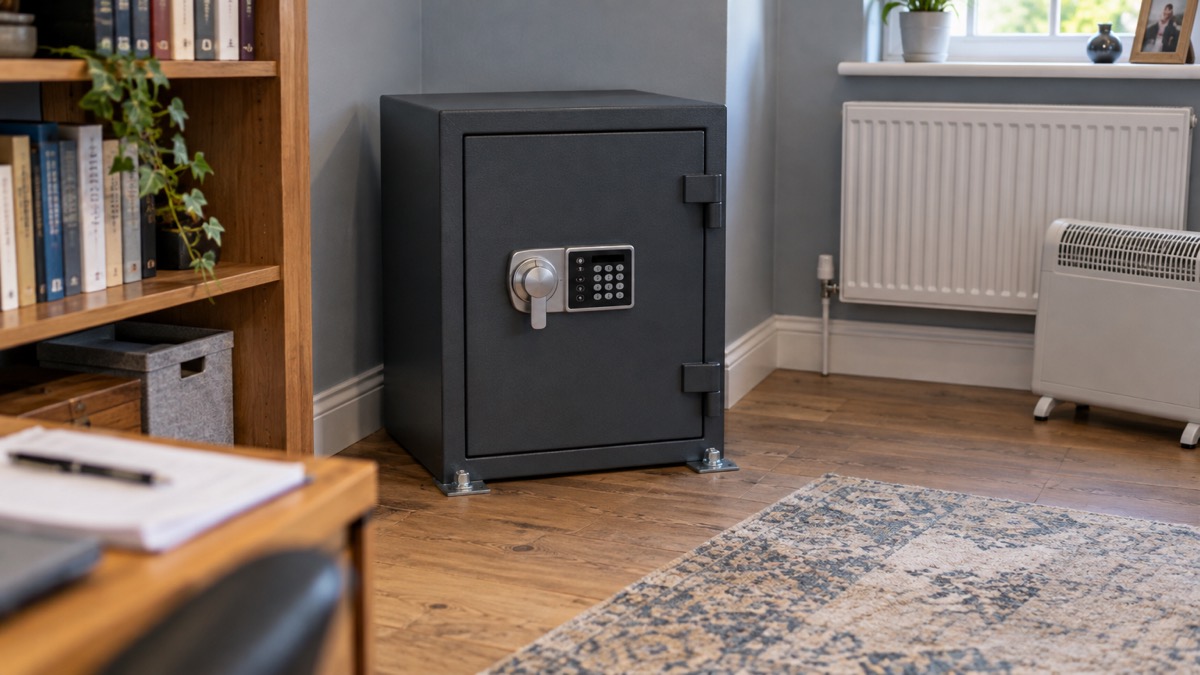
Fire safes are tested in furnaces that simulate a fully developed fire, and the numbers are far beyond anything a kitchen oven produces. The NT Fire 017 test subjects the safe to a 1, 1½ or 2 hour fire test at up to 927°C, with no drop test5. The American UL 72 test is harsher still: a 30 minute, 1 hour or 2 hour fire test at a temperature of 1090°C, followed by a drop test of 9 metres, simulating the safe falling through a burning floor5. Master Lock's fire chests, sold in the UK, are rated to keep contents safe for either thirty minutes or sixty minutes in temperatures of at least 843°C7.
What the rating means in practice is time and temperature inside the box. The furnace climbs to its peak and the safe's insulation holds the interior below the point at which paper chars, for the stated duration. A 30 minute rating is the entry level and suits a fire that is caught and extinguished quickly. A 60 minute or 2 hour rating buys more margin for a fire that takes hold, or for a building where the fire service takes longer to reach and control it. If you need protection against fire and theft in one box, look for a product sold specifically as a fire and security safe, since the two tests measure different things5.
Two practical points follow. First, match the duration to your building: a flat in a building with a stay safe policy, or a rural property with a longer response time, argues for a longer rating. Second, siting matters. A safe fixed in a cupboard on the ground floor, away from the kitchen and any single source of intense heat, faces a more survivable fire than one next to the boiler. The rating is a laboratory result; where you put the safe decides how close your real fire comes to the laboratory's conditions.
Data media and backups need different protection
Paper is surprisingly tough. It survives heat that would destroy a hard drive, and a fire safe rated for documents is tested to keep the interior below the temperature at which paper ignites or chars. Digital and magnetic media are far more fragile: they are destroyed at lower temperatures than paper, which is why safes tested for data media are held to stricter limits than document safes5. A USB stick, an external hard drive, memory cards, backup tapes and photographic negatives will all be destroyed inside a safe whose interior stayed cool enough to save the documents sitting next to them.
This is why fire ratings are stated separately for paper and for data. A safe certified under EN 15659 for paper, such as Burton's Home Safe Grade 0, which carries an EN15659 LFS 30P rating, is certified for 30 minutes of paper protection4. Data media need a safe or chest specifically tested and certified for data, which holds the interior to a far lower temperature for the same furnace exposure. If you are keeping backups of family photographs or business records on physical media in a safe, check that the certification says data, not just paper.
The better answer for anything digital is not to rely on the safe at all. Keep a second copy somewhere else entirely: cloud storage, a drive at a relative's house, or both. The same logic applies to documents: scan the passports, deeds and certificates, keep the originals in the fire-rated safe, and keep the scans somewhere a fire cannot reach them. A safe protects one copy in one place. Copies protect you against the loss of that place. For securing the accounts those backups and scans live in, use a strong lock on every device and account: a PIN, password, biometric such as fingerprint or facial recognition, or a pattern, any of which is better than none8.
After the flames are out: what survives, and what to do
A fire does not end when the flames go out. The fire service may need hours to fully extinguish a serious fire, and the building stays dangerous and often wet from firefighting afterwards. A fire-rated safe is designed with this in mind: its insulation keeps working as the building cools, and good fire safes also seal against water and steam, because a document that survived the fire itself can still be ruined by a hose. When you are eventually allowed back in, open the safe carefully, let the contents dry if they are damp, and photograph everything for the insurance claim before you move it.
What you must not do is go back in to check. The rules for a fire in a flat under a stay safe policy are the clearest statement of the general principle: do not try and fight the fire, do not stop to collect belongings, do not go back into your flat, do not use the lifts, and do not re-enter the building until told it is safe6. Firefighters control re-entry because of structural damage, smoke, and hot spots that can reignite. Your safe's contents are exactly the things worth waiting for, and the whole point of the fire rating is that they can wait.
If you live in a flat, the arrangements around you are changing. From 6 April 2026, new regulations come into force in England under the Fire Safety (Residential Evacuation Plans) (England) Regulations 2025 to improve the safety of residents who may need support to evacuate their building in a fire9. They apply to residential buildings 18 metres or 7 storeys above ground level or higher9. If your flat is in such a building, find out your building's evacuation strategy now, before any emergency, because it affects what you do and how much time you have.
After a fire or a break-in, the practical steps are wider than the safe: making the home secure again, dealing with insurers and getting support are covered in after a burglary and making a damaged home safe. A full fire safety plan, as Warwickshire Fire and Rescue Service puts it, covers more than just what to do if the worst happens: it covers prevention and detection too10. A safe is the last line of that plan, not the plan itself.
Safes rated for both burglary and fire
The strongest category of domestic safe carries both a burglary grade and a fire rating, tested and certified separately. Burton's Home Safe Grade 0 is the clearest example in the UK market: it is independently attack tested and certified to EN1143-1 Grade 0 for burglary and to EN15659 LFS 30P for fire, meaning 30 minutes of paper fire protection4. De Raat's Protector range is marketed as burglary and fire resistant safes for home and office security11. These safes cost more and weigh more than single-rating safes because they carry both thick attack-resistant steel and fire insulation, and for most households protecting both documents and valuables in one place, they are the sensible target.
Within the dual category, the grades still ladder upward. Burton's range runs from the Home Safe S2, tested to EN14450 Grade S2 by Sold Secure and carrying the AiS insurance approval and the Secure by Design Police Approved Specification4, through Grade 0, to the Home Safe Grade 1 MKII, Grade 2 MKII and Grade 3, each independently attack tested and certified for insurance purposes to its EN1143-1 grade by ECB•S4. The higher the grade, the longer and more sophisticated the attack it resisted in testing, and the higher the cash rating an insurer will typically attach to it. If you are keeping significant cash or jewellery, read can you keep cash or jewellery in a fire safe and check the grade against your insurer's requirements, which are covered in home insurance conditions.
Product pages for individual models in this range, including the Burton Home Safe S2 Size 1, the Burton Home Safe G0, the Burton Home Safe Grade 1 MKII and the Burton Home Safe G3 Size 1, set out the specifications of each. The choice between them is not about brand but about matching the grade to the value of the contents and the fire duration to the building.
Lock options: key, electronic code or fingerprint
The lock is what you interact with every day, and the three common types suit different households. A key lock is simple, never needs batteries and cannot be forgotten, but a lost key means a locksmith, and a key kept in a drawer next to the safe defeats the safe entirely. An electronic lock with a keypad opens quickly to a code and can manage multiple users: Burton's Home Safe Size 1 Electronic Lock uses an EN1300 Class B certified lock with a number keypad, holds 1 master code and 8 user codes, and offers time delay functionality12. A biometric lock opens to a fingerprint: the Master Lock Biometric Safe LX110BEURHRO stores up to 30 fingerprints, which the distributor, Securikey, says means no memorisation is required13.
Codes have their own discipline. A code written down, shared widely or left at default length is a weakness. Burton's Primo Home Safe uses a 3 to 6 digit code4, and the same principle that applies to phone and device locks applies here: use a PIN, password, biometric or pattern, and any is better than none8. A 6 digit code is harder to guess than a 3 digit one; change the factory code before anything goes in the safe; and give a user code rather than the master code to anyone who needs occasional access, since the master code is what lets you add and remove users.
Two features matter for shared or business use. Dual control means the safe needs two codes entered in sequence, so no single person can open it alone, which suits a workplace, club or care setting. The number of codes a safe supports also varies with its purpose: Burton's Home Safe Size 1 Electronic Lock offers 1 Master code and 8 user codes12, while the Burton Home Safe G3 Size 1 Electronic Lock offers 1 Master code and 1 user code, so check the code count against how many people will legitimately need access. Neither is necessary for a straightforward family safe, but both are worth knowing about when comparing models.
One related product is not a safe but is often confused with one: the key safe. A Master Lock Select Access is a lock box for keys, secured to an outside wall, that lets you share the combination with people of your choice, such as carers or family14. It is an access device, not a security container: it holds a key, not valuables, and choosing one is covered in key safes and which key safes are police preferred.
Fixing, certification and what insurers look for
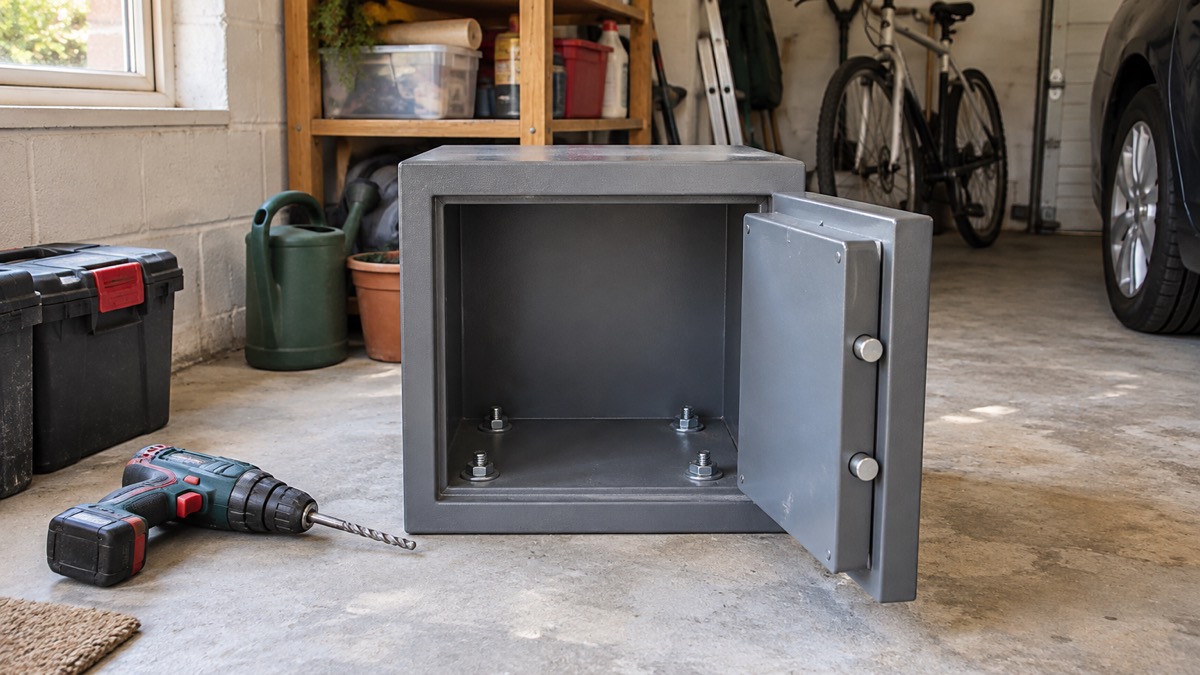
An unfixed safe is a box with a handle. Police Scotland's housebreaking advice is to make sure the safe is installed into the fabric of your home, such as beams or concrete1. The reason is simple: a burglar with a few minutes and a trolley will take the whole safe and open it elsewhere, whatever its grade. Fixing into concrete or a structural beam with the maker's anchoring kit, so the safe cannot be levered out, is what turns the laboratory grade into real protection. Follow the maker's instructions for the fixing kit supplied, and if you cannot fix into the floor, fix into a masonry wall.
Certification is what separates a tested safe from a marketed one. The phrases to look for are independent attack testing and certification by a named body: ECB•S for EN 1143-1 grades, Sold Secure for EN 14450 testing, and AiS, the Association of Insurance Surveyors, for insurance approval4. Burton's Home Safe S2 carries all three plus the Secure by Design Police Approved Specification4, and Secure by Design is the police initiative whose approval also covers products such as windows and doors, where Police Scotland advises buying ones certified by Secure by Design1. How to verify police approval for any security product is covered in how to tell if a security product is police approved.
Insurers look for certified fire resistance and a certified burglary grade because those are the claims they can check. A safe described as fire resistant by its maker with no standard, no duration and no testing body gives an insurer nothing to price against, and may give you nothing in a claim. A safe's cash rating indicates the amount of cash an insurer might be willing to cover when stored inside it, subject to the policy and installation conditions4, and for some valuables and most jewellery that figure is multiplied by a factor of ten4. Eurograde safes are recommended by all British Insurers if they are tested to EN 1143-1 by the ECBS testing house4. The wider conditions your policy may impose, on locks, alarms and unoccupancy as well as safes, are set out in home insurance conditions.
Inside the safe, think about layout as well as rating. Shelving determines what actually fits: Burton's Home Safe range is supplied with one removable shelf12, so a safe can hold a shelf of documents and, with the shelf removed, a taller item. Measure what you intend to store, including the document folders and boxes rather than the items loose, and compare against the maker's internal dimensions, which are always smaller than the external ones.
Free fire safety help in each nation
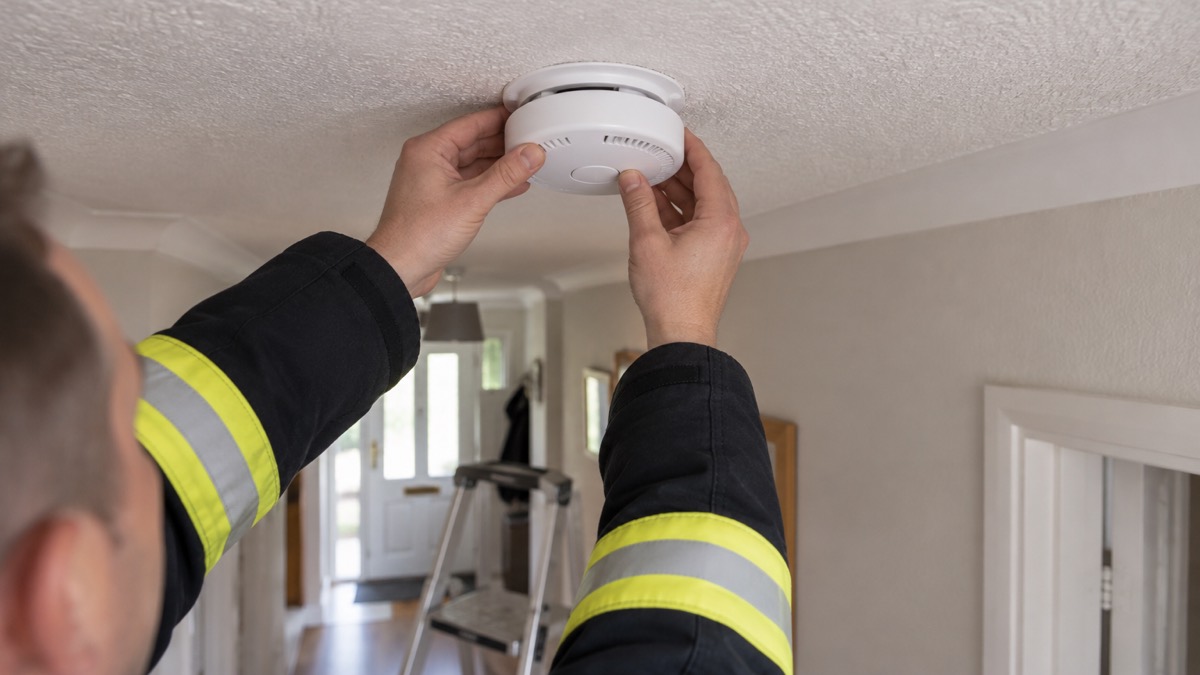
A safe sits inside a wider fire safety plan, and every fire and rescue service in the UK offers free help to build one. The starting point everywhere is an online check: the Fire Kills campaign directs households to complete a free home fire safety check at www.ohfsc.co.uk for advice specific to you and your home15, and NHS England's winter advice repeats the same address16. In Northern Ireland, the online Home Fire Safety Check produces a personalised fire action plan showing the potential causes of fire in your home, and households identified at greater risk are referred for an in-person visit from the Northern Ireland Fire and Rescue Service17, whose stated aim is to prevent fires in the home from occurring18.
In-person visits vary by service but follow the same pattern. Oxfordshire's home safety check covers reducing fire risk, checking smoke alarms, escape planning, and advice on falls, flood and power cuts19. Surrey Fire and Rescue Service visits homes to give personalised fire safety advice and fit smoke alarms free20. Cornwall's free home fire safety check is a person centred risk assessment with prevention advice and signposting to other support21. Lincolnshire Fire and Rescue's community risk management plan makes Home Fire Safety Visits its main prevention method, targeting the most vulnerable22. In Belfast, the home safety check includes a room-by-room inspection and can include security advice alongside energy saving23. What your own fire and rescue service offers depends on where you live, so check its website for the visits and eligibility rules that apply to you.
| Nation | Where to start | What you may get |
|---|---|---|
| England | Free online check at www.ohfsc.co.uk15 | Eligibility for a Home Fire Safety Assessment visit; free smoke and heat alarms may be fitted depending on risk24 |
| Scotland | Your local service's home fire safety visit | Personalised advice and free smoke alarm fitting20 |
| Wales | Your local service's home fire safety check | Prevention advice and signposting to other services21 |
| Northern Ireland | Online Home Fire Safety Check17 | A personalised fire action plan; an in-person visit if identified at greater risk17 |
Two final points of prevention worth acting on. Smoke alarms can be purchased from most DIY stores and some supermarkets25, so there is no barrier to having working detection on every level, which is what gives you the time a fire safe assumes you will use to get out. And with some 7,000 house fires a year in the UK caused by faulty electrics, appliances, wiring and overloaded sockets3, checking appliances and sockets is the prevention step that most directly reduces the risk your safe is there to insure against. Make your escape plan too: Warwickshire Fire and Rescue Service's guidance is that a full fire safety plan covers prevention and detection as well as what to do if the worst happens10.
Sources (25)
- Break-in and housebreaking advice, Police Scotland, 2026
- Residential sprinkler advice, Cheshire Fire and Rescue Service, 2024
- Electrical safety at home, Dorset and Wiltshire Fire and Rescue Service, 2023
- Burton Security Product Guide, Burton Safes, July 2024
- Certification and accreditations, De Raat, 2026
- Fire safety information for residents living in flats operating a stay safe policy, Greater Manchester Fire and Rescue Service, 2026
- What is the best fireproof safe for home use, Fire Protection Online, 2017
- Cyber security: protecting your family, Essex Prepared, 2026
- Residential Personal Emergency Evacuation Plans, North Yorkshire Fire and Rescue Service, 2026
- Making a home escape plan, Warwickshire Fire and Rescue Service, 2026
- Protector domestic safes, De Raat, 2026
- Burton Home Safe Size 1 Electronic Lock, Burton Safes, 2026
- Master Lock Biometric Safe LX110BEURHRO, Securikey, 2024
- Personal key safes, Master Lock, 2026
- Fire Kills campaign, Fire Kills, 2026
- We're here to help you stay well this winter, NHS England, 2024
- Avoiding accidental fires in the home, nidirect, 2025
- Community safety, Northern Ireland Fire and Rescue Service, 2024
- Keep safe and well, Oxfordshire County Council, 2026
- Fire safety for parents and carers, Surrey County Council, 2026
- Free home fire safety check, Cornwall Council, 2026
- Community Risk Management Plan, Lincolnshire Fire and Rescue, 2024
- Home safety, Belfast City Council, 2026
- Fire safety in the home, Greater Manchester Fire and Rescue Service, 2026
- Safe at home: frequently asked questions, North Yorkshire Fire and Rescue Service, 2026
 After a Break-In Checklist
 Holiday Security Checklist
 Moving Home Locks Checklist
 After a Burglary
 Bogus Callers
 Coming Home to a Break-In
 Catalytic Converter Theft
 Riots and Disorder Near Home
 Securing a Damaged Home
 Dogs as a Burglar Deterrent
 Doorstep Selling and Your Rights
 Empty Homes and Long Absences
 Leaving Home on Holiday
 How Burglars Choose a Home
 Home Insurance Conditions