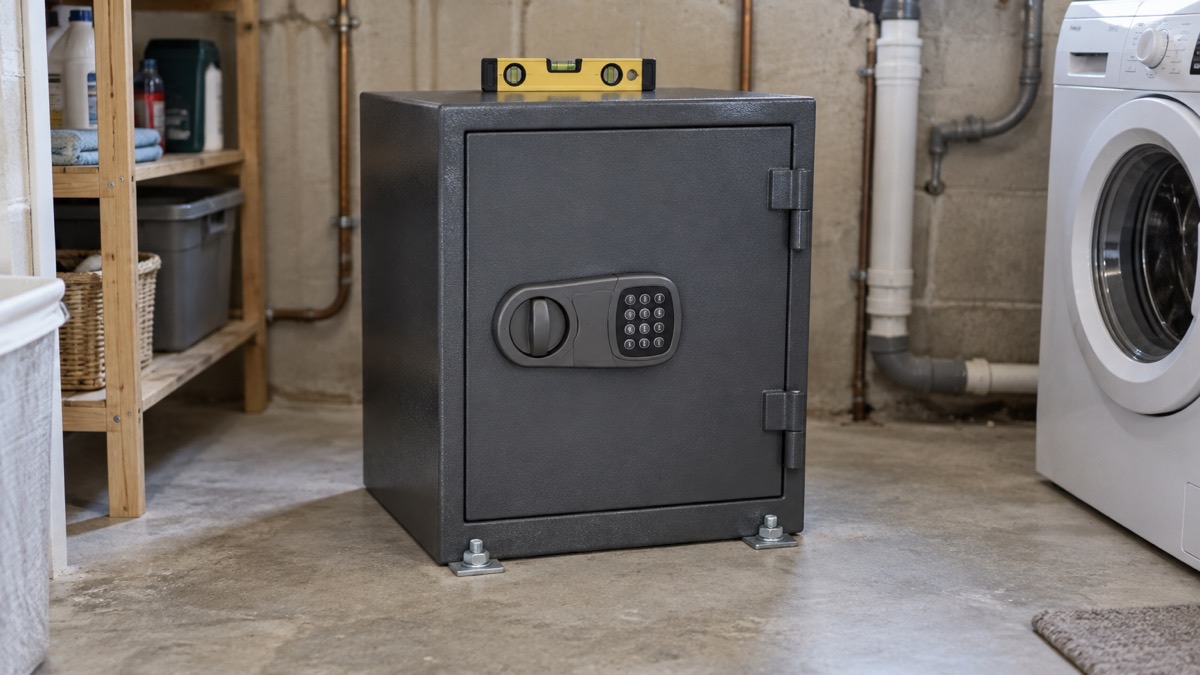
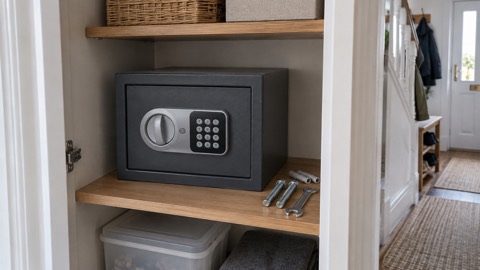
The Burton Home Safe G3 Size 1 is a small, heavy, insurance-approved home safe with an electronic keypad lock. The maker, Burton, lists it as certified to EN1143-1 Grade 3 for burglary protection and rated LFS 30P for fire, which means it is built to protect paper documents from a fire for 30 minutes. It holds 30 litres, weighs 160kg and measures 370 x 480 x 450mm outside.
If you are thinking of buying one, the practical questions are whether it will fit where you want it, whether you can move it, and whether your insurer will accept it. The maker states that the security rating only applies if the safe is bolted to a solid floor, and that it must be bolted to the floor or wall to keep its certification. That is the single most important thing to get right: an unbolted safe is a heavy box that can be carried out.
This page sets out what the safe is, what its ratings mean, how the lock works, how much room it gives you, and how to look after the batteries safely. It does not give a price, and it does not compare the safe with other makes.
What the Burton Home Safe G3 Size 1 is
The Size 1 is the smallest of 3 sizes in the Burton Home Safe G3 range1. It is a freestanding safe with a single door, an electronic number keypad and a powder-coated finish in Anthracite Grey1. Inside there is one height adjustable shelf, so you can divide the 30 litres into two levels or take the shelf out for taller items1.
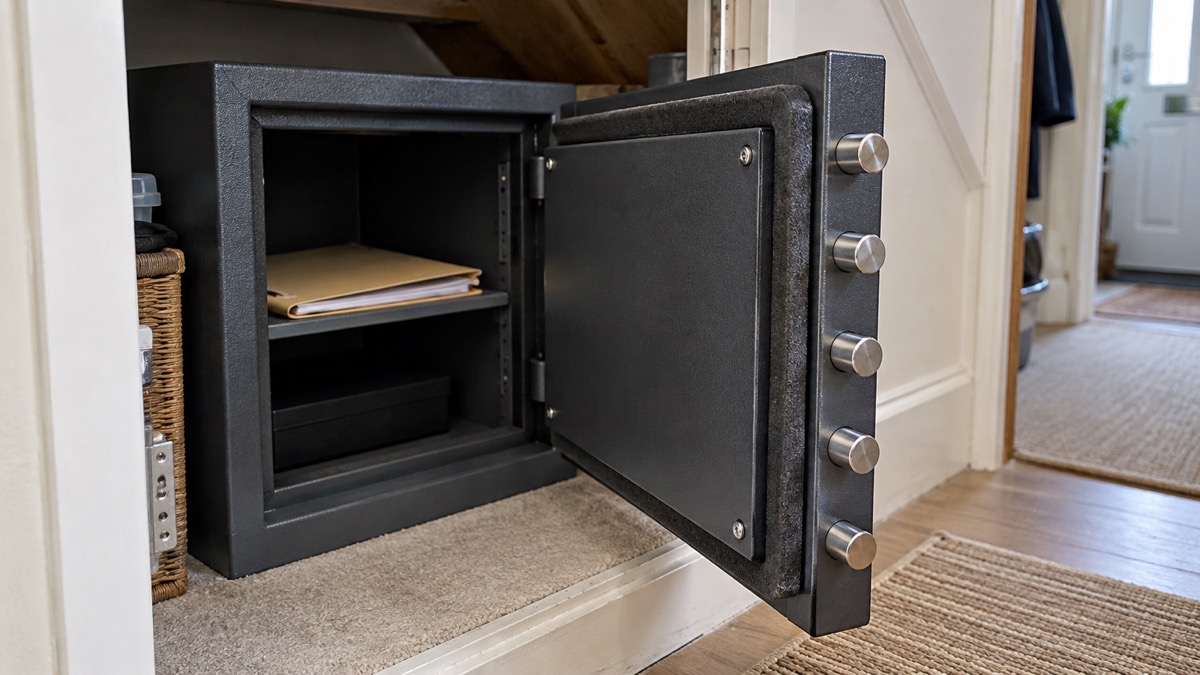
The door is held by double bolted 3 way locking bolts, and there is a dog bolt on the hinge side for protection against hinge attacks1. Those are the features that decide how long the safe resists someone with tools, and they are the reason a Grade 3 safe is heavier and more expensive than a simple cash box. The lock itself is an EN1300 Class B certified lock1.
The safe comes with a 1 year warranty from the maker1. It is supplied with a fixing kit, and the maker is clear that it must be bolted to the floor or wall to maintain its security certification1. There are pre-drilled fixing holes in the base and the rear, one in each1.
Who it suits: a household that wants a small, well-rated safe for documents, jewellery or a modest amount of cash, has a solid floor or wall to bolt it to, and can manage moving 160kg into position once. It is not a large safe: 30 litres is roughly the space of a small suitcase, so it suits a folder of papers and a box of valuables rather than a collection.
Security rating: EN1143-1 Grade 3 and insurance approval
The maker states that the safe is independently tested and certified to EN1143-1 Grade 3 by ECBS, and that it is approved by the Association of Insurance Surveyors (AiS)1. Those two facts do different jobs. The EN1143-1 Grade 3 certification is a European standard for burglary resistance: it tells you how long the safe is expected to resist attack with tools. The AiS approval tells you that insurance surveyors recognise the safe, which matters when you are agreeing cover with your insurer.
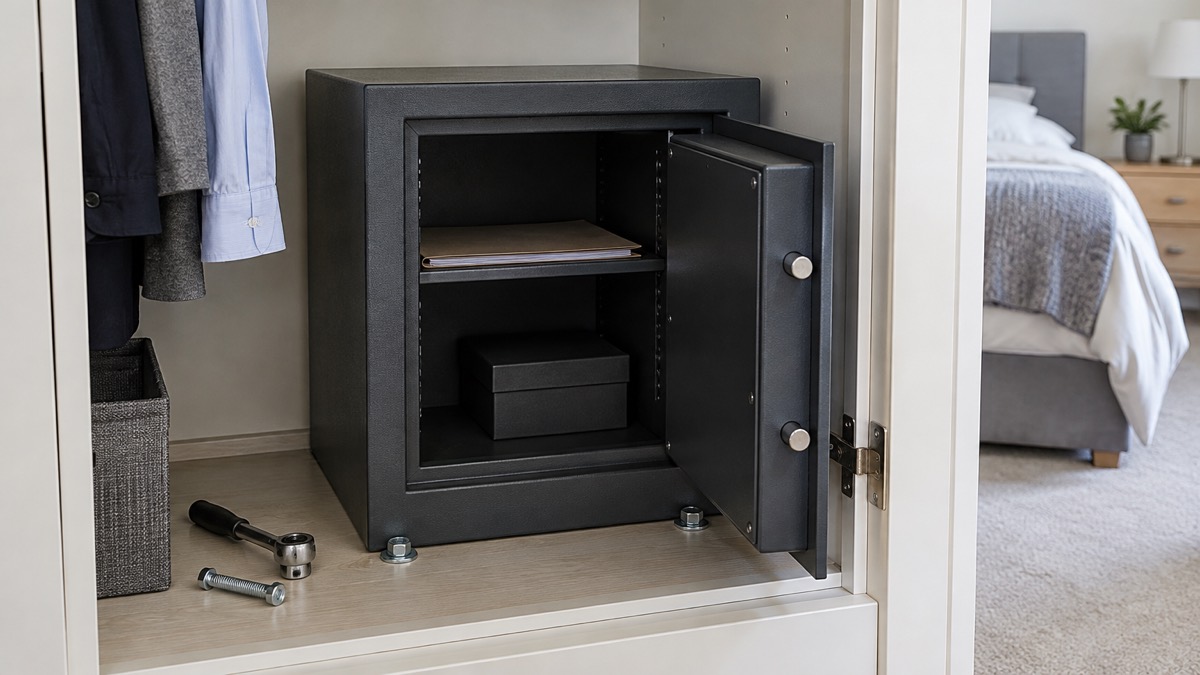
The maker also gives an RU score of 120 for the Size 11. The RU score is the number insurers use when they work out how much cash and valuables they will cover inside a safe. The maker does not publish a cash figure on the product page, so the RU score is the figure to quote to your insurer rather than a promise of a particular sum.
For comparison, other makers in the same market describe their graded safes in the same terms: Chubbsafes lists its ProGuard as certified EN 1143-1 as Grade III for burglary protection2, and its DuoGuard GIII as EN 1143-1 Grade III certified by ECB•S4. That is the language of the standard, not a claim by one maker. If you want to understand what the grades mean before you choose, our guide to home safes and their fire, burglary and cash ratings explains the system.
Fire protection: 30 minutes to LFS 30P
The Size 1 is rated LFS 30P to EN15659, with 30 minutes of fire protection1. LFS stands for light fire storage: it is the rating for safes that protect paper documents, not for digital media or photographs, which need a higher grade. In practice, 30 minutes is the window in which paper inside the safe should survive a house fire long enough for the fire service to arrive and put it out.
That 30 minutes is worth putting in context. North Yorkshire Fire and Rescue Service states that most doors will withstand a fire for approximately 30 minutes5. Westminster City Council's fire safety guidance for purpose-built flats says walls, floors and doors will hold back flames and smoke for a minimum of 30 to 60 minutes6. A 30 minute fire rating is therefore in line with the compartmentation of an ordinary home, not a guarantee that the safe will survive any fire.
Other makers offer longer fire ratings at higher grades: Chubbsafes lists its DuoGuard GIII with 60 minutes of fire protection alongside Grade III burglary protection2, and its Senator with LFS 30P for up to 30 minutes7. If paper documents are your main concern, 30 minutes is the common rating for a home safe. If you need to protect photographs or digital media, check the rating carefully before you buy, because LFS 30P is a paper rating.
The electronic keypad lock and its PIN codes
The lock is an easy to use electronic lock with a number keypad, certified to EN1300 Class B1. It holds 1 master code and 1 user code, and the PIN codes are 6 digits and user programmable1. The master code is the one that lets you change settings and add or remove the user code; the user code is the one you give to someone who needs occasional access.
The maker lists time delay functionality as a feature1. A time delay means the safe waits after a correct code is entered before it opens, so that someone who has forced the code out of you cannot open it immediately. The maker does not publish the delay length on the product page, so check the manual that comes with the safe before you rely on it.
Practical points on the codes:
- Change the master code from the factory setting as soon as the safe is installed, and keep the new one somewhere other than in the safe.
- Give the user code only to people who need regular access, and change it when that access ends.
- Keep the keypad clean and dry; a greasy or dusty keypad is harder to read and wears faster.
- Do not use a code that is easy to guess from your address, birthday or phone number.
If the keypad stops responding, the maker's own troubleshooting for its electronic locks is worth following. BURG-WÄCHTER, which makes electronic safes, advises that if the electronic lock gives no signal, you should change the batteries, clean the contacts with pole grease or contact spray, then remove the batteries, press ON/Enter at least 3 times, insert new batteries and try the known code8. Its PointSafe guidance adds that if the safe does not respond to code entry, you should open it with the emergency key, then check and replace the batteries, using only high-quality brand batteries of type LR 6 and no rechargeable batteries8. Those are the maker's instructions for its own products; check the Burton manual for the equivalent procedure on this safe.
Size and space: 30 litres inside, 160kg to move
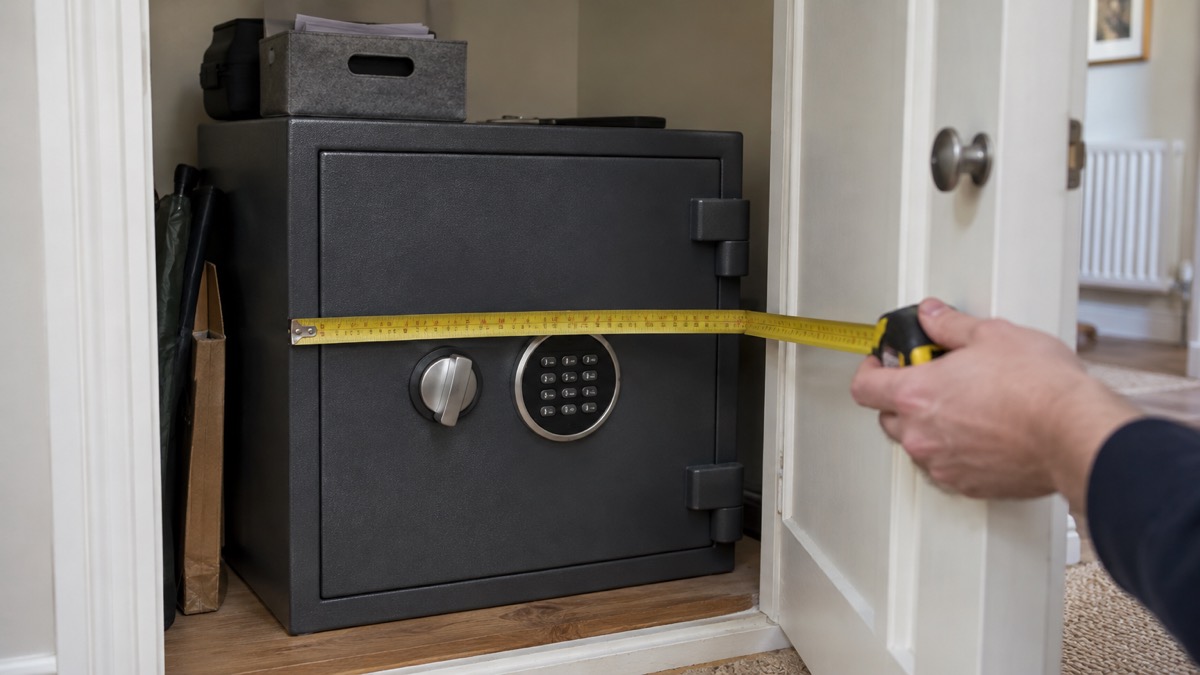
The Size 1 gives you 30 litres of internal space, with internal dimensions of 270 x 380 x 290mm1. The external dimensions are 370 x 480 x 450mm1. It weighs 160kg1. That weight is the point of a Grade 3 safe, and it is also the practical problem: 160kg is more than two people should lift without help, and it will need moving on a trolley or by a specialist carrier.
The measurements you need before you commit are not just the external size. The maker states that you should add 45mm to the external depth for the safe door handle, and add 30mm to the external depth for the keypad and hinges1. The door opens to 180 degrees to allow full access1, so you need clear space in front of and beside the door for it to swing fully open.
| Specification | Size 1 | Size 2 |
|---|---|---|
| External dimensions (H x W x D) | 370 x 480 x 450mm1 | 500 x 480 x 450mm1 |
| Internal dimensions (H x W x D) | 270 x 380 x 290mm1 | 400 x 380 x 290mm1 |
| Volume | 30 litres1 | Not stated on the product page1 |
| Weight | 160kg1 | 196kg1 |
| Shelves | 1 height adjustable1 | 21 |
The Size 2 shows what the next step up buys: a taller body, 196kg and 2 shelves1. The maker states there are 3 sizes available in the range1. If you are storing a lot of paperwork or a collection, the larger size may suit you better; if you have a tight cupboard, the Size 1 is the one that fits.
Changing the batteries and looking after the lock
The lock runs on 2 x AA batteries, which are supplied1. The maker does not state a battery life on the product page, so treat the first set as a guide and replace them before they run flat rather than after. A safe you cannot open is worse than no safe, and the emergency procedures for a flat battery are not something you want to learn in a hurry.
The fire and rescue service advice on batteries is consistent across the UK. Cheshire Fire and Rescue Service advises that you should change batteries when needed or report any faults or concerns to your landlord9. The NHS advises that items using button batteries and any spares should be stored safely and out of children's reach10. AA batteries are not button batteries, but the same discipline applies: keep spares out of reach of children and pets.
The maker's own instructions for its electronic locks are the ones to follow for this safe. BURG-WÄCHTER advises using only high-quality brand batteries of type LR 6 and no rechargeable batteries in its PointSafe8. Rechargeable AA cells run at a lower voltage and can confuse a lock's battery test, so use good quality alkaline cells and replace the whole set at once.
For the lock itself, the general battery advice from the fire and rescue service and the government is to follow the manufacturer's instructions and not to modify or tamper with the battery13. The Energy Saving Trust's guidance on domestic battery storage adds the simple rule: do make sure you follow proper safety procedures when dealing with batteries15. If the keypad gives no signal, work through the maker's sequence: change the batteries, clean the contacts, remove the batteries, press ON/Enter at least 3 times, insert new batteries and try the known code8.
Where to get help and what to do if something goes wrong
If the safe will not open, the first thing to do is not to force it. Work through the maker's troubleshooting sequence above, and if that fails, contact Burton's support with the model and the serial number. If you have lost the code, the maker's manual will set out the recovery procedure; do not drill the safe yourself, because that will destroy the fire and burglary rating.
If you are burgled, the safe's rating is only useful if you can show your insurer what was inside it. Keep a record of valuables separately from the safe, and photograph documents before they go in. Our guide to property marking and keeping a record of valuables explains how to do that, and our page on coming home to a break-in sets out what to do first.
For fire safety in the home more widely, every UK fire and rescue service offers a home fire safety check. London Fire Brigade's online checker takes 2 minutes and is completely free16. Cornwall Fire and Rescue Service says its check will take between 30 and 60 minutes of your time17. Devon and Somerset Fire and Rescue Service says its online check takes around 15 minutes18. The Northern Ireland Fire and Rescue Service's online self-assessment also takes around 15 minutes19.
If you need to call 999, North Yorkshire Fire and Rescue Service advises that most doors will withstand a fire for approximately 30 minutes5, which is the window you are working with when you raise the alarm. It is worth spending a few minutes making sure everyone in the household knows where the safe is, what is in it and who has the code.
The safe is one part of a wider approach to home security. Our guide to how burglars choose a home explains what puts them off, and our page on doors and locks covers the standards that make entry harder. If you are comparing this safe with the rest of the Burton range, the Burton Home Safe G0 and the Burton Home Safe S2 Size 1 are covered separately.
Sources (19)
- Burton Home Safe G3 Size 1 Electronic Lock, Burton Safes, 2026-11-03
- Graded Safes, Chubbsafes, 2026-07-31
- Graded Safes product page, Chubbsafes, 2026-07-31
- DuoGuard GIII datasheet, Chubbsafes, 2025-04-15
- Making a 999 call, North Yorkshire Fire and Rescue Service, 2024-05-20
- Fire safety in the home, Westminster City Council, 2017-01
- Senator datasheet, Chubbsafes, 2026
- Safes FAQs, BURG-WÄCHTER, 2026-11-02
- High rise homes, flats and apartments, Cheshire Fire and Rescue Service, 2026-05-20
- Preventing accidents, Just One Norfolk NHS, 2026-10-28
- Battery safety for e-cycle users, GOV.UK, 2024-02-01
- Lithium batteries, Surrey County Council, 2026-10-28
- E-scooters, e-bikes and batteries, Manchester Fire and Rescue Service, 2026-10-29
- E-bike and e-scooter fire safety in the home, Manchester Fire and Rescue Service, 2026-10-29
- Battery storage, Centre for Alternative Technology, 2025-06-27
- Home fire safety, London Fire Brigade, 2026-10-25
- Free home fire safety check, Cornwall Council, 2026-10-29
- Home safety visits, Devon and Somerset Fire and Rescue Service, 2026
- Home fire safety check, Northern Ireland Fire and Rescue Service, 2026-10-25

 Burton Home Safe S2 Size 1