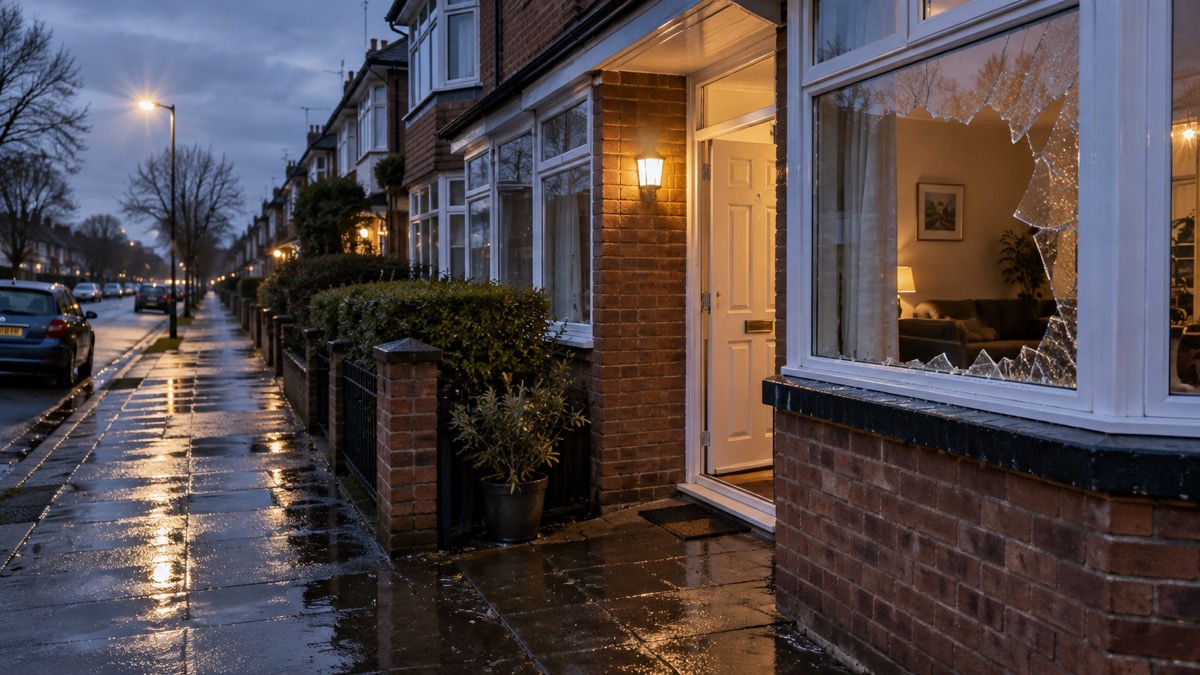
Coming home to a forced door, a smashed window or rooms turned over is a shock, and the first decisions you make matter. The short version is this: if you think the intruder may still be inside, do not go in or search the house yourself. Get to a safe place and call 999. Police Scotland's housebreaking guidance is direct on this point: call 999 if you think the intruder is still there1. If you are already certain the intruder has gone, because you have watched the house from outside, or a neighbour saw them leave, report it on 101 or through the police online reporting form instead1.
Two rules cover almost everything else in the first hour. First, your safety comes before your property: official guidance on being followed says never take chances with your safety, and the same principle applies here2. Second, touch as little as possible until the police have been. A forced door, a smashed window and even the things left on the floor are evidence, and the police can get more from an undisturbed scene than a tidied one. This page walks through those first minutes in order: getting safe, the 999 call, what to do once the intruder is confirmed gone, and how to make the home secure again that day.
Get to safety before you check anything
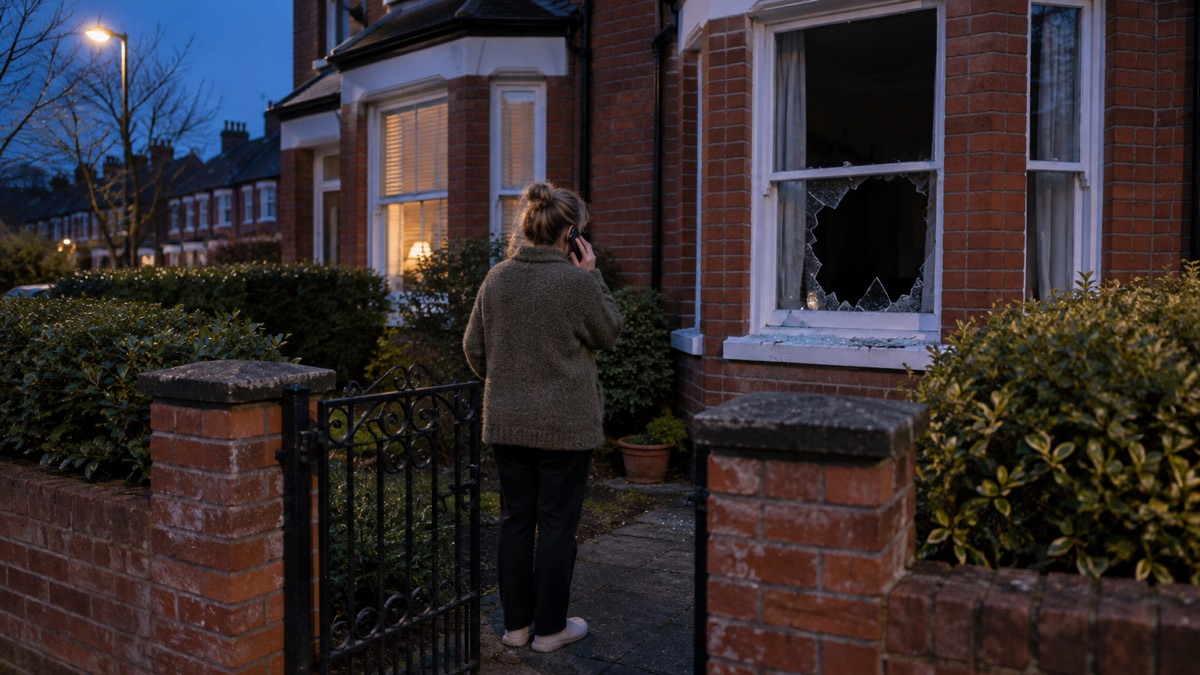
The instinct on finding an open or damaged door is to go in and see what has happened, what is missing, whether the pets are all right. Resist it. If someone is still inside, walking in puts you in the one place you should not be, and it can turn a property crime into a confrontation. Official guidance on personal safety is blunt about the order of priorities: on the first sign of danger, get to a safe location and call for help, and never take chances with your safety2. The same guidance applies to threats: if you are threatened with violence, let your valuables go, because property can be replaced and you cannot2.
A safe place means somewhere you can see the house from without being seen from it, or better, somewhere with other people: a neighbour's house, a shop, a car you can lock and drive a short distance. If you arrived by car and spotted the damage from the street, stay in the car. Guidance on vehicle crime makes a related point: if something feels wrong, wait until you are somewhere safe and where there are people before you stop and deal with it6. Scan the immediate area as you do so. If someone is watching the house, moving away visibly and calmly is the safest thing you can do.
If you are already inside when you realise something is wrong, say you walk into the hall and hear movement upstairs, get out the way you came in if you can do so without passing the noise, and call 999 once you are out or from a safe room with the door locked. Fire and rescue guidance for people who cannot get out of a flat applies the same logic in reverse: open a window, dial 999, and if you have no phone, shout for help7. If you cannot leave, put a locked door and a phone between you and whoever is inside, and tell the call handler exactly where you are in the building.
Before approaching anyone who is hurt, the NHS in Scotland is clear: always make sure the area is safe first8. That means not going to a casualty, even a family member, if the person who hurt them may still be nearby. Emergency preparedness guidance for households puts the whole sequence in one line: check for injuries, help yourself before attempting to help others, follow the advice of the emergency services, and do not put yourself or others in danger9. Community resilience guidance adds the habit of checking your surroundings on arrival: if the environment is not safe, move somewhere else10.
One more thing in those first minutes: if you have a burglar alarm and it is sounding, leave it sounding. If it is not set, do not go in to set it. The routine of checking the alarm is set belongs to when you leave the house normally, not to now11. Your job at this point is to be somewhere else, on the phone.
Call 999 if the intruder may still be there
The dividing line between 999 and 101 is whether the crime is happening now or someone is in danger. GOV.UK's guidance on contacting the police states it plainly: call 999 if you are reporting a crime that is in progress or if someone is in immediate danger3. A break-in you have just discovered sits exactly on that line, because you usually cannot know whether the person has left. The Police Service of Northern Ireland's house security guidance resolves it the same way for its residents: if you have been burgled, call the police immediately on 99912. Police Scotland's housebreaking advice says the same: call 999 if you think the intruder is still there1.
When you call, say first that you think someone may still be inside the property. That single piece of information changes how the call is handled and how quickly officers are sent. Fire and rescue guidance on 999 calls asks callers to stay calm, say if someone is still inside the property, and make sure the address given is correct, especially if access to the property is from a different road13. That last point matters more than it sounds: if your house is reached from a back lane, a shared drive or a rear entrance, say so, or the first responders may arrive at the wrong side of the building.
Do not go back in to look for the intruder, and do not ask a family member or neighbour to. North Wales Fire and Rescue Service gives this advice for fires, and the reasoning transfers exactly: if there is someone still inside, wait for the fire and rescue service to arrive, tell them about the person, and they will be able to find them quicker than you14. The police, arriving to a burglary in progress, are equipped and trained for exactly this. You are not, and a house you know well is still a set of rooms with a stranger in them.
If an unexpected caller at the door is part of what has alarmed you, perhaps someone is still on the property pretending to be a workman, the same number applies. Avon and Somerset Police's doorstep crime guidance says that if an unexpected caller makes you feel alarmed or intimidated, call 999 immediately15.
How a 999 call works, and what to say
Knowing what happens on the other end makes the call easier to make, especially when you are shaken. Every 999 call is directed to a call centre and answered by a BT operator, who will ask which service you need16. You say "police". The operator connects you to the police, and a police call handler then takes over and asks questions. The call is free from any phone, including mobiles without credit17. You do not need to know your phone number or have any paperwork to hand, but you do need the address, and the correct one, including how the property is actually reached13.
The call handler will ask questions while help is on the way. This is normal and does not delay the response. South Western Ambulance NHS Foundation Trust's guidance for callers waiting for an ambulance applies here too: stay calm18. Answer what is asked, in short answers, and if you can hear or see the intruder, say so and keep saying what they are doing. If you are hiding, whispering is fine, and the silent call system, covered below, exists precisely for situations where you cannot speak at all.
Silent calls and dropped landline calls: the 45-second window
If speaking would put you in danger, you can still get help. On a mobile, dial 999, and if you cannot speak, the Metropolitan Police guidance says to press 55 or tap when prompted, and your call will be transferred to the police4. The same guidance carries a warning worth knowing in advance: if you do not press 55 or respond, your call could be ended4. Pressing 55 tells the system the call is genuine; it does not let the call handler hear you any better, so be ready to communicate however you can once connected. PSNI guidance describes the same system: respond to the operator's questions by coughing or tapping the handset, and if prompted press 55 to be put through to police19.
On a landline the system works differently, and in your favour. If you do not speak or answer questions and the operator can only hear background noise, they will transfer your call to the police4. And if you have to put the handset down, or it is knocked from your hand, the line may remain connected for 45 seconds in case you pick it up again5. The IOPC's guide to the silent solution system explains what happens in that window: if you pick up again during the 45 seconds and the BT operator is concerned for your safety, the call will be connected to police16. The same guide adds that if no service is requested but anything suspicious is heard, BT operators will connect you to a police call handler16.
The practical points to remember: 55 is for mobiles, not landlines; on a landline, background noise alone can be enough; and a dropped landline call is not a lost call, so if you can, pick up again within 45 seconds. Bath and North East Somerset Council's guidance confirms the same mechanics: if you press 55, the operator will be notified and the call transferred to the police20.
Intruder gone: report it on 101, online or in person
Once you are confident the intruder has left, the report moves to the non-emergency routes. Police Scotland's guidance sets out the options: call 101 or fill in the online form if the intruder has gone, and you can report it online, by phone, or in person1. The same three routes exist across the UK. NI Direct's guidance on emergency situations describes 101 as the number for a minor crime or incident, giving examples that include a stolen item and property damage21. Doorstep crime guidance from Police Scotland lists the same three ways to report: online, by phone, or in person22.
Reporting online suits a break-in discovered after the fact, where nothing is urgent and you want to write down details at your own pace. The gov.uk reporting route for fraud, which is a useful model for how online reporting works, lets you report online either by signing up for an account or continuing as a guest23. Calling 101 suits cases where you want to talk it through, and visiting a police station in person suits people who would rather explain face to face or who do not get on with online forms.
Whichever route you use, the same details help: when you left the house and when you returned, what is damaged or missing, whether anything was touched or moved, and whether neighbours saw or heard anything, including unfamiliar vehicles. Do not tidy, do not repair, and do not throw away anything the intruder touched until the police have recorded the scene. Fingerprints, shoe marks and tool marks on a forced door or window are all evidence that a cleaned-up scene loses. Our page on what to do after a burglary covers the days that follow: crime numbers, insurers, repairs and support.
It is still a crime even if nothing is stolen
A common reason people give for not reporting is that "they didn't actually take anything". Police Scotland's guidance closes that door: it is still a crime even if nothing is stolen1. Someone breaking into your house or garden is called breaking and entering, or housebreaking, and the offence is complete when the break-in happens, not when property leaves the building1. Reporting matters beyond your own case too: police build a picture of activity in an area, and your report may be the one that connects a series of break-ins on your street. If you would prefer to report without giving your name, our page on reporting a burglary anonymously explains how that works.
When to use 999 and when to use 101
The rule is simple enough to remember under stress. NI Direct's guidance lists when 999 is the right choice: a danger to life, someone using or threatening serious violence, serious injury to someone or their property, and crimes being committed now, and it names house burglary and robbery among the examples21. GOV.UK gives the shorter version: 999 for a crime in progress or someone in immediate danger3. Everything else, a break-in discovered after the event, damage found on returning home, a shed found broken into overnight, goes to 101 or the online form1.
If you are unsure, call 999. A call handler would far rather route a non-urgent report to the right place than learn that someone stayed quiet about a real emergency because they were not certain it qualified. Our page on when to call 999 or 101 about a crime at home goes through the boundary cases in more detail.
| Situation | Number | Why |
|---|---|---|
| You think the intruder may still be inside | 999 | A crime in progress and possible danger to you1 |
| Someone has been injured | 999 | Danger to life or serious injury21 |
| An unexpected caller alarms or intimidates you | 999 | Immediate concern for your safety15 |
| Break-in discovered, intruder clearly gone | 101 or online | Not in progress, no one in danger1 |
| Damage or theft found after the event | 101 or online | Minor crime or incident21 |
If someone is injured
If anyone was hurt, during the break-in or while getting away from it, that changes the call: ask for an ambulance as well as the police, or say someone is injured when the operator asks which service you need. Cheshire Fire and Rescue Service's first aid guidance says to call for help if needed, whether that is 999, 111 or your GP, and to seek help immediately if the person has other injuries24. While waiting, the ambulance service's guidance is to stay calm18, and the household preparedness rule applies: check for injuries, help yourself before attempting to help others, and follow the advice of the emergency services9.
Before you go to anyone who is hurt, make sure the area is safe8. If the person who caused the injury may still be nearby, do not approach: give the location and what you can see to the call handler and let the police secure the scene first. This is one of the hardest instructions to follow when the casualty is someone you love, and one of the most important.
Think as well about how responders will get in. NHS guidance on falls suggests ensuring a family member or neighbour has a spare key so people can get to you quickly, or leaving a spare key in a police-approved key safe, a secure box with a combination lock kept outside the home that anyone you have shared the code with can access25. After a break-in, when a door may be jammed or damaged, a key safe or a neighbour's spare key can save the ambulance crew vital minutes. Our page on key safes explains the police-approved kind and where to fit one.
Damaged doors, windows and debris
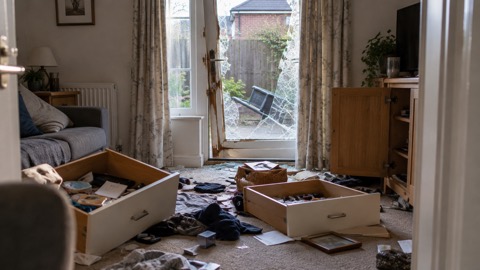
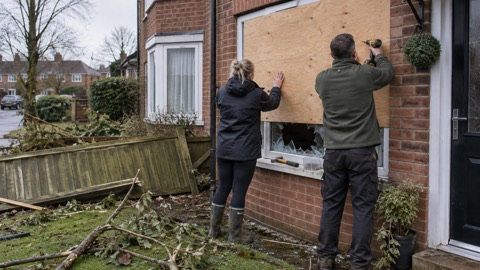
A forced door or smashed window leaves two problems at once: an insecure home and a scene the police need to see. Until the police have attended and told you otherwise, change nothing. Do not sweep up glass, do not screw a split frame back together, do not bring in a boarding-up firm. Photograph everything on your phone if you can do so safely from outside or from rooms you are sure are clear, since photos help both the police and any insurance claim, but the physical scene should stay as the intruder left it.
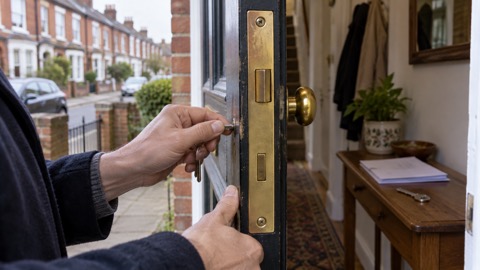
Once the police release the scene, repairs become urgent, because a house with a broken door or window is exactly the house that looks easy to enter again. NI Direct's guidance on securing doors and windows says that if your door or window frames are damaged or coming away from the wall, get them fixed and securely fitted using strong screws or bolts, because good locks are useless otherwise26. The same guidance warns that if you do not have a mortise deadlock on exterior doors, your home may be more at risk26. Our page on doors and locks covers the standards to look for when a damaged door has to be replaced rather than repaired.
If you had to break a window yourself, to escape or to get help, treat the hazard immediately: fire and rescue guidance says to cover the jagged glass with towels or thick bedding27, and Surrey Fire and Rescue Service adds that if you have to escape from a window, throw some more bedding out of it to break your fall17. Where debris is extensive, household preparedness guidance says to check the exterior of the property for cracks, leave immediately if any part of the building looks unstable, and wear protective clothing and footwear9. A break-in rarely causes structural damage, but a violent forced entry on a already weak door frame can, and a door frame coming away from the wall is a job for a builder as well as a locksmith26.
Break-ins in the garden or shed
Sheds, garages and gardens get broken into more often than houses, and many people are unsure whether it counts. It does. Police Scotland's guidance defines housebreaking as covering your house or garden1, and the same rule applies: it is still a crime even if nothing is stolen1. Report it the same way, 999 if you think whoever did it is still on the property, 101 or the online form if they have gone1.
Garden break-ins deserve reporting for another reason: they are often a step towards the house. Tools taken from a shed become the crowbar that opens a back door, and a broken side gate is an invitation to try the rear of the house next. After any garden break-in, check the boundaries. Police Scotland advises making sure gates are not broken and can be locked in 2 different places1. Our page on terraced houses and rear alleys covers gates and back-door security in more depth.
Storm damage and break-in damage can look alike, and both leave the same weakness. Sussex Resilience Forum's severe weather advice is to secure doors, windows and loose outside objects such as garden furniture, bins, plant pots and trampolines28. After a storm, walk the boundary before you leave the house again: a gate blown off its hinges is as good as no gate, and a shed door hanging open advertises what is inside.
Reporting in Scotland and Northern Ireland
The differences between the nations are in the non-emergency routes and who handles the report, not in the emergency itself. What follows sets out those routes for Scotland and Northern Ireland so you know which number or service to use.
In Scotland, Police Scotland handles housebreaking reports, through 101 or its online form1. Where the break-in involves money lost to a scam or fraud, the National Cyber Security Centre's guidance is to tell your bank straight away and report it as a crime to Report Fraud for England, Wales and Northern Ireland, or to Police Scotland for Scotland29. The gov.uk fraud reporting guidance says the same: if you are in Scotland and you have lost money because of an online scam or fraud, report the crime to Police Scotland23.
In Northern Ireland, the Police Service of Northern Ireland takes reports. Its own guidance says that if you are in Northern Ireland you can report to the PSNI directly by calling 101 or visiting its online reporting page30. NI Direct's general guidance is the same: if you have witnessed a crime, or a crime has been committed against you, tell the police21. Our page on Scotland and Northern Ireland covers the differences in reporting and support in more detail.
One related point for after a break-in: if the intruder has taken phones, laptops or devices with accounts on them, treat those accounts as compromised. The NCSC's guidance on data breaches says that if you have lost money, tell your bank and report it as a crime to Report Fraud, the UK's reporting centre for cyber crime, and in Scotland contact the police by dialling 10131. If you later receive suspicious calls or messages connected to the break-in, hang up and contact your phone provider31.
Why an empty-looking house is more at risk
Most break-ins are opportunistic, and the opportunity is usually a house that looks empty. Police Scotland's guidance says housebreaking is more likely when a house looks empty1. The Police Service of Northern Ireland puts a number on the value of doing something about it: properties without security measures in place are ten times more likely to be burgled than those with simple security measures such as quality door locks12. That figure is worth remembering when you are deciding what to fix first after a break-in, because the house that was just broken into is, for a while, the least secure one on the street.
The measures that follow are the ones the official guidance names. Good home security, such as using window and door locks, is the best way to reduce your chances of being burgled12. A visible burglar alarm matters too: NI Direct's guidance on securing your home says opportunist burglars tend to avoid houses where they can see one, and the cost of your home insurance may also be reduced32. Our page on burglar alarms explains the types, and if you already have one, police guidance on pre-holiday routines is simply to ensure it is set before you leave11.
Empty-looking is not only about being away for weeks. It is also the evening pattern: no lights, no movement, curtains open on a dark room. NI Direct's guidance on securing your home warns that with a public profile, talking about your holiday on social media could tell an opportunistic burglar that your home will be empty for a couple of weeks32. Our pages on making your house look occupied and on leaving your home while you are on holiday cover the practical steps, and the holiday checklist gathers them in one list.
After a break-in, the immediate priority is closing the gap the intruder used, and then the gaps they might use next. Fix the damaged frames and fit proper locks26, secure the gates1, set the alarm when you go out11, and keep a record of what you own so that anything taken is easier to describe and harder to sell on. The steps in the first hour, getting safe, calling the right number, and preserving the scene, are covered in our step-by-step checklist for after a break-in, and the days that follow, from crime numbers to repairs, in what to do after a burglary.
Sources (32)
- Break-in and housebreaking advice, Police Scotland, 2026-11-02
- Protect yourself outdoors, Police Service of Northern Ireland, 2026-11-02
- Contact the police, GOV.UK, 2026-10-29
- How to make a silent 999 call, Metropolitan Police, 2026-11-02
- How to make a silent 999 call, police.uk, 2026-11-02
- Preventing car and vehicle theft, Sussex Police, 2026-11-02
- High-rise homes, flats and apartments, Cheshire Fire and Rescue Service, 2026-05-20
- How to do a primary survey, NHS inform, 2026-07-24
- Prepare yourself, Greater Manchester Combined Authority, 2026-10-29
- Community Emergency Hub, Buckinghamshire Council, 2026
- Pre-holiday routine, Avon and Somerset Police, 2026-11-02
- House security, Police Service of Northern Ireland, 2026-11-02
- What to do if there's a fire, Dorset and Wiltshire Fire and Rescue Service, 2021-12-02
- Get out, stay out and call 999, North Wales Fire and Rescue Service, 2026-10-26
- Doorstep crime, Avon and Somerset Police, 2026-11-02
- Silent solution guide, Independent Office for Police Conduct, 2023
- Fire in the home, Surrey Fire and Rescue Service, 2026-08-24
- What to do when the ambulance is coming, South Western Ambulance NHS Foundation Trust, 2026-10-29
- Christmas safety advice, Police Service of Northern Ireland, 2026-11-02
- If you can't speak when you call 999, Bath and North East Somerset Council, 2026
- Emergency situations and keeping safe, NI Direct, 2025-01-08
- Rogue traders and doorstep crime, Police Scotland, 2026-11-02
- Report suspicious emails, websites and phishing, GOV.UK, 2026-10-29
- Burn awareness, Cheshire Fire and Rescue Service, 2026-05-20
- What to do if you fall, NHS inform, 2026-04-30
- Securing doors and windows, NI Direct, 2024-08-27
- If you are trapped by fire, Essex Prepared, 2026-10-29
- Preparing for an emergency: be ready, stay safe, act now, Sussex Resilience Forum, 2025-10
- Phishing: respond and recover, National Cyber Security Centre, 2026
- Protect Yourself booklet, Police Service of Northern Ireland, 2024
- Data breaches guidance, National Cyber Security Centre, 2021-01-28
- Securing your home, NI Direct, 2024-01-23
 After a Break-In Checklist
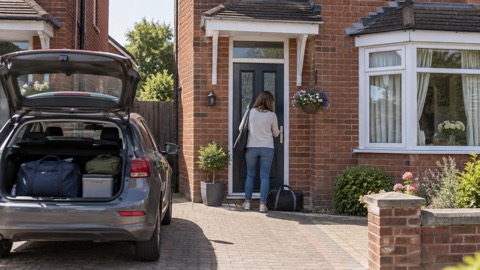 Holiday Security Checklist
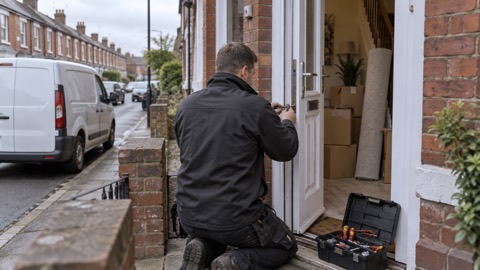 Moving Home Locks Checklist
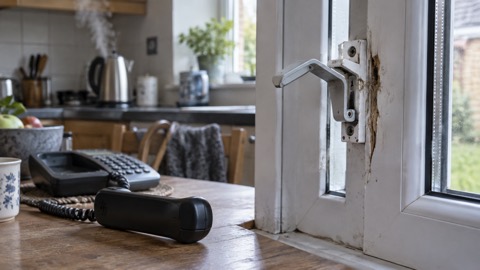 After a Burglary
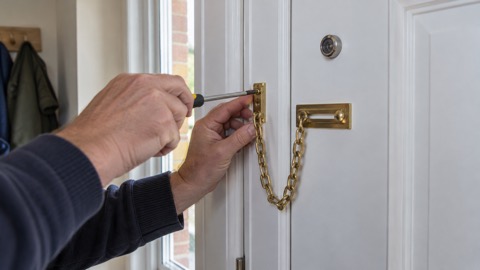 Bogus Callers
 Catalytic Converter Theft
 Riots and Disorder Near Home
 Securing a Damaged Home
 Dogs as a Burglar Deterrent
 Doorstep Selling and Your Rights
 Empty Homes and Long Absences
 Leaving Home on Holiday
 How Burglars Choose a Home
 Home Insurance Conditions
 Keyless Car Theft