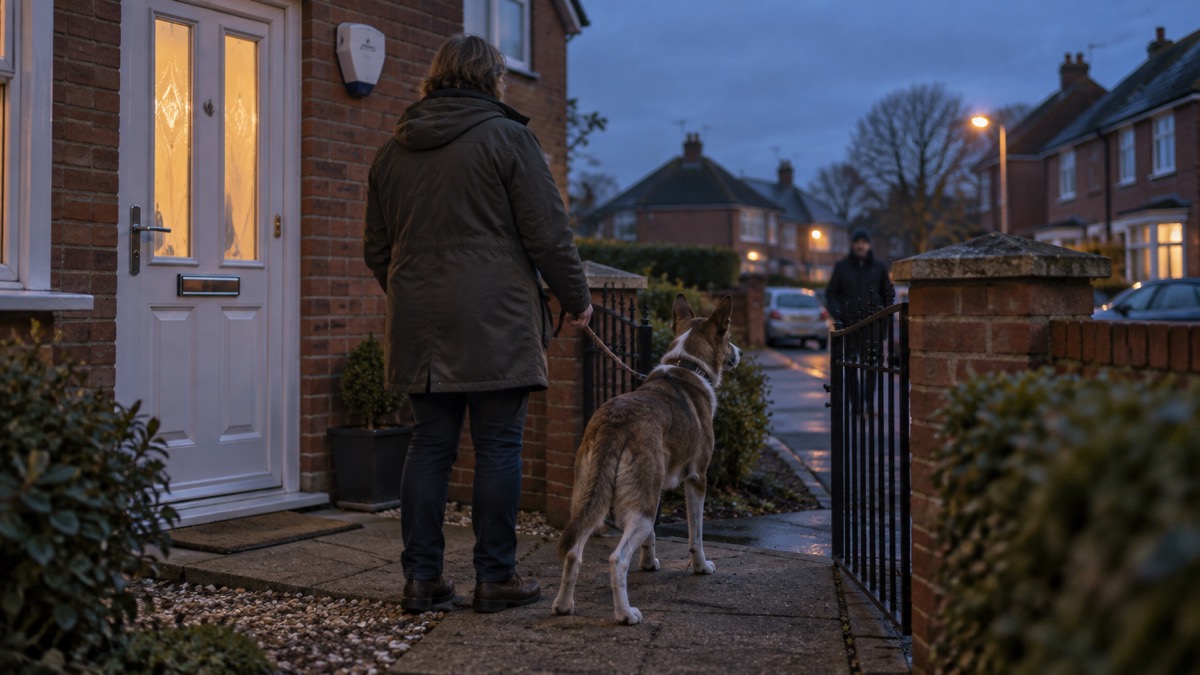
A dog can help protect your home, but it is not a lock. Police guidance in Northern Ireland puts it plainly: "A good guard dog is an asset. A barking dog may warn you of intruders."1 At the same time, police and council guidance across the UK is consistent that physical security comes first: "Good home security, such as using window and door locks, is the best way to reduce your chances of being burgled."2 Most burglaries are crimes of opportunity, and a home that is easy to enter will be entered whether or not a dog lives there.3
So the honest answer to "do dogs deter burglars" is: partly, and only as one layer. A barking dog adds noise, attention and unpredictability, all things a burglar dislikes, and official guidance treats that as a genuine benefit.1 But a dog cannot be relied on the way a locked door or a fitted alarm can: it may be asleep, shut in another room, friendly to strangers, or silenced. The rest of this page sets out how to use a dog well as part of your home security, what the law says if you or your dog confront an intruder, and how to keep the dog itself safe, because a dog that panics or escapes is a risk to you and to emergency responders.
What a dog does, and what it cannot do
Police guidance in Northern Ireland describes a guard dog as an asset for two reasons: the dog's presence itself, and the warning a barking dog gives you when someone is outside or trying to get in.1 That warning is the most practical benefit for an ordinary household. A burglar's main aim is to work unseen and unheard, and a dog that barks at the door defeats both. The same logic appears in fire service guidance on making a home look occupied: leaving a radio on low is recommended because "Even moderate background noise can deter a person who is scouting out a break-in."7 A dog is, in effect, background noise that responds to the person scouting your home.
What a dog cannot do is guarantee anything. Guidance on home security treats deterrence as a stack of measures, each one slowing a burglar down or making the job noisier: closed and secured gates, a locked garage, tended hedges and fences, and a fitted burglar alarm where you can.8 A dog fits into that stack but does not replace any part of it. There is also a timing problem: many break-ins happen when the household is out, and a dog left alone may bark at everything or nothing, or may be shut away from the doors and windows a burglar uses. If you are relying on the dog's bark as your alarm, you are relying on the dog being awake, in the right room, and inclined to bark at a stranger rather than hide.
The visible traces of a dog can help in small ways. Damage to fencing should be repaired promptly to deter intruders, according to fire service guidance on protecting property, and a dog that uses the garden gives you a reason to check the fence line often.9 But do not overstate the effect. The strongest documented deterrents in official guidance are the ones a burglar can see and does not want to tackle: window locks in plain view, because "the noise of breaking glass would attract attention", and a home that is clearly not an easy target.10 For a fuller picture of how burglars size up a home, see how burglars choose a house.
What to do: build the dog into your home security
Treat your dog as one layer in a routine you follow every time you leave the house and every night. Police Scotland's advice to residents was to make sure the property is not an easy target by keeping it appropriately secured with windows and doors locked, and, when leaving home, to ensure all locks are working and any alarm systems, motion lighting and CCTV are activated.11 Your dog changes what "secured" means in two ways: its bark adds a deterrent, and its presence adds a responsibility, because you must be sure it cannot escape or be harmed while you are out.
A workable routine looks like this:
- Lock windows and doors, including internal doors between the room the dog is in and the outside, so the dog cannot reach an opening door or window.2
- Check the garden boundary: gates closed and secure, fencing in good repair, and no gaps a dog could squeeze through or a burglar could use.8
- Activate any alarm, motion lighting or CCTV you have fitted.11 If your alarm has pet-friendly sensors, make sure they are set so the dog does not trigger false alerts; see alarm sensors and pets.
- Leave a radio on low for background noise, which fire service guidance says can deter someone scouting a break-in.7
- Keep car keys somewhere a burglar reaching through a window or letterbox cannot find them, because police guidance warns that improved car security means thieves now break into houses to steal the keys.12
- Make sure the dog is wearing a readable collar and ID tag even indoors, and that its microchip details are current, in case it escapes while you are out.6
Two of those points deserve emphasis. First, the car keys point is easy to miss: the dog may guard the hallway, but if the keys hang by the front door, a burglar who gets that far has what they came for.12 Second, the radio is not a gimmick; it comes from the same family of official advice as timed lighting and closed curtains, all of it aimed at making an empty house seem occupied. For more on that, see making your house look occupied and the wider home security guide.
What you need: identification, control and a secure garden
The kit that matters here is not for the burglar, it is for the dog. Pet welfare charities are consistent that a dog should wear a well-fitting collar with an ID tag carrying up-to-date contact details at all times, including indoors, because a dog that bolts through an open door during a disturbance is far more likely to come home if it can be identified.6 The microchip is the backstop: check that the registered details are current, not just that the chip exists.13
| What your dog needs | Why | Who says so |
|---|---|---|
| Collar with a readable ID tag, worn even in the house | A dog that escapes during a break-in, fireworks or a storm can be returned quickly | Blue Cross6 |
| Up-to-date microchip details | The tag can be lost; the chip is the permanent link to you | PDSA13 |
| A secure lead for evacuations and emergencies | The dog must remain under control when you leave home in a hurry | PDSA13 |
| A garden with no escape routes | Holes in fences let a panicked dog out and let scouts see in | PDSA14 |
| A separate room you can shut the dog in | So ambulance crews and other responders can work safely | North West Ambulance Service5 |
The garden point does double duty for security. Fireworks and storm guidance from the PDSA tells owners to secure the home and garden in advance and to make escape routes, such as holes in fences, inaccessible.14 The same holes that let a frightened dog out on fireworks night are the gaps in your boundary that make the property look untended and easy to approach. Repairing fencing promptly deters intruders, according to Cheshire Fire and Rescue Service guidance on protecting property from arson.9
Staying safe: your dog, intruders and the law
If someone does break in while you are at home, the law is on your side as the householder, and that extends to the confusion of the moment. Crown Prosecution Service guidance on householders and the use of force against intruders confirms that you can protect yourself, others in the home and your property, and that where the facts are very clear or the injuries involved are less serious, "the investigation will be concluded very quickly, without any need for arrest."4 A dog that bites an intruder in those circumstances is part of the same picture: the CPS guidance recognises that in the confrontation itself you are not expected to weigh precisely what force is reasonable.4
The limit comes afterwards. Chasing an intruder as they run off is a different matter from a confrontation in your home, and the law on pursuing someone who has left, recovering your property and making a citizen's arrest is not set out in the guidance quoted on this page, so we do not state it here. What is clear is that a dog released after an intruder has left is a danger to everyone nearby, including neighbours and arriving police officers, so keep the dog with you rather than sending it after anyone. For the full picture of your rights, see your rights if someone breaks into your home.
"you are still allowed to use reasonable force to recover your property and make a citizen's arrest"
There is a second legal dimension this page cannot settle: the specific statutes governing dangerous dogs and guard dogs. Those rules are not set out in the official guidance quoted here, so we do not state them. What the guidance does show is that control runs through every piece of official advice: a dog under control, on a short, strong lead attached to a well-fitting collar near roads, and secured in a separate room when emergency responders arrive, is an asset to your household. A dog out of control is a liability whatever the law says, and if you are seriously considering a dog for protection, ask your local police force or a welfare charity such as the Blue Cross about the current legal requirements where you live.
Staying safe: your dog and emergency responders
The situation most dog owners do not plan for is an emergency at home where crews need to get in fast. Ambulance services across England, Wales and Northern Ireland ask for the same thing. North West Ambulance Service says: "Secure your pets, keep them in a separate room to allow our crews safe access."5 South Western Ambulance Service says to put pets somewhere safe.15 The Northern Ireland Ambulance Service goes further: "Lock away any family pets to ensure there are no delays in reaching the patient."16 A dog that is calm with your family may behave very differently when strangers enter urgently, with equipment, shouting or a stretcher.
Make this part of your household plan:
- Decide now which room the dog goes in, and make sure that room has a door you can shut quickly.5
- Tell everyone in the household, including children, that their job in a medical emergency is to call for help and secure the dog.15
- If you have to evacuate, keep the dog on a secure lead with up-to-date ID; the PDSA advises exactly that for storm evacuations.13
- If you are leaving your home because of flooding, Surrey County Council guidance says to make sure the property is left secure to reduce the risk of burglars breaking in, and to be careful of doorstep callers who may trick or steal from you by asking to turn off water or check the electricity.17 A dog left behind in a flood evacuation must be shut in safely with water, and the property secured behind you.
Fire crews face the same problem, and dogs are regularly rescued from house fires: Devon and Somerset Fire and Rescue Service reported one small dog rescued from a property fire in September 2024,18 and North Wales Fire and Rescue Service rescued a dog named Rupert from a tumble dryer fire in July 2026.19 Those rescues take time and put firefighters at risk. A dog shut in one room is easier to find and to carry out than one loose in a smoke-filled house, so the same rule that protects ambulance crews protects fire crews and the dog itself. For the wider picture, see pets and animals in an emergency.
Staying safe: fireworks, storms and escapes
The times a dog is most likely to be lost are the times it is frightened, and those are also times when your home's security is tested. Blue Cross advice for fireworks nights is to close all windows and doors, block off cat flaps, draw the curtains and switch on the TV or radio at increased volume if the animals are used to it.6 The PDSA adds the preparation that matters for security: secure the home and garden in advance, and make escape routes such as holes in fences inaccessible.14
One instruction surprises many owners: do not coax a frightened dog out of hiding. Blue Cross is clear that a dog pacing, whining or hiding is trying to find safety and should not be disturbed.6 The fear itself is common. The PDSA's 2021 Animal Wellbeing Report found that 15 per cent of UK dogs obtained during the pandemic, around 139,000 dogs, were showing signs of fear.14 A fearful dog is not a deterrent to anyone; it is a household member that needs a quiet, enclosed space, closed curtains and familiar noise. For storm preparation, the PDSA repeats the identification advice: always ensure the dog wears a collar with an ID tag in case it escapes, and check that microchip details are up to date.13
Away from home, two further official warnings apply. The RSPCA's guidance on dogs in hot cars sets out the steps if you find a dog in distress and are sure you need to free it: tell the police what you intend to do and why, take photos or videos of the dog, and take the names and telephone numbers of any other witnesses.20 And if you walk your dog on the coast, the RNLI reported 41 dog walkers aided by lifeguards in 2024, a reminder that dogs get their owners into trouble as often as the reverse; keep the dog under control and, if it is cut off by the tide, call for help rather than going in after it.21
Where Scotland, Wales and Northern Ireland differ
The core advice in this page is UK-wide: locks first, a barking dog as an asset, identification on the dog at all times, and pets secured before responders arrive. The differences are in who gives the advice and in a few regional specifics.
In Scotland, Police Scotland's home security advice to West Lothian residents in March 2023 was to keep the home appropriately secured with windows and doors locked, to ensure all locks are working and any alarm systems, motion lighting and CCTV are activated when leaving, and to be vigilant and take appropriate measures to keep properties safe.11 If you walk your dog in rural Scotland, the Scottish SPCA notes that adders are found in quiet, open areas such as heathland, moorland and woodland, and in warmer weather on beaches and sand dunes, and that they are most active, and most likely to bite people and dogs, in spring after hibernation.22 Keep your dog under control and on a path in those areas in spring.
In Wales, the fire and rescue service guidance on leaving your home unattended is the source of the radio advice in this page,7 and North Wales Fire and Rescue Service's rescue of a dog from a tumble dryer fire in July 2026 is a reminder that appliance safety and pet safety are linked.19 For reporting fraud, Ofcom notes that the Report Fraud service covers Wales, England and Northern Ireland.23
In Northern Ireland, the practical guidance quoted on this page includes the PSNI's Protect Yourself booklet, which is the source for the guard dog advice.1 The Northern Ireland Ambulance Service asks you to lock away family pets so there are no delays in reaching the patient.16 For reporting crime and getting support in Scotland and Northern Ireland generally, see Scotland and Northern Ireland: reporting crime and getting support.
One figure worth knowing if you live in Scotland: the Scottish Environment Protection Agency's National Flood Risk Assessment puts 1 in 8 properties across Scotland at risk of flooding in a medium likelihood scenario, up from 284,000 properties in its 2018 assessment.24 If your home is one of them, the flooding guidance in this page applies with extra force: when you evacuate, the property must be left secure against burglars, the dog must be on a lead with ID, and you should be wary of doorstep callers afterwards.17
Sources (24)
- Protect Yourself booklet, PSNI, 2024
- House Security guidance, PSNI, 2026
- Home safety advice, Devon County Council, 2025
- Householders and the use of force against intruders, Crown Prosecution Service, 2018
- Preparing for an ambulance arrival, North West Ambulance Service, 2026
- Fireworks and pets, Blue Cross, 2025
- While You Are Away, Mid and West Wales Fire and Rescue Service, 2026
- Securing your home, nidirect, 2024
- Protect your property from arson, Cheshire Fire and Rescue Service, 2024
- Securing doors and windows, nidirect, 2024
- Home security advice for West Lothian, Police Scotland, 2023
- Home safety advice leaflet, PSNI, 2022
- Keeping pets safe in stormy weather, PDSA, 2022
- Firework fear preparation, PDSA, 2021
- What to do when the ambulance is coming, South Western Ambulance Service, 2026
- What to do before help arrives, Northern Ireland Ambulance Service, 2026
- Staying healthy and safe after flooding, Surrey County Council, 2026
- Property fire at Ansford, Devon and Somerset Fire and Rescue Service, 2024
- Tumble dryer fire, Cartrefi Conwy resident, North Wales Fire and Rescue Service, 2026
- Dogs in hot cars, RSPCA, 2026
- Top Dog coastal safety, RNLI, 2024
- Adder bites, Scottish SPCA, 2026
- Report Fraud service coverage, Ofcom, 2024
- National Flood Risk Assessment, Scottish Environment Protection Agency, 2025
 After a Break-In Checklist
 Holiday Security Checklist
 Moving Home Locks Checklist
 After a Burglary
 Bogus Callers
 Coming Home to a Break-In
 Catalytic Converter Theft
 Riots and Disorder Near Home
 Securing a Damaged Home
 Doorstep Selling and Your Rights
 Empty Homes and Long Absences
 Leaving Home on Holiday
 How Burglars Choose a Home
 Home Insurance Conditions
 Keyless Car Theft