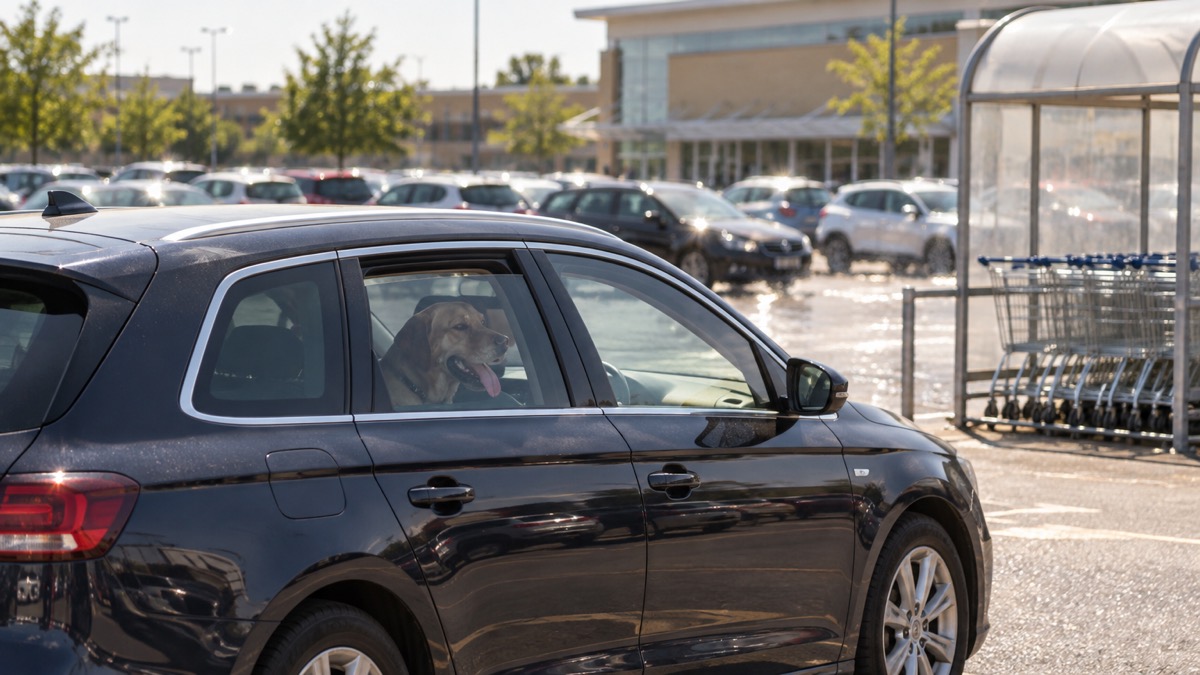
No, you cannot safely leave your dog alone in a car, not even for a few minutes and not even with the windows open. That is the consistent message from fire and rescue services, councils, the NHS and veterinary charities across the UK. Devon and Somerset Fire and Rescue Service list it among their top causes of rescues: never leave your dog in a car, especially not on a warm day1. The PDSA, the UK's veterinary charity, puts it more bluntly still: never leave your pet alone in the car, because no length of time is too short to be dangerous2.
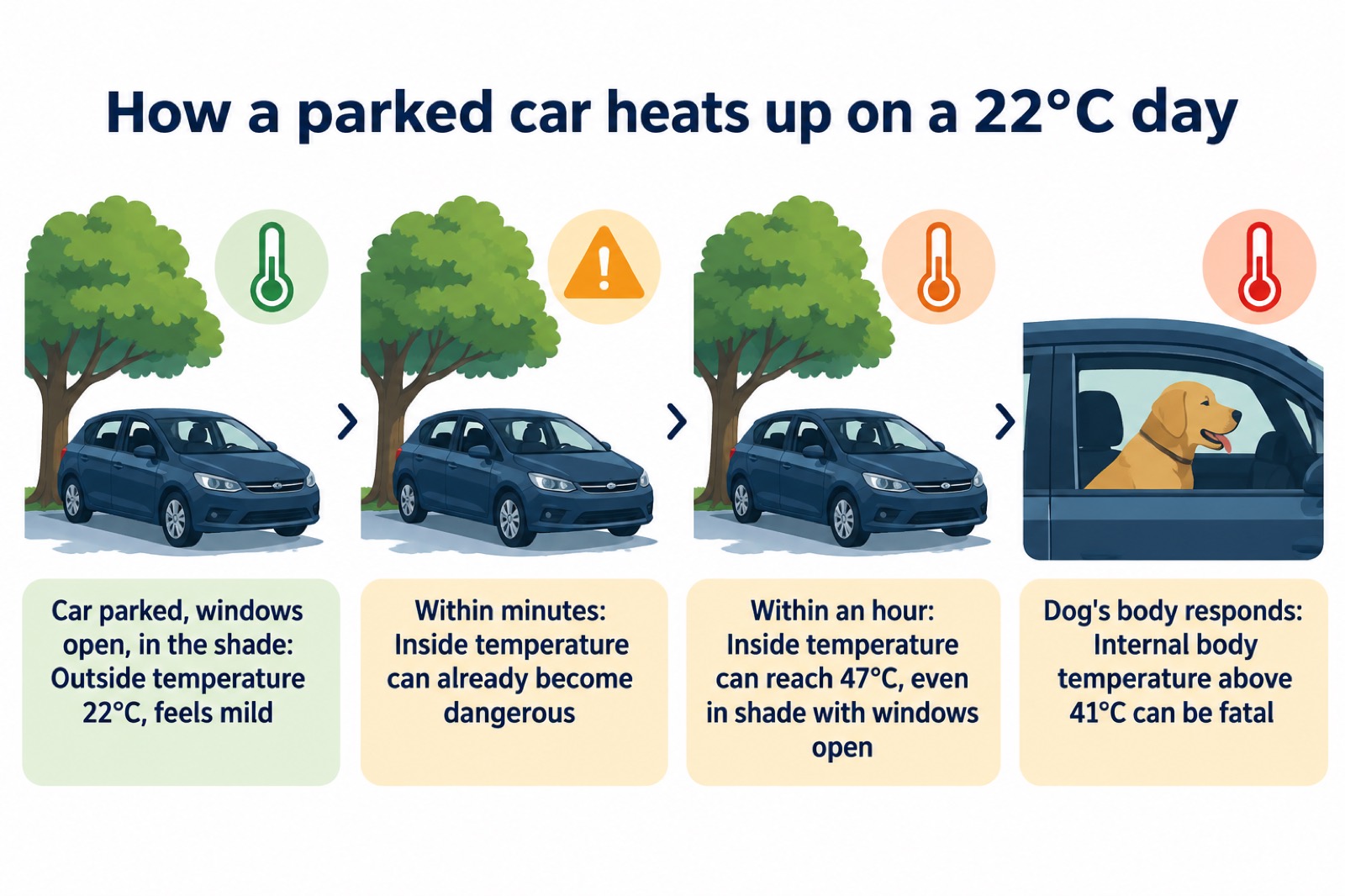
The reason is how fast a parked car heats up. When it is 22°C outside, a temperature that feels pleasantly mild, the inside of a car can reach 47°C within an hour, and that is even when the car is parked in the shade with the windows open2. A dog's body cannot cope with that. If a dog's internal body temperature exceeds 41°C, it can be fatal2. This page explains how the heat builds, why the usual workarounds do not work, which dogs are most at risk, how to spot heatstroke, and exactly what to do if you find a dog alone in a hot car.
How fast a car heats up: 22°C outside, 47°C inside
The single most important number for any dog owner is the relationship between the outside temperature and the inside of a parked car. The PDSA's guidance on safe car travel for pets states it directly: "When it's 22°C outside, within an hour the temperature in a car can reach an unbearable and deadly 47°C"2. Twenty-two degrees is not a heatwave. It is the kind of day when people leave their coats at home and think nothing of leaving the dog in the car for a quick errand. That is precisely the mistake this figure is warning against.
Two details make it worse. First, that rise happens even when the car is parked in the shade with the windows open6, so the two precautions most people rely on are already built into the number. Second, the full hour is not needed for danger. Devon and Somerset Fire and Rescue Service warn that temperatures inside a parked vehicle can become dangerous within minutes3, and Somerset Council give the same warning about children: never leave a child alone in a car even for a few minutes, because temperatures inside a stationary vehicle can rise to dangerous levels within minutes7.
The mechanism is simple enough to explain why it happens so fast. Sunlight passes through the windows and warms the interior surfaces, and the warm air cannot escape again through the glass. A closed or partly closed car becomes, in effect, a small greenhouse. Official heat-health guidance across the UK repeats the same instruction because of this: ensure that babies, children, older people or animals are not left alone in parked cars, which can quickly overheat8. The Met Office adds that even on cool days, strong sunshine can make car interiors very hot9, so the danger is not confined to summer.
Why open windows, shade and air conditioning do not make it safe
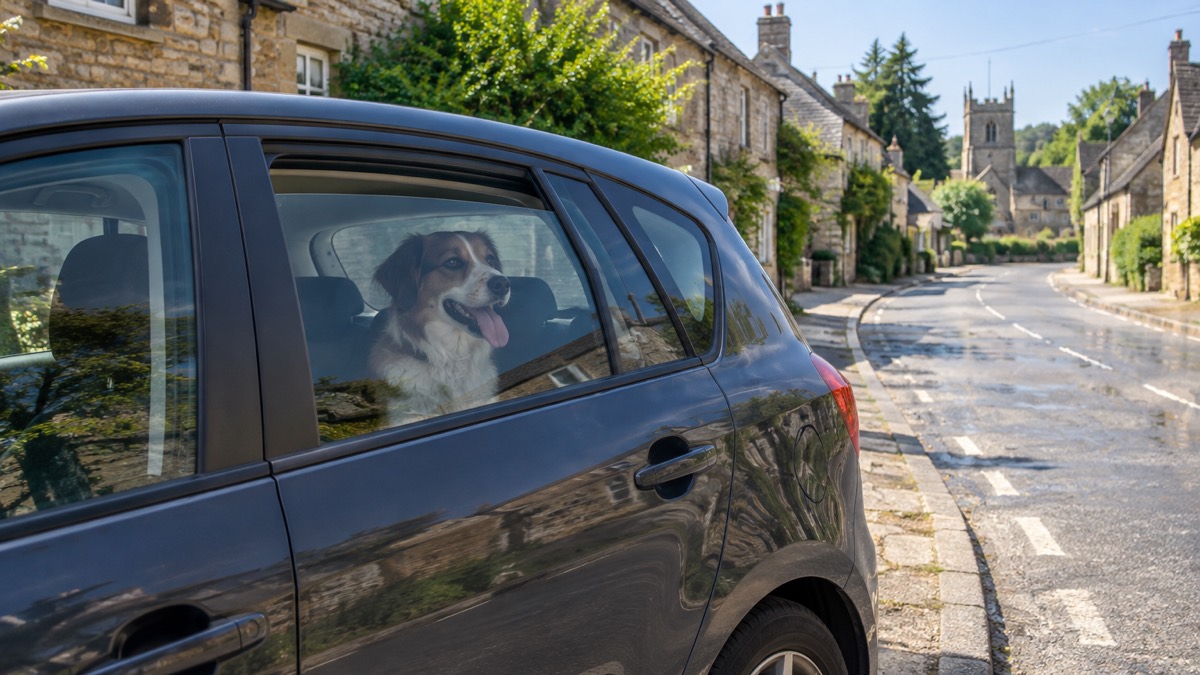
Most people who leave a dog in a car have taken some precaution, and every common precaution fails. Westminster City Council's pet welfare guidance addresses the most popular one head on: never leave an animal in a car as an alternative, even with the windows open, as cars can become dangerously hot in minutes, and this is not just a risk in the summer10. Open windows do not stop a car heating to dangerous levels, so that precaution does not change the outcome on a warm day.
NHS guidance for parents makes the same point about children, and the physiology transfers: do not leave children in a car, as they are at high risk of heat related illness even if windows are open11. Councils and health bodies across England repeat the instruction in identical terms: never leave anyone in a closed, parked vehicle, especially infants, young children or animals12, and never leave children, vulnerable adults or pets in parked vehicles18. The UK Health Security Agency's national "Beat the Heat" guidance says the same: make sure that babies, children, older people and pets are not left alone in stationary cars or other closed spaces19.
Air conditioning is the third common answer, and it fails for a simpler reason: it only works while the engine is running. The moment you park and leave the dog, the air conditioning stops, and the car begins heating like any other parked car. No source in official UK guidance treats a running engine and air conditioning as a safe way to leave a dog unattended, and leaving an engine running unattended brings its own risks. The rule that all of this points to is simple: when you park, take your pet with you rather than leave it in the car.
"never leave an animal in a car as an alternative even if the windows are open as cars can become dangerously hot in minu[tes]"
There is one specific situation where official advice does say to leave a pet in the car with the windows open, and it is worth being clear about the difference. Milton Keynes Council's vehicle breakdown advice states that if you break down and have to leave the vehicle, it is usually safest to leave the pets in the car with the windows open to allow ventilation, but not open enough that your pet can escape, and to leave your pet with water if you can20. That is a breakdown on a live road, where the danger of a loose dog near traffic outweighs the heat risk, and it is a supervised emergency, not an errand. On a motorway, National Highways and the Highway Code take the opposite line for good reason: animals must be kept in the vehicle or, in an emergency, under control on the verge21.
Dogs overheat in minutes, and 41°C can be fatal
Dogs do not sweat over their bodies the way people do; they pant to shed heat, and panting works far less well in a hot, enclosed space where the air around them is already hotter than they are. The PDSA's guidance gives the threshold every owner should know: if your dog's internal body temperature exceeds 41°C, it can be fatal2. A car interior that has reached 47°C2 is well past that point, and a dog left inside it is not slowly becoming uncomfortable, it is moving towards a veterinary emergency.
The speed matters as much as the temperature. Devon and Somerset Fire and Rescue Service warn that temperatures inside a parked vehicle can become dangerous within minutes3. A dog's condition can deteriorate along a similar timescale, which is why the PDSA's phrase "not long is too long"2 is the right way to think about it. A two-minute errand is not a margin of safety, because the errand is never reliably two minutes.
Signs of heatstroke to check for
The PDSA list four questions to ask about a dog you can see in a car2:
- Is the dog panting heavily?
- Is the dog drooling excessively?
- Does the dog appear lethargic, drowsy or uncoordinated?
- Is the dog collapsed or vomiting?
Heavy panting and drooling are the early signs. Lethargy, drowsiness, unsteadiness, collapse and vomiting mean the dog is in serious trouble and needs emergency help immediately. If you see a dog in a hot car showing any of these signs, dial 999 at once2. For a dog that has been moved out of the heat, our page on keeping dogs, cats and small animals cool in hot weather covers what to do next, and emergency vets: out-of-hours care explains how to reach a vet outside normal hours.
Which dogs are most at risk in hot weather
Not every dog copes with heat equally, and the dogs most likely to come to harm in a hot car are the ones least able to shed heat. Official guidance from the Met Office, repeated by councils and health bodies, is consistent on the groups to watch: do not exercise dogs in the hottest parts of the day, especially older pets, flat-faced breeds or dogs with known heart or lung problems, and stick to early morning or late evening walks9. The same groups are the ones for whom a hot car is most dangerous, because age, breathing structure and heart or lung problems all reduce a dog's ability to cool itself by panting.
| Dog | Why heat is harder for them |
|---|---|
| Older dogs | Ageing makes coping with heat harder |
| Flat-faced (brachycephalic) breeds | Their airway structure makes panting less effective; named alongside older pets in official guidance22 |
| Dogs with heart or lung problems | Underlying disease adds to the strain heat places on the body |
| Overweight and large dogs | More body mass to cool, and more strain on the heart and lungs in heat |
The practical implication for car travel is that if you own one of these dogs, the bar for leaving them in a car is not merely "don't", it is "plan the journey so the situation never arises". Travel in the cooler parts of the day, take your dog out of the car the moment you park, and make sure animals have access to shade and fresh drinking water throughout the day and are never left in hot vehicles, as Devon and Somerset Fire and Rescue Service advise during heatwaves3. Our page on when it is too hot to walk your dog covers the exercise side of the same problem.
Finding a dog in a hot car: dial 999 and ask for the police
If you see a dog in a hot car, what you do next depends on the dog's condition. The PDSA's guidance splits it into two situations2.
If the dog is showing signs of heatstroke, heavy panting, excessive drooling, lethargy, drowsiness, uncoordination, collapse or vomiting, dial 999 immediately2. This is an emergency, and the police are the right service to call. Tell the call handler what you can see, give the car's location and registration number, and describe the signs the dog is showing. Stay near the car if it is safe to do so, so you can direct officers to the exact vehicle and keep watching the dog. While waiting, keep other people and pets somewhere safe and back from the vehicle, the same principle the ambulance service applies when help is on its way: put pets somewhere safe23.
If the dog is not yet showing heatstroke signs, take note of the car's registration number. If you are worried about the dog's welfare, you may wish to report the incident to the police2. This is the non-emergency route, and it exists precisely so that concerns are recorded and acted on before the dog reaches the point of collapse. Our page on what to do if you see a dog in a hot car walks through this in more detail.
Breaking into a car to rescue a dog: what the law allows
UK law does not contain a simple "hot car defence" that anyone can invoke at will. What exists is more nuanced: if you damage property, including a car window, to protect a dog in immediate danger, you may be able to rely on the defence of lawful excuse, but whether that succeeds depends on the circumstances, including whether the damage was proportionate and whether help was genuinely needed at once. Because the outcome is never guaranteed, the safe course is always the same: call 999 first, tell the police what you can see, and let them direct what happens. A call handler told that a dog is collapsed and vomiting in a hot car will treat it as the emergency it is.
Two practical points follow. First, the stronger the evidence of danger, the better founded any decision to act: the heatstroke signs listed by the PDSA2 are what police and courts would look at. Second, once the dog is out, it needs cooling and veterinary care urgently, because a body temperature above 41°C can be fatal2. Move the dog to shade or a cooler space, offer water, and get to a vet. Our pages on pet first aid kits and moving an injured dog or cat to the vet cover the practical side.
Travelling with a dog in hot weather: restraint, carriers and the law
The safest way to keep your dog out of a hot car is to plan journeys so the dog is never in one unattended. Beyond that, hot weather travel has its own rules, and they start with restraint.
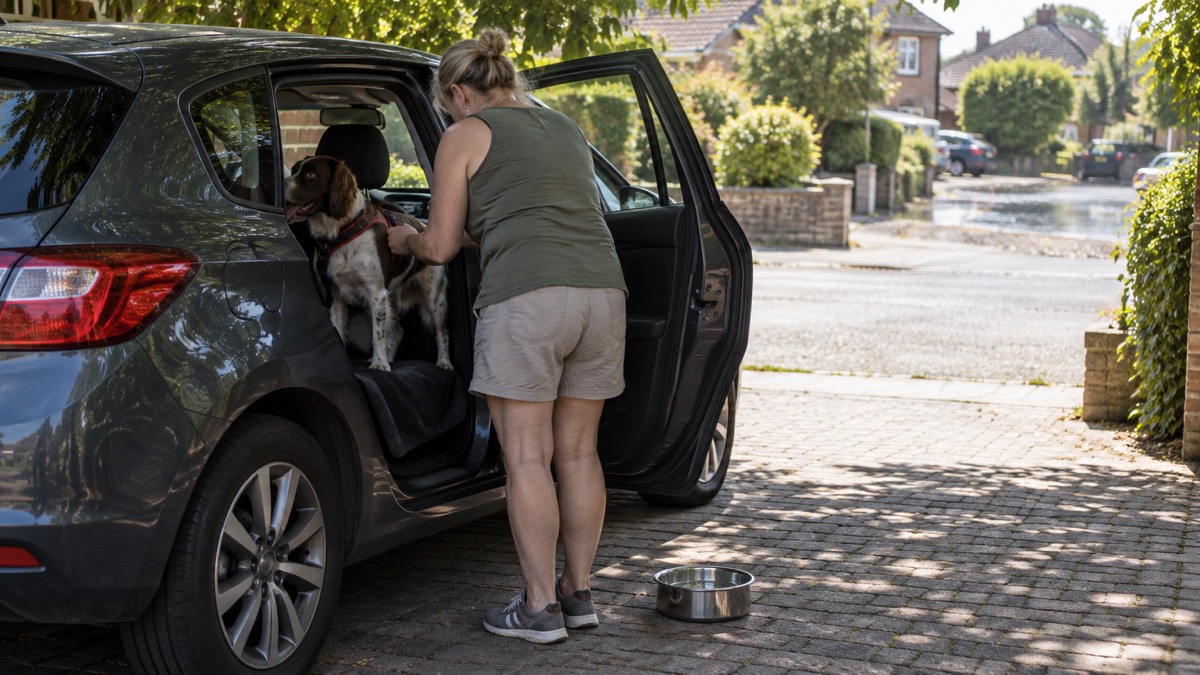
The Highway Code says that drivers must "make sure dogs and other animals are suitably restrained" in your car5. This is not optional courtesy advice: a lot of car insurance policies require you to restrain your pets properly, and a loose pet in the car could break the terms of your insurance2. The physical reason is stark. The PDSA calculates that at just 30mph, an unrestrained dog weighing 20kg would be hurled forward with a force equivalent to the weight of a small moose2. In a collision, that animal becomes a projectile that can injure the dog, the driver and every passenger.
A pet seatbelt or carrier can stop your dog or cat from moving around in the car and distracting you whilst you drive2. Choose between them by what suits your dog and your car:
| Option | What it does | Who it suits |
|---|---|---|
| Pet seatbelt or harness | Keeps the dog restrained on the seat | Dogs that travel calmly on seats |
| Carrier or crate | Contains the dog fully | Small dogs, nervous dogs, and any dog in a car where a crate fits |
| Guard or boot partition | Separates the boot from the cabin | Larger dogs travelling in the boot |
One caution on products: unlike human safety devices, there is no legal requirement for pet restraint products to be crash tested2. A harness or carrier sold for car travel has not necessarily been proven in a crash, so fit it properly, follow the maker's instructions, and do not assume that any product labelled for cars has passed a test. Pets who are used to travelling in the car from a young age are much more likely to be relaxed and comfortable during car trips2, so short, calm journeys early in a dog's life make every later journey easier.
Habits that keep hot weather travel safe
- Take your pet out of the car as soon as possible when you park, and try to leave your car in the shade2.
- Make sure animals have access to shade and fresh drinking water throughout the day and are never left in hot vehicles3.
- Do not let your dog stick their head out of the window while moving. The PDSA warns they could knock their head on something, fall out, be injured by stones kicked up by the tyres, or distract other drivers2.
- Travel in the cooler parts of the day, and walk dogs early morning or late evening rather than in the hottest parts, especially older pets, flat-faced breeds or dogs with known heart or lung problems9.
- Keep towels in the car: they serve to dry off after rain or to dry off pets24.
- If you are planning to travel with pets in winter conditions, ensure animals are safe and secure and will not be a distraction to people travelling in your vehicle25.
For longer journeys and emergencies, it is worth having a proper carrier for each pet. Emergency planning guidance advises that in an evacuation a carrier is required for each pet, and that carriers should be constructed of wire mesh or plastic, as cardboard carriers will disintegrate in a flood26. Place bedding and old newspapers in your pet carrier to make it comfortable27. These points, and the wider question of what to keep ready, are covered in our guide to including your pets in a household emergency plan.
Cold days, cloudy days and quick errands
The hot car problem is easiest to understand on a blazing summer day, but the underlying rule does not switch off in October. Westminster City Council's guidance is explicit that cars becoming dangerously hot in minutes "is not just a risk in the summer"10, and the Met Office warns that even on cool days, strong sunshine can make car interiors very hot9. A mild, bright spring or autumn day can still push a parked car to dangerous temperatures, and cloud cover can clear while you are away from the car. So the answer to "what about a cloudy day?" is the same as for a sunny one: if you cannot take your dog with you when you park, do not bring them on the trip.
Cold weather reverses the direction of the risk but not the conclusion. Northern Ireland's official winter advice is not to leave your dog or cat outdoors in freezing temperatures for long, and not to leave your dog or cat alone in a car during cold weather28. A stationary car in a freeze becomes a cold trap, and the wait is stressful for the animal. The Met Office's winter weather guidance, echoing the British Veterinary Association, adds that even simple things like leaving your dog outside a shop in extremely cold weather can be stressful for them29. Our page on pets in cold weather, snow and ice covers winter travel and walks in full.
The "quick errand" is where most of these decisions go wrong, so it is worth being direct about it. The PDSA's rule, "not long is too long"2, exists because the length of the errand is never under your control, and because the temperature inside the car can become dangerous within minutes3. A queue, a closed till, a card machine that will not read your card: any of these turns a moment into a quarter of an hour. The only reliable way to keep the time short is to take the dog with you, or leave them at home with shade and water.
Stormy weather brings a different set of cautions for dog owners on the road. Official advice during strong winds and heavy rain is to keep an eye on the forecast and, if you need to take your dog outside, keep it on a lead31. If storms are forecast, park vehicles in a garage if available, or otherwise keep them clear of buildings, trees, walls and fences32. And if you are caught out in the rain, those towels kept in the car24 earn their place.
Where to get help
The numbers and routes, in the order you would need them:
- A dog in a hot car showing heatstroke signs: dial 999 immediately and ask for the police6.
- A dog in a hot car not yet showing signs: note the car's registration number and consider reporting the incident to the police2.
- A vehicle fire: dial 999 and ask for fire33.
- A vet urgently, including out of hours: see emergency vets: out-of-hours care and the 24-hour rule.
- A breakdown with a dog on board: follow your breakdown provider's advice.
For the wider picture of keeping pets safe through heat, cold, floods and other emergencies, start with our guide to pets and animals in an emergency.
Sources (33)
- Top causes of rescues and how to avoid them, Devon and Somerset Fire and Rescue Service, 2026
- Safe car travel for pets, PDSA, 2026
- How to stay safe during a heatwave, Devon and Somerset Fire and Rescue Service, 2026
- Heatwave: how to cope in hot weather, NHS South Western Ambulance Service, 2026
- The Highway Code: breakdowns and incidents (rules 274 to 287), GOV.UK, 2026
- Dogs die in hot cars (and on hot walks) - PDSA, PDSA
- Stay cool and safe in hot weather, Somerset Council, 2026
- How to keep cool this summer, Lancashire County Council, 2026
- Hot weather and its impacts, Met Office, 2026
- Pet welfare in an emergency, Westminster City Council, 2025
- Safety in summer, NHS (Healthier Together), 2026
- Stay safe this summer, Cornwall Council, 2026
- Heatwave, Lancashire Prepared, 2026
- Tips for keeping older people cool, Met Office, 2026
- Hot weather advice, NHS Central and East (Integrated Care Board), 2026
- Staying well in summer, Warwickshire County Council, 2026
- Stay safe during hot weather, London Borough of Bexley, 2026
- Adverse weather events, Llangattock Community Council, 2026
- Beat the heat: staying safe in hot weather, UK Health Security Agency, 2026
- Vehicle breakdown advice, Milton Keynes City Council, 2026
- Driving on motorways, National Highways, 2026
- How to Recognise & Treat Heatstroke in Dogs - RSPCA - rspca.org.uk, RSPCA
- What to do when the ambulance is coming, NHS South Western Ambulance Service, 2026
- Out and about: personal resilience, Wiltshire and Swindon Prepared, 2026
- Driving in winter, Northumberland County Council, 2026
- Prepare for an emergency, Slough Borough Council, 2026
- Preparing your pets for an emergency, South Gloucestershire Council, 2026
- Staying warm in winter, nidirect (Northern Ireland government), 2026
- WeatherReady weather hacks, Met Office, 2026
- WeatherReady weather hacks, Met Office, 2026
- Strong winds and heavy rain warning: information and advice, nidirect (Northern Ireland government), 2026
- Storms and gales, Lancashire Prepared, 2026
- Car and vehicle fires, Devon and Somerset Fire and Rescue Service, 2026
 Pet Emergency Documents
 Storing Pet Food and Water
 Carer's Emergency Plan
 Antifreeze Poisoning
 Pets in Cold Weather and Snow
 Emergency Vets and Out-of-Hours
 Pet First Aid Kits
 Keeping Pets Safe in Floods
 Keeping Pets Cool in Hot Weather
 Oak Processionary Moth and Dogs
 Pets in Your Emergency Plan