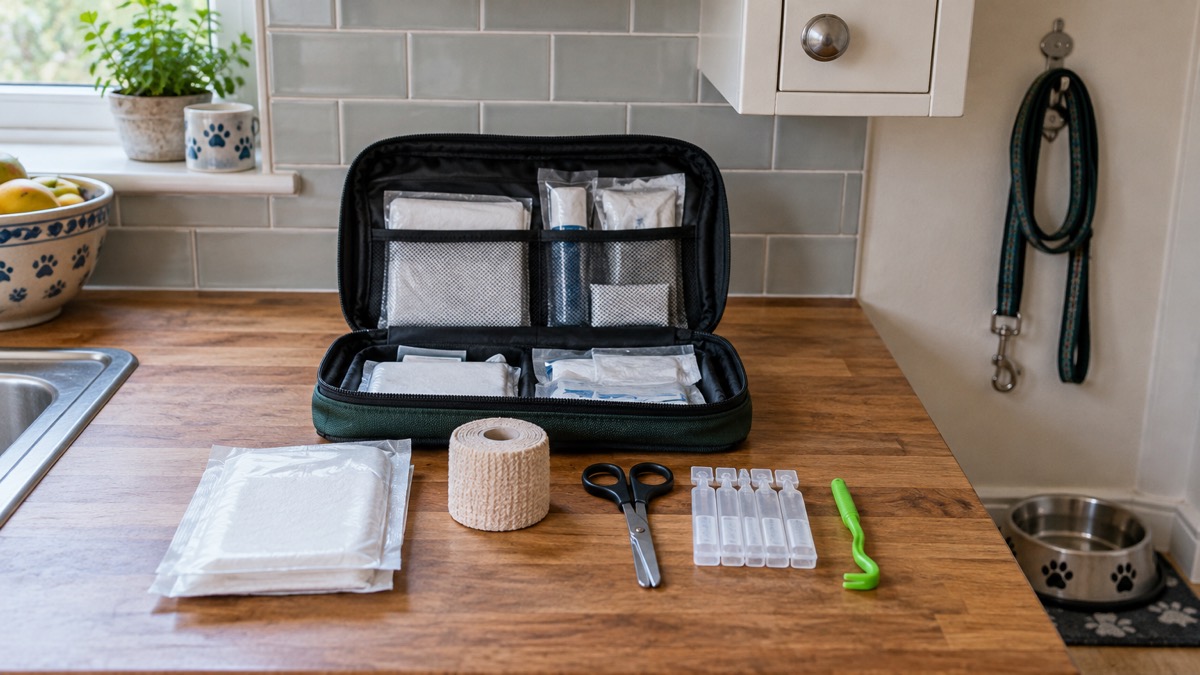
Every household with a dog or cat should keep a first aid kit for their pet at home, and a smaller one in the car and in the bag they take on walks. The principle is the same one the NHS and council emergency planners apply to people: a well-stocked first aid kit at home lets you deal with minor accidents and injuries1, and official emergency kit checklists for the car and the home both include a first aid kit as standard2. For pets, the same kit has to cover a wider range of situations, from a cut paw on a walk to a firework night when your cat bolts out of the door.
A pet first aid kit is not a substitute for a vet. The maker of the Stero-Paws Animal First Aid Kit states plainly that the kit is for giving initial care, and that if your pet is injured or unwell you should contact a vet as soon as possible3. What the kit does is buy you time and stop a minor problem getting worse on the way to professional help.
This page sets out what a pet first aid kit should contain, what each item is for, how ready-made kits compare with building your own, and how the kit fits into the wider job of planning for your pets in an emergency.
Why every pet owner needs a kit at home and on the move
Council emergency planners across the UK put a first aid kit on every version of the household emergency list. Neath Port Talbot's emergency kit checklist includes a first aid kit for the car and essential medication and a first aid kit for the home2. Dumfries and Galloway's household emergency plan guidance says the pack should include a first aid kit7, and Anglesey's Home Emergency Plan adds a detail that matters in a real emergency: have a first aid kit and make sure everyone in the house knows where it is6. Lincolnshire's emergency advice goes further for pet owners, listing pet care items and current photos of your pet in case they get lost as part of an emergency kit8.
For pets, the same logic applies with one addition: most of the accidents that need first aid happen away from home. A cut paw, a tick, or a dog that picks up grit and salt on a winter walk all happen on the pavement or in the park, not in the kitchen. That is why a walk kit and a car kit matter as much as the home kit.
The car kit can be a general household one rather than a pet-specific one. The Be Ready checklist for the home includes pet food and bottled water alongside the family's supplies9. A single first aid kit in the boot, plus a bag of pet essentials, covers both.
What goes in a pet first aid kit
The fullest official description of a pet emergency kit comes from Buckinghamshire Council's emergency grab bag guidance, which includes emergency medication and food for pets4:
- Food: several days' supply, kept in an airtight, waterproof container
- Water: a water bowl and several days' supply of water
- Medicine: an extra supply of any medicine your pet takes regularly, in a waterproof container
- A first aid kit
- A collar with ID tag, and a harness or leash
- A travelling bag, crate or sturdy carrier, ideally one for each pet
- Grooming items
- Sanitation needs: pet litter and a litter box, newspapers, paper towels, plastic trash bags and household chlorine bleach
- A picture of you and your pet together
- Familiar items such as favourite toys, treats or bedding
Other councils echo the same core items. Wiltshire's emergency kit guidance includes emergency medication and food for pets10, and the national Be Ready checklist includes pet food and bottled water in the household kit9. Westminster City Council's pet welfare in an emergency guidance, updated in September 2025, advises setting aside a bag of pet essentials nearby, including a leash or carrier for every animal, any medication your pet needs, tinned or dried food, bowls, litter, and towelling or bedding as required11.
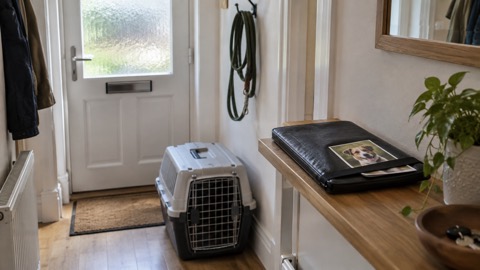
The picture of you and your pet together is there for a specific reason: if your pet is lost in an emergency, it proves ownership when you claim them. London's resilience guidance adds the same idea from the other direction, advising owners to carry a picture of the pet, microchip their animals, know their hiding places, and put a pet sticker in the front window so rescuers know an animal is inside12.
Tick tweezers, wound wash and dressings: what each item is for
The dressings and instruments in a pet kit are much the same as the ones recommended for people, because the jobs they do are the same: stop bleeding, keep a wound clean, and remove small foreign bodies. A pet first aid kit should contain the following1:
| Item | What it is for |
|---|---|
| Plasters in a variety of sizes and shapes | Covering small cuts and grazes |
| Small, medium and large sterile gauze dressings | Padding and covering larger wounds |
| At least two sterile eye dressings | Covering an injured eye |
| Triangular bandages | Slings and improvised padding |
| Crêpe rolled bandages | Holding dressings in place on a limb or paw |
| Safety pins and sticky tape | Securing bandages |
| Disposable sterile gloves | Protecting you and the wound |
| Tweezers | Removing ticks, thorns and splinters |
| Scissors | Cutting tape, plasters and bandage rolls to size |
| Alcohol-free cleansing wipes | Cleaning skin around a wound |
| Thermometer, preferably digital | Checking for fever or overheating |
| Distilled water for cleaning wounds | Flushing dirt out of a wound |
| Eye wash and eye bath | Washing dust or foreign bodies out of an eye |
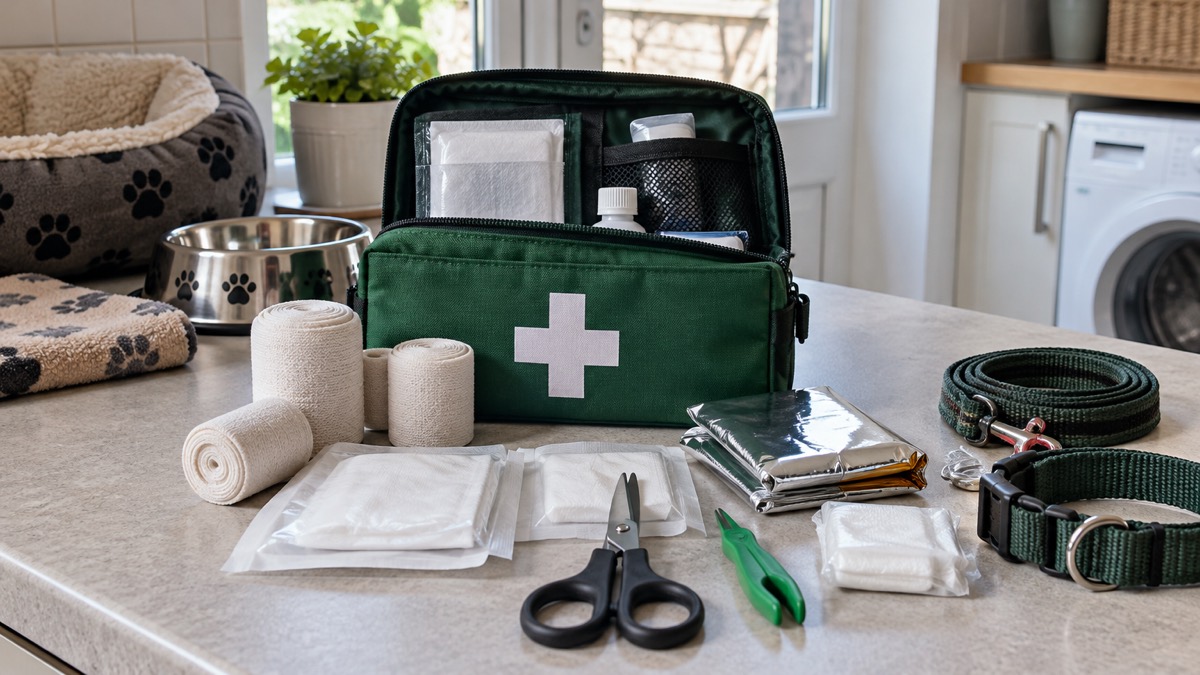
The national Be Ready checklist describes a first aid kit as including waterproof plasters, bandages, a thermometer, antiseptic, eyewash solution, sterile dressings and gloves, medical tape for dressings, and tweezers13.
Two items deserve a note for pet owners. Tweezers and tick tweezers both appear on the pet first aid kit list, the tick tweezers for removing ticks and the ordinary tweezers for small foreign bodies1. Wound wash matters because a dog that has rolled in something irritating, or a cat with dust in its eye, needs the area flushed before it can be examined properly. The maker of the Animal First Aid Kit describes it as ideal for when your pet is having an emergency, such as trauma or eye issues14.
A flood warden's kit list from Harborough District Council shows what a complete packaged kit looks like item by item: two foil blankets, two adhesive dressings, two non-adhesive dressings, twenty assorted fabric plasters, twenty assorted waterproof plasters, a triangle bandage, twenty cleansing wipes, two pairs of gloves, a conforming bandage, scissors, five cotton gauze swabs, a resuscitation mask, twelve safety pins, microporous tape, tweezers and an instruction sheet15. That list is for people, but it is a useful template for checking a pet kit against, and the resuscitation mask and instruction sheet point to two items pet kits handle differently, covered below.
Ready-made kits: what the Stero-Paws and Animal First Aid kits include
Two questions decide between a ready-made kit and a self-assembled one: whether you want the checking done for you, and whether you need to carry it.
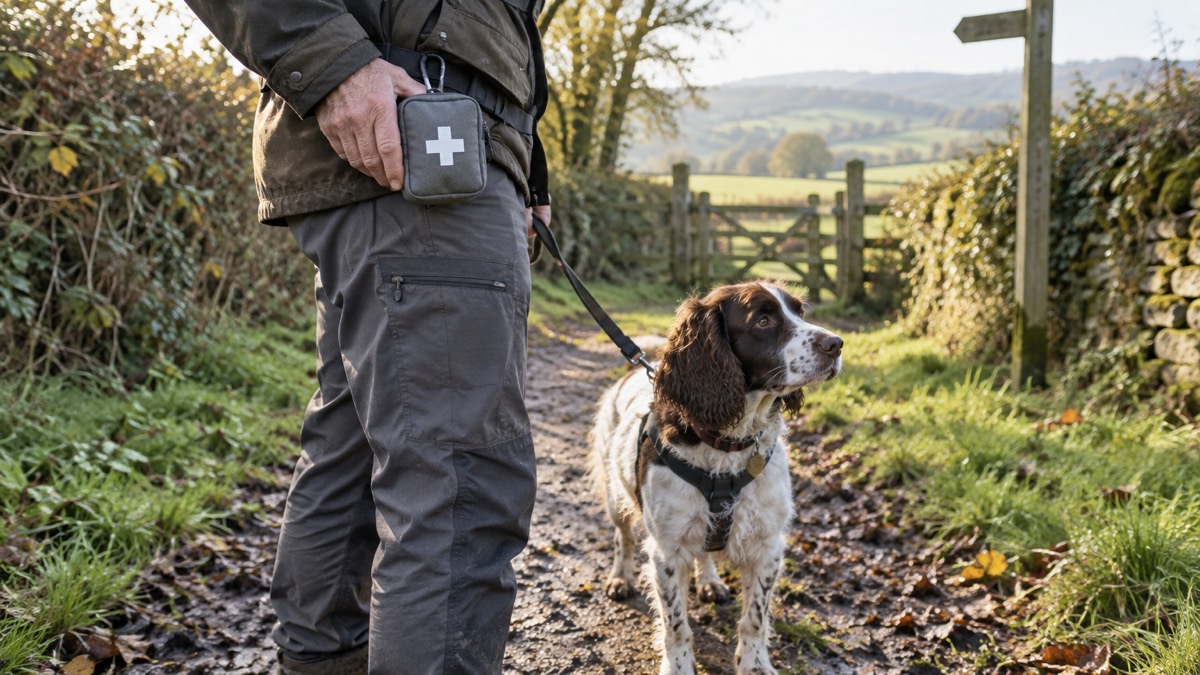
The Stero-Paws Animal First Aid Kit, made by Steroplast, is a pet-specific kit developed by first aid specialists with guidance from vets and pet owners3. The maker states it is designed with dogs and cats in mind, but many of the items can be useful for other small animals3. It comes in two forms: a soft nylon bag with a zip fastening and a belt clip for easy carrying during walks or travel, and the same kit in a clear box3. The belt clip is the feature that matters for walkers: it means the kit goes on your belt rather than in a pocket you have to dig into.
The Animal First Aid Kit, also from Steroplast, is described by the maker as containing all the animal first aid kit essentials, ideal for treating animal injuries sustained in or out of doors, and for emergencies such as trauma or eye issues14. It was in stock at the time of checking14. A Wallace Cameron pet first aid kit is another option; we cover it on its own page.
A self-assembled kit has the advantage that you know exactly what is in it and can match it to your pet: a large dog needs bigger dressings and a second conforming bandage; a cat needs nothing extra beyond the eye wash. The disadvantage is the same as with any self-assembled kit: it is only as complete as your last check. A ready-made kit starts complete, but still needs checking, because items get used and not replaced.
Whichever you choose, the kit for the car and the walk bag can be smaller than the home kit. The home kit holds the bulk of the supplies, including the several days' supply of food and water and the spare medicine4.
CPR leaflets and resuscitation aids
One item that separates pet kits from people kits is the pet CPR guidance leaflet. The Animal First Aid Kit includes one, described by the maker as handy tips, advice and steps to follow if you ever need to give CPR to your pet14. The maker's contents list for the kit gives the quantity as one pet CPR guidance leaflet, though the same page also lists two Sterowipes; the two entries are not reconciled in the maker's own listing, so treat the exact count as uncertain14.
A leaflet is not a substitute for knowing what to do before an emergency. If you want to be able to act quickly, read the leaflet when the kit arrives, not when you need it.
A first aid kit gives initial care, not treatment: when to call a vet
The most important thing to understand about a pet first aid kit is what it cannot do. The maker of the Stero-Paws kit answers the question directly in its own frequently asked questions:
"No. The kit is for giving initial care. If your pet is injured or unwell, contact a vet as soon as possible."
Steroplast, maker of the Stero-Paws Animal First Aid Kit3
That is the maker's own advice about its own product, and it matches the official position. South Wales Fire and Rescue Service's After the Fire booklet states that any injured animals or pets affected by smoke or fire should be taken to a vet for prompt treatment16. The same rule applies to every serious injury: first aid stops bleeding and keeps the animal stable; the vet treats.
Know the warning signs that mean go straight to the vet rather than starting with the kit. Major bleeding, difficulty breathing, a suspected fracture, burns, smoke inhalation, collapse, or any poisoning all need a vet immediately. For out-of-hours situations, see our guide to emergency vets and the 24-hour rule, and for moving an injured animal safely, our guide on transporting an injured dog or cat to the vet.
If your pet is hit by a car, the first aid kit is the second thing you reach for, not the first: our guide on what to do if your pet is hit by a car sets out the order of actions.
Firework season: keeping dogs and cats safe
Firework season is when a pet first aid kit and a pet emergency plan overlap most. The consistent official advice, from fire and rescue services across England and Wales, is to keep pets indoors. Manchester Fire and Rescue Service's fireworks safety code says "Keep pets indoors"17, Lincolnshire's bonfire safety guidance says to keep them indoors during fireworks displays for their wellbeing18, and Cornwall Council's firework safety advice adds the reason and the precaution: make sure cats and dogs have name tags on them in case the noise scares them and they run off19.
Blue Cross's advice for pet owners adds two points that go beyond the basics. Walk your dog earlier in the day, before the fireworks start, so the evening walk does not coincide with the noise20. And avoid leaving your pet alone if you know there are going to be fireworks nearby; if you must leave and come back to a destructive, frightened pet, do not shout at them20.
The name tag point connects directly to the kit. A pet that bolts during fireworks is a lost pet, and the kit items that matter then are the picture of you and your pet together, the collar with ID tag, and a sturdy carrier to bring them home in4. Check before firework season that the tag is legible and the microchip details are up to date.
North Yorkshire Fire and Rescue Service's pet safety campaign adds a year-round point worth acting on: pet proof your home by looking for potential fire hazards through the eyes of a pet. Loose wires, stove tops and flammable objects near items that heat up can all cause a fire21. A curious cat or a puppy chewing a loose wire is a house fire risk as well as an injury risk.
For other animals at firework time, see our guides on horses during fireworks and protecting rabbits and guinea pigs.
Hazards to plan for: rock salt and heat
Two seasonal hazards belong in any discussion of pet first aid, because the kit can help with both.
Rock salt and grit. The Met Office, quoting the British Veterinary Association, warns that grit or rock salt can be extremely toxic to dogs and cats if ingested22. The risk is not just walking on treated paths: dogs lick their paws and legs clean afterwards, and swallow the salt. The Met Office's seasonal advice is simple and belongs in every winter walk kit: pack a towel to remove toxic grit or rock salt from your dog's paws when you're out and about5. Wipe paws and legs before the dog can lick them, and again when you get home. Our page on rock salt and dogs' and cats' paws covers this in detail.
In the garden, the same caution applies to other chemicals. Blue Cross advises pet owners considering slug and snail pellets to use a pet-safe alternative, or make sure treated areas are completely inaccessible to cats and other animals23. Fareham Borough Council's chemical accident guidance adds the general rule for any chemical emergency at home: bring pets indoors24.
Heat. Devon County Council's hot weather guidance warns that surfaces such as tarmac, artificial grass, pavements and sand can become extremely hot and may cause burns to pets' paws25. Burned paws are a first aid situation: the dressings, gloves and cleansing wipes in the kit are what you reach for on the way to the vet. Prevention is better, and our guides on keeping dogs, cats and small animals cool in hot weather, when it is too hot to walk your dog and dogs in hot cars cover the signs and the timings.
Household first aid kits for people
A pet first aid kit does not replace the household kit for people; the two sit side by side. NHS guidance is clear that it is important to have a well-stocked first aid kit in your home so you can deal with minor accidents and injuries1, and the standard contents list is the one set out in the table above, with the addition of creams and medicines for people: skin rash cream such as hydrocortisone or calendula, cream or spray for insect bites and stings, antiseptic cream, painkillers, and antihistamine cream or tablets1.
Note that the medicines on the people list are for people, not for pets, and never give human painkillers to a pet. A pet kit's medicine compartment should hold only the pet's own prescribed medicine, kept in a waterproof container4.
There is one type of people kit worth knowing about even though it is not for pets. ProtectUK's official guidance describes the Public Access Trauma (PAcT) First Aid Kit, which supports treatment of immediate, life-threatening injuries such as major bleeding and those not breathing on their own, and may also be used by an injured person who is able to self-treat themselves26. These kits are appearing in public places, and knowing they exist is useful if you are ever first on the scene of a serious incident.
For the full people-side picture, see our guide to first aid at home.
Storage, checking and restocking
Where you keep the kit matters as much as what is in it. Anglesey's Home Emergency Plan advice is to have a first aid kit and make sure everyone in the house knows where it is6. That means one agreed place, not a cupboard that only one person can find, and it applies to the pet kit as much as the people kit.
Check the kit on a schedule, not just after an emergency. The things that lapse are the ones with dates: the spare medicine, the cleansing wipes, the sterile dressings. The things that go missing are the ones used on ordinary days: plasters, tape, the tweezers that also get used in the kitchen. After any use, replace what you used before the kit goes back in its place.
Keep the pet-specific extras with the kit rather than scattered around the house: the spare leash or carrier, the picture of you and your pet together, and the current photos of your pet in case they get lost that Lincolnshire's emergency advice recommends8. Westminster's guidance to set aside a bag of pet essentials nearby, with a leash or carrier for every animal, medication, food, bowls, litter and towelling or bedding, is the model to follow11.
Finally, connect the kit to the wider plan. A first aid kit is one item on the household emergency list, alongside food, water, torches and a way of staying informed. Our emergency kit guide covers the household side, and our page on how much pet food and water to store covers the pet side. If you are just starting out, begin with getting prepared and including your pets in a household emergency plan.
Sources (26)
- What should I keep in my first aid kit?, Collingwood Surgery NHS, 2026
- NPT Prepared Emergency Kit Checklist, Neath Port Talbot Council, 2026
- Stero-Paws Animal First Aid Kit, Steroplast, 2026
- Emergency Grab Bag, Buckinghamshire Council, 2023
- Weatherhacks to try as clocks go back, Met Office, 2023
- Home Emergency Plan, Isle of Anglesey County Council, 2020
- Create a Household Emergency and Lifesaving Plan, Dumfries and Galloway Council, 2026
- Get help and advice in an emergency, Lincolnshire County Council, 2026
- Be Ready Checklist, UK Government Be Ready campaign, 2026
- Planning for an emergency kit, Wiltshire Council, 2026
- Pet welfare in an emergency, Westminster City Council, 2025
- Boost your resilience: 30 ways, Greater London Authority, 2016
- Be ready for emergencies - Be Ready, prepare.campaign.gov.uk (Be Ready campaign)
- Animal First Aid Kit, Steroplast, 2026
- Author: Vanica Patel, Harborough District Council
- After the Fire booklet, Mid and West Wales Fire and Rescue Service, 2013
- Fireworks safety, Manchester Fire and Rescue Service, 2026
- Bonfire safety, Lincolnshire County Council, 2026
- Keep your pets safe: firework safety, Cornwall Council Fire and Rescue Service, 2025
- Fireworks and pets advice, Blue Cross, 2019
- Pet Safety Campaign, North Yorkshire Fire and Rescue Service, 2025
- WeatherReady weather hacks, Met Office, 2026
- Protecting your cat from common toxins, Blue Cross, 2025
- Major incidents and chemical emergencies, Fareham Borough Council, 2026
- Staying well in hot weather, Devon County Council, 2026
- First aid provisions, ProtectUK, 2026
 Pet Emergency Documents
 Storing Pet Food and Water
 Carer's Emergency Plan
 Antifreeze Poisoning
 Pets in Cold Weather and Snow
 Emergency Vets and Out-of-Hours
 Keeping Pets Safe in Floods
 How Fast a Car Heats Up
 Keeping Pets Cool in Hot Weather
 Oak Processionary Moth and Dogs
 Pets in Your Emergency Plan