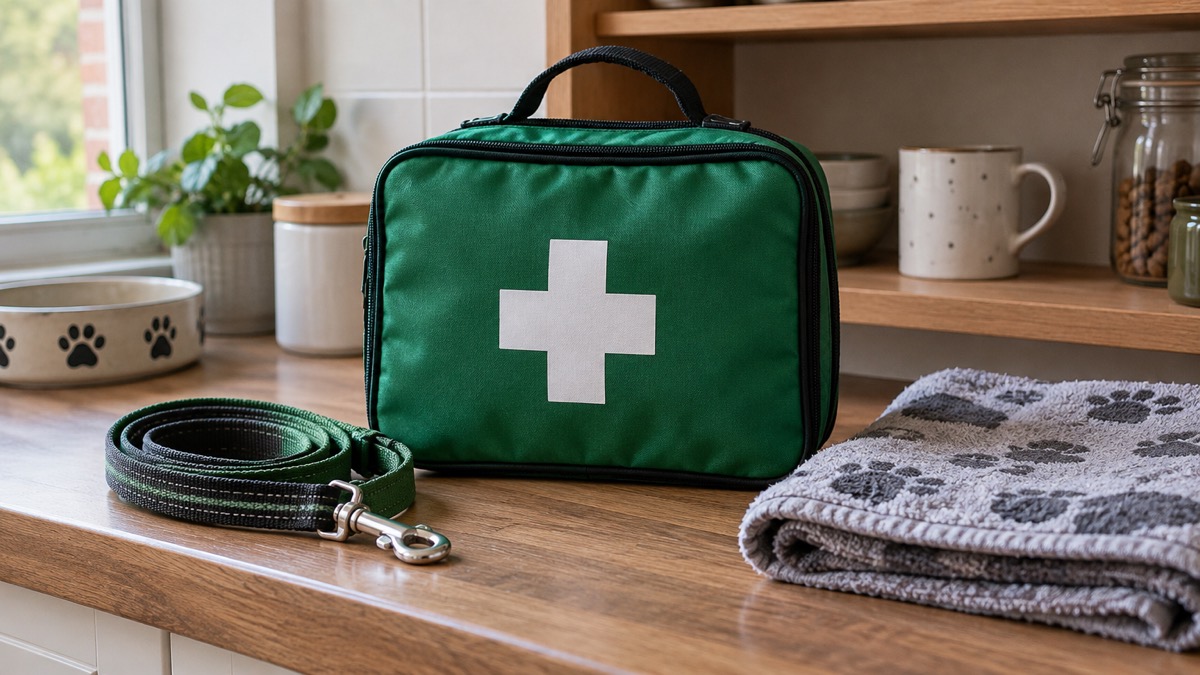
The Wallace Cameron Pet First Aid Kit is a boxed set of dressings, wipes, bandages and protective items for treating a pet's minor injuries, sold in a case the maker calls a Bambino Box. It is made by Wallace Cameron, a first aid supplier, and the maker lists it as suitable for use at home, on walks, during travel and while on holiday1. The point of it is simple: when a dog cuts a pad on glass or a cat comes off worse in a scrap, the things you need are already together in one place rather than scattered through a kitchen drawer.
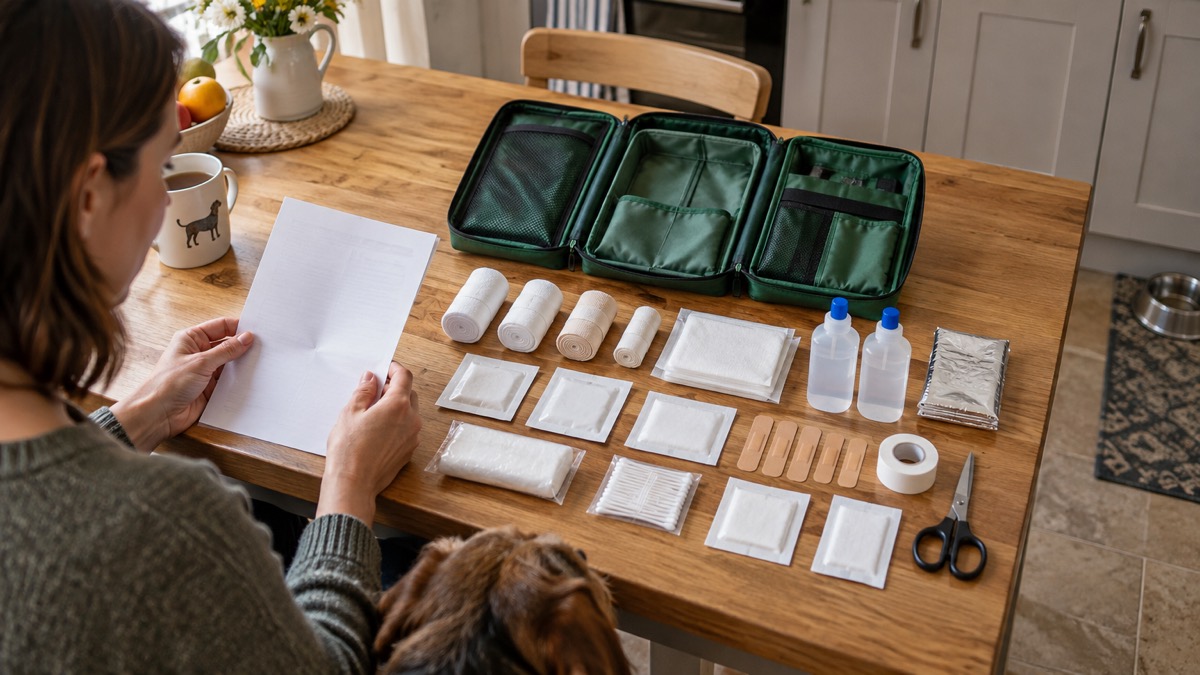
The kit holds 20 sterile saline wipes, 40 plasters, 11 dressings in three sizes, 6 triangular bandages, 2 eye pads, 2 bottles of eye wash, 4 pairs of gloves, 4 aprons, a clinical waste bag, a thermal blanket, a resuscitation aid, 12 safety pins, a roll of microporous tape, a pair of scissors and a first aid guidance leaflet1. The maker describes it as providing support for managing common minor injuries and unexpected incidents involving pets2.
It is not a substitute for a vet. A kit like this lets you clean a graze, cover a cut and keep your pet comfortable on the way to professional help. For anything more than a minor injury, the right move is still to ring your vet or an emergency vet. If you are building your pet supplies from scratch, our guide to pet first aid kits sets this kit alongside what a kit needs to contain.
What the kit is for, and what it is not
The maker's own description is modest and worth taking at face value: the kit provides support for managing common minor injuries and unexpected incidents involving pets2. That covers the everyday things, a cut pad, a small wound, something in an eye, a graze from a scrape against a wall or a thorn. It gives you the means to clean and cover an injury and to keep your pet warm and calm while you decide what to do next.
What it does not do is diagnose or treat. The PDSA, the pet charity, advises owners to prepare a pet first aid kit for use at home and when out and about, and its own list of contents includes bandages, blunt-ended scissors, wound wash, cotton wool, tweezers, tick tweezers, wound dressing, self-adhesive tape, dressings, vinyl gloves, a foil blanket, antiseptic wipes and a blanket to use as a stretcher4. That list is a useful check on what a kit is for: cleaning, covering, protecting yourself and keeping the animal warm. None of it replaces a vet.
The kit also sits within a wider household habit. Official emergency guidance for households says to keep a first aid kit or first aid items, and essential medication or medical supplies to last several days5. A pet kit belongs in the same cupboard as the family kit, because the emergency that needs one often needs the other. Our first aid at home guide covers the human side.
What is in the kit: 20 saline wipes, 11 dressings and 40 plasters
The contents are the reason to buy a boxed kit rather than assemble one, so it is worth knowing exactly what you get. The maker's contents list gives the quantities item by item1.
| Item | Quantity | What it is for |
|---|---|---|
| Sterile saline wipes | 20 | Cleaning wounds and around the eyes |
| Plasters | 40 | Covering small cuts and grazes |
| Medium dressings | 6 | Padding and covering a wound |
| Large dressings | 2 | Larger wounds |
| Extra-large dressings | 3 | Larger wounds and limbs |
| Fabric dressing strip | 1 | Cutting to length to hold a dressing |
| Triangular bandages | 6 | Bandaging and slings |
| Safety pins | 12 | Fastening bandages |
| Microporous tape | 1 | Holding dressings in place |
| Scissors | 1 | Cutting dressings and tape |
| First aid guidance leaflet | 1 | A reminder of what to do |
The 11 dressings are the 6 medium, 2 large and 3 extra-large dressings together1. The maker lists the sterile saline wipes with the code 1023001, which is the reference to quote when you replace them3.
The mix is close to what official guidance asks of a household first aid kit. NHS advice lists plasters in a variety of sizes and shapes, sterile gauze dressings, triangular bandages, safety pins, disposable sterile gloves, scissors, alcohol-free cleansing wipes, sticky tape and eye wash among the basics6. The Be Ready household checklist asks for waterproof plasters, bandages, antiseptic, eyewash solution, sterile dressings, gloves, medical tape and tweezers7. A pet kit does not need to match a human kit item for item, but the overlap is a sign the contents are sensible.
Gloves, aprons and a waste bag: protecting yourself while you treat your pet
An injured animal may bite or scratch, even one that has never done so before, and blood and other fluids carry a risk to you as well as to the pet. The maker says the kit includes gloves and a clinical waste bag to help protect the user while treating a pet's injuries3. The full list adds 4 pairs of gloves and 4 aprons1.
The practical routine is straightforward. Put on a pair of gloves before you touch a wound, and an apron if there is likely to be blood or mess. Use a fresh pair for each treatment rather than putting a used pair back in the box. When you have finished, put soiled dressings and used gloves into the clinical waste bag rather than the kitchen bin, and wash your hands afterwards even though you wore gloves.
Official pet emergency guidance makes the same point from the other direction: a pet emergency kit should include sanitation needs such as litter bags9. Keeping waste contained matters as much for hygiene as for tidiness, particularly if you are treating an animal in a car, a tent or someone else's house.
Eye care: eye pads and two eye wash bottles
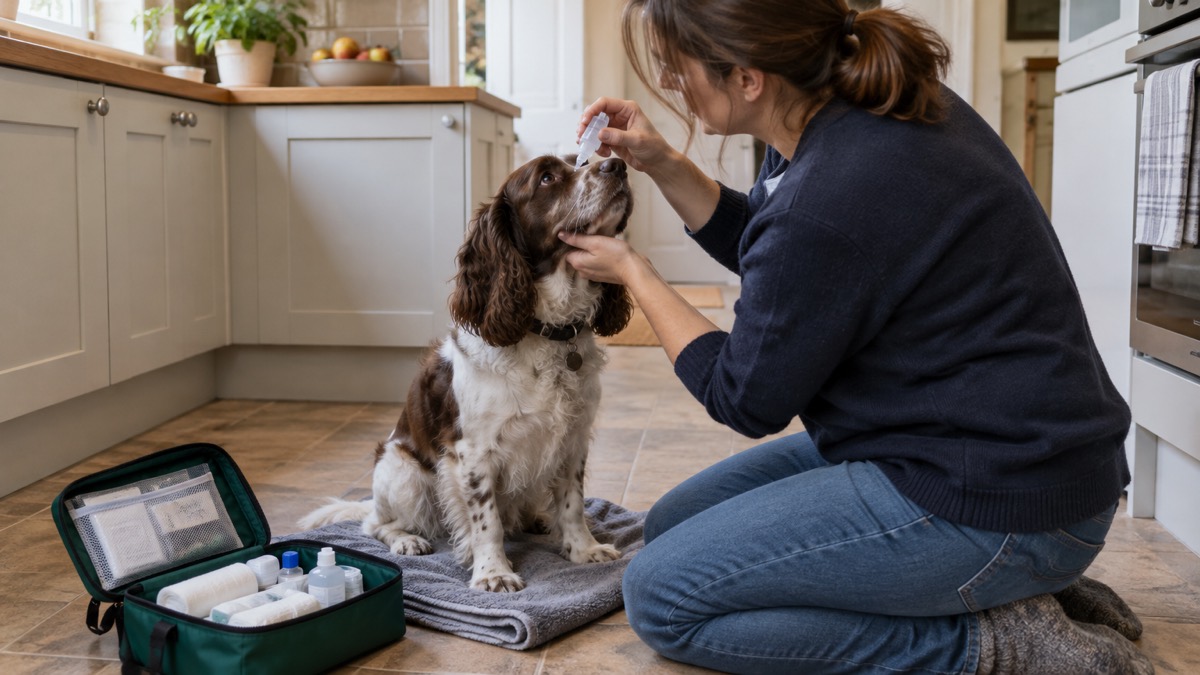
Eye injuries are common in pets and easy to make worse by rubbing. The kit carries 2 eye pads and 2 eye wash bottles of 500ml each1. The eye wash is for flushing something out, and the pads are for covering an eye once it has been cleaned.
Use the wash gently. Hold your pet's head steady, flush from the inner corner of the eye outwards so you are not washing debris across the eye, and use enough to clear it rather than a token splash. Do not press on the eyeball. If the eye is held shut, is swollen, or your pet is pawing at it or sensitive to light, flush it if you can and then contact your vet: an eye that will not open needs to be seen.
The PDSA's list of what a pet kit should contain includes wound wash and a blanket to use as a stretcher, and its general advice is to have a kit at home and when out and about4. Eye wash appears in official household first aid lists too, alongside an eye bath10. The two 500ml bottles in this kit are a generous supply for a single animal, which is useful if you need to flush repeatedly on the way to the vet.
Thermal blanket and resuscitation aid for a more serious incident
Two items in the kit are for the moments when a minor injury has become something worse. The kit contains 1 thermal blanket and 1 resuscitation aid1.
The thermal blanket is a foil sheet that holds an animal's body heat while you wait for help or travel to the vet. Foil blankets appear in official and independent kit lists: Scotland's emergency kit guidance for a car includes a blanket12, a council flood evacuation checklist lists blankets among what to pack13, and the St John Ambulance runner's kit list includes a foil blanket14. A pet that has been in cold water, been hit by a car or lost blood can chill quickly, so wrap it loosely and keep checking it is breathing.
The resuscitation aid is a barrier device for giving rescue breaths. It is there so that, if you have been trained and your vet has talked you through it, you can give breaths without direct mouth-to-mouth contact with the animal. It is not a substitute for training. If your pet has stopped breathing, ring your vet or an emergency vet immediately and follow their instructions; our guide to emergency vets explains out-of-hours cover.
Where to keep it: wall mounted at home or carried on walks and holidays
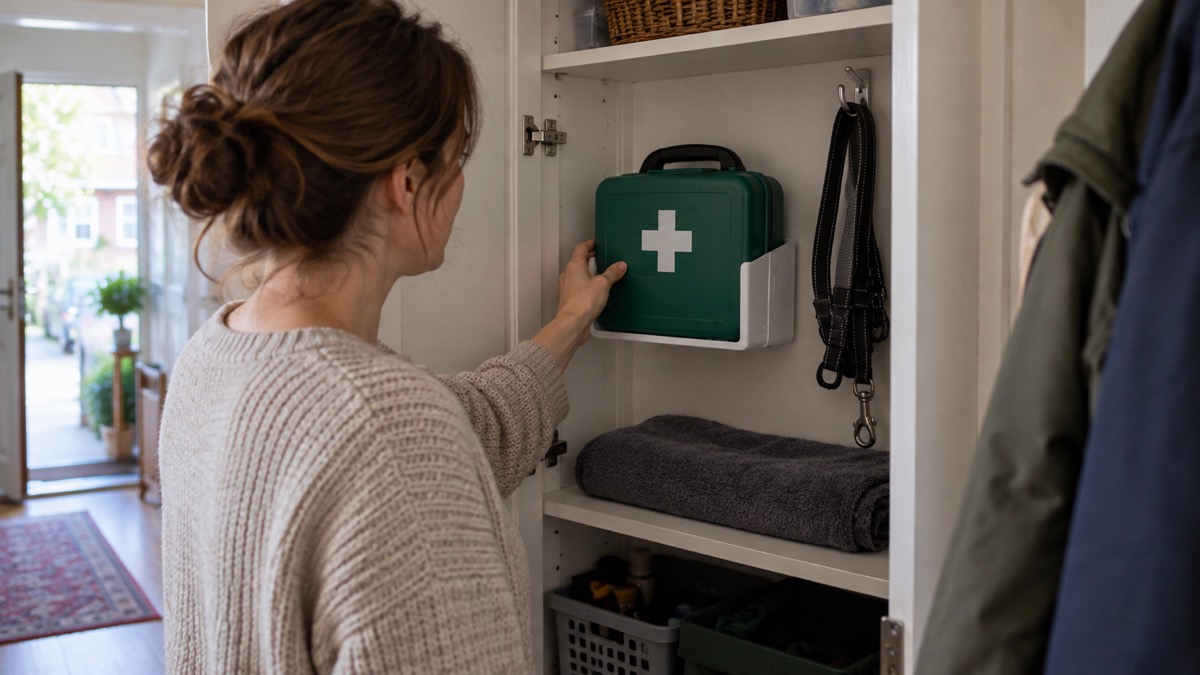
The maker lists the kit as suitable for use at home, on walks, during travel and while on holiday, and describes the Bambino Box as wall mountable, easily transportable and giving easy access1. That gives you two sensible arrangements, and the right one depends on how you use it.
- At home, on the wall. Official guidance advises considering mounting first aid provisions on a wall or in a cabinet so they are visible and easy to access by any person15. A wall bracket supplier makes the same point: secure your first aid kit to a wall where it can be reached easily, where people will see it regularly and remember where it is16. A kit you can see is a kit you remember.
- On walks and holidays, in the bag or car. The PDSA suggests that if you travel with your pet, a smaller kit in your car or bag is a good idea too4. The Bambino Box is described as easily transportable, so it can move between the wall and the car boot.
Wherever it lives, store it properly. NHS guidance on first aid supplies says to keep a first aid kit locked and in a cool, dry place out of the reach of children, and to check medicines regularly to make sure they are within their use-by dates17. That applies to the wipes and any sealed items in a pet kit as much as to a family kit. A bathroom cabinet is a poor home because of the damp; a high shelf in a hall cupboard is better.
If your pet is part of a household emergency plan, the kit should be listed with the rest of the pet supplies. Westminster City Council advises setting aside a bag of pet essentials nearby, including a leash or carrier for every animal, any medication your pet needs, tinned or dried food, bowls, litter, and towelling or bedding as required18. Our guide to including your pets in a household emergency plan takes that further, and the pets and animals section covers the wider picture.
Using the kit safely: scissors, wounds and when to stop
A few habits make the difference between a kit that helps and one that makes things worse.
- Scissors. The kit contains one pair1. The PDSA's contents list specifies blunt-ended scissors for a pet kit4. Cut dressings and tape, not fur, and have someone hold the pet steady.
- Wipes and wound cleaning. Use a fresh sterile saline wipe for each wound and work outwards from the wound rather than back towards it. Do not reuse a wipe.
- Dressings. Cover a wound with a dressing and hold it with the microporous tape or a bandage. Do not pull a bandage tight enough to restrict a limb; check that you can still feel warmth beyond it.
- When to stop. If bleeding will not stop with pressure, if the wound is deep, if a limb looks broken, or if your pet is distressed, pale or limp, stop treating and get to the vet.
The kit's contents echo what official guidance asks of a household first aid kit, which is a reasonable check on whether it is complete enough to be useful: NHS advice lists plasters, sterile dressings, triangular bandages, safety pins, disposable sterile gloves, scissors, cleansing wipes, sticky tape and eye wash among the basics10, and other NHS lists add a thermometer, tweezers and antiseptic19. The Be Ready checklist asks for waterproof plasters, bandages, a thermometer, antiseptic, eyewash solution, sterile dressings, gloves, medical tape and tweezers7. A pet kit does not need a thermometer or painkillers, but if you find yourself wishing for tweezers for a tick or a splinter, that is a gap to fill separately.
Where to get help
A first aid kit buys you time, not a diagnosis. For anything beyond a minor injury, contact your vet; out of hours, contact an emergency vet service. Our guide to emergency vets and the 24-hour rule explains how out-of-hours cover works in the UK.
If your pet is injured and you need to move it, our guide to moving an injured dog or cat to the vet sets out how to do it without causing further harm. If your pet has been hit by a car, see what to do if your pet is hit by a car.
For the wider household, official guidance is to keep a first aid kit handy in case of an emergency20, and to keep essential medication and a first aid kit at home21. A pet kit in the same cupboard means one less thing to think about when something goes wrong.
Sources (21)
- Astroplast Bambino Pet First Aid Kit Complete Each, Wallace Cameron, 2026-05-15
- Pet First Aid Kits, Wallace Cameron, 2026-05-15
- Wallace Cameron Pet First Aid Kit, Wallace Cameron, 2026-05-15
- First Aid for Pets, PDSA, 2026-10-29
- Be Ready Household Emergency Plan, UK Government, 2026
- What to Keep in Your Medicine Cabinet, NHS Hertfordshire and West Essex, 2026-10-28
- Get Prepared for Emergencies, UK Government, 2026-10-21
- Be Ready for Emergencies, UK Government, 2026-10-21
- Your Pets, Wiltshire and Swindon Prepared, 2026-10-25
- What Should I Keep in My First Aid Kit?, NHS, 2026-10-28
- Accidents, First Aid and Treatments: What Should I Keep in My First Aid Kit, Collingwood Surgery, 2026-10-28
- Emergency Kit, Ready Scotland, 2026-10-22
- Flood Evacuation Checklist, Croydon Council, 2025
- Runners First Aid, St John Ambulance, 2026-10-28
- First Aid Provisions, ProtectUK, 2026-06-01
- Wall Brackets, Steroplast, 2026-10-29
- West Mercia Risk Register V4, West Midlands Ambulance Service, 2025-01
- Pet Welfare Emergency, Westminster City Council, 2025-09-24
- Keep Well Stocked Medicine Cabinet at Home, NHS Black Country ICB, 2026-10-28
- 12 Tips to Prepare for a Power Cut, Horsted Keynes Parish Council, 2026
- Emergency Kit Checklist, Neath Port Talbot Council, 2026-10-29