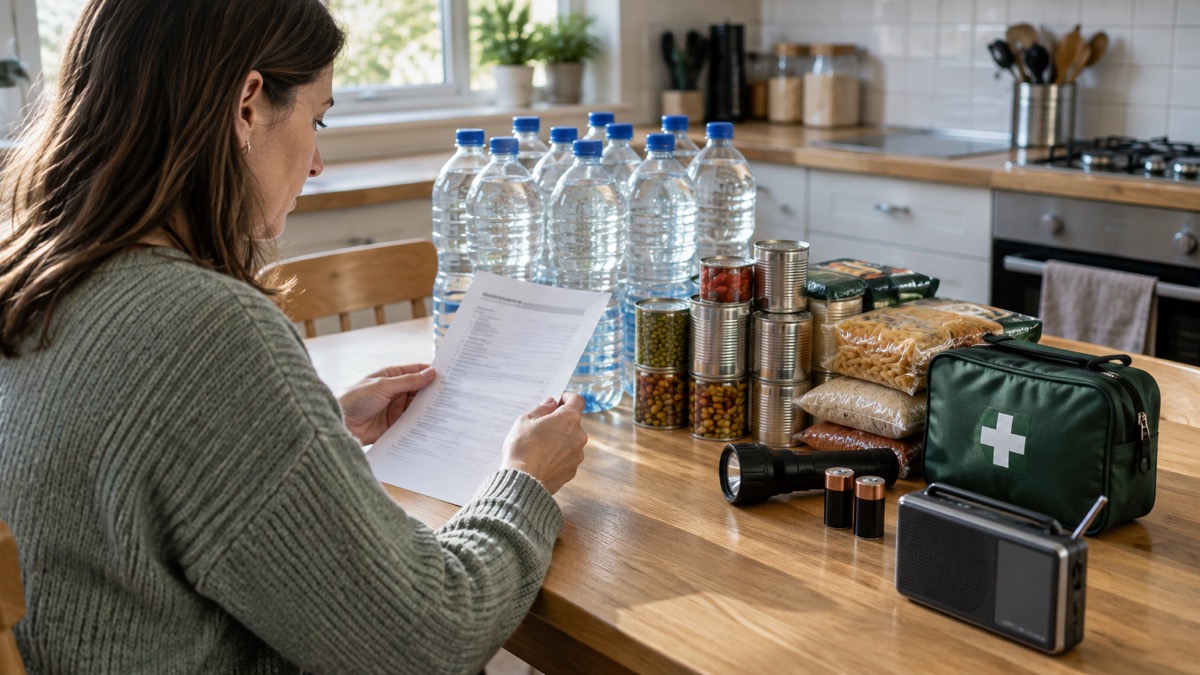
On 22 October 2026 the UK Government launched the Be Ready campaign, encouraging households to take a few simple steps so they can get through three days of disruption to everyday services such as power, water, phones and the internet1. At the heart of it is a short checklist: bottled water at 3 litres per person per day for drinking, non-perishable food for 3 days, a first aid kit, a torch rather than candles, and your important phone numbers written down on paper2.
The reasoning behind the three-day figure is straightforward. Being ready for 3 days helps you manage while support reaches those most in need2. In a widespread emergency, the emergency services and councils help the most vulnerable first, and a household that can look after itself for three days is one that does not add to that demand.
This page goes through the government's checklist item by item: what each one means in practice, how much to store, and where the advice differs in Scotland and Northern Ireland. If you want the fuller picture of what a household should keep ready, our guides to the home emergency pack and the grab bag build on the same official advice.
Why the checklist is built around three days
The government's advice to be prepared for three days of disruption is the organising principle of the whole campaign, and it is not unique to the UK: the press release announcing Be Ready notes that the same three-day figure is also used by other countries1. The campaign site puts it in one line: being ready for 3 days helps you manage while support reaches those most in need2.
Councils across the UK have been giving the same figure for years, which is a good sign that it is a settled judgement rather than a new one. Renfrewshire Council advises keeping supplies that can meet essential household needs for at least 3 days6. Argyll and Bute Council asks households to keep at least three days' supply of food, bottled water and other essentials, including medicines, and tinned and dry foods which store safely without need for electricity7. A Scottish Borders community plan asks residents to ensure they have sufficient supplies at home to meet household needs for at least three days8, and West Yorkshire Prepared's household emergency plan asks for food and bottled water for 3 days, with a warning not to rely on your fridge or freezer for food9.
Three days is a planning figure, not a prediction. Most power cuts and water outages are over far sooner, but the longer, rarer events are the ones a household cannot muddle through on its own. If you want to think through how long your own supplies should last for the risks where you live, see how many days your supplies should last.
Water: 3 litres per person per day for drinking
The Be Ready checklist asks for bottled water for 3 days, at 3 litres per person per day for drinking, and it is explicit that this is drinking water only: more would be needed for other tasks such as cooking and washing2. The campaign's household emergency plan uses the same wording, 3 litres per person per day for at least 3 days10, and the government's water outage guidance states that 3 litres of drinking water per person per day for 3 days is recommended11.
That 3-litre figure sits at the top of a range in older official guidance. North Devon Council and North Herts Council both note that a minimum of 2.5 to 3 litres of drinking water per person per day is recommended by the World Health Organisation for survival12, and Dumfries and Galloway Council's household plan asks for 2.5 litres of bottled water per person for each day14. Birmingham City Council splits the difference in its own advice: at least 2 litres per person per day for drinking, and at least 3 litres per person per day when you count water for cooking and washing15.
For a household that wants to be comfortable rather than merely alive, Greater Manchester Combined Authority and North Devon Council both advise that 10 litres per person per day will make you more comfortable by also providing for basic cooking and hygiene needs12. Denbighshire Council's emergency supplies kit guidance adds that a normally active person needs at least two litres of water daily just for drinking, and that children, nursing mothers and ill people need more17.
| Source of advice | Drinking water | Cooking and washing |
|---|---|---|
| Be Ready checklist (2026) | 3 litres per person per day, for 3 days2 | More would be needed; not specified |
| Government water outage guidance | 3 litres per person per day for 3 days11 | Not specified |
| North Devon and GMCA guidance | 2.5 to 3 litres per person per day minimum12 | 10 litres per person per day for comfort |
| Birmingham City Council | At least 2 litres per person per day | At least 3 litres per person per day combined15 |
| Dumfries and Galloway household plan | 2.5 litres per person per day14 | Not specified |
In practice, buy bottled water in sealed bottles, store it somewhere cool and dark, and work out your household's total from the number of people: the Be Ready checklist advises 3 litres per person per day for drinking, for 3 days, with more needed for cooking and washing. Our water in an emergency guide covers storage, rotation and what to do if the supply is interrupted.
Food that keeps without a fridge or cooking
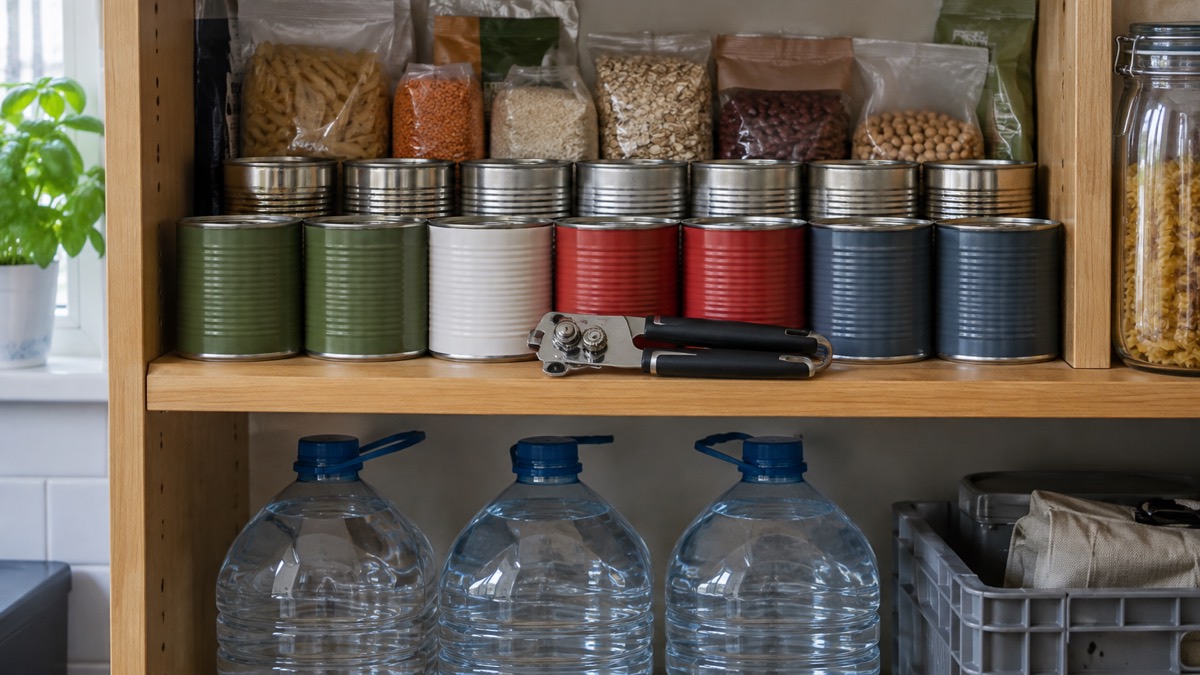
The Be Ready checklist asks for non-perishable food for 3 days: food with a long shelf life that doesn't need refrigeration or cooking, such as tinned meat, fish or vegetables, dried fruit and nuts3. Its household emergency plan is more specific still: non-perishable food to last at least 3 days that does not require cooking or refrigerating, for example tinned meat, fruit or vegetables, plus a tin opener10.
The reasoning is that the emergencies this kit is for are the ones that take out power or water. Argyll and Bute Council makes the point directly: keep tinned and dry foods which store safely without need for electricity7. West Yorkshire Prepared's plan warns households not to rely on the fridge or freezer for food9, and the Be Ready campaign's own power cut guidance adds two often-forgotten items: ready-made baby formula and pet food, if your household needs them18.
The most useful advice on what to buy is also the simplest, from the Be Ready checklist itself: it's best to buy food you'd usually eat3. A shelf of unfamiliar tins is a store you will never rotate; a shelf of the tinned and dried foods your household already eats gets used and replaced naturally.
- Tinned meat, fish, fruit or vegetables, plus a tin opener3
- Dried fruit and nuts3
- Cereal and fruit bars, kept up to date13
- Ready-made baby formula and pet food if needed18
- Foods that can be eaten without heating or water, such as ready-to-eat meats, canned or boxed juices, UHT milk, soup, crackers, cereal bars, biscuits and boiled sweets17
Denbighshire Council's emergency supplies kit guidance also suggests food for infants or persons on special diets, and vitamins17. Lincolnshire Council's pet preparedness advice adds pet food and treats to the list19. For storage, rotation and what to do with a fridge full of food when the power goes, see our emergency food guide and checking and restocking supplies.
First aid kit contents
The Be Ready campaign's preparedness guidance sets out what it expects in a first aid kit, including items such as waterproof plasters, bandages, a thermometer, antiseptic, eyewash solution, sterile dressings and gloves, medical tape for dressings, and tweezers4. That is a fuller list than many households keep in the bathroom cupboard, and it is worth checking yours against it item by item.
The same basic kit appears across official guidance at home and in the car. Ready Scotland's emergency kit page lists a first aid kit among its car emergency kit contents20, and Neath Port Talbot Council advises keeping a first aid kit in your car in the event of an emergency21. Scottish Borders Council's resilience advice makes it one of the first steps of its 30-day programme: gather together a small first aid kit and keep it to hand22.
Two things make the first aid kit more than a box of plasters. The first is that in a widespread emergency you may be waiting longer for an ambulance, so the kit needs to be capable, not token. The second is that it needs to be findable in the dark: keep it with the rest of your emergency kit rather than scattered around the house. West Midlands Ambulance Service's public safety advice adds the point that ties the whole kit together: write down key phone numbers on paper, including the contact details of people you may need to reach urgently23. Our first aid at home guide covers what to learn as well as what to own.
| Item | What it is for |
|---|---|
| Waterproof plasters | Covering small wounds4 |
| Bandages and sterile dressings | Supporting and covering larger wounds4 |
| Medical tape | Fixing dressings in place4 |
| Antiseptic | Cleaning wounds4 |
| Eyewash solution | Rinsing the eyes4 |
| Thermometer | Checking temperature4 |
| Gloves | Keeping treatment clean4 |
| Tweezers | Removing splinters and debris4 |
Light without fire: why torches are safer than candles
The Be Ready checklist is blunt on this point: torches are safer than candles2. That single sentence is the government's position on emergency lighting, and it exists because candles and matches are a fire risk in exactly the circumstances you would use them: a dark house, in a hurry, perhaps with children around and perhaps with a draught from a broken window.
The older council guidance shows how the advice has settled. Denbighshire's 2020 kit list still included candles and matches alongside a torch plus extra batteries or a wind-up torch17, and the 2018 Gavinton, Fogo and Polwarth community plan in the Scottish Borders likewise listed candles and matches, but also a battery torch with spare batteries or a wind-up torch8. North Herts Council's kit list from 2015 includes a battery or dynamo powered torch and spare batteries, with matches in a waterproof container13. The current national advice has dropped the candles and kept the torch, which tells you where official thinking now sits.
What to keep instead is well established across the guidance:
- A torch plus extra batteries, or a wind-up torch that needs no batteries at all17
- A battery or dynamo powered torch with spare batteries13
- A wind-up or battery torch in the grab bag as well as the home kit24
Keep a torch where you can find it without light: a bedside drawer or a fixed spot near the fuse box both work. Our emergency lighting guide covers torches, lanterns and the safe place for each, and the power cuts guide covers what to do the moment the lights go out.
Important numbers written down on paper
The Be Ready campaign asks households to write down important phone numbers on paper and store them somewhere easy to find in a power cut, including emergency contacts, a medication list, radio frequencies and insurance policy details4. The paper matters because the emergencies this kit is for are the ones that take out phones or the internet, and a contact list locked inside a dead mobile is no contact list at all.
Council guidance fills out whose numbers to write. North Devon Council advises writing down important phone numbers, including your utility suppliers and people you may need to contact12. West Midlands Ambulance Service's advice is to include the contact details of people you may need to reach urgently23. The Be Ready household emergency plan lists the emergency services number, 999, at the top of the sheet10.
Paper copies of documents matter as much as phone numbers. Denbighshire Council's kit guidance asks households to keep personal identification, cash and credit card, copies of important documents such as birth certificates, marriage certificates, wills, deeds, insurance papers and immunisation records, an emergency contacts list and an extra set of house and car keys, stored in watertight containers17. Cornwall Fire and Rescue Service adds a habit worth adopting in flood-prone areas: keep important documents in a box up off of the floor25. Denbighshire also suggests making a list of all your kit's contents, putting it outside the kit or in a prominent place, and writing all expiry dates on the list with when they need changing17.
- Emergency services: 99910
- Utility suppliers: gas, electricity, water12
- People you may need to reach urgently, including next of kin23
- Your medication list4
- Local radio frequencies4
- Insurance policy details4
Our guide to important documents covers which papers to copy and how to store them, and staying informed covers radios and keeping in touch when networks are down.
Who the Be Ready campaign is for
The Be Ready campaign is for every household in the UK, but its advertising is aimed first at the groups most likely to need help in everyday emergencies. The government's press release states that social media and radio advertising will help reach audiences who may be particularly at-risk in everyday emergencies: families with young children and older people1.
The campaign was also built with people in mind who are often missed by preparedness advice. It has been built in collaboration with charities and campaigners that work with groups that are often under-represented, including people with insecure housing and people who use foodbanks1. More than five hundred organisations across the UK, from charities to businesses, have already signed up to share the campaign's messages1.
The campaign is the first stage of a three-year campaign to help households across the UK feel better prepared1. It followed a commitment in the government's Resilience Action Plan, published on 8 July 2025, to launch a national resilience public awareness campaign, confirmed in a written statement to Parliament on 14 July 202626. The government has also worked closely with local resilience forums across the UK to root the advice in what works for local communities1.
If you or someone in your household needs extra help in an emergency, because of age, disability or a medical dependency, our extra help guide covers the support that exists and how to get on the radar of your utility companies before anything goes wrong.
Advice for Scotland and Northern Ireland
The Be Ready campaign site itself points readers elsewhere for nation-specific advice: for local advice tailored to people living in Scotland or Northern Ireland, visit the Ready Scotland and NI Direct websites5. The underlying three-day advice is the same across the UK, but the local detail differs.
In Scotland, Ready Scotland maintains its own emergency kit guidance, including a car emergency kit that lists a first aid kit among its contents20. NHS inform, Scotland's health information service, has self-help guides for a range of conditions, and the Scottish Ambulance Service's guidance on when to call 999 lists a heart attack among the reasons to call27. In Northern Ireland, Belfast City Council's emergency advice is to follow the advice of the emergency services during an incident28.
Our page on Scotland, Wales and Northern Ireland sets out the official advice on supplies in each nation side by side.
The wider government guidance and the National Risk Register
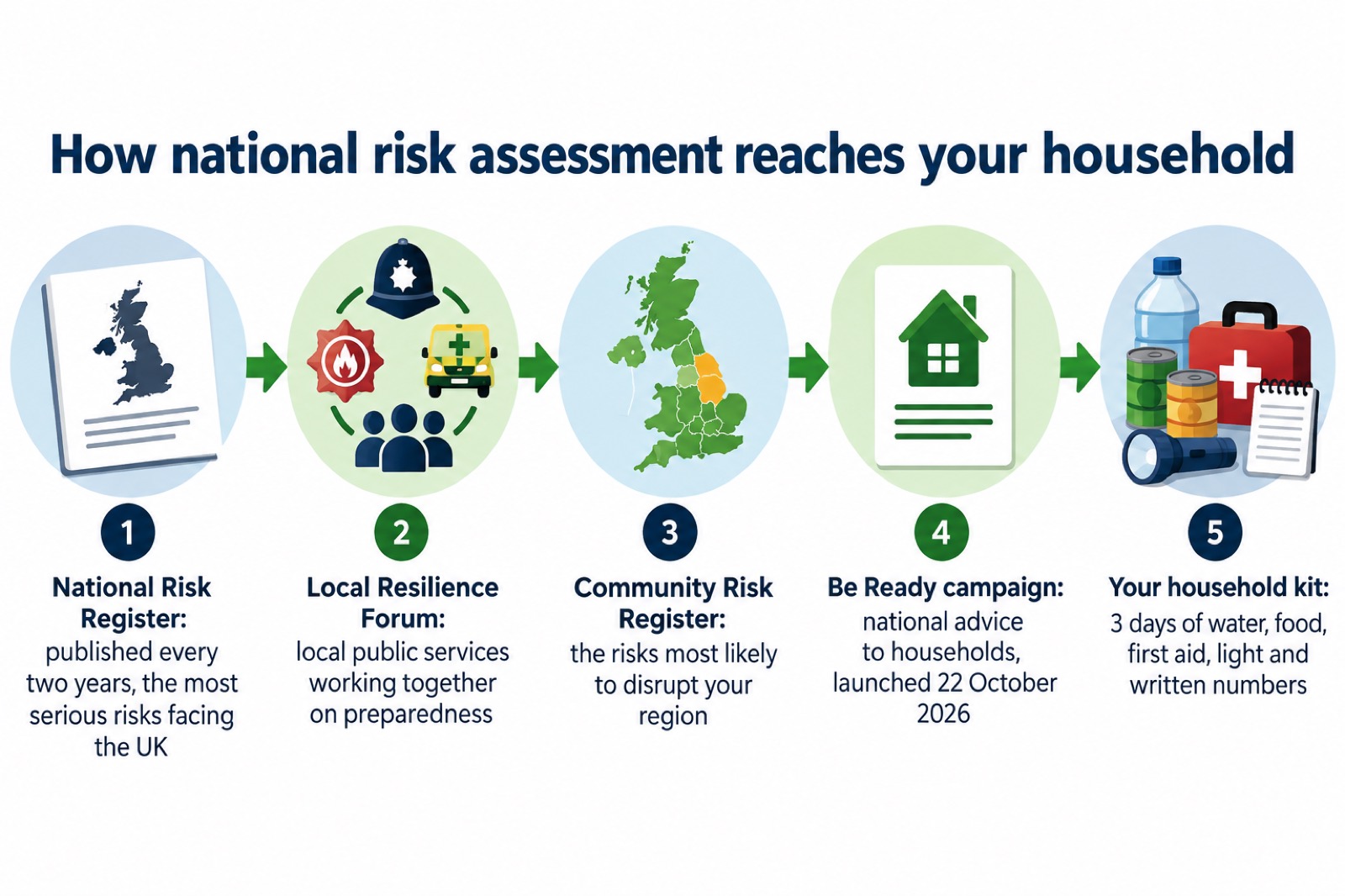
Be Ready is the public-facing end of a much larger system of government planning. Every two years, the Government publishes the National Risk Register, which sets out the most serious risks facing the UK16. The government regularly assesses the natural hazards and man-made threats that could affect the UK29, and the published register includes a summary of all but the most sensitive, classified risks26.
The Be Ready campaign grew out of earlier work. The gov.uk/prepare website was launched in July 2024, providing simple and effective steps people can take to be more prepared30, and the Be Ready campaign has seen that previous Prepare website updated with new messaging and branding1. The campaign site also carries a caveat worth knowing: this site will not be updated with live information during an emergency5. It is a preparation resource, not a live news source.
Closer to home, the campaign's own site directs you to the risks where you live. In England, Local Resilience Forums are partnerships made up of representatives from local public services, including the emergency services, local authorities, the NHS, the Environment Agency and other organisations involved in emergency preparedness, such as utilities providers31. Each Local Resilience Forum publishes a Community Risk Register which sets out the different risks most likely to cause disruption in your region31, and West Midlands Ambulance Service advises households to find out more about their local resilience forum and the advice in those community risk registers23.
Reading your local register tells you which of the national risks actually matter on your street: a coastal community's register looks very different from an inner-city one. Our how the UK prepares for emergencies guide explains the system in more depth, and our section pages on flooding, storms and snow and power cuts cover the risks most likely to hit a household.
Putting the checklist together
The Be Ready checklist is deliberately short, and everything on it can be gathered in a single shopping trip and an hour with a pen and paper. Work through it in this order:
- Buy bottled water: 3 litres per person per day for 3 days, drinking water only2
- Buy 3 days of non-perishable food you already eat, plus a tin opener3
- Check your first aid kit against the campaign's contents list and fill the gaps4
- Put a torch, and spare batteries or a wind-up torch, where you can find it in the dark2
- Write your key phone numbers, medication list, radio frequencies and insurance details on paper, and store them somewhere easy to find in a power cut4
- Add ready-made baby formula and pet food if your household needs them18
Then keep it current. Denbighshire Council's advice to write all expiry dates on a contents list kept in a prominent place17 is the habit that stops a kit quietly going out of date. Our household preparedness checklist covers the home kit, grab bag and car kit together, and where and how to store your supplies covers the practicalities of keeping it all safe and dry.
Sources (31)
- Households encouraged to take small, simple steps to stay prepared in an emergency, GOV.UK, 2026-10-22
- Be Ready for emergencies, Be Ready campaign
- Be Ready Checklist, Be Ready campaign, 2026-10
- Get prepared for emergencies, Prepare campaign
- Be Ready campaign home page, Be Ready campaign, 2026-10-19
- Prepare your home for emergencies, Renfrewshire Council, 2025-10-09
- Winter weather: ready and be prepared, Argyll and Bute Council
- Gavinton, Fogo and Polwarth Resilient Community Plan, Scottish Borders Council, 2018
- Household Emergency Plan, West Yorkshire Prepared, 2025-08
- Be Ready Household Emergency Plan, Be Ready campaign, 2026-10
- Water supply interruptions or outages, Prepare campaign, 2026-10-12
- Be prepared for emergencies, North Devon Council, 2026-10-29
- Preparing for emergencies, North Herts Council, 2015-01-12
- Create a household emergency lifesaving plan, Dumfries and Galloway Council
- Are you ready?, Birmingham City Council, 2026-05-06
- Loss of essential services, Greater Manchester Combined Authority, 2026-10-29
- Emergency Supplies Kit, Denbighshire Council, 2020
- Power cuts, Be Ready campaign, 2026-10-21
- Get help and advice in an emergency, Lincolnshire Council, 2026-10-29
- Emergency kit, Ready Scotland, 2026-10-22
- NPT Prepared emergency kit checklist, Neath Port Talbot Council, 2026-10-29
- Be more resilient in 30 simple ways in 30 days, Scottish Borders Council, 2026-10-29
- Be prepared, West Midlands Ambulance Service NHS Trust, 2026-06-16
- Household Emergency Plan, London Borough of Hillingdon, 2025-08
- Be prepared in case of an emergency, Cornwall Fire and Rescue Service, 2022-01-28
- Resilience Action Plan annual update, HCWS244, UK Parliament, 2026-07-14
- When should you call 999?, Scottish Ambulance Service, 2026-10-29
- Emergency advice, Belfast City Council, 2026-10-29
- National emergencies, GOV.UK, 2026-10-29
- How would you prepare for an emergency?, NHS Cheshire and Merseyside, 2024-07-10
- Check the risks where you are, Be Ready campaign, 2026-10-20