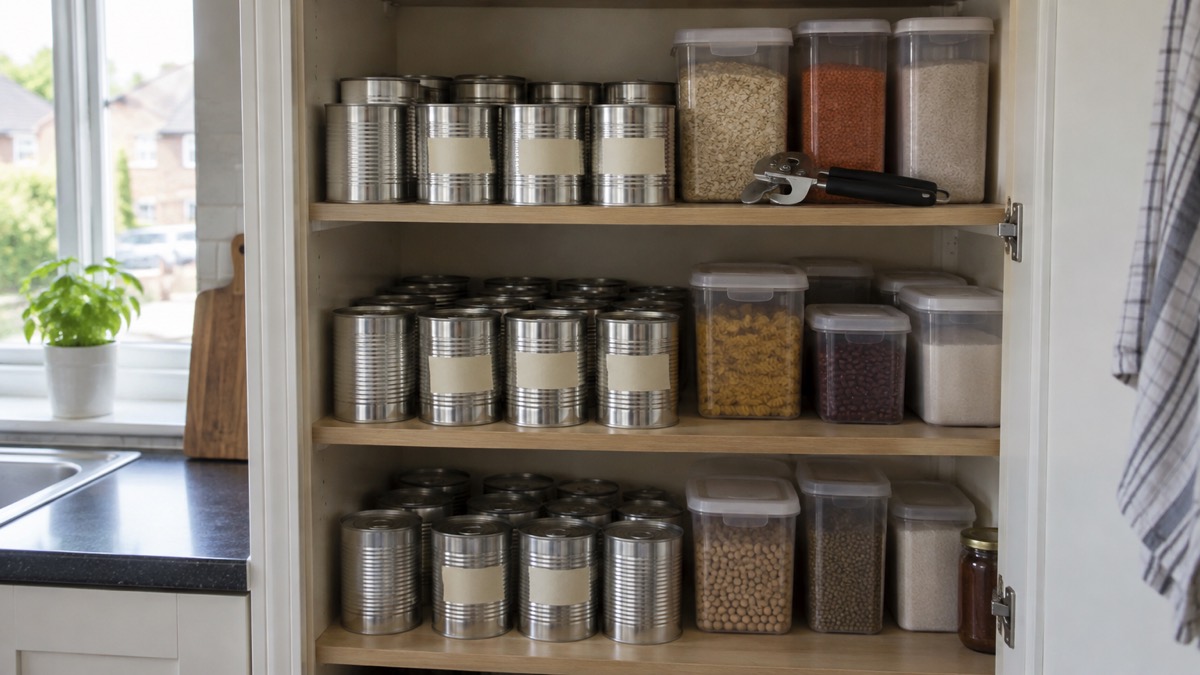
A store cupboard only works if the food in it is still safe to eat on the day you need it. That means rotating: buying food you already eat, always using the oldest first, and replacing what you use. Official UK guidance is blunt about the first part, saying "It's best to buy food you'd usually eat"1, because food your household actually likes never sits untouched long enough to go out of date.
The scale to aim for is modest. The national Be Ready checklist asks households to keep non-perishable food for 3 days2, and councils across England, Scotland and Wales give the same figure: "at least three days' supply of non-perishable food"3, "3 days' supply of bottled water and food that does not need cooking and will not go off"4. Rotation is what keeps that three-day buffer real, year after year, without waste.
The method is a simple habit called first in, first out: whatever went into the cupboard first comes out first. This page covers what belongs in the store, how to order and label your shelves, how long everyday food really lasts, what to check and how often, and the mistakes that let a store quietly go stale.
What counts as emergency food in your store
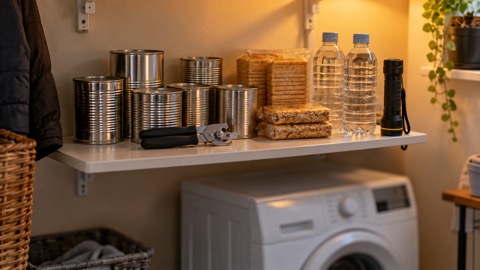
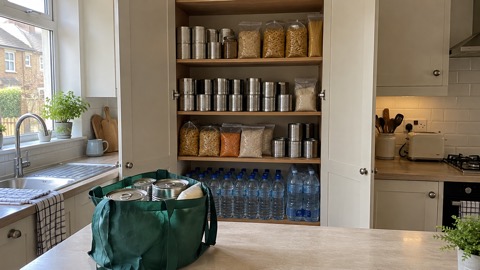
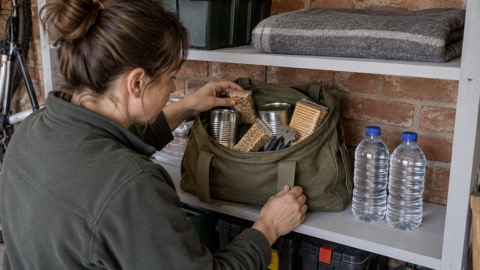
Emergency food is food that survives without power and can be eaten without cooking. The Be Ready checklist defines it as "Food with a long shelf life that doesn't need refrigeration or cooking e.g. tinned meat, fish or vegetables, dried fruit and nuts"1. The Household Emergency Plan version adds tinned fruit and a tin opener8. Denbighshire's emergency supplies kit list goes further: "foods that you can readily eat without heating or water, such as ready-to-eat meats or tuna, fruits, vegetables, canned or boxed juices, UHT milk, soup, high energy food like crackers or cereal bars, vitamins, food for infants or persons on special diets, biscuits, boiled sweets and powdered milk"9.
Notice what is not on these lists: anything frozen, anything chilled, anything that needs a working hob. Your fridge and freezer contents are useful in an emergency, but they are a shrinking resource, not a store. The store is the shelf-stable food, and it is what rotation applies to.
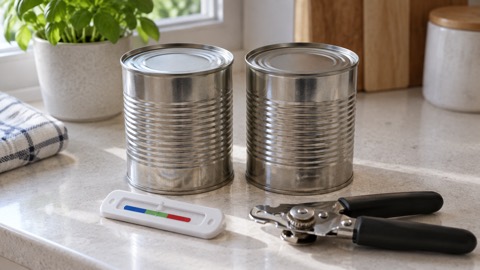
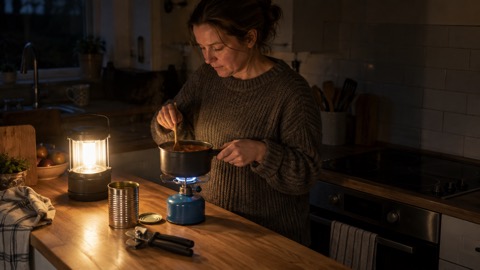
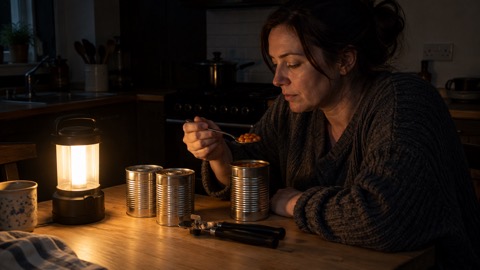
Two small additions matter. If anyone in the house needs them, include baby food and pet food in the definition: the Royal Borough of Windsor and Maidenhead's home emergency plan lists "Non-perishable foods (inc. baby food/pet food)" among grab bag essentials10, and Lincolnshire's advice includes pet food and treats3. And if your store contains tinned food, keep a tin opener with it: Nottinghamshire's checklist pairs "in date tinned food and tin opener/long life snacks"11, and Lincolnshire spells out "Tin opener for food (if kit contains tinned food)"3. A tin of soup without an opener is not emergency food.
For a fuller picture of what belongs on the shelf, see what to keep in an emergency store cupboard and how much emergency food to store per person.
Everyday food lasts days, not weeks
Rotation starts with an honest picture of how long ordinary food keeps, because it sets the boundary between your kitchen and your store. Food Standards Scotland gives the working numbers for a power cut: "Your fridge should keep your food at a safe temperature for up to four hours" with the door kept closed, and "The food in your freezer should stay frozen up to 48 hours if it's full or about 24 hours if it's half full"5. A parish power-cut guide attributes the same four-hour fridge figure to the Food Standards Agency12, and Sussex resilience guidance notes some food can last up to 8 hours if the fridge and freezer are kept closed13, so the documents give a range; treat four hours as the safe planning figure for the fridge and check food carefully beyond that.
| Where the food is | How long it stays safe in a power cut | Condition |
|---|---|---|
| Fridge | Up to 4 hours | Door kept closed as much as possible5 |
| Freezer, full | Up to 48 hours | Door kept closed5 |
| Freezer, half full | About 24 hours | Door kept closed5 |
| Leftovers in the fridge | Eat within 2 days | Cooled quickly and refrigerated6 |
Everyday guidance fills in the rest. Keep your fridge between 0°C and 5°C14. Do not leave the fridge door open for long periods6. Cool leftovers quickly, get them into the fridge within one and a half hours, and eat them within two days15. If a food goes off quickly and the label gives no storage instructions, put it in the fridge and eat it within 2 days16.
The point for rotation is this: everything in the fridge and freezer is on a clock measured in hours and days, not months. It cannot be part of a store you check twice a year. Store food lives on the shelf; fridge food lives in this week's meals. Keeping the two ideas separate is what stops people planning around a freezer full of food that a single power cut can put at risk. More detail is on fridge and freezer temperatures and thermometers and how long you can keep leftovers in the fridge.
Store what you already eat so rotation happens naturally
The single most useful piece of advice in the official guidance is also the simplest: buy what you normally buy. The Be Ready checklist says "It's best to buy food you'd usually eat"1, and Scotland's Ready campaign asks for "food that does not need cooking and will not go off, or that you rely on"4. Nottinghamshire's version is "ready to eat food (for example tinned) and a tin opener"11, and Neath Port Talbot's is "ready-to-eat food that won't go off"17.
Why this matters for rotation: a store built from your normal diet rotates itself. The tinned tomatoes, the crackers, the cereal bars and the UHT milk you keep are the same ones you use in ordinary weeks, so the oldest gets eaten and the newest takes its place without any special effort. A store built from unfamiliar survival rations does the opposite: nobody opens it, nothing moves, and in three years you own a box of out-of-date food you never wanted to eat in the first place.
Building the store this way is also cheap and gradual. NHS winter guidance is explicit that "You do not need to stockpile food or medicines, but it is sensible to have enough essential items to manage comfortably", and that "Adding one or two extra items to your normal weekly shop can help you build up a small reserve over time"7. That is the whole acquisition strategy: a couple of extra tins a week, and the three-day buffer assembles itself.
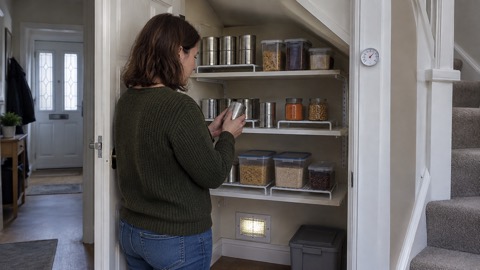
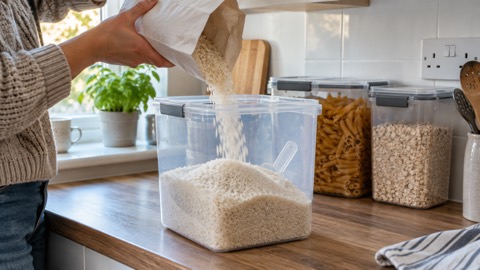
Storage habits keep the reserve in good condition. Food Standards Scotland advises keeping cupboard and pantry food "in sealed bags or containers", which keeps it fresh and stops anything falling into it by accident16. Do not reuse empty tins to cook or store food: in an opened can, the food and tin are exposed to air, and the tin might transfer to the food more quickly16. If you keep raw meat in the fridge, store it in sealed containers at the bottom of the fridge, keep raw and ready-to-eat foods apart, and use different boards for raw and ready-to-eat foods. Keep defrosting meat, fish and poultry covered or in a sealed container on the bottom shelf of the fridge so liquid cannot drip onto other food15. For the shelf-stable store itself, see keeping a long-term store cool, dry and free of pests.
First in, first out: using the oldest food first
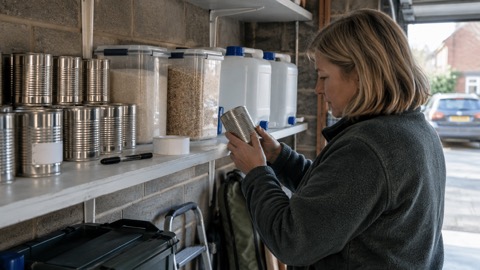
First in, first out means the food that entered your cupboard first leaves it first. Shops and warehouses call it FIFO; at home it is three habits.
- Date everything as it arrives. Write the best-before or use-by date on the lid or label with a permanent marker where you can see it at a glance, especially on multi-packs and anything decanted into containers. Denbighshire's kit advice is to "Write all expiry dates" on your contents list9, and the same discipline applied to the tins themselves makes the order visible on the shelf.
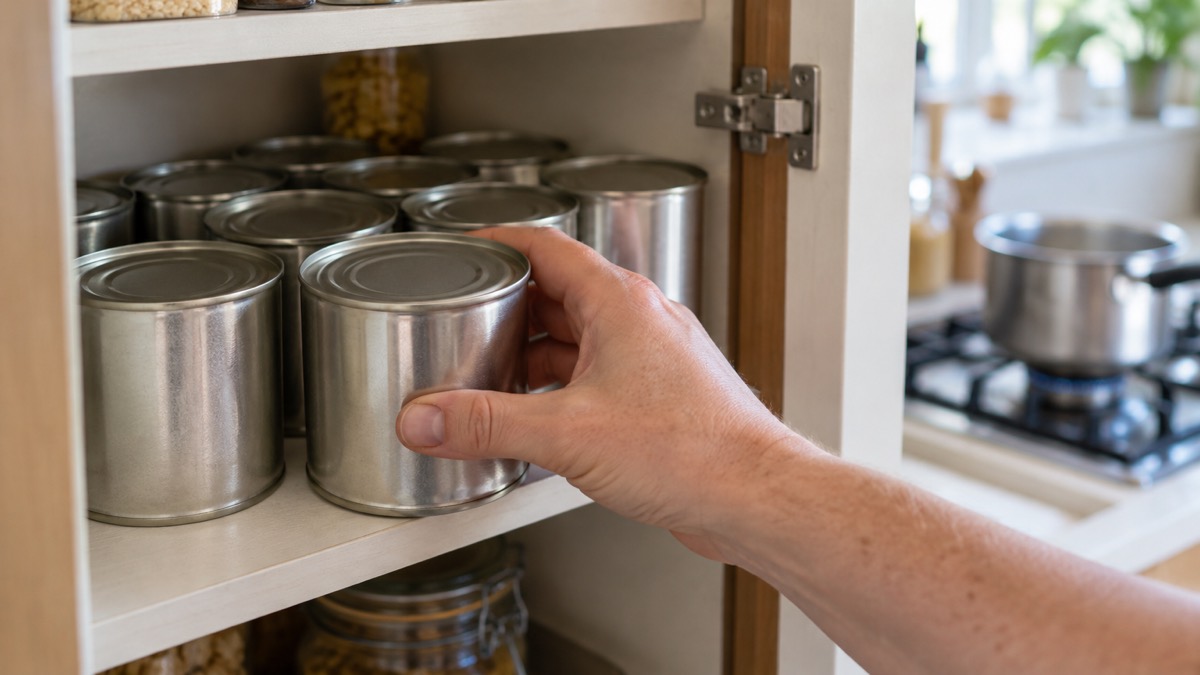
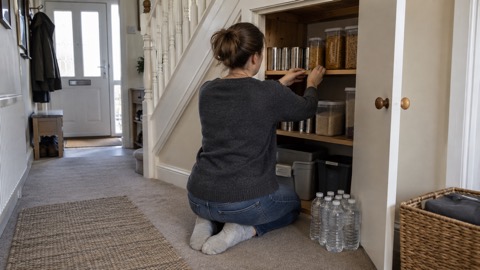
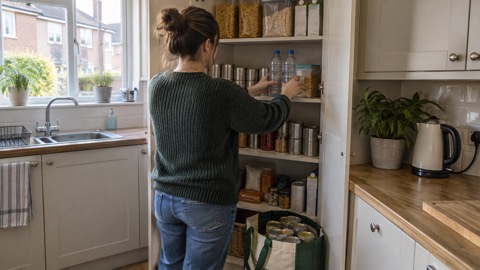
- Order the shelf oldest at the front. When you put new shopping away, move the older items forward and put the new ones behind. The front of the shelf is then always the food to use next, and you never have to hunt for dates mid-cook.
- Cook from the front. Reach for the front tin, the front packet, the oldest jar. When you use one, it goes on the shopping list, and the replacement takes its place at the back.
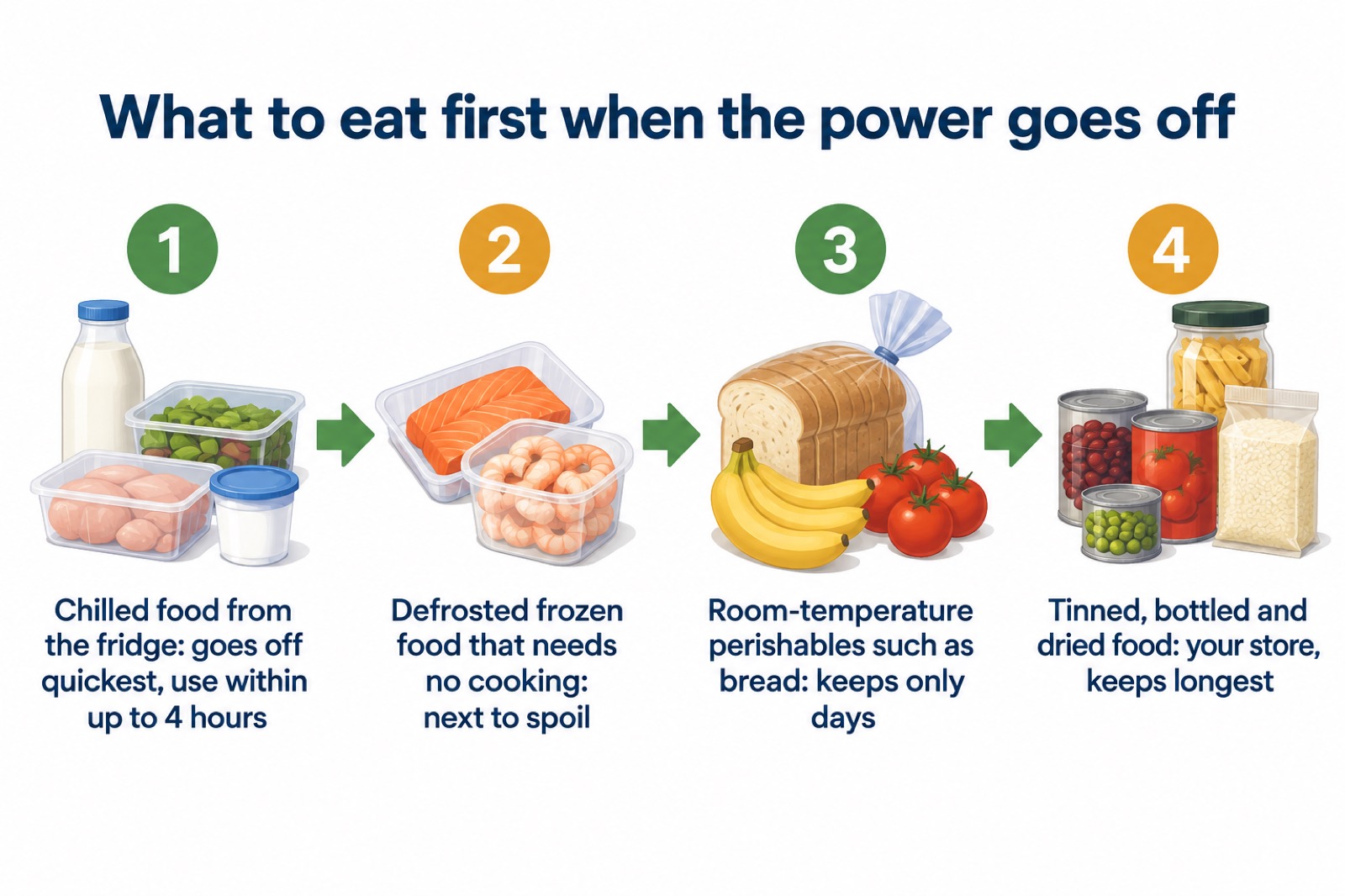
The same principle, applied in a hurry, is exactly what official guidance says to do in a power cut. Food Standards Scotland gives an explicit use order: "To keep food safe and reduce food waste, use up foods in the following order": chilled fridge foods first, then defrosted frozen food that does not need cooking, then room-temperature perishable food such as bread, then room-temperature tinned, bottled and dried food5. The reasoning is given too: "As chilled foods will go off the quickest, you should try to use these up first before other foods during a power cut"5. First in, first out in an emergency becomes first-to-spoil, first out.
Two safety points sit alongside that order. Defrost food in the fridge so it does not get too warm6, because when food is stored above fridge temperatures bacteria can grow and multiply, which Food Standards Scotland calls the "Danger Zone"6. And do not return thawed frozen desserts such as ice cream to the freezer once they have thawed14. If frozen food has fully defrosted and you are unsure, can you refreeze defrosted meat covers the decision. For meals that need no heat at all, see meals without power.
Canned goods, grains and freeze-dried food keep longest
The long-keeping end of the food spectrum is where a store earns its place, because long shelf life means less frequent rotation. Best-before dates, according to Food Standards Scotland, "appear on a wide range of foods, which can include frozen, dried and tinned foods, such as canned tomatoes, bread and cereal"18. Best-before is about quality rather than safety, which is why tinned and dried goods suit a store you dip into slowly; use-by dates, by contrast, are "Usually found on foods like raw meat or fish, cooked sliced meats, and some dairy products"18, and those foods belong in the fridge and this week's meals, not the store. The distinction is explained fully on shelf life, use by and best before dates explained.
Council kit lists point to the same long-life core. Birmingham's preparedness page lists "long-life food such as canned food, dried food and energy bars"19. Argyll and Bute's winter advice says to keep "at least three days' supply of food, bottled water and other essentials, including medicines, and tinned and dry foods which store safely without need for electricity"20. Hampshire's grab bag list includes canned food21.
| Type of food | Typical examples from official lists | Where it fits your rotation |
|---|---|---|
| Canned | Tinned meat, fish, vegetables, fruit, soup, juices1 | Everyday eating, rotates naturally |
| Dried and grains | Long-life pasta, rice, lentils, chickpeas, butter beans, oats, whole-grain crackers, oatcakes and crispbreads9 | Everyday eating, rotates naturally |
| Freeze-dried and ration packs | Long-life meals needing only water | Rarely eaten, needs dated checks |
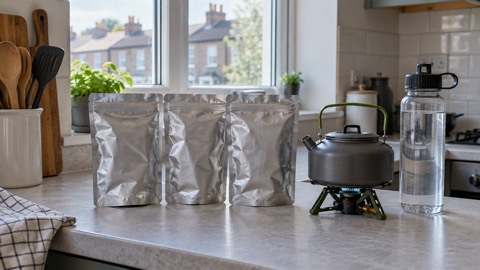
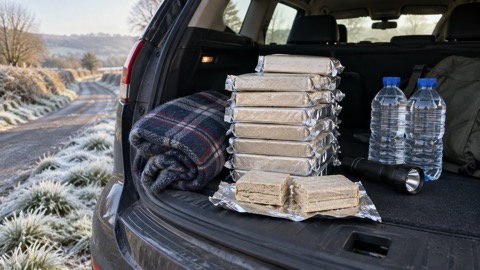
Freeze-dried meals sit in a different position. They keep for a long time and need only water, which makes them a reasonable back-stop for a store you rarely touch, but they are not food most households eat week to week, so they do not rotate through the kitchen on their own. If you keep them, write the date on each packet, put them behind the tins in your use order, and check them on your regular review. Freeze-dried meals: what they are and how to choose and how long freeze-dried emergency meals keep cover the details, and tinned or freeze-dried meals sets the two side by side. For the staples, see rice, pasta, oats and pulses for long-term storage and tinned food: shelf life, damaged cans and opening without power.
How long your store should cover: a few days, not a few weeks
The official target is consistent across the UK, and it is smaller than many people assume. Birmingham says "Keep enough supplies to meet your household's needs for at least 72 hours" and notes that "In rare but serious situations, you may need to stay indoors for up to 3 days"19. Greater Manchester asks households to "Consider what supplies you and your household might need during an emergency lasting a few days, such as a power cut"22, and Wiltshire's kit list includes spare medication alongside the food23.
The reason a few days is enough is that most disruptions are short. Ofgem's consumer advice notes that "Network companies have 24 hours to restore your power if more than 5,000 homes are affected by a single fault" in normal weather24. Nothing in the official guidance asks a household to hold weeks of food, and NHS winter guidance says plainly that you do not need to stockpile7.
For rotation, a three-day store is good news: it is small enough to sit inside your normal shopping habits. Six tins and a packet of crackers per person, more or less, is the whole commitment, and every item in it is something you would eat anyway. If you want to hold more than three days, the same rotation rules apply, just with deeper shelves; how much emergency food to store per person works through the arithmetic.
Checking and restocking all your emergency supplies
Food is only one dated item in a household kit, so the check should cover everything at once. Denbighshire's emergency supplies kit advice is the clearest instruction in the official guidance: "Make a list of all contents and put it outside the kit and/or in a prominent place in your home. Write all expiry dates" on it, with when they need changing9. That list turns an annual check from an afternoon of rummaging into ten minutes with a pen.
What to check, and why:
- Food dates. Every tin, packet and jar in the store, against your contents list9.
- Batteries and torches. Birmingham lists a torch with spare batteries or a wind-up torch19.
- Pet supplies. Pet food, water and routine medication, per Birmingham's list19, and pet food and treats per Lincolnshire3.
- Everything with a date. Write all expiry dates on your contents list, with when they need changing, and replace expired items as part of the same check9.
How often? The official guidance on kit contents does not fix a single interval, but a government consultation on personal emergency evacuation plans found opinion split between roughly six-monthly and annual reviews: "13% or 44 of respondents thought information in the boxes should be reviewed every 6 months", while "just under a third (30% or 104) thought this should be every 12 months"25. A practical reading: glance at the food dates when you do a big shop or at each change of season, and do the full kit check against the list at least once a year, timed to something you will not forget, such as the clocks changing or the pre-winter shop that NHS and council winter campaigns promote7.
Restocking is the easy half. When the check finds something used or out of date, it goes on the shopping list and one or two extras in the next weekly shop replace it7. If a real emergency used up part of the store, the same gradual method refills it within a few weeks. The full kit picture, including torches, stoves, blankets and sanitation, is on emergency kit: what a UK household should keep ready, and a printable version of the food side is at emergency store cupboard checklist.
Where rotation goes wrong
Most rotation failures come from four patterns, and all four are avoidable.
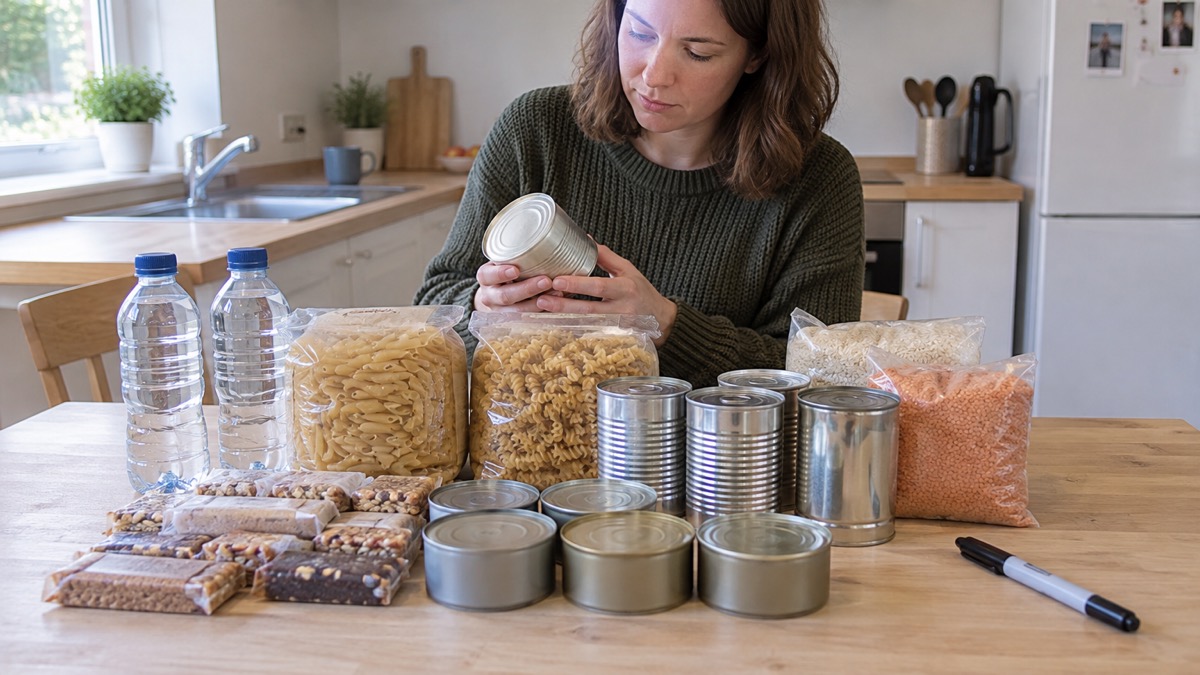
The forgotten back row. New shopping goes in at the front, the oldest slips behind it, and a tin reaches the back of the cupboard and stays there for years. The fix is to write all expiry dates on your contents list, with when they need changing, so a forgotten tin is caught at the next check rather than left to hide at the back9.
The store nobody eats. Buying food because it keeps for a long time rather than because anyone likes it guarantees a static store. Official guidance points the other way: buy what you usually eat1. If you do hold long-life specialist items such as freeze-dried meals or ration packs, keep them separate, dated and checked, and accept that they will not rotate on their own.
The undated kit. Batteries, medicines, first aid dressings, pet food and baby food all expire, and a kit without a contents list hides that. Denbighshire's instruction to list all contents with their expiry dates, kept in a prominent place, exists precisely to stop this9.
The freezer-as-store mistake. Planning your emergency food around a freezer full of meals works only until the power goes. A full freezer buys up to 48 hours and a half-full one about 245, and after that you are eating in a hurry or throwing food away. The shelf-stable three-day store is the reliable layer; the freezer is a bonus.
One further caution applies to any equipment you buy to support the store or the kit. London Fire Brigade's guidance on personal emergency evacuation plans advises against using online marketplaces to look for cheaper alternatives to any equipment recommended, as they may not always meet safety standards26. The same care applies to camping stoves and can openers: a stove that fails in a power cut is worse than no stove, and heating and cooking without mains power or gas covers choosing and using them safely.
Finally, do not let the store become an excuse to under-prepare elsewhere. Ofgem's consumer advice warns that not heating homes as much as needed to save money, known as "self-rationing", "can be extremely dangerous"24. A rotated food store is one layer of a prepared household, not a substitute for heating, water or the rest of the kit. If you are building the whole picture, getting started: preparing your household for an emergency is the place to begin, and starting a store cupboard supply step by step walks through the first shop.
Sources (26)
- Be Ready Checklist, UK Government Be Ready campaign, 2026
- Get prepared for emergencies, UK Government, 2026
- Get help and advice in an emergency, Lincolnshire County Council, 2026
- Emergency kit, Scottish Government Ready campaign, 2026
- Food safety in the kitchen: power cuts, Food Standards Scotland, 2026
- Food safety in the kitchen: chilling, Food Standards Scotland, 2026
- Be prepared for winter emergencies, NHS Norfolk and Suffolk, 2026
- Be Ready Household Emergency Plan, UK Government Be Ready campaign, 2026
- Emergency supplies kit, Denbighshire County Council, 2020
- Your home emergency plan, Royal Borough of Windsor and Maidenhead, 2026
- Preparing for an emergency, Nottinghamshire County Council, 2026
- 12 tips to prepare for a power cut, Horsted Keynes Parish Council, 2026
- Be ready, stay safe, act now, Sussex Resilience Forum, 2025
- Preparing and cooking food safely, NHS inform Scotland, 2025
- Food poisoning and waterborne infections, Devon and Somerset Fire and Rescue Service area guidance via Shropshire Council, 2026
- Food safety in the kitchen: food storage, Food Standards Scotland, 2026
- NPT Prepared emergency kit checklist, Neath Port Talbot Council, 2026
- Use by and best before dates, Food Standards Scotland, 2026
- Are you ready?, Birmingham City Council, 2026
- Winter weather: be prepared, Argyll and Bute Council, 2026
- Reduce the risk of wildfire damage to your property, Hampshire and Isle of Wight Fire and Rescue Service, 2026
- Prepare yourself, Greater Manchester Combined Authority, 2026
- Planning for an emergency kit, Wiltshire Council, 2026
- Energy domestic consumer advice, England and Wales, Ofgem, 2024
- Personal Emergency Evacuation Plans consultation response, UK Government, 2024
- Residential personal emergency evacuation plans: a guide, London Fire Brigade, 2026
 Long-Term Storage Kit Checklist
 Store Cupboard Checklist
 30-Day Household Checklist
 How Much Emergency Food to Store
 What to Store in an Emergency
 Starting a Store Cupboard
 Shelf Life and Date Labels
 Long-Term Storage Conditions
 Meals Without Power
 Self-Heating Meals
 Tinned Food Guide
 Rice, Pasta and Pulses Storage
 Freeze-Dried Meals
 Emergency Ration Packs
 Emergency Ration Bars