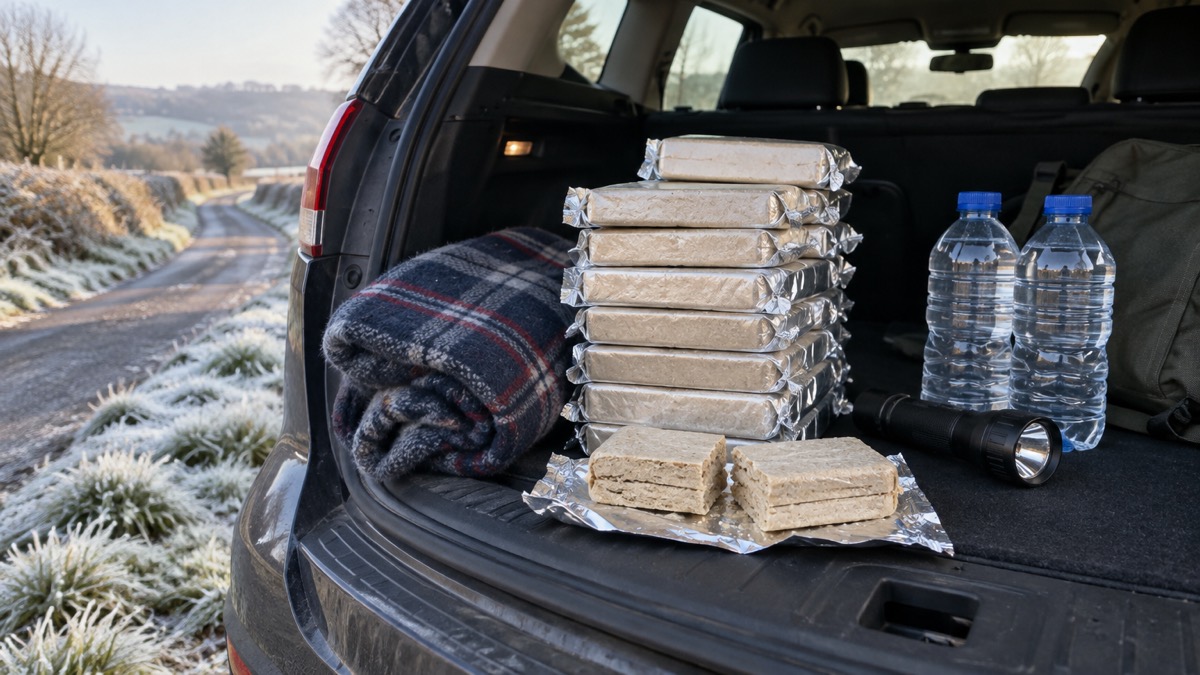
Emergency ration bars are compressed blocks of ready-to-eat food, designed to be eaten straight from the pack with no cooking, no heating and no refrigeration. They are dense, compact and made to sit in a cupboard for years: the best-known example, the NRG-5 emergency ration made by Katadyn, has a stated shelf life of 20 years1. That combination, no cooking plus a very long storage life, is what sets them apart from every other kind of emergency food.
The numbers are simple. One 500g pack of NRG-5 provides 2300 kcal, which the maker states covers the daily energy requirements of an adult1. So a household of two adults planning on three days of food, the minimum most UK official guidance recommends, needs roughly six packs if ration bars were their whole food store2. In practice ration bars work best as one part of a store, not all of it, and this page explains where they fit.
UK local authorities and resilience partnerships consistently list long-life food in their emergency kit advice: tinned food that does not need cooking, dried food, cereal bars and energy bars all appear in published checklists3. Ration bars are the most concentrated form of that idea, and they suit households that want something small, forgettable and still edible decades later.
What an emergency ration bar is
A ration bar is food engineered for storage rather than enjoyment. It is a compressed block, sold as a sealed pack, that delivers the maximum calories in the minimum weight and volume, and that survives being left alone in a cupboard for years. The NRG-5 is described by its maker simply as an "emergency food ration", packaged as a bar, and it is made in Germany6. It is the kind of product that lifeboat crews, expeditions and humanitarian agencies have long carried, and it has crossed into household preparedness for the same reasons: it needs nothing but hands and a mouth.
The defining feature is that nothing has to work for you to eat it. No cooker, no kettle, no tin opener, no power. Official UK emergency kit guidance repeatedly stresses food that needs no cooking: the national Be Ready checklist suggests "food with a long shelf life that doesn't need refrigeration or cooking"2, Nottinghamshire's kit list includes "in date tinned food and tin opener/long life snacks"7, and Birmingham's household supplies list names "long-life food such as canned food, dried food and energy bars"3. A ration bar takes that principle to its limit, because even a tin needs an opener and a tin opener can be lost.
That matters most in the situations where you would actually open the pack: a power cut that takes out your cooker, a flood that forces you upstairs with whatever you can carry, or an evacuation where you leave with a grab bag. Wiltshire's emergency kit guidance includes "bottled water and dried foods such as cereal bars"8, and the Scottish Flood Forum's emergency flood kit suggests "non-perishable food items (including energy or cereal bars)"9. Ration bars are the densest possible version of that item.
One 500g pack covers an adult's daily energy
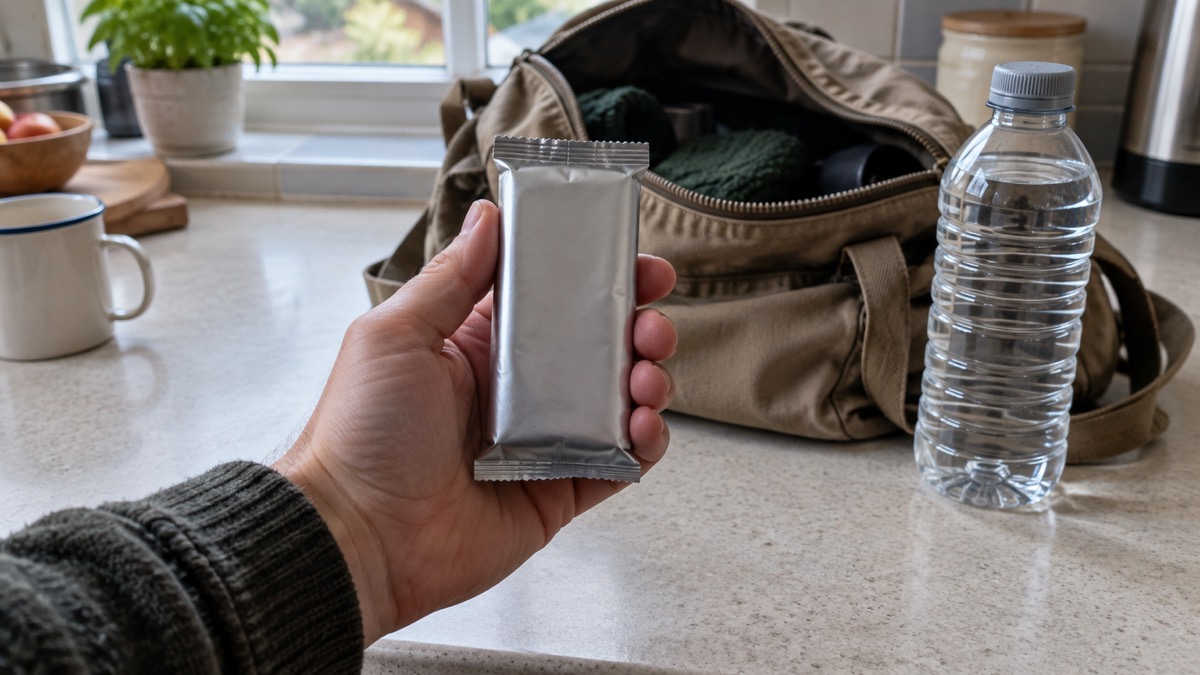
The headline figure for the NRG-5 is 500g and 2300 kcal per pack, and the maker states plainly: "A pack of NRG-5® (500g / 2300 kcal) covers the daily energy requirements of an adult"1. The maker's datasheet repeats the same figure and gives the underlying density: 1925 kJ or 460 kcal per 100g6. That concentration is the whole point of the product. Half a kilogram of food that feeds an adult for a day fits in a jacket pocket.
For comparison, a freeze-dried emergency ration pack works differently. The Expedition Foods Emergency Rations for 1 Week provides one breakfast, one lunch and one dinner per day for seven days, with 7 breakfasts, 7 lunches and 7 dinners in the pack, and the breakfasts alone total 5,600 kcal5. It is a fuller eating experience, three proper meals a day rather than a dense bar, but it needs water for rehydration and its stated shelf life is up to five years, not twenty5.
To plan with ration bars, work from calories rather than packs. One 500g pack is 2300 kcal and covers an adult day1, so count one pack per adult per day and add packs for children at smaller portions. Children need less energy than adults, so a family stretches the same packs further, though the maker's guidance on children, covered below, is about suitability rather than exact portions1. For a fuller method of working out how much food your household needs, see How Much Emergency Food to Store per Person.
Eating them: straight from the pack, or crushed with water
The simplest way to eat a ration bar is to open the pack and eat it. The NRG-5 is "ready-to-eat, no heating or boiling required"1, which is what makes it usable in the first hours of an emergency when you may have no power, no gas and no safe way to heat anything.
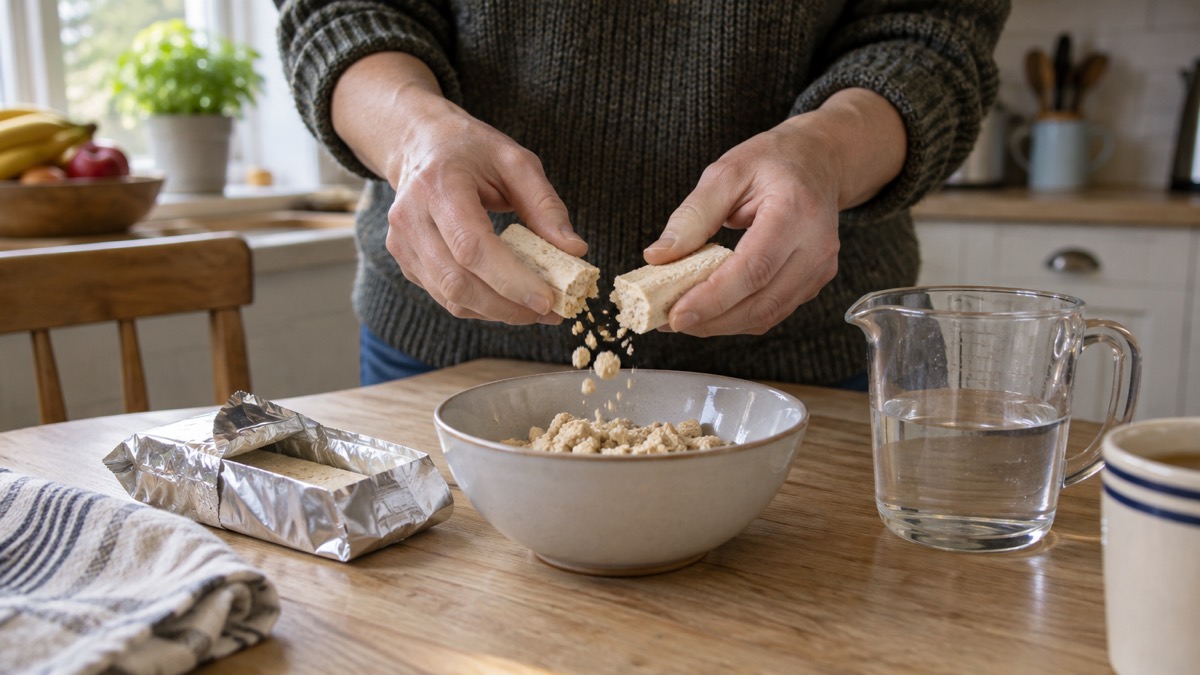
If you want variety, or if you are feeding small children or someone who struggles with dry, dense food, the bars can be broken down. The maker explains: "By crushing the compressed bars and adding water, you can prepare a nutritious mash or an energy drink, depending on how much water you add"1. More water gives you a drink; less gives you a mash. The maker also gives the instruction "Add hot water, stir and follow the instructions on the pouch"1, so hot water is an option when you have it, but it is never a requirement.
This is where ration bars and freeze-dried meals differ most sharply. Freeze-dried meals must be rehydrated before eating: Expedition Foods states its "meals can be rehydrated with hot or cold water"5. Cold water works, which is useful in a power cut, but water is still essential. A ration bar needs water only if you choose the mash or drink form, so in a genuine water shortage the bar that can be eaten dry has the edge.
Two safety points from official food guidance apply to any emergency eating. First, in a power cut, Food Standards Scotland advises using foods in a set order: chilled fridge foods first, then defrosted frozen food that does not need cooking, then room-temperature perishable food such as bread, and only then room-temperature tinned, bottled and dried food10. Ration bars sit at the end of that order, so save them and eat the perishables first. Second, Food Standards Scotland warns "do not reuse empty tins to cook or store food", because in an opened can the tin can transfer to the food more quickly11; a ration bar avoids this entirely, since you eat from its own pouch.
Shelf life: up to 20 years if kept cool and dry
The NRG-5's stated shelf life is 20 years1, which is far beyond almost any other food you can buy for a home store. Freeze-dried meals from Expedition Foods keep for up to five years5, and ordinary tinned and dried foods vary widely. For most households the attraction is obvious: you buy the packs once, put them at the back of a cupboard, and forget about them for two decades. There is nothing to rotate, nothing to check each year, and nothing that quietly expires the way a tin of soup eventually does.
That 20 years depends on storage. The maker's datasheet gives the storage conditions as "keep cool and dry"6. In practice that means a normal indoor cupboard in a heated home: not the loft, which can get far hotter than a comfortable room on a summer's day, not a garage or shed, which swings between freezing and baking, and not next to the oven, boiler or a radiator. Damp is the other enemy, so keep packs off the floor and away from anywhere that could leak. Our guide to Keeping a Long-Term Store Cool, Dry and Free of Pests covers the detail.
One honest caveat: the 20-year figure is the maker's own claim for an unopened pack stored correctly1. It is a maker's figure, not an independent test result, and it assumes the seal stays intact. Inspect packs occasionally for damage, and if a pack is punctured, swollen or damp, do not eat it. The distinction between "use by" and "best before" matters here too: Food Standards Scotland explains that use-by dates, usually found on raw meat or fish, cooked sliced meats and some dairy products, are about safety, while best-before dates are about quality12. Long-life foods such as ration bars carry the latter kind of date, which is why they can be trusted well beyond everyday food.
How long you should store food for overall is a separate question from how long any item keeps. Some councils go further than the everyday checklists: Central Bedfordshire recommends a home emergency kit to look after your family for at least 7 days of disruption13. Ration bars are one of the few foods that make a 7 day store practical in a small flat.
What is in a bar: fat, sugar, protein and added vitamins and minerals
A ration bar is not a balanced meal in the everyday sense. It is energy, deliberately concentrated, built from the macronutrients that pack the most calories per gram. The NRG-5 datasheet gives the composition per 100g6:
| Nutrient | Per 100g |
|---|---|
| Energy | 1925 kJ / 460 kcal6 |
| Fat | 18.5g, of which saturates 17.1g6 |
| Carbohydrate | 60.2g, of which sugars 18.3g6 |
Read that table before you buy, because it tells you what you are really eating. Most of the fat is saturated (17.1g of the 18.5g per 100g), and nearly a fifth of the carbohydrate is sugar6. That is not a flaw; it is how you reach 460 kcal in 100g of food. But it means ration bars are emergency energy, not everyday nutrition, and they are not a substitute for the varied diet that official guidance wants you to keep in your store. The NHS-backed winter guidance in Norfolk and Suffolk, for example, recommends keeping "a supply of long-lasting cupboard essentials such as tinned vegetables, beans, pulses, soup and pasta"14, which is a far better basis for a week of eating than bars alone.
The full ingredients list, including any added vitamins and minerals and the salt content, is printed on the pack itself. The NRG-5 packaging carries its information in eight languages, including English6, so check the English panel for the ingredients and nutrition breakdown of the exact product you have. If anyone in your household has an allergy, the pack's own ingredients list is the authoritative source, not a website summary.
Giving ration bars to children
The NRG-5 can be given to children from 6 months old, according to the maker1. That reflects how the product is used in humanitarian settings, where it is often the only food available for whole families, and the mash form, made by crushing the bars and adding water1, is the practical way to feed it to a baby or toddler too young to chew a dense bar.
Even so, treat the maker's age guidance as a floor, not a menu plan. Babies under 6 months should not have it at all1, and for infants from 6 months the NHS and council emergency guidance is clear that their normal milk comes first: Lincolnshire's emergency kit advice says to include infant formula milk and nappies if required15, and Greater Manchester's household advice says to include ready-made baby formula if needed16. Ready-made formula is the safer choice in an emergency because it needs no mixing with cooled boiled water. Our page on Babies, Young Children and Medical Diets in an Emergency covers this in full, including How to Make Up Baby Formula in a Power Cut.
For older children, ration bars work like they do for adults, with smaller portions. Lancashire's emergency pack list includes toys, books and activities alongside the food and water17, a reminder that keeping children settled during an emergency is about more than food alone.
Diet and allergens: vegan and lactose-free options
The NRG-5 is listed by its maker as suitable for vegans, and as lactose-free1. That single product therefore covers two of the most common dietary restrictions at once, which is unusual among emergency foods and genuinely useful: one store bought around it works for a mixed household of omnivores, vegans and the lactose intolerant without buying separate supplies.
That said, "vegan and lactose-free" is not the same as "free of every allergen". The maker's product page states "Allergens Lactose Free"1, but it does not claim the product is free of all allergens, so anyone with an allergy to an ingredient other than lactose must read the pack's own ingredients list before eating it. The packaging carries ingredients information in English, German, French, Dutch, Polish, Swedish, Danish and Norwegian6, so the English panel is there to be checked. For households with medical, religious or allergy diets, our page on Emergency Food for Medical, Religious and Allergy Diets goes further, and there is also a dedicated NRG-5 ZERO ration variant page covering a gluten and lactose free version.
For everyone else, the practical point is that diet suitability is one of the things to verify on the pack before you commit to a store built around ration bars, alongside the calories and the date. A store that suits your household in year one still has to suit it in year ten.
Ration bars, freeze-dried meals and everyday food: where each fits
No single food is the right answer for a home store, and the three main options do different jobs. Official guidance points towards everyday food first: the national Be Ready checklist says "it's best to buy food you'd usually eat"2, and Wiltshire and Swindon Prepared advise avoiding fresh or perishable food and keeping longer-lasting products such as tinned food for emergencies18. Denbighshire's emergency supplies kit goes further, listing foods "that you can readily eat without heating or water, such as ready-to-eat meats or tuna, fruits, vegetables, canned or boxed juices, UHT milk, soup, high energy food like crackers or cereal bars, vitamins, food for infants or persons on special diets, biscuits, boiled sweets and powdered milk"19.
| Everyday tinned and dried food | Freeze-dried meals | Ration bars | |
|---|---|---|---|
| Shelf life | Varies by food | Up to five years5 | 20 years1 |
| Preparation | None for ready-to-eat tins | Rehydrate with hot or cold water5 | None; optional water for mash or drink1 |
| Eating quality | Familiar, varied | Proper meals, three a day5 | Dense, plain, repetitive |
| Space per day of food | Bulky | Light and compact | Most compact |
| Best role | The bulk of your store | Comfort and morale on longer disruptions | The deep reserve and grab bag |
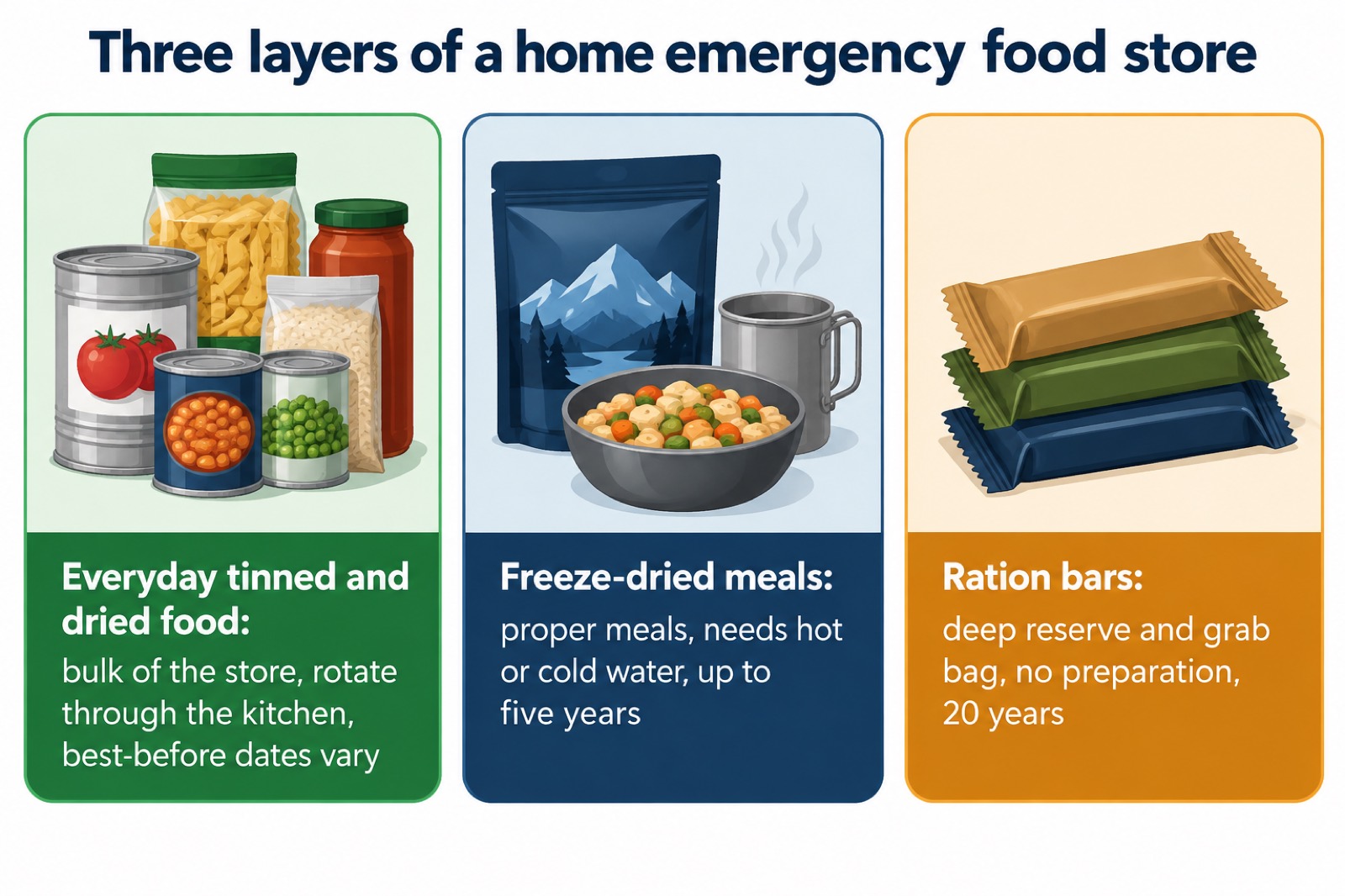
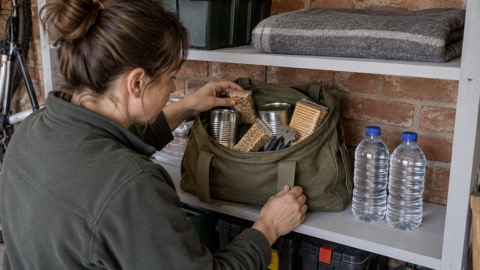
The sensible pattern, and the one that fits official advice, is layers. Build the bulk of your store from food you normally eat, tins, pasta, pulses and dried goods, so it rotates through your kitchen and nothing is wasted2. Add freeze-dried meals if you want hot meals during a longer disruption: Expedition Foods states its meals can be rehydrated with hot or cold water5. Keep a small number of ration bars as the layer you never touch: the packs that go in the grab bag, the car, or the back of the cupboard, ready to eat with no heating or boiling required.
If your area floods, remember that stored food and flood water do not mix. Runnymede Borough Council's advice is blunt: "Any food which has come into contact with flood water should be disposed of immediately, preferably in plastic refuse sacks (double bagged if possible)"20. Keep your reserve packs high, not under the stairs. Our pages on What to Keep in an Emergency Store Cupboard, Starting a Store Cupboard Supply Step by Step, Freeze-Dried Meals: What They Are and How to Choose and Where to Keep an Emergency Store If Your Area Floods cover each layer in detail.
What to check on the pack before you choose
Before you buy any ration bar, read the pack. The differences between products are exactly the things this page has covered, and they are all printed on the label or the maker's datasheet. Check:
- Total calories per pack. For the NRG-5 it is 2300 kcal per 500g1; work out how many packs cover your household for the days you have planned.
- Shelf life and date. NRG-5 states 20 years1; freeze-dried meals state up to five5. Check the date printed on the actual pack you are buying, not the product page.
- Storage conditions. The NRG-5 datasheet says keep cool and dry6. Make sure you have a spot that stays that way year-round.
- Ingredients and allergens. The NRG-5 is vegan and lactose-free1, but check the English ingredients panel for anything else your household must avoid6.
- Preparation. Confirm it is ready to eat with no heating required1 if that is what you need; some products, like freeze-dried meals, always need water5.
- Age suitability. The NRG-5 states children from 6 months1; check the equivalent statement for any other product.
- Pack integrity. Once home, check packs periodically for punctures, swelling or damp, and store them off the floor and away from heat6.
For the NRG-5 specifically, the maker's datasheet also gives the supply details: packs come in cartons of 24 x 500g, with a carton weighing 12kg net6, which is worth knowing if you are buying for a household rather than trying one pack. Full detail is on our NRG-5 Emergency Food Ration page, and the freeze-dried alternative is covered on the Expedition Foods Emergency Rations for 1 Week page.
Where to go next
Ration bars are one small, long-lived layer of a prepared household. The food section's main guide, Emergency Food: A Household Guide, pulls the whole subject together, and Rotating Your Store: First In, First Out and Shelf Life, Use By and Best Before Dates Explained cover the everyday food that should make up most of it. For the wider kit that sits alongside your food, see Emergency Kit: What a UK Household Should Keep Ready and Water in an Emergency: A Household Guide.
Sources (20)
- NRG-5 Emergency Food Ration product page, Katadyn, 2026
- Be Ready Checklist, UK Government Be Ready campaign, 2026
- Are You Ready household preparedness advice, Birmingham City Council, 2026
- Emergency kit checklist, Neath Port Talbot Council, 2026
- Emergency Rations for 1 Week product page, Expedition Foods, 2026
- NRG-5 500g datasheet, Katadyn, 2025
- Preparing for an emergency, Nottinghamshire County Council, 2026
- Planning for an emergency kit, Wiltshire Council, 2026
- Emergency Flood Kit, Scottish Flood Forum, 2018
- Food safety in the kitchen: power cuts, Food Standards Scotland, 2026
- Food safety in the kitchen: food storage, Food Standards Scotland, 2026
- Use by and best before dates, Food Standards Scotland, 2026
- Emergency kits and grab bags, Central Bedfordshire Council, 2026
- Stay warm and nourished, NHS Norfolk and Suffolk Integrated Care Board, 2026
- Get help and advice in an emergency, Lincolnshire County Council, 2026
- Loss of essential services, Greater Manchester Combined Authority, 2026
- Emergency pack, Lancashire Prepared, 2026
- What is a national power outage, Wiltshire and Swindon Prepared, 2026
- Emergency Supplies Kit, Denbighshire County Council, 2020
- Flooding advice, Runnymede Borough Council, 2026
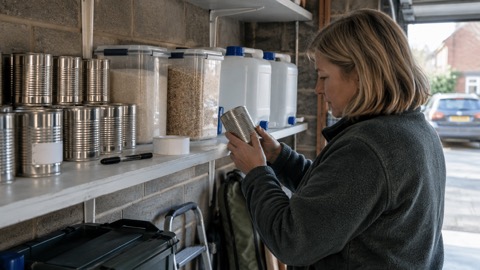 Long-Term Storage Kit Checklist
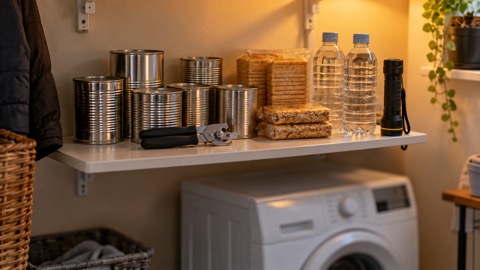 Store Cupboard Checklist
 30-Day Household Checklist
 How Much Emergency Food to Store
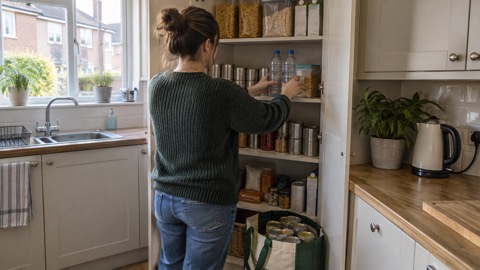 What to Store in an Emergency
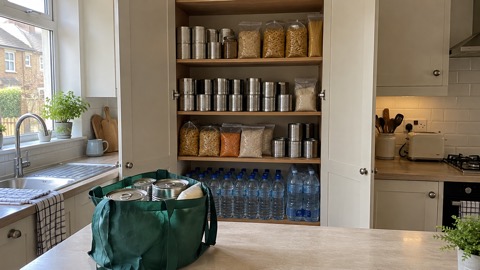 Starting a Store Cupboard
 Shelf Life and Date Labels
 Rotating Your Food Store
 Long-Term Storage Conditions
 Meals Without Power
 Self-Heating Meals
 Tinned Food Guide
 Rice, Pasta and Pulses Storage
 Freeze-Dried Meals
 Emergency Ration Packs