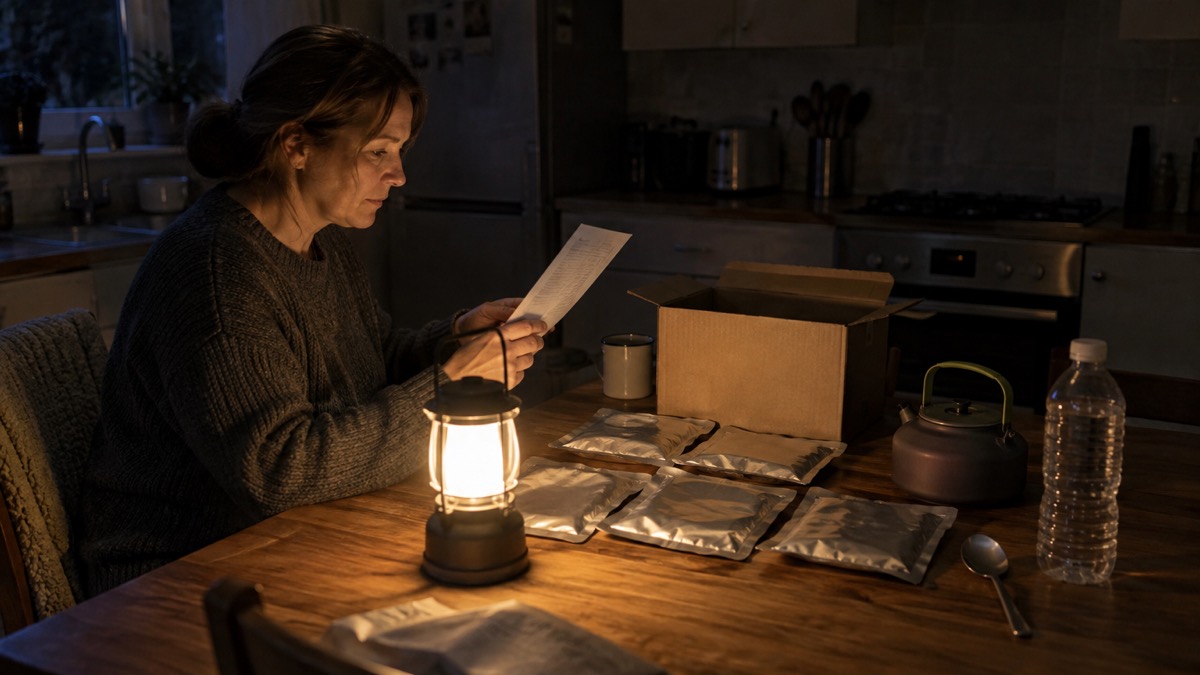
The Expedition Foods Emergency Rations for 1 Week is a freeze-dried ration pack holding one breakfast, one lunch and one dinner for each day of a week, giving 2,050 calories a day and 14,350 calories in total1. It weighs 3.71kg, or 8.18lbs, and the maker states that the meals can be rehydrated with hot or cold water, so you do not need a stove to eat from it1. The meals have a shelf life of up to five years1.
For a household, the simplest way to use it is as a ready-made week of food for one person that needs no fridge and no cooking. Official UK guidance puts the basic household store at three days of food that does not need refrigeration or cooking2, and some councils suggest reserves for up to ten days4. A one week pack covers the three day baseline with room to spare, and two of them cover a fortnight.
This page sets out what is in the pack, how the calories break down, how to rehydrate the meals with or without a stove, how to store it and check the dates, and how to plan a household supply around one pack per person per week.
What is in the pack, meal by meal
The pack is built as a full day's eating, repeated seven times: one breakfast, one lunch and one dinner per day1. The maker lists seven breakfasts, seven lunches and seven dinners1. The breakfasts may be Porridge with Blueberries, Porridge with Strawberries, Granola with Raspberries or Very Berry Muesli, depending on what goes into the pack1.
The calories are not spread evenly. Breakfast and dinner are the heavier meals at 800 calories each, while lunch is lighter at 450 calories1. Over the week that gives 5,600 calories of breakfast, 3,150 calories of lunch and 800 calories of dinner each day1.
| Meal | Calories per meal | Meals in the pack | Total calories |
|---|---|---|---|
| Breakfast | 800 | 7 | 5,6001 |
| Lunch | 450 | 7 | 3,1501 |
| Dinner | 800 | 7 | 800 each1 |
| Whole pack | 2,050 a day | 21 | 14,3501 |
That shape suits a household in an emergency. The big breakfast and dinner can be eaten hot when you have fuel, and the lighter lunch works with cold water when you do not. If you are used to a bigger midday meal, plan something else for lunch from your store cupboard, such as crackers, cereal bars or ready-to-eat tinned food, which official guidance lists as the sort of food to keep for days when you cannot cook2.
Rehydrating the meals, with or without a stove
The maker states that the meals can be rehydrated with hot or cold water1. That single line is what makes the pack useful in a power cut or a flood: you can eat from it with nothing more than water and a spoon.
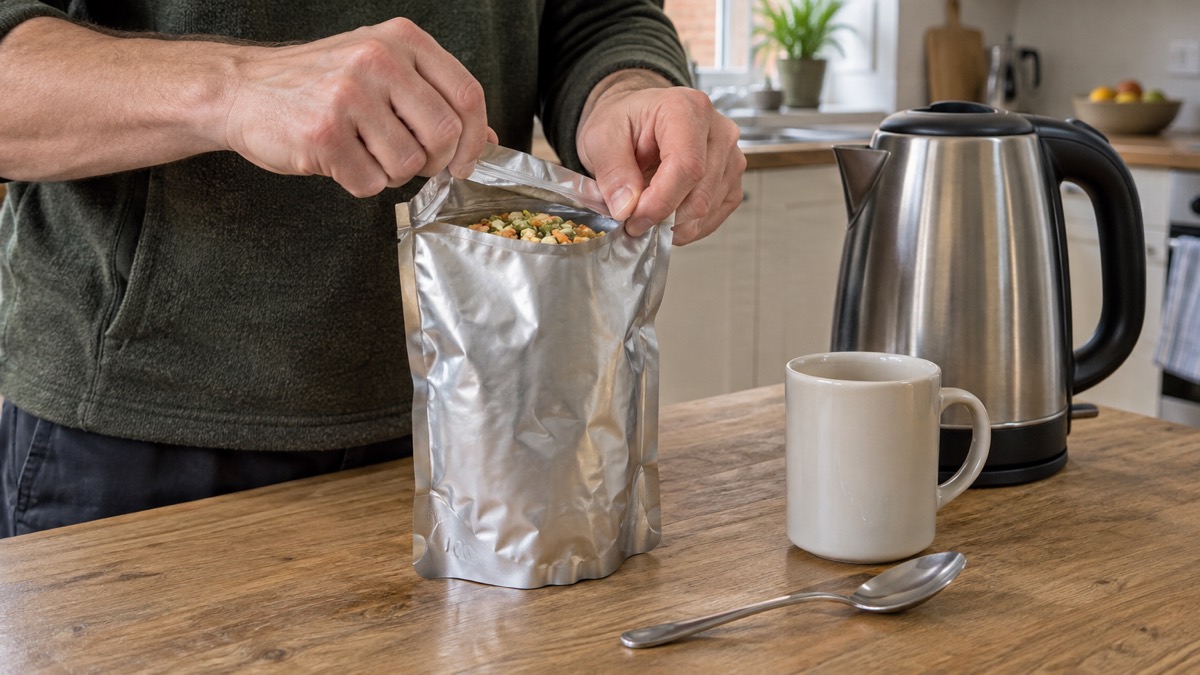
Hot water softens the meal faster and gives you a warm dinner, which matters in cold weather. The NHS advises eating at least one hot meal each day if possible6. If you have a camping stove, a flask or a way to boil water, use it for the dinner and keep the cold water method for lunch. Cooking appliances and fuel are part of the standard household kit lists published by councils7.
Cold water works, but it takes longer and the result is less appetising. In hot weather a cold meal is no hardship, and public health advice for heat is to drink plenty of fluids and eat cold, water-rich foods9. In cold weather, a cold rehydrated meal is the last thing you want, so keep at least one way of heating water in your kit.
How long it keeps, and how to check the dates
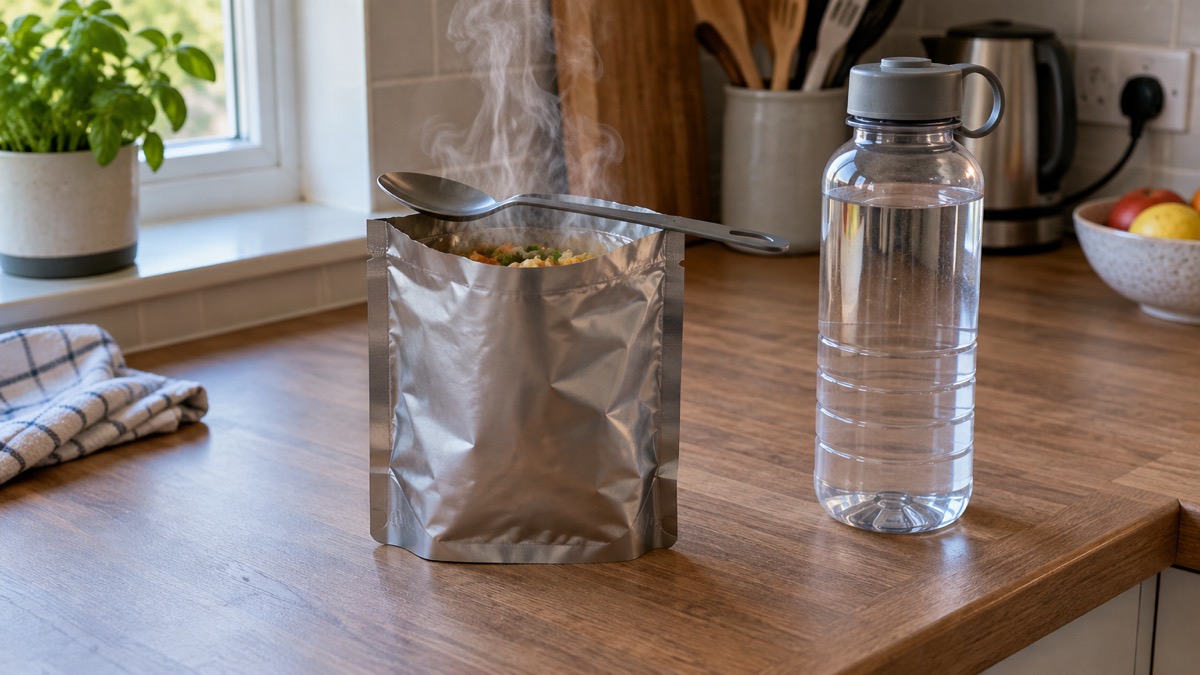
The maker states that Expedition Foods meals have a shelf life of up to five years1. That is a long window for an emergency store, and it is the main reason a freeze-dried pack suits a household that wants food put by and then forgotten about until it is needed.
The date that matters is the use-by date on each pouch. Food Standards Scotland is clear that a use-by date is about safety: after that date the food is not safe to eat11. Check the dates when the pack arrives, write the earliest one on your store list, and replace meals before they pass. The same discipline applies to the rest of your store: official advice is to check use-by dates and use food before they expire12, and the National Flood Forum's kit list tells households to check use-by dates on stored food bars13.
Store the pack somewhere cool and dry, out of reach of damp and pests, and away from anywhere that could flood. If your area floods, keep the store high up rather than on a garage floor.
Planning a household supply around one pack per person per week
The pack is designed as one person's food for one week1. That makes the arithmetic simple: one pack per person per week of cover you want. A household of four wanting a week of food needs four packs, and a household wanting a fortnight needs eight.
Official UK guidance sets the floor much lower. Councils and the Be Ready campaign advise enough food for at least three days, and food that does not need refrigeration or cooking2. Some go further: a community booklet in Culham suggests reserves for up to ten days including medication, food and water4. A one week pack sits comfortably above the three day baseline and close to the ten day figure.
Build the store gradually. NHS Norfolk and Suffolk advise adding one or two extra items to your normal weekly shop to build a small reserve over time16. That approach works with a ration pack too: buy one pack, put it away, and add a second when the budget allows.
| Household need | Packs needed | What it covers |
|---|---|---|
| Three day baseline | 1 pack per person | Enough emergency food for three days, plus a can opener1 |
| One week of cover | 1 pack per person | Seven days at 2,050 calories a day1 |
| A fortnight | 2 packs per person | Two packs, each covering one week at 2,050 calories a day1 |
Keep the pack alongside the rest of your household kit: a first aid kit and several days of essential medication17, a torch and spare batteries, a radio, and water19. The Be Ready household plan lists essential medication or medical supplies to last several days as part of the same preparation18. A ration pack is food only; it does not replace water, warmth or medicine.
What the pack does not do
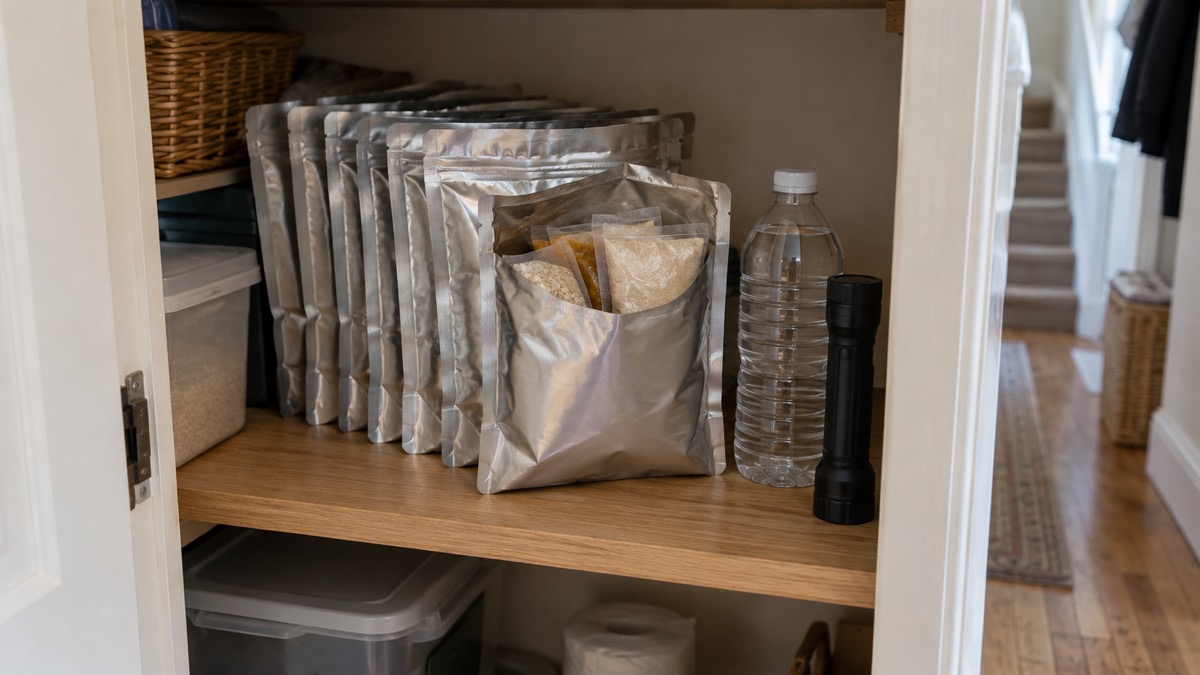
The pack is a food supply, not a complete household kit. It weighs 3.71kg, or 8.18lbs, which matters if you may have to carry it1.
A ration pack is food, and it is worth being clear about what it leaves out. It does not provide drinking water, and rehydrating the meals uses water on top of what you drink. Which? gives two and a half to three litres of drinking water per person per day as the figure to store5, and North Devon council cites the same range as the World Health Organisation's recommendation for survival2. Store water for rehydration as well.
It does not heat itself. The meals need water, hot or cold, and a spoon or bowl. If you want hot food you need a stove, fuel or a flask, and those come from your wider kit7.
It does not cover special diets. Babies, young children and people on medical diets need food planned around them, and official kit lists include supplies for babies and small children and food for people on special diets20. If someone in the household has a medical diet, take advice from their GP or dietitian before relying on a ration pack.
It does not replace a plan. The Be Ready campaign and councils advise a household emergency plan, an evacuation checklist and a grab bag with documents and medication21. The pack is one line on that list.
Where to get help and further reading
If you are building a store from scratch, start with the emergency food guide and the page on how much emergency food to store per person. For the wider kit, see the emergency kit guide, and for water, the water guide.
If you want to compare ration formats, the pages on emergency ration packs and freeze-dried meals set out how they work. For meals you can eat with no water at all, see meals without power. For preparing a freeze-dried meal, see how to prepare a freeze-dried meal, and for cold water specifically, can you make freeze-dried meals with cold water.
If money is tight, getting emergency food help explains food banks, councils and local support. For households with older, disabled or medically dependent members, see extra help in an emergency.
Sources (23)
- Expedition Foods Emergency Rations for 1 Week, Expedition Foods, 2026-10-28
- Be prepared for emergencies, North Devon Council, 2026-10-29
- Household emergency planning, Devon Communities Together, 2026-10-29
- Are You Ready booklet, Culham Parish Council, 2025-09
- Emergency kit packing list, Which?, 2026-09-30
- Stay warm and nourished, NHS Norfolk and Suffolk ICB, 2026-10-16
- Are you ready, Birmingham City Council, 2026-05-06
- Brentor Community Emergency Plan, Devon Communities Together, 2021-03
- Coping with hot weather in London, Greater London Authority, 2026-10-25
- Keeping safe during a heatwave, Carers UK, 2026-10-25
- Use-by and best-before dates, Food Standards Scotland, 2026-10-25
- Infectious diseases control, Northumberland County Council, 2026-10-28
- Preparing for flooding, National Flood Forum, 2026-10-29
- Preparing for emergencies, North Hertfordshire Council, 2015-01-12
- Get help and advice in an emergency, Lincolnshire County Council, 2026-10-29
- Be prepared for winter emergencies, NHS Norfolk and Suffolk ICB, 2026-10-01
- Create a household emergency plan, Dumfries and Galloway Council, 2026
- Be Ready Household Emergency Plan, UK Government Be Ready campaign, 2026
- Household Emergency Plan, West Yorkshire Prepared, 2026
- Emergency supplies kit, Denbighshire County Council, 2020
- Preparing for emergencies, Somerset Council, 2026-09-17
- Preparing for emergencies, Somerset Council, 2026-09-17
- Wildfires, South Wales Fire and Rescue Service, 2026-07-29
 NRG-5 Emergency Ration
 NRG-5 ZERO Ration