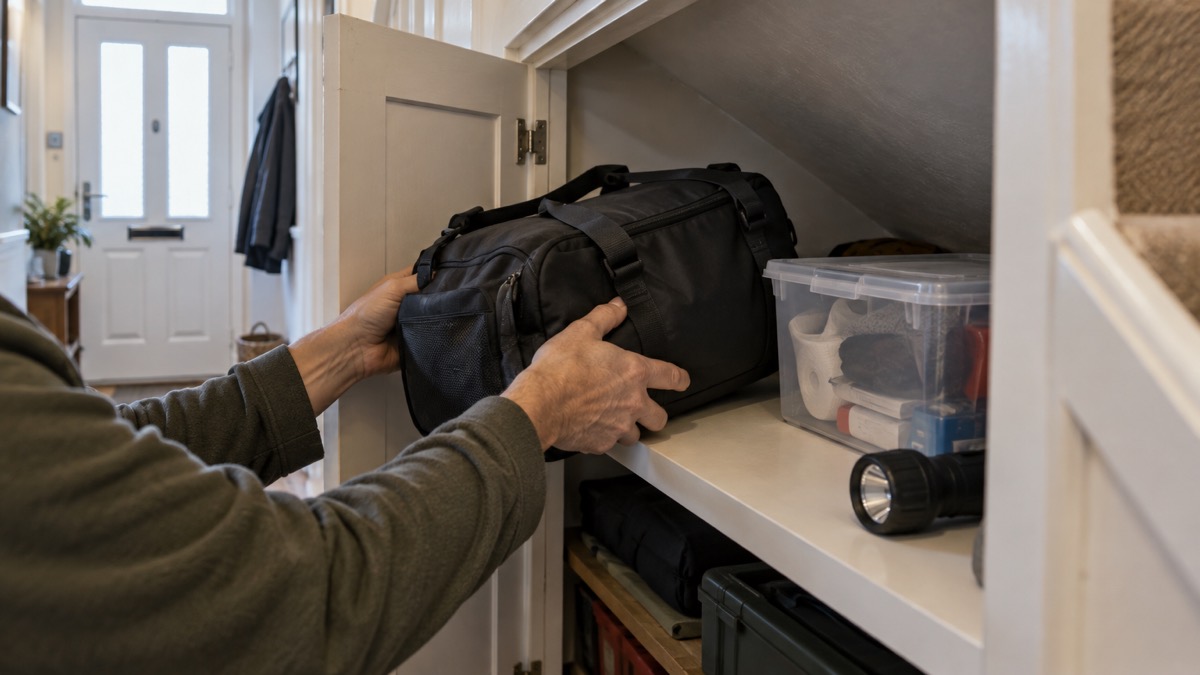
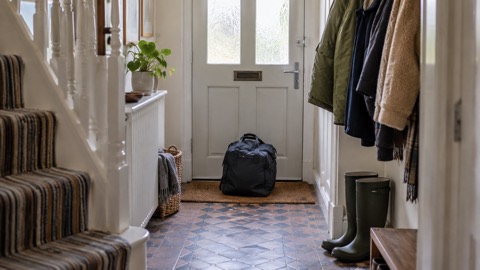
Where you keep your emergency supplies matters as much as what is in them. A well-stocked kit at the back of a damp garage, or a grab bag buried under the Christmas decorations, is not much use at two in the morning. The advice from councils across the UK is consistent: store your kit near an exit to your home, such as by the front door or under the stairs, so it can be easily grabbed on the way out1, and keep it somewhere in the house where everyone can get to it if needed2.
The second rule is just as important. A kit only works if people can find it. Councils and fire and rescue services repeatedly ask households to keep supplies in a designated place that every member of the household knows about3, and to tell overnight guests and visitors where keys and essentials are kept4. This page walks through how to choose that place, how to protect the contents from heat, damp and flood water, and what to do differently if you live in a flat or a home without stairs.
Keep your kit by the front door or under the stairs
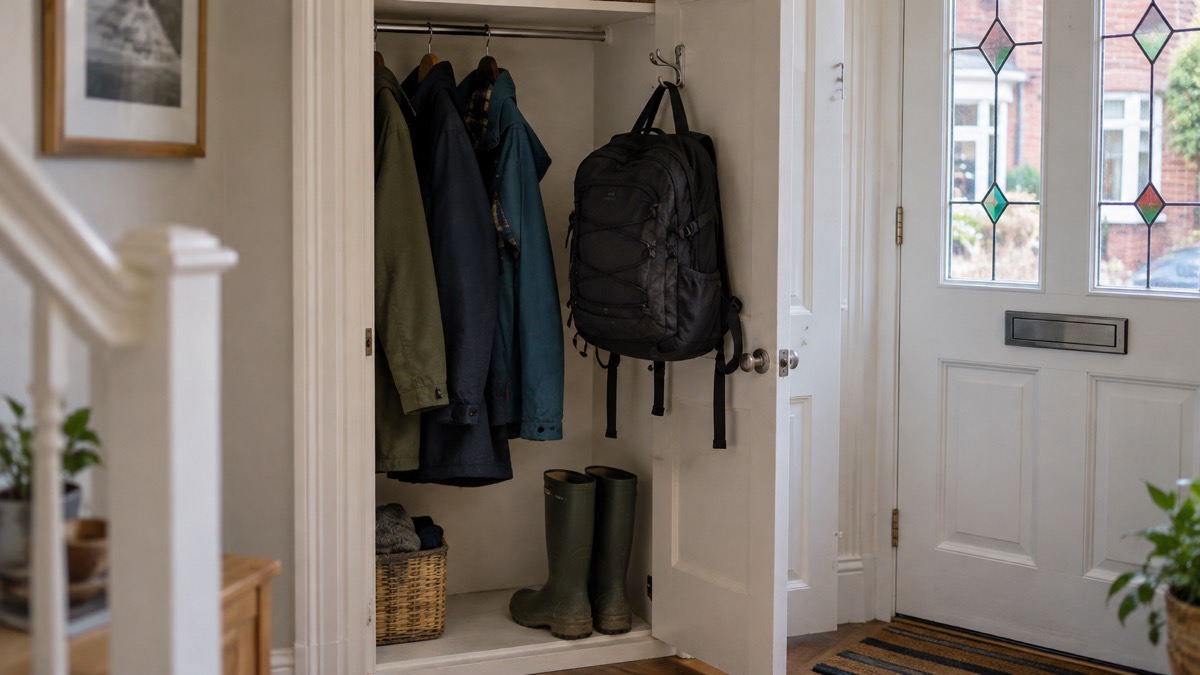
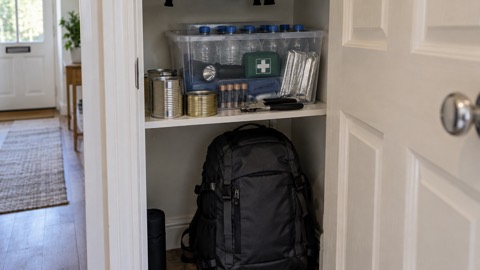
Wiltshire Council's guidance on planning for an emergency kit is blunt about location: "Your kit should be stored near an exit to your home such as by the front door or under the stairs so it can be easily grabbed"1. The reason is simple. In an evacuation, whether from fire, flood or a gas leak, you will leave through a door, and you will not have time to search the house. A kit that sits on the route you take out of the building is a kit you will actually carry with you.
Northern Ireland's nidirect guidance agrees on the principle rather than the exact spot: the household emergency kit "should be kept somewhere in the house where everyone can get to it if needed"2. That wording matters for larger households. A box in a parent's locked study, or in a shed needing a key from a hook in the kitchen, fails the test. Somewhere in the house, on the normal route through the home, reachable by every adult who lives there.
The same logic governs the smaller grab bag you would take if you had to leave home. Flood grab bag guidance is to keep it "upstairs or near your door"6. Those two options cover the two main scenarios: a fire, where you leave downwards and quickly, and a flood, where you may be trapped upstairs waiting for rescue and need supplies with you. If you keep only one grab bag, near the door is the better default; if flooding is a real risk where you live, a second, smaller bag upstairs is worth the space.
Fire and rescue services apply the same thinking to escape plans. Scottish Fire and Rescue Service advice for high-rise residents is to keep your fire escape plan "somewhere visible and near your front door"8. The plan and the kit belong together: if you have a printed emergency plan, keep it in or taped to the kit box, so the one thing you grab on the way out contains both.
Choosing a spot: under the stairs, utility cupboard or garage
Once you accept the "near an exit" rule, the practical question is which space in your home fits it. Most UK homes offer a shortlist: the under-stairs cupboard, the hall, a utility cupboard, the garage, or a landing. Each has strengths and one serious trap.
The under-stairs cupboard is the spot councils name most often1, and it is a good one: it is on the ground floor, near the front door in most layouts, enclosed and dark. But it has a specific fire risk that the fire and rescue services warn about. North Wales Fire and Rescue Service advises: "Don't store combustible materials (clothes, papers, cleaning materials etc.) close to your service head (cutout fuse), electricity meter or fusebox, particularly if these are under the stairs (a means of escape from upper levels in an emergency)"7. In many homes the under-stairs cupboard is exactly where the fusebox and meter live. Check yours before filling the cupboard. If the electrical equipment is there, keep the kit itself in a closed plastic box, keep it well clear of the electrics, and do not use the same cupboard for coats, cardboard or cleaning products.
| Location | Good for | Watch out for |
|---|---|---|
| Under the stairs | On the exit route, enclosed, dark | Often houses the fusebox and meter: keep kit well clear and no combustibles nearby7 |
| Hall or by the front door | Near an exit to your home, so it can be grabbed easily1 | , |
| Utility cupboard | Dry, often cool | May be next to a boiler; check what else is stored there |
| Garage | Cool, dry storage that is easy to get to9 | , |
| Upstairs landing or bedroom | Flood grab bag storage6 | , |
The garage deserves its own caution. It can seem the obvious place for a bulky kit, but garages are frequently unheated and prone to damp, which degrades batteries, medicines, matches and paper. They can also be locked separately, or on the far side of a house fire. If you use the garage for overflow stores, keep the main kit and grab bag inside the house, and keep garage items up off the floor. Cornwall Council's preparedness advice includes "keeping important documents in a box up off of the floor"9, a habit that protects against both flooding and burst pipes wherever you store things.
One more consideration for households with anyone who finds stairs difficult: an NHS integrated care board home safety checklist advises people to "Store frequently used items on the same floor where possible"10. If someone in your home has limited mobility, keep at least a torch, medication and a phone charger on the floor where they sleep and spend their day, not solely in a ground-floor cupboard.
Cool, dry and easy to reach in the dark
The contents of a kit are perishable in ways people forget. Batteries drain and corrode, medicines expire, matches spoil in damp, and adhesive tape loses its stick. The storage conditions matter as much as the location.
The NHS advice on first aid kits sets the standard: "Your first aid kit should be locked and kept in a cool, dry place out of the reach of children."5 Apply the same rule to the wider kit. A cool, dry place means away from radiators, boilers, sunny windowsills and the drying cupboard over a hot water tank. Locked and out of children's reach applies to anything harmful if swallowed or played with: medicines, matches, batteries and sharp tools. North Hertfordshire Council's kit list includes matches in a waterproof container, spare batteries, dust mask, plastic sheeting and duct tape11, several of which are either attractive to small children or ruined by damp.
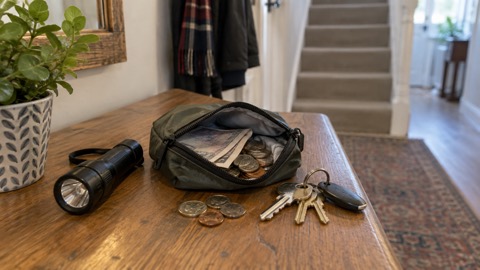
Darkness is the other half of "easy to reach". Power cuts are the most common emergency a UK household faces, and you will be looking for the kit without the lights. Scottish Fire and Rescue Service advice on heating and gas is to "Keep torches and batteries where you can find them easily in an emergency"12. Practically, that means a torch lives with the kit, and a second torch lives upstairs, each in a fixed spot that never changes. Wiltshire's kit list includes spare keys for your windows, car and house1; those belong in the same fixed place, because a spare key you cannot find in the dark is not a spare key.
For more on lighting choices, see our guide to emergency lighting at home, and for what to do when the power goes, our power cuts guide.
Plastic boxes or backpacks to keep supplies together
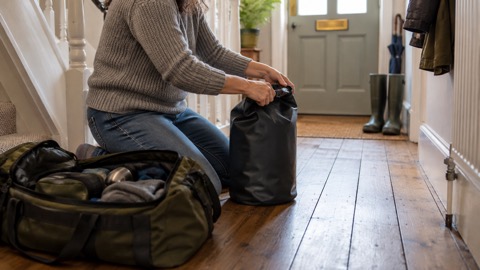
How you contain the kit is part of how you store it. Denbighshire Council's emergency supplies kit guidance is practical: "Try using plastic boxes or backpacks to keep the supplies together. The kit should be kept in a designated place."3 Dumfries and Galloway Council goes further on protection: "We would encourage the use of a waterproof container or bag" for the household emergency pack13.
The two formats suit different jobs, and many households end up with both:
- A lidded plastic box holds the bulkier home kit: tinned and packet food, spare batteries, tools to turn off utility supplies, local maps, rubbish bags, plastic sheeting and duct tape11. It stacks, it keeps dust and damp off the contents, and it can be labelled. It is not meant to be carried far.
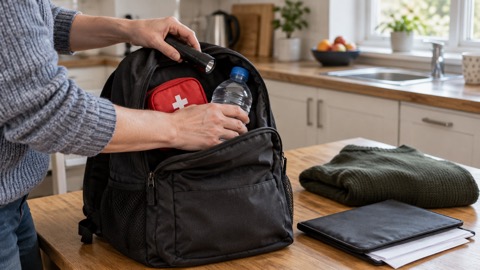
- A backpack or small holdall is the evacuation kit, the grab bag. Argyll and Bute Council describes the emergency box as "Small enough to carry and stored in a safe place that everyone in your home can access quickly and more importantly know"14. If you cannot lift it and walk with it, it is not a grab bag.
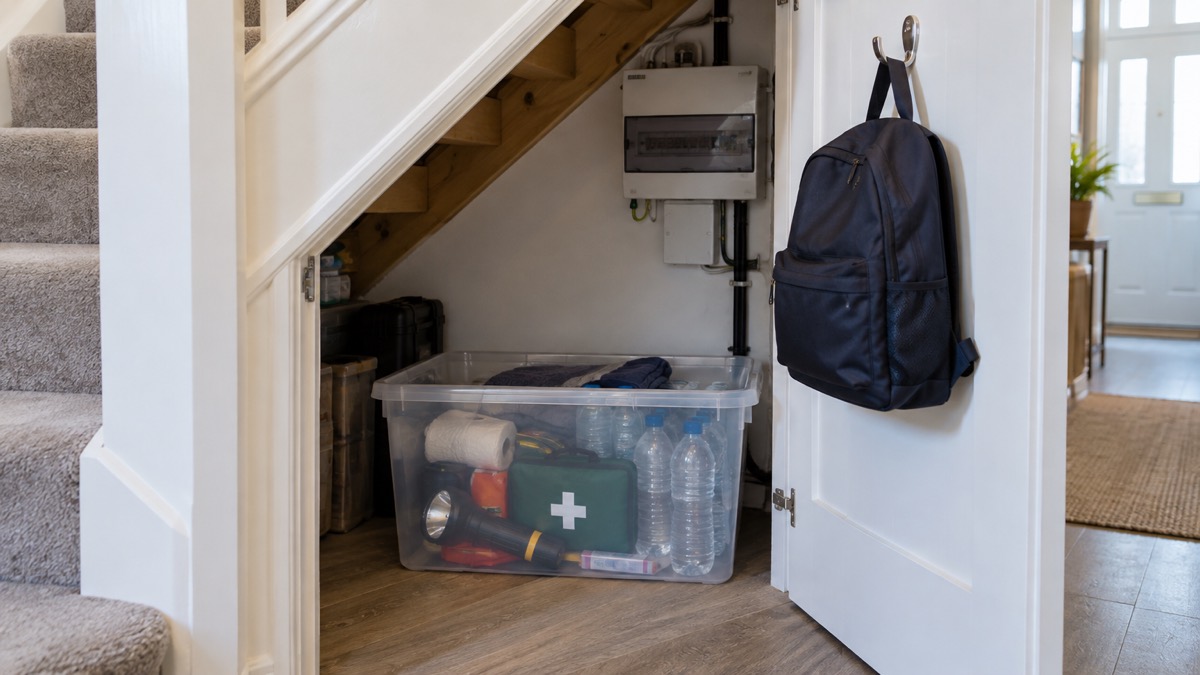
North Hertfordshire Council recommends preparing both: a household emergency kit for sheltering at home, and "a smaller personal kit e.g. in a backpack for use should you need to be evacuated", making sure everyone knows where the kits are kept11. Royal Berkshire's home emergency plan adds a detail worth copying: keep the plan itself "in a safe place at home which is accessible and in a waterproof bag where possible"15.
*A lidded plastic box for the home kit, with a separate small backpack as the grab bag.]
For help choosing the bag itself, see our guide to choosing a rucksack or holdall, and for keeping the contents dry, dry bags, pouches and waterproof cases. What goes inside each is covered in our pages on the home emergency pack and the grab bag.
A designated place everyone in the household knows
Every official source in this area repeats one instruction: the kit is only as good as the household's shared knowledge of it. Scottish Borders Council recommends that "all households create a small emergency kit and keep it in a safe but accessible place"16. Argyll and Bute's version stresses that everyone in the home must know where it is14. The instruction repeats because a kit that only one person can find fails on the night that person is away.
This is a five-minute job, not a project:
- Show every adult and older child in the house where the kit and grab bag are, and let each of them lift the bag once so they know its weight and contents.
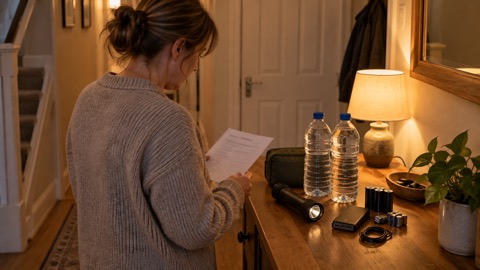
- Keep a printed or handwritten copy of your emergency plan with the kit. Ready Scotland's advice is to "Keep a printed or handwritten copy somewhere handy and make sure everyone in your home knows where it is"17. Belfast City Council says the same of its household plan: keep it "somewhere safe where you can easily find it in an emergency"18.
- Include door and window keys in the shared knowledge. Humberside Fire and Rescue Service advises: "Make sure everyone staying knows where the door keys are kept"19.
Bradford Council's flood pack advice widens the circle beyond the household: keep the kit together in an easily accessible area, "and to make sure as many people as possible know where to find this pack"6. That is particularly relevant for carers, which we come to below.
Telling visitors, guests and carers where it is
Households change. Children grow up and stop needing to be shown; relatives stay over; carers visit; lodgers arrive. When someone stays the night, tell them where the door keys are kept, and extend that habit to the kit: anyone staying should know where the torch, the keys and the grab bag are.
If you or someone you live with receives care, this becomes more than courtesy. A carer who knows where the emergency plan, medication list and grab bag are kept can act on your behalf if you cannot. Show them the spot, and make sure the printed copy of the plan is somewhere handy rather than filed away. Our guide to extra help in an emergency covers the wider arrangements for older, disabled and medically dependent households.
Flats and homes without stairs
If you live in a flat, the "under the stairs" advice does not apply, but the principles do: near the exit, everyone knows, nothing blocking the escape route. The specific risks in flats come from fire, and the fire and rescue services have detailed advice.
Manchester Fire and Rescue Service guidance for residents of flats operating an evacuation strategy tells you to keep doors and window keys accessible, and adds a warning with a reason attached: "Avoid keeping them in the kitchen because this is where most fires in the home start."20 Everyone in the flat should know where the keys are. When the alarm sounds, the sequence is: get everyone out, make sure the flat door closes behind you, leave by the stairs and not the lift unless your building's plan says otherwise, then get out, stay out, call 99920.
North Wales Fire and Rescue Service gives the same instruction for a fire in your flat or a neighbour's: leave, close the door, use the stairs, call 99921. If the fire is elsewhere in the building and you are told to stay put, Scottish Fire and Rescue Service advice is to go to a window and wait for help8. In practice, that means a flat's grab bag and keys should live in the hall by the front door, not in the kitchen, and a torch and any essential medication should also be within reach of where you sleep.
For converted flats and houses, London Fire Brigade's escape plan guidance covers the same ground: keep keys where everyone you live with can find them, on hooks or in boxes on window sills22. Our home emergencies guide covers fire escape planning in more detail.
Storing water for drinking and sanitation
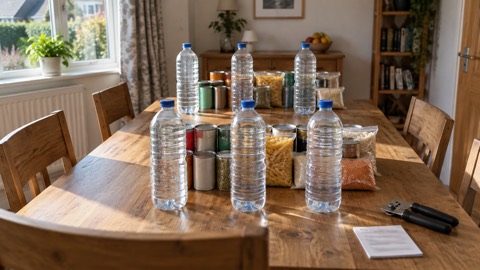
Water is the heaviest and bulkiest part of any kit, and it needs its own storage decisions. Lincolnshire Council's emergency advice lists water for drinking and sanitation among the basics to have ready23, and its pet emergency kit advice includes drinkable water in plastic bottles23. Sealed plastic bottles are the practical answer: they are portable, they keep the water clean, and a few of them can go straight into the grab bag.
Split your water storage rather than concentrating it:
- With the grab bag: a small number of sealed bottles, light enough to carry, enough for immediate drinking needs on the move.
- With the home kit: larger stores for drinking and sanitation during a stay-at-home emergency, kept where the floor can take the weight and where a leak would not ruin documents or electronics.
Keep bottles off the floor and out of sunlight, and store them away from anything with a smell, as plastic can taint. Our water in an emergency guide covers quantities, rotation and treating water you cannot trust.
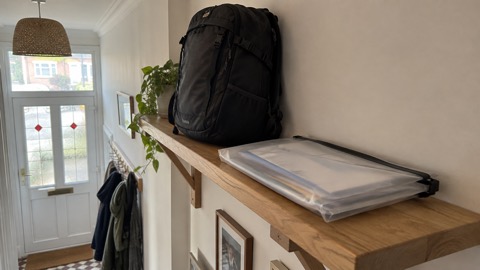
Documents deserve the same watertight treatment. Denbighshire Council advises storing identification, cash, copies of birth certificates, marriage certificates, wills, deeds, insurance papers and immunisation records, plus an emergency contacts list and a spare set of house and car keys, in watertight containers3. North Hertfordshire Council's list is similar: identification, bank details, birth certificates, insurance documents, passport and benefit and pension details, in a waterproof container11. West Northamptonshire Council adds that an emergency grab bag should be pre-prepared and kept in an easily accessible place in your home24. Our page on important documents sets out which papers to copy and how.
Storing batteries, power banks and gas cylinders safely
Two items in a modern kit need particular care in storage: lithium-ion batteries and gas cylinders.
Lithium-ion power banks and battery packs should be kept cool, dry and away from anything combustible, and never where they can be knocked, crushed or get wet. Keep them in the kit box, in a room-temperature spot, and check them when you check the rest of the kit. Our backup power guide covers choosing, charging and looking after power banks and portable power stations.
Gas cylinders and portable gas heaters are a separate matter, and the advice is firm. Scottish Fire and Rescue Service advises storing spare cylinders outside where possible12. A spare calor gas bottle in the under-stairs cupboard beside the emergency kit is a hazard rather than a convenience: if the cupboard catches fire, the cylinder can greatly increase the fire. Keep cylinders out of the house, out of the kit cupboard, and away from the escape route. Our heating and cooking without mains power guide covers using portable heaters and stoves safely.
Keeping the kit ready over the years
Storage is not a one-off decision. A kit that sits untouched for three years will have flat batteries, expired medicine and a torch that no longer works. Build a check into your routine: when the clocks change, open the box, test the torch, check the dates, and put everything back in the same place. Our guide to checking and restocking supplies covers expiry dates and replacing items, and the household preparedness checklist ties the home kit, grab bag and car kit together.
The habit that matters most is the simplest one: the kit goes back to its designated spot every time. A grab bag borrowed for a camping trip and left in the boot of the car is, for the night it matters, not a grab bag. Choose the place once, tell everyone, and keep it there.
Sources (24)
- Planning for an emergency kit, Wiltshire Council, 2026
- Household emergency kit, nidirect (Northern Ireland government), 2026
- Emergency supplies kit, Denbighshire County Council, 2020
- Plan your escape, Staffordshire Fire and Rescue Service, 2026
- What should I keep in my first aid kit?, Collingwood Surgery (NHS), 2026
- Create a flood pack, Bradford Council, 2026
- Looking after the electrics, North Wales Fire and Rescue Service, 2026
- High-rise living, Scottish Fire and Rescue Service, 2026
- Be prepared in case of an emergency, Cornwall Council, 2022
- Stay Steady and Safe home safety checklist, Norfolk and Suffolk NHS Integrated Care Board, 2026
- Preparing for emergencies, North Hertfordshire District Council, 2015
- Heating and gas, Scottish Fire and Rescue Service, 2024
- Create a household emergency life-saving plan, Dumfries and Galloway Council, 2026
- Preparing for civil emergencies in Argyll and Bute, Argyll and Bute Council, 2026
- Emergency home emergency plan, Royal Borough of Windsor and Maidenhead, 2025
- Emergency planning, Scottish Borders Council, 2026
- Emergency plan, Ready Scotland, 2026
- Emergency planning, Belfast City Council, 2026
- Celebrate safely, Humberside Fire and Rescue Service, 2026
- Fire safety information for residents living in flats operating an evacuation strategy, Manchester Fire and Rescue Service, 2026
- High-rise living, North Wales Fire and Rescue Service, 2026
- Escape plan for houses and converted flats, London Fire Brigade, 2026
- Get help and advice in an emergency, Lincolnshire County Council, 2026
- Protecting yourself, West Northamptonshire Council, 2024
 30-Day Household Checklist
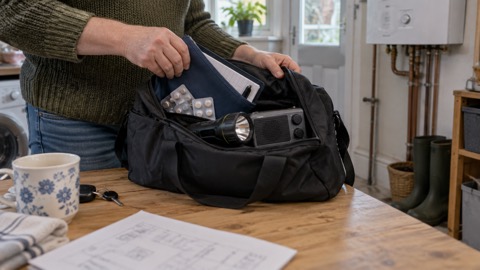 Emergency Plan Template
 Supply Interruption Checklist
 Home Emergency Pack
 Grab Bags
 What to Keep in Your Car
 Important Documents
 Cash to Keep at Home
 How Many Days Supplies Last
 Checking and Restocking Supplies
 Rucksacks and Holdalls
 Keeping Supplies Dry
 Foil Blankets
 Portable Jump Starters
 Supplies for Babies and Children