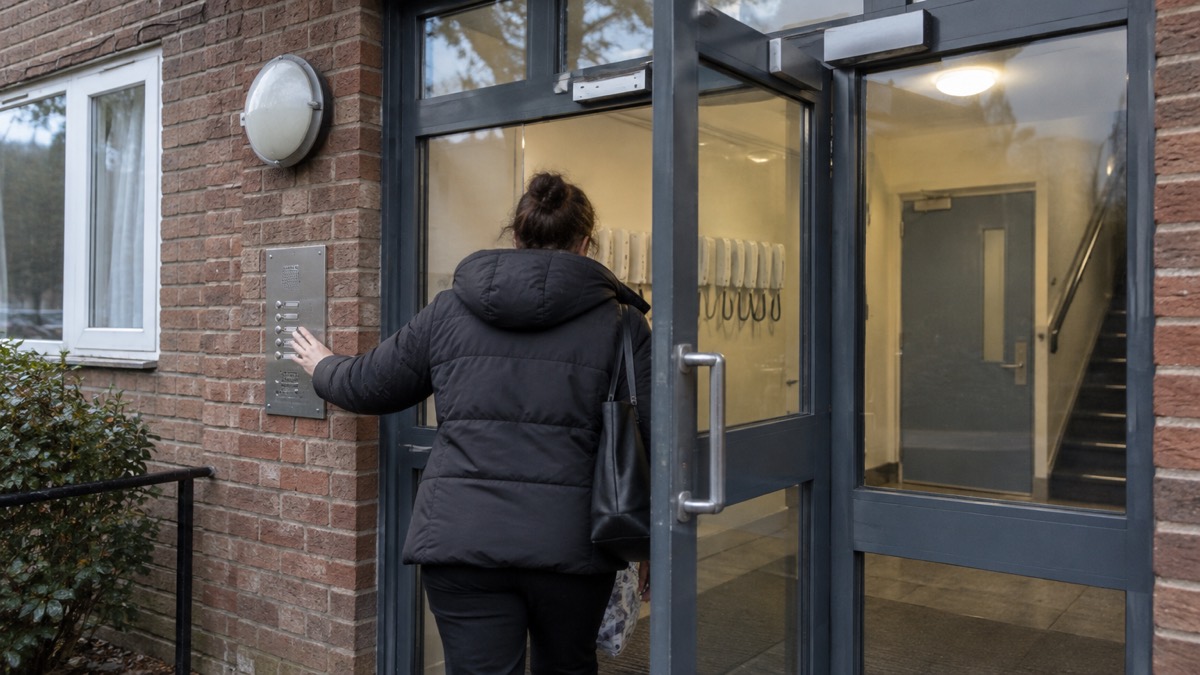
If you live in a flat, the doors around you are doing two jobs at once. They keep intruders out, and they hold back fire and smoke long enough for you and your neighbours to escape. The communal entrance, the doors onto stairwells and corridors, and your own flat front door are all part of one system, and it only works if the doors are shut and undamaged.
The most useful things you can do are simple. Check that fire doors close on their own. Never prop them open. Report damage or faults to your housing provider or managing agent. Keep your escape routes clear. This page explains what fire doors do, how to check them, what the law says about your own flat door, and what to do if fire breaks out in your block.
Why the communal doors in your block matter
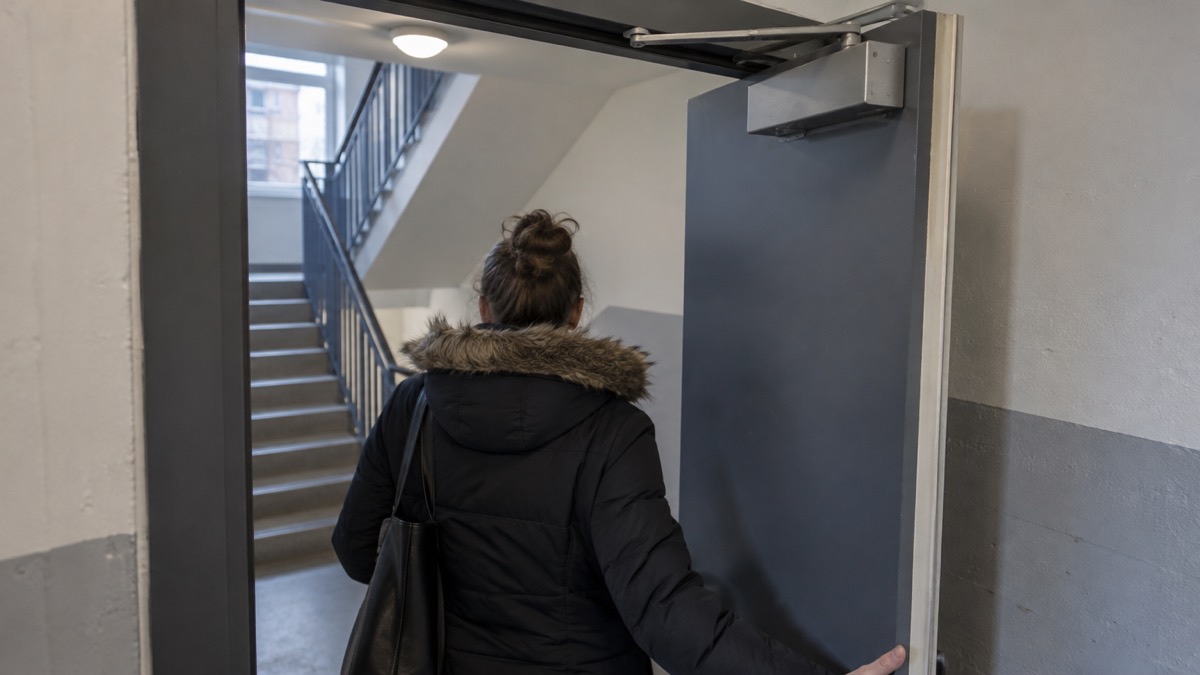
High rise blocks of flats are designed with fire safety as a priority. The walls, doors and floors are specially designed to resist fire and stop the spread of smoke, and the roads and areas outside are designed so that emergency vehicles can get near5. This design has a name you may hear from your landlord or fire service: compartmentation. The walls, floors, ceilings and doors of flats, internally and externally, if properly constructed and not modified in a way that reduces the fire protection, should contain a fire within its compartment long enough to allow safe and effective intervention by the fire service6.
That last part is the catch. Compartmentation depends on the doors being kept shut and not propped open5. A block of flats is a chain of sealed boxes: your flat, the corridor, the stairwell, the next flat. Every door in that chain is a barrier. When one is wedged open with a fire extinguisher or a shoe, smoke and fire can move freely through the building, and the escape route everyone shares fills with smoke.
The communal entrance door, the one you use every day with your key or entry fob, is part of this. So are the heavier doors onto stairwells and corridors. In a block of flats you will find fire and smoke doors on the stairwells, the corridors and on the flat front doors, and protecting areas where there is a risk of combustion, such as bin storage or a mains electricity service cupboard2. Sometimes you will also find fire doors inside individual flats, but this depends on the specific design and layout of the flat2.
There is a security side to communal doors too. A communal entrance that closes properly, with a working lock or entry system, stops people who have no reason to be in the block from wandering in. The police advise that alarms and CCTV should meet British Standards (PD6662)7, and a locksmith who is a member of the Master Locksmiths Association can check whether a front door is secure and what it is made of, reinforce the frame, often with London and Birmingham bars, and check whether locks and hinges are British Standard approved8. Our page on doors and locks covers the security side of doors in more detail.
Fire doors: what they are and what they do
A fire door is not just a sturdy door. It is a tested assembly: the door leaf, the frame, the hinges, the latch and the closer all work together. Fire doors are designed to close automatically to prevent smoke from spreading into escape routes, and can help contain a fire for up to 30 minutes1. Thirty minutes is enough time for you to get out and for firefighters to arrive and work.
Your own flat front door is part of this system. Greater Manchester Fire and Rescue Service puts it plainly:
Your flat front door is designed as a fire door: if a fire starts inside your flat, it is there to hold back the fire and smoke so they do not spread into the corridor and communal areas3.
Where a home sits above or below a commercial premises with shared access, the doors between the commercial unit and the homes should be British Standard FD30 or FD60 fire doors, and should be kept closed, not propped open for extra ventilation9. FD30 and FD60 are the ratings: the door is tested to hold back fire for a stated period. If you live in a flat above a shop or a takeaway, this is worth knowing, because the door between the two uses is a critical barrier.
The legal framework backs this up. The Fire Safety Act 2021 clarified that the scope of the Fire Safety Order includes the structure, external walls, and individual flat entrance doors of multi-occupied residential buildings10. In plain terms, your flat's front door is not purely your own affair: it is part of the building's fire safety arrangements, and the responsible person for the building has duties towards it.
Hinges, closers, latches and gaps: what a fire door depends on
A fire door fails at its weakest fitting. The things to know are simple.
Fire doors are fitted with self-closing devices, which can be fitted to the top of the door or within the frame3. When the closer works, the door shuts itself every time. When it does not, the door is a hole in the building's fire protection.
The hinges carry the weight of a heavy door. London Fire Brigade advises checking that all hinges are firmly fixed, with three or more of them, and with no missing or broken screws2. A fire door hanging on two hinges, or with screws working loose, may not stay in place in a fire.
The door must close firmly onto the latch without sticking on the floor or the frame2. It must not have big gaps between the door and the door frame3. Gaps let smoke through even when the door is shut, and a door that sticks partway shut is not shut at all.
London Fire Brigade's warning is worth remembering:
Check the door closes firmly onto the latch without sticking on the floor or the frame. A fire door only works when it is closed, and it is completely useless if it is wedged open or cannot close fully, so never prop it open2.
| Part | What it does | What to look for |
|---|---|---|
| Self-closing device | Pulls the door shut after each use | Door closes on its own from any angle3 |
| Hinges | Carry the door's weight | Three or more, firmly fixed, no missing or broken screws2 |
| Latch | Holds the door fully shut in the frame | Door closes firmly onto the latch without sticking2 |
| Frame and gaps | Seal the edge against smoke | No big gaps between door and frame3 |
What to check on the fire doors in your building
You do not need to be an expert to spot a failing fire door. Fire and rescue services ask residents to do exactly this, because the people who use a door every day notice before anyone else. South Wales Fire and Rescue Service advises residents to check that front doors and fire doors close on their own, and to report to the building manager if they do not1.
A walk through your block takes a few minutes. Check:
- Closing: does each fire door close on its own, from fully open?1
- Latch: does it close firmly onto the latch, without sticking on the floor or frame?2
- Hinges: three or more, firmly fixed, no missing or broken screws?2
- Gaps: no big gaps between the door and the frame?3
- Wedges and props: is anything holding a door open? If so, close it3
- Damage: dents, holes, broken glazing or a hanging closer all count as damage to report3
If you see a fire door wedged open, close it. If you spot damage to a fire door, report it to your housing provider or managing agent3. If you suspect a door is faulty, report it to the building owner2. Always report any damage to firefighting equipment, fire alarms, fire doors or fire escapes to your housing provider11. These are not petty complaints: a reported closer is a door that will work on the night it matters.
Residents are also asked to allow access to their flat for the front door to be checked12. Your flat door is on the inspection list because it protects the corridor, not just you, so when the housing provider or managing agent asks to inspect it, letting them in protects your neighbours as much as your household.
Keeping communal fire doors shut, and what not to do
The rules for communal areas come down to one principle: the escape route belongs to everyone, so nobody may block it. Greater Manchester Fire and Rescue Service lists the things residents must not do, and they are worth setting out in full because each one is common in blocks of flats:
- Do not prop open fire doors in communal areas13
- Do not obstruct the communal areas, stairs, corridors and landings, as these are escape routes for the building12
- Do not store prams, bikes or mobility scooters in corridors13
- Check before doing any work in your flat that it will not affect fire safety13
- Report discarded rubbish to your landlord so it does not pile up on escape routes14
The pram by the door and the bike chained to the stairwell rail feel harmless, and most of the time they are. But in a smoke-filled corridor at night, anything that narrows the escape route slows everyone down and trips the person who cannot see well. Keep escape routes inside and outside your flat clear of obstacles at all times15.
One hazard deserves special mention. If the gas or electricity supply meters are under the stairs, or at the entrance to your flat or bedsit, and are in a cupboard that is not fire protected or is used for storage, that is a fire risk9. Meter cupboards that double as storage cupboards are a common find in older blocks. If yours is being used to store anything, raise it with your housing provider.
Replacing or altering your flat front door
Your flat front door is yours to live behind, but not entirely yours to change. If you want to change your own flat's door, you must make sure it meets the required standard, is installed correctly and is certified15. If your front door faces onto a common area in the building, it needs to be a fire door, fit for purpose, and regularly inspected and maintained2.
The rules on alterations are strict because a fire door's rating depends on the whole assembly. Greater Manchester Fire and Rescue Service tells residents not to drill any holes in the door, for example to fit a spy hole, change the letterbox or fit a new doorbell3. Each hole can breach the door's fire resistance. If you want a spy hole or a different letterbox, ask your housing provider or managing agent first: they can confirm what is allowed and arrange work that keeps the door's certification. Our page on letterbox guards covers the security side of letterboxes.
On security, the door material matters. The police advise that tested and certified uPVC doors are more secure, as they have a highly secure multi-locking mechanism using a system of hooks and latches8. But security must not come at the cost of fire performance: a door that resists a burglar but burns through in five minutes, or that cannot close itself, fails the building. If you are unsure, a member of the Master Locksmiths Association can check whether your front door is secure and the material it is made of8.
If you keep valuables in the flat, the same principle applies to a safe: the police advise making sure the safe is installed into the fabric of your home, such as beams or concrete7. Our page on home safes explains the fire and burglary ratings to look for.
Fire safety and escape: what to do if fire breaks out
What you do in a fire depends on where the fire is, and on your building's evacuation strategy. Flats and maisonettes are built to give you some protection from fire, and it is often safer to stay inside your property to avoid having too many people exiting the building at once while firefighters are trying to enter16. Guidance to Stay Put, unless fire or smoke is affecting your flat, is based on the fire protection provided in the building and the walls and doors of each flat16. Many services now call this a Stay Safe policy. Find out which strategy your block operates: your building management team or housing association should have told you, and Cheshire Fire and Rescue Service advises following the fire safety advice they provide17.
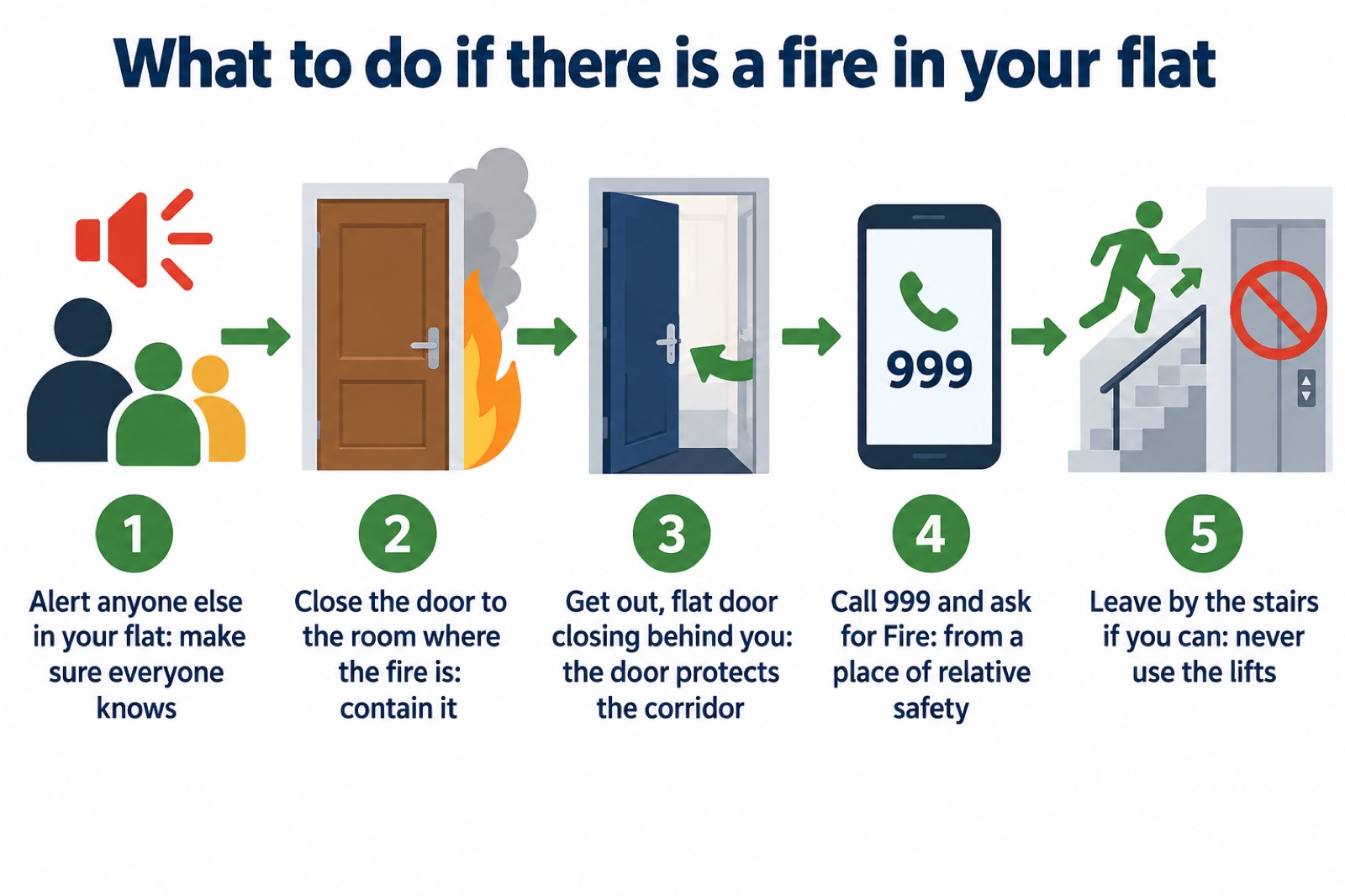
If there is a fire in your flat, get out. Alert anyone else in your flat. Close the door to the room where the fire is. Get out of your flat, making sure the flat door closes behind you. Call 999 and ask for Fire. Leave the building using the stairs if you can18. North Yorkshire Fire and Rescue Service gives the same instruction in short form: leave your flat and close all doors behind you to stop the fire spreading11. Never try to fight the fire yourself, do not stop to collect belongings, do not go back into your flat, do not use the lifts, and do not re-enter the building until told it is safe18.
If there is a fire elsewhere in the building, and your block operates a stay safe policy, close your doors and windows and stay in your flat unless advised by the fire service to leave11. This feels wrong to many people, but it is the design working as intended: your flat is a fire-resistant box, and the corridors stay clear for firefighters. Buildings are designed so that rescues can take place internally; in normal circumstances, during a fire within a flat, communal corridors and staircases should remain smoke free, allowing firefighters to carry out rescues from within the building14.
If you cannot get out, move to a room away from the fire and call 999. Keep the door to the room closed and use towels or bedding at the bottom of the door to stop smoke getting in18. London Fire Brigade advises finding a safe room as far as possible within the flat from any fire or smoke, with a window if possible, closing the door and using soft materials to block any gaps19. If your front door becomes hot, wet it down20.
Two habits make all of this work when it matters. First, keep door and window keys accessible, and avoid keeping them in the kitchen, because this is where most fires in the home start. Everyone in the flat should know where the keys are4. A window that opens is an escape route only if the key is to hand. Second, make an escape plan so that you and those you live with know what to do if there is a fire in your flat, learn what the escape signage means, identify a second escape route, and review the plan regularly14. Many fires happen at night when occupants are asleep, and closed doors reduce fire and smoke spread and protect escape routes21, which is one more reason every door in the flat should be shut at bedtime.
For the wider picture on house fires, see our guide to home emergencies.
Alarms and detection in flats
Each flat in a high rise building will normally have its own stand-alone detection and alarm, which should alert the occupants of the affected flat in the event of fire occurring within that flat. This alarm will not normally be linked to any other area of the block14. So your smoke alarm protects you, and nobody else's alarm will wake you. Fit a smoke alarm on every level of your flat and a heat alarm in your kitchen, and test your alarms at least monthly6. South Wales Fire and Rescue Service is blunter still: check fire alarms weekly, and do not cover them1. If your flat is not fitted with an alarm, these can be purchased from supermarkets and DIY stores1.
When buying, look for the standard: smoke alarms should meet BS EN14604:200522. In Scotland, the law on fire and smoke alarms sets out what the alarms must have, and in a shared property like a tenement or block of flats there is no need for alarms in different properties to be linked to each other23. In homes with more than one level, fit alarms in the downstairs hallway and on every stair landing22.
Most purpose-built blocks of flats are not fitted with communal fire alarm systems, because they can lead to false alarms and be vandalised. This means fire and rescue staff have to ask residents to leave in the event of an emergency by visiting each flat16. This is why the stay safe policy exists, and why a fire elsewhere in the block does not automatically mean the whole building empties. If your block does have a communal system, faults matter: report damage to fire alarms to your housing provider11. A small number of communal systems have been subject to official product safety notices, and where a manufacturer has begun a replacement programme, your managing agent should tell residents24.
A fire blanket is worth having in the kitchen. When buying fire safety equipment, always look for the British Standard mark, BS EN 1869:1997 or BS 7944:1999 for fire blankets25.
Who to contact, and getting help
The people responsible for your building's fire safety are your housing provider or managing agent. If you are concerned about the fire safety in your building, contact them12. That covers faulty fire doors, damaged closers, blocked escape routes, discarded rubbish, meter cupboards being used for storage, and communal alarm faults. If you suspect a door is faulty and cannot identify the managing agent, report it to the building owner2.
Your local fire and rescue service is the second port of call for advice, not for complaints about your landlord. Greater Manchester Fire and Rescue Service works closely with housing providers and managing agents to support fire safety in blocks of flats so that buildings are safe and residents can feel safe18.
Fire and rescue services also run national campaigns. The Northern Ireland Fire and Rescue Service runs Fire Safety Week in partnership with the National Directorate for Fire and Emergency Management in the Republic of Ireland, encouraging everyone to Know the Room, Know the Risk, Know the Person26. Campaigns like these are a good moment to walk your block and do the door checks above.
For the security side of flat living, our home security guide covers the rest of the picture, from burglar alarms and video doorbells to bogus callers, who remain one of the main ways strangers get into blocks of flats.
Sources (26)
- High rise living, South Wales Fire and Rescue Service
- Fire doors, London Fire Brigade
- Fire doors and why they are important, Greater Manchester Fire and Rescue Service
- Know your escape plan, Greater Manchester Fire and Rescue Service
- High rise homes, flats and apartments, Cheshire Fire and Rescue Service
- Flat fire safety: stay safe, Greater Manchester Fire and Rescue Service
- Break in and housebreaking, Police Scotland
- Door security, Avon and Somerset Police
- Advice if you live above or below a commercial premises, Dorset and Wiltshire Fire and Rescue Service
- Personal Emergency Evacuation Plans consultation response, HM Government
- High rise building safety, North Yorkshire Fire and Rescue Service
- What you can do to help keep your building safe, Greater Manchester Fire and Rescue Service
- Fire safety information for residents living in flats operating an evacuation strategy, Greater Manchester Fire and Rescue Service
- FAQs about safety in high rise premises, Dorset and Wiltshire Fire and Rescue Service
- Fire safety in flats and high rise buildings, Devon and Somerset Fire and Rescue Service
- Evacuation strategy, Surrey County Council Fire and Rescue Service
- Stay safe at home: high rise homes, flats and apartments, Cheshire Fire and Rescue Service
- Fire safety information for residents living in flats operating a Stay Safe policy, Greater Manchester Fire and Rescue Service
- Escape plan: blocks of flats, London Fire Brigade
- If you are trapped by fire, Essex Prepared
- Charge safely for your own safety, Northern Ireland Fire and Rescue Service
- Alarms, Scottish Fire and Rescue Service
- Fire and smoke alarms in Scottish homes: what the alarms must have, Scottish Government
- Product recall: Bull and Cygnus Fire Alarm Detection System, HM Government, 2026-08-12
- Fire safety equipment, Devon and Somerset Fire and Rescue Service
- Fire Safety Week 2026, Northern Ireland Fire and Rescue Service, 2026-10-12
 Moving Home Locks Checklist
 After a Break-In Checklist
 Holiday Security Checklist
 Locking Up When Evacuating
 Key Safes for Carers
 Keys and Spare Sets
 Terraced Houses and Rear Alleys
 Smart Locks
 Windows and Ground-Floor Risks