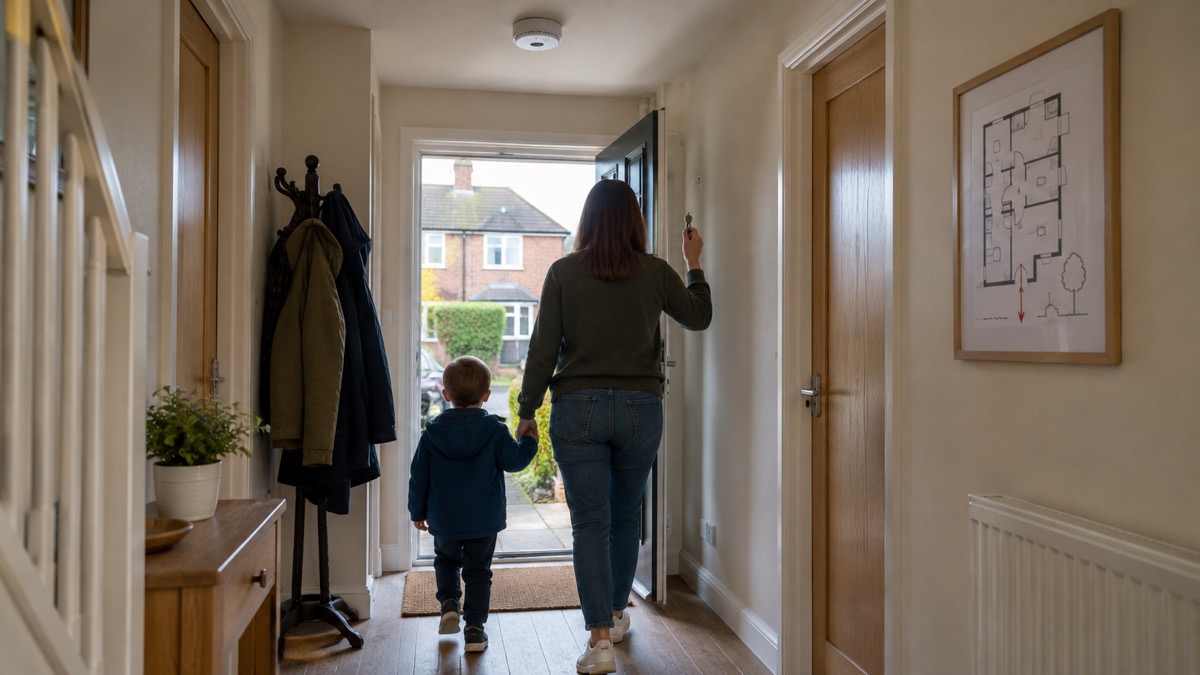
Working smoke alarms will warn you of a fire, but fire and rescue services are clear that alarms alone are not enough: you should also make a fire escape plan1. The national Fire Kills campaign makes the same point, advising households to fit working smoke alarms in more places in the home and to plan and practise an escape plan2. An alarm buys you time; the plan is what tells everyone what to do with it.
The reason a plan matters so much is smoke. Warwickshire Fire and Rescue Service warns plainly that smoke is poisonous and can kill you, and that smoke and fumes can quickly overcome anyone, which is why everyone should leave immediately3. In a real fire you may have seconds, not minutes, and you will not be thinking clearly. A household that has agreed its routes, its keys and its meeting point beforehand acts on instinct instead of improvising.
A fire escape plan does not need to be complicated. Suffolk Fire and Rescue Service says it only takes about 5 minutes to create a home fire escape plan, and its online planner walks you through it5. This page sets out what every UK household should put in that plan, how to adapt it for flats and high-rise buildings, how to talk to children about it, and what to do in the moments when the plan has to work.
What a fire escape plan contains
Suffolk Fire and Rescue Service breaks a home fire escape plan into five parts: who is in your plan, meaning the people you live with; what your main escape route is; what your back-up escape route is; where to gather once you are outside; and which room can act as a refuge if you cannot escape5. That structure works for almost any home, and it is worth writing the answers down rather than holding them in your head.
Around those five parts, fire and rescue services add a set of habits that make the plan work in practice:
- Keep door and window keys where everyone in the home can find them, and avoid keeping them in the kitchen, because this is where most fires in the home start4
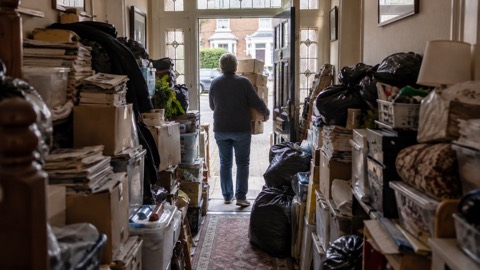
- Keep hallways and doorways free from clutter, including communal areas if you live in a flat, and report discarded rubbish to your landlord9
- Make sure everyone knows what to do when they hear a fire alarm or carbon monoxide alarm, and how to escape from every bedroom at night10
- Keep vital documents somewhere easy to find10
- Review the plan regularly, and whenever the layout of your home or the people in it changes9
The bedtime routine deserves a mention here. South Wales Fire and Rescue Service publishes an escape plan template and bedtime routine that includes simple nightly checks, such as putting fireguards around open fires and not building up the fire before going to bed11. North Yorkshire Fire and Rescue Service similarly advises a bedtime route and escape plan, on the reasoning that fires at night, when everyone is asleep and alarms are the only warning, are the ones where a plan matters most12. If you keep keys out of the kitchen, clear the hallway and know your routes before you sleep, the plan is already half done.
Plan a main route and a back-up route
Your main escape route is the normal way out of your home: usually the hallway and the front door. Devon and Somerset Fire and Rescue Service advises planning a second escape route in case the first one is blocked6, and Northern Ireland Fire and Rescue Service advises making sure everyone knows the quickest way out and considering an alternative13. The point of the second route is that fire is most likely to start in the kitchen or living room, exactly the rooms your main route may pass through.
Walk both routes with everyone in the household, including at night and in the dark. Wiltshire and Swindon Prepared advises identifying your nearest and best exits, including how you would escape from each bedroom, and asking yourself which window you might escape from in a fire10. Cornwall Fire and Rescue Service adds a simple test: plan an escape route and make sure everyone knows how to escape14.
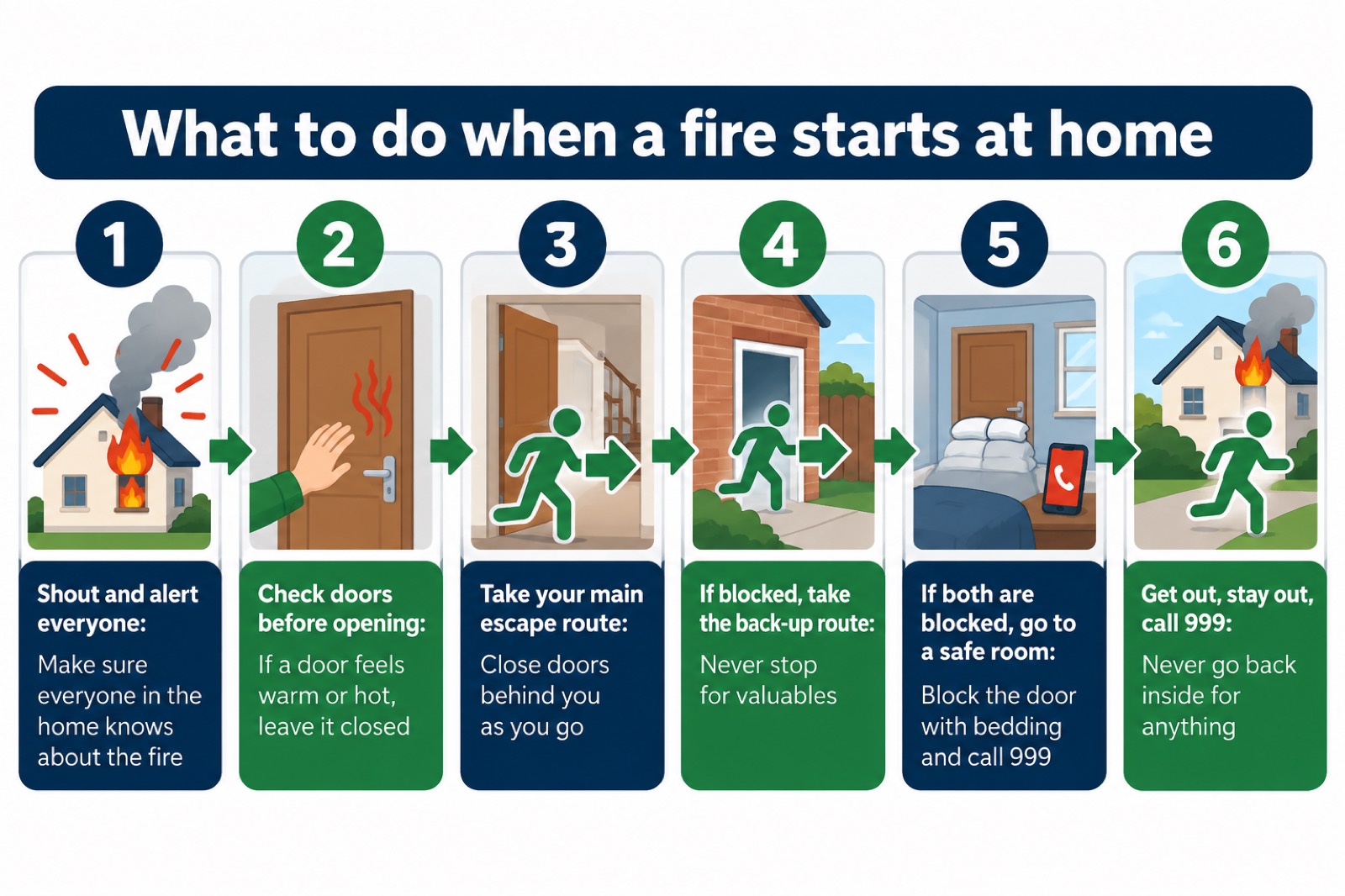
Two rules apply whichever route you take. First, close doors behind you. Scottish Fire and Rescue Service advises that if there is a fire in your home, you should close the door where the fire is, because this helps protect your escape route and stops the fire spreading so quickly8. Second, do not stop for valuables, and never try to tackle the fire yourself12. North Yorkshire Fire and Rescue Service is direct about this: keep calm, act quickly, and get everyone out as soon as possible12.
Check closed doors before you open them
On your way out you will meet closed doors, and each one is a question: is the fire behind it? The advice from every fire and rescue service that addresses this is the same. The London Fire Brigade's easy-read fire safety booklet instructs: "Use the back of your hand. Leave the door closed if it feels warm or hot."7
"Use the back of your hand. Leave the door closed if it feels warm or hot."
The reason for the back of your hand is that it is more sensitive to heat than your palm, and it protects you from the reflex of gripping a hot handle. The national Prepare campaign states the rule plainly: before you open a door, check if it is warm, and if it is, do not open it, because fire is on the other side15. Devon and Somerset Fire and Rescue Service uses the same wording when advising parents and child carers16.
If a door is warm or hot, do not go through it. Turn back and use your second escape route. If that too is blocked, you move to plan B, which is to protect yourself in a room and wait for rescue. Scottish Fire and Rescue Service's guidance is categorical: never open a door if it is warm to the touch8. Teach this to children as part of the plan, because a child woken by smoke will reach for the nearest door.
Plan B if you are trapped: block the smoke and stay put
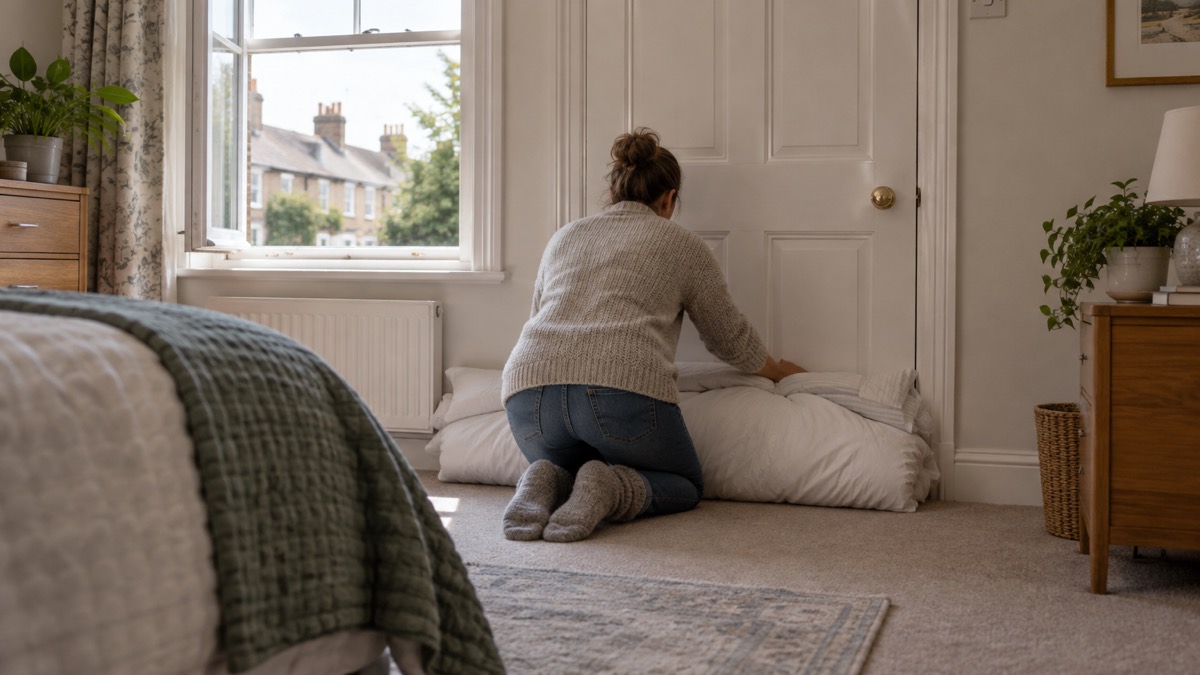
If both your routes are blocked, the advice changes from escaping to protecting yourself, and it is consistent across the UK's fire and rescue services. London Fire Brigade's guidance for blocks of flats advises finding a safe room as far as possible from any fire or smoke, with a window if possible, closing the door and using soft materials to block any gaps to stop the smoke17. Manchester Fire and Rescue Service gives the same steps for a house: if your escape route is blocked and you cannot escape through a window, call 999 immediately, find a room to wait in, open a window, put cushions and bedding around the bottom of the door, and keep low to the floor if smoke enters18.
The steps in order:
- Get everyone into one room, ideally one with a window that opens, as far from the fire as you can19
- Close the door and put bedding, cushions, towels or clothes along the bottom of it to block the smoke19
- Open the window and stay close to it for fresh air7
- Call 999 if you have a phone, and be ready to describe where you are6
- Shout "FIRE" and "HELP" from the window as loudly as you can19
- Wait to be rescued, and keep leaning out of the open window for fresh air until firefighters arrive8
Devon and Somerset Fire and Rescue Service describes this as the plan B conversation to have with children: when you feel a door and it feels hot or warm to the touch, you must not go through it, and instead you block the bottom of the door with bedding, cushions or blankets, stand by an open window, shout for help, and dial 999 if you have a phone16. Essex County Fire and Rescue Service adds that if your escape is blocked by fire, it may be safer to stay put until the fire service arrives20. This is not giving up: a closed, sealed door between you and a fire, with fresh air from a window and firefighters on the way, is a survivable position.
Where windows must not be used as an escape route
Windows are a back-up route, not a first choice, and there is a hard limit on when to use them. Manchester Fire and Rescue Service advises that you should only try to escape through a window if you are on the ground or first floor, under 3 metres in height, and your escape route is blocked; if you are higher up, wait to be rescued by firefighters4. Scottish Fire and Rescue Service says only ever try to escape from a first floor window if you have no other choice21, and suggests thinking in advance about how you would do it, for example by climbing out onto a garage roof or extension and getting down safely19.
If a window escape from the ground or first floor is your only option, Devon and Somerset Fire and Rescue Service advises throwing bedding or cushions out first to break your fall6. Cornwall Fire and Rescue Service agrees that if you are on the ground or first floor, you may be able to escape through a window14.
Two further rules sit alongside this. Do not use a balcony to escape unless it is part of an official escape route24. And once you are out, never go back inside: Warwickshire Fire and Rescue Service says do not go back in for anything3, and Scottish Fire and Rescue Service says never try to go back inside until a firefighter tells you it is safe8.
Escape plans for flats: never rely on the lift
If you live in a flat, the same principles apply with one addition that changes everything: the lift. Oxfordshire's guidance is blunt that if you live in a flat, the lift will be out of action if there is a fire, so choose an escape route that does not require one1. Devon and Somerset Fire and Rescue Service, Manchester Fire and Rescue Service, Scottish Fire and Rescue Service and North Yorkshire Fire and Rescue Service all give the same instruction in the same words: use the stairs, never the lift6.
If a fire starts inside your flat, the advice is to leave the same way you normally would, but by the stairs. London Fire Brigade's easy-read booklet gives the sequence: leave the flat, close all doors on your way out, do not use the lift7. Manchester Fire and Rescue Service, for flats operating an evacuation strategy, adds that you should never try to fight the fire yourself, that you should close the door to the room where the fire is where it is possible and safe, alert people in the flat, activate any manual alarms, call 999 and stay on the phone whilst evacuating9. South Wales Fire and Rescue Service adds a practical step for anyone who cannot safely use the stairs alone: go to a refuge point or place of safety, such as a neighbour's flat, and call 99926.
| Situation in a flat | What to do |
|---|---|
| Fire inside your flat | Take the normal way out, close doors behind you, use the stairs, never the lift7 |
| Fire or smoke in your flat, route not clear | Call 999 and be ready to describe where you are and the quickest way for firefighters to reach you6 |
| Cannot use the stairs alone | Go to a refuge point or place of safety, such as a neighbour's flat, and call 99926 |
| Trapped in the building | Find a safe room away from the smoke, seal the door, open a window, call 99917 |
Manchester Fire and Rescue Service also advises flat residents to learn escape signage, keep door and window keys accessible and out of the kitchen, keep hallways and communal areas clear of clutter, report discarded rubbish to the landlord, identify a second escape route and review the plan regularly9. If you want a fuller walkthrough of a fire in a block, see our guide to what to do if there is a fire in your block of flats.
High-rise homes: know your building's plan
High-rise residents have one extra job: finding out the building's evacuation strategy before any emergency. Warwickshire's high-rise guidance advises making sure you know your building's evacuation plan, which will say whether it has a stay safe, stay put strategy or an evacuation strategy27. Mid and West Wales Fire and Rescue Service advises people who live in high rise properties and purpose-built flats or maisonettes to know their escape route and what to do if there is a fire inside your home or somewhere else in the building24.
The practical preparations are concrete. Essex County Fire and Rescue Service advises knowing the fire plan for your building, avoiding lifts and balconies if there is a fire, counting how many doors you need to go through to reach the stairs, keeping corridors and stairways clear, and making sure doors to stairways are not locked20. Warwickshire Fire and Rescue Service advises keeping all exits clear, keeping door and window keys near the exit, preparing a grab bag with prescriptions, documents such as a driving licence and passport, spare keys, a mobile phone, a charger and a torch, knowing how to isolate your gas, electric and water supply, and getting to know neighbours who may need assistance in an emergency28. South Wales Fire and Rescue Service adds simple housekeeping such as disposing of waste correctly29, and North Yorkshire Fire and Rescue Service says to communicate the escape plan to all occupants25.
The Scottish Government has published an information leaflet giving residents of high rise buildings information on how to prevent fires and what to do if there is a fire30. Residents who cannot use stairs unaided should also know that the government has looked specifically at personal emergency evacuation plans: a consultation on Personal Emergency Evacuation Plans in high-rise residential buildings ran from 8 June 2021 to 19 July 2021 and drew 312 online survey responses plus a further 70 in alternative formats31. Ask your landlord or building manager what arrangements, if any, exist for your building.
Talking to children about the plan
A plan only works if the youngest people in the house know it. Devon and Somerset Fire and Rescue Service suggests a useful starting point: when talking to children, refer to what they do at school in their fire drill, and apply that to your home situation16. Children already understand the idea of lining up and leaving a building; you are transferring that habit to home.
The Fire Kills campaign advises teaching children never to hide from fire or from firefighters, practising the plan regularly and making it feel like a game, and making sure they know to get out and stay out, and never to go back inside for toys or pets23. The national Prepare campaign adds that you will probably need to talk about fire safety with children more than once to make sure they have remembered and understood what you have taught them15. One conversation is not enough; make the plan part of normal family life.
Give children the specific rules they need. The government's fire safety advice for parents and child carers teaches the same door check as adults use: before you open a door, check if it is warm, and if it is, do not open it, because fire is on the other side32. It also teaches the trapped position for children: go into a room with a window if the way out is blocked, put bedding or towels along the bottom of the door to stop smoke getting in, open the window and shout "HELP FIRE"32. If a child in your household is setting fires rather than just learning about them, fire services run intervention schemes, covered in our guide to children who set fires.
Once you are out: get out, stay out, call 999
The instruction that ends every fire service escape plan in the UK is the same eight words: get out, stay out, call 9992. Devon and Somerset Fire and Rescue Service adds the detail of the last step: once you are out, get well away from the building and call 999 if you have not already6. North Yorkshire Fire and Rescue Service reminds households that 999 calls are free12.
Agree your meeting point as part of the plan, so that you can confirm everyone is out without going back in. Fire services include identifying escape routes and meeting points together in emergency planning29. When you call, be ready to describe where you are and, if anyone is still inside, where they are in the building and the quickest way for firefighters to reach them6. If you are calling while trapped inside, stay on the phone while you evacuate if you can9.
Do not go back in for anything3. Not for a pet, not for a phone, not for documents. Firefighters have protective equipment and breathing apparatus; you do not. Our guide to how fire and rescue services respond to a call explains what happens after you make that call, and our guide to what to do after a fire covers the days that follow.
Make your plan online in about 5 minutes
Suffolk Fire and Rescue Service has an online planner that turns the whole of this page into a short exercise: it only takes about 5 minutes to create a home fire escape plan5. The planner covers who is in your plan, your main and back-up escape routes, where to gather outside, and which room can act as a refuge5. Once you are finished, you can email the plan to yourself and anyone else who lives in your home5, which solves the sharing problem at a stroke.
Suffolk also publishes a 16-question quiz about escaping a fire at home, covering what to do when you first realise there is a fire, how to check if there is a fire behind closed doors, what to have in your escape kit, what to do if your escape route is blocked, and what to do once you get out of the house5. The service recommends taking the quiz before starting your plan, but it is not essential5. More than 1,000 people have taken the quiz, scoring it on average 4.4 out of 5 for usefulness5.
South Wales Fire and Rescue Service offers a printable alternative, an escape plan template and bedtime routine you can fill in on paper11. Whichever format you use, the test of the plan is not the document but the practising. Scottish Fire and Rescue Service makes the case for rehearsal plainly: practising helps everyone stay calm if there is a fire, and it also helps you get to safety quicker8. Staffordshire Fire and Rescue Service advises planning your escape with the same emphasis on practice33, and Cheshire Fire and Rescue Service tells residents to plan, practise and understand your escape route and building evacuation procedure22.
Practise both routes. Practise at night. Practise the door check and the trapped position. Then review the plan whenever your home changes: a new lock, a rearranged bedroom, a new person in the house. Five minutes of planning, and a few minutes of practice a couple of times a year, is the whole cost of a plan that fire and rescue services across England, Scotland, Wales and Northern Ireland agree can save your household's lives.
Sources (33)
- Be prepared for an emergency, Oxfordshire County Council
- Fire Kills campaign, Fire Kills campaign
- Making a home escape plan, Warwickshire Fire and Rescue Service
- Know your escape plan, Manchester Fire and Rescue Service
- Create a fire escape plan, Suffolk Fire and Rescue Service
- Escape plan, Devon and Somerset Fire and Rescue Service
- Easy-read fire safety booklet, London Fire Brigade
- Your guide to fire safety, Scottish Fire and Rescue Service
- Fire safety information for residents living in flats, Manchester Fire and Rescue Service
- At home: home emergency evacuation plan, Wiltshire and Swindon Prepared
- Escape plan template and bedtime routine, South Wales Fire and Rescue Service, 2020
- Bedtime route and escape plan, North Yorkshire Fire and Rescue Service
- Student safety and home fire safety, Northern Ireland Fire and Rescue Service
- Fire safety at home: escape plan, Cornwall Fire and Rescue Service
- Domestic fire, Prepare campaign
- Talk to your children about fire safety, Devon and Somerset Fire and Rescue Service
- Escape plan for blocks of flats, London Fire Brigade
- Planning an escape route, Manchester Fire and Rescue Service
- In an emergency, Scottish Fire and Rescue Service
- Fire safety in the home, Essex County Fire and Rescue Service, 2025-02
- Escape plan, Scottish Fire and Rescue Service
- High rise homes, flats and apartments, Cheshire Fire and Rescue Service
- Escape, Fire Kills campaign
- Fire safety in high rise flats, Mid and West Wales Fire and Rescue Service
- High rise building safety, North Yorkshire Fire and Rescue Service
- In the event of a fire, South Wales Fire and Rescue Service
- High rise buildings, Warwickshire Fire and Rescue Service
- Fire safety in high rise buildings, Warwickshire Fire and Rescue Service
- High rise living, South Wales Fire and Rescue Service
- Home fire safety: high rise residents information leaflet, Scottish Government, 2019-12
- Personal Emergency Evacuation Plans consultation response, UK Government, 2024-12-02
- Fire safety for parents and child carers, UK Government, 2022-05-25
- Plan your escape, Staffordshire Fire and Rescue Service
 Home Fire Safety Checklist
 Bedtime Fire Safety Checks
 Fire Risk Checks for Carers
 What to Do If Fire Starts
 Fire in a Block of Flats
 Kitchen Fires and Cooking Safety
 Electrical Fires and Sockets
 Smoking, Matches and Lighters
 E-bike Charging Safety
 Hoarding and Fire Risk
 Thatched Properties Fire Risk
 Fireworks and Bonfire Safety
 What to Do After a House Fire
 How Fire Services Respond
 Alarms for Deaf People