If a child or young person in your household has been playing with matches, setting small fires or showing an unusual interest in fire, help is available free from your local fire and rescue service. Services run intervention schemes under different names, and anyone can make a direct referral, with referrals accepted from parents, family members, schools and other agencies1. Trained practitioners work with children and young people, carrying out visits in the home or at school, and without help and guidance these behaviours can increase and lead to more serious consequences such as serious personal injury and damage to homes, schools and property2.
The schemes are free and confidential1. Anyone can make a referral, including parents, family members, schools and other agencies2, and the number of sessions a child receives is matched to their level of risk, from two sessions for a low or medium-risk case up to five for a very high-risk case3. The most important thing to know is that fire-setting should never be ignored: without help and guidance these behaviours can increase and lead to serious personal injury and damage to homes, schools and property4.
Your local fire service runs a free scheme for children who set fires
Every fire and rescue service that publishes guidance on this subject runs some form of intervention for children who play with or set fires, and every one of them describes it as free. London Fire Brigade offers free one-to-one fire safety education to children and young people who have demonstrated any type of firesetting or fire play, and provides advice to parents and carers7. North Yorkshire Fire and Rescue Service offers what it calls a FREE Firesafe Intervention Programme for children and young people who set fires or who play with fire8. Surrey County Council's Firewise Scheme provides one-to-one fire safety advice for children and their parents or carers9.
The names differ because each service runs its own scheme, but the shape is the same. Warwickshire County Council describes its fire setting intervention scheme as an educational programme that aims to raise awareness about the dangers of fire, support informed decision-making, and provide fire safety advice to parents and carers5. Suffolk Fire and Rescue Service directs anyone with concerns around fire setting to its Fire Prevention Team and its Firesetter Intervention Scheme, whose purpose is stopping a child's interest in fire10. Lincolnshire's Firesetters Intervention Scheme aims to help children and young people understand and control the feelings and circumstances that lead them to set fire4.
If you are not sure whether your service runs a scheme, contact its non-emergency number and ask. North Yorkshire Fire and Rescue Service asks parents and guardians worried about a child playing with fire to get in touch immediately8, and Devon and Somerset Fire and Rescue Service asks anyone who thinks a child is showing an unhealthy interest in fire to contact it directly11. The general fire safety advice on what to do if a fire does start is covered in our guide to house fires.
Who can be referred: young people up to 18
The age limit is consistent across the services that publish one. Warwickshire's scheme is for children and young people under 18 who have shown an interest in fire or displayed fire setting behaviour5. Cornwall's Fire Safety Intervention Scheme works with young people up to 18 years of age2. Devon and Somerset's Fire Safety Intervention service is for any person up to the age of 18 living in Devon or Somerset3. Lincolnshire's scheme covers children and young people generally4.
What counts as grounds for a referral is broader than many parents expect. Oxfordshire's Firewise scheme supports children who have shown an interest in fire or who have demonstrated that they are experimenting with fire12, so you do not need to wait for a serious incident before asking for help. Devon and Somerset Fire and Rescue Service notes that it is not uncommon for children as young as two to show an interest in fire11, and its guidance on fire starting behaviour in young children says most children have a natural curiosity about fire that can show as young as two years old3.
That curiosity is not in itself a sign of a problem, but it is the reason the schemes exist. A household with children is twice as likely to experience a fire as one without children, according to Somerset Council's home safety guidance13, and Devon and Somerset Fire and Rescue Service likewise states that households with children can be at a higher risk of fire11. Children under 5 face particular danger around flames and hot surfaces: Somerset Council's guidance says their risk level is 6 to 7 times greater than the average for the population as a whole, with boys at slightly higher risk than girls, that children under 3 are the most vulnerable group, and that around half the injuries are to children under 5 years of age13. Government guidance on identifying vulnerable people in an emergency makes the same point in general terms: all children and young people are less able to help themselves, especially those under 514.
How to make a referral
Anyone can make a direct referral. Cornwall Fire and Rescue Service, whose scheme accepts referrals from parents, family members, schools and other agencies, puts it plainly2. Lincolnshire allows you to make an online referral to its Firesetters Intervention Scheme4. Essex County Fire and Rescue Service directs people to essex-fire.gov.uk/fsi15. Devon and Somerset asks you to complete the FSI Referral Form fully, stating whether parental consent has been provided, and send it to FSIreferrals@dsfire.gov.uk3.
The table below gathers the published contact routes for the services whose details are given in official guidance. If your area is not listed, call your service's non-emergency number and ask for its fire-setting or fire safety intervention team.
| Fire and rescue service | How to make contact | Notes |
|---|---|---|
| Devon and Somerset | Fire Safety Intervention Officer on 01803 653733, or email FSIreferrals@dsfire.gov.uk | Complete the FSI Referral Form and state whether parental consent has been given3 |
| Lincolnshire | Online referral to the Firesetters Intervention Scheme; queries on 01476 565441 | Fire Safety Team also on 01754 898980 or Fire.Safety@lincoln.fire-uk.org4 |
| North Yorkshire | Freephone 0800 074 0064, or email safeguarding@northyorksfire.gov.uk | Confidential advice for parents and guardians worried about a child playing with fire17 |
| Essex | essex-fire.gov.uk/fsi | Referral route given in the service's home fire safety booklet15 |
| London | Via the London Fire Brigade firesetting intervention pages | Free, confidential scheme1 |
A few practical points from the published guidance. North Yorkshire Fire and Rescue Service also gives a general contact number, 01609 780150, for anyone with concerns about a child or young person8. Lincolnshire Fire and Rescue's general non-emergency telephone number is 01522 555777, and its headquarters address is Deepdale Lane, Nettleham, Lincoln, LN2 2LT6. Lincolnshire's person-centred fire risk assessment checklist adds that if there are no working smoke alarms fitted in the home, you should contact Lincolnshire Fire and Rescue for an urgent referral16, a reminder that alarm provision and intervention often go together; our guide to smoke alarms covers choosing them.
After you send a referral, Devon and Somerset Fire and Rescue Service says a member of the Fire Safety Intervention team will reply to acknowledge receipt of the referral3. If you do not hear back promptly, follow up on the number or email address you used.
Parent or carer consent comes first
No intervention can go ahead without a parent or guardian's agreement. Cornwall Fire and Rescue Service states that an intervention can only take place with the permission of the parent or guardian of the child2. Lincolnshire's scheme requires consent from the parent or carer for anyone under the age of 18 for the intervention to proceed4. Devon and Somerset needs the permission of parents or carers before it carries out any visit to schools, homes or other establishments3.
This matters for how a referral from someone outside the household works. A school or another agency can refer a child, as Cornwall confirms it has received referrals from schools and other agencies2, but the scheme cannot begin work until you, as parent or carer, agree. If a teacher or another professional raises concerns with you, you can also make the referral yourself, and doing so may speed things up because you can give consent at the same time.
Consent also shapes what the service tells you. Because the schemes are described as confidential1, and North Yorkshire offers confidential advice specifically to parents and guardians worried about a child playing with fire17, you can discuss your concerns before committing to anything. Use that first conversation to ask how the sessions work, where they happen and what your child will be told.
What happens in the sessions
The sessions are educational, not punitive. Cornwall's trained practitioners work to offer help, guidance and education to deter children from further fire-setting behaviour2. Warwickshire's programme aims to raise awareness about the dangers of fire, support informed decision-making, and provide fire safety advice to parents and carers5. Lincolnshire's scheme helps children and young people understand and control the feelings and circumstances that lead them to set fire4. London Fire Brigade provides free one-to-one fire safety education and advice to parents and carers7.
Alongside the one-to-one work, the services publish practical teaching you can reinforce at home. Devon and Somerset Fire and Rescue Service and Cornwall Council both advise parents to explain that fire is a tool, not a toy, and that it is dangerous, can cause harm and may lead to death3. Devon and Somerset adds that fire setting should never be ignored3, and Oxfordshire's Firewise guidance is blunt about timing: if you have noticed any signs of firesetting, do not ignore them, because early intervention is vital in changing a young person's behaviour and can save lives12.
The teaching itself is adjusted to the child's age. Dorset and Wiltshire Fire and Rescue Service says younger children, around five and below, should be given clear instructions about what they should and should not do, while with older children it is better to explain why, so they can understand the danger and apply that knowledge to different situations18. The same advice appears in government fire safety guidance for parents and child carers19 and in Devon and Somerset's advice to parents20. Wiltshire and Swindon Prepared adds that you will probably need to talk about fire safety with children more than once, to make sure they have remembered and understood what you have taught them21.
Basic rules to teach, drawn from the official guidance:
- Never play with matches, lighters or lighted candles, and tell a grown-up if you see matches or lighters lying around20
- Do not touch or play with matches, lighters, candles, electrical appliances or sockets21
- If you see smoke or flames, tell a grown-up straight away, get out quickly, do not go back for anything even toys or pets, and call 999 and ask for the fire and rescue service19
- If there is smoke, crawl along the floor, because the air will be clearer down there19
- Teach your child to STOP, DROP and ROLL if their clothing catches fire22
Dorset and Wiltshire Fire and Rescue Service also notes that children learn by example: let your children see you being sensible and careful about cooking, candles and other potential risks, and practise your escape plan with them18. Our guide to making a fire escape plan covers that side of the preparation.
Sessions by risk level: from two up to five
Devon and Somerset Fire and Rescue Service sets out the clearest published model. It uses a system of low, medium, high, and very high risk levels, and the number of sessions follows from that: a low or medium referral may require two sessions, whereas a very high referral could receive up to five sessions3. Lincolnshire's scheme undertakes at least two visits in the home or school4.
The risk level is assessed by the service, not by you, and it is the reason the referral form matters. Devon and Somerset asks you to complete the FSI Referral Form fully, stating whether parental consent has been provided3, because the detail you give about what has happened helps the team judge the level of risk and therefore the intensity of the intervention. Give a factual account: what you have seen, when it happened, and anything that has changed since.
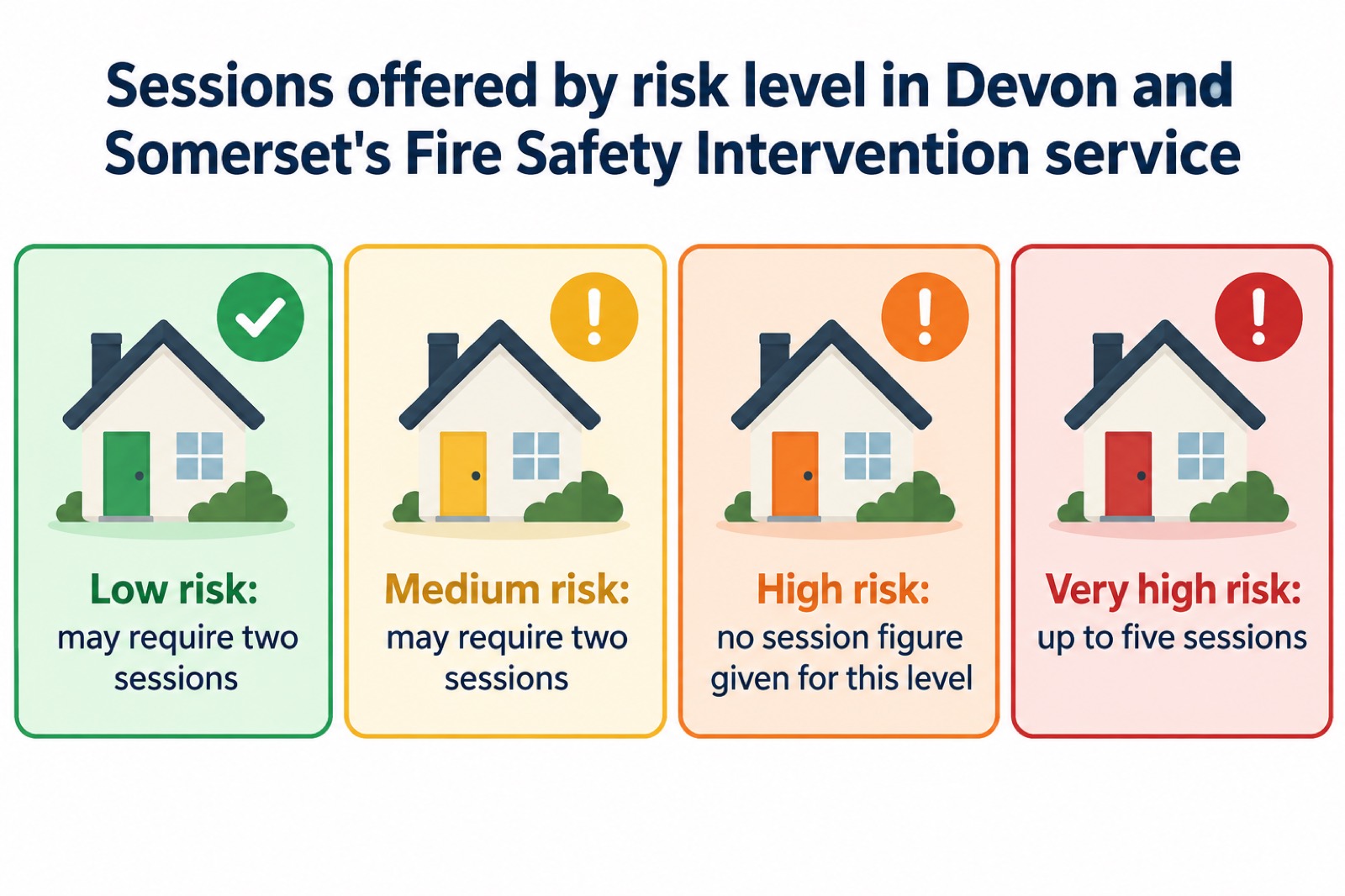
The risk levels also explain why two children referred for apparently similar behaviour may receive very different amounts of help. A single episode of curiosity with matches may sit at low or medium risk and be resolved in two sessions, while repeated or escalating fire-setting sits higher and draws a longer programme. If you are unsure where your child's behaviour falls, say so when you make the referral and ask the team how it assesses risk.
Where sessions take place
Cornwall Fire and Rescue Service lists the options: practitioners can visit children in their homes, at school or a designated place of safety, and they can also provide sessions over the phone2. Lincolnshire's scheme undertakes its visits in the home or school4. Devon and Somerset needs the permission of parents or carers before any visit to schools, homes or other establishments3.
The choice of location is usually discussed when the referral is acknowledged. A home visit has the advantage that the practitioner can see the real environment, and in Devon and Somerset's case a free Home Fire Safety Visit can be provided alongside the intervention work3. A school visit may suit a child who has been referred by teachers, and a designated place of safety or a phone session may work where a home visit is difficult or where the child would be more comfortable elsewhere. None of these options changes the consent rule: whatever the location, the parent or carer's permission comes first for anyone under 182.
When a scheme is paused: what help is still available
Services can pause their intervention programmes, and one currently has. Devon and Somerset Fire and Rescue Service states that its Fire Safety Intervention work is currently paused, but that it is still accepting referrals for high-risk cases, and that it is still able to provide free Home Fire Safety Visits and offer advice and support over the phone from one of its FSI Team members3. It anticipates reinstating the full service in 20263.
If your local scheme is paused or has a waiting list, the published guidance points to help that does not depend on it:
- Home fire safety visits: free in Devon and Somerset's case, and offered by fire services generally as part of their community safety work3
- Telephone advice: Devon and Somerset's FSI Team offers advice and support over the phone while intervention work is paused3
- Online educational resources: StayWise is a free online library of educational resources and activities from the UK's leading emergency services, designed to keep children safe, at staywise.co.uk15, and the UK government's domestic fire guidance points to the Staywise website's resources and games for educating children about fire safety23. Dorset and Wiltshire Fire and Rescue Service also maintains a safety stories and activities library for children24
- Your own teaching at home: the age-adjusted advice above, from explaining that fire is a tool not a toy to practising an escape plan3
A pause does not mean you should wait. Devon and Somerset is explicit that high-risk referrals are still accepted during the pause3, so if you are seriously worried, refer anyway and let the service judge the risk level.
Why fire-setting needs help early
The official guidance is consistent on this point. Oxfordshire's Firewise guidance states that if you have noticed any signs of firesetting, you should not ignore them, because early intervention is vital in changing a young person's behaviour and can save lives12. Lincolnshire Fire and Rescue warns that without help and guidance, these behaviours can increase and lead to more serious consequences such as serious personal injury, damage to homes, schools and property4. North Yorkshire Fire and Rescue Service, in a plea to parents and guardians following a number of deliberate fires, states that playing with fire in the home or garden can have serious unintended consequences17, and repeats the warning in a later appeal about deliberate fires25. Devon and Somerset's guidance on fire starting behaviour in young children says most children have a natural curiosity about fire that can show as young as two years old, and that fire setting should never be ignored3.
The injury figures explain the urgency. Somerset Council's home safety guidance records that children under 5 have a risk level from flames and hot surfaces 6 to 7 times greater than the population average, that children under 3 are the most vulnerable group, and that around half the injuries are to children under 513. The same guidance notes that the elderly and the very young, aged four and under, are most at risk from fire overall13. North Yorkshire Fire and Rescue Service adds a preventive step for parents of teenagers: talk regularly with children and teenagers about fire-setting, peer pressure, and the real consequences of antisocial behaviour8.
There are things you can do around the home while you wait for a referral or between sessions. Fire and Rescue Service guidance for the home advises: do not leave matches and candles where children can find them; use a child-proof cigarette lighter with safety locks which go out when you let go; make sure fires and heaters have fixed guards; and do not place toys nearer than a metre (3 feet) to anything hot, because even if the toys do not catch fire, your child may be burned26. Our guide to smoking, matches and lighters covers that household risk in more detail.
Talking to your child while you wait for the scheme
The intervention sessions do not replace what you do day to day, and the official guidance gives a clear method for the conversations at home. Devon and Somerset Fire and Rescue Service advises referring to what children already do at school in their fire drill and applying that to your home situation20, which turns something familiar into an escape plan for the house. Suffolk Fire and Rescue Service makes the same point from the school's side: ensure staff know what to do in the event of a fire with well-rehearsed actions10, so a child who has practised at school will recognise the logic at home.
Keep the messages age-appropriate. For children around five and below, give clear instructions about what they should and should not do; with older children, explain why, so they can understand the danger and apply the knowledge to different situations18. Repeat the conversation: you will probably need to talk about fire safety more than once to make sure they have remembered and understood20. Letting children help with the household emergency plan and kit can help them remember the information and feel safer, according to Ready Scotland's emergency plan guidance27.
If the worst happens and someone is burnt, the London and South East Burns Network guidance is to stop the burning process, cool, cover and call for help, and to seek early advice from your local Burn Service; the St Andrews Centre in Chelmsford gives telephone advice for adults on 0300 44 30475 and for children on 0300 44 3040528. Dorset and Wiltshire Fire and Rescue Service gives the same three-step summary: if someone is burnt, cool, cover and call for help29. If your child needs help in an emergency, call 99929.
Sources (29)
- Worried about a young person setting fires, London Fire Brigade
- Fire safety interventions, Cornwall Council, 2026-08-14
- Fire starting behaviour in young children, Devon and Somerset Fire and Rescue Service, 2026
- Fire safety interventions, Lincolnshire Fire and Rescue, 2026-10-29
- Fire safety advice for parents, Warwickshire County Council, 2026-10-29
- Caravan safety, Lincolnshire Fire and Rescue, 2026-10-29
- Grass and wildfires, London Fire Brigade, 2026-10-25
- Light Nights campaign, North Yorkshire Fire and Rescue Service, 2026-06-10
- Fire safety for parents and carers, Surrey County Council, 2026-10-28
- Putting a stop to arson, Suffolk Fire and Rescue Service, 2026-10-29
- Advice for parents and guardians, Devon and Somerset Fire and Rescue Service, 2026
- Fire and community safety, Oxfordshire County Council, 2026
- Accident hazards, Somerset Council, 2026-10-28
- Identifying and supporting persons who are vulnerable in an emergency, GOV.UK, 2025-04-28
- Fire safety in the home 2025, Essex County Fire and Rescue Service, 2025-02
- Person-centred fire risk assessment, Lincolnshire Fire and Rescue, 2022
- Plea to parents and guardians following a number of deliberate fires, North Yorkshire Fire and Rescue Service, 2020-04-15
- Parents and carers information, Dorset and Wiltshire Fire and Rescue Service, 2025-06-24
- Fire safety for parents and child carers, GOV.UK, 2022-05-25
- Talk to your children about fire safety, Devon and Somerset Fire and Rescue Service, 2026
- What children should know about fires, Wiltshire and Swindon Prepared, 2026-10-25
- Stay safe this Halloween, Wiltshire and Swindon Prepared
- Domestic fire, Campaign.gov.uk, 2026-10-12
- DWise safety stories and activities library, Dorset and Wiltshire Fire and Rescue Service
- Deliberate fires plea, North Yorkshire Fire and Rescue Service, 2021-04-07
- Your guide to fire safety, Scottish Fire and Rescue Service
- Emergency plan, Ready Scotland, 2026-10-29
- Burns referral guidance, London and South East Burns Network, 2026
- Summer safety, Dorset and Wiltshire Fire and Rescue Service, 2022-10-17