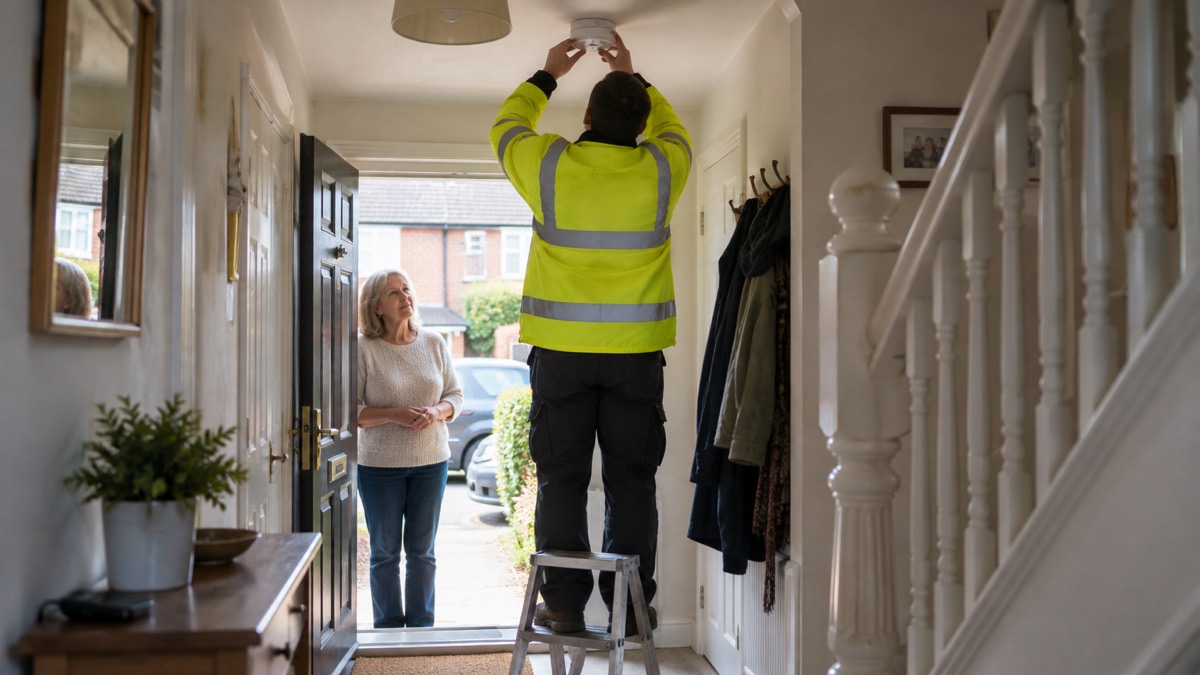
Every fire and rescue service in the UK offers a free home fire safety visit. A firefighter or community safety officer comes to your home, checks your fire risks, fits free smoke alarms if you need them, and helps you plan how to escape if a fire starts. It costs nothing: fill in the Home Fire Safety Checker and you will be given tailored advice for your home, with a visit arranged if you are eligible1. In Scotland, the Scottish Fire and Rescue Service offers free fire safety visits to everyone in Scotland2.
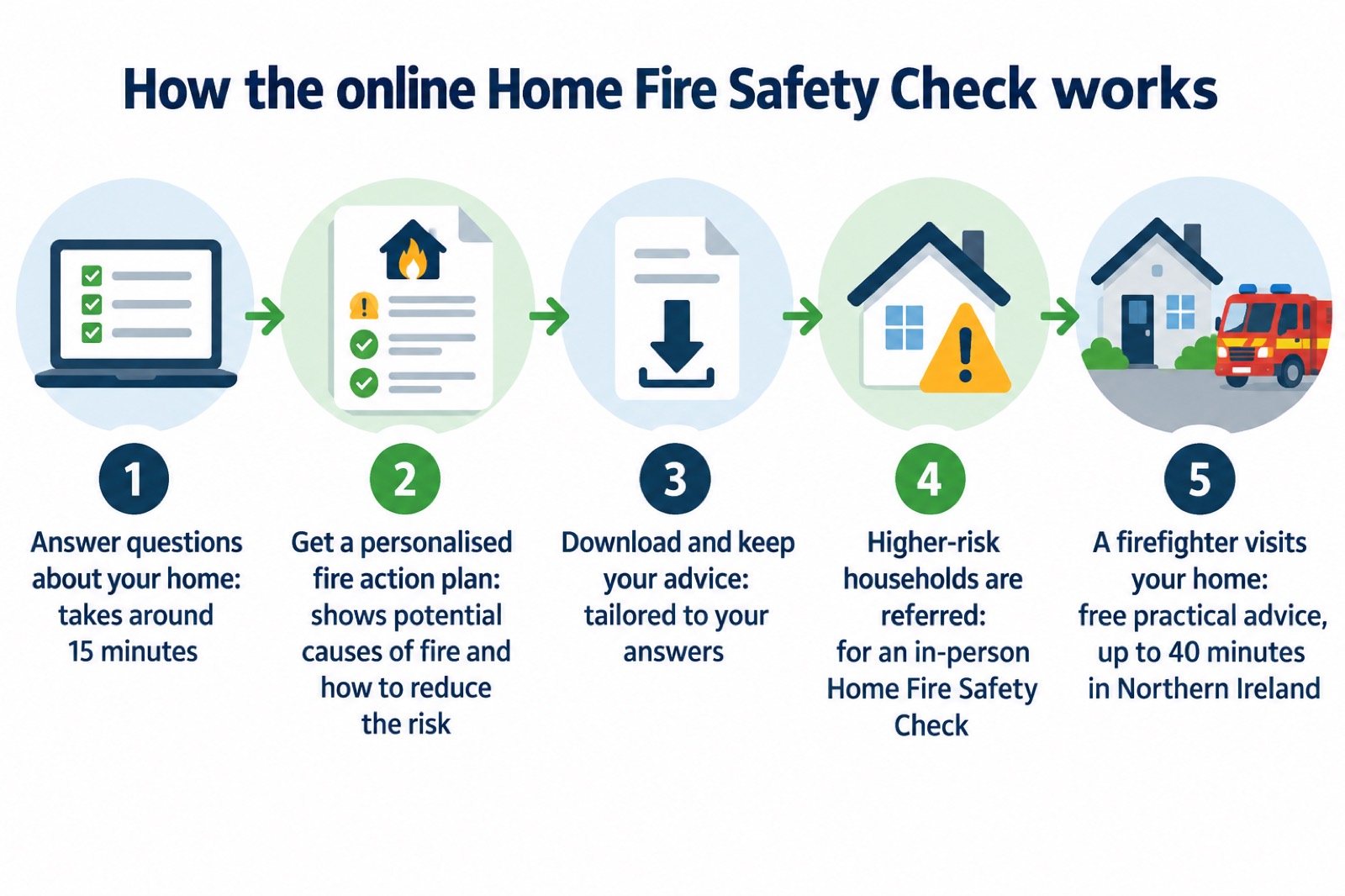
The quickest way in is usually the online Home Fire Safety Check, which takes around 15 minutes and gives you tailored advice you can download and keep3. If it identifies your household as higher risk, it refers you for a full in-person visit4. If you already know you want someone to come out, you can book directly by phone or text, and the routes differ between England, Scotland, Wales and Northern Ireland.
This page explains who can get a visit, what happens during one, how to book in each nation, and what to do if you are worried about a visitor or cannot get online.
Every fire service offers free home fire safety visits
Home fire safety visits are a core part of what fire and rescue services do, not an extra or a favour. London Fire Brigade directs people to its Home Fire Safety Checker first, which assesses the level of risk in a household through a series of questions, gives tailored advice, and arranges a visit if you are eligible1. The Brigade has visited nearly 90,000 Londoners to provide personalised home fire safety advice, many of them vulnerable, and states that community safety advice and prevention messages have seen a reduction in the demand for its services10. In other words, the visits work, which is why every service keeps offering them.
The Welsh Government's guidance is the same in principle: fire and rescue services offer a home safety visit to those who need it, and a visit includes free home safety advice and equipment, including smoke alarms and carbon monoxide alarms if needed11. In Northern Ireland, the guidance from nidirect is that if you are concerned about fire safety in your home, you can ask for a free home fire safety check, which is a visit to your home to provide advice on how to stay safe from fire12.
The reason the services push these visits so hard is the pattern they see in fatal fires. The Northern Ireland Fire and Rescue Service reported that 2025 was its highest year of house fire fatalities in a quarter of a century, with 16 losses of life, the highest number since 19998. A third of those incidents did not have working smoke alarms, and 75% of the fatalities were people who lived alone8. That is why the services want to get into homes before a fire happens, and why they particularly want to reach people who live alone.
Who can get a free visit
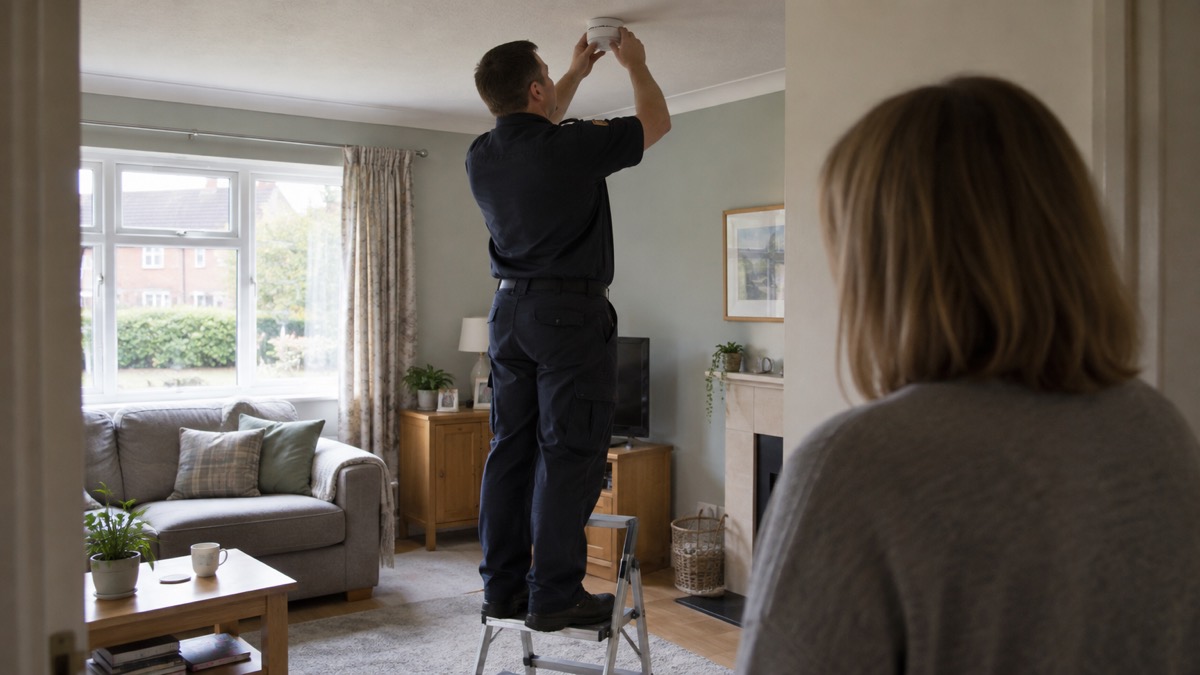
The short answer is anyone can ask, but in-person visits are prioritised for people at higher risk. The Scottish Fire and Rescue Service carries out Home Fire Safety Visits for people at the highest risk of experiencing a fire in the home13. Northern Ireland's online check is available to anyone, but the in-person Home Fire Safety Check that follows is only available to those identified as being more at risk3. Devon and Somerset Fire and Rescue Service has determined its eligibility criteria using information gathered from various sources, including personal factors, lifestyle factors and home environment, plus incident data and partner agencies4.
Services publish examples of who tends to qualify. Staffordshire Fire and Rescue Service lists residents who may be eligible for a Safe and Well visit as those aged 65+ living alone, those with mobility issues, those who have a history of house fires, those who smoke inside their property, and households with children under the age of five14. In Northern Ireland, NIFRS asks anyone concerned about an elderly relative, neighbour or someone who may be vulnerable to consider referring them for a Free Home Fire Safety Check through its website15.
If you do not meet the criteria for an in-person visit, you are not turned away with nothing. Staffordshire offers a tailored help and advice service instead for those who do not fit the criteria14. South Wales Fire and Rescue Service says that for some households a visit may not be needed, and instead you will be given up to date guidance about how to reduce the risk of fires starting in your home, and free smoke alarms if required5. The online check itself is available to everyone and produces a personalised fire action plan whatever your risk level16.
Start with the online Home Fire Safety Check: around 15 minutes
The online Home Fire Safety Check is a self-assessment: you answer a series of questions about your home and habits, and at the end you receive a personalised fire action plan which shows the potential causes of fire in your home and gives safety advice to help reduce the risk of fire16. It takes around 15 minutes4. The advice is tailored to your answers, and you can download and keep it for future reference3. If the assessment identifies your household at greater risk, you will be referred for an in-person Home Fire Safety Check, where the fire service visits to give further practical advice16.
The check was developed through a partnership between the National Fire Chiefs Council, Fire Kills and Safelincs3. It was launched in 2022, given Ministerial approval, and had been used 42,110 times up to April 202317. It was initially launched in England, with a Welsh tool under development at that time17. Even where a fire and rescue service has not formally onboarded the tool, if a person in its area completes the assessment and needs a visit, the information is passed to that service17.
You do not have to do it for yourself. The check can be completed for yourself or with anyone who would benefit, such as a neighbour, friend or relative3, and nidirect specifically suggests doing the safety check with someone you are concerned about, especially those who may not have access to the internet16. London Fire Brigade describes its version as a simple tool that can guide you around the home helping you spot fire risks, and says it only takes a few minutes to check your home and get tailored advice for your family10.
How to book a visit in England, Scotland, Wales and Northern Ireland
The routes differ by nation, so here they are side by side. In every case the visit and any alarms fitted are free.
| Nation | How to book | Notes |
|---|---|---|
| England | Fill in your local service's Home Fire Safety Checker, or call your service directly | The checker gives tailored advice and arranges a visit if you are eligible1 |
| Scotland | Call 0800 0731 999, or text FIRE to 80800, or visit the Scottish Fire and Rescue Service website | Free visits offered to everyone in Scotland6 |
| Wales | Request a home safety visit through your local fire and rescue service, or complete its online self-assessment | Visits offered to those who need it, with free advice and equipment11 |
| Northern Ireland | Complete the online Home Fire Safety Check at www.nifrs.org, or call 028 9266 4221 | Phone route for those with no internet or unable to complete the online check8 |
England
In England, most services route you through the online checker first. London Fire Brigade asks you to fill in its Home Fire Safety Checker, which gives tailored advice for your home and arranges a visit if you are eligible1. Devon and Somerset Fire and Rescue Service runs its online check the same way: it takes around 15 minutes, and if necessary it will refer you for a full in-person home fire safety visit4. The online check was made available to all fire and rescue services in England, and if it identifies a person at increased risk who would benefit from a physical visit, this is flagged to the appropriate service19.
Scotland
The Scottish Fire and Rescue Service offers free fire safety visits to everyone in Scotland2. To arrange one, you can call 0800 0731 9996 or text FIRE to 808007. Partners and agencies can also refer households: those with EGRESS secure email software can send the Partner Referral Form securely, and those without it can submit details via the Home Fire Safety Questionnaire or call 0800 0731 99913.
Scotland also has its own alarm law, which the visit can help you understand. Every home in Scotland must have interlinked fire alarms, a requirement that applies to all Scottish homes as of February 20226. Interlinked means if one goes off, they all go off, so you will always hear an alarm wherever you are in your home6. All smoke and heat alarms should be attached to the ceiling and be interlinked, and you need one heat alarm in the kitchen2. The Scottish Fire and Rescue Service's guidance confirms the requirement is to have all smoke and heat alarms interlinked, and that all alarms should be ceiling mounted and interlinked20.
Wales
In Wales, the Welsh Government advises that your local fire and rescue service offers a home safety visit to those who need it, and a visit includes free home safety advice and equipment, including smoke alarms and carbon monoxide alarms if needed11. South Wales Fire and Rescue Service asks you to book a safe and well visit online: while you wait for the service to get in touch it suggests reading its booklet and trying some of the tips to reduce the risk in your home21. Importantly, South Wales Fire and Rescue Service warns that if you do not click the link to book a safe and well visit, it cannot contact you to arrange one, so make sure you complete that step21.
If an alarm installed by the fire service later develops a fault, you can contact 0800 169 1234 or email saw@mawwfire.gov.uk for a replacement22.
Northern Ireland
In Northern Ireland, start the online Home Fire Safety Check at www.nifrs.org18. If you fit NIFRS Person at Risk criteria, have no access to the internet, or are unable to complete the online self-assessment, contact NIFRS by phone on 028 9266 4221 to receive a free in person Home Fire Safety Check8. The in-person visit takes up to 40 minutes3. NIFRS works collaboratively with partner agencies to reach those in the community who may be more at risk from fire23.
Free smoke alarms, including alarms for deaf and hard of hearing people
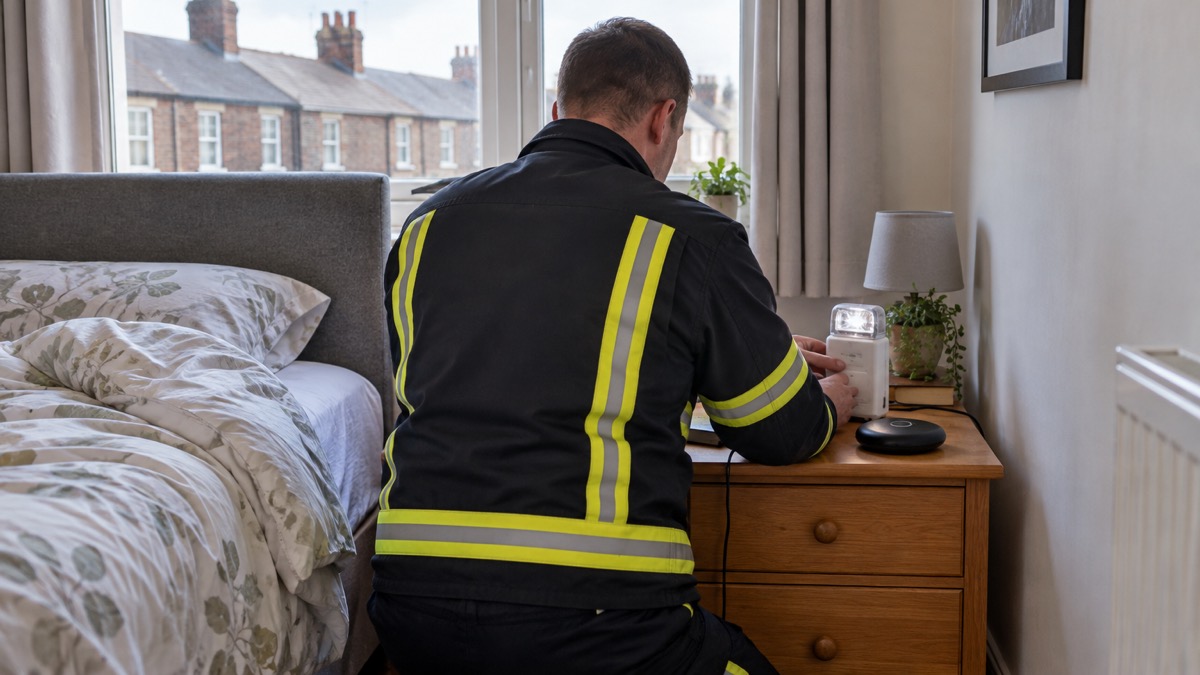
Fitting alarms is one of the main things a visit delivers. London Fire Brigade will even fit free smoke alarms during the visit if you need them1. South Wales Fire and Rescue Service will provide and install free smoke alarms and heat detectors where risk is identified5. The Welsh Government guidance adds carbon monoxide alarms to the list where needed11.
For deaf and hard of hearing people, specialist alarms are available through the same route. London Fire Brigade states that specialist alarms can also be fitted, for example strobe light and vibrating pad alarms for those who are deaf or hard of hearing24. South Wales Fire and Rescue Service likewise provides alarms for people who are Deaf or hard of hearing5. Devon and Somerset Fire and Rescue Service gives an example of how this works in practice: a customer with hearing aids was given equipment that would wake him if there is a fire when he takes his hearing aid out at night, plus a blanket4.
The Scottish Fire and Rescue Service maintains a deaf awareness page with resources, advice and guidance for people who are deaf or have hearing loss, including educational videos in British Sign Language25. Its colleagues in East, North and South Ayrshire have also worked with local organisations to produce a BSL video covering the Your Guide to Fire Safety booklet25.
The reason alarms matter so much is blunt. A third of Northern Ireland's fatal house fires in 2025 did not have working smoke alarms8. If your alarms are old, missing, or you cannot reach them to test, a free visit solves all three problems at once.
What happens during the visit
A home fire safety visit is a structured check, not a quick look round. Devon and Somerset Fire and Rescue Service lists what a visit covers:
- checking smoke alarms are set up correctly
- making a fire escape plan
- electrics and charging safely
- cooking safely
- heaters and heating
- bedtime checks
- identifying and discussing any further support, and fitting specialist fire safety equipment where required4
The advice on each topic matches what the services say year round. Cooking is the number one cause of accidental fires, according to NIFRS26, which advises never to leave cooking unattended, and if you need to leave the kitchen while cooking, even for just a few seconds, take pans off the heat or turn them off completely27. On electrics, NIFRS advises not leaving electrics charging on soft surfaces, not overloading extension leads, and staying vigilant for signs of overheating or malfunction when charging reusable vapes or e-cigarettes26. Smoking materials have been the leading cause of fatal house fires in Northern Ireland, accounting for 43% of such deaths over the past 10 years, and NIFRS strongly advises smoking outdoors at your property and extinguishing cigarettes before placing them in a suitable container such as a metal bin8.
Visits are short. Devon and Somerset says the visit usually takes around 45 minutes4; Northern Ireland says up to 40 minutes3; South Wales says about 30 minutes5. Devon and Somerset carries out home safety visits Monday to Friday, between 9am and 5pm, and offers a morning slot between 9.30am and 1pm or an afternoon slot between 1pm and 5pm4.
If you are worried about who is coming, you can check. Devon and Somerset Fire and Rescue Service says that if you have any concerns about the identity of someone visiting you, call 0800 05 02 9994. If you are worried about coronavirus and want staff to wear gloves and a face covering, let them know on the day or in advance on 0800 05 02 9994.
Safe and Well visits: help beyond fire safety
In some areas, the visit goes further than fire. Staffordshire Fire and Rescue Service offers a Safe and Well visit for residents who qualify, to ensure they are safe at home, and for those who do not fit the criteria it offers a tailored help and advice service instead14. You can contact its Contact Centre on 0800 0241 999, and residents who are deaf or hard of hearing can text a request or enquiry to 07528 983 10114.
The Safe and Well model covers wider wellbeing topics alongside fire safety. The five main additional topics are smoking cessation, home security, falls prevention, scamming awareness, and tackling loneliness and isolation22. This matters because the people most at risk from fire are often the same people at risk in other ways: 75% of Northern Ireland's 2025 fire fatalities were people who lived alone, and over 65% of those were also in the NIFRS People at Risk group8.
Referrals work in both directions. Fire services work with partner agencies to reach those most at risk23, and partners can refer households into the fire service, for example via the Scottish Fire and Rescue Service's referral routes13. NIFRS also provides safety advice beyond fire, including water safety, wildfire safety and seasonal fire safety advice23. So if a visit uncovers a need the firefighter cannot meet, such as falls prevention or loneliness, they can point you or refer you to the right support.
Where this fits with your wider home safety
A home fire safety visit is the single highest-value step in home safety because it is free, expert and tailored. Around it, a few related habits and pieces of kit make a real difference, and the fire service's own advice points the way.
If the power goes off, reach for a torch rather than a candle: our guides on torches, head torches and battery lanterns cover what to keep and where, and where to keep torchches so you can find them in the dark is worth reading alongside your escape plan. If you do use candles, follow the fire service's advice and our candle safety checklist, and consider LED candles as a safer alternative. Our page on charging and storing rechargeable torches safely covers how to keep torches ready and charged safely.
Finally, know what to do if the worst happens. The Scottish Fire and Rescue Service is unequivocal:
"The only safe thing to do is get out the building, call 999 and ask for the Fire Service."
Scottish Fire and Rescue Service9
NIFRS puts it the same way: get out, stay out and call 99926. Make your escape plan before you need it, and let the fire service help you make it for free.
Sources (27)
- Home fire safety visits, London Fire Brigade, 2026-10-25
- Fire and smoke alarms in Scottish homes, Scottish Government, 2024-08-14
- Home Fire Safety Check, Northern Ireland Fire and Rescue Service, 2026-10-25
- Home safety visits, Devon and Somerset Fire and Rescue Service, 2026
- Request a home safety visit, South Wales Fire and Rescue Service, 2026-08-20
- Smoke and heat alarms, Scottish Fire and Rescue Service, 2025-04-14
- Chimney safety leaflet, Scottish Fire and Rescue Service, 2024-01
- NIFRS reveals highest house fire fatalities in 25 years, Northern Ireland Fire and Rescue Service, 2026-01-23
- In an emergency, Scottish Fire and Rescue Service, 2026-10-25
- Help people be safer in their homes, London Fire Brigade, 2026-10-25
- Get a free home safety check from your local fire and rescue service, Welsh Government, 2026
- Fire safety and prevention, nidirect, 2025-06-09
- Home fire safety visits, Scottish Fire and Rescue Service, 2026-10-25
- Living alone, Staffordshire Fire and Rescue Service, 2026-10-26
- Crack down on fire risks this Easter, Northern Ireland Fire and Rescue Service, 2026-03-30
- Avoiding accidental fires in the home, nidirect, 2025-10-16
- Home Fire Safety Week Toolkit 2023, National Fire Chiefs Council, 2023
- Ten lives lost in accidental house fires in Northern Ireland this year, Northern Ireland Fire and Rescue Service, 2025-10-13
- Cost of living toolkit, National Fire Chiefs Council, 2022
- Your guide to fire safety, Scottish Fire and Rescue Service, 2023-11-03
- Self-assessment, South Wales Fire and Rescue Service, 2026-08-20
- Adverse weather events and fires, Llangattock Community Council, 2023-10-12
- Community safety, Northern Ireland Fire and Rescue Service, 2024-09-06
- Sprinklers, London Fire Brigade, 2026-10-25
- Deaf awareness, Scottish Fire and Rescue Service, 2024-08-08
- Student Fire Safety Week sparks practising safe charging, Northern Ireland Fire and Rescue Service, 2025-09-22
- Hop into safety this Easter: top tips from NIFRS, Northern Ireland Fire and Rescue Service, 2025-04