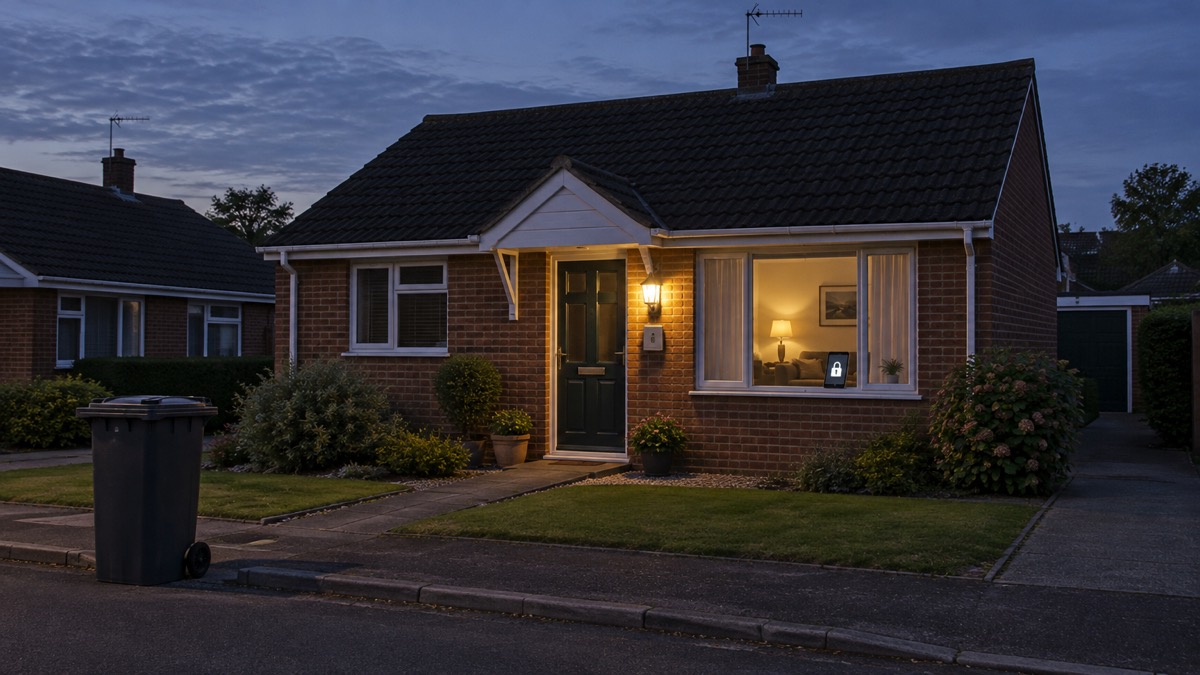
Living alone does not make an emergency more likely to happen, but it changes what happens next. Devon and Somerset Fire and Rescue Service explains the reason plainly: when you live alone, "there is no one around to help with alerting the occupant to risky behaviours, or to alert them to a fire or help with evacuation"1. Cheshire Fire and Rescue Service puts the same point in everyday terms: living alone can mean no one is immediately there to help if something goes wrong2. The practical answer is not to worry more, but to build a small set of arrangements so that someone always knows you are all right, and so that help can reach you quickly if you are not.
The numbers explain why this is worth an hour of your time. People who live alone are nearly 4 times more likely to die or be seriously injured in a fire, according to Staffordshire Fire and Rescue Service3. Without any working smoke alarms, you are 11 times more likely to die in a fire4. Staffordshire recorded 741 accidental house fires over five years in properties where the occupier lived alone and was aged 45 or over3. The risk is not evenly spread: Devon and Somerset's research finds living alone raises fire risk "but only when combined with other risk and vulnerability factors"1, so the more of those factors that apply to you, the more the arrangements on this page matter.
This page covers the things that make the biggest difference for someone on their own: check-in arrangements, fire safety, preventing falls, a key safe so help can get in, personal alarms and the digital phone switchover, what happens to alarms in a power cut, and staying safe through cold weather and heatwaves. If you also live with a disability, a health condition or you care for someone, the extra help section covers those situations in more depth.
Why living alone changes the risk
The core problem is detection and delay. In a two-person household, a fall in the hallway, a pan left on the hob or a sudden illness is usually noticed within minutes. Living alone, the same event can go unnoticed for hours or a full day, and in a fire the delay can be fatal. Devon and Somerset Fire and Rescue Service's research identifies eight factors that increase the likelihood of a fire: smoking, limited mobility, living alone, alcohol misuse, drug use, mental health concerns including memory loss, poor housekeeping such as hoarding or blocked escape routes, and not having a working smoke alarm1. Living alone appears on that list in its own right, but it also multiplies the effect of the others, because there is no second person to notice the risky behaviour or raise the alarm.
Age compounds this. Devon and Somerset note that older people are more likely to live alone, that those over 85 are more likely to have health concerns and reduced mobility, and that low-income households are less likely to have fire safety measures in the home1. Devon and Somerset's "Same 4" campaign states that older people aged 65 and over are at greater risk, "especially when living alone or if they have health conditions"9. Cheshire Fire and Rescue Service's Safe and Well booklet adds a sharper detail: a person under pensionable age living alone is most likely to experience a fire in the home, while someone over pensionable age living alone is most likely to die in the event of one10.
None of this means living alone is unsafe in itself. It means the safety net that other households get for free, a second pair of eyes, has to be built deliberately. The rest of this page is that net: alarms that shout for you, a key safe that lets responders in, a check-in arrangement that notices your absence, and telecare that summons help at the press of a button.
Fire safety when you live alone
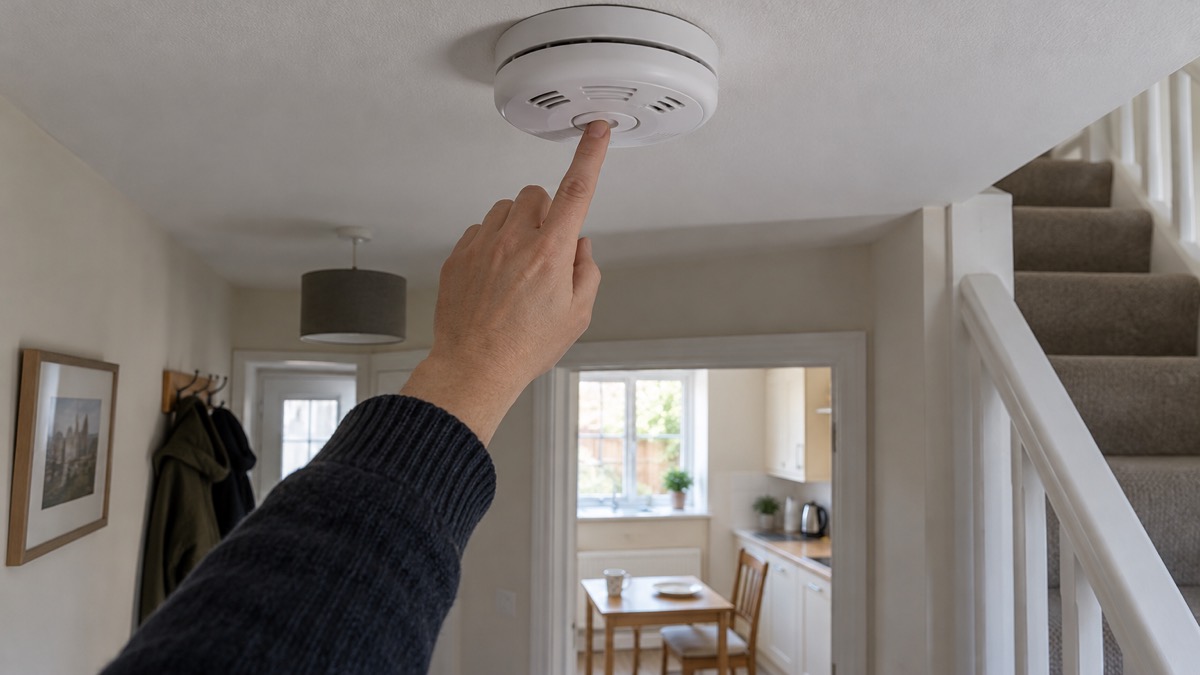
Fire is the emergency where living alone matters most, and the fire and rescue services' advice is consistent across the UK. Northern Ireland Fire and Rescue Service's home fire safety advice for people living alone covers the essentials: install a smoke alarm on all levels of your property, never remove the battery or take the alarm off its back plate unless you are replacing the battery or fitting a new alarm, fit a heat alarm in the kitchen rather than a smoke alarm, never overload sockets with one plug per socket, make a fire escape plan, and have a bedtime routine11. Surrey County Council's fire safety tips, reviewed in August 2026, list living alone among the recognised risk factors and repeat the core habits: test smoke alarms regularly, never leave cooking unattended, keep exits clear, and avoid overloading electrical sockets12.
The bedtime routine deserves a special mention for anyone on their own. Living alone is itself listed as a risk factor for fire13, and the fire safety advice for people living alone includes making a fire escape plan and having a bedtime routine, with doors to stairways not locked13. If you smoke, London Fire Brigade's guidance for carers of smokers carries a direct message for solitary smokers: "Encourage them to only light up if there is someone around to make sure they are safe"14. Applied to yourself, that means smoking is the moment to be most careful, and never smoking in bed or when drowsy.
If you live in a flat, the escape plan differs. South Wales Fire and Rescue Service advises that if you cannot safely use the stairs alone, go to a refuge point or place of safety15. Staffordshire Fire and Rescue Service adds the flat-dwelling rule: "If there's a fire elsewhere in the building, you are usually safest in your own flat, unless heat or smoke is affecting you"16. That stay-put principle matters most when you live alone, because it removes the pressure to make a dash down communal stairs on your own. If heat or smoke does reach you, leave by the nearest safe route and do not go back inside once you are out.
If a fire does start, the fire and rescue services' instruction is the same everywhere: raise the alarm without investigating, get out of the building, call 999 and stay outside17. For a fuller treatment of fire risk for older and disabled people, see fire risk for older and disabled people at home, and for help getting alarms tested if bending or reaching is difficult, see how to test smoke alarms if you have reduced mobility.
Preventing falls at home
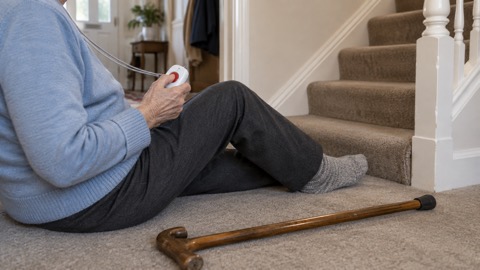
A fall is the most common emergency where living alone turns a mishap into a long lie on the floor, so prevention is worth as much as any alarm. The advice from health services and councils is strikingly consistent, and most of it costs nothing. South East Coast Ambulance Service's winter preparedness guidance lists the basics: mop up spillages immediately, remove clutter, trailing wires and frayed carpet, use non-slip mats and rugs, make sure all rooms, passages and staircases are well lit, organise your home so climbing, stretching and bending are kept to a minimum, get help to do things you cannot safely do alone, do not walk on slippery floors in socks or tights, avoid loose-fitting trailing clothes, and wear well-fitting shoes in good condition that support the ankle18. It also advises taking care of your feet, trimming toenails regularly and seeing a GP or podiatrist about any foot problems18.
Oxford Health NHS Foundation Trust's falls guidance adds the seasonal point: make sure stairs, hallways and walkways are well lit during the darker months19. Staffordshire County Council's maintaining your home guide boils it down to reducing clutter and clearing floors and walkways to prevent trips and falls20. Cornwall Council's slips, trips and falls advice for private tenants gives a practical checklist: keep the stairs clear, do not leave shoes or other things on the floor, clean up spills straight away, make sure your lights work and change lightbulbs when needed, use rugs that do not slip especially on wooden or tiled floors, and tell your landlord if something is broken or unsafe21.
| What to check | Why it matters | Who advises it |
|---|---|---|
| Trailing wires and frayed carpet removed | Common trip hazards at home | South East Coast Ambulance Service18 |
| Well-fitting shoes with grip, not socks or tights | Footwear decides whether a slippery floor catches you | South East Coast Ambulance Service18 |
Beyond those two, walk round your home and look for the hazards falls-prevention checklists single out: carpets and floor coverings that are not secure, loose rugs and mats, spillages left on the floor, and poor lighting on stairs, hallways and walkways. Many of these are hard to spot when you walk the same route every day, so ask a friend or relative to help you look.
North Wales Fire and Rescue Service's dementia fire safety guidance makes the same point for anyone whose attention or memory is variable: the risk of a fall can be minimised by paying attention to rugs, loose carpets especially on the stairs and slippery floors, and by removing trailing flexes, unsteady furniture and clutter22. Northern Ireland Fire and Rescue Service suggests an additional handrail at stairs or steps, and speaking to your GP to be referred to the Falls Prevention Team within your local Health Trust11. In England, ask your GP or council about a local falls prevention service. For what to do if a fall does happen, see falls at home: getting up, getting help and prevention, and for making the bathroom specifically safer, see how to make a bathroom safer against falls.
A key safe lets help get in fast
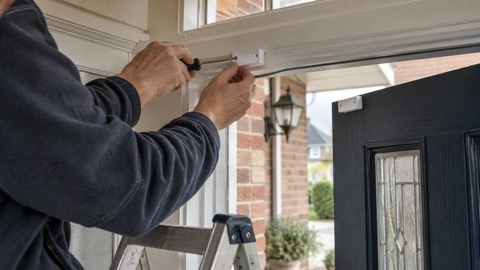
If you have a fall, a fire or a medical emergency at home, the ambulance or fire crew needs to get in. A locked door costs minutes, and forcing it costs damage and further delay. Devon and Somerset Fire and Rescue Service's equipment guidance describes the solution: "A key safe is a lockable box that holds a key. This means carers, family or emergency services can get into the home if" they need to, and some key safes are police-approved6. The box is fixed to an outdoor wall and opened with a code you choose, so only the people you give the code to can use it.
The same guidance covers a related fitting that helps in the opposite direction: getting out. Thumb turn locks, it says, "offer increased safety should you need a quick exit from the building, such as in the case of a fire or other emergency, as you don't need to locate the key first to unlock the door"6. For someone who may be confused, frightened or unable to reach a key in a hurry, a thumb turn on the final exit door removes one step from escaping.
If a key safe is not right for you, the simpler arrangements still work. The government's emergency preparedness advice for disabled people and carers, updated in October 2026, is to "Make arrangements with someone you trust to be able to access your home in an emergency (i.e. giving a family member, carer, or trusted neighbour a spare key)"5. The Scottish Government's emergency kit advice goes further and says to include spare keys to your home and car in your home emergency kit23. Whichever route you take, the test is simple: could someone reach you inside your home within a few minutes, at night, without breaking anything?
For more detail on choosing and positioning one, see key safes: letting carers and responders in and where to fit a key safe for emergency access.
Personal alarms, telecare and the digital switchover
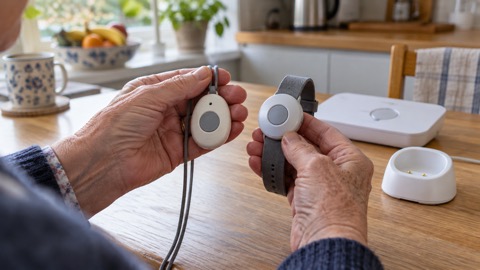
A personal alarm replaces the shout for help that a person living alone cannot rely on. Devon and Somerset Fire and Rescue Service describes the standard telecare package: "an emergency alarm unit with red button pendant so that help can be requested from a monitoring centre"6. The pendant is worn on the wrist or around the neck; pressing it opens a call to a monitoring centre, which can then send a named responder or emergency services. Lincolnshire County Council's telecare service notes that if you do not have a named family member or carer, you can use its Wellbeing Response Service instead24, and many councils arrange something similar. Telecare can also include monitored smoke detection, which is worth considering if you might not hear or react to a standard alarm quickly6.
Not everything needs to be a monitored service. Lincolnshire's Technology Enabled Care guidance points out that solutions "could be in the form of telecare devices, sensors, or simply 'off the shelf' household devices such as smart speakers, smart light bulbs, and one cup hot water dispensers"24. A smart speaker that lets you call a contact by voice, or a one-cup dispenser that removes the need to carry a full kettle, both reduce risk in daily life. For choosing between the main options, see personal alarms: types and how to choose one, what happens when you press a personal alarm, and the comparison of a home personal alarm or GPS alarm.
Tell your phone provider before January 2027
There is a deadline attached to all of this. Argyll and Bute Council's digital phone switchover guidance states: "Between now and January 2027 most telephone providers will be moving their customers from old analogue landlines over to" digital services7. Many telecare alarms were designed to work down an analogue phone line, and a switchover can stop them connecting to the monitoring centre. The council's advice is direct: "If you or a relative uses a Telecare alarm (can also be known as community alarm), please contact your provider to check that it is compatible"7. Your telecoms provider, for example Vodafone or BT, should contact you before the switchover to discuss what it means for you, but you do not need to wait for that call7.
When the power goes off: what happens to alarms and phones
A power cut or a phone network outage is the moment your arrangements are tested. The government's advice on phone and broadband outages, updated in October 2026, tells you what to do in advance: "If you have medical or personal alarm devices that use phone or internet connections, check with the provider or manufacturer how they work if the network is down", including how a personal alarm or a diabetes sensor would function if mobile or broadband service is lost8. Ask the question in those exact terms, and ask how long any battery backup in the alarm unit lasts.
The same official advice covers the human side of an outage: "Check in on neighbours, particularly anyone who might live alone or might need extra support, and make sure they know what's happening and have the help they need"8. Turned around, that means agreeing now with a neighbour that you will check on each other during an outage. Keep a charged mobile phone and a torch where you can find them in the dark, and keep a battery or wind-up radio so you can hear what is happening. For the fuller picture, see power cuts: a household guide, staying informed and in touch in an emergency, and the specific question of whether a telecare or personal alarm works in a power cut.
Staying well in cold weather
Cold weather raises several risks at once for someone alone: falls on icy steps, heating failures, and the slow drift into a cold house that no one else notices. The London Ambulance Service's seasonal advice is written for exactly this situation: "just popping in for a cup of tea to say hello and making sure they are stocked with groceries and their heating is working would make such a difference" to someone isolated and struggling in colder weather25. If you are that person, the same logic applies in reverse: arrange for someone to pop in, and make it easy for them by being stocked up before a cold snap.
Winter health guidance from NHS Highland's Your Health Guide adds a specific night-time rule: keep your bedroom windows closed at night26. It feels counter-intuitive to anyone brought up to air a room, but in cold weather a closed bedroom window keeps the temperature where it needs to be, and that matters most for older people. South East Coast Ambulance Service's winter guidance also covers the falls angle, with its advice on well-lit stairs and walkways during darker months18, and Oxford Health's falls guidance makes the same point19.
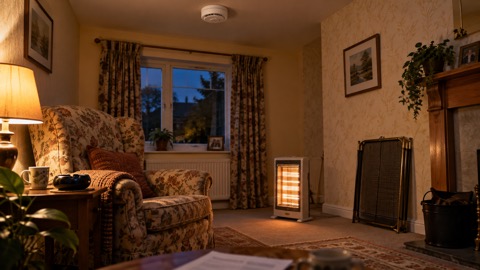
Heating safely matters as much as heating at all. Armagh City, Banbridge and Craigavon Borough Council's guidance on safe use of heaters and generators is blunt about the boundaries: electric space heaters should be used "only in enclosed, supervised spaces" and are "not for outdoor or unsupervised use (like garages or sheds) unless the heater is rated for that environment", while for indoor use of diesel heaters, "use vented diesel heaters only (connected to a chimney or flue)" and "use a CO alarm in any partially enclosed space"27. Never bring a heater designed for outdoors, such as a patio heater, inside.
If your heating fails, help exists before you resort to improvisation. Contact your energy supplier, your local council or the Age UK helpline, and if you rely on electricity for medical equipment or heating, join your supplier's Priority Services Register, covered in signing up to Priority Services Registers for energy and water. For heating and cooking without mains gas or power, see heating and cooking without mains power or gas, and for a checklist you can run through for an older relative, see winter checks for an older relative's home.
Staying safe in a heatwave
Heat is the mirror image of cold: the risk builds quietly, and living alone removes the person most likely to notice it. NHS heatwave guidance identifies "people who live alone and may be unable to care for themselves" as more vulnerable in a heatwave28. The Met Office's advice for keeping older people cool says to look out for those who may struggle to keep themselves cool and hydrated, noting that older people, those with underlying conditions and those who live alone are particularly at risk29. Mid and West Wales Fire and Rescue Service's heatwave advice says to pay special attention to those most at risk, namely elderly people and small children, ensuring they are comfortable and staying out of the sun as much as possible, and to wear loose fitting, breathable clothing and a hat if possible30.
For your own household, the practical steps follow from that: keep out of the sun during the hottest part of the day, drink regularly rather than waiting until you feel thirsty, wear loose clothing, and arrange for someone to contact you during a hot spell, since heat exhaustion can leave you confused and less able to help yourself. Age UK offers a range of free information and advice designed to help older people live well during the summer months and protect themselves when the temperature rises29. For the wider picture, see heatwaves and drought: a household guide.
Neighbour and community check schemes
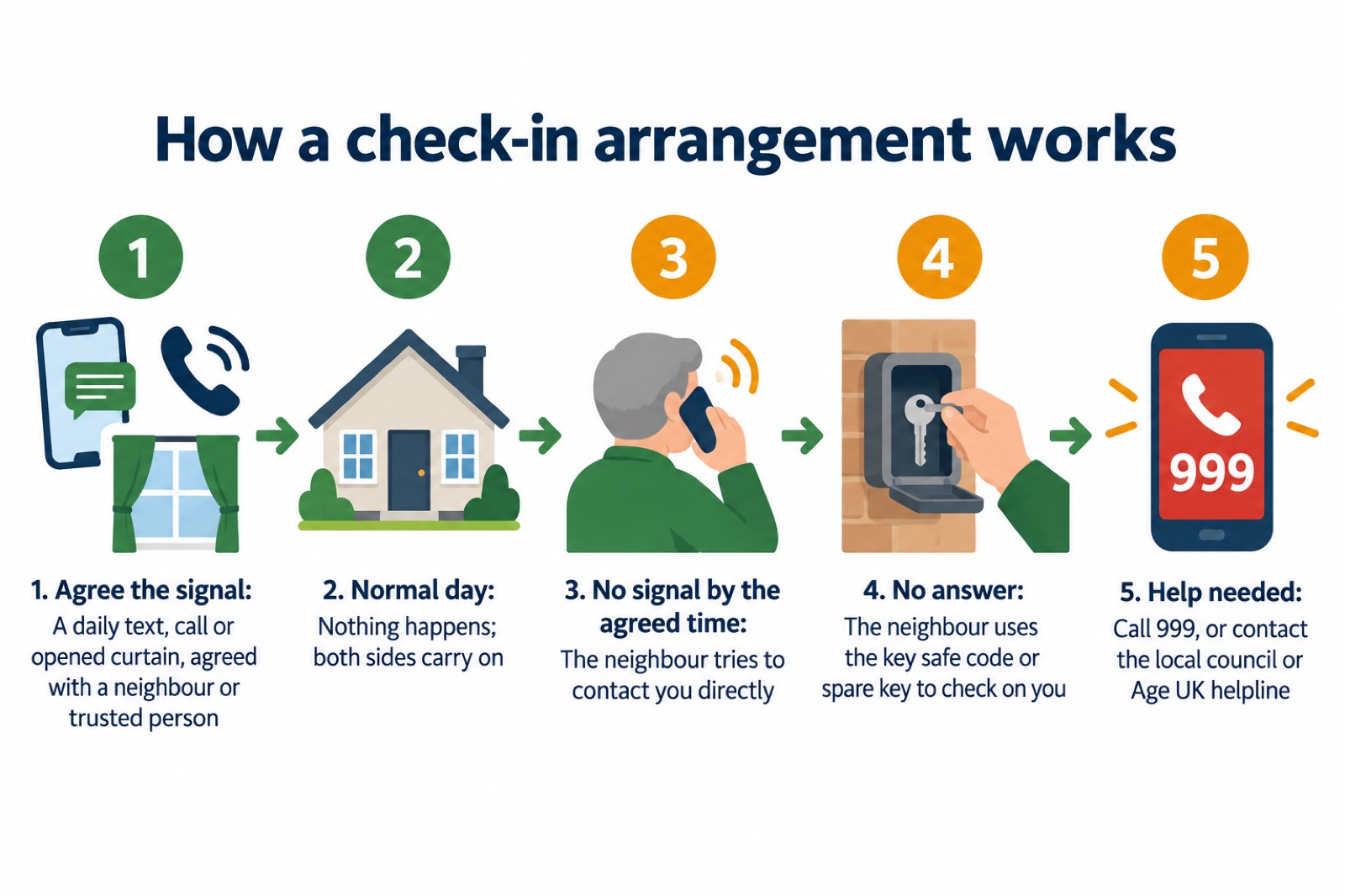
The single most valuable arrangement for someone living alone is also the simplest: someone who notices when you have not been in touch. The government's preparedness advice for disabled people and carers puts it as an instruction: "Make a plan with a neighbour or someone else you trust to check on you in an emergency situation if they haven't heard from you"5. That can be as informal as a daily text, a curtain opened in the morning, or a milk bottle taken in, agreed between two households. The point is that both sides know what counts as "not heard from" and what to do next.
The phone and broadband outage advice gives the same habit a place in wider emergencies: check in on neighbours, particularly anyone who might live alone or need extra support, and make sure they know what is happening and have the help they need8. South Western Ambulance Service's neighbour and vulnerable people support guidance names who to contact when a check-in reveals a problem: your local council, or the Age UK helpline, if you are concerned about someone's wellbeing31. Community-level schemes, from street groups to formal welfare check arrangements run through councils and charities, extend the same idea across a whole street. For how such groups organise, see community resilience: a guide for neighbours and local groups.
Where to get help: fire service visits, councils and Age UK
You do not have to assemble all of this alone, and several services will come to you. Fire and rescue services across the UK offer free home safety visits, often called Safe and Well visits, which are designed to help you spot fire risks early and offer support if you are feeling alone or need help staying safe2. The visits are free, they are not inspections, and you can refer yourself or ask a relative, neighbour or GP to refer you. For the process, see how to refer a vulnerable person for a fire safety check.
Beyond the fire service, the main sources of help are:
- Your local council: adult social care can assess needs at home, including falls prevention, equipment and telecare.
- Age UK: free information and advice for older people, including summer heat protection29, and a helpline you can call if you are worried about yourself or a neighbour31.
- Your GP: if you are worried about falls, speak to your GP about referral to falls prevention support in your area.
- Your energy and water suppliers: Priority Services Registers give extra support to households that need it, covered in what energy and water companies must do for registered customers.
- Your telecoms provider: contact them before the digital switchover if you use a telecare alarm7.
If you live in a park home, you face a particular combination of risks, since park homes can be more vulnerable to fire spread and are often occupied by people living alone. Contact your local fire and rescue service directly and ask about a home safety visit. For the wider set of arrangements for older, disabled and medically dependent households, start with the extra help section.
Sources (31)
- Home Safety Partnerships, Devon and Somerset Fire and Rescue Service, 2026
- Living Alone, Cheshire Fire and Rescue Service, 2026
- Living Alone, Staffordshire Fire and Rescue Service, 2026
- Domestic Fire, Prepare Campaign, 2026
- Advice for Disabled Persons and Carers, Be Ready Campaign, 2026
- Equipment, Devon and Somerset Fire and Rescue Service, 2026
- Digital Phone Switchover, Argyll and Bute Council, 2026
- Phone and Broadband Outages, Prepare Campaign, 2026
- Same 4: Fire Safety Starts at Home, Devon and Somerset Fire and Rescue Service, 2025
- Safe and Well Booklet, Cheshire Fire and Rescue Service, 2026
- Home Fire Safety, Northern Ireland Fire and Rescue Service, 2026
- Fire Safety at Home: Tips, Surrey County Council, 2026
- Bedtime Route and Escape Plan, North Yorkshire Fire and Rescue Service, 2026
- Caring for Smokers, London Fire Brigade, 2026
- High Rise Living, South Wales Fire and Rescue Service, 2026
- Plan Your Escape, Staffordshire Fire and Rescue Service, 2026
- Fire Safety for Parents and Child Carers, Dorset and Wiltshire Fire and Rescue Service, 2021
- Winter Preparedness, South East Coast Ambulance Service, 2025
- Falls Guidance at Home, Oxford Health NHS Foundation Trust, 2026
- Maintaining Your Home, Staffordshire County Council, 2026
- Slips, Trips and Falls, Cornwall Council, 2025
- Dementia Fire Safety, North Wales Fire and Rescue Service, 2026
- Emergency Kit, Ready Scotland, 2026
- Telecare, Lincolnshire County Council, 2026
- Keeping Safe and Well in Colder Weather, London Ambulance Service, 2026
- Your Health Guide Winter 2025, NHS Highland, 2025
- Safe Use of Heaters and Generators, Armagh City, Banbridge and Craigavon Borough Council, 2026
- Heatwave: How to Cope in Hot Weather, NHS, 2026
- Tips for Keeping Older People Cool, Met Office, 2026
- Heatwave Safety Advice, Mid and West Wales Fire and Rescue Service, 2026
- Neighbour and Vulnerable People Support, South Western Ambulance Service, 2026
 Carer's Emergency Plan
 Herbert Protocol Form
 In Case of Emergency Card
 Energy and Water Company Duties
 Personal Alarms
 What Happens When Alarm Pressed
 How Fall Detectors Work
 Home Oxygen Therapy Safety
 Airflow Mattress Fire Risk
 Fire Risk at Home
 Dementia and Emergencies
 Falls at Home
 Sight Loss and Emergencies
 Deaf and Hard of Hearing Safety