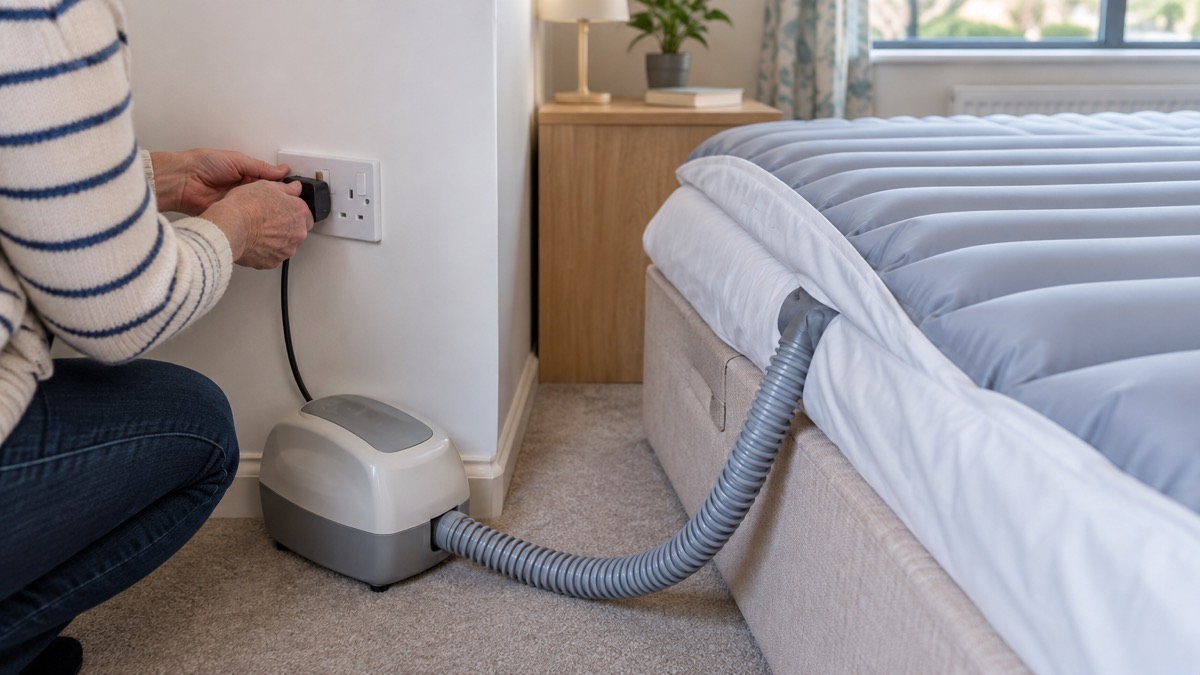
A dynamic airflow mattress is a piece of healthcare equipment that keeps someone bedbound or immobile for long periods comfortable and free of pressure sores. It is filled with air by an electric pump that adjusts the pressure to the person's needs1. That constant airflow is exactly what makes the mattress a serious fire hazard: if it is punctured by a heat source such as a match or a cigarette, the escaping air acts as a bellows, intensifying the fire and causing it to spread rapidly2.
Fire and rescue services across the UK are clear about the rules. Never smoke in bed or near an airflow mattress. Keep ignition sources such as candles, incense sticks and oil burners away. Keep fires and heaters at a safe distance. Never use an electric blanket on the mattress, and never place hot items such as hair dryers or hair straighteners on it3. Where medical oxygen is in use, the risk is greater still, because oxygen makes any fire burn more fiercely4.
This page explains why the risk exists, what happens when the pump loses mains power, and what to do about each source of ignition. It is written for households and carers, and every instruction comes from UK fire and rescue services or other official guidance.
Why a punctured airflow mattress makes fire spread rapidly
The danger comes from the way the mattress works. A dynamic airflow mattress is inflated by an electric pump, and the pump continuously adjusts the pressure according to the person's needs1. The mattress is kept constantly full of moving air.
If that surface is punctured by a heat source, such as a match or a cigarette, the escaping airflow can cause a fire to spread rapidly1. Devon and Somerset Fire and Rescue Service describes the mechanism plainly: the escaping air acts as a bellows, which can intensify the fire and cause it to spread rapidly2. North Yorkshire Fire and Rescue Service adds an important detail about the pump's behaviour: if the mattress becomes punctured, the pump works harder to keep the mattress inflated, and where the puncture is caused by an ignition source, the escaping air acts as bellows and can cause the fire to increase in intensity and to spread quickly7.
So the equipment does not merely catch fire like ordinary bedding. It actively feeds the fire with a stream of air, and the pump responds to the loss of pressure by pushing more air through. Greater Manchester Fire and Rescue Service has recorded five fire incidents in Greater Manchester relating to the use of dynamic air flow pressure relieving mattresses in the domestic environment over a four-year period, four of which were fatal, with two further incidents in other areas, one of which was fatal8. This is a real and documented risk, not a theoretical one.
The same principle applies to other air-filled pressure relieving devices. Manchester Fire and Rescue Service warns that if the mattress is punctured and air escapes, the released air can support the spread of fire9. West Yorkshire Fire and Rescue Service puts it in similar terms: if a fire occurs and an airflow product is punctured, escaping air can feed the fire, causing it to develop and spread very quickly6.
"If punctured by a heat source, the escaping airflow could fuel a fire which would spread rapidly."
Never smoke in bed or near an airflow mattress
This is the single most important rule, and every UK fire and rescue service gives it. Devon and Somerset Fire and Rescue Service's instruction is direct: never smoke near an airflow mattress, or let the person you care for smoke in bed1. Manchester Fire and Rescue Service extends it to all air-filled equipment: never smoke on, or near to, an air-filled pressure relieving mattress or device10.
The reasons are specific to this equipment. A cigarette or match dropped on the mattress can puncture it, and the escaping air then fuels the fire2. Beyond the mattress itself, standard smoking fire safety rules apply with extra force:
- Never leave smoking materials unattended3
- Never smoke in bed11
- Never smoke if you have taken medication that makes you feel drowsy or if you have consumed alcohol3
- Never smoke near oxygen therapy equipment or an airflow mattress3
- Do not smoke near clothing, bedding or dressings contaminated with emollient creams3
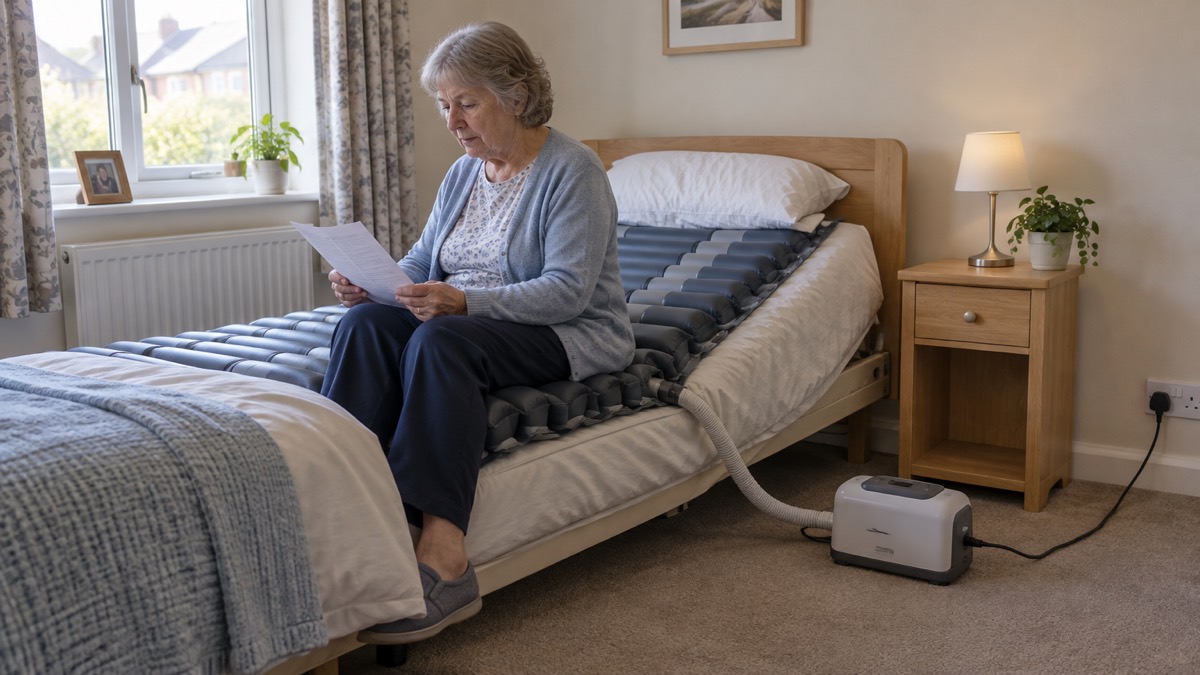
Two further risks are worth knowing. First, people who are bed or chair-bound and use incontinence products that cover an area outside their clothing are at higher risk when combined with smoking, because ash or embers can land on the pads and easily catch fire1. Second, Greater Manchester Fire and Rescue Service recommends that fire retardant bedding should be used to reduce fire risk, and that where there is a smoking risk the air flow mattress should be replaced8. If the person you care for will not stop smoking, raising the replacement of the dynamic mattress with the equipment provider is a legitimate and fire-service-backed step.
If smoking continues in the home at all, do it well away from the bed, use a proper ashtray, and put cigarettes out fully. Never smoke near the equipment, and never in bed1.
Keep ignition sources at a safe distance
Smoking is the most dangerous ignition source, but it is not the only one. London Fire Brigade's advice for carers lists the items to keep away from airflow mattresses: ignition sources such as matches, cigarettes, candles, incense sticks or oil burners5. The Scottish Fire and Rescue Service's carers guide says the same: keep ignition sources such as candles, incense sticks or oil burners away from air pressure relieving mattresses, keep fires and heaters away, and ensure electrical equipment is well maintained and kept a safe distance12.
The full list of things to keep away from the bed and the mattress:
- Matches and lighters5
- Candles5
- Incense sticks5
- Oil burners5
- Fires and heaters13
- Electric blankets: never use one on an airflow mattress3
- Hot items such as hair dryers or hair straighteners: never place them on the mattress3
Mid and West Wales Fire and Rescue Service adds a practical point about heaters: ensure all fires and heaters are kept at a safe distance from the equipment13. That matters most in winter, when portable heaters are brought close to beds. North Yorkshire Fire and Rescue Service advises plugging electric heaters into a wall socket rather than an extension lead, because extension leads can easily be overloaded and cause fires14.
Matches, lighters and candles should also be kept out of reach of children15, and, in a household where anyone might be confused or drowsy, out of reach more generally. Norfolk's NHS guidance for families simply says: keep matches, lighters and cigarettes out of reach16.
Medical oxygen makes any fire burn more fiercely
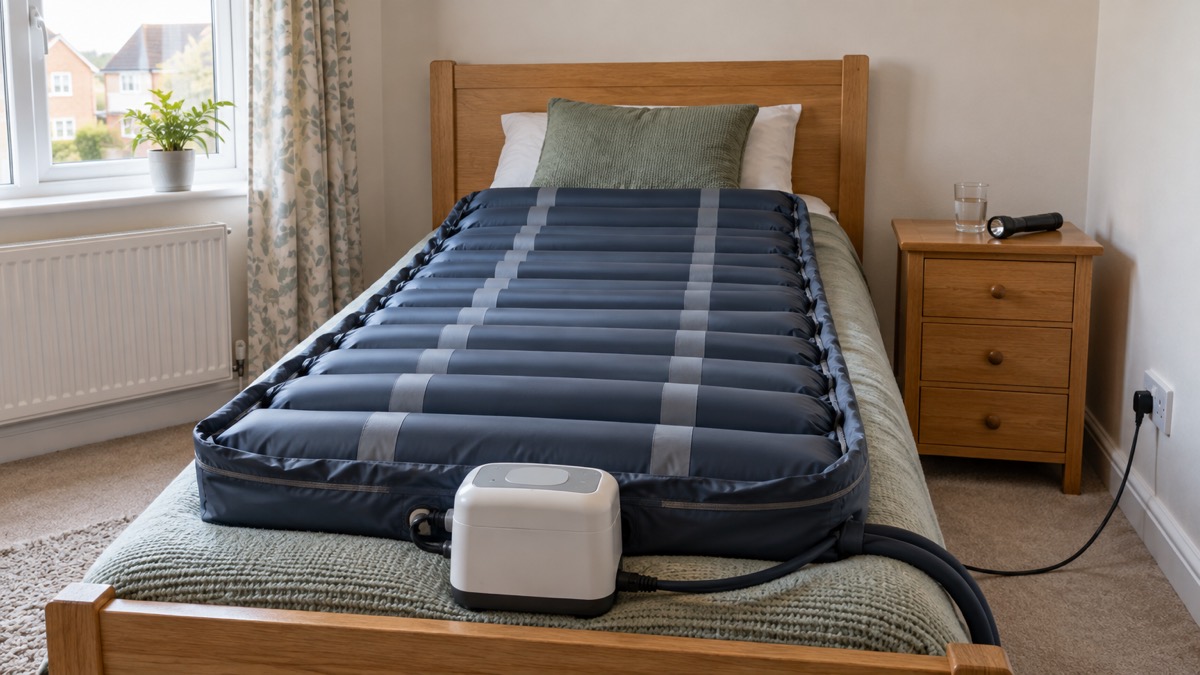
Many people who use a dynamic airflow mattress also use medical oxygen, and the two together raise the stakes considerably. Mid and West Wales Fire and Rescue Service states it plainly: the use of medical oxygen will further intensify any fire that starts13. Warwickshire County Council's fire safety guidance makes the same point: oxygen supports combustion and can accelerate fire incidents17.
The reason is that oxygen significantly increases flammability, making materials that would not typically catch fire easily much more combustible13. The Scottish Fire and Rescue Service explains how this builds up in a home: oxygen, even at low flows, can saturate everyday items such as clothing, furniture and carpets, creating an environment where fires can ignite and spread rapidly4. Devon and Somerset Fire and Rescue Service describes the same effect: the oxygen-rich atmosphere stays within clothing and furnishings, creating an increased risk of rapid-fire spread, which is a particular risk for smokers1.
There is also a risk to anyone responding to a fire. Medical oxygen cylinders pose a risk to firefighters and the user in the event of a fire because the heat can cause the cylinders to explode1.
If oxygen is used in the household:
- Never smoke, and never let anyone else smoke, near oxygen therapy equipment3
- Never introduce an ignition source close to the oxygen or into an oxygen enriched environment18
- Keep e-cigarettes and vapes away from oxygen equipment19
- Tell the fire and rescue service about the oxygen when you request a home fire safety visit, so responders know what to expect
For more on oxygen itself, including what happens to the supply in an emergency, see our guide to home oxygen therapy.
Battery backup in a power cut: the pump can keep feeding a fire
Dynamic airflow mattress pumps contain an emergency battery backup. In a power cut, that backup keeps the pump working, which is good for the person's comfort and pressure care, but it has a fire safety consequence. Devon and Somerset Fire and Rescue Service warns that the emergency battery backup may continue to pump air, which can cause the fire to burn longer1. The Scottish Fire and Rescue Service gives the same warning20. Northern Ireland Fire and Rescue Service combines the two risks in one instruction: if punctured by a heat source, the escaping airflow could fuel a fire which would spread rapidly, and the emergency battery backup may continue to pump air, causing a fire to burn longer3.
In other words, a power cut does not make the mattress safer. The pump keeps discharging compressed air even without mains electricity21, so the rules on smoking, candles and heaters matter just as much during an outage as at any other time.
A few practical points for power cuts in a household with this equipment:
- Check that any mains powered smoke alarm's battery back-up is working after a power cut22
- Keep the pump plugged in so its own battery stays charged and the mattress keeps working
- Do not bring candles or flame-based lighting closer to the bed during the outage; use torches instead
- If power cuts are frequent in your area, the Environment Agency's flooding preparation guidance notes you may need a back-up generator for an electric pump if there are power cuts23
Households that depend on mains power for medical equipment can also register as priority customers with their energy supplier. See our guide to signing up to Priority Services Registers, and for alarms that rely on electricity, whether a telecare or personal alarm works in a power cut.
Plug the pump directly into a wall socket
West Yorkshire Fire and Rescue Service's guidance on airflow pressure-relieving equipment is specific: plug equipment directly into a wall socket, and avoid multi-socket adapters6. The reason is electrical load. Heaters and other high-drawing appliances plugged into the same adapter can overload it, and overloaded adapters cause fires. The Scottish Fire and Rescue Service's general electrical safety advice warns against putting too many plugs in sockets24, and Armagh City, Banbridge and Craigavon Borough Council's guidance on heaters states that heaters draw a lot of power and can cause cords to overheat, leading to fires, so they should be plugged directly into a wall outlet and never into extension cords or power strips25.
The pump runs continuously, so it needs a reliable, dedicated supply. Give it its own wall socket, and do not share that socket with a heater, a kettle or anything else that draws significant power.
Related electrical points from fire service guidance:
- Appliances left plugged in, in sleep mode or on standby still have power flowing through them24
- Unplug appliances when you are not using them, when they are fully charged, or when you go to bed26
- Batteries, including those in vapes and other devices, present a fire risk when over-charged, short-circuited, submerged in water or damaged27
Never attempt to power the pump from a generator plugged into a wall outlet. The council guidance on generators warns never to connect a generator directly to your domestic electrical system by plugging it into a wall outlet, because backfeeding puts neighbours and workers at severe risk25. If a generator is genuinely needed for the pump, it must be connected properly, and the equipment supplier should be asked first.
How a dynamic airflow mattress works, and who uses one
Dynamic airflow pressure relieving mattresses and overlays are used to prevent and treat pressure sores and ulcers, which can be caused by extended periods of immobility28. Mid and West Wales Fire and Rescue Service describes the equipment as specifically designed to prevent or treat pressure sores caused by being bedbound or immobile for extended periods13.
The equipment may include pillows as well as mattresses, all filled with air by a pump, with pressure adjusted through the pump according to individual needs5. It is the "dynamic" part, the continuously moving and adjusted air, that distinguishes these mattresses from static pressure relieving surfaces, and it is the same feature that creates the fire risk. A static mattress has no pump and no escaping airflow, so a puncture does not feed a fire in the way a dynamic mattress can.
The equipment is normally supplied or prescribed rather than bought off the shelf, which means there is a named provider behind it. If you have questions about the mattress, the pump, its battery backup or a possible replacement, contact the equipment provider or the healthcare professional who arranged it. Where there is a smoking risk, Greater Manchester Fire and Rescue Service recommends the air flow mattress should be replaced, and fire retardant bedding should be used to reduce fire risk8, so this is a conversation worth having with the supplier.
Talking to the person you care for about fire safety
Manchester Fire and Rescue Service asks carers to talk with the person they are providing care for about the associated fire safety advice, especially staying away from smoking materials, naked flames, or other ignition sources that could puncture the mattress and start a fire9. That conversation matters, because the person using the mattress is the one exposed to the risk every night, and rules imposed without explanation are easily forgotten.
Some points that help the conversation:
- Explain the mechanism in plain terms: the mattress is full of air under pressure, and if a flame punctures it, the escaping air fans the fire rather than letting it die down2
- Agree where smoking will happen, if it continues: out of bed, away from the mattress and any oxygen equipment1
- Agree where candles, incense and oil burners will be kept, or whether they will be replaced with torches or electric lighting5
- Keep matches, lighters and cigarettes out of reach if there is any risk of drowsiness, confusion or unsupervised use3
- Make sure smoke alarms are working and can be heard in the bedroom
Fire and rescue services want to hear from households like this. Mid and West Wales Fire and Rescue Service asks anyone who knows a person using a dynamic airflow mattress to have a chat with them about Home Fire Safety Visits13. These visits are free, and a referral can be made by the person themselves, a carer, a family member or a support worker. Our guide on how to refer a vulnerable person for a fire safety check walks through the process.
Unpaid carers can also plan ahead for the moments they cannot be there. See our pages on carers: planning for when you cannot be there and the carer's emergency plan checklist, and for the wider picture of fire risk in the home, fire risk for older and disabled people.
Sources (28)
- Specialist health equipment, Devon and Somerset Fire and Rescue Service
- Specialist health equipment, Mid and West Wales Fire and Rescue Service
- Home fire safety, Northern Ireland Fire and Rescue Service
- Medical oxygen, Scottish Fire and Rescue Service
- Specialist health equipment, London Fire Brigade
- Medication and medical devices, West Yorkshire Fire and Rescue Service
- Medical equipment, North Yorkshire Fire and Rescue Service
- Safer Together: Fire Risk Identification and Management, Northern Ireland Fire and Rescue Service, 2021-02
- Pressure relieving devices, Manchester Fire and Rescue Service
- Smoking, Manchester Fire and Rescue Service
- Top ways to reduce your risk of having a fire in the home, Devon and Somerset Fire and Rescue Service
- Supporting fire safety: home carers guide, Scottish Fire and Rescue Service, 2021-05
- Specialist health equipment, Mid and West Wales Fire and Rescue Service
- Heating your home, North Yorkshire Fire and Rescue Service
- Fire safety advice in your flat, Manchester Fire and Rescue Service
- Burns and scalds, Just One Norfolk (NHS)
- Fire safety when using medication and medical equipment, Warwickshire County Council
- Additional advice for carers of home oxygen users, Manchester Fire and Rescue Service
- Digital easy read fire safety booklet, London Fire Brigade
- Air pressure relief mattresses, Scottish Fire and Rescue Service, 2024-05-31
- Home safety partnerships, Devon and Somerset Fire and Rescue Service
- Winter safety, North Wales Fire and Rescue Service
- Prepare your property for flooding, GOV.UK, 2009-10-01
- Electrical safety, Scottish Fire and Rescue Service, 2025-02-27
- Safe use of heaters and generators, Armagh City, Banbridge and Craigavon Borough Council
- Stay safe over 18m flat fire safety, Manchester Fire and Rescue Service
- Batteries, Humberside Fire and Rescue Service
- Healthcare equipment: advice for carers, Dorset and Wiltshire Fire and Rescue Service, 2025-11-19
 Carer's Emergency Plan
 Herbert Protocol Form
 In Case of Emergency Card
 Energy and Water Company Duties
 Personal Alarms
 What Happens When Alarm Pressed
 How Fall Detectors Work
 Home Oxygen Therapy Safety
 Fire Risk at Home
 Dementia and Emergencies
 Falls at Home
 Living Alone Safely
 Sight Loss and Emergencies
 Deaf and Hard of Hearing Safety