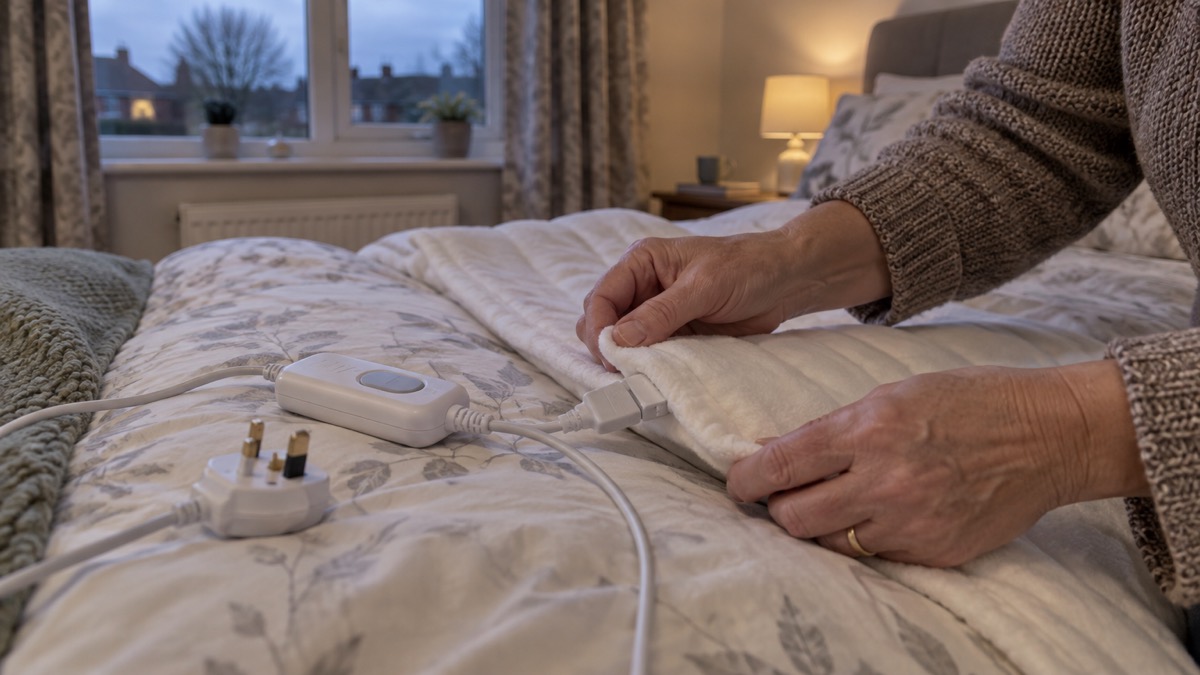
An electric blanket is a low-cost way to stay warm in a cold bedroom, but it is also an electrical appliance that lies under or over you while you sleep, and that makes its condition matter. Warwickshire County Council's fire safety guidance is blunt about the stakes: electric blankets cause hundreds of fires a year1. Mid and West Wales Fire and Rescue Service adds that fires caused by electrical appliances and electric blankets have the highest rate of injury of any fire type, at 440 injuries for every 1,000 fires2.
The good news is that almost all of this risk is avoidable at home, without special tools or knowledge. The actions that fire and rescue services repeat year after year are simple: check the blanket for damage before each winter, never use it with a hot water bottle, fit the correct fuse, store it flat or rolled rather than folded, and replace it once it passes 10 years old. This page sets out each of those steps, what to look for, who should not use an electric blanket at all, and where to get one tested for free.
Why fire and rescue services take electric blankets seriously
The headline numbers explain the attention. Devon and Somerset Fire and Rescue Service reports that some 7,000 house fires a year in the UK are caused by faulty electrics, appliances, wiring and overloaded sockets9. North Wales Fire and Rescue Service's winter safety advice puts a figure on the blanket share of that: 5,000 fires a year are caused by faulty electric blankets10. Devon and Somerset also notes that faulty electric blankets are a common cause of fire, alongside electrical chargers and appliances that do not comply with British or European safety standards11.
Two things make blanket fires unusually dangerous compared with other electrical fires. First, the blanket is in the bed with you, so a fire starts close to bedding and to a sleeping person. Second, the blanket itself is the thing being heated, so a fault in it develops where you are lying rather than across the room.
The pattern of recent product recalls shows where the risk comes from: heating elements that overheat. Since 2023, the government's product safety body has recalled electric heated blankets sold by Online Home Shop, which presented a serious risk of fire12; B&Q GoodHome Saturnia blankets, where an electric component can overheat and present a risk of fire and electric shock13; Snuggla king size blankets sold via Amazon, eBay, Etsy and TikTok Shop, which are prone to overheating in use and present a serious risk of fire and burns14; and Hamilton McBride single, double and king size blankets, whose heating element can overheat and cause the blanket to ignite15. If you own a blanket from any of these ranges, stop using it and follow the instructions on the recall notice.
Who should not use an electric blanket
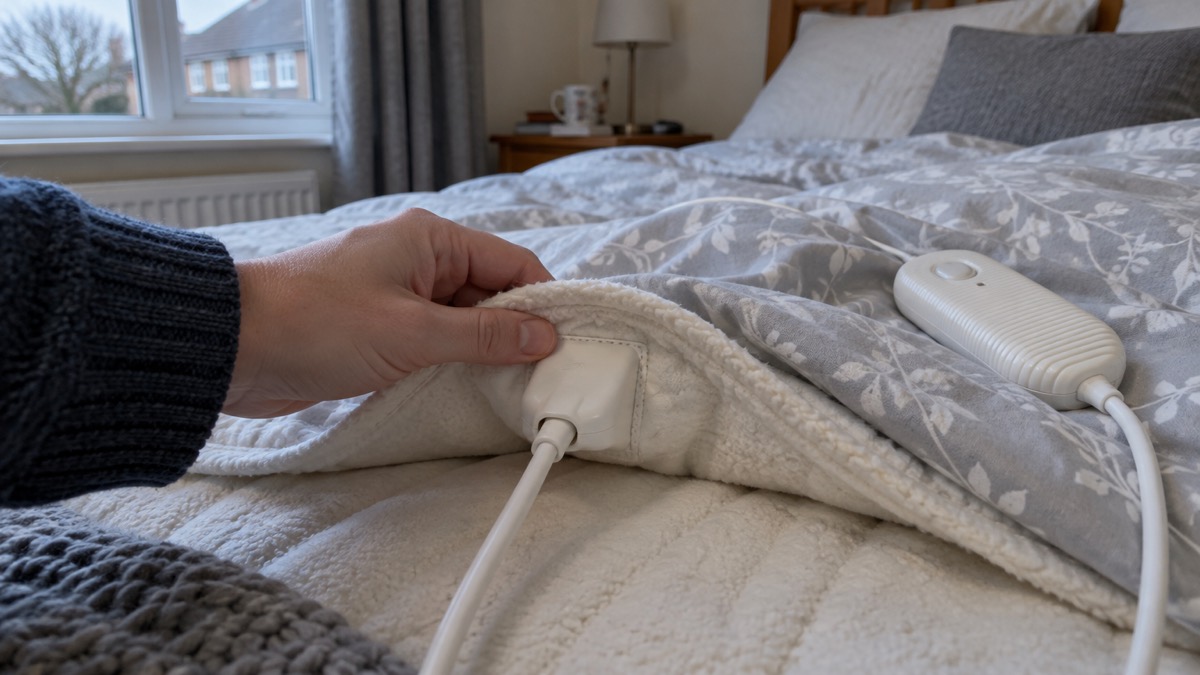
Some people should not use an electric blanket at all, whatever its condition, because of how they sleep or what they use on their skin. This is official fire and rescue service advice, not a matter of preference, and it applies even to a brand-new blanket.
Manchester Fire and Rescue Service advises: do not use an electric blanket if you have a pressure relieving device, experience incontinence or use emollient creams17. North Yorkshire Fire and Rescue Service goes further on the mattress point: never use an electric blanket if you have an air flow pressure relief mattress or use emollient creams, and ask for non-flammable alternatives instead18. Emollient creams matter because they transfer to bedding and make fabric more flammable; the air flow mattress matters because the blanket's heat and wiring interact badly with the device.
Humberside Fire and Rescue Service adds two more groups: do not use an electric blanket on the bed of a helpless person, an infant, or a person who may have a condition that makes them insensitive to heat19. Someone who cannot feel overheating, or cannot move away from it or call for help, is exactly the person a blanket fire would harm most. The same service advises that people with pacemakers fitted should not use heated bedding for all-night use19.
If any of these apply to you or someone you care for, ask about non-flammable ways of keeping warm instead: extra bedding and nightwear, a warm drink before bed, and keeping the bedroom door closed to hold heat in. Our page on clothing and bedding to stay warm in a cold home covers these options, and extra help in an emergency lists the support available to older and disabled households.
| Who | The advice | Who gives it |
|---|---|---|
| People with a pressure relieving device or air flow mattress | Do not use an electric blanket | Manchester FRS17; North Yorkshire FRS18 |
| People who experience incontinence | Do not use an electric blanket | Manchester FRS17 |
| People who use emollient creams | Do not use; ask for non-flammable alternatives | Manchester FRS17; North Yorkshire FRS18 |
| Helpless people and infants | Do not use on their beds | Humberside FRS19 |
| People insensitive to heat | Do not use on their beds | Humberside FRS19 |
| People with pacemakers | No all-night use of heated bedding | Humberside FRS19 |
The plug and fuse: small parts that matter
An electric blanket in the UK must run through a three-pin UK plug, and that plug must carry the right fuse. Mid and West Wales Fire and Rescue Service's electric blanket safety guidance states that a 3 amp BS 1362 fuse must be fitted6. Scottish Fire and Rescue Service includes electric blankets in its list of appliances that take a 3 amp fuse, alongside lamps, televisions, radios, clocks and games consoles16. A fuse that is too heavy will not blow when it should, and a lightweight flex protected by too high a fuse is a fire risk in itself.
If you buy a blanket from a UK merchant, Electrical Safety First advises checking that it has a three-pin UK plug, which should also include a fuse20. Blankets bought online from overseas sellers sometimes arrive with an adaptor or a two-pin plug and no UK fuse; treat that as a reason not to use the blanket until it has been checked.
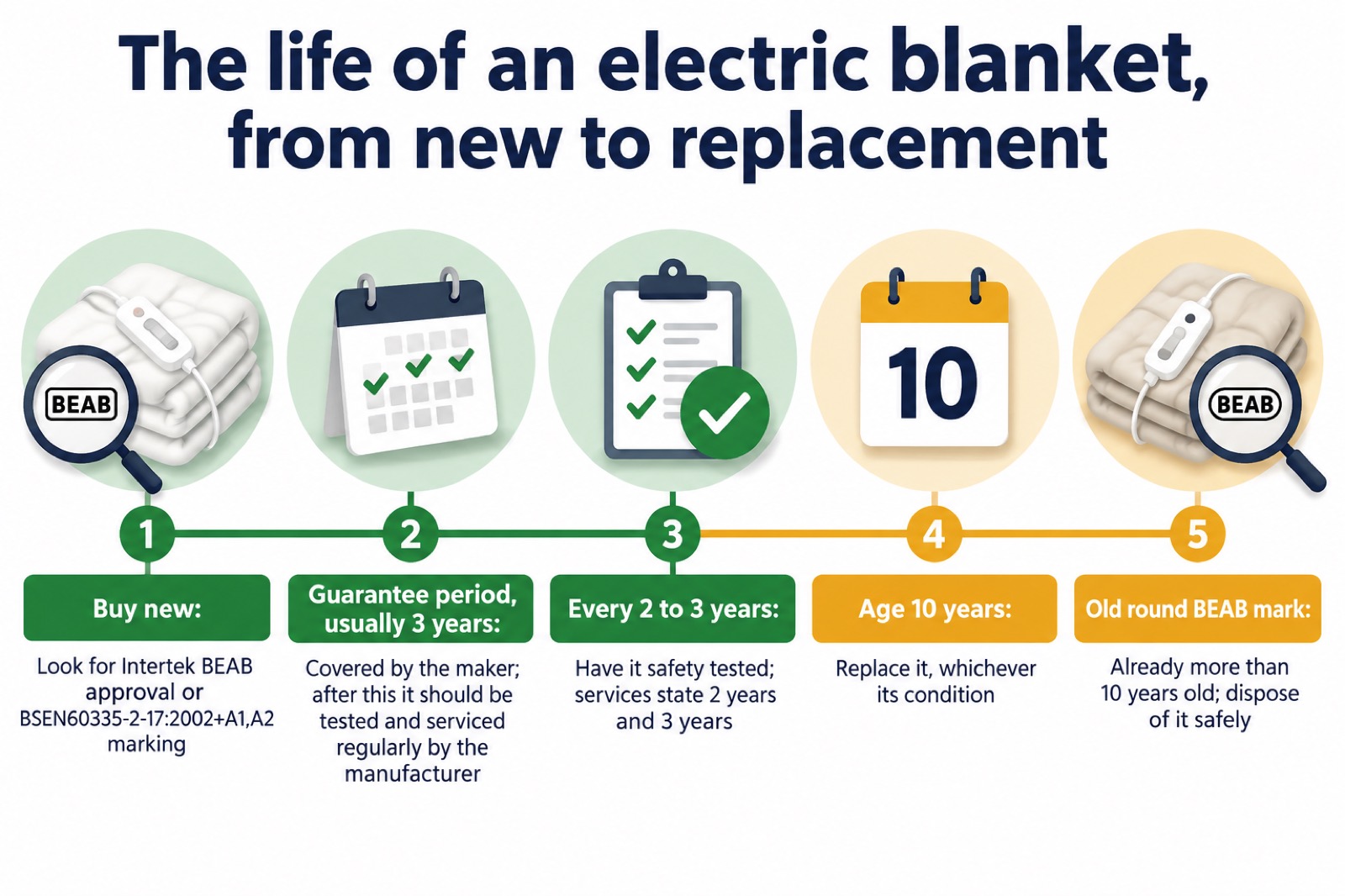
When you buy new, look for the safety marks. Scottish Fire and Rescue Service says to make sure the blanket is either Intertek BEAB approved or marked BSEN60335-2-17:2002+A1,A216. The current BEAB approval is a recognised certification; the old round BEAB symbol is a different matter entirely, and is covered below under replacement age.
Check it before every winter: the full list of danger signs
Go over the blanket, its flex and its connections before you put it on the bed each autumn, and again if it has been off the bed for a long time. Check for danger signs such as fraying fabric or scorch marks1, and look more widely for exposed elements, creasing or folding, soiling, damp patches, damaged or missing tie tapes, worn flex and loose connections3.
- Fraying fabric3
- Scorch marks3
- Exposed elements3
- Creasing or folding3
- Soiling3
- Damp patches3
- Damaged or missing tie tapes3
- Worn flex3
- Loose connections3
Mid and West Wales Fire and Rescue Service adds one more replacement trigger: the fabric is worn or frayed6. North Yorkshire Fire and Rescue Service's advice is simply to always check electric blankets regularly for wear21, and Lancashire County Council's healthy home guidance says to always check regularly for signs of wear or damage and to contact the manufacturer if in doubt about its safety22.
Two of the list items deserve a word of explanation. Creasing and folding matter because they point to how the blanket has been stored: a blanket that has been folded hard has bent wiring inside it, and bent or pinched wiring is what leads to short circuits. Damp patches matter because water and electricity do not mix, and a blanket that has been damp may have damage you cannot see. If in doubt, do not guess: contact the manufacturer22.
How old is too old: the 10-year rule and the round BEAB mark
Fire and rescue services agree on the age limit. Manchester Fire and Rescue Service says to replace your electric blanket when it is more than 10 years old3. Mid and West Wales Fire and Rescue Service says the same: electric blankets should be replaced every 10 years and tested every 2 years4. Shropshire Community Health NHS Trust's home safety advice puts it as a pair of rules: electric blankets should be safety checked every 3 years and replaced every 10 years5.
The round BEAB mark is a quick way to date an older blanket without paperwork. Warwickshire County Council explains that an old BEAB safety mark, the round symbol, means the blanket is more than 10 years old1. If you are looking at a blanket with that mark, it has already passed the replacement age, and the advice is to consider disposing of it safely and buying a new one6.
Testing: every two to three years, and where to go
The testing interval is the one point where official guidance differs slightly, and it is worth knowing both figures. Mid and West Wales Fire and Rescue Service says electric blankets should be tested every 2 years4. Shropshire Community Health NHS Trust says every 3 years5, as does the Greater London Authority's cold weather guidance7, Suffolk's Winter Matters campaign23, Derbyshire County Council, which says to have electric blankets serviced at least every 3 years24, and NHS Western Isles' Keep Safe Keep Well campaign, which notes that manufacturers often recommend testing every 3 years25.
Scottish Fire and Rescue Service adds a timing detail that helps you plan: after the guarantee runs out, usually 3 years, the blanket should be tested and serviced regularly by the manufacturer16. So the guarantee period tells you when the testing clock starts.
Where to go depends on your area. Some fire and rescue services and councils run free electric blanket testing sessions, and Oxfordshire's programme lists electric blanket safety check locations running in September and October 202626. These sessions are usually held in the autumn, before the cold weather arrives, so September is the month to search for your local service's programme. If your area does not run free testing, contact the blanket's manufacturer, since official guidance says testing and servicing should be carried out by the manufacturer16. Norfolk County Council's Stay Well This Winter campaign also points people to Electrical Safety First for electric blanket advice27.
Storing it without damaging the wiring
Storage is where most avoidable damage happens, and the rule is consistent across every service that publishes guidance: do not fold an electric blanket. North Wales Fire and Rescue Service says to store electric blankets flat or rolled up, never fold, and not to use one if the wiring is old or damaged8. Lincolnshire County Council says the same: do not fold them, as it can damage the wiring28. NHS Western Isles' campaign puts it as "roll them, don't fold them"25.
The simplest option is to leave the blanket on the bed all year round, or place it flat on a spare bed6. A blanket that never leaves the mattress can never be folded wrong. If you do need to put it away, store it flat, rolled up or loosely folded to prevent damaging the internal wiring29. The one thing no guidance permits is folding, because folding can damage the wiring.
The reason behind all of this is mechanical. Warwickshire County Council's electrical fire safety guidance explains that pinching or folding can damage the internal wiring and potentially cause a short circuit or fire30. The heating element inside a blanket is a thin wire; fold it sharply and repeatedly, and it breaks or chafes against itself, and the damage is invisible from outside the fabric.
Electric blanket or heated throw: how each is used
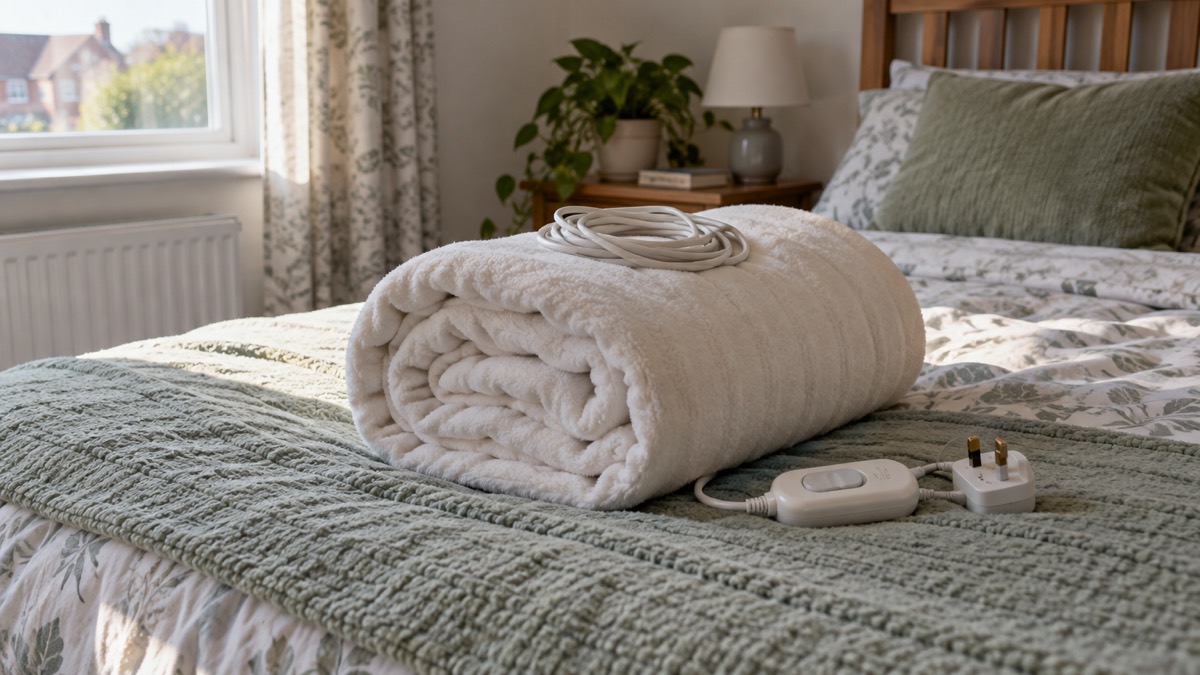
Households often use the words interchangeably, but the two are positioned differently, and using each the wrong way round is itself a hazard. Electrical Safety First's guidance is specific: under-blankets must only be positioned under the occupant of the bed, and over-blankets must only be positioned above the occupant20. An under-blanket laid over the sleeper, or an over-blanket slept on top of, puts wiring where it was never designed to be, and traps heat against the element.
Electrical Safety First also flags adjustable beds as a special case: under-blankets should not be used on adjustable beds, and if one is used on an adjustable bed, check that the blanket and cord do not become trapped or rucked, for example in the hinges20. A moving bed frame is exactly the kind of pinch point that damages wiring.
Know which type of warming you have bought, because some are not meant for all-night use. Cumberland Council's keeping warm guidance says to check what type it is: some electric blankets are designed only to warm the bed before you get in and should not be used throughout the night31. The maker's instructions state which type yours is. Suffolk Fire and Rescue Service gives the matching safety rule: unplug blankets before you get into bed, unless the blanket has a thermostat control for safe all-night use29.
A heated throw used on the sofa follows the same principles: check it for the same danger signs, keep it flat rather than bundled, and follow the maker's instructions on duration. The NHS Norfolk and Waveney integrated care board's winter guidance sums up the whole approach: electric blankets and portable heaters can be a great way to stay warm, but it is important that they are used safely32. For other ways to warm a room or a bed safely, see our guides to portable heaters, using a portable heater safely and keeping one room warm.
Never with a hot water bottle, and other rules of use
The single most repeated rule in all the guidance is also the easiest to break by accident on a cold night: never use a hot water bottle and an electric blanket at the same time. Nidirect's Northern Ireland advice explains the reason: to prevent the risk of electrocution, avoid using an electric blanket with a hot water bottle33. Water escaping from a bottle onto a live blanket, or onto dampened wiring, is the hazard. Choose one or the other each night. If it is the bottle, nidirect advises filling it with warm water, never boiling, to prevent scalds or burns33, and our hot water bottle guide covers checking and replacing them.
The other rules of use come from the same body of official advice:
- Use the blanket only as instructed by the maker7
- Unplug before getting into bed unless it has a thermostat control for safe all-night use29
- Check regularly for wear or damage, and contact the manufacturer if in doubt about its safety22
- Make sure everyone in the household knows how to use electric blankets safely; London Fire Brigade includes this in its family fire safety advice34
Second-hand blankets, recalls and safe disposal
Official advice on second-hand blankets is consistent: avoid them. Suffolk Fire and Rescue Service says to try not to buy second-hand blankets and to check regularly for wear and tear29, and its seasonal winter campaign states that electric blankets should be bought new23. The reasoning is practical rather than precious: a blanket's age and storage history decide its safety, and neither is visible in a photograph on a resale listing. A blanket that was folded in a drawer for years, or that is already past its 10-year life, can look perfect and still be unsafe. If you are given one, work through the danger signs list above and have it tested before anyone sleeps under it.
Check recall notices before and after buying. The government's product safety alerts pages carry the recalls mentioned earlier: Online Home Shop electric heated blankets, recalled in April 2023 as they present a serious risk of fire12; B&Q GoodHome Saturnia electric blankets, recalled in December 2025 over a fire and electric shock risk from an overheating component13; Snuggla king size electric blankets sold via Amazon, eBay, Etsy and TikTok Shop, recalled in February 2025 as they may overheat in use and present a serious risk of fire and burns14; and Hamilton McBride single, double and king size blankets, recalled in October 2024 because the heating element can overheat and cause the blanket to ignite15. If a blanket in your house matches any of these, stop using it and follow the recall notice.
When a blanket reaches the end of its life, dispose of it safely. Mid and West Wales Fire and Rescue Service advises that if your blanket is more than ten years old, you should consider disposing of it safely and buying a new one, and that disposal should comply with the WEEE (Waste Electric and Electronic Equipment) Directive6. In practice that means taking it to a household waste recycling centre that accepts small electricals, or using a retailer's electrical take-back scheme, rather than putting it in the bin. Cut the flex off only if your local recycling centre asks for it, and never pass an old blanket on to a charity shop or a resale site, where it becomes someone else's untested fire risk.
Getting help and staying warm safely
If you are not sure about a blanket, do not use it until you are. Contact the manufacturer22, ask your local fire and rescue service about free testing26, or check Electrical Safety First's electric blanket advice, which Norfolk County Council's winter campaign points people towards27. Many fire and rescue services also offer home fire safety checks, and the before-winter checklist for your heating on this site includes the electric blanket check alongside chimneys, heaters and smoke alarms.
An electric blanket is one layer of a warm household, not the whole answer. Alongside it, keep bedding and clothing that holds warmth without electricity, know how to stop draughts so the heat you have stays in the room, and have a plan for the nights when the power is off, covered in our power cuts guide. Used within its limits, checked for danger signs each year and replaced when it is more than 10 years old, an electric blanket can go on doing its job winter after winter.
Sources (34)
- Electric blankets and portable heaters safety, Warwickshire County Council, 2026
- Older person safety, Mid and West Wales Fire and Rescue Service, 2026
- Electric blankets, Manchester Fire and Rescue Service, 2026
- Electrical safety in your home, Mid and West Wales Fire and Rescue Service, 2026
- Home safety check advice, Shropshire Community Health NHS Trust, 2016
- Electric blanket safety, Mid and West Wales Fire and Rescue Service, 2019
- Keeping warm, healthy and safe in cold weather, Greater London Authority, 2026
- Winter safety, North Wales Fire and Rescue Service, 2026
- Electrical safety, Devon and Somerset Fire and Rescue Service, 2023
- Stay safe this winter, North Wales Fire and Rescue Service, 2016
- Home safety partnerships, Devon and Somerset Fire and Rescue Service, 2026
- Product recall: Online Home Shop electric heated blankets, UK Government, 2023
- Product recall: B&Q GoodHome Saturnia electric blanket, UK Government, 2025
- Product recall: Snuggla king size electric blanket, UK Government, 2025
- Product recall: Hamilton McBride electric blankets, UK Government, 2024
- Your guide to fire safety, Scottish Fire and Rescue Service, 2023
- Electric blankets, Manchester Fire and Rescue Service, 2026
- Heating your home, North Yorkshire Fire and Rescue Service, 2026
- Electric blanket safety advice, Humberside Fire and Rescue Service, 2026
- Cost of living electrical safety guidance, Electrical Safety First, 2022
- Electrical safety, North Yorkshire Fire and Rescue Service, 2026
- Keeping warm and well during winter, Lancashire County Council, 2026
- Seasonal winter safety advice, Suffolk Fire and Rescue Service, 2026
- Snow buddies winter information, Derbyshire County Council, 2026
- Keep Safe Keep Well winter safety campaign 2024-2025, NHS Western Isles, 2024
- Free electric blanket testing, Oxfordshire County Council, 2026
- Stay well this winter, Norfolk County Council, 2026
- Heaters and electric blankets, Lincolnshire County Council, 2026
- Fire safety in the home, Suffolk Fire and Rescue Service, 2021
- Electrical fire safety, Warwickshire County Council, 2026
- Keeping warm, Cumberland Council, 2026
- Stay warm and nourished this winter, NHS Norfolk and Waveney Integrated Care Board, 2026
- Staying warm in winter, nidirect, 2026
- Electrical items in the home, London Fire Brigade, 2026
 Before-Winter Heating Checks
 Backup Stove Kit Checklist
 Wood Burner Lighting Kit
 Keeping One Room Warm
 Clothing and Bedding for Cold
 Stopping Draughts
 Hot Water Bottle Safety
 Wheat Bags and Fire Risk
 Portable Heater Types
 Portable Heater Safety
 Wood Burners in a Power Cut
 Using a Wood Burner Safely
 Open Fires and Fire Guards
 Firewood and Seasoning Logs
 Smoke Control Areas