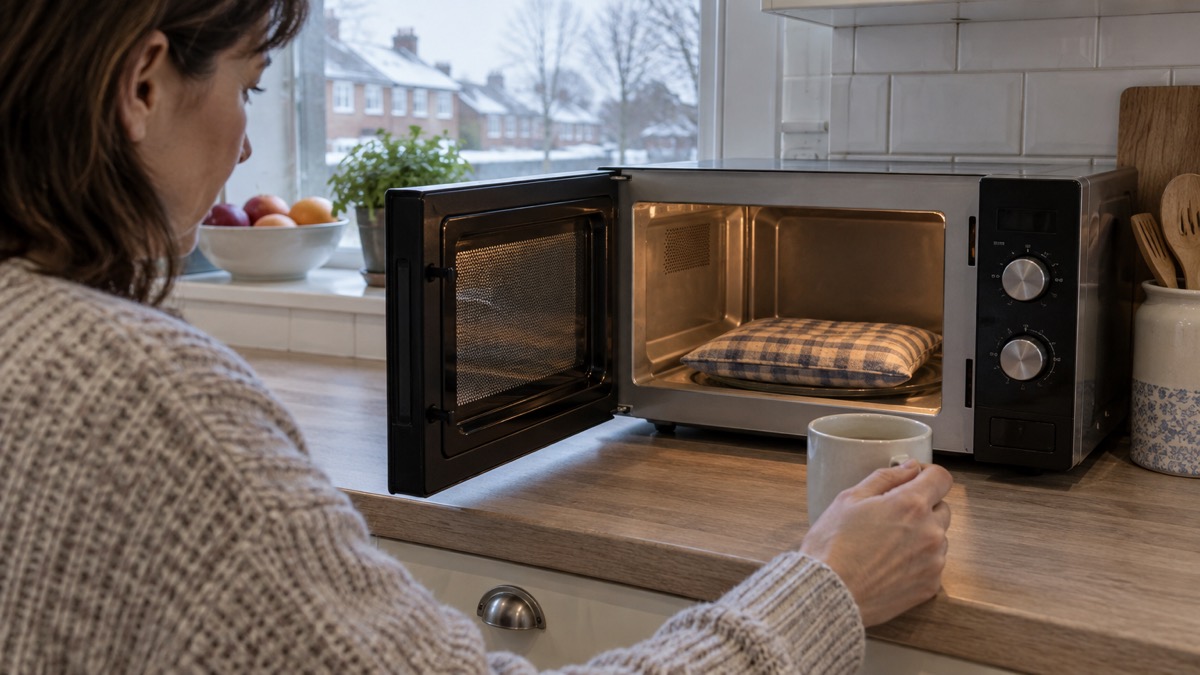
A wheat bag is one of the simplest comforts in a cold house: a fabric pouch of dry grain that you heat in the microwave and hold against cold hands, aching shoulders or cramp. Fire and rescue services across the UK support their use, but they are equally clear about the limit. Manchester Fire and Rescue Service warns that "if used incorrectly, they can cause burns or fires"1, and Cheshire Fire and Rescue Service makes the same point: improper use can increase fire and burn risk2.
The rules that keep you safe are short. Follow the heating times on the label. Place a cup of water in the microwave alongside the bag. Never leave the microwave unattended while it is heating. And never, under any circumstances, take a hot bag to bed or tuck it under a blanket, because a bag that cannot lose heat can catch fire1. This page explains each of those rules, why they exist, and what to do when a bag gets old.
What a wheat bag is, and what is inside it
A wheat bag is a sealed fabric pouch filled with dry grain. When the grain is microwaved, it absorbs the energy and holds the heat, releasing it slowly over the time you use the bag. Nothing in it is complicated, and that is the point: it is a cheap, reusable heat pack that needs no wiring, no battery and no flame.
What is inside matters more than it looks. Dorset and Wiltshire Fire and Rescue Service explain that wheat bags available in shops usually contain buckwheat4, and Manchester Fire and Rescue Service adds the reason: shop-bought bags usually contain buckwheat with known moisture levels1. That known moisture level is what makes a safe heating time possible. The grain needs some moisture to absorb microwave energy evenly; the maker knows how much is in their filling, tests the bag, and prints a heating time that brings it to a safe temperature without driving off all the moisture or scorching the grain.
This is also why the filling is not a matter of preference. Both fire services warn that using a type of wheat other than buckwheat may increase the risks of overheating, fires and burns1. Ordinary wheat from a kitchen cupboard, or grain bought loose from a farm shop, does not come with a known moisture content, so nobody can tell you how long it is safe to microwave it for. The fabric matters too: Manchester Fire and Rescue Service warns that adding oils can soak the fabric and make it more flammable1, which is why scented or "aromatherapy" wheat bags should be treated with real caution and only used exactly as their maker describes.
Why wheat bags catch fire: moisture, heat that cannot escape, and age
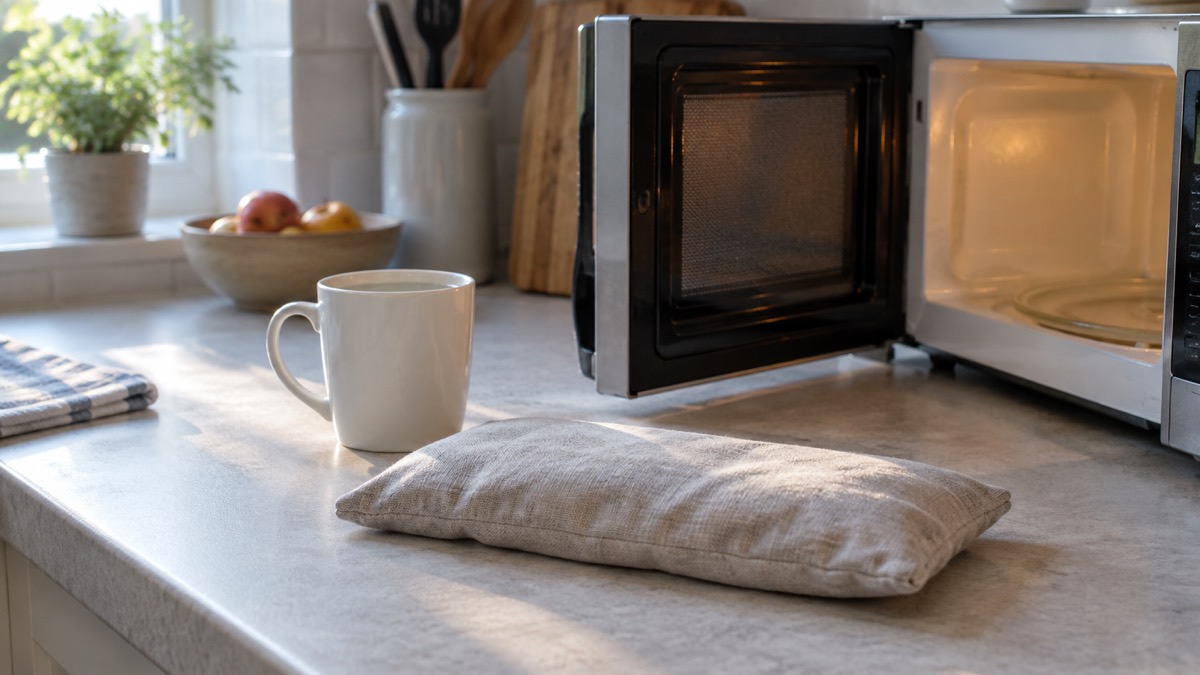
The fire risk in a wheat bag comes from three things working together, and understanding them makes every rule on this page obvious rather than arbitrary.
The first is moisture. The grain in a new bag holds a known amount of moisture, and it is that moisture which keeps the heating gentle and even. Each time you microwave the bag, some of that moisture is driven off. Cheshire Fire and Rescue Service states the consequence plainly: repeated heating can dry out the contents and increase the risk of ignition3. A bag that has been reheated many times over many months is a different object from the one you bought, even if it looks and smells the same.
The second is trapped heat. A wheat bag cools safely by releasing heat into the air around it. Under a duvet, inside a bed, or wrapped in a blanket, that heat has nowhere to go. Manchester Fire and Rescue Service gives the instruction in full: "Do not keep a hot bag under blankets or in warm places, it can catch fire"1. The bag does not need a flame to ignite; dry grain that keeps absorbing and holding heat can eventually smoulder and catch fire on its own.
The third is overheating in the microwave itself. Heating a bag for longer than its label states, or heating a bag whose safe time you do not know, can scorch the filling. Manchester Fire and Rescue Service's instruction is to follow the heating times on the label to avoid overheating or fire1. This is the same principle the fire and rescue services apply to any household appliance: Lincolnshire's home fire safety guidance on electrical products tells people to read the instructions and warnings provided by the manufacturer5, and Cheshire Fire and Rescue Service says of white goods, "Always follow the manufacturer's instructions for use and maintenance"6. A wheat bag is no different just because it has no plug.
How to heat a wheat bag safely
The safe routine is short, and every step of it comes from fire and rescue service guidance. Follow it every time, not just the first time.
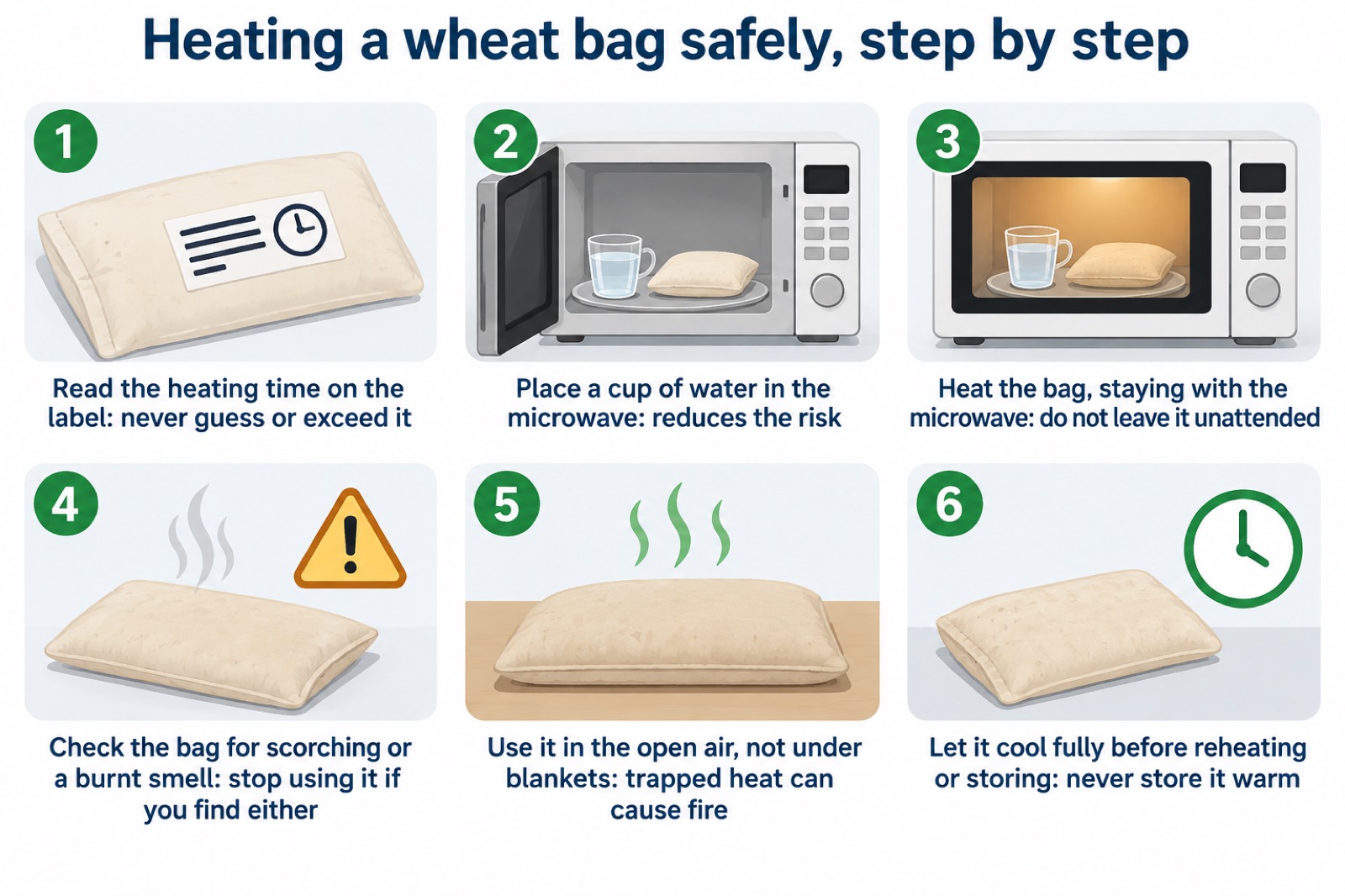
- Read the label. Use the heating times printed on the bag or its packaging, and never exceed them1. If the bag has no label, see the section below on bags without instructions.
- Place a cup of water in the microwave alongside the bag. Manchester Fire and Rescue Service's advice is: "When microwaving, place a cup of water inside to reduce risk"1. The water absorbs some of the microwave energy, which helps stop the bag itself from being driven to a dangerously high temperature.
- Stay with the microwave for the whole heating time. Cheshire Fire and Rescue Service instructs: "Do not leave the microwave unattended while heating"3. If something begins to smoulder, you can stop it immediately.
- Check the bag before you use it. Handle it carefully, feel for any hot spots, and if you notice a burnt smell or scorched patches, stop using the bag.
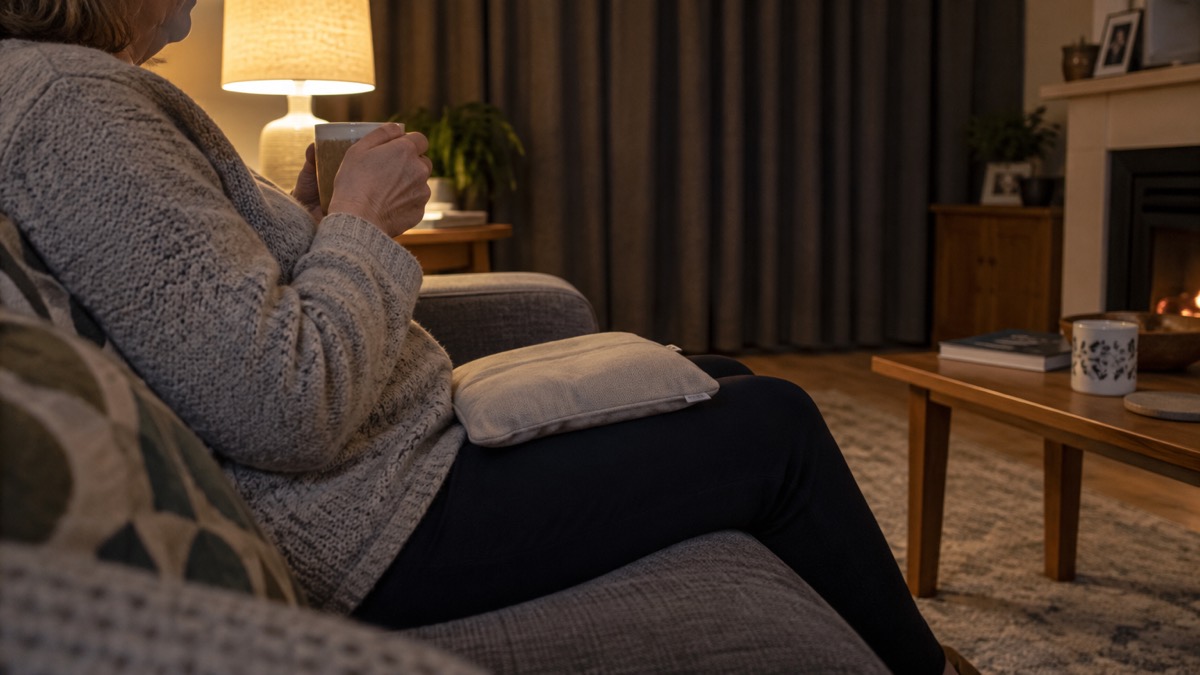
- Use it in the open, not under anything. Hold it on your lap, against your shoulder or wherever you need it, with air able to circulate around it1.
- Let it cool completely before reheating or storing it. Never put a warm bag away in a drawer, a cupboard or under bedding while it still holds heat1.
Two habits deserve special mention because they are the ones people drift into. The first is reheating a bag repeatedly in one sitting because it has cooled: each cycle dries the filling further3. The second is treating the microwave like a background task. The unattended-heating rule exists because a wheat bag that ignites does so quickly, and a smouldering bag left alone in a microwave can become a kitchen fire.
Why a wheat bag must never go in bed
This is the single most important rule on the page, and it deserves its own explanation because it is the use people most want a wheat bag for. On a cold night, a warm bag under the covers feels like exactly the right idea. It is the one use the fire and rescue services rule out completely.
The reason is trapped heat, as described above. A bag lying in the open cools steadily and safely. The same bag under a duvet is insulated on all sides: it holds its heat, the grain continues to cook, and the drier and hotter the filling becomes, the closer it moves towards ignition. Manchester Fire and Rescue Service's instruction covers the bed, the blanket and every variation of the idea: do not keep a hot bag under blankets or in warm places, it can catch fire1. A bed is the warmest place in the house, which makes it the most dangerous place for a hot bag.
If you are cold in bed, use bedding instead. Extra layers, a thicker duvet or a hot water bottle filled at the start of the night are the safe options, and our page on clothing and bedding to stay warm in a cold home covers what helps. A hot water bottle cools from a known temperature and is designed to sit in a bed; a wheat bag is not.
Babies and young children need a separate word. The Lullaby Trust's cold weather safer sleep guidance advises that a baby sleeping bag is a safer option if you bedshare, because there is no loose fabric that could cover their face, and warns that weighted swaddles, blankets and sleeping bags are not recommended for babies under 1 year because of the risk of overheating and head covering7. A hot wheat bag in or near a cot combines both hazards: it is a loose, heavy, very warm object. Never use one with a baby, and keep wheat bags out of reach of young children, in the same way that other household safety guidance keeps small items and plastic bags away from them.
Reheating, drying out, and when to replace a bag
Every wheat bag has a working life, and it is measured in heating cycles rather than years. Cheshire Fire and Rescue Service's guidance is that repeated heating can dry out the contents and increase the risk of ignition3. There is no published number of heats at which a bag becomes unsafe, so the responsibility sits with you to notice the age of the bag and treat it accordingly.
The practical approach is this. Keep track of how long you have had a bag and how often it is used. A bag heated once a week through the winter is being reheated dozens of times a season, and each of those heats removes a little more moisture from the grain. Follow the maker's guidance on the bag's life if the label or their website gives one. After heating, check for the warning signs you can sense: a scorched or "cooked" smell, visible browning or burnt patches on the fabric or filling, or a bag that comes out of the microwave hotter than it used to at the same setting. Any of these means the filling is drying out3.
When in doubt, replace the bag. It is one of the least expensive items in the house, and the alternative is keeping a slowly drying pouch of grain in your microwave and against your skin. The same instinct applies elsewhere in home fire safety: Devon and Somerset Fire and Rescue Service has reported fires resulting from people using old or damaged heaters, drying washing on heaters, or using candles8, and the lesson transfers directly. Age and damage turn a safe everyday item into a fire risk, and the time to act on it is before the fire, not after.
Choosing a wheat bag: instructions, maker details and what to avoid
Because safety depends so heavily on the heating time, the most important feature of a wheat bag is not its fabric or its shape but its labelling. Cheshire Fire and Rescue Service's buying advice is direct: "Buy wheat bags with clear instructions and manufacturer details"3. A bag that tells you who made it, what is in it and how long to heat it for is a bag you can use safely for as long as its filling lasts.
When you shop, check for the following before anything else:
- A printed heating time, with the microwave power it applies to1
- The maker's name and contact details, so you can ask questions or check guidance3
- A buckwheat filling, the usual shop-bought filling, with known moisture levels1
- No added oils or scented treatments unless the maker specifically instructs their use, since oils can soak the fabric and make it more flammable1
- A reputable retailer, the same principle Peterborough Trading Standards applies to product safety generally: buy from a seller you can go back to, and look for a CE or UKCA mark where a product carries one9
What to avoid follows from the same facts. Homemade wheat bags pose a greater fire and injury risk, because the moisture content and volume are not known and a proper heating time cannot be recommended4. A bag made at home from ordinary wheat, or a market-stall bag with no label, gives you none of the information that makes a shop-bought bag safe. If you enjoy crafts, apply it to the cover rather than the filling: a removable cotton sleeve on a manufactured, labelled bag is safe, while a self-filled pouch of grain is not.
What to do with a bag that has no instructions
A bag without instructions is not a puzzle to solve but a bag to replace. The whole safety system around wheat bags rests on knowing the heating time, and that time depends on the filling, its moisture level and the bag's volume. Dorset and Wiltshire Fire and Rescue Service explain that a proper heating time cannot be recommended when the moisture content and volume are not known4, which is exactly the position you are in with an unlabelled bag.
Do not work around it by heating for a short time and hoping. A bag heated for too little is merely useless, but a bag heated for slightly too long, or reheated to get it warm enough, is on the path towards the drying and scorching described above1. Guessing does not give you a safe middle route; it gives you an untested one.
The same applies to a bag whose label has been lost or washed out after years of use. If you cannot read the heating time, you cannot follow it, and following the label is the instruction that exists to prevent overheating and fire1. Treat a bag with no legible instructions as finished, and buy its replacement with the checks in the section above.
If a wheat bag burns someone
A wheat bag that is too hot, or held against the skin too long, can burn, and burns from heated grain can be serious because the bag is often held in place rather than snatched away. The first step in burn first aid, as set out in NHS burn care guidance, is to stop the burning process10: move the bag away and break the contact between the hot fabric and the skin.
For what to do next, follow the general principles in our first aid at home guide, and seek medical advice for any burn that blisters, breaks the skin or covers a large area. A burn from a wheat bag is a burn like any other, and the fact that a comforting object caused it does not make it milder.
If a bag has burned someone because it came out of the microwave far hotter than expected, treat that as a warning about the bag itself as well as the injury. An overheating bag is a bag whose filling may be drying out3, and it should be checked against the signs above and replaced if there is any doubt.
Wheat bags in a power cut
One practical point that matters to a prepared household: a wheat bag can only be heated in a microwave, and a microwave needs mains electricity. In a power cut, a wheat bag is a cold bag, and no amount of wishing will change that. If part of your reason for keeping one is warmth during outages, plan around this limitation.
The alternatives that work without electricity are covered elsewhere on this site. A hot water bottle needs only water heated on a camping stove or a wood burner, and our page comparing a hot water bottle or wheat bag sets out the differences side by side. For heating a whole person rather than a joint, our guide to keeping one room warm when the heating fails and the wider heating and cooking without mains power section cover the options, from layered clothing to safe portable heaters.
The same trapped-heat rules apply to any microwave-heated alternative as to wheat bags: never put them under blankets, and never leave the microwave unattended11.
Where the advice comes from
The safety rules on this page come from UK fire and rescue services, which attend the consequences when they are broken. Manchester Fire and Rescue Service publishes the core wheat bag guidance: the burns and fire risk, the cup of water, the label times, the ban on hot bags under blankets, and the warnings about other wheat types and added oils1. Cheshire Fire and Rescue Service adds the unattended-microwave rule, the drying effect of repeated heating, and the buying advice on instructions and maker details2. Dorset and Wiltshire Fire and Rescue Service explains why homemade bags are riskier and why buckwheat is the standard filling4. The Scottish Fire and Rescue Service's heating safety guidance reinforces the wider principle of never using heaters to dry or warm items that trap heat, such as airing clothes over a heater13. If you want the guidance first-hand, your local fire and rescue service's home safety pages are the place to look, and many offer free home fire safety visits.
Sources (13)
- Wheat bags, Manchester Fire and Rescue Service
- Staying warm, Cheshire Fire and Rescue Service, 2026-08-06
- Heated wheat bags, Cheshire Fire and Rescue Service, 2026-05-20
- Wheat bags, Dorset and Wiltshire Fire and Rescue Service, 2022-11-28
- Smoking and vaping safety, Lincolnshire County Council, 2026-10-29
- White goods electrical fire safety, Cheshire Fire and Rescue Service, 2026-05-20
- Cold weather: safer sleep guidance, The Lullaby Trust, 2025-02-01
- Think fire safety when saving money on your energy bills, Devon and Somerset Fire and Rescue Service, 2022-10-05
- Product safety campaigns, Peterborough City Council Trading Standards, 2026-10-29
- Burn first aid safety, London and South East Burns Network, 2026
- WeatherReady weather hacks, Met Office, 2026-10-25
- WeatherReady weather hacks, Met Office, 2026-10-26
- Heating and gas safety, Scottish Fire and Rescue Service, 2024-11-21
 Before-Winter Heating Checks
 Backup Stove Kit Checklist
 Wood Burner Lighting Kit
 Keeping One Room Warm
 Clothing and Bedding for Cold
 Stopping Draughts
 Hot Water Bottle Safety
 Electric Blanket Safety
 Portable Heater Types
 Portable Heater Safety
 Wood Burners in a Power Cut
 Using a Wood Burner Safely
 Open Fires and Fire Guards
 Firewood and Seasoning Logs
 Smoke Control Areas