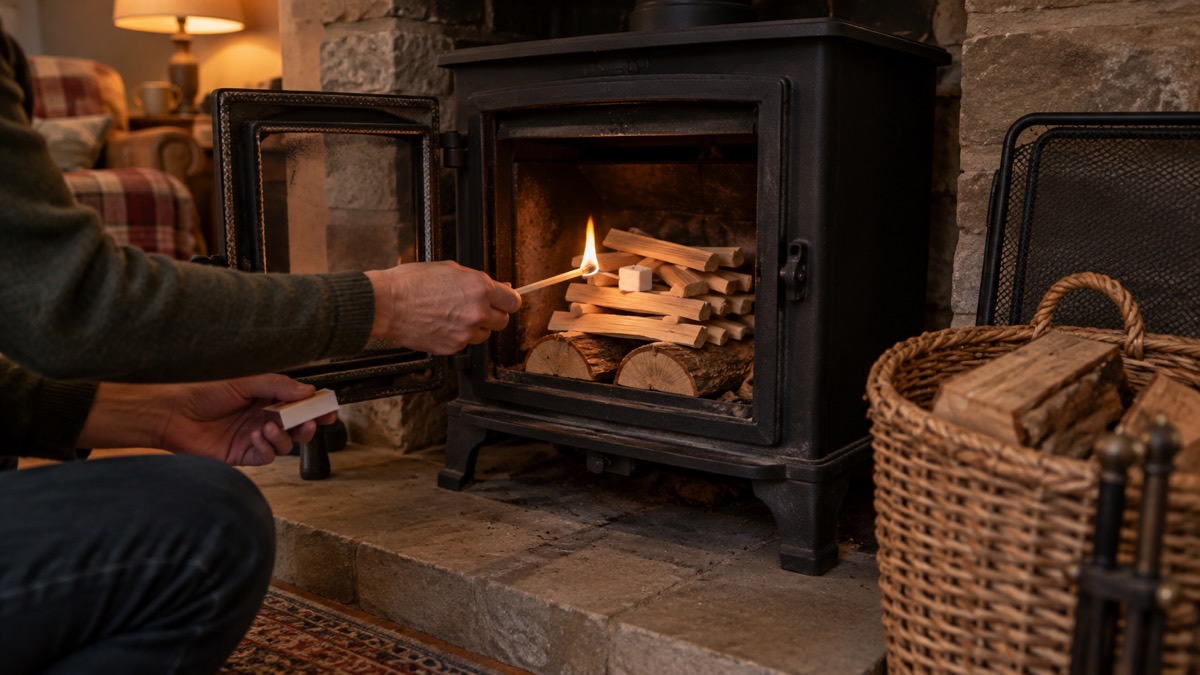
A wood burner is only as good as what you put beside it. Before the first cold evening, gather the things that light it cleanly and the things that keep you safe once it is hot: dry seasoned wood below 20% moisture content, kindling, paper or firelighters, a means of handling the door and fuel without burning yourself, somewhere safe for the ash, and a working carbon monoxide alarm1. The fire and rescue service is clear that you should never use flammable liquids such as petrol or paraffin to light a fire, and that you should only burn the correct fuel, because burning other materials can cause toxic fumes, chimney fires and carbon monoxide poisoning3.
Lighting is a short, supervised job. Charnwood's manual for its Haven stove describes building a stack of 6 to 8 softwood kindling sticks on top of two small logs, with paper or a firelighter in the centre, and says not to leave the stove unattended during the lighting period5. The fire service advises using kindling to start a fire, with firelighters used carefully if at all4. Once it is going, the safety kit matters more than the lighting kit: a guard for children, a clear zone around the stove, and an alarm that will wake you if carbon monoxide builds up6.
This checklist sets out what to gather, why each item earns its place, and how to keep the kit ready through the winter. It also covers where to get help with a Charnwood stove, what the Ecodesign rules changed, and which official guidance to trust when advice online conflicts.
The wood burner lighting and safety kit list
Gather these before you need them, and keep them together near the stove but not against it. Each item answers a specific problem: getting the fire lit without a flare-up, handling a hot door, dealing with ash, and knowing quickly if something is wrong.
Lighting the stove without a flare-up
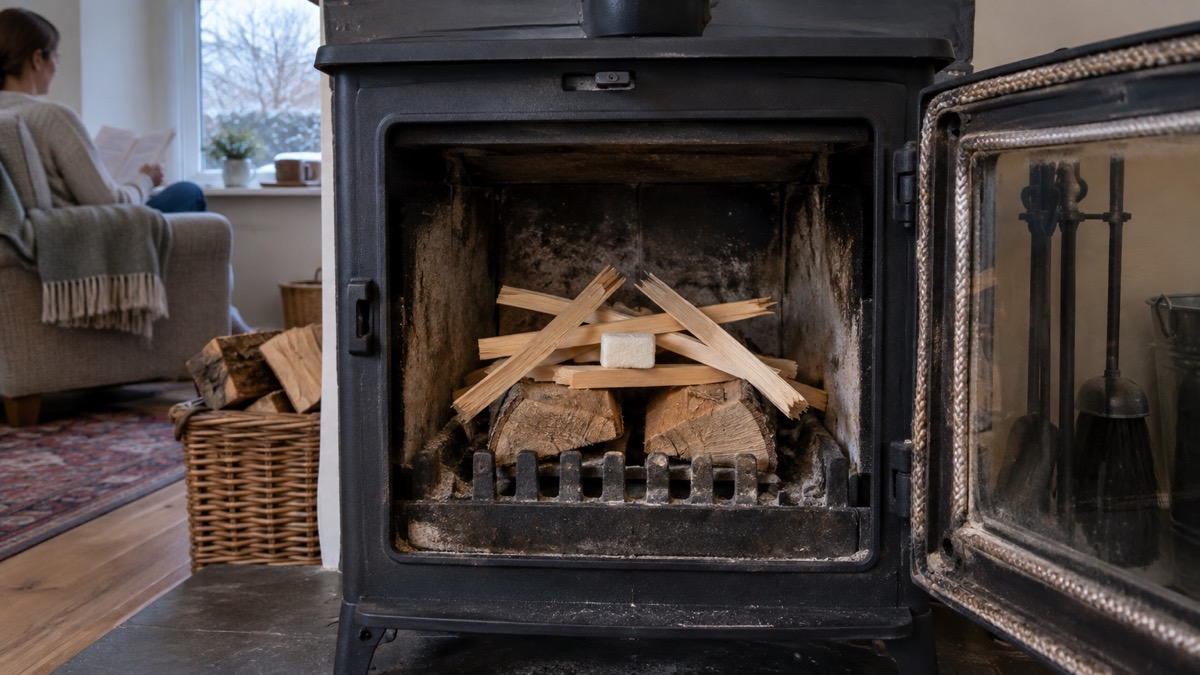
The lighting method matters as much as the kit. Charnwood's manual sets out a simple sequence: two small logs, a stack of 6 to 8 softwood kindling sticks on top, and paper or a firelighter in the centre5. Light it, close the door as directed, and stay with the stove during the lighting period, because the manual says not to leave it unattended and not to leave the door open except as directed, to avoid excessive smoke5.
A few habits make the difference between a clean burn and a smoky one:
- Use the right fuel for the appliance. Using coal in a wood stove can damage it12.
- Do not burn wet, treated, painted or glued wood8.
- Do not stack logs or combustible materials against the stove. The fire service has been called to fires caused by logs stored against the hot outer surface of wood burners6.
- Place the stove on a fire-resistant base. Direct placement onto a hardwood floor or carpet increases the risk of fire because of the heat in the fire box6.
- Keep permanent ventilation clear and have the appliance serviced and the chimney swept regularly2.
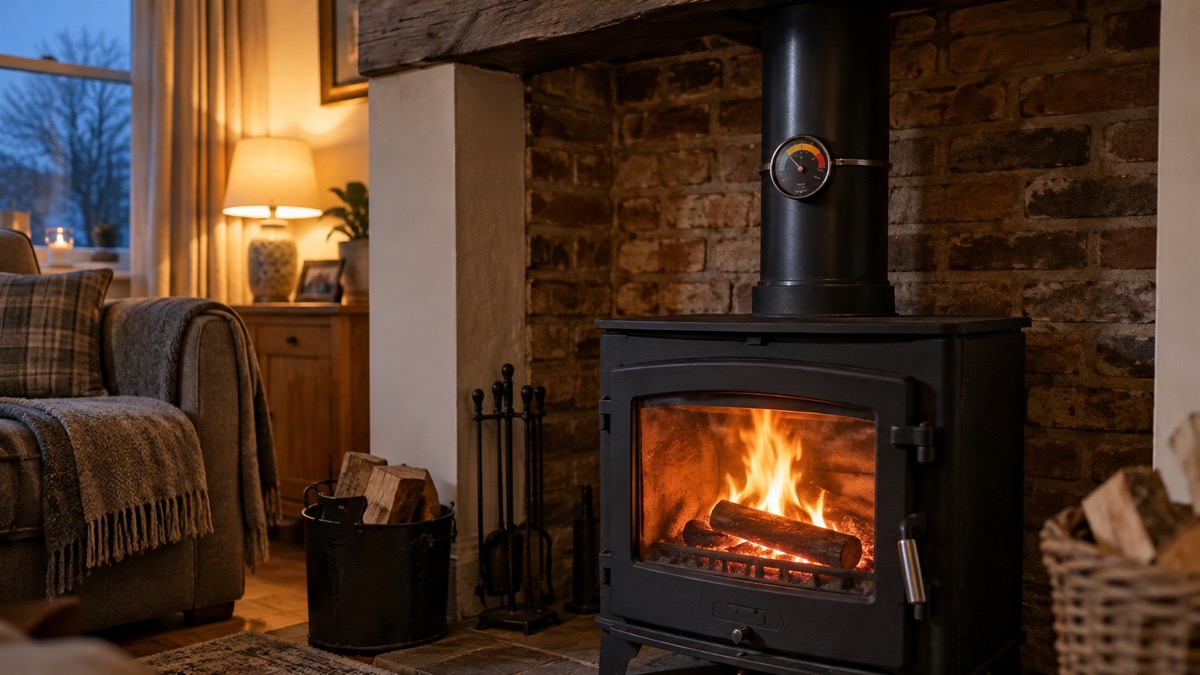
If the stove is not burning correctly, contact the company or shop that sold it to you, or the British Solid Fuel Appliance Manufacturers' Association for advice6. A stove pipe thermometer helps you see whether you are firing it in the right range5.
Getting help from Charnwood, your installer or a Premier Dealer
Charnwood is a British stove maker, and its appliances are common enough that one Denbighshire housing report from May 2025 counted 107 Charnwood solid fuel appliances among 185 solid fuel properties in the council's stock13. That scale means spares and advice are usually available, but the route to them is specific.
Your first call is the company or shop that sold you the stove, or your installer. The fire service advises contacting the seller or the British Solid Fuel Appliance Manufacturers' Association if a wood burner is not burning correctly6. Charnwood's own manual tells you to order spare parts through your supplier, and to specify the colour when ordering any item marked with a hash symbol, including hinges, fire door assemblies, oven door assemblies, access door assemblies, legs sets, store stands, flue collars, heat shields, rear shelf kits and flame guards5. A stove pipe thermometer can be bought from your supplier or from Charnwood5.
| What you need | Who to ask | What to have ready |
|---|---|---|
| A spare part | Your local stockist, quoting the model, part number and description5 | The manual and the part details |
| Advice on poor burning | The company or shop that sold it, or the British Solid Fuel Appliance Manufacturers' Association6 | Fuel type, moisture, air settings, sweep date |
| A stove pipe thermometer | Your supplier or Charnwood5 | The flue diameter |
| Installation or flue advice | Your installer, your local Charnwood Premier Dealer, or Charnwood Customer Services5 | Chimney condition and lining details5 |
If the chimney is in poor condition, Charnwood's manual says to seek expert advice on lining, and any lining must be suitable for solid fuel5. A prefabricated block chimney or a twin-walled insulated stainless steel flue to BSEN 15287-1:2007 can be used if there is no existing chimney5.
Older Charnwood stoves discontinued under Ecodesign rules
Any new stove placed on the market in the UK must now be Ecodesign compliant14. That rule retired a generation of older models, including several Charnwood stoves that households still own and use.
| Model | Type | Discontinued | Notes |
|---|---|---|---|
| Country 16B MF | Multi-fuel boiler stove | 31 December 202115 | Heats domestic hot water plus around 10 radiators; needs a 12mm non-combustible hearth15 |
| Country 16B WB | Woodburner | 31 December 2021 | Retired under the Ecodesign requirement for new stoves14 |
| SLX 45 | Stove | 31 December 2021 | Retired under the Ecodesign requirement for new stoves14 |
If you own one of these, it remains usable, but support and spares come through your supplier rather than as a current model5. The Ecodesign rules also affect what you can burn. In a smoke control area, you can only burn unauthorised fuels such as wood on Defra exempt appliances, and you can only burn controlled fuels in Ecodesign stoves if they also appear on the list of Defra approved appliances16. If you want to burn immediately, look for the Ready to Burn logo as a guarantee of good quality dry wood14.
Where the official guidance on lighting and burning wood comes from
Advice on wood burners comes from several bodies, and they mostly agree. The fire and rescue services in England and Wales publish safety pages on chimneys, open fires and wood-burning stoves6. Defra publishes guidance on open fires and wood-burning stoves, including a practical leaflet issued in April 2023 on reducing smoke and health impacts16. The Forestry Commission's Biomass Energy Centre published version 1.2 of its Wood as Fuel guide in October 2009, replacing the 1985 Keighley guide17. The Health and Safety Executive for Northern Ireland covers carbon monoxide from fuel-burning appliances7, and NHS Inform covers indoor air pollution in Scotland18. Always follow the manufacturer's instructions for boilers, stoves, gas fires and solid fuel room heaters19.
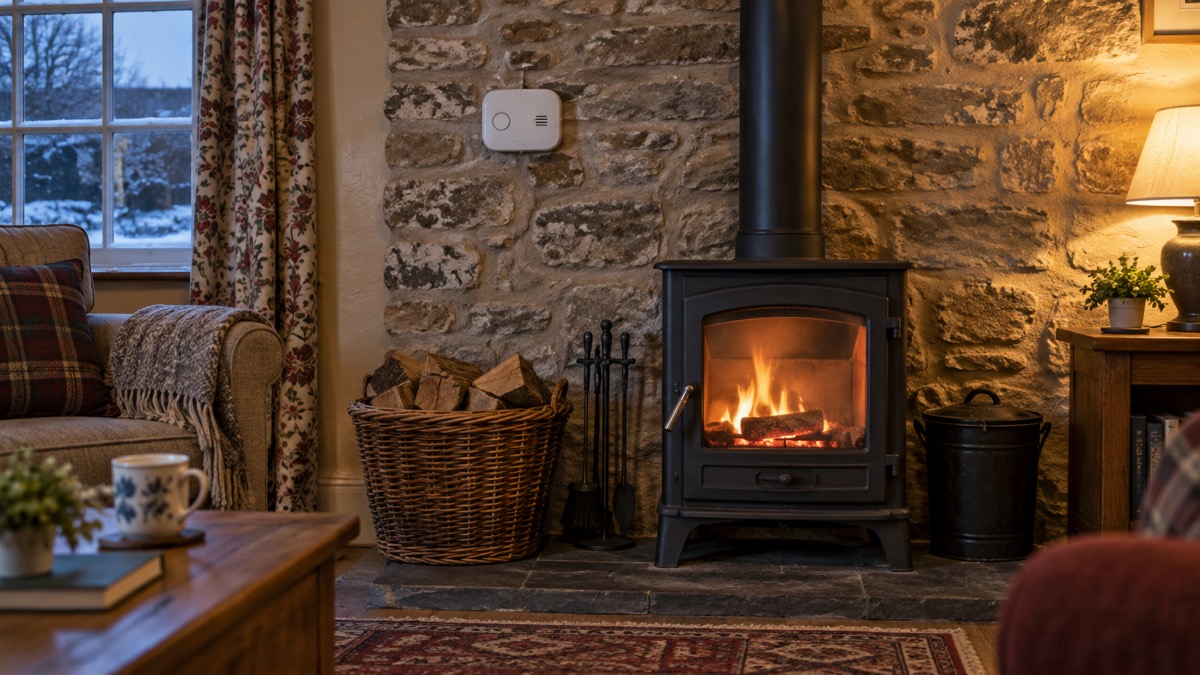
Where guidance conflicts, follow the more cautious line. On countryside fires, one official report notes that Fire England advises using barbecues in "designated areas of the countryside and follow safety" while the Forestry Commission states, "Follow the Countryside Code and never light open fires, such as campfires or barbecues, in the countryside"20. For a household stove, the practical rule is simpler: burn only dry, suitable fuel, keep the stove and flue maintained, and keep a carbon monoxide alarm working2.
"Always follow the manufacturer's instructions for boilers, stoves, gas fires and solid fuel room heaters."
Candles and tea lights are a separate risk, and Scottish Fire and Rescue has published guidance on using them safely during a power cut21. If you use them, place them on a fixed, heat-resistant surface away from curtains and soft furnishings, on a non-flammable surface such as a plate or tile, in a proper holder where possible22. Never use a lighter, match or lit rolled-up paper to light a bioethanol fire; use a manual or electric taper19.
Sources (22)
- Chimney fire safety week, North Yorkshire Fire and Rescue Service, 2026-09-08
- Your home energy checklist, National Energy Action, 2026-10-09
- Stay fire safe, Greater Manchester Fire and Rescue Service, 2026-10-29
- Chimney fire safety, Devon and Somerset Fire and Rescue Service, 2023-09-01
- Charnwood Haven instructions, Charnwood, 2025-10
- Chimneys, open fires and wood burning stoves, Mid and West Wales Fire and Rescue Service, 2026-10-29
- Carbon monoxide, Health and Safety Executive for Northern Ireland, 2026
- Fuel Good campaign, Oxford City Council, 2026-10-29
- Chimney safety, Dorset and Wiltshire Fire and Rescue Service, 2024-11-07
- Emergency supplies kit, Denbighshire County Council, 2020
- Burn awareness, Cheshire Fire and Rescue Service, 2026-05-20
- Kitchen safety, Scottish Fire and Rescue Service, 2024-11-11
- Housing heating scrutiny report, Denbighshire County Council, 2025-05
- Ready to Burn guidance, Defra, 2023-10
- Country 16B MF, Charnwood, 2026-10-20
- Ready to Burn guidance, Defra, 2023-04
- Wood as Fuel guide, Forestry Commission Biomass Energy Centre, 2009-10
- Indoor air pollution, NHS Inform, 2026-08-05
- Public messaging for summer concurrent risks, GOV.UK, 2025-12-16
- Useful information for you and your community, Argyll and Bute Council, 2026
- Candle safety, Mid and West Wales Fire and Rescue Service, 2026-10-29
- Candle safety, Carmarthenshire County Council, 2026-06-26
 Before-Winter Heating Checks
 Backup Stove Kit Checklist
 30-Day Household Checklist