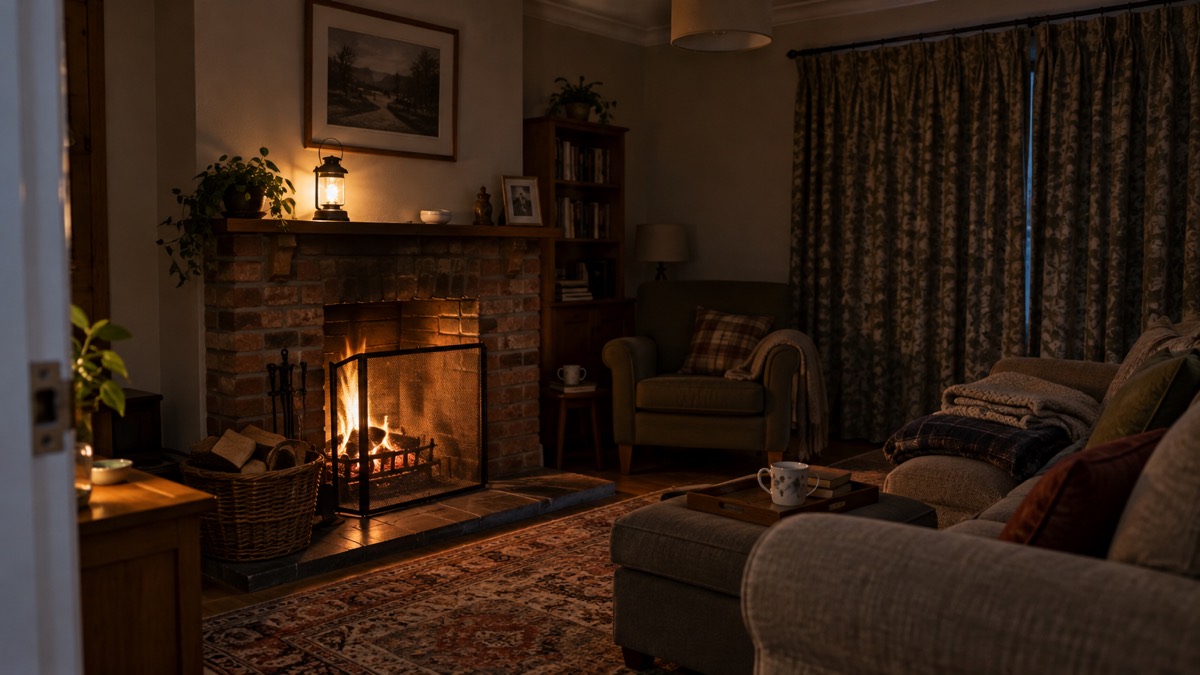
An open fire is one of the oldest ways of keeping a room warm, and in a power cut or a heating failure it can be a real comfort. But it is also a naked flame in your living room, and fire and rescue services across the UK are clear about what makes one safe: the right fuel, lit the right way; a fireguard in place whenever the fire is burning; a chimney that is swept often enough for what you burn; and working smoke and carbon monoxide alarms to warn you if something goes wrong1.
The rules are not onerous, and none of them stop you enjoying the fire. North Yorkshire Fire and Rescue Service describes the fireguard as one of the most overlooked but important safety measures for open fires and log burners, because it helps prevent hot embers escaping and igniting carpets or furnishings4. London Fire Brigade's advice is the same: use a fireguard to protect against flying sparks and hot embers, and supervise children and pets carefully2. Warwickshire County Council adds the third leg of the stool: alarms, which in the event of a fire or carbon monoxide leak give early warning and allow a prompt response3.
This page sets out what the official guidance says, step by step: how to light the fire, what to burn and what never to burn, how to use a fireguard, how to settle the fire safely before bed, how often to have the chimney swept, and what to do if a chimney fire or a carbon monoxide alarm happens. If you are planning how to heat your home in an outage more broadly, start with our guide to heating and cooking without mains power or gas.
Lighting the fire: firelighters only, never petrol
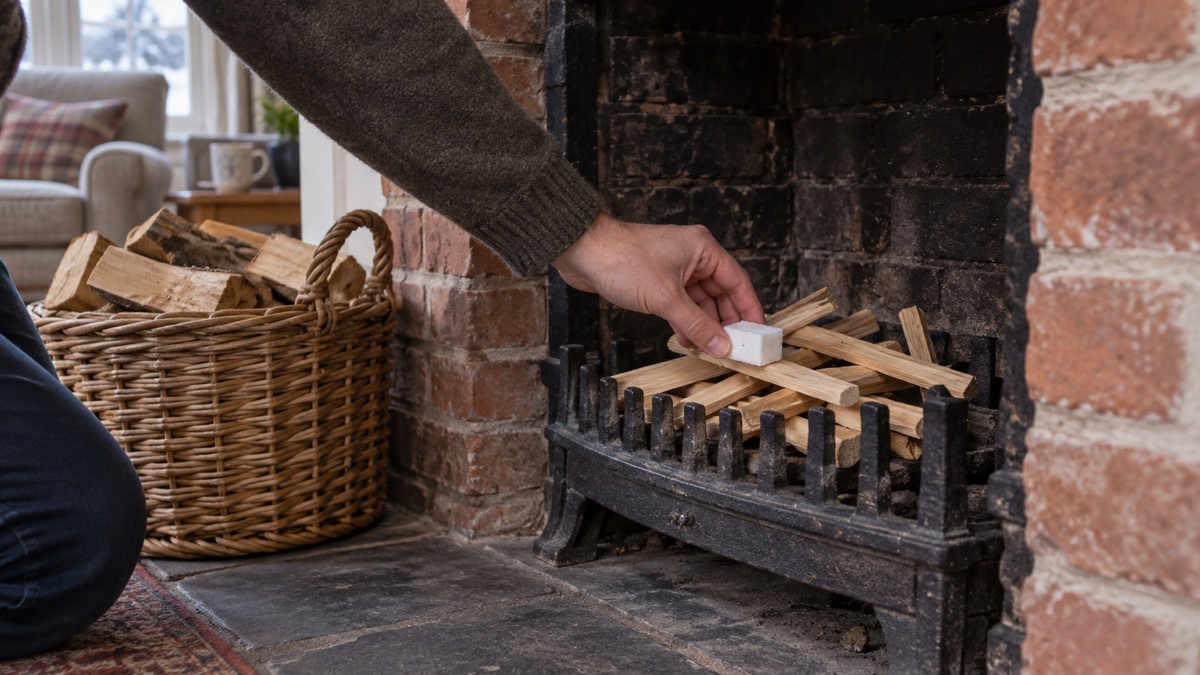
Every fire and rescue service that has published guidance on this point says the same thing, and it is worth being blunt about it: never light an open fire with petrol, paraffin, diesel, white spirit or methylated spirit. Dorset and Wiltshire Fire and Rescue Service gives the reason in one line:
"Never use petrol, it can ignite quickly and soon get out of control."
Dorset and Wiltshire Fire and Rescue Service11
Manchester Fire and Rescue Service spells out the list of prohibited liquids and the alternative: use firelighters instead7. The same instruction appears in guidance on barbecues and bonfires, where the danger is identical, and in the Scottish Fire and Rescue Service's chimney safety leaflet, which says simply: do not light fires using flammable liquids such as petrol or paraffin12. A flammable liquid does not burn gently; it vapourises, and the vapour can flash across the grate faster than you can step back.
The safe method, according to North Yorkshire Fire and Rescue Service, is to use recognised fire lighters or starter fuel, only on cold coals, and only the minimum necessary13. Mid and West Wales Fire and Rescue Service gives the same instruction: apply firelighters or starter fuel only to cold coals, use the minimum necessary, and never use petrol14. The "cold coals" part matters. Starter fuel poured onto anything already warm, let alone lit, can flare immediately. Once the fire is lit, never add more liquid fuel15.
In practice, for an open fire, that means building your kindling first, putting one or two firelighters among it while everything is cold, and lighting those with a match. If you are lighting a fire outdoors rather than at a hearth, the rules extend further: Wiltshire and Swindon Prepared advises landowners that an open fire outdoors should be downwind and at least 10 metres away from any buildings or structures, and that you should avoid lighting open fires in the countryside altogether in dry conditions16.
What to burn, and what never to burn
The fuel you put on an open fire matters for three reasons: your health, your chimney, and the air your neighbours breathe. Devon and Somerset Fire and Rescue Service is direct about what belongs on an open fire or wood burner:
"You must burn seasoned (specially dried) wood, smokeless fuels or coal."
Devon and Somerset Fire and Rescue Service8
Seasoned wood is wood that has been specially dried, and the reason for insisting on it is set out in the government's own air quality guidance. When burnt, wet wood with a moisture content above 20 per cent produces lots of smoke, particles and tar deposits which can damage your health and the environment18. That tar does not just drift away: it condenses on the inside of the chimney, where it becomes the fuel for a chimney fire later in the winter. Our page on firewood and how dry it should be explains how to season and check logs.
The list of things never to burn is just as important. Warwickshire County Council advises households to avoid burning wet or green wood, treated wood, rubbish, or plastics, as these can produce harmful substances and increase the risk of chimney fires3. Lincolnshire's bonfire safety guidance, which applies the same chemistry to any fire, adds the sharpest warning: do not burn aerosols, tyres, canisters or anything containing foam or paint, because many produce toxic fumes and some containers may explode, causing injury19. Manchester Fire and Rescue Service sums up the stakes: burning the wrong materials in open fires and wood burning stoves can cause toxic fumes, chimney fires and carbon monoxide poisoning20.
| Safe to burn | Never burn |
|---|---|
| Seasoned (specially dried) wood8 | Wet or green wood3 |
| Smokeless fuels8 | Treated or painted wood3 |
| Coal8 | Household rubbish and plastics3 |
| Clean, dry kindling and firelighters7 | Aerosols, tyres, canisters, foam or paint19 |
Two further rules from the fire services cover how you feed the fire. Manchester Fire and Rescue Service advises: do not add fuel to a burning fire or refill a firebox fuel container that is still hot21. And if someone in your household uses medical oxygen, Manchester's guidance for carers is to keep ignition sources well away from the oxygen: no smoking materials, naked flames or open fires in an oxygen enriched environment22.
If you live in a smoke control area, usually a town or city, there are legal limits on what you may burn on an open fire, and smokeless fuel is the standard requirement. Our page on smoke control areas explains how to find out whether you are in one. For the full list of woods and waste that should never go on a fire, see what wood and rubbish you should never burn.
A fireguard whenever the fire is lit
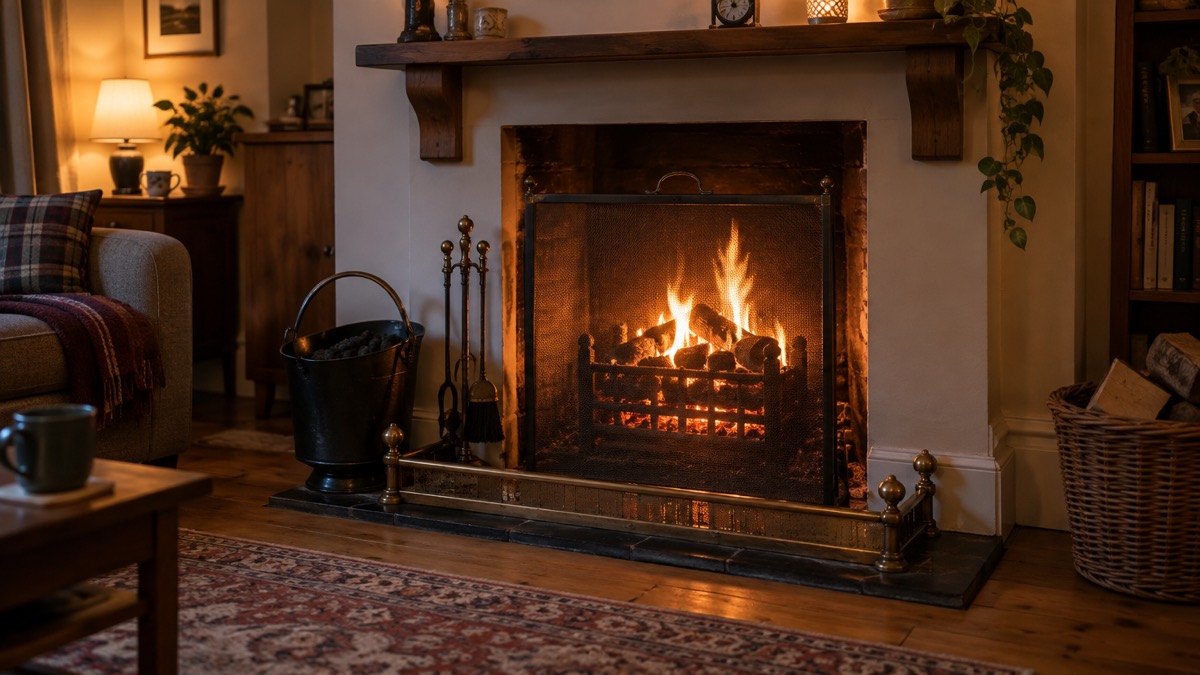
A spark guard or fireguard is not an optional extra. Cornwall Fire and Rescue Service's instruction is the simplest statement of the rule: ensure a fireguard is in front of the fire at all times5. London Fire Brigade explains what the guard is doing: it protects against flying sparks and hot embers2. An open fire routinely throws small embers forward off the grate, and a single one landing on a rug or the edge of a sofa is how a hearth fire becomes a house fire. North Yorkshire Fire and Rescue Service makes the same point: a fireguard helps prevent hot embers from escaping and igniting carpets or furnishings23.
The Scottish Fire and Rescue Service extends the rule to stoves as well as open hearths: always use a fire guard to protect against flying sparks from hot embers12. For an open fire, where the fuel sits loose in the grate rather than behind a stove door, the guard is doing more work, so choose one that stands solidly and covers the whole opening. A spark guard of fine mesh, held in a frame, stops the small embers; a heavier fireguard with a frame around it also keeps people at a distance.
If you have children or pets, the guidance gets firmer still:
- Devon and Somerset Fire and Rescue Service: ensure you have child-proof fireguards in front of an open fire or heaters, and put up fireguards at night24
- The Scottish Fire and Rescue Service: keep the guard up at all times if you have children or pets25
- Manchester Fire and Rescue Service: use a fireguard particularly if you have children or pets21
- London Fire Brigade: watch out for children and pets, supervise them carefully, and use fire guards2
For households with toddlers, a freestanding guard that encloses the hearth, rather than a guard that simply hooks across the opening, is what "child-proof" means in practice: it keeps small hands off the guard itself, which will be hot, and it cannot be pulled down onto the floor. Whatever guard you use, check that it stands stable on the hearth and that nothing combustible is stacked against it. North Yorkshire Fire and Rescue Service advises keeping combustible materials at least one metre away from the fireplace or stove4.
Settling the fire before bed
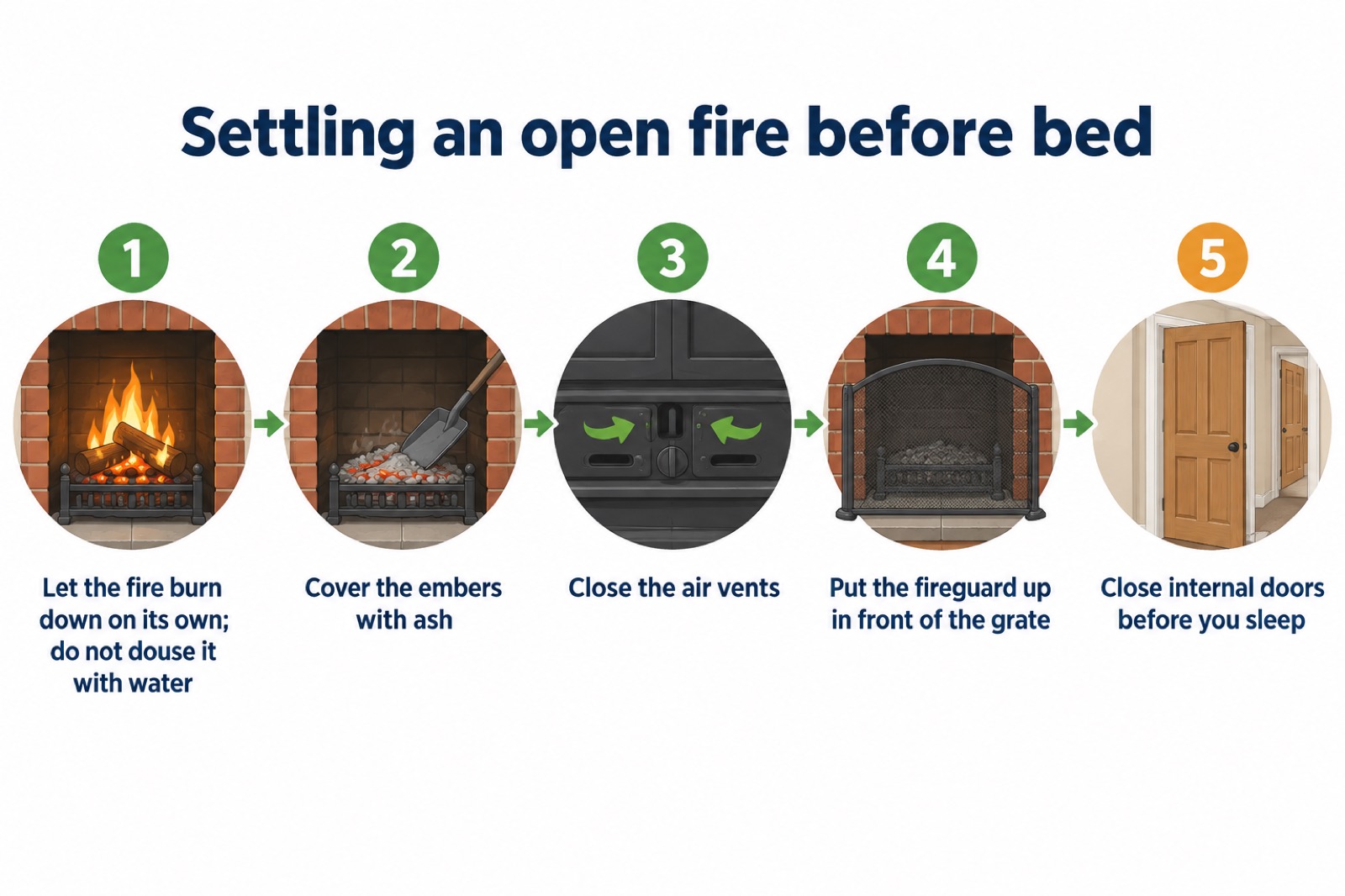
The most dangerous hours for any household fire are the ones when everyone is asleep, which is why fire and rescue services publish a bedtime routine. For an open fire, the Scottish Fire and Rescue Service's instruction is the core of it: let fires burn down before going to bed, and put the guard up25. Mid and West Wales Fire and Rescue Service goes slightly further and says to extinguish the fire before going to bed or leaving the house10. If your fire has burned down to embers by bedtime, both instructions amount to the same thing: nothing left that can flare, and a guard in front of whatever is.
North Yorkshire Fire and Rescue Service gives the most detailed method for settling a fire safely overnight, and it is worth quoting because it runs against what many people instinctively do:
"Avoid extinguishing fires with water before leaving the house or going to bed."
North Yorkshire Fire and Rescue Service1
Instead, allow the fire to burn down, spread the embers, cover them with ash and close the air vents4. Closing the vents starves what is left of oxygen; the ash blanket holds the heat down. Dousing a hot grate with water can crack the grate or the hearth, and sends a cloud of steam and ash into the room. Our page on how to dispose of ashes safely covers what to do with the ash in the morning, because embers hidden in ash can stay hot for a long time.
The fire is one item in a wider bedtime check that fire services ask every household to make. Devon and Somerset Fire and Rescue Service's bedtime check includes extinguishing open fires, stoves, candles and cigarettes properly and putting up fireguards24. The Northern Ireland Fire and Rescue Service's routine adds the rest: switch off and unplug electrical appliances not designed to stay on, avoid leaving chargers on overnight, switch off portable heaters, close all doors, keep keys accessible, keep escape routes clear, and keep a phone in the bedroom26. Staffordshire Fire and Rescue Service adds two points that matter if you have guests: make sure exits are kept clear, and tell them where the keys are kept27.
Never leave the fire unattended
A fire left burning in an empty room is a risk, and the guidance says so plainly. North Yorkshire Fire and Rescue Service: never leave a fire unattended, particularly around children or pets4. The same principle runs through official guidance on every other kind of fire. Oxfordshire's wildfire prevention advice warns never to leave a BBQ unattended, because embers can stay hot for hours and reignite later28. Devon and Somerset Fire and Rescue Service says of bonfires that the embers can stay hot for a long time, so make sure it is cool before you leave it unattended29. The physics does not change because the fire is in a grate rather than a garden.
The practical rule for a household is simple: if nobody is in the room, the fire should either be settled behind its guard or out. That applies to popping out to the shop as much as to going to bed. Before you leave the house, follow the same routine as bedtime: burn down, spread, cover with ash, vents closed, guard up4.
Two groups need extra thought. Children and pets should be supervised whenever the fire is lit, and lighters and matches kept out of their reach2. And if anyone in the home uses medical oxygen, the fire and the oxygen must be kept apart: Manchester Fire and Rescue Service's guidance for carers asks you to talk about the fire risk of any ignition source close to oxygen, especially staying away from smoking materials, naked flames and open fires22.
Have the chimney swept, and how often
A chimney fire is the open fire's characteristic failure, and it is almost always a fuel and maintenance problem: tar from wet wood, or soot from coal, built up inside the flue until it ignites. The remedy is regular sweeping by someone qualified. Warwickshire County Council advises scheduling annual chimney inspections and cleanings by a qualified professional3, and the government's burn better guidance says the same: get your chimney swept at least once a year by a chimney sweep18.
How often, exactly, depends on what you burn, and the fire services publish the frequencies by fuel. North Wales Fire and Rescue Service gives the fullest table: wood up to four times a year, smokeless coal at least once a year, bituminous coal twice a year, and oil once a year6. Cornwall Fire and Rescue Service agrees: wood burning fires four times a year when in use, solid fuel fires once a year for smokeless fuel and twice a year for coal, oil fires once a year, and gas fires once a year if designed for sweeping5. Lincolnshire and Mid and West Wales publish the same figures30.
| Fuel | How often to sweep | Source |
|---|---|---|
| Wood | Up to four times a year when in use | 6 |
| Bituminous coal | Twice a year | 6 |
| Smokeless fuel or smokeless coal | At least once a year | 6 |
| Oil fired appliances | Once a year | 6 |
| Gas appliances | Once a year if designed for sweeping | 10 |
If you use your open fire only occasionally, for instance during power cuts, the once a year minimum still applies before the burning season starts. A chimney that has stood unused for years needs checking before its first fire: our page on lighting an open fire after years without use covers that, and how often a chimney should be swept gives the detail. If you are buying in fuel for the winter, our before-winter checklist brings the sweep, the fuel and the alarms together.
Smoke and carbon monoxide alarms
Alarms are the safety net under everything else on this page. Warwickshire County Council's summary is the reason: in the event of a fire or carbon monoxide leak, alarms can provide early warning, allowing for a prompt response3. An open fire is a fixed combustion appliance: it burns fuel, and any fuel that burns incompletely produces carbon monoxide, which has no smell and no taste.
Manchester Fire and Rescue Service recommends a carbon monoxide alarm in rooms where you have a fixed combustion appliance, and its list of such appliances includes the open fireplace alongside gas fires, gas boilers and log burners20. Surrey County Council's guidance on detectors makes the same recommendation for homes with combustion appliances31. Fit the alarm in the room with the hearth, following the maker's instructions on height and position, test it regularly, and replace it when the maker says to.
Smoke alarms matter just as much, because the other thing an open fire can cause is a fire in the room. Fit smoke alarms on every level of the home, test them regularly, and make them part of the bedtime check. If your fire is part of a wider plan for heating through a power cut, pair this page with keeping one room warm when the heating fails and clothing and bedding to stay warm in a cold home, so you are not relying on the hearth alone.
If a chimney fire starts or the carbon monoxide alarm sounds
A chimney fire sounds like a roaring or rumbling in the flue, sometimes with smoke or sparks at the chimney pot. If you suspect one, get everyone out of the house, stay out, and call 999. Do not try to put it out yourself. Afterward, do not relight the fire until the chimney has been inspected and swept; a chimney that has burned once is likely to have cracked lining or residual deposits. Our page on chimney fires covers the warning signs and what to do in full.
A carbon monoxide alarm sounding is treated differently, because the danger is a gas rather than a fire. Surrey County Council's guidance sets out the sequence: open all doors and windows, stop using and turn off all fuel burning appliances, evacuate leaving doors and windows open, and do not re-enter the property until the alarm has stopped31. Then contact your gas or fuel supplier on their emergency number. If anyone in the household feels unwell, with headache, dizziness or nausea, treat it as a medical emergency as well.
Both events have a common cause worth acting on afterward: fuel that was wrong for the fire, or a chimney that was overdue for sweeping. Fix those before the next fire is lit. If you want the wider picture of fire, carbon monoxide and gas risks at home, see our guide to home emergencies.
Getting help and getting it right
Most of what makes an open fire safe is free: the right fuel, the guard, the bedtime routine. Two things cost a little and are worth planning for: the annual sweep and the alarms. If you are on a low income, your local fire and rescue service may offer a free home fire safety visit, and it is worth asking, because the services that publish this guidance, from Cornwall to Manchester to the Scottish Fire and Rescue Service, all run some form of it5.
For the wider job of keeping warm through an outage, an open fire is one option among several, and it is not the most efficient: much of its heat goes up the chimney. A wood burner or multi-fuel stove captures more of the heat, and our comparison of a wood burner or multi-fuel stove sets out the differences. Whatever you burn, the safety rules on this page are the ones the fire and rescue services ask every household with an open fire to follow: light it with firelighters only, burn seasoned wood or smokeless fuel, keep the guard up, settle it properly before bed, sweep the chimney, and keep the alarms working.
Sources (31)
- Chimney fire safety advice for open fires and log burners, North Yorkshire Fire and Rescue Service, 2026-09-08
- Portable heaters, gas fires and open fires, London Fire Brigade, 2026-10-25
- Safe home heating, Warwickshire County Council, 2026-10-29
- Chimney Fire Safety Week: Residents encouraged to act now to prevent winter fires - North Yorkshire Fire & Rescue Service, North Yorkshire Fire and Rescue Service
- Chimney fires, Cornwall Fire and Rescue Service, 2026-10-29
- Chimney fires, North Wales Fire and Rescue Service, 2026-10-28
- Bonfire safety: Bang Out of Order, Manchester Fire and Rescue Service, 2026-10-29
- Stay warm safely this winter, Devon and Somerset Fire and Rescue Service, 2026
- Carbon monoxide safety, Manchester Fire and Rescue Service, 2026-10-29
- Chimneys, open fires and wood burning stoves, Mid and West Wales Fire and Rescue Service, 2026-10-29
- Heath fires and countryside safety, Dorset and Wiltshire Fire and Rescue Service, 2026-05-05
- Chimney safety leaflet, Scottish Fire and Rescue Service, 2024-01
- Garden safety, North Yorkshire Fire and Rescue Service, 2026-08-11
- Barbecue safety, Mid and West Wales Fire and Rescue Service, 2026-10-29
- Outdoor cooking safety, Manchester Fire and Rescue Service, 2026-10-29
- Wildfires: risks and advice, Wiltshire and Swindon Prepared, 2026-10-25
- Fire and summer safety advice, nidirect, 2026-07-03
- Burn better: open fires and wood-burning stoves, Defra UK Air, 2026-10-29
- Bonfire safety, Lincolnshire County Council, 2026-10-29
- Stay fire safe, Manchester Fire and Rescue Service, 2026-10-29
- Chimney safety, Manchester Fire and Rescue Service, 2026-10-29
- Home oxygen and fire safety, Manchester Fire and Rescue Service, 2026-10-29
- Chimneys, open fires and log burners | Devon and Somerset Fire and Rescue Service, Devon and Somerset Fire and Rescue Service
- Advice for parents and guardians, Devon and Somerset Fire and Rescue Service, 2026
- Kitchen safety, Scottish Fire and Rescue Service, 2024-11-11
- Home fire safety, Northern Ireland Fire and Rescue Service, 2026-10-14
- Plan your escape, Staffordshire Fire and Rescue Service, 2026-10-29
- Help prevent wildfires, Oxfordshire County Council, 2026
- Bonfires, Devon and Somerset Fire and Rescue Service, 2026
- Chimney safety, Lincolnshire County Council, 2026-10-29
- Smoke alarms and carbon monoxide detectors, Surrey County Council, 2026-08-24
 Before-Winter Heating Checks
 Backup Stove Kit Checklist
 Wood Burner Lighting Kit
 Keeping One Room Warm
 Clothing and Bedding for Cold
 Stopping Draughts
 Hot Water Bottle Safety
 Wheat Bags and Fire Risk
 Electric Blanket Safety
 Portable Heater Types
 Portable Heater Safety
 Wood Burners in a Power Cut
 Using a Wood Burner Safely
 Firewood and Seasoning Logs
 Smoke Control Areas