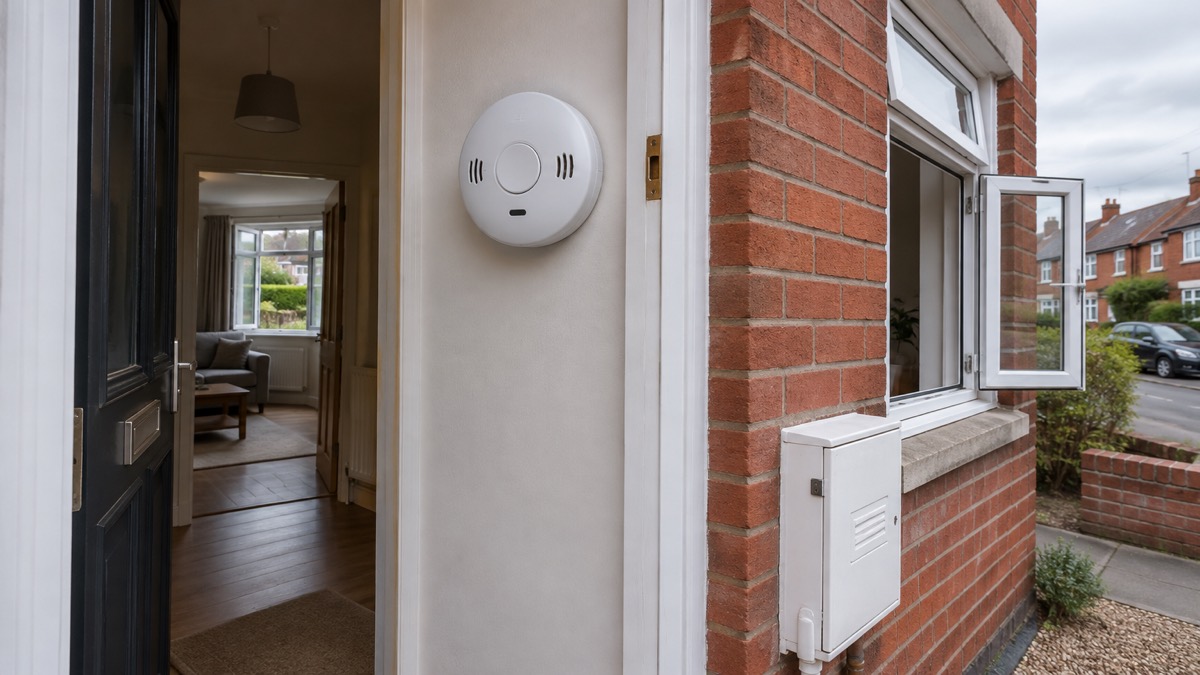
If your carbon monoxide alarm is sounding, or you suspect carbon monoxide in your house, act now and do not wait to work out the cause. Get everyone out of the property into fresh air first. If it is safe to do so on your way, turn off fuel burning appliances such as the boiler, gas fire or log burner, and open doors and windows. Then call the gas emergency helpline on 0800 111 999, which is free and available 24 hours a day, 365 days a year1.
If anyone in the household feels unwell, call 999 immediately. The NHS says to call 999 or go to A&E if someone who may have been exposed to carbon monoxide is finding it hard to breathe, has suddenly become confused, has lost consciousness, feels weak, or has chest or muscle pain4. Do not go back inside until the alarm has stopped and the property has been declared safe5.
Carbon monoxide has no smell and no taste, and you cannot see it, which is why an audible alarm matters. Devon and Somerset Fire and Rescue Service is blunt about it: these alarms rarely beep as a false alarm, so if your carbon monoxide detector is beeping you should act fast and get out of the property1. Treat every alert as real.
When the alarm sounds: get out, then let fresh air in
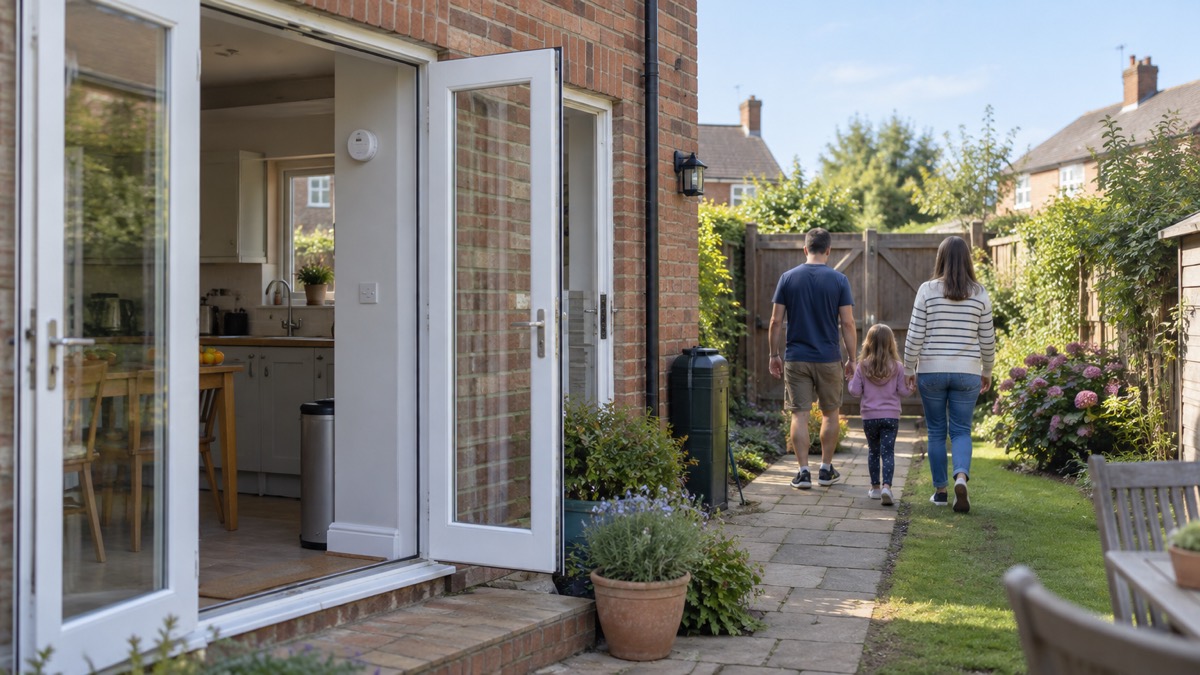
The order matters. North Wales Fire and Rescue Service advises that if your carbon monoxide alarm sounds, or you suspect carbon monoxide poisoning, you should leave the building immediately, call the emergency services if anyone feels unwell, and not re-enter until it has been declared safe6. Surrey County Council gives the fuller sequence: open all doors and windows, stop using and turn off all fuel burning appliances, evacuate leaving doors and windows open, and do not re-enter the property until the alarm has stopped5. The Northern Ireland Fire and Rescue Service puts it the same way: isolate all possible sources, ventilate the property and get out7.
In practice, follow these steps in order:
- Get everyone out of the property, including pets if you can do so without delay. People first, always.
- If it is safe on your way out, turn off fuel burning appliances: the boiler, gas fire, log burner, oil heater, anything with a flame5.
- Open doors and windows as you leave, so fresh air dilutes the gas while you are outside5.
- Stay outside in the fresh air, and call the emergency number for your fuel type9.
- Do not go back in until the alarm has stopped and the property has been declared safe5.
One point from independent advice is worth adding once you are out: Which? warns that after the alarm has sounded you should avoid using light switches, smoking or striking a match, for example to light a candle, because a spark could catch fire if there is a gas leak as well14. If you also smell gas, follow the steps on what to do if you smell gas, which cover this in full.
Turn off the appliances and stay out
Turning the appliance off stops more carbon monoxide being produced, but it does not make the room safe on its own. Manchester Fire and Rescue Service advises you to turn off gas appliances and leave the house2. If the appliance is in a closed room, or you would have to go back in to reach it, leave it and get out instead. The nidirect guidance for Northern Ireland is clear that you should switch off the appliance immediately and open your window or go outside12.
Two rules from the official guidance protect you after the event:
- Do not use the appliance again until it has been tested by a registered engineer. This applies to the boiler, fire, cooker or heater you suspect, and it applies even if the alarm stops and you feel fine12.
- Do not sleep in a room where you think there are carbon monoxide fumes. Belfast City Council states this plainly, and it is the single most important rule if the incident happens at night12.
An alarm is there to alert you and to get you out in time; it is not a meter that tells you when the air is clean again. Only ventilation, time and a professional check do that, which is why the stay-out rule exists.
Who to call: 0800 111 999 for gas, or the helpline for your fuel
For gas appliances, the number to call is the National Gas Emergency Service, also called the Gas Emergency Helpline, on 0800 111 999. It is free, and it is the same number across England, Scotland and Wales. Devon and Somerset Fire and Rescue Service adds the wider rule: if a carbon monoxide alarm is beeping, immediately get out of the building and call the relevant helpline for the fuel type, and for gas that helpline is 0800 111 99913.
| Your situation | Who to call | Number |
|---|---|---|
| CO alarm sounding, gas appliances in the house | Gas Emergency Helpline | 0800 111 9993 |
| You think a gas appliance is leaking CO | National Gas Helpline | 0800 111 9994 |
What happens when you ring
Cornwall Fire and Rescue Service explains what to expect: you will be put through to a trained operator who will take all the details, and all calls to the National Gas Emergency Service are recorded and may be monitored16. Wiltshire and Swindon Prepared sets out what the service does with your call: the National Gas Emergency Service is available 24 hours a day, 365 days a year and will send out an engineer to keep you and your property safe10. So a call at 2am gets the same response as a call at midday.
What the engineer does on arrival
The engineer's job is to make the property safe. They will identify and isolate the source of the carbon monoxide, which may be a faulty appliance, a blocked flue or a leak, and they will make the area safe so you can re-enter. Until they or another competent person have declared the property safe, treat the house as unsafe, especially for sleeping in. If your heating is out of action for a period afterwards, our guide to gas and heating failures covers how to keep warm and what to do next.
Feeling unwell: when to call 999 or your doctor
Carbon monoxide poisoning can affect anyone in the house, and symptoms can continue or develop after you have left. Warwickshire County Council's advice is direct: if the alarm sounds or you suspect carbon monoxide because of symptoms such as headaches, dizziness or nausea, leave your home, call 999, and seek medical attention, and do not re-enter until the property has been deemed safe by professionals11. Devon and Somerset Fire and Rescue Service says the same for the moment of the incident: if you start to feel unwell, this could be carbon monoxide poisoning, so call 999 immediately13.
The NHS lists the signs that make it an emergency. Call 999 or go to A&E if you think you or someone else has been exposed to carbon monoxide and4:
- you are finding it hard to breathe
- you have suddenly become confused
- someone has lost consciousness
- you are feeling weak
- you have chest or muscle pain
NHS 111 Wales gives the same emergency signs: finding it hard to breathe, suddenly becoming confused, or someone losing consciousness15. If the symptoms are milder, the nidirect guidance for Northern Ireland advises seeking medical help from a qualified healthcare professional, and the guidance also notes you can contact NHS 111 or your GP9. The full list of symptoms, and how they differ from common illnesses like flu, is on our page about carbon monoxide poisoning symptoms.
A CO alarm rarely gives a false alarm
Many people's first instinct when the alarm sounds is that it must be a fault, because nothing smells and nobody feels ill. Resist that instinct. Devon and Somerset Fire and Rescue Service states that carbon monoxide alarms rarely beep as a false alarm, so if your carbon monoxide detector is beeping you should act fast and get out of the property1. That is the whole basis of the advice on this page: treat every alert as real, every time.
This matters most at night and in winter. Carbon monoxide alarms rarely beep as a false alarm, so if the detector is beeping you should act fast and get out of the property. Power cuts push households towards portable heaters, generators and other improvised heating, exactly the equipment that produces carbon monoxide.
If your alarm is chirping intermittently rather than sounding in full alarm, that is usually a low battery or a fault rather than a carbon monoxide alert, and it needs prompt attention. Our page on why your carbon monoxide alarm is beeping separates the two patterns. But a full alarm tone gets the full response on this page, without pausing to diagnose.
Where to fit a CO alarm: 1 to 3 metres from the appliance
Position decides whether the alarm does its job. North Wales Fire and Rescue Service's advice sheet gives the distances: the alarm must be 1 to 3 metres away from the appliance, a minimum of 1000mm and a maximum of 3000mm, when it is sited in the same room as the appliance17. Cherwell District Council, giving the rules used for rented homes, adds the height and placement: alarms should be positioned at head height, either on a wall or shelf, approximately 1 to 3 metres away from a potential source of carbon monoxide18.
For rooms where people sleep, or rooms remote from the appliance, the siting rule changes. North Wales Fire and Rescue Service advises that alarms in sleeping rooms or rooms remote from the appliances should be located just below but relatively close to the breathing zone of the occupant, and between the occupant and the appliance17. In plain terms: in a bedroom, put the alarm near the bed, at the height of a person lying or sitting there, on the side between the sleeper and the boiler or fire.
| Where the alarm goes | Position rule |
|---|---|
| Same room as the appliance | 1 to 3 metres from it, minimum 1000mm, maximum 3000mm17 |
| Height | Head height, on a wall or shelf18 |
| Sleeping rooms or rooms remote from the appliance | Just below and close to the occupant's breathing zone, between occupant and appliance17 |
| Rooms with a fixed combustion appliance | One alarm in each room used as living accommodation containing the appliance, excluding gas cookers18 |
Manchester Fire and Rescue Service recommends placing a carbon monoxide alarm in rooms where you have a fixed combustion appliance, such as a gas fire, gas boiler, log burner or open fireplace19. Our page on where to put a carbon monoxide alarm goes into more detail on each room of the house.
Choosing an alarm: EN 50291 and regular testing
Buy an alarm that meets the standard. Warwickshire County Council advises looking for one that meets the British Standard BS EN 50291 to ensure its effectiveness is guaranteed20, and Manchester Fire and Rescue Service says the same: install an audible carbon monoxide alarm that meets European Standard EN 502912. The standard covers how quickly the alarm responds at different carbon monoxide concentrations, so an alarm without it may be slow or unreliable. Our page on alarm standards explains what EN 50291 requires.
Carbon monoxide alarms are available from DIY and hardware stores1, and Manchester Fire and Rescue Service says you can buy and install an audible CO alarm online or from DIY shops19. Our guide to carbon monoxide alarms compares the types side by side, including sealed long life batteries versus replaceable ones.
Once fitted, maintain it:
- Test at least once a month using the test button20.
- Replace batteries annually, or as soon as the low battery signal sounds, for alarms with replaceable batteries14.
- Check everyone in the house knows the sound and what it means11.
Which? also advises testing your alarm regularly using the test button and replacing the batteries annually or when the low battery signal sounds14. Our page on how often to test alarms gives a routine for the whole house.
Recalled carbon monoxide alarms: check before you rely on one
A recalled alarm is worse than no alarm, because it gives false confidence. The Office for Product Safety and Standards has issued a product safety report on an unbranded carbon monoxide alarm for domestic use with an LCD ppm display, powered by AA batteries and packaged in black and orange cardboard, notified by Local Authority Trading Standards under case number 2112-059121. The advice is unambiguous:
The Office for Product Safety and Standards advises owners to stop using this product immediately and seek alternative carbon monoxide detection, and to contact the distributor they purchased from to request redress21.
Office for Product Safety and Standards21
If you own an unbranded CO alarm matching that description, stop using it and get a replacement that meets EN 50291. More generally, check any alarm you already own against current recalls before relying on it; our page on how to check if an electrical product has been recalled explains how.
Landlords must fit CO alarms in rented homes
If you rent, the law is on your side. Landlords are required by law to install working smoke and carbon monoxide alarms in their properties, under measures announced on 11 March 2015 and amended in 202222. From 1 October 2022, the Smoke and Carbon Monoxide Alarm (Amendment) Regulations 2022 require all relevant landlords in England to ensure a carbon monoxide alarm is equipped in any room used as living accommodation which contains a fixed combustion appliance, excluding gas cookers23. Cherwell District Council adds that landlords should choose alarms compliant with British Standards BS 5029118.
The 2022 regulations also cover what happens when an alarm stops working. Landlords must repair or replace alarms as soon as reasonably practicable after being notified they are faulty by the tenant or their representative18. So the practical steps for a renter are:
- Check which rooms have a fixed combustion appliance, and whether each has a working CO alarm.
- Test the alarm monthly yourself20.
- If it is faulty or missing, notify your landlord or letting agent in writing, and keep a copy.
- If nothing happens, the landlord is in breach of the regulations, and your local council's housing standards team enforces them.
The rules described here are the England regulations. Arrangements in Scotland, Wales and Northern Ireland differ in places, and our page on Wales and Northern Ireland covers those differences.
Log burners, generators, caravans and hearing impairment
Log burners and solid fuel. Somerset Council says a carbon monoxide alarm should be fitted if you have a gas boiler or solid fuel appliance22, and the Scottish Fire and Rescue Service advises carbon monoxide alarms if you have heating or cooking appliances fuelled by gas, coal, wood or oil, noting they do not need to be linked to the fire alarms24. A log burner or open fire always produces carbon monoxide; the danger comes from a blocked chimney, a poor draw or a faulty door seal letting it into the room rather than up the flue. Fit the alarm in the same room, 1 to 3 metres away17.
Generators and portable heaters. Armagh City, Banbridge and Craigavon Council advises using suitably located carbon monoxide alarms inside your home, outbuilding or the area being serviced by the generator, and installing a carbon monoxide alarm near any diesel space heater, with a fire extinguisher rated for fuel fires nearby25. Never run a generator indoors or in an attached garage, and never point its exhaust at a window or vent.
Caravans and holiday accommodation. The government's fire safety outdoors advice says to consider fitting a carbon monoxide alarm in caravans26, and the Northern Ireland Fire and Rescue Service urges students to check, as soon as they arrive at their accommodation, that they have working smoke alarms and carbon monoxide alarms and know their escape routes27. A portable EN 50291 alarm travels easily.
Hearing impairment. A standard alarm is no use to someone who cannot hear it. Anglesey Council's Telecare service describes a carbon monoxide detector that raises an audible alarm within the home and provides additional protection by raising an instant alarm call to the monitoring centre when carbon monoxide levels are increased, for example from a blocked flue or chimney or faulty appliances28. Ask your council or telecare provider what is available locally, and see our page on alarms for deaf and hard of hearing people for the full range of options.
Make sure everyone in the house knows the plan
An alarm only saves the people who respond to it correctly. Warwickshire County Council advises ensuring that all household members, including children, are aware of the sound and meaning of a CO alarm, respond promptly and evacuate safely, and that you regularly discuss carbon monoxide safety and develop an emergency plan11. Wiltshire and Swindon Prepared frames it as a question every household should be able to answer: does everyone know what the carbon monoxide alarm means and what to do next?29
A short household plan covers it:
- Press the test button so everyone, children included, recognises the sound.
- Agree that the response is always the same: out of the house, then the call.
- Pick a meeting point away from the house, as in a fire escape plan.
- Keep the gas emergency number, 0800 111 999, somewhere visible or in every adult's phone.
- Practise the conversation occasionally, and revisit it if you change heating or add a log burner.
Prevention sits alongside the plan. NHS guidance for parents advises getting appliances serviced regularly and fitting a carbon monoxide alarm where there are flame burning appliances or open fires30, and Belfast City Council repeats the servicing advice alongside its alarm guidance31. Servicing is what stops the alarm ever sounding; the alarm is the backstop when something still goes wrong. For the wider picture of fires and emergencies at home, see our home emergencies guide.
Sources (31)
- Carbon monoxide safety at home, Devon and Somerset Fire and Rescue Service
- Carbon monoxide: your safety, Manchester Fire and Rescue Service
- Book a home safety visit, Devon and Somerset Fire and Rescue Service
- Carbon monoxide poisoning, NHS
- Smoke alarms and carbon monoxide detectors, Surrey County Council, 2026-08-24
- Carbon monoxide safety at home, North Wales Fire and Rescue Service
- Community safety: other safety, Northern Ireland Fire and Rescue Service, 2026-10-22
- Carbon monoxide: stay safe at home, Cheshire Fire and Rescue Service, 2026-05-20
- Carbon monoxide poisoning, nidirect, 2024-12-16
- What you might need in a gas outage, Wiltshire and Swindon Prepared, 2026-10-25
- Safe home heating, Warwickshire County Council, 2026-10-29
- Home safety, Belfast City Council, 2026-10-29
- Fire service sees worrying increase in carbon monoxide incidents and fire risks due to power cuts, Devon and Somerset Fire and Rescue Service, 2022-02-20
- Five ways to avoid a carbon monoxide build up, Which?, 2026-07-14
- Carbon monoxide poisoning, NHS 111 Wales, 2025-10-02
- Action to take if you smell gas, Cornwall Fire and Rescue Service, 2021-05-10
- Carbon monoxide alarm advice sheet, North Wales Fire and Rescue Service, 2024
- Housing standards: smoke and carbon monoxide alarms, Cherwell District Council, 2026-10-29
- Carbon monoxide: home fire safety, Manchester Fire and Rescue Service, 2026-10-29
- Smoke alarms and CO detectors, Warwickshire County Council, 2026-10-29
- Product safety report: carbon monoxide alarm 2112-0591, Office for Product Safety and Standards, 2022-03-27
- Household fire safety, Somerset Council, 2025-01-30
- Smoke and carbon monoxide alarms, North Yorkshire Fire and Rescue Service, 2026-02-20
- Smoke and heat alarms at home, Scottish Fire and Rescue Service, 2025-04-14
- Safe use of heaters and generators, Armagh City, Banbridge and Craigavon Council, 2026-10-29
- Fire safety outdoors, HM Government, 2022-05-25
- Charge safely for your own safety, Northern Ireland Fire and Rescue Service, 2026-09-21
- Telecare service: what is available, Isle of Anglesey County Council, 2026-10-29
- Personal resilience at home, Wiltshire and Swindon Prepared, 2026-10-25
- Poisoning: keeping your child safe at home, South Yorkshire Healthier Together NHS, 2026-10-29
- Home safety, Belfast City Council, 2026-10-29
 Home Fire Safety Checklist
 Bedtime Fire Safety Checks
 Fire Risk Checks for Carers
 What to Do If Fire Starts
 How to Make a Fire Escape Plan
 Fire in a Block of Flats
 Kitchen Fires and Cooking Safety
 Electrical Fires and Sockets
 Smoking, Matches and Lighters
 E-bike Charging Safety
 Hoarding and Fire Risk
 Thatched Properties Fire Risk
 Fireworks and Bonfire Safety
 What to Do After a House Fire
 How Fire Services Respond