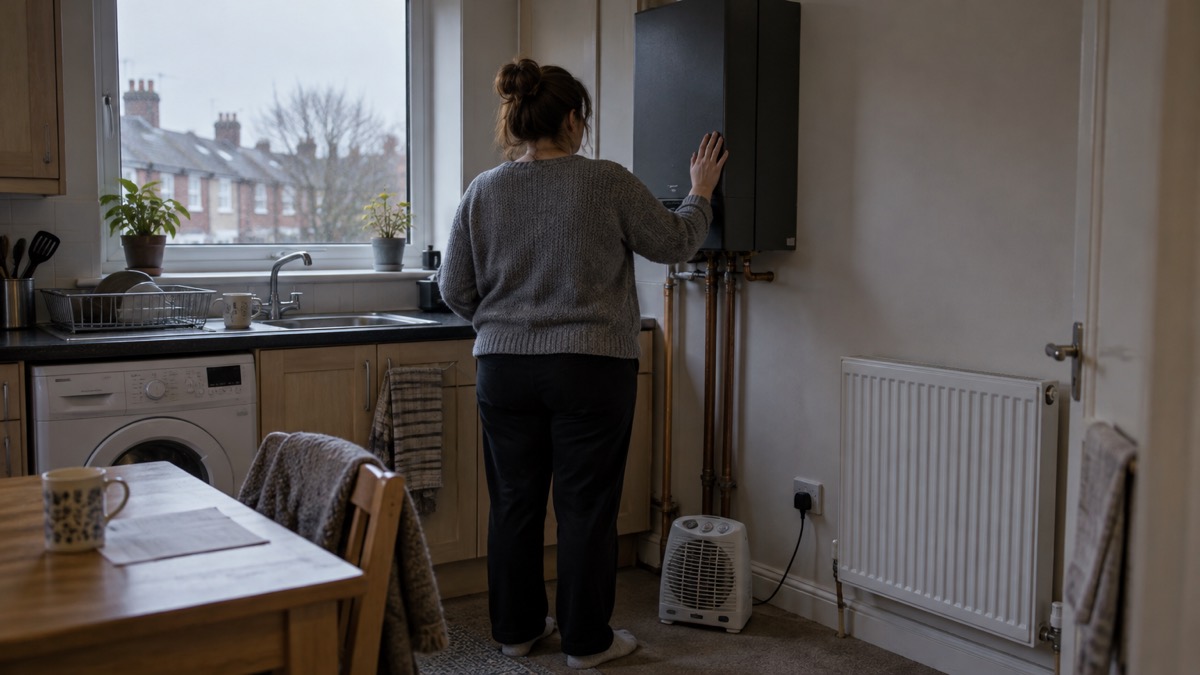
If the boiler breaks in your rented home, the first step is simple: report it to your landlord immediately, in writing if you can, and keep a copy of what you sent. Being a tenant means your landlord is responsible for the safety of gas appliances in your home1, and for keeping heating, hot water, gas and electricity systems in working order2. With something serious like a boiler failure, official guidance says it might be reasonable to expect the landlord to arrange for a technician to attend within 24 hours to carry out an initial inspection3.
If a Gas Safe registered engineer disconnects your boiler because it is unsafe, your landlord must provide you with emergency heating while the remedial work is arranged4. You should never attempt to repair a gas appliance yourself: any work on appliances such as cookers, boilers or fires has to be carried out by a Gas Safe Registered engineer5. This page sets out what your landlord must legally do, what you are entitled to see and hold, and where to go if nothing happens.
What to do first when the boiler breaks
Report the fault to your landlord straight away. Fire and rescue guidance for tenants is to familiarise yourself with the location of detectors and immediately report any malfunctioning units to your landlord6, and the same prompt reporting applies to the boiler itself. Put it in writing, by email or text, so you have a record of when you reported it and what you asked for. If the problem turns out to be a gas leak or you smell gas, do not wait for your landlord: ring the National Gas Emergency Service at once, because any work on appliances such as cookers, boilers or fires afterwards has to be carried out by a Gas Safe Registered engineer5.
What counts as a reasonable response time depends on how serious the fault is. Official guidance on renting a safe home says that with something serious or dangerous, like a boiler failure or an electricity outage, it might be reasonable to expect the landlord to arrange for a technician to attend within 24 hours to carry out an initial inspection3. That is an initial inspection, not necessarily a completed repair: parts may need ordering, or a full service visit may follow. But it sets the benchmark to hold your landlord to when you chase them.
If the outcome is that the boiler is unsafe and an engineer disconnects it, the rules change in your favour. The Health and Safety Executive's guidance is clear:
"If a heating appliance has been disconnected then your landlord must provide you with emergency heating."
So a condemned boiler does not leave you with nothing: your landlord must supply emergency heating while arranging remedial work by a Gas Safe registered engineer, and you can contact your local authority for more information about what help is available4. Our page on what help there is if your appliance is condemned goes into this in more detail.
A few situations need slightly different first steps:
- Burst or frozen pipes as well as the boiler: in rented accommodation, landlords are responsible for insulating and protecting inside pipework9, so report it and let them arrange the plumber. It is still sensible to have contact details for a plumber yourself9.
- Oil-fired boiler with a leak: call your landlord and make them aware of the leak, find where it is coming from, switch off the oil supply at the tank, and block the spill from entering drains using absorbent materials such as earth or sand10.
- Wood pellet boiler: if problems are encountered, such as the system not heating correctly or flue gas flowing into the boiler room, turn the unit off and seek assistance immediately11.
- Problems that only affect your property: for emergencies such as blocked manholes or sewers, first check whether the issue only affects your property. If it does, and you rent, speak to your landlord rather than calling out a contractor yourself12.
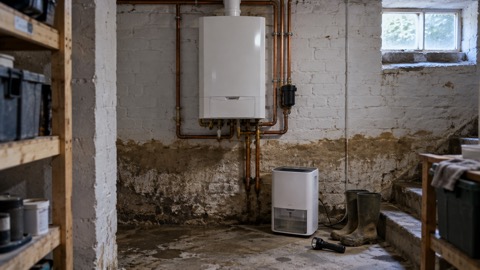
Before you call the landlord, it is worth running through the basic checks to make before calling a boiler engineer: a low pressure gauge, a frozen condensate pipe or a programmer that has reset after a power cut can all look like a breakdown but take minutes to fix. If the fault is one of those, tell your landlord what you found anyway, so it is on record.
Your landlord must keep gas appliances safe and maintained
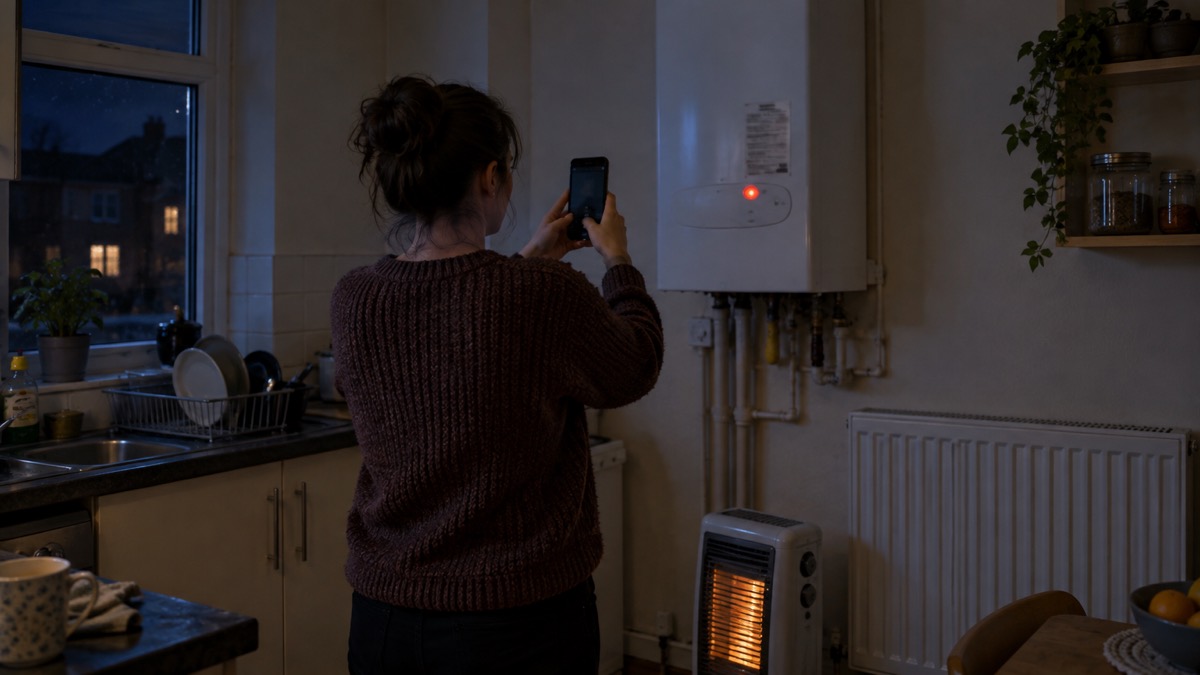
The legal foundation is the Gas Safety (Installation and Use) Regulations 1998, which deal with landlords' duties to make sure gas appliances, fittings and flues provided for tenants are safe4. Under those regulations, landlords must repair and maintain gas pipework, flues and appliances in safe condition, ensure an annual gas safety check is done on each appliance and flue, and keep a record of each gas safety check13. The duty sits with the landlord personally: being a tenant means your landlord is responsible for the safety of gas appliances in your home1.
All of this work must be done by an engineer on the Gas Safe Register. Landlords of rented accommodation must have any gas appliance they own regularly maintained by a Gas Safe registered engineer and issue the tenant with a copy of the gas safety record following the annual gas safety check14. Gas appliances should be serviced annually by a Gas Safe registered engineer, and this is a legal requirement for landlords15. Never attempt DIY repairs on gas appliances or electrical installations15. Our guide to finding a Gas Safe registered engineer and checking their card explains how to verify whoever attends your home.
The annual check covers the gas appliances your landlord provides. Your landlord should get your gas appliances safety checked at least once a year, including your gas boiler, gas cooker and gas fire1. If you own a gas appliance yourself, for example a cooker you brought to the property, approach your landlord and ask for it to be included, at reasonable cost, within the gas safety maintenance and check they arrange with a Gas Safe registered engineer4. Landlords in England are legally required to cover the appliances they own, and the Government also "expect and encourage reputable landlords to cover all gas appliances"16.
Two edge cases are worth knowing:
- Subletting: if a property is sublet, the original landlord is still responsible for gas safety checks and cannot transfer this responsibility to the tenant who is subletting; if the property is wholly sublet, the contract must clearly allocate responsibility for completing the check4.
- Communal appliances: where a landlord lets within a building they do not own, their arrangements with the building owner must ensure that any communal gas appliances, flues and pipework used by tenants are maintained and checked for safety by the building owner, with evidence of checks available4.
Landlords must also ensure all gas and electrical appliances are in good working order in privately rented accommodation17, and they must show you safety certificates so you can see when gas and electrical appliances were last checked7. If you are sleeping in a room with a gas appliance, coal or log fire, that is a particular carbon monoxide risk, and NHS guidance is to ensure your landlord has completed the annual Gas Safety check18.
The gas safety record: what you must be given and when
Every year, after the Gas Safe registered engineer completes the safety check, your landlord must give you a copy of the record. The rules on timing are specific:
- The landlord must keep a record of the safety check for 2 years4
- A copy must be issued to each existing tenant within 28 days of the check being completed4
- A copy must be issued to any new tenants before they move in4
- The record should be issued on completion of the checks and not delayed even if defects are found or until remedial action has been taken; it is described as a "living document" to be supplemented with follow-up action records4
In practice, this is the document people call the Gas Safety Certificate, and you are entitled to have written notification within 28 days of the safety check being done1. Make sure your landlord has provided you with a Gas Safety Certificate if gas is supplied to the property when you move in19, and if you do not have a record that the gas appliances in your rented home have been safety checked, ask your landlord for a copy1. If they do not provide it on request, you can notify the Health and Safety Executive, which is the reporting route covered later on this page14.
The check itself must happen annually: within 12 months of the installation of a new appliance or flue, and annually thereafter, by a Gas Safe Registered engineer4. LPG appliances owned and provided by the landlord must also have a safety check at least once every 12 months by a Gas Safe registered engineer4. Between tenancies, a landlord re-letting a property must ensure all appliances and flues are safe with an up-to-date gas safety check record, with a copy given to tenants before they move in, and if tampering or vandalism is suspected, they must arrange another gas safety check before giving access to new tenants4.
Carbon monoxide alarms: what the law requires in a rented home
Carbon monoxide has no smell and no taste, and a faulty boiler or flue can produce it. The alarm rules for rented homes in England come from the Smoke and Carbon Monoxide Alarm Regulations, with measures announced on 11 March 2015 and amendments in 202220. The key change, from 1 October 2022, is that all relevant landlords in England must provide a carbon monoxide alarm in any room used as living accommodation which contains a fixed combustion appliance, excluding gas cookers4. All private and social landlords must ensure this in all of their rented properties21.
The rules in summary:
| Requirement | Who it applies to | Detail |
|---|---|---|
| CO alarm in any room used as living accommodation with a fixed combustion appliance (excluding gas cookers) | Private and social landlords, England, from 1 October 202221 | Includes rooms with a boiler, gas fire, wood burner or other fixed combustion appliance |
| CO alarm in any room with a solid fuel burning appliance, such as a coal or wood burning fire or stove | Private landlords in England16 | The original 2015 requirement, still in force |
| Alarms repaired or replaced once the landlord is informed they are faulty | Landlords8 | Must be done as soon as reasonably practicable after notification21 |
| CO alarm in any room with a solid fuel burning appliance | Private landlords in Scotland22 | Part of the repairing standard duties |
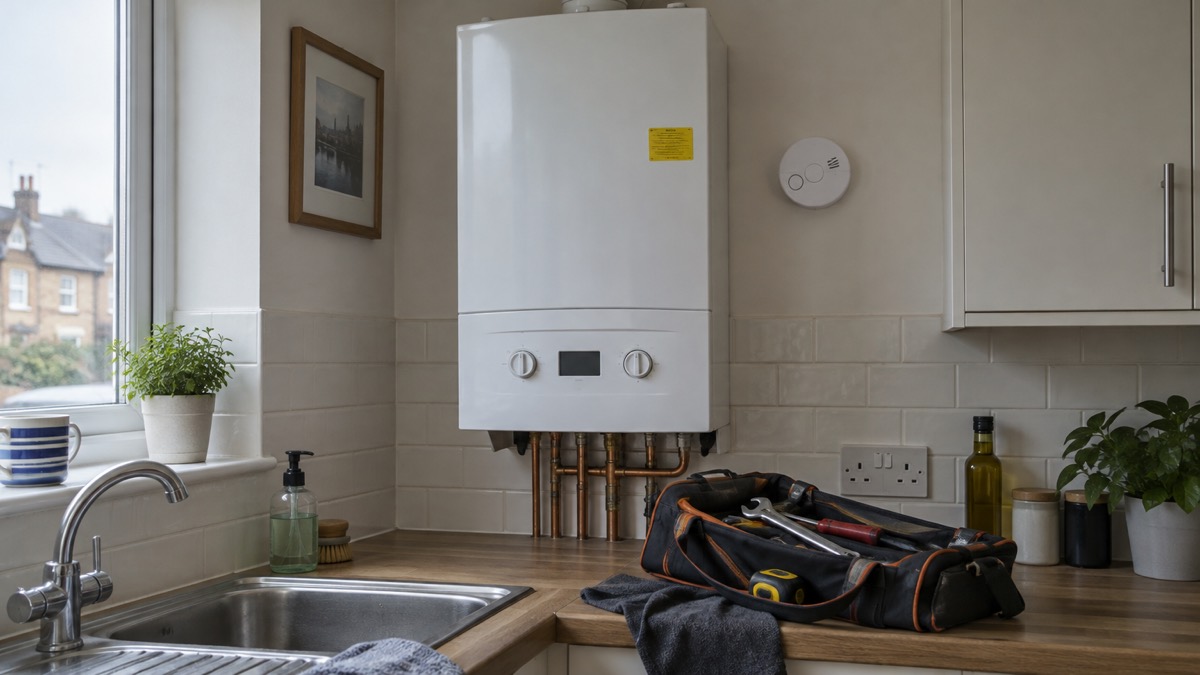
The repair duty matters as much as the fitting duty. Manchester Fire and Rescue Service advises tenants that landlords "must also ensure smoke alarms and carbon monoxide alarms are repaired or replaced once informed and found that they are faulty"8, and the amended regulations require landlords to repair or replace alarms as soon as reasonably practicable after being notified they are faulty by the tenant or their representative21. So if you press the test button and nothing happens, report it in writing the same way you would report a boiler fault. Cheshire Fire and Rescue Service puts the landlord's side of it plainly: repair or replace smoke and carbon monoxide alarms if they are reported as faulty23.
Your own part is to test the alarms regularly. Your landlord must fit working smoke alarms and a carbon monoxide detector, which should then be tested regularly7. Devon and Somerset Fire and Rescue Service reminds tenants that landlords are required by law to install working smoke and carbon monoxide alarms in their properties24, and fire and rescue guidance adds that the law requires landlords to ensure there are carbon monoxide alarms in any room used as living accommodation which contains a fixed combustion appliance (excluding gas cookers) and to check they are working at the start of the tenancy15.
How many carbon monoxide alarms a rented home needs
The legal answer is one per room that needs one, not one per home. From 1 October 2022, all private and social landlords must ensure that in all of their rented properties there are smoke alarms on every storey where there is a room used wholly or partly as living accommodation, and carbon monoxide alarms in any room used wholly or partly as living accommodation where a fixed combustion appliance is present, excluding gas cookers21. So a home with a gas boiler in the kitchen and a gas fire in the living room needs a CO alarm in each of those rooms.
For solid fuel, the rule is categorical: private rental sector landlords are bound by law to install one CO alarm in any room that contains a solid fuel burning appliance25, and all landlords of private residential rental properties in England are required by law to install a carbon monoxide alarm in any room that contains a solid fuel burning appliance, such as coal or wood burning fires and stoves16. Solid fuel appliances can also cause carbon monoxide poisoning, and carbon monoxide alarms are required by law for privately rented properties with such appliances3.
On the alarms themselves, official guidance recommends that carbon monoxide alarms in rental properties are mains-powered with integral battery back-up and installed by a competent electrician to British Standard BS EN 50292:201321. Alarms should be compliant with British Standards BS 5029121. These are the specifications that decide whether an alarm is fit for a tenancy, so it is reasonable to ask your landlord what standard the alarms in your home meet. Cheshire Fire and Rescue Service's home safety advice is blunt about whose job it is: "Your landlord must provide one if you rent your home"26.
In Northern Ireland, the approach is broader: landlords are always responsible for gas and electrical appliances27, and the alarm requirements there are set out in Northern Ireland guidance on gas safety and carbon monoxide28. Wherever you rent in the UK, the practical test is the same: identify every room used as living accommodation that contains a fixed combustion appliance other than a gas cooker, and there should be a working CO alarm in each.
Homes that run only on electricity, and why neighbours' boilers still matter
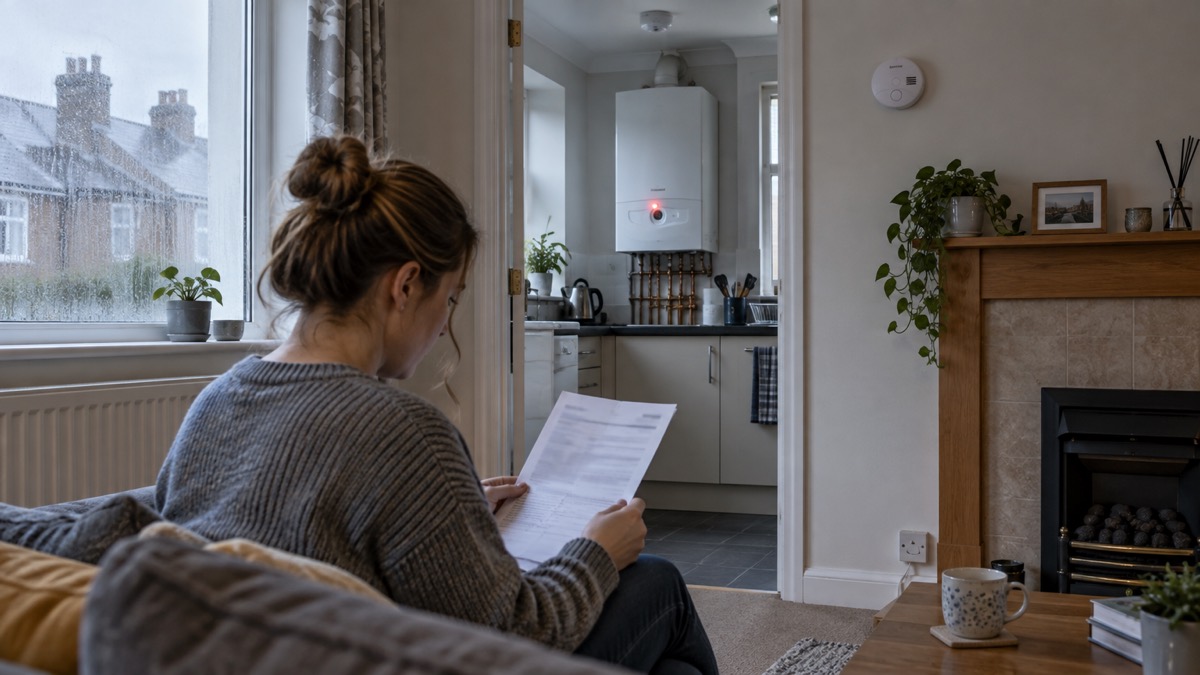
If your rented home has no gas at all, the gas safety check and gas safety record do not apply, because there are no gas appliances to check. But your landlord's repair duties do not disappear: landlords are always responsible for gas and electrical appliances27, and landlords must ensure all gas and electrical appliances are in good working order in privately rented accommodation17. An electric boiler, storage heaters or a heat pump that fail are repair issues in exactly the same way as a gas boiler, and the same prompt reporting and the same 24 hour expectation for an initial inspection apply3. Our guides to heat pump breakdowns in cold weather and to heating and cooking without mains power or gas cover the electric side.
Even in an all-electric home, other people's combustion appliances can still affect you, and this is where the layout of your building matters. Official Scottish guidance notes that it is not the responsibility of a landlord to install CO detectors in neighbouring properties, but landlords should be aware of the potential risk of gas escaping into other living spaces in tenement flats with multiple owners29. In a tenement or a converted house split into flats, a faulty flue next door can put carbon monoxide into your rooms, so a CO alarm is worth having even if you have no combustion appliance of your own.
Fire spread between adjoining properties is the other reason neighbours matter. Fire service incident reports show how damage crosses boundaries: a fire in a semi detached bungalow at Ansford measuring 5 metres by 7 metres, of brick walls and tiled roof, was reported by Devon and Somerset Fire and Rescue Service30, and a property fire at Burnham-on-Sea in January 2026 involving an open fire place within a ground floor lounge caused 90% fire damage and 100% smoke damage to the lounge, with the remainder of the property 80% smoke damaged31. In London, fires damaged a four roomed flat on the 18th floor of a 20 floor residential block, and part of a four roomed flat on the first floor in Beckenham32. None of these are reasons for alarm, but they are reasons to know your escape routes and to take any alarm, yours or a neighbour's, seriously.
If you are in shared accommodation, there are extra expectations: there should be fire blankets and fire extinguishers in shared kitchens7, and your landlord must fit working smoke alarms and a carbon monoxide detector, which should then be tested regularly7.
Landlord duties in Scotland: the repairing standard
Scotland runs its own framework. Private landlords in Scotland are required by law to ensure that a rented house meets the repairing standard at the start of a tenancy and throughout a tenancy29. The Repairing Standard is set out by the Scottish Government22, and under the Gas Safety (Installation and Use) Regulations 1998 landlords are legally responsible for the safety of their tenants in relation to gas safety29. The repairing standard duties include repairing and maintaining gas pipework, flues and appliances in safe condition, and ensuring an annual gas safety check is done on each appliance and flue, with a record kept13.
The repairing standard is broader than gas alone. Landlords of rented homes must repair damage to the structure and exterior, such as walls, roof, windows and doors; repair plumbing, heating, gas, electricity and water supply systems; and repair fixtures and fittings they provided, such as carpets, curtains and appliances2. If flooding from rain affects your rented home, your landlord is responsible for repairs, including fixing damage to the structure and making sure water, gas, electricity, sanitation and heating are working2. Private landlords have a legal responsibility to ensure tenants live in safe and secure homes, and furniture must also be fire safe22.
On carbon monoxide alarms specifically, a CO alarm must be in place within any room with a solid fuel burning appliance in Scottish rented properties22. An important point for tenants chasing repairs: private landlords in Scotland may rely on professional advice from a suitably qualified person, for example a Gas Safe Registered engineer, but they retain personal responsibility to ensure any house they rent meets the repairing standard29. "The engineer said it was fine" is not a defence against the standard.
The Scottish Housing Quality Standard is also available for further support to tenants and landlords22. For the practical side of boiler faults, our pages on boiler breakdowns in cold weather and boiler servicing apply equally north of the border.
Where to complain if your landlord does not act
Most landlords will act once you report a fault in writing, but if they do not, you have several routes, and which one depends on what has gone wrong.
If your landlord will not give you the gas safety record. Notify the Health and Safety Executive if your landlord does not, on request, provide you with a copy of the record14. This is the direct route for the missing certificate, and asking for it in writing first gives you the evidence you need.
If your landlord does not arrange the annual gas safety check. Your landlord should arrange an annual gas safety check for any fixed appliances; if they fail to provide this, report them to your local authority33. Local authorities also enforce housing standards in rented homes more generally34.
If repairs stall, including heating and hot water. The same local authority route applies, and the official benchmark of an initial inspection within 24 hours for something serious like a boiler failure is the standard to point to3. Keep your written reports, dates and any responses together, because a complaint with a timeline is far harder to ignore.
If you rent in Scotland. Tenants have a right to refer any landlord not complying with the carbon monoxide alarm duty or any other element of the repairing standard to the First-tier Tribunal for Scotland Housing and Property Chamber29. This covers the full repairing standard, not just alarms, so a landlord who will not repair heating is within the Tribunal's reach.
A landlord who provides emergency heating after a disconnection but then leaves the remedial work undone is still falling short: the emergency heating is a stopgap while a Gas Safe registered engineer carries out the repair4. If you are left without heating for a long period, our page on help from networks during a long outage and the guide to extra support for vulnerable households list further sources of help, and the Priority Services Register may apply if someone in the household is older, disabled or medically dependent.
Sources (34)
- Gas safety for tenants, Greater London Authority, 2026-10-25
- Housing help if your home is flooded, Somerset Council, 2026-06-04
- How to rent a safe home, HM Government, 2020-12-10
- Gas safety: frequently asked questions for landlords and tenants, Health and Safety Executive
- What you might need in a gas outage, Wiltshire and Swindon Prepared, 2026-10-25
- Safe home heating, Warwickshire County Council, 2026-10-29
- Shared and rented accommodation, Devon and Somerset Fire and Rescue Service, 2025-06-24
- Additional advice for tenants: smoke and heat alarms, Manchester Fire and Rescue Service, 2026-10-29
- Steps to reduce the risk of burst pipes, nidirect, 2025-10-23
- Domestic oil pollution, Northumberland County Council, 2026-10-28
- Wood pellet fuels and carbon monoxide, Health and Safety Executive, 2026
- Emergency contact numbers, Belfast City Council, 2026-10-29
- Carbon monoxide detectors: governmental guidance, Scottish Borders Council, 2015-06-25
- Gas safety: information for students and tenants, Health and Safety Executive
- Fire safety prevention advice, Fire Kills campaign, 2026-03-25
- Fire alarms and carbon monoxide detectors, Lincolnshire County Council, 2026-10-29
- Safety advice for students, Lincolnshire County Council, 2026-10-29
- Sleeping in a room with a gas appliance, coal or log fire, Doncaster and Bassetlaw Teaching Hospitals NHS Foundation Trust, 2026-03-06
- Safety advice for tenants, Devon and Somerset Fire and Rescue Service, 2026-03-06
- Household fire safety, Somerset Council, 2025-01-30
- Housing standards: smoke and carbon monoxide alarms, Cherwell District Council, 2026-10-29
- Fire safety in rented accommodation, Scottish Fire and Rescue Service, 2024-02-06
- Smoke alarms, Cheshire Fire and Rescue Service, 2026-07-27
- Carbon monoxide safety, Devon and Somerset Fire and Rescue Service, 2026
- Fire safety in the home, Westminster City Council, 2017-01
- Safe and well booklet, Cheshire Fire and Rescue Service, 2026-04
- Carbon monoxide alarms, Health and Safety Executive for Northern Ireland, 2026
- Gas safety and carbon monoxide, nidirect, 2025-11-24
- Carbon monoxide alarms in private rented properties: guidance, Scottish Government, 2021-02-16
- Property fire at Ansford, 9 September 2024, Devon and Somerset Fire and Rescue Service, 2024-09-09
- Property fire at Burnham-on-Sea, 15 January 2026, Devon and Somerset Fire and Rescue Service, 2026-01-15
- Brigade warns Londoners about the dangers of smoking following weekend fires, London Fire Brigade, 2026-10-19
- Stay fire safe, Manchester Fire and Rescue Service, 2026-10-29
- Student and rented accommodation safety, North Yorkshire Fire and Rescue Service, 2026-09-21
 Checks Before Calling Engineer
 Boiler Checks When Moving In
 Power Cut Kit Checklist
 National Gas Emergency Service
 When the Mains Supply Goes Off
 Getting Supply Back After Outage
 Compensation for Supply Cuts
 Planned Pipe Works
 Help During a Long Outage
 Prepayment Meters
 LPG Homes in Winter
 Oil Boiler Breakdowns
 Boiler Breakdown in Cold Weather
 Boiler Fault Codes
 Boiler Pressure Gauge