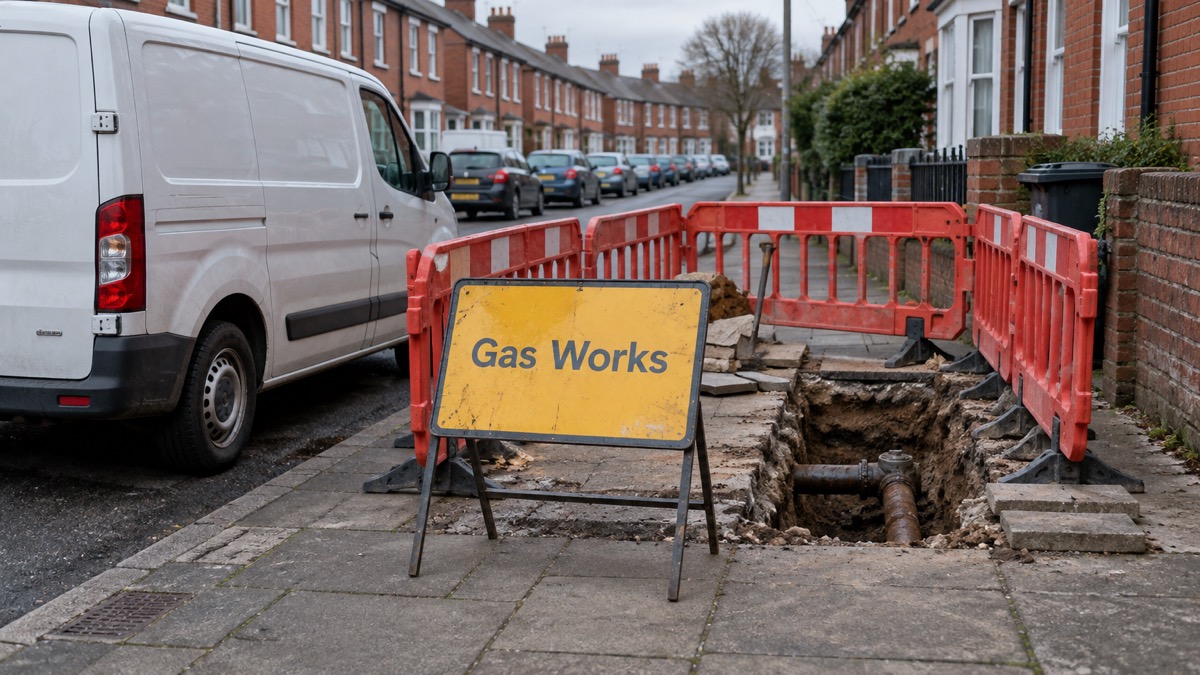
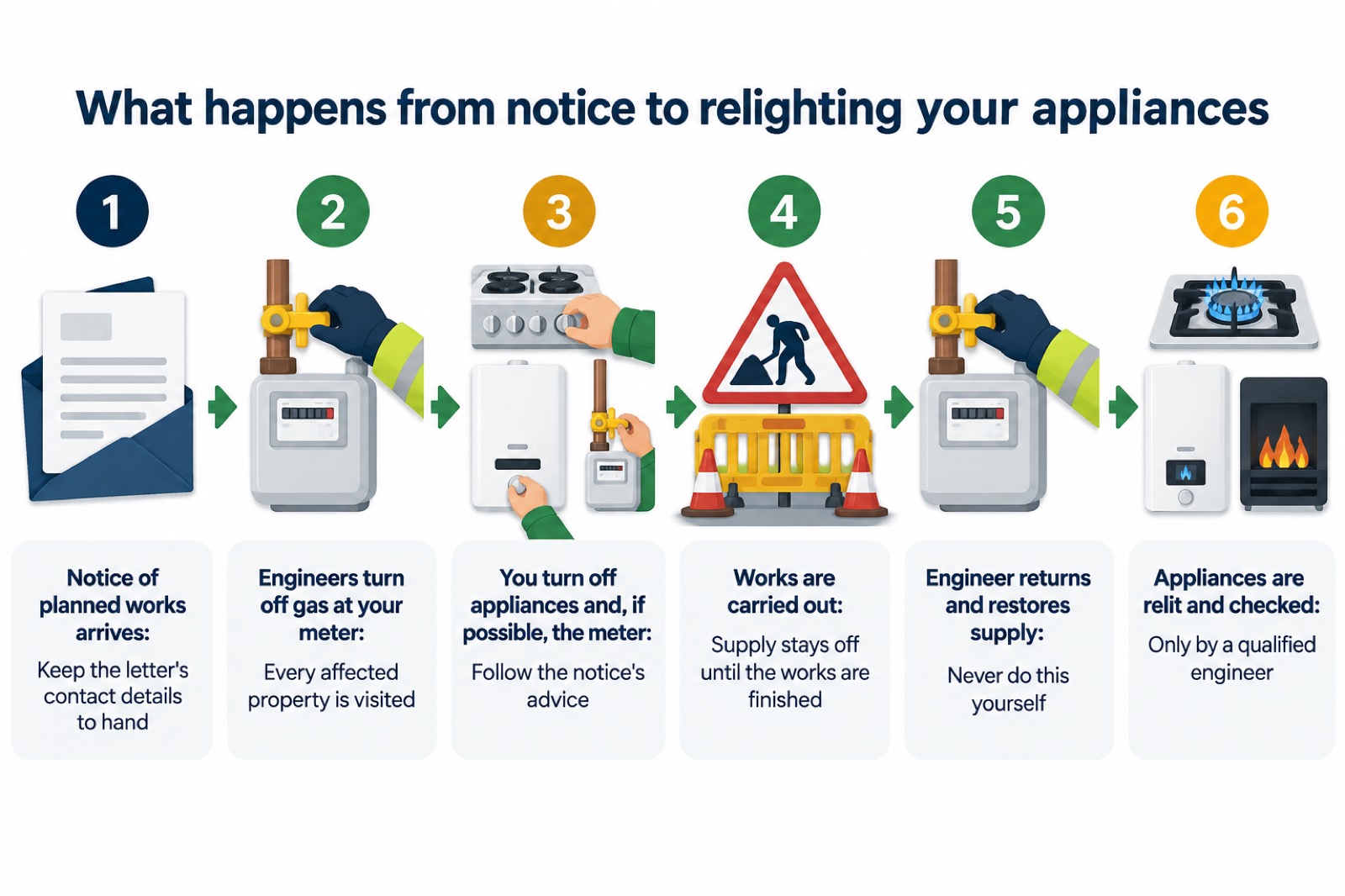
When the gas network in your street needs replacing or repairing, the work is usually planned in advance, and households are told before the supply goes off. The gas is not switched off at the end of the road: engineers turn off the gas at the meter of every affected property, and they have to come back to turn each one on again and check it. That is why a planned interruption feels more involved than a power cut, and why the single most important rule is simple: never turn your gas supply back on yourself.
Your protections come down to notice and money. Ofgem, the energy regulator, sets out that a network operator should give you notice of planned gas works, and if it does not, you may get £40 extra in compensation1. The rules are more specific still: you can claim £20 if your network operator did not give five days' notice of planned gas works, and at least £40 if it did not give seven days' notice2. There is no confirmed timescale for how long the gas will be off on the day, so treat the notice you receive as your guide and prepare for the works to overrun.
What happens when your gas supply is turned off for pipe works
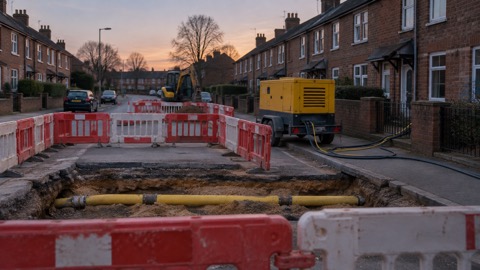
Planned works, often a gas mains replacement, are announced by letter or card through your door before they begin. Keep that letter somewhere you can find it, because it carries the contact details you will need if the works overrun or nobody comes back to restore your supply. If you are on the Priority Services Register, you should also receive advance written notice before planned work temporarily stops your supply7.
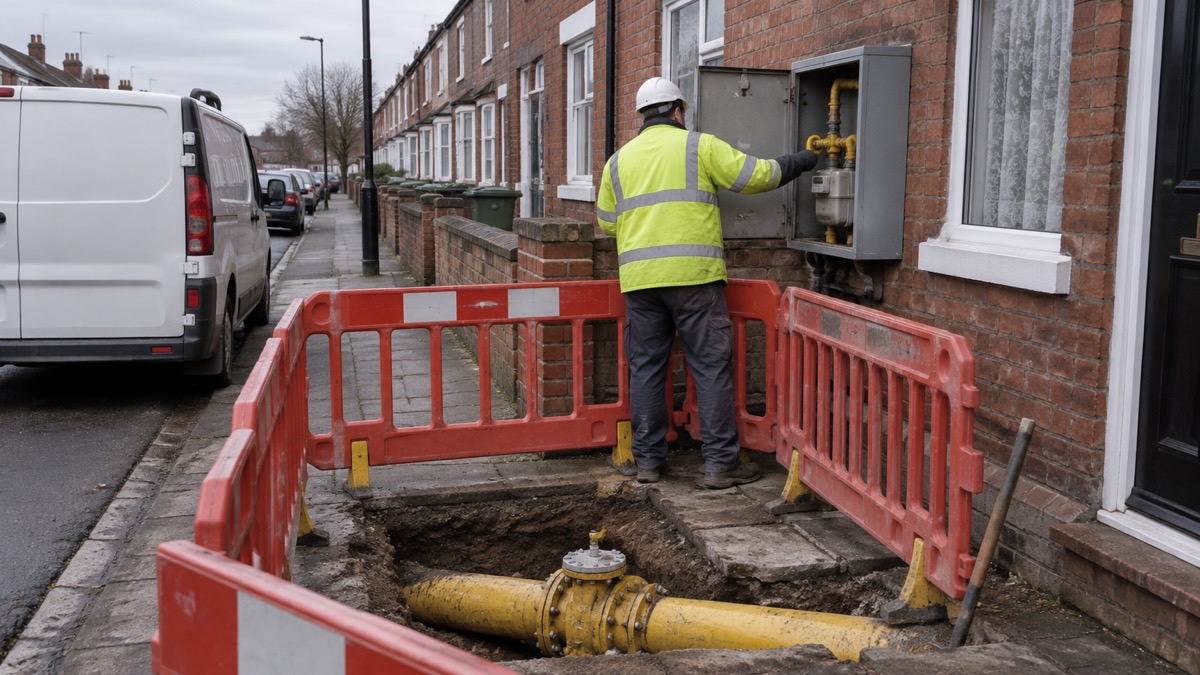
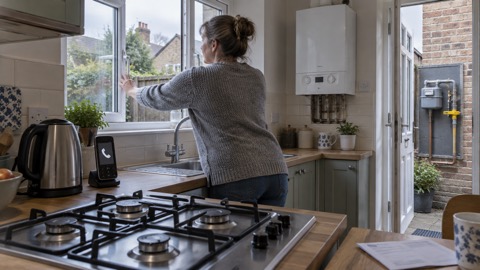
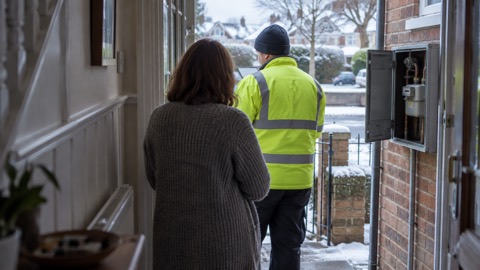
On the day itself, engineers work along the street and turn off the gas at the meter of every affected property. Wiltshire and Swindon Prepared, the local resilience forum's public guidance, describes the same sequence households should follow themselves: turn off all your gas appliances and, if possible, switch off the gas at the meter3. The engineers handle the network side; your job is to make sure nothing in your home is left drawing gas when the supply is interrupted, and to be available later for the reconnection visit.
Priority customers are visited first. Households on the Priority Services Register get extra help when supplies stop working, and networks plan their rounds around them8. If you are not on the register and think you should be, see the section below on extra support.
If the engineer calls while you are out
Engineers cannot always reach everyone on the first round, and if you are out when they call, they will usually leave a card. Contact the network operator using the number on your works notice and arrange a return visit. If you have any concern about the state of your supply or appliances after the works, say so when you ring.
Never let the missed visit tempt you into turning the supply on at the meter yourself. Surrey Prepared's household guidance is unambiguous: if you turned off your gas, it must be turned on again by a professional for safety reasons5. The same rule applies to the network's side of the meter. Our page on what to do if you missed the reconnection visit takes this situation step by step.
Your emergency control valve: where it is and when to use it
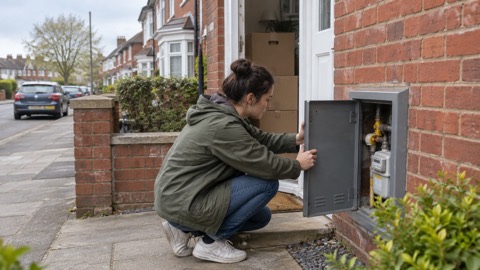
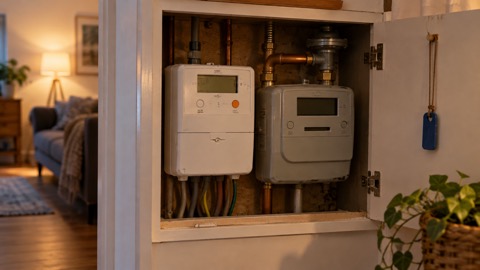
The gas safety shut-off valve, properly called the emergency control valve, is located at your gas meter9. It is typically a quarter-turn lever on the pipe immediately beside or above the meter. Find yours now, while nothing is wrong, and make sure everyone in the household who might need to use it knows where it is.
North Devon Council's emergency planning advice makes this part of general household readiness: know where the water, gas and electricity controls are, so you can turn supplies off when it is safe and you have been advised to do so10. During planned works, the advice you are given will come from the network operator's notice and from the engineers on the day.
When should you turn it off yourself? The Health and Safety Executive's guidance for a suspected gas leak is to shut off the gas supply at the meter control valve if you know where it is11, and its carbon monoxide guidance for a suspected spillage is to switch off the appliance and shut off the gas supply at the meter control valve12. Devon and Somerset Fire and Rescue Service add one condition for rented homes and any home where the meter sits below ground level: turn off the gas at the meter, unless the meter is in a cellar or basement13. If your meter is in a basement and you smell gas, do not go down to it; leave the building and call the emergency line.
Never turn your gas supply back on yourself
This is the rule that matters most once the works are done, and every official source in this area states it the same way. The government's Be Ready household emergency plan puts it in capitals: "You can turn the water and electricity back on yourself but NOT THE GAS. This must be done by a qualified engineer."4 Surrey County Council's guidance repeats it: if you turned off gas, it must be turned on again by a professional for safety reasons16.
The reason is that restoring a gas supply is not just a matter of opening a valve. Each appliance has to be relit and checked, and the pipework has to be confirmed sound, before the supply is safe to use. Warwickshire County Council warn that handling gas appliances, pipelines or fittings without proper training and expertise can lead to serious hazards, and that gas-related tasks should not be attempted as DIY projects14. Manchester Fire and Rescue Service are blunter still: "Never attempt DIY gas work as it is very dangerous."15
The legal framework backs this up. Argyll and Bute Council's gas safety guidance states that only a Gas Safe registered engineer should carry out gas work, and anyone else is breaking the law17. Wiltshire and Swindon Prepared add that after a gas leak has been stopped, any work on appliances such as cookers, boilers or fires has to be carried out by a Gas Safe registered engineer3. When the engineer arrives to restore your supply, check their credentials: the Greater London Authority's advice to tenants applies in any home, and it is to always check the engineer's Gas Safe Register ID card18. Our guide to finding a Gas Safe registered engineer and checking their card shows what to look for.
How long the gas will be off: no confirmed timescale
No official source gives a fixed duration for a planned gas interruption, because it depends on the length of main being replaced, the number of properties on the street and what the excavation reveals. Treat the timescale in your works notice as an estimate, and plan for the works to overrun. If they do, the compensation rules are what hold the network to account.
Ofgem's consumer guidance for England and Wales sets out the payments for planned interruptions: £20 if your network operator did not give five days' notice, and at least £40 if it did not give seven days' notice2. Ofgem's planning guidance adds that if the operator does not give you notice of planned maintenance at all, you may get £40 extra1. For unplanned gas cuts, the documents give two figures and they disagree: Ofgem's payment checker says you can claim £70 extra for every additional 24 hours your gas supply is off, increasing depending on how long the supply is off20, while Ofgem's consumer advice document says at least £60 for every 24 hours you are without gas, with more claimable beyond 24 hours2. Give both figures and claim through your supplier; our page on compensation when mains supply is interrupted explains how.
| Situation | Payment | Source of the rule |
|---|---|---|
| Planned works, no five days' notice | £20 | Ofgem consumer advice, 20242 |
| Planned works, no seven days' notice | At least £40 | Ofgem consumer advice, 20242 |
| No notice of planned maintenance | £40 extra | Ofgem planning guidance1 |
| Unplanned cut, each 24 hours | £70 extra (payment checker) or at least £60 (consumer advice) | Ofgem20 |
Why supplies are interrupted
Planned interruptions happen because the network needs work, and the same utility infrastructure fails unplanned for reasons that are worth recognising. The government's Be Ready guidance on water supply interruptions notes that outages occur for many reasons, ranging from scheduled maintenance to burst water mains21. Essex Prepared's utility failure guidance describes the wider pattern: pipe bursts and contamination, and infrastructure failures or pollution incidents, can disrupt supply22. Gas mains are replaced for the same underlying reasons: old iron pipes are swapped for modern plastic ones street by street, and that work cannot be done with gas flowing.
Water getting into the gas network is one of the specific hazards this work addresses, and it is also a reason a planned job can grow. If water has entered the network or a pipe is found to be more damaged than expected, the works take longer and the reconnection visits slip. This is why the advice throughout this page is to keep the notice's contact details to hand and to check in with the network operator if the day passes without a visit.
Flooding adds its own version of this problem, and the official advice is consistent across sources. Belfast City Council's flooding advice is to plan who will turn off the gas if water enters your home23. Surrey's after-flood guidance says to turn off the gas supply to appliances that have been flooded or where vents and flues may have been affected, and to contact your utility company if in any doubt24. The West Midlands Local Resilience Forum's community risk register says to turn off electricity and gas supplies if they have been in contact with water and get them checked before using them again25. Northumberland Council add that after flooding it is crucial to have appliances inspected by a Gas Safe registered engineer before they are used again26. If your planned works coincide with flooding, the flood takes priority: everything stays off until a registered engineer has checked it.
Who to contact if you think there is a problem on the gas network
For anything that smells, hisses or worries you, the number is the same one used across the UK for gas emergencies. The Health and Safety Executive give National Grid's Gas Emergency Freephone number as 0800 111 9996, and Northumberland Council state it plainly: "If you smell gas, or suspect a gas leak, call National Gas Emergency Service immediately on 0800 111 999."26 Wiltshire and Swindon Prepared's gas outage guidance says to call the National Gas Emergency Service immediately if there is a leak3. Our page on the National Gas Emergency Service explains what happens when you ring.
For everything that is not an emergency, contact the network operator named on your works notice. In an emergency, your gas, electricity or water supplier should keep you informed about service disruptions, and ni direct's guidance for Northern Ireland confirms this applies across utilities7. If the works overrun, if nobody has come to restore your supply, or if your appliances will not work after restoration, the notice's contact number is the first call. If an engineer examines an appliance and recommends further work, the HSE's advice is to always follow the advice given, and if you have doubts, follow it in the interim and contact the Gas Safe Register for further advice6.
Staying safe and warm while the gas is off
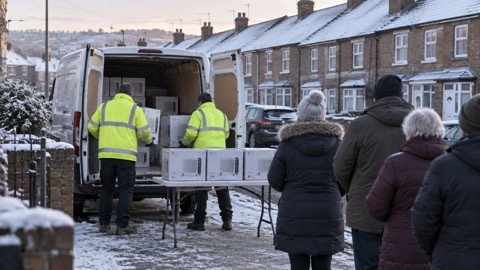
A planned interruption usually means no central heating and no gas cooking for a period of hours. The safe ways through it are the ordinary ones: extra layers, warm drinks, food that does not need cooking, and a flask filled before the supply goes off. Our guides to heating and cooking without mains power or gas and emergency food cover the practical side in full.
The dangers to avoid are the improvised ones. Mid and West Wales Fire and Rescue Service's guidance on portable heaters includes a rule that matters in any home during an interruption: never change a gas cylinder on a stairway or other escape route27. Barbecues and camping stoves are for outdoors.
Ventilation matters even when nothing is burning. The HSE's domestic gas FAQ instructs households to never block ventilation6, because gas appliances, when they are relit, need the airflow they were designed for. And if you are going to be away from home while works are in progress, Mid and West Wales Fire and Rescue Service advise you to turn off all gas appliances that do not need to run whilst you are away28.
Warwickshire Council's home safety guidance adds one piece of preparation that costs nothing: have a plan in place that the whole household is aware of for evacuating the premises safely and contacting emergency services in the event of a gas leak, suspected carbon monoxide exposure, or any other gas-related emergency14. For a planned interruption, that plan can be as simple as agreeing who turns off the appliances, where the torch is, and where you will go if the works run long and the house gets cold.
Extra support: the Priority Services Register
The Priority Services Register is a free service that can give extra help if your electricity, gas or water stops working29. Derbyshire County Council's guidance lists advance notice of interruptions among the help given30, and for planned gas works that notice is the difference between being ready and being caught out. Oxford Health NHS Foundation Trust describe the register in plain terms: it exists for households who need extra help when a utility stops working29.
Most energy providers on the register will offer a free annual gas check to homeowners who have not had a gas safety check in the last 12 months15. Ofgem's policy statement expects energy companies to consider customers who are visually impaired or blind and hearing impaired or deaf as potentially vulnerable customers who may require additional assistance in communicating with their energy company31, and its consultation on register services has proposed practical help including knock and wait, where an engineer visiting a customer's home waits longer for a response before leaving32. That last point matters directly for planned works: if you answer the door slowly, a registered household can expect the engineer to wait.
Join the register through your energy supplier; our page on extra support from networks and suppliers walks through the process, and the broader extra help in an emergency guide covers the other schemes.
Renters and landlords during planned works
If you rent, your landlord has legal duties that intersect with any interruption. Gas appliances must be checked by a registered Gas Safe engineer every year33, and the Fire Kills campaign guidance states that landlords must arrange an annual gas safety check by a Gas Safe engineer where there are any gas appliances34. A planned interruption does not remove that duty, and the reconnection visit is a reasonable moment to ask when the last check was done.
The Greater London Authority warn that every year, landlords are conned by illegal gas workers who perform poor gas work, causing serious illness and death of tenants18. The same risk sits with households dealing directly with whoever turns up after works: check the Gas Safe Register ID card every time18. If access for a safety check fails, the HSE advise leaving a notice stating an attempt was made, with contact details, and keeping a record of all correspondence6. Our page on broken boilers in rented homes sets out what your landlord must do.
Preparing before the works begin
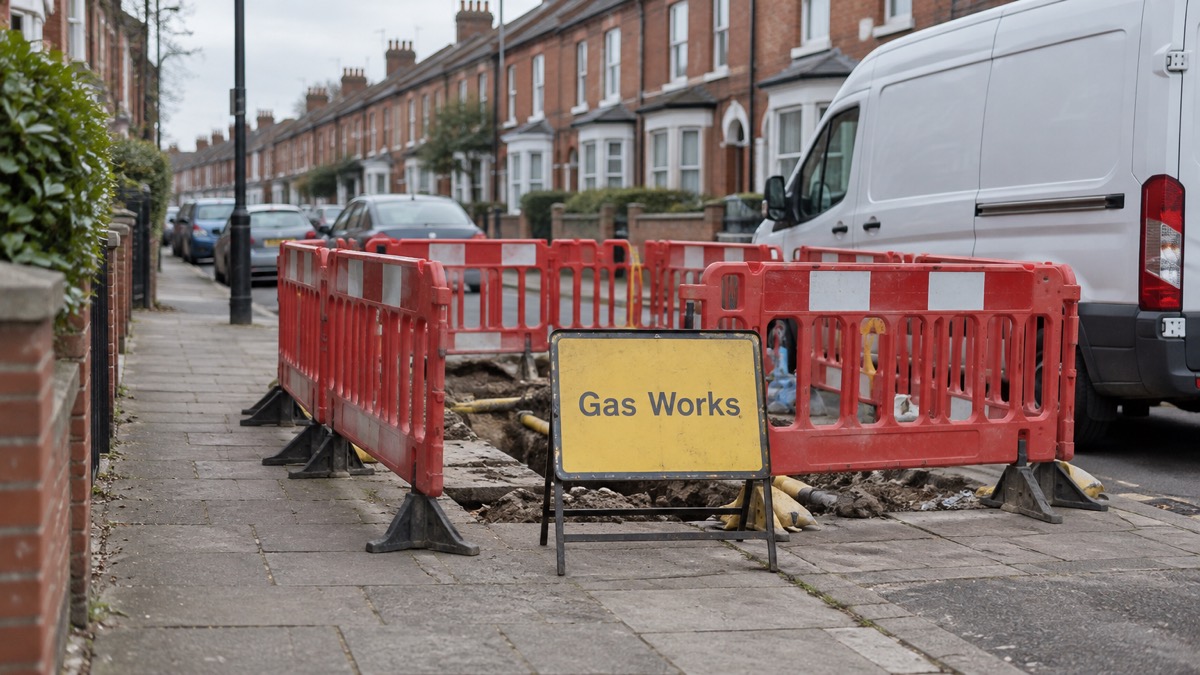
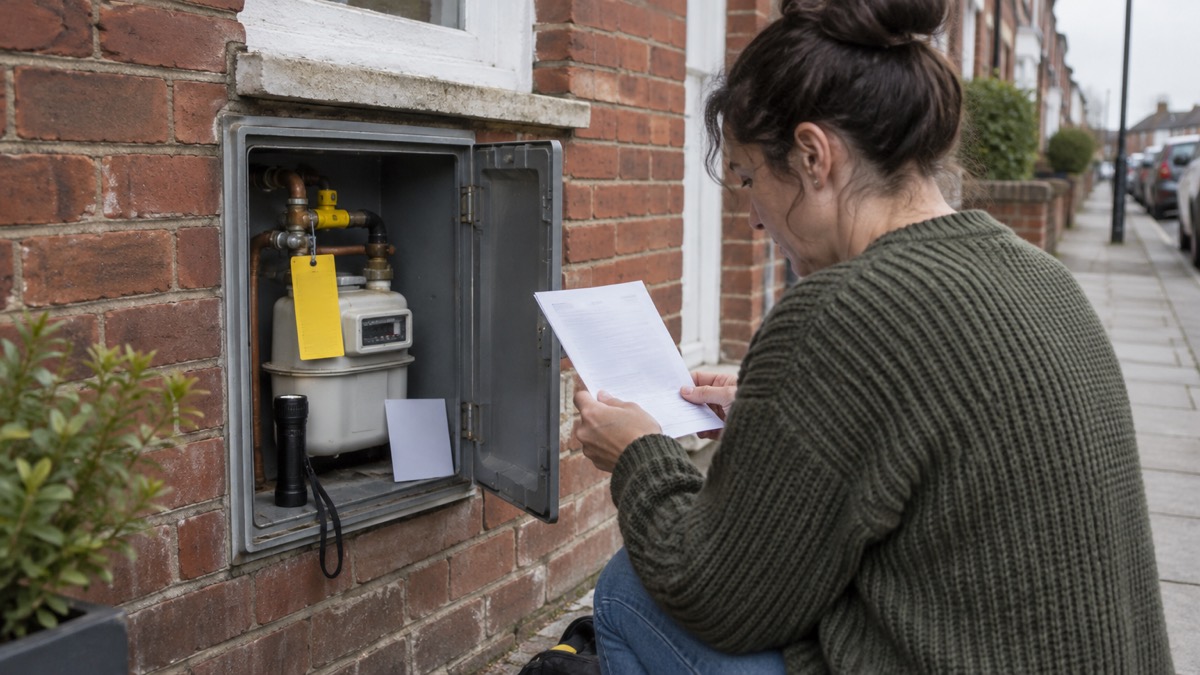
The notice through your door is your cue to prepare, and the preparation is modest. Surrey County Council's household readiness guidance covers the essentials: know where your gas and other controls are, and know that gas, unlike water and electricity, needs a professional to restore16. The government's Be Ready household emergency plan asks households to know how to turn off utilities and to keep a plan the household can follow4.
- Read the works notice and note the dates and the contact number2
- Find your emergency control valve at the meter and make sure others in the household know it too5
- Turn off all gas appliances before the supply goes off, and switch off the gas at the meter if possible3
- Fill a flask and gather food that needs no cooking3
- Join the Priority Services Register if anyone in the household needs extra help29
- Keep the National Gas Emergency Service number, 0800 111 999, to hand throughout6
For the wider picture of supply interruptions, see our guide to what to do when the mains supply to your home goes off, and for the restoration visit itself, getting your supply back on after an outage.
Sources (35)
- Plan for a power cut, Ofgem
- Energy domestic consumer advice, England and Wales, Ofgem, 2024-11
- What you might need in a gas outage, Wiltshire and Swindon Prepared, 2026-10-25
- Be Ready Household Emergency Plan, Be Ready campaign, 2026
- Surrey Prepared ICE template, Surrey County Council, 2026-10-29
- Domestic gas FAQs, Health and Safety Executive, 2026
- Energy, power supply and utilities, nidirect, 2025-10-23
- Priority Services | Wessex Water, Wessex Water
- FAQs | Northern Gas Networks, Northern Gas Networks
- Be prepared for emergencies, North Devon Council, 2026-10-29
- Gas safety: FAQs for owner occupiers, Health and Safety Executive, 2026
- Carbon monoxide: gas safety, Health and Safety Executive, 2026
- Home safety advice for tenants, Devon and Somerset Fire and Rescue Service, 2026
- Safe home heating, Warwickshire County Council, 2026-10-29
- Stay fire safe, Manchester Fire and Rescue Service, 2026-10-29
- Homes prepared, Surrey County Council, 2026-10-28
- Gas safety, Argyll and Bute Council, 2026
- Gas safety for tenants, Greater London Authority, 2026-10-25
- Loss of gas supply incidents | SGN Your gas. Our network., SGN
- Check if you can get payment for a power cut, Ofgem, 2026
- Water supply interruptions or outages, Be Ready campaign, 2026-10-12
- Ongoing risks: utility failure, Essex Prepared, 2026-10-29
- Flooding advice, Belfast City Council, 2026-10-29
- After a flood, Surrey County Council, 2026-09-23
- Community Risk Register, West Midlands Local Resilience Forum, 2023-12
- Information about specific safety concerns, Northumberland Council, 2026-05-21
- Portable heaters, Mid and West Wales Fire and Rescue Service, 2026-10-29
- While you are away, Mid and West Wales Fire and Rescue Service, 2026-10-29
- Guidance at home, Oxford Health NHS Foundation Trust, 2026-09-15
- Priority Services Register, Derbyshire County Council, 2026-10-29
- PSR update, open letter, Ofgem, 2015-03-26
- Consultation on PSR review, Ofgem, 2014-06-30
- Household fire safety, Somerset Council, 2025-01-30
- Fire Kills prevention advice, Fire Kills campaign, 2026-03-25
- At home: personal resilience, Wiltshire and Swindon Prepared, 2026-10-25
 Checks Before Calling Engineer
 Boiler Checks When Moving In
 Power Cut Kit Checklist
 National Gas Emergency Service
 When the Mains Supply Goes Off
 Getting Supply Back After Outage
 Compensation for Supply Cuts
 Help During a Long Outage
 Prepayment Meters
 LPG Homes in Winter
 Oil Boiler Breakdowns
 Boiler Breakdown in Cold Weather
 Boiler Fault Codes
 Boiler Pressure Gauge
 Frozen Condensate Pipes