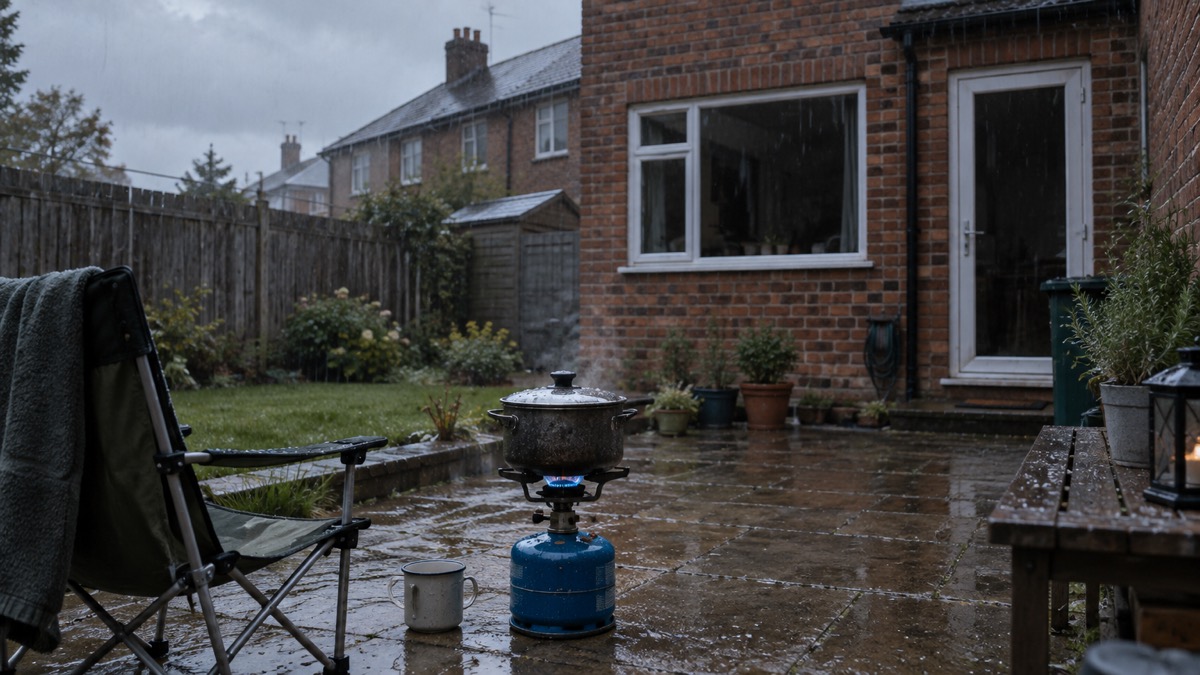
No, it is not safe to use a camping stove indoors. Camping stoves are designed to be used outside only, and that is the consistent position of fire and rescue services across the UK. London Fire Brigade states it plainly: "It's never safe to use any type of outdoor cooking equipment like a BBQ or camping stove indoors. Doing so poses a serious risk of fire and deadly carbon monoxide poisoning"1. The NHS gives the same instruction: do not use a barbecue or camping stove indoors, or inside a tent2.
The reason is carbon monoxide. A camping stove burning gas, spirit or any other fuel gives off carbon monoxide, a gas you cannot see or smell. Dorset and Wiltshire Fire and Rescue Service warns that stoves and barbecues can cause carbon monoxide poisoning even if you have the doors and windows open3. Cumbria Fire and Rescue Service warns that carbon monoxide can build up to levels that can kill very quickly in enclosed spaces such as tents and awnings4. There is no arrangement of open windows that makes indoor use safe.
That does not make a camping stove useless in an emergency. It is a good way to cook and boil water during a power cut, provided you use it outside, on a stable surface, well away from your home, tent, caravan and anything that burns. This page sets out the official advice on where a stove must never go, how to set up a safe outdoor cooking spot, what to do if a fire starts, and how the same rules apply to barbecues, heaters and lanterns. If you are choosing a stove in the first place, see our guide to camping stoves for a power cut.
Camping stoves are made for outdoor use only
Every UK fire and rescue service that has published guidance on the point says the same thing. Dorset and Wiltshire Fire and Rescue Service: "Using camping stoves or barbecues indoors is really dangerous. They are designed to be used outside only"3. Devon and Somerset Fire and Rescue Service tells people not to use barbecues or stoves inside a tent or caravan5. Mid and West Wales Fire and Rescue Service instructs people not to use indoor camping stoves or other petrol, propane or natural gas devices that are meant for outdoor use10.
The design reason is simple. A camping stove is an open flame with no flue, no chimney and no way to vent its combustion products outside. Everything it burns, and everything it gives off, stays in the room or tent with you. Appliances that are safe indoors, such as a properly installed gas cooker or a wood burner with a working chimney, are designed and fitted to deal with those products. A camping stove is not.
The UK government's own advice for consumers during a power cut makes the same point from the other direction: if you use a camping stove, barbecue or bottled gas stove to cook during an outage, check the manufacturer's instructions for safe use, because most are designed for outdoor use only7. So the maker's instructions are the first thing to read, and for almost every camping stove sold in the UK they will say outdoor use only.
One maker, Trangia, does publish guidance for people who feel they must use its spirit burner indoors, for example during a power outage. Even that guidance, from the maker's own support pages, says to make sure the space has good air circulation, to avoid small spaces with poor ventilation, and notes that in an apartment it is enough to have a window ajar11. Treat this as the outer edge of what any maker is willing to say, and note that it applies to one maker's spirit burner only. It does not override the fire services' blanket instruction, and it is not a licence to bring a gas cartridge stove into your kitchen.
Why indoor use is dangerous: carbon monoxide
Carbon monoxide, usually written CO, is produced when a fuel burns without enough oxygen, and it is produced in dangerous amounts by camping stoves, barbecues and similar equipment used in enclosed spaces. The NHS lists using barbecues or camping stoves inside as a direct cause of carbon monoxide build-up2, and NHS 111 Wales gives the same cause and the same instruction12. You cannot see it, taste it or smell it, which is why it is sometimes called the silent killer.
The fire risk is just as real as the gas risk. Devon and Somerset Fire and Rescue Service puts both together in one sentence: "The carbon monoxide they produce can kill, and the heat they produce will set the tent on fire"5. An open flame near tent fabric, curtains, bedding or kitchen clutter can start a fire in seconds, and most household fires start in the kitchen, as Warwickshire County Council's fire safety advice notes9.
A common and deadly pattern is people bringing a barbecue or stove inside to keep warm. Oxfordshire County Council's fire and rescue service warns that barbecues or gas stoves inside tents, awnings, caravans or mobile homes pose a serious carbon monoxide risk in addition to the fire risk13. Cumbria Fire and Rescue Service says never to use a barbecue inside to keep you warm4. The Health and Safety Executive for Northern Ireland records that carbon monoxide poisoning also occurs when people bring gas and charcoal barbecues into tents and other small enclosed spaces, sometimes in an attempt to keep warm14. If your aim is warmth rather than cooking, a stove is the wrong tool entirely: see our guides to keeping one room warm when the heating fails and using a portable heater safely at home.
Where fuel-burning camping kit must never go
The list of places is longer than many people expect, and it is worth being blunt about it. Humberside Fire and Rescue Service groups the equipment together: camping stoves, camping heaters, lanterns, charcoal grills and disposable barbecues are all fuel-burning equipment, and none of it should ever be used inside a tent, camper or other enclosed shelter, because using these indoors can cause carbon monoxide poisoning6. Cheshire Fire and Rescue Service gives the identical list and the identical instruction for tents15 and for caravans16.
| Place | What the official advice says | Who says it |
|---|---|---|
| Your house or flat | Never use outdoor appliances such as generators, charcoal grills or camping stoves indoors or in enclosed spaces | Warwickshire County Council17 |
| A tent | Never use fuel-burning devices inside a tent, including stoves, heaters, lanterns, grills and disposable barbecues | Cheshire Fire and Rescue Service15 |
| A caravan or mobile home | Never use fuel-burning devices inside the caravan; do not use stoves or barbecues inside or too close to your caravan | Lincolnshire County Council18, Devon and Somerset Fire and Rescue Service19 |
| A boat or houseboat | Never take portable or disposable barbecues, grills or charcoal fuel burners into any confined space such as a houseboat | Wiltshire and Swindon Prepared20 |
| A garage or vehicle | Turning on vehicle or lawn mower engines in an enclosed space such as a garage can cause a carbon monoxide build-up, as can using barbecues or camping stoves inside | NHS2 |
| An awning | Never use a barbecue indoors, in a tent, under an awning or in a caravan | UK government outdoor fire safety guidance21 |
Two entries on that list deserve a word of explanation. A caravan or mobile home may feel like a semi-outdoor space, especially with a door open, but fire services treat it exactly as an enclosed space, and Devon and Somerset Fire and Rescue Service adds that stoves and barbecues must not be used too close to a caravan either, because of the fire risk to the structure19. A garage is included because the NHS lists it alongside indoor stove use as a cause of carbon monoxide build-up2: an engine running in a garage and a stove burning in a kitchen produce the same problem in the same way.
The Northern Ireland direct government advice adds a general rule that covers every row of the table: only equipment designed to be used indoors should be brought inside the home22. That is the test to apply to anything you own. If the maker designed it for the outdoors, it stays outdoors.
Cooking in a power cut: use the stove outside
A power cut is the moment this question usually becomes urgent, and the official advice is clear and consistent across the UK nations. Food Standards Scotland confirms that in a power cut you can cook food and heat water for food preparation and cleaning using a camping stove, barbecue or bottled gas stove, checking the manufacturer's instructions for safe use23. The UK government's consumer advice for food safety in a power cut says the same, and adds that most of these appliances are designed for outdoor use only7. Warwickshire County Council's home heating safety advice is more direct still: do not use outdoor appliances such as generators, charcoal grills or camping stoves indoors or in enclosed spaces17.
So the practical plan for a power cut is:
- Take the stove outside, to a spot well away from the house, following the set-up advice in the next section.
- Check the maker's instructions before lighting it, and follow them7.
- Cook and boil water as you normally would, allowing extra time, because cooking with these appliances can take longer than your usual ways of cooking23.
- Make sure food is steaming hot and cooked all the way through before eating it23.
- Never bring the stove back inside while it is lit or still hot, and never use it to warm the room17.
Two safety points around the stove itself matter during a power cut. First, the Scottish Fire and Rescue Service advises that if you are using a camping stove outdoors, you should never change gas cartridges indoors or near ignition sources8. Do the cartridge change outside, in daylight if you can, away from the lit stove and away from anything that could spark. Our guide to gas cartridges covers valve types and storage in more detail.
Second, do not let the stove drift into a heating role. The UK Chief Medical Officers' public health advice for a national power outage is explicit: do not light a fire indoors unless you have a proper heating appliance for the purpose or a fireplace with a working chimney, do not use camping stoves and barbecues indoors, and do not use petrol or diesel generators or similar fuel-driven equipment indoors24. Devon and Somerset Fire and Rescue Service likewise says never to use barbecues, camping stoves or patio heaters for heat indoors25. For staying warm safely during an outage, see our guides on clothing and bedding and draughts, and for the wider picture see our power cuts guide.
Setting up a safe outdoor cooking spot
Outside is the right place, but where exactly outside matters. The fire services' advice on placement converges on a few simple rules.
- Cook outside and away from the tent. Mid and West Wales Fire and Rescue Service says to cook outside and away from the tent, keep cooking appliances away from the tent walls, and never cook inside a small tent or near flammable materials or long grass, because they can all set alight easily26.
- Place the stove or barbecue well away from your tent, because tents easily catch fire. That is Devon and Somerset Fire and Rescue Service's wording5, and Cumbria Fire and Rescue Service says the same: place your cooking area well away from the tent4.
- Keep it away from the caravan too. Devon and Somerset Fire and Rescue Service says do not use stoves or barbecues inside or too close to your caravan19.
- Keep the surface stable and level. A stove that tips drops a burning pan and a lit burner onto the ground. Set it on a flat, solid surface such as a camp kitchen table or a paving slab, not on grass, gravel or a wobbly patio table.
- Watch where the exhaust goes. Cheshire Fire and Rescue Service advises that when using fuel-burning devices outdoors, the exhaust should not vent into enclosed shelters15. Do not park the stove just outside an open tent door, awning or window where fumes can blow back inside.
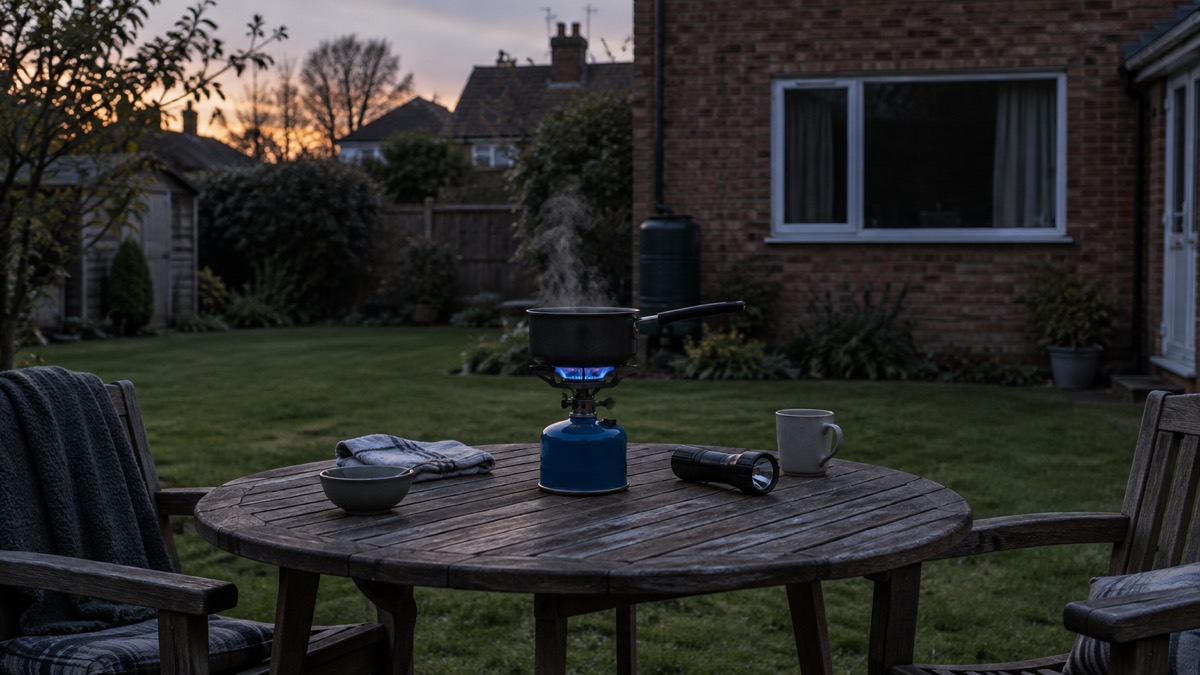
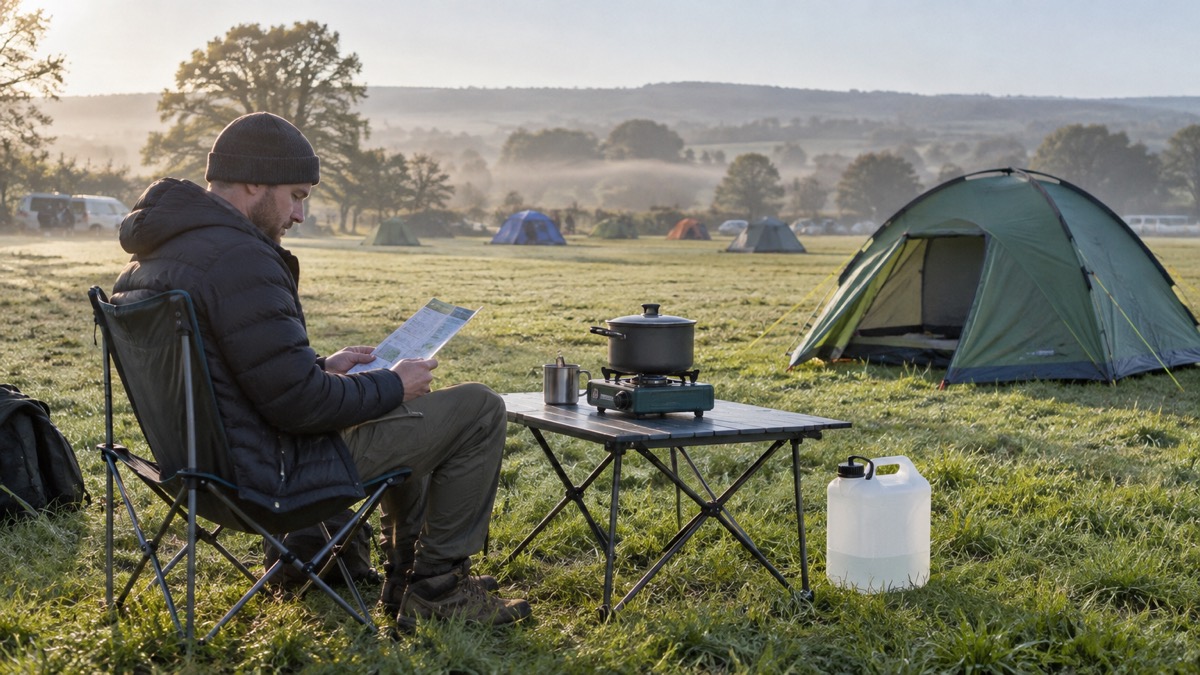
*A safe outdoor cooking spot: outside, on a stable table, well away from the tent and anything flammable.
If you are cooking in the countryside rather than at home, further rules apply. Surrey County Council's countryside code advice says do not use barbecues or camping stoves in the countryside or light an open fire, because they can quickly spread and get out of control27. The Scottish Government's wildfire readiness campaign says to keep campfires small, controlled and supervised, and if you are cooking food, to use a camping stove instead of an open fire28. NHS Lanarkshire's summer preparedness advice says always to be safe and put out campfires, and where possible to use a stove for cooking rather than an open fire29. In wildfire-prone areas, a stove is the safer choice, but only in a cleared spot away from long grass and moorland vegetation.
If a fire starts while you are cooking
Cooking fires are the most common household fires, and most can be prevented by the habits above: never leaving the appliance unattended, keeping handles turned away, and keeping the stove clear of anything that burns9. If a fire does start, what you do in the first few seconds matters.
Warwickshire County Council's kitchen fire safety advice covers the situation directly. If you have a fire from oil or grease, never attempt to extinguish it with water, because this can cause the fire to spread. Instead, turn off the heat source and, if it is safe to do so, leave the room and call 9999.
"If you have a fire from oil or grease, never attempt to extinguish it with water, as this can cause the fire to spread. Instead, turn off the heat source and, if safe to do so, leave the room and call 999."
Applied to a camping stove, that means:
- Turn off the stove at its control valve if you can reach it safely. For a gas cartridge stove, this stops the fuel at the source.
- Never put water on a burning pan of oil or fat. The water flashes to steam and throws burning oil across the area.
- Get people out and away, closing doors behind you if the fire is near a building.
- Call 999 and ask for the fire and rescue service. Do not go back in to tackle the fire yourself.
- If a gas cartridge or cylinder is involved or close to the flames, get much further away before calling, and tell the call handler what fuel is burning.
Cheshire Fire and Rescue Service adds one piece of preparation that costs nothing: have an escape plan15. At home, know how everyone would get out if a fire spread from the cooking area to the building, and agree where you would meet. Our home emergencies guide covers fire, carbon monoxide and gas leak responses in more detail.
Can you use a camping stove in a tent?
No, and this deserves its own answer because it is where people most often bend the rule, telling themselves a large tent or a brief use is different. It is not. The NHS instruction is unqualified: do not use a barbecue or camping stove indoors or inside a tent2. Devon and Somerset Fire and Rescue Service says do not use barbecues or stoves inside your tent or caravan5. The Northern Ireland Fire and Rescue Service's summer safety advice records the general rule as always cooking outside and well away from your tent, no matter how large, because of the fire risk as well as the carbon monoxide risk30.
The same applies to everything else that burns. Cheshire Fire and Rescue Service says never to use fuel-burning devices inside a tent, giving disposable barbecues, camping stoves, camping heaters, lanterns and charcoal grills as its examples15. North Yorkshire Fire and Rescue Service says never to take a portable barbecue, or lit charcoal, into an enclosed space like a tent or caravan31. North Wales Fire and Rescue Service says never to use a barbecue, lit charcoal or disposable barbecue inside a tent, caravan or other enclosed space32. The UK government's outdoor fire safety guidance says never to use a barbecue indoors, in a tent, under an awning or in a caravan21.
Candles fall under the same rule. North Yorkshire Fire and Rescue Service says never to use candles in or near a tent, because torches are much safer31, and Cumbria Fire and Rescue Service gives the same advice4. Tent fabric burns quickly, and a naked flame in a confined space adds carbon monoxide to the fire risk. Use a torch or a battery lantern for light in and around a tent; our emergency lighting guide covers the options.
Cumbria Fire and Rescue Service adds one more rule that applies to gas equipment generally: never take a gas stove, light or heater into a tent, caravan or cabin unless it is a permanent fixture, installed and maintained correctly4. That distinction matters. A caravan's own built-in gas cooker, installed and serviced as the manufacturer intends, is a different thing from a portable camping stove brought in through the door. The first is designed for the space; the second is not. For more on this, see our guide to keeping warm and cooking in tents and caravans.
Frequently asked questions
Can I use a camping stove in my caravan or on a boat? No. Fire and rescue services say never to use fuel-burning devices inside a caravan, including camping stoves, heaters, lanterns and charcoal grills16. The Health and Safety Executive for Northern Ireland records carbon monoxide incidents and deaths in holiday homes, caravans and boats, often from faulty gas cookers, appliances or petrol-powered generators14. Only equipment that is a permanent fixture, correctly installed and maintained, should be used in these spaces4.
Is a disposable barbecue safe indoors if I keep the door open? No. Wiltshire and Swindon Prepared's guidance is never to take portable or disposable barbecues, grills or charcoal fuel burners into your home or any confined space such as a tent, houseboat or caravan20. The Northern Ireland Fire and Rescue Service says never to use a barbecue indoors, because burning or smouldering fuel can cause carbon monoxide poisoning33. A disposable barbecue stays dangerous while it cools, so it must stay outside overnight too.
What about camping heaters and lanterns, not just stoves? The same rule applies. Humberside Fire and Rescue Service lists camping heaters, lanterns, charcoal grills and disposable barbecues alongside camping stoves as fuel-burning equipment that should never be used inside a tent, camper or other enclosed shelter, because of carbon monoxide6. Devon and Somerset Fire and Rescue Service also says never to use barbecues, camping stoves or patio heaters for heat indoors25.
Does opening windows and doors make indoor use safe? No. Dorset and Wiltshire Fire and Rescue Service warns that camping stoves and barbecues can cause carbon monoxide poisoning even if you have the doors and windows open3. Ventilation reduces the risk but does not remove it, and no UK fire service treats an open window as making indoor use acceptable. The only safe approach is to cook outside.
Can I use candles in a tent for light? No. North Yorkshire Fire and Rescue Service and Cumbria Fire and Rescue Service both say never to use candles in or near a tent, because torches are much safer31. Tent fabric catches fire easily, and a flame in a confined space adds a carbon monoxide risk as well. Pack a torch or battery lantern instead.
How do I keep children safe around a camping stove? Cook outside and place your cooking area well away from the tent, as Cumbria Fire and Rescue Service advises, and never cook inside a small tent or near flammable materials or long grass, because they can all set alight easily. Stay with children the whole time they are cooking, and keep the stove or barbecue well away from your caravan as well as your tent.
I am in a holiday let. Does the advice change? No. The Health and Safety Executive for Northern Ireland notes that carbon monoxide incidents and fatalities occur in holiday homes as well as caravans and boats, often from faulty gas cookers, appliances or petrol-powered generators14. Do not bring camping stoves or barbecues inside a holiday let. If the property has a proper heating appliance or a fireplace with a working chimney, use that instead24.
Where to get help and more information
If you suspect carbon monoxide poisoning, the NHS advice is to stop using the appliance, get fresh air and seek medical help; our home emergencies guide covers the symptoms and the immediate steps. If a fire starts, turn off the heat if it is safe to do so, leave and call 9999. For planning ahead, our before-winter checklist for your heating and stove and backup stove kit checklist set out what to have ready, and the wider heating and cooking guide covers every way of keeping warm and fed without mains power.
Sources (33)
- Cooking safety in the home, London Fire Brigade
- Carbon monoxide poisoning, NHS, 2025-12-16
- Staying safe while cutting costs, Dorset and Wiltshire Fire and Rescue Service, 2024-10-23
- Safety outdoors, Cumbria Fire and Rescue Service, 2026-10-29
- Camping and caravanning safety, Devon and Somerset Fire and Rescue Service, 2026
- Barbecue safety, Humberside Fire and Rescue Service, 2026-10-29
- Food safety in a power cut: advice for consumers, GOV.UK, 2023-07-26
- Power cuts, Scottish Fire and Rescue Service, 2026-10-25
- Kitchen fire safety, Warwickshire County Council, 2026-10-29
- Carbon monoxide safety, Mid and West Wales Fire and Rescue Service, 2023
- Guide to the spirit burner, Trangia, 2026-02-11
- Carbon monoxide poisoning, NHS 111 Wales, 2025-10-02
- Help prevent wildfires, Oxfordshire County Council, 2026
- Carbon monoxide, Health and Safety Executive for Northern Ireland, 2026
- Camping safety, Cheshire Fire and Rescue Service, 2025-07-26
- Caravan safety, Cheshire Fire and Rescue Service, 2025-07-26
- Safe home heating, Warwickshire County Council, 2026-10-29
- Caravan safety, Lincolnshire County Council, 2026-10-29
- Caravans and mobile homes, Devon and Somerset Fire and Rescue Service, 2026
- Carbon monoxide: the silent killer, Wiltshire and Swindon Prepared, 2026-10-25
- Fire safety outdoors, GOV.UK, 2022-05-25
- Strong winds and heavy rain warning: information and advice, nidirect, 2026-01-27
- Food safety in the kitchen: power cuts, Food Standards Scotland, 2026-10-25
- Keeping warm or cool in extreme weather, GOV.UK, 2025-12-16
- Stay warm safely this winter, Devon and Somerset Fire and Rescue Service, 2026
- Camping safety advice, Mid and West Wales Fire and Rescue Service, 2026-10-29
- Be wildfire aware, Surrey County Council, 2026-09-07
- Wildfires, Ready Scotland, 2026-05-12
- Summer preparedness, NHS Lanarkshire, 2024-06-26
- Simple steps to keep you safe this summer, Northern Ireland Fire and Rescue Service, 2022-06-24
- Caravans and camping, North Yorkshire Fire and Rescue Service, 2026-05-13
- Barbecue safety, North Wales Fire and Rescue Service, 2026-10-29
- Home fire safety, Northern Ireland Fire and Rescue Service, 2026-10-14
 Before-Winter Heating Checks
 Backup Stove Kit Checklist
 Wood Burner Lighting Kit
 Keeping One Room Warm
 Clothing and Bedding for Cold
 Stopping Draughts
 Hot Water Bottle Safety
 Wheat Bags and Fire Risk
 Electric Blanket Safety
 Portable Heater Types
 Portable Heater Safety
 Wood Burners in a Power Cut
 Using a Wood Burner Safely
 Open Fires and Fire Guards
 Firewood and Seasoning Logs