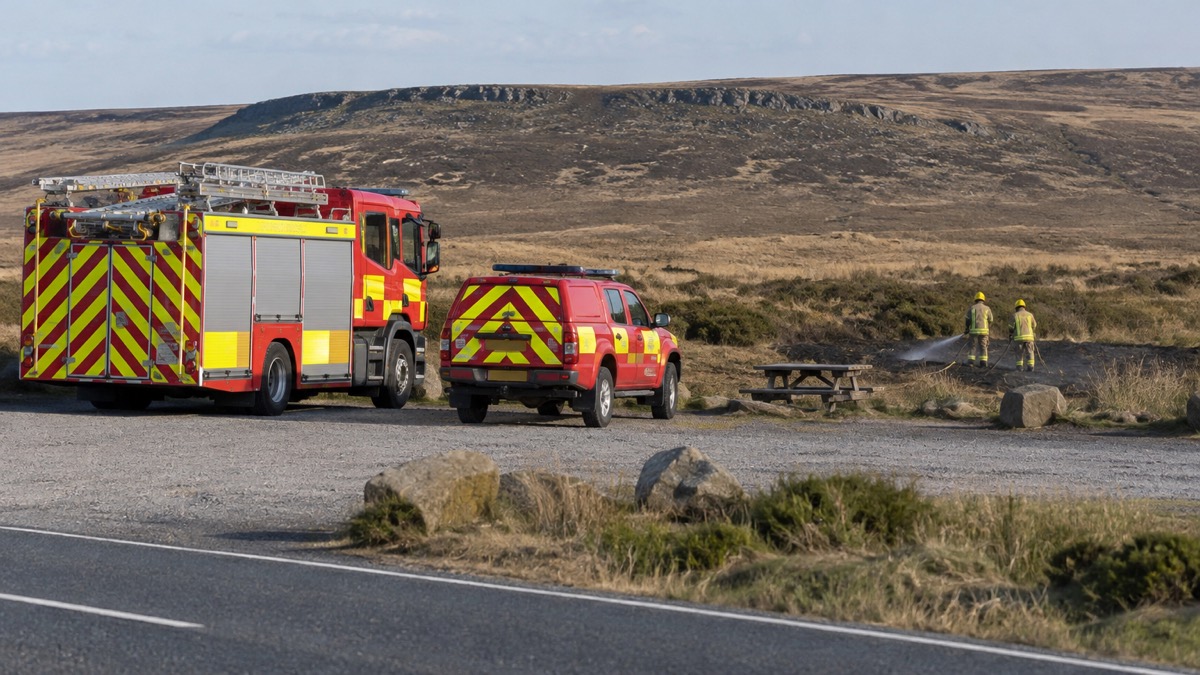
A barbecue is one of the easiest ways for an ordinary household to start a countryside fire, and the risk is highest exactly when people most want to cook outside: hot, dry, settled weather. Fire and rescue services across the UK give the same core instruction. Use a barbecue only in a suitable and safe area, and never leave it unattended1. During hot and dry weather, avoid bonfires and be extra careful with barbecues, because dry ground in the summer increases the risk of fire3.
If you are heading for open countryside, parks or moorland, the safest choice is to leave the barbecue at home. Suffolk Fire and Rescue Service advises people to avoid using disposable barbecues in open countryside, parks and moorland areas4, and Surrey County Council's countryside advice is blunt: swap the disposable BBQ for a picnic1. A picnic is a safer option than a BBQ when visiting moorland and rural areas5.
If a fire does get away, the limit of what you should tackle is a bucket of water. Fire services say do not attempt to tackle fires that cannot be put out with a bucket of water; leave the area as quickly as possible and call 9996.
Only use a barbecue in a designated area, and never leave it alone
The instruction is repeated almost word for word by fire services in England, Wales and Northern Ireland: only use barbecues in suitable and safe areas, and never leave them unattended2. Mid and West Wales Fire and Rescue Service puts it in capitals in its Welsh-language guidance, and its English pages say the same11. The reason is simple. An unattended barbecue is a fire with nobody watching it, and dry grass, leaves and shrubs nearby will take a spark.
Where you place it matters as much as whether you watch it. Mid and West Wales Fire and Rescue Service advises placing disposable barbecues well away from the house, shed or fences3, and North Yorkshire Fire and Rescue Service says to keep a garden barbecue away from hedges, fences, sheds and anything else that can catch fire12. Do not use disposable barbecues near or on public benches3: the bench, the dry grass around it and the litter beneath it are all fuel.
- Use a designated barbecue area, a suitable safe spot, or your own garden, well clear of anything that burns2
- Never leave it, not even for a minute, and never let children or pets near it2
- Keep it off dry grass, dry leaves, decking edges and public benches3
- Have a bucket of water or a garden hose to hand before you light it13
Some places go further than advice. Surrey County Council introduced a ban on selling or supplying disposable barbecues in August 2026 because of wildfire risk, with no set end date and enforcement by Trading Standards10. A number of retailers have already stopped selling disposable barbecues14. Bans and restrictions vary by council, park and landowner, so check the rules for the specific place you are visiting before you travel10.
Why a barbecue that looks out can still start a fire
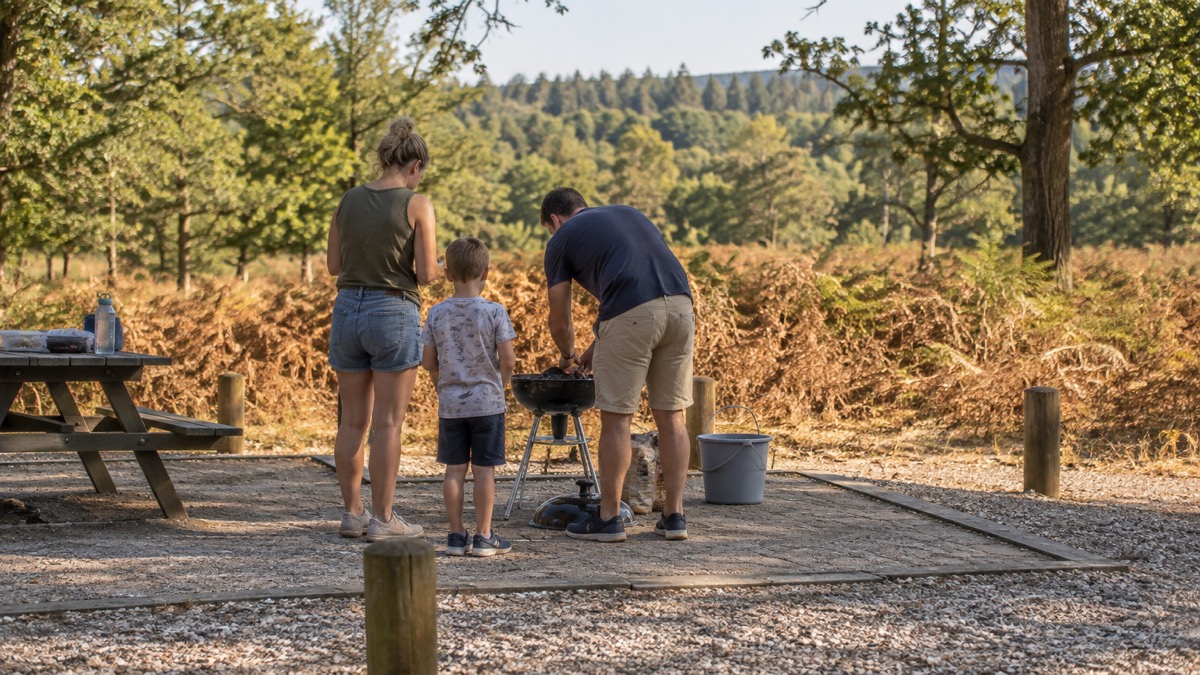
The most common mistake is treating a barbecue as finished when the flames have gone. Fire services warn that seemingly extinguished bonfires and BBQs often pose a continued risk of causing wildfires8. The heat stays in the fuel and the metal long after the visible fire has died, and dry ground underneath or beside it can be warmed until it catches.
Disposable barbecues are a particular problem because they are designed to be thrown away. Humberside Fire and Rescue Service says disposable BBQs are often not put out properly, which can cause grass fires, especially in hot weather when the ground is dry14. Oxfordshire County Council warns that disposing of them before they have completely cooled can cause serious fires, putting people, wildlife and the environment at risk15. A barbecue that looks out is not the same as a barbecue that is cold.
There is a second, quieter route to a fire that has nothing to do with heat. Glass left in woodland or open spaces can start a fire when sunlight shines through it, which is why Sussex's emergency planning advice says do not leave bottles or glass in woodlands or outside spaces17. North Yorkshire Fire and Rescue Service asks visitors to take rubbish home, especially glass bottles, and to dispose of smoking materials safely5. If you take a barbecue out, take it home cold, and take your bottles and cigarette ends with it.
Hot, dry and windy weather: when the risk is highest
Dry ground is the factor that turns a small mistake into a wildfire. The Northern Ireland government advises that during hot and dry weather you should avoid bonfires and be extra careful with barbecues, because dry ground in the summer increases the risk of fire18. Dorset and Wiltshire Fire and Rescue Service says disposable barbecues and open flames can easily ignite dry grass and vegetation, particularly during periods of prolonged hot weather19.
Wind makes it worse. Wildfires can spread rapidly, change direction without warning and threaten people, homes, livestock and wildlife19, and they can spread quickly and threaten homes and infrastructure, particularly during warm, dry weather20. Surrey County Council notes that wildfires are a particular risk during dry weather spells, when they can devastate wildlife and habitats as well as people and property1.
The risk is not confined to remote moorland. Disposable barbecues and open flames can easily ignite dry grass and vegetation, particularly during periods of prolonged hot weather21. Disposable BBQs are often not put out properly, which can cause grass fires, especially in hot weather when the ground is dry21. Wildfires can spread quickly and threaten homes and infrastructure, particularly during warm, dry weather21.
Official warnings can arrive on your phone. If you get one, treat it as a direct instruction for the days ahead: no barbecues, no bonfires, no fireworks, nothing that makes a spark outdoors. During hot and dry weather, avoid bonfires and be extra careful with barbecues, because dry ground in the summer increases the risk of fire21.
How fast a wildfire spreads, and why you cannot outrun one
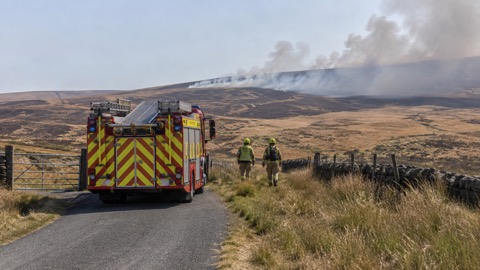
A countryside fire is not a large campfire. London Fire Brigade describes wildfires as uncontrolled and unpredictable, able to spread very quickly22. Essex's emergency planning guidance explains why: they can quickly spread over large areas due to dry conditions, wind, and the availability of flammable materials like grass, leaves and shrubs23. North Wales Fire and Rescue Service says grass and gorse fires spread very quickly when grass and mountains become very dry in summer24.
That combination of dry fuel, wind and slope is why fire services tell people not to try to outrun or fight a fire they have found. Cheshire Fire and Rescue Service says do not attempt to put the fire out yourself, because grass and crop fires can travel very quickly and change direction without warning9. Surrey County Council's advice if you see a fire in the countryside is to get far away from it, because it can spread incredibly quickly, and that your safety is the most important thing10.
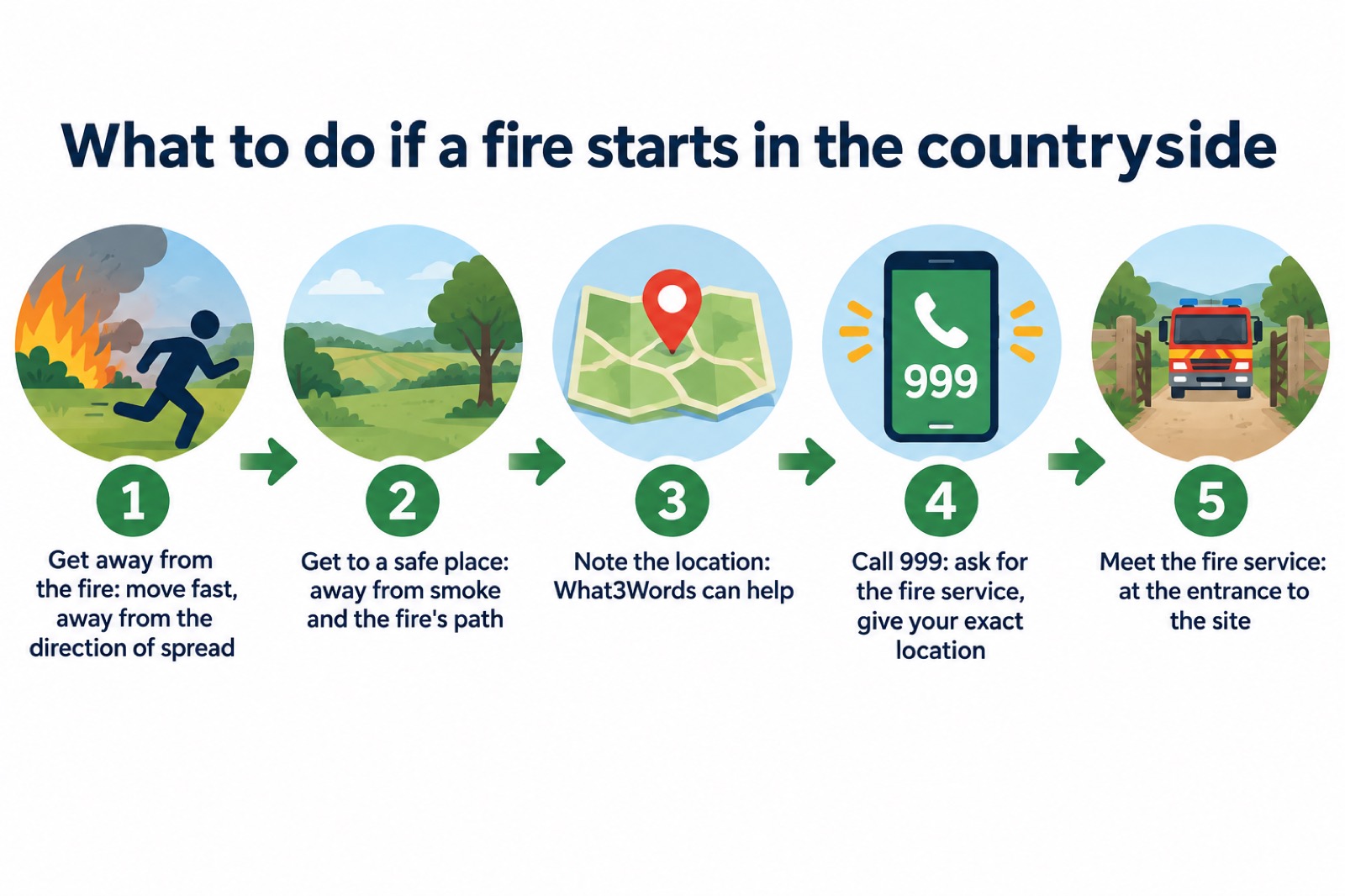
The practical rule is to move early and move away, not to watch. If you are on a moor or heath and see smoke or flame, head for a road, a track or open ground you have already crossed, and keep going until you are well clear. Do not head uphill into wind, and do not stop to film. Our guide to what to do if you see or are near a wildfire sets out the steps in full, and the wider wildfires and grass fires page explains how risk is assessed.
If a fire gets away: a bucket of water is the limit
Every household barbecue should have water within reach before it is lit. The Northern Ireland Fire and Rescue Service advises keeping a bucket of water or garden hose nearby in case of emergencies, and repeats the same advice across its summer safety guidance13. It is a small thing that decides whether a flare-up stays a flare-up.
But the bucket is a limit, not a licence. Cumbria Fire and Rescue Service says do not attempt to tackle fires that can't be put out with a bucket of water, and to leave the area as quickly as possible6. The Northern Ireland Fire and Rescue Service gives the same instruction in its wildfire statement7, and Cheshire Fire and Rescue Service says do not attempt to put the fire out yourself9. If the fire is bigger than a bucket, or moving, or you cannot see its edge, it is already beyond what a household can safely handle.
In a garden, the same logic applies at a smaller scale. If a barbecue or fire pit flares and catches a fence or shed, use the water you have ready, and call 999 if it spreads beyond what you can put out. Keep the garden hose connected during dry spells, and keep the area around the barbecue clear of dry cuttings and rubbish. Our home emergencies guide covers fire in and around the house, and protecting your home and garden from a wildfire covers the longer-term steps for homes near open land.
Reporting a fire in the countryside: 999, ask for the fire service
If you see a fire in the countryside, report it immediately, leave the area as soon as possible and dial 99929. Ask for the fire service and give your exact location8. The Northern Ireland government's advice is the same: if you see a fire in the countryside, phone the Fire and Rescue Service on 99916. Cheshire Fire and Rescue Service asks the public to alert the service to fires as early as possible via 999 calls9.
Location is the hard part in open country, so prepare for it. Dorset and Wiltshire Fire and Rescue Service advises getting to a safe place, noting the fire location (What3Words can help), calling 999, and meeting the Fire and Rescue Service at the entrance8. A what3words reference, a grid reference, a named car park or a postcode for the nearest building all help crews find the seat of the fire before it spreads.
- Call 999 and ask for the fire service8
- Give the exact location, using What3Words or a landmark if you can8
- Move to a safe place and meet crews at the entrance8
- Do not block tracks or gates with your car
Suspicious activity is worth reporting too. Surrey County Council asks people to report anti-social behaviour, campfires, large quantities of litter or fly tipping, use of disposable barbecues, broken gates, cropped locks, burning of waste material and arson10. If you see someone lighting a fire where they should not, or leaving a barbecue burning, report it to the police once any fire is dealt with.
Disposable barbecues, the Scottish Outdoor Access Code and controlled burning
Rules on disposable barbecues are a patchwork, and it pays to know which one applies where you are going.
| Where you are | What applies |
|---|---|
| England | Fire services advise against disposable barbecues in open countryside, parks and moorland4; some councils, including Surrey, have banned their sale or supply10 |
| Wales | Use only in suitable and safe areas, never unattended, and well away from houses, sheds and fences2 |
| Scotland | Follow the Scottish Outdoor Access Code, which covers not starting fires in woodlands31 |
| Northern Ireland | Use only in designated areas, never unattended, and report fires on 99932 |
In Scotland, Forestry and Land Scotland asks visitors to follow the Scottish Outdoor Access Code's advice and not start fires in woodlands31. The code is the framework for responsible access to the Scottish outdoors, and its camping guidance covers fires. In practice that means no campfires or barbecues among trees, and extra care on dry ground anywhere.
Controlled burning by farmers and land managers is a separate matter, and it is lawful within limits. Mid and West Wales Fire and Rescue Service says controlled habitat burning is important in maintaining natural habitats and reducing the amount of dry heather and vegetation which, when left unburnt, can devastate habitats and wildlife in Wales33. In Wales, controlled burning is permitted between 1 October and 31 March34. If you see a large fire on moorland in summer, outside that window, treat it as suspicious and report it.
Where to get help and what to do next
The help you need depends on what is happening. For a fire that is burning, call 999 and ask for the fire service8. For suspicious activity, arson or a barbecue left burning where it should not be, contact the police.
Before the next hot spell, do three things. Decide now that open countryside gets a picnic, not a barbecue1. If you cook in the garden, set up away from hedges, fences and sheds, with a bucket of water or hose ready12. And keep an eye on official warnings, including emergency alerts, which can tell you when the national wildfire risk is very high21.
For the wider picture, our heatwaves and drought section covers hot weather planning, and the hot weather preparation checklist helps you get the household ready before a dry spell arrives. If you are cooking without mains power or gas for other reasons, see heating and cooking without mains power or gas.
Sources (34)
- Be wildfire aware in the countryside, Surrey County Council, 7 September 2026
- Walking in the countryside, Mid and West Wales Fire and Rescue Service, 2026
- Barbecue safety, Mid and West Wales Fire and Rescue Service, 2026
- Warm weather safety, Suffolk Fire and Rescue Service, 2026
- Fire service shares summer safety advice as temperatures rise, North Yorkshire Fire and Rescue Service, 26 June 2026
- Safety outdoors, Cumbria Fire and Rescue Service, 2026
- NIFRS statement: wildfires in Northern Ireland, Northern Ireland Fire and Rescue Service, 30 April 2026
- Heath fires and countryside safety, Dorset and Wiltshire Fire and Rescue Service, 5 May 2026
- Countryside safety, Cheshire Fire and Rescue Service, 14 July 2026
- Wildfire, Surrey County Council, August 2026
- Cerdded yng nghefn gwlad, Mid and West Wales Fire and Rescue Service, 2026
- Water and wildfire campaign launched, North Yorkshire Fire and Rescue Service, 21 April 2021
- Stay safe this summer: essential tips from NIFRS, Northern Ireland Fire and Rescue Service, 23 June 2026
- Barbecue safety, Humberside Fire and Rescue Service, 2026
- Help prevent wildfires, Oxfordshire County Council, 2026
- Fire and summer safety advice, nidirect, 3 July 2026
- Preparing for an emergency: be ready, stay safe, act now, Sussex Resilience Forum, October 2025
- Hot weather advice, nidirect, 5 October 2026
- How to stay safe during a heatwave, Dorset and Wiltshire Fire and Rescue Service, 23 June 2026
- Stay safe this summer: reduce the risk of wildfires, Wiltshire and Swindon Prepared, 25 October 2026
- Public messaging for summer concurrent risks: extreme heat, drought and wildfires, GOV.UK, 16 December 2025
- Grass and wildfires, London Fire Brigade, 25 October 2026
- Wildfire, Essex Prepared, 2026
- Grass and gorse fires, North Wales Fire and Rescue Service, 2026
- NIFRS simple steps to stay safe this summer, Northern Ireland Fire and Rescue Service, 24 June 2024
- NIFRS simple steps to stay safe this summer, Northern Ireland Fire and Rescue Service, 24 June 2022
- NIFRS appeal: simple steps to keep you safe this summer, Northern Ireland Fire and Rescue Service, 24 June 2022
- Staying safe, Greater Manchester Fire and Rescue Service, 2026
- Countryside safety, Greater Manchester Fire and Rescue Service, 2026
- Other safety, Northern Ireland Fire and Rescue Service, 22 October 2026
- Wildfire prevention, Forestry and Land Scotland, 2026
- Protect people, property and nature from wildfires, Northern Ireland Fire and Rescue Service, 16 March 2026
- Farm fire safety, Mid and West Wales Fire and Rescue Service, 2026
- Adverse weather events, Llangattock Community Council, 25 October 2026
 Flood Warning Checklist
 First Steps After a Flood
 Insurance Claim Records
 Hosepipe Ban Exemptions
 Hosepipe Ban Fines and Reporting
 Hosepipe Bans and the Garden
 Hosepipe Ban Rules
 Pools, Ponds and Car Washing
 Private Water Supply Drying Up
 Wildfire Home Protection
 What to Do Near a Wildfire