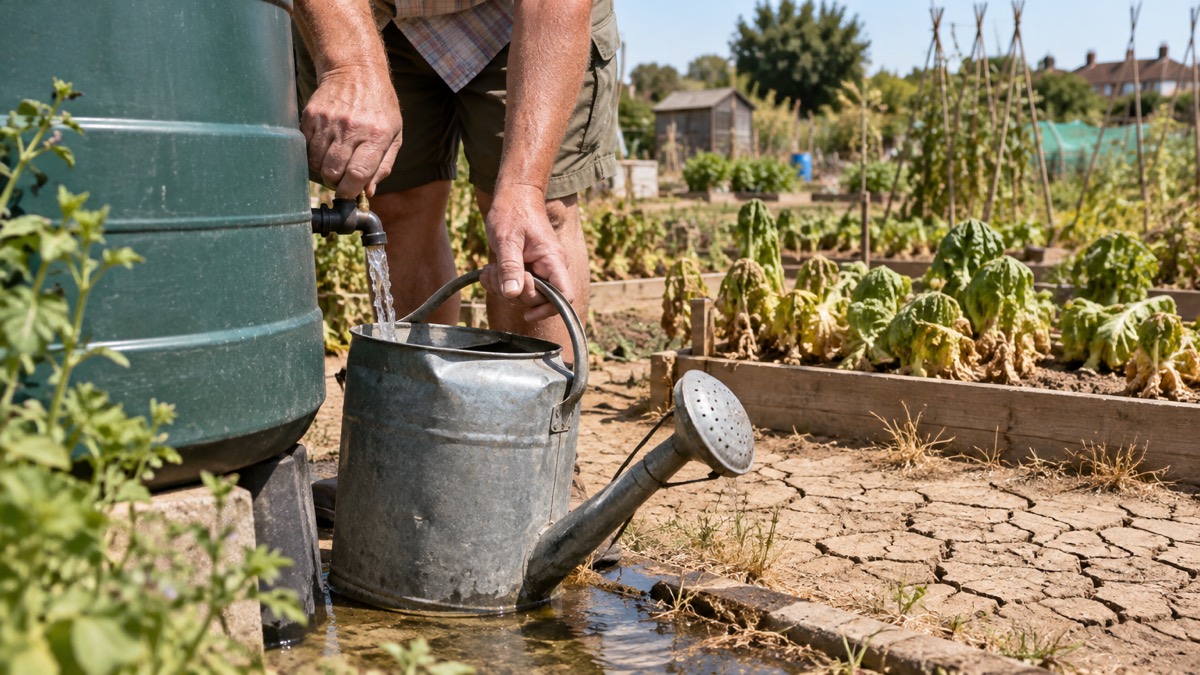
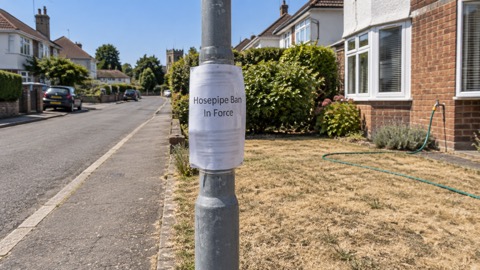
A hosepipe ban does not stop you watering your garden. It stops you using a hosepipe to do it. You can still water by hand with a watering can or a bucket, and you can use water collected in a water butt, even through a hosepipe1. What changes is the method, and in some areas the exemptions that used to let certain households use a hosepipe at all.
The ban is a Temporary Use Ban, declared by your water company to cut demand when water use is exceptionally high, so there is enough treated drinking water for everyone2. It covers far more than the garden: sprinklers, irrigation systems and pressure washers connected to the mains are caught too, because the rules apply to anything that connects to the mains supply3. Breaking it can lead to a fine of up to £1,0004.
So the practical answer for an ordinary household is: put the sprinkler away, get the watering can out, water early or late, and check your own company's page for the exemptions and any tightening since the ban began. This page sets out what is covered, who is exempt, how to make every can count, and what happens if you ignore it.
Watering cans and water butts are allowed; hosepipes and sprinklers are not
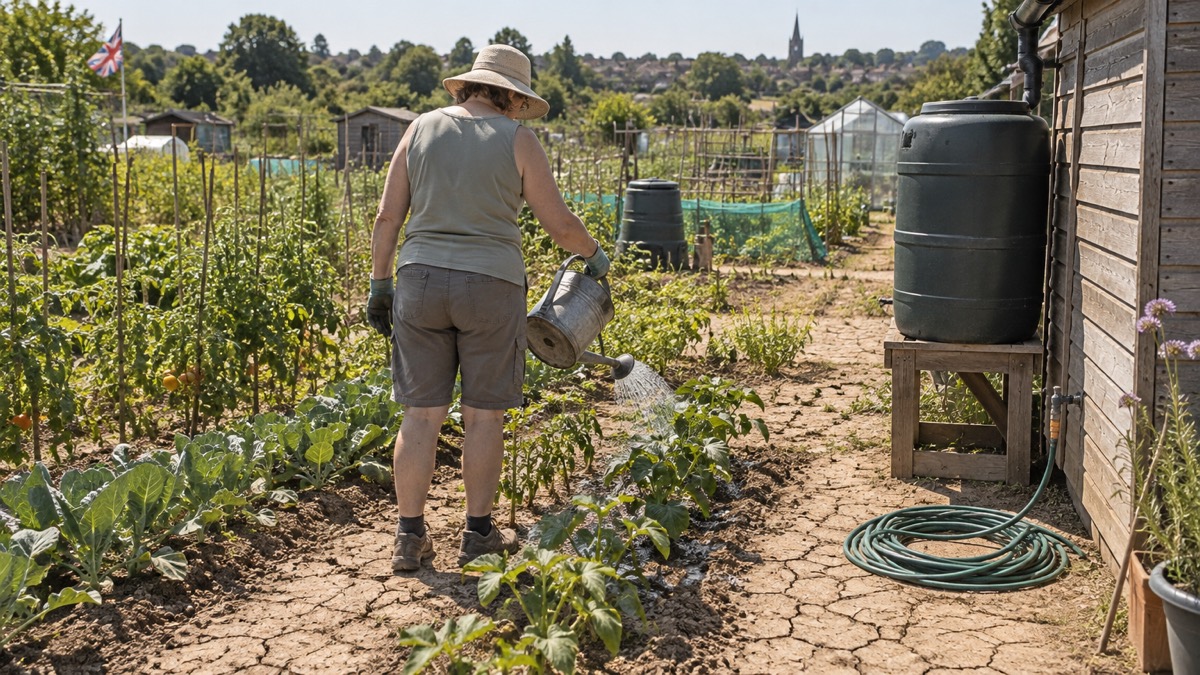
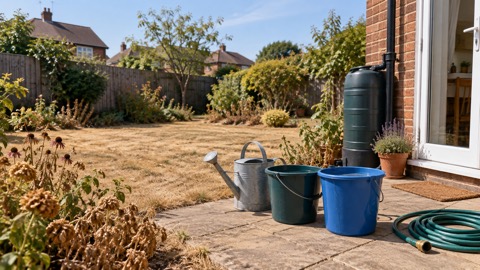
The distinction the rules draw is between water you carry and water the mains delivers under pressure. Affinity Water puts it plainly: you can water your garden using a watering can or water collected in a water butt, just not with a hosepipe or sprinkler7. Wessex Water lists watering plants with a watering can and using water from a water butt among the activities its ban does not affect, alongside everyday essential use such as showering and washing8.
Bristol Water adds that there is no restriction on using a watering can in your garden at all, and that watering is most efficient at a cooler time of day, early morning or late evening3. South East Water says the same in practice: you may water your garden with tap water by hand using a bucket or watering can, or with greywater or rainwater from a water butt through a hosepipe1.
The trap is the word "hosepipe". It is defined widely. South East Water states that a hosepipe means anything designed, adapted or used to serve the same purpose as a hosepipe, including garden sprinklers and irrigation systems connected to the mains and anything attached to them, such as pressure washers9. So a soaker hose run off an outdoor tap, a sprinkler on a timer, or a jet washer used to clean the patio all fall inside the ban, even though none of them looks like someone standing with a hose.
What to have ready, then, is simple and cheap:
- A watering can with a rose, for beds, pots and newly planted shrubs
- One or more buckets, for carrying water from a butt or a bath
- A water butt connected to a downpipe, filled by rain before the dry spell
- Greywater from washing up or a bath, used on established plants and lawns, as fire and rescue services and councils suggest10
What the ban covers: gardens, lawns, allotments and green spaces
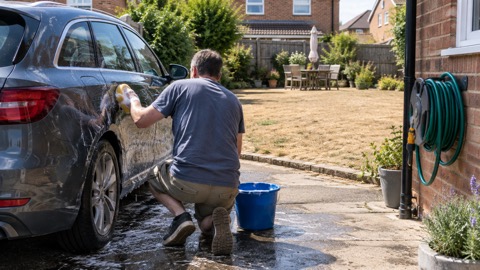
The list of prohibited uses is long and consistent between companies. Essex & Suffolk Water sets out the standard set: watering a garden using a hosepipe; cleaning a private motor vehicle or trailer; watering plants on domestic or other non-commercial premises; cleaning a private leisure boat; filling or maintaining a domestic swimming or paddling pool; drawing water by hosepipe for domestic recreational use such as a hot tub; filling or maintaining a domestic pond; filling or maintaining an ornamental fountain; cleaning walls or windows of domestic premises; cleaning paths or patios; and cleaning other artificial outdoor surfaces12.
For a gardener, three parts of that matter most.
Gardens and lawns. Bristol Water says do not use a hosepipe to water your garden, including lawns, grass verges, allotments and other green spaces3. South East Water defines a garden widely too: a public garden, a lawn, a park, a grass verge or an area of grass used for sport or recreation1. Cambridge Water lists watering a garden using a hosepipe or sprinkler system among prohibited activities4.
Allotments. Bristol Water states you cannot use a hosepipe to water a non-commercial allotment or vegetable patch2. South East Water classes an allotment used for non-commercial purposes as a garden, so hosepipe use is restricted, while watering cans, buckets or drip and trickle irrigation are permitted6. Commercial agricultural activity is treated separately: Southern Water says agricultural activities will not be affected by the ban, but you must observe all the restrictions13.
Green spaces and sport. Because a garden includes parks, verges and sports grass, a hosepipe on a village green or a playing field is caught by the same rule1.
| Place | Hosepipe allowed? | What to use instead |
|---|---|---|
| Domestic garden, beds and borders | No3 | Watering can, bucket, water butt7 |
| Lawn | No3 | Let it brown off; water by can only if essential |
| Non-commercial allotment or veg patch | No2 | Watering can, bucket, approved drip irrigation6 |
| Public garden, park, verge, sports grass | No1 | Hand watering where permitted |
| Commercial agricultural land | Activity not affected, but restrictions observed13 | Follow the company's guidance |
Who is exempt, including Priority Services Register customers
Exemptions exist because some people cannot physically water a garden by hand, and the rules are meant to protect health and welfare as well as water. The pattern is similar across companies but not identical, so the exemption that applies to you depends on your supplier.
Southern Water exempts customers on its Priority Services Register with medical or mobility needs, including Blue Badge holders and those on its WaterSure tariff13. Affinity Water exempts customers on the Priority Services Register, on the WaterSure tariff, and Blue Badge holders who cannot use a watering can or bucket because of a health condition or disability7. Bristol Water exempts customers who hold a Blue Badge, or are on the Priority Services Register or receive support through the WaterSure Plus tariff, and who are unable to make a reasonable adjustment because of a health condition or disability3. The Consumer Council for Water advises that if you have mobility problems and are on your water company's Priority Services Register, the hosepipe ban should not apply to you14.
South Staffs Water describes the same approach from the company side: it makes a number of standard exemptions, such as for Blue Badge holders, and can make further standard exemptions for specific activities, for example where there is a need to maintain a pond that contains fish15.
Two cautions. First, an exemption is not always automatic: some companies ask you to register or confirm your circumstances, and Affinity Water says it will contact customers first to check awareness and exemptions before taking further action7. Second, exemptions can be withdrawn. South East Water announced on 2 October 2026 the removal of previously permitted exemptions in Sussex, except those required for health, safety or welfare purposes, and the updated restrictions came into force and became enforceable on 9 October 20266. If you relied on an exemption last summer, read the current notice rather than assuming it still stands.
If you are not yet on the Priority Services Register and have medical or mobility needs, ask your water company to add you. It is the route through which most of these exemptions are recognised, and it also helps the company reach you during a supply interruption. Our guide to extra help in an emergency explains what the register does more broadly.
Watering at cooler times of day to make every can count
Once you are carrying water rather than spraying it, timing and technique decide how much of it reaches the roots. Bristol Water says watering is most efficient if done at a cooler time of day, early morning or late evening3. Cornwall Council gives the reason: water gardens in the early morning or late evening to reduce evaporation, and collect rainwater for gardens, pots and outdoor plants whenever possible5.
The same advice appears in fire and rescue service guidance, because a dry garden is also a fire risk. Suffolk Fire and Rescue Service advises keeping your garden maintained and watered in dry spells, and considering water from water butts or wastewater from the home if hosepipe bans are in place10. North Yorkshire Fire and Rescue Service gives the same advice for protecting your home from wildfires11. The fire service's interest is not cosmetic: dry grass, hedges and mulch near a building carry flame, and a damp border is a break. Our page on protecting your home and garden from a wildfire sets out the wider measures.
Practical ways to make a can go further:
- Water the soil, not the leaves, and give fewer, deeper soakings rather than a daily sprinkle
- Water in the early morning or late evening, when less is lost to evaporation3
- Prioritise new planting, pots and vegetables; established lawns and shrubs recover from drying out
- Keep your garden maintained and watered in dry spells, and consider water from water butts or wastewater from the home if a hosepipe ban is in place10
- Use a watering can instead of a garden hose15
- Keep a full water butt before restrictions bite; rain in spring and autumn is free water for summer
New turf, new planting and drip irrigation: the limited exceptions
A few garden activities can still use a hosepipe, but the exceptions are narrow, time-limited and vary by company. Do not assume the one you read about applies where you live.
New turf. Southern Water says you can water newly laid turf for 28 days with a hosepipe13. South East Water's Kent guidance allows a hosepipe on new turf laid before the start of the ban in domestic gardens for 28 days (4 weeks) after laying, outside daily peak hours of 8am to 10am and 5pm to 9pm, with evidence of the completion date required1. Thames Water and Cambridge Water allow a hosepipe on newly laid or sown lawns and new planting for the first 28 days, and not otherwise on domestic gardens17. But South East Water's Sussex restrictions, updated in October 2026, state that watering newly laid turf with a hosepipe is not permitted6. The same company, in two parts of its region, gives two different answers, which is exactly why you check your own area.
New trees and hedging. Southern Water allows a hosepipe for watering trees, whips, saplings and hedging planted before the ban in the last three years, where this cannot reasonably be done with a watering can18. Wessex Water's exemptions include trees, hedges and saplings planted within the last three years, where it is not feasible to use a watering can8.
Drip and trickle irrigation. Several companies allow an approved drip or trickle irrigation system fitted with a pressure-reducing valve and a timer, alongside hosepipe use for health or safety reasons, reduced mobility without a Blue Badge, and new turf in its first 28 days12. The controls are the point: a pressure-reducing valve and a timer make the system deliver water slowly and only when needed, rather than running a tap continuously. A drip line connected straight to an outdoor tap without them is a hosepipe by the definition above and is banned9.
| Exception | What is allowed | Conditions | Source |
|---|---|---|---|
| New turf | Hosepipe for 28 days after laying, in some areas | Laid before the ban; outside 8am to 10am and 5pm to 9pm; proof of date | 1 |
| New turf, Sussex | Not permitted under updated restrictions | None | 6 |
| New lawns and planting | First 28 days only | Domestic premises | 17 |
| New trees, saplings, hedging | Hosepipe where a can cannot reasonably do it | Planted in the last three years | 18 |
| Drip or trickle irrigation | Approved system | Pressure-reducing valve and timer fitted | 12 |
Fines of up to £1,000 and how water companies enforce the ban
A Temporary Use Ban is backed by law, not just by advice. Cambridge Water states that under the Water Industry Act 1991, anyone who fails to comply with a temporary use ban could be prosecuted and fined up to £1,000 by a Magistrates' Court4. The Consumer Council for Water puts the same figure plainly: breaking the rules could land you a fine of up to £1000, which is enforceable by law19. Affinity Water, Southern Water and Bristol Water all state a maximum of up to £1,0007.
In practice, companies describe a measured approach before prosecution. Affinity Water says that if you are seen using a hosepipe during the ban, you can expect it to get in touch first, to check whether you are aware of the ban or entitled to an exemption, before taking further action if hosepipe use continues7. That is a chance to correct a misunderstanding, not a licence to carry on.
Enforcement also runs through publicity and notice. South East Water published notice of its tightened Sussex restrictions in the London Gazette and the Sussex Express on 2 October 2026, ahead of the rules becoming enforceable on 9 October6. Companies can and do publicise the start of a ban: South East Water brought restrictions into force for customers in Sussex, Surrey, Hampshire and Berkshire from 00:01 on Saturday 25 July 20269, and Essex & Suffolk Water's ban for all household customers began at 00:01 on Monday 3 August 2026, the first in the area since 199720.
When a hosepipe ban is lifted
A ban is lifted when the reason for it goes. Dŵr Cymru Welsh Water lifted the hosepipe ban for customers on the Mid and South Ceredigion water network on 4 September 2026, after an improvement in treated water storage levels across the affected zone meant restrictions were no longer required21. The company had warned in July that a ban might be needed in mid and south Ceredigion that weekend as record demand continued21. The sequence, warning then restriction then lifting as storage recovered, is typical.
You will not usually have to guess. Companies announce the start and end of restrictions on their websites and by letter or email, and the ending is as public as the beginning. Until you see that announcement for your area, assume the ban is still in force, even if the weather has broken and the grass has greened up. Storage and river levels recover more slowly than gardens do.
If the drought continues instead, restrictions can tighten rather than lift. The Consumer Council for Water warns that if the drought continues, your water company might ban all water use classed as non-essential, which would affect businesses that use water such as car washes19. South East Water's removal of most Sussex exemptions from 9 October 2026 is an example of a ban getting stricter mid-season6. Our guide to how Temporary Use Bans work explains the legal mechanism, and England's 2026 drought: where restrictions apply tracks which companies have bans in place.
Sources (21)
- Tubs Kent FAQs, South East Water, 2026
- Hosepipe ban FAQs, Bristol Water, 2026
- Hosepipe ban exceptions, Bristol Water, 2026
- Temporary hosepipe ban FAQs, Cambridge Water, 2026
- Private water supplies, Cornwall Council, 2026
- Sussex hosepipe restrictions FAQs, South East Water, 2026
- Hosepipe ban FAQs, Affinity Water, 2026
- Hosepipe ban, Wessex Water, 2026
- Temporary Use Bans, South East Water, 2026
- Warm weather safety, Suffolk Fire and Rescue Service, 2026
- Protecting your home from wildfires, North Yorkshire Fire and Rescue Service, 2026
- Temporary use ban FAQs, Essex & Suffolk Water, 2026
- Temporary use ban advice, Southern Water, 2026
- Hosepipe bans FAQ, Consumer Council for Water, 2026
- Drought FAQs, South Staffs Water, 2026
- Protecting your garden, Devon and Somerset Fire and Rescue Service, 2026
- Hosepipe ban FAQs, Thames Water, 2026
- Hosepipe ban exemptions, Southern Water, 2026
- Hosepipe bans, Consumer Council for Water, 2026
- Temporary Use Ban, Essex & Suffolk Water, 2026
- Drought, Dŵr Cymru Welsh Water, 2026
 Flood Warning Checklist
 First Steps After a Flood
 Insurance Claim Records
 Barbecues and Wildfire Risk
 Hosepipe Ban Exemptions
 Hosepipe Ban Fines and Reporting
 Hosepipe Ban Rules
 Pools, Ponds and Car Washing
 Private Water Supply Drying Up
 Wildfire Home Protection
 What to Do Near a Wildfire