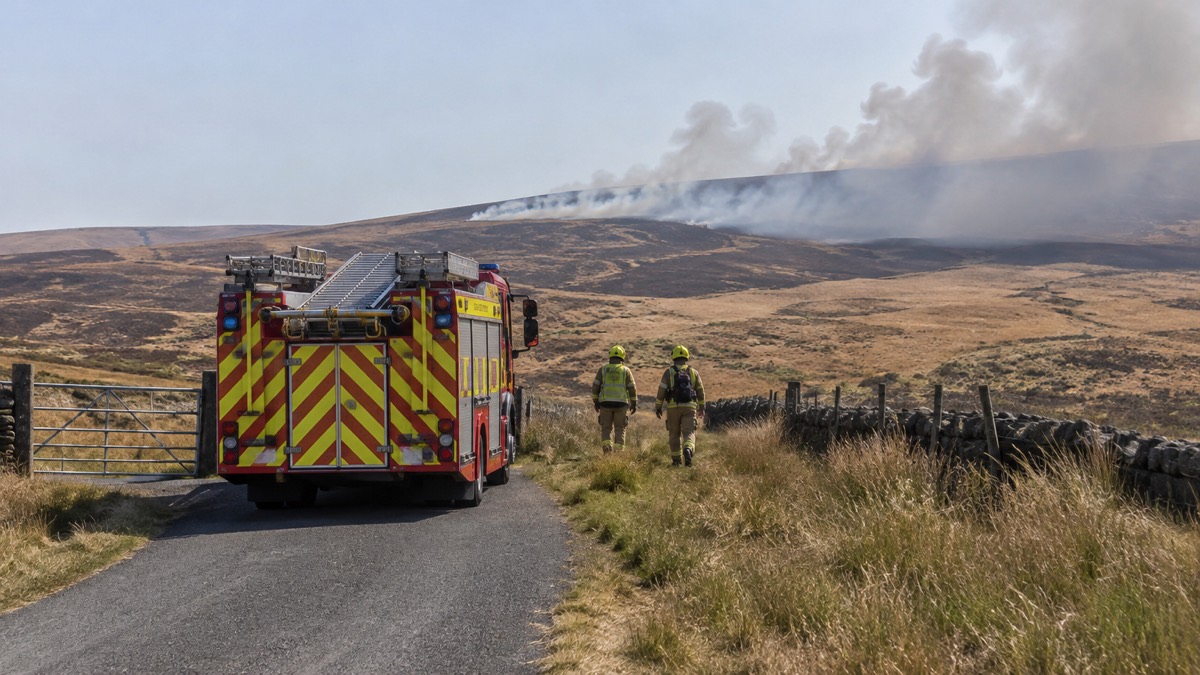
If you see a fire in the countryside, call 999 and ask for the fire service, then leave the area as quickly as possible. Do not assume someone else has already reported it. Give the operator as much information as you can about the location, the size of the fire, the terrain and anything else that seems relevant, so crews can find it and approach safely1.
Do not try to fight it. Fire and rescue services across the UK give the same instruction: do not attempt to tackle fires that cannot be put out with a bucket of water, and leave the area as quickly as possible4. A developed wildfire creates its own wind, which drives it at speeds faster than people can get out of its way, and fires can change direction and jump, so judging which way it will go is not something to attempt4.
Most wildfires are started by people, and most of that is avoidable. In hot, dry or windy weather, do not light a fire outdoors at all, and follow any local restrictions and signage2. If you are concerned about a fire near your home, there is separate advice on protecting your home and garden from a wildfire.
Call 999 and ask for the fire service as soon as you see a wildfire
The first action is always the same, whichever nation you are in. Forestry and Land Scotland says that if you see a wildfire, call 999 and ask for the Fire Service1. The Scottish Government's Ready Scotland campaign says once you are safe, call 999 and ask for the fire service2. Lancashire's preparedness service puts it more bluntly: ring 999, and do not assume someone else has3. In Northern Ireland, the Northern Ireland Fire and Rescue Service asks you to report a fire in the countryside to NIFRS immediately on 99912.
The order matters. If the fire is close, move to a place of safety first and call 999 immediately, as Devon and Somerset Fire and Rescue Service advises13. If you are already at a safe distance, call straight away. Either way, the call comes before anything else.
What to say when you get through:
- Where you are: a road name, a what3words location if you have it, a landmark, a car park or a named path. Be as precise as you can.
- What you can see: the size of the fire, whether it is grass, heath, woodland or a building, and how fast it seems to be moving.
- The terrain: slopes, tracks, gates and anything that might affect how crews reach it.
- Which way the wind is blowing, if you can tell.
Wiltshire and Swindon's preparedness service asks callers to provide as much information as they can about the location, size, terrain and any other relevant information3. That detail is what lets control rooms send the right appliances to the right access point.
Once you have called, leave. Do not stay to watch, and do not drive towards the fire to get a better look: Wiltshire and Swindon's guidance says do not travel to the area of a wildfire, as this may slow the emergency response10. If you are in a caravan or mobile home and there is a fire, get out, stay out and call the Fire and Rescue Service immediately12. The same principle applies in a house: once you are out, stay out14.
Only tackle a fire you can put out with a bucket of water
Every fire service in the UK gives the same limit, and it is worth reading twice: do not attempt to tackle fires that cannot be put out with a bucket of water, and leave the area as quickly as possible4. That is not a comment on your courage or your garden hose. It is a recognition that a fire beyond that size is already behaving in ways a person on foot cannot control.
The reason is in how wildfires move. A developed wildfire creates its own wind, which drives it at speeds faster than people can get out of its way4. Fires spread quickly over large areas because of dry conditions, wind and the availability of flammable material such as grass, leaves and shrubs17. They also change direction and can jump, which makes them very difficult to contain7. A fire that looks like it is heading away from you can turn, and a fire that looks small can be the edge of something much larger behind a ridge or a hedge.
If you are in a building and a fire is approaching, the advice is the standard fire advice: get out, stay out and call the Fire and Rescue Service immediately12. Close doors behind you if you can do so without delay, and do not go back inside for possessions.
The one situation where a bucket of water is the right tool is a small fire you have just started yourself, such as a barbecue that has caught a patch of dry grass. Even then, the priority is to stop it spreading and to call for help if it has got beyond a bucket. If you are not certain, treat it as beyond you and call 999.
Why you cannot outrun a wildfire
People often assume they can walk or drive away from a fire faster than it can travel. The guidance says otherwise. A developed wildfire creates its own wind, which drives it at speeds faster than people can get out of its way4. That single sentence is the reason the advice is to leave early rather than to watch and decide.
Wildfires spread quickly over large areas because of dry conditions, wind and the availability of flammable materials like grass, leaves and shrubs17. They change direction and can jump, which makes them very difficult to contain7. A fire can cross a track, a hedge or a line of trees and appear on the other side of you. That is what "jump" means in practice, and it is why the services do not ask the public to judge a safe distance.
The practical consequences for a household:
- Leave as soon as you are told to, or as soon as you see smoke close by. Do not wait to see how it develops.
- Do not drive towards the fire to collect someone or to look. Do not travel to the area of a wildfire, as this may slow the emergency response10.
- Follow local guidance and signage, particularly during periods of heightened wildfire risk when access restrictions may be in place10.
- If you are cut off, move to a place of safety and call 999. Do not try to tackle the fire3.
Hot, dry, windy weather: when wildfire risk is highest
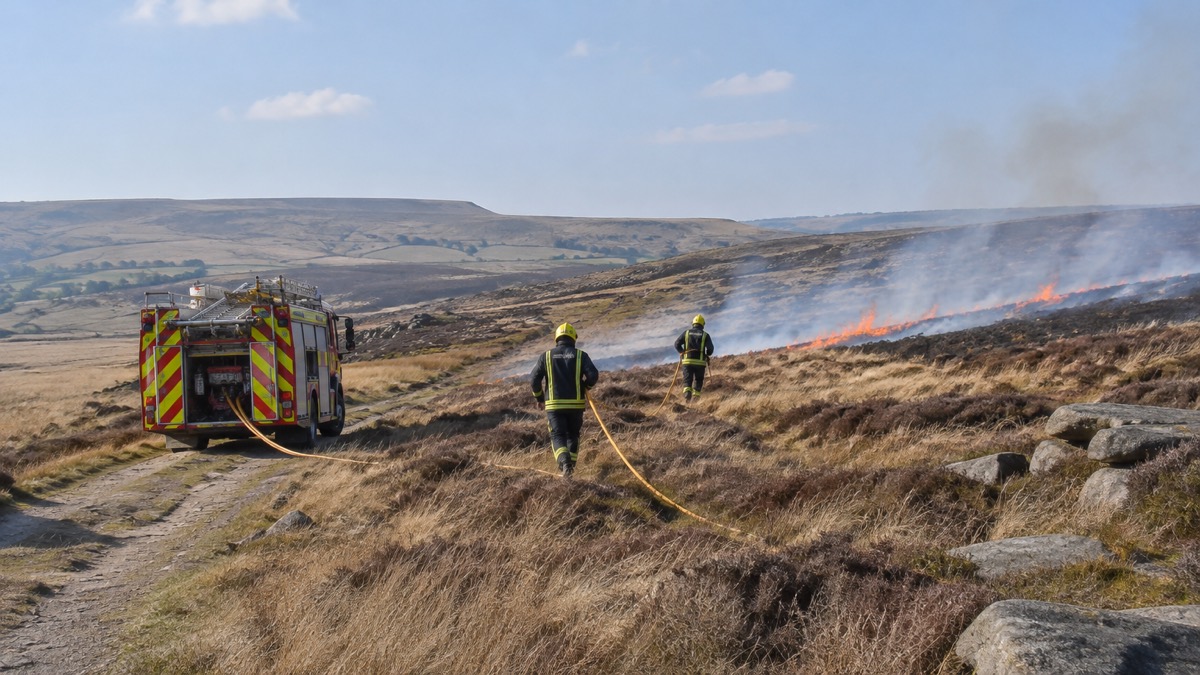
Wildfire risk in the UK is not spread evenly through the year. Wildfires can spread quickly and threaten homes and infrastructure, particularly during warm, dry weather7. The Scottish Government's hot weather guidance notes an increased risk from uncontrolled, quickly spreading wildfires during hot weather18. Dry conditions can allow fire to spread quickly, putting lives, wildlife and property at risk12.
The conditions that matter most are the ones that dry out vegetation and drive a fire along: high temperatures, low humidity and wind. Ready Scotland's advice is not to light a fire outdoors if there is a wildfire danger warning in place in your location, or during periods of high winds, high temperatures or low humidity2. North Yorkshire Fire and Rescue Service asks people to follow local restrictions and fire warnings, especially during dry or windy conditions8.
Wildfires are a particular risk during dry weather spells, when they can be as devastating to wildlife and habitats as they are to people and property19. That is why the advice is seasonal as well as situational: the same barbecue that is fine in a wet April is a different proposition in a dry August.
| Condition | What it does | What to do |
|---|---|---|
| Warm, dry weather | Fires spread quickly and threaten homes and infrastructure7 | Check local warnings before lighting anything outdoors |
| Hot weather | Increased risk from uncontrolled, quickly spreading wildfires18 | Follow local restrictions and signage10 |
| High winds | Drives fire across open ground2 | Do not light a fire outdoors2 |
| Low humidity | Dries vegetation, making it ready to burn2 | Do not light a fire outdoors2 |
| Dry spell | Fire can be as devastating to habitats as to people and property19 | Take litter home, especially glass20 |
The UK does not have a single national wildfire warning scale that applies everywhere. Warnings come from the fire and rescue service for your area, from the devolved governments and from local councils, and they are issued for particular places and periods. Fire and rescue services in Scotland have issued warnings for the Central Highlands, southern and eastern Scotland, and separately for the eastern Highlands, eastern and southern Scotland21. When a warning is in place, share it with family, friends and any visitors, as the Scottish Fire and Rescue Service asks21.
Barbecues, bonfires and naked flames in the countryside
Almost every wildfire in the UK is started by people, and the commonest culprits are the ones people bring with them: disposable barbecues, camping stoves, campfires and cigarettes. The advice from fire and rescue services is consistent and blunt.
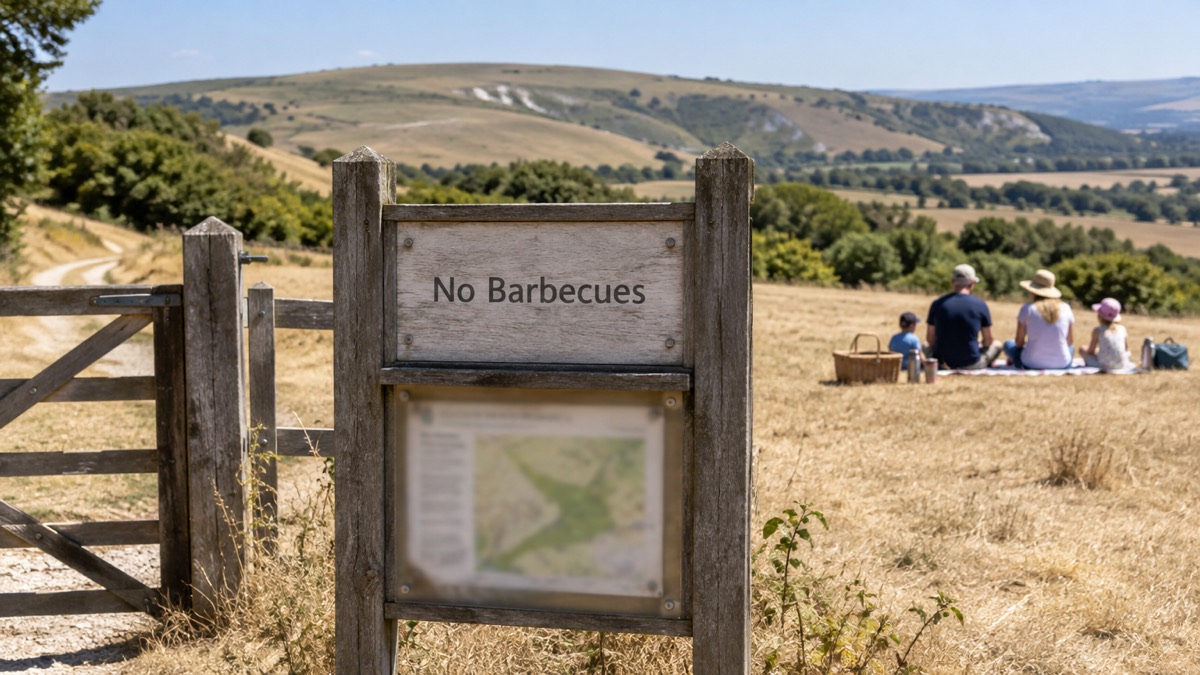
Surrey County Council's countryside advice is to "Burger Off!" with barbecues, camping stoves and open fires in the countryside23. Its wildfire awareness page says: don't use barbecues or camping stoves in the countryside or light an open fire, because they can quickly spread and get out of control19. Oxfordshire County Council says to avoid lighting bonfires, campfires or any open fires in the countryside, on open land, or in areas of dry grass, woodland or heath24. Wiltshire and Swindon's preparedness service says do not light fires in the countryside or other open spaces, including parks, moorland and wooded areas10.
Where a barbecue is allowed, Cumbria Fire and Rescue Service says only use barbecues in a suitable and safe area and never leave them unattended6. North Yorkshire Fire and Rescue Service says do not use disposable barbecues, campfires or fireworks on grassland, moors or in wooded areas8. Suffolk Fire and Rescue Service advises avoiding disposable barbecues in open countryside, parks and moorland areas25. Devon and Somerset Fire and Rescue Service recommends a picnic or sandwiches rather than a disposable barbecue, and says that if you do use one away from home, be very careful, as they have caused many wildfires in recent years26.
If you are visiting the countryside, North Yorkshire Fire and Rescue Service asks you to stick to paths, leave gates and property as you find them, take your litter home, especially glass bottles and jars, dispose of smoking materials carefully, and never have campfires or barbecues on dry grassland20. Glass and cigarettes are worth singling out: a discarded bottle can focus sunlight, and a cigarette end can smoulder in dry grass long after the smoker has gone.
In Scotland, Forestry and Land Scotland asks visitors to follow the Scottish Outdoor Access Code's advice and not to start fires in woodlands1. The code's camping guidance covers not starting fires in woodlands1. The Scottish Fire and Rescue Service says human behaviour can significantly lower the chances of a wildfire starting, so people should act safely and responsibly in rural environments and always follow the Scottish Outdoor Access Code22.
If you have had a fire of any kind, make sure it is out and the surroundings are made safe before you leave27. In Northern Ireland, the fire service asks people to ensure barbecues are fully extinguished and cold before disposing of the contents28.
Reporting deliberate fire-setting to the police
Some countryside fires are started deliberately. Fire and rescue services treat this as a crime and ask the public to report it. Northern Ireland's fire service says any suspicious behaviour should be reported to the police immediately29. In Wales, the Fire and Rescue Services say deliberate fire setting is a crime and appeal for information on anyone deliberately setting fires to call 101, or to report anonymously to Crimestoppers on 0800 555 11130.
There are anonymous routes too. Greater Manchester Fire and Rescue Service asks people to anonymously report deliberate firesetting to FireStoppers31, and its Be Moor Aware campaign repeats the same route32. In Wales, the Fire and Rescue Services ask people to report deliberate fires and antisocial gatherings to protect the community so that emergencies can be responded to quickly24.
What to report, and to whom:
- A fire that is burning now: call 999 and ask for the fire service1.
- Suspicious behaviour, not a fire in progress: report it to the police immediately29.
- Information about deliberate fire-setting after the event: call 101, or Crimestoppers on 0800 555 111 in Wales30, or FireStoppers anonymously31.
Do not approach anyone you suspect of starting a fire, and do not put yourself in the way of a fire to get a description. Report what you saw from a safe place.
Where wildfires happen in the UK, and how bad they get
Wildfires in the UK are less frequent than in some other parts of the world, but they can cause significant damage to ecosystems, disrupt communities and require a coordinated response from emergency services and land managers to control and extinguish them17. They are not confined to remote moorland. The summer 2022 heatwave saw an unprecedented number of wildfires, particularly in urban areas like London33.
The record is a useful measure of how the risk has grown. Fire and rescue services in England and Wales had responded to 996 wildfires as of 4 September 2025, up from 994 in the 2022 drought, which was previously the worst year on record34. Individual fires can run for a long time: a fire on Winter Hill near Bolton in summer 2018 burned for six weeks and affected 18 square kilometres of moorland3.
Scotland classifies a wildfire as a large, uncontrolled outdoor fire exceeding 1,000 square meters of burned area on appropriate land types35. That definition is a useful guide to what the services mean by the word: not a bonfire, not a barbecue, but a fire that has escaped and is burning across open ground.
The risk is not only to open land. A wildfire can threaten homes and infrastructure7, and the advice for households near one is to follow local guidance and signage, and to leave when told10. If you want to reduce the risk to your property before a fire starts, see protecting your home and garden from a wildfire. For the wider picture of how hot, dry summers are changing the risk, see wildfires and grass fires: risk and prevention.
Emergency alerts and warnings: how you will be told
You may be warned about wildfire risk by an emergency alert on your phone. On 14 August 2026 the UK Government sent an emergency alert at 7:01pm to England and Wales warning of a very high national wildfire risk and advising against any fire-starting activity11. Alerts of this kind go to compatible phones in the area they cover, and they are intended to reach people who are not following the news.
Beyond the national alert, warnings come from several places:
- Fire and rescue services issue wildfire warnings for their areas, often naming the regions and the period covered21.
- Local councils publish countryside and wildfire advice, and some impose local restrictions such as the disposable barbecue ban in Surrey11.
- Land managers such as Forestry and Land Scotland publish prevention advice for visitors1.
- Local signage on moors, in parks and at access points may restrict access during heightened risk10.
If you are concerned about wildfires near your property, North Yorkshire Fire and Rescue Service points people to its wildfire advice and guidance to keep themselves safe36. The practical step is to know which service covers your area and to check its warnings before you set out on a dry, windy day. For the wider question of how to stay informed in an emergency, see staying informed and in touch in an emergency.
If a fire seems to have gone out
A fire that looks finished may not be. Embers can smoulder under ash and flare up again, and a further grass fire can start in the same area days later. After the Wennington wildfire in East London in July 2022, a further grass fire began burning in the area three days after the main fire37.
The lesson for a household is simple. If you have had a bonfire, make sure the fire is out and the surroundings are made safe before you leave27. If you are out walking and see smoke or flames, even a small amount, call 999 rather than investigating. Stay calm, and give the location as precisely as you can38.
"Make sure that the fire is out and surroundings are made safe before leaving"
If you have reported a fire and it appears to have gone out, do not assume the incident is over. Crews may still be working in the area, and access may be restricted. Follow any instructions from the emergency services and do not return to the area until you are told it is safe.
Sources (38)
- Wildfire prevention, Forestry and Land Scotland, 2026-10-29
- Wildfires, Ready Scotland, 2026-05-12
- Wildfires, Lancashire Prepared, 2026-10-29
- Heath fires and countryside safety, Dorset and Wiltshire Fire and Rescue Service, 2026-05-05
- Wildfires, Wiltshire and Swindon Prepared, 2026-10-25
- Safety outdoors, Cumbria Fire and Rescue Service, 2026-10-29
- Be informed about hazards: wildfires, Prepare, 2026-10-21
- Light nights campaign, North Yorkshire Fire and Rescue Service, 2026-06-10
- Other safety, Northern Ireland Fire and Rescue Service, 2026-10-22
- Stay safe this summer: reduce the risk of wildfires, Wiltshire and Swindon Prepared, 2026-10-25
- Wildfire, Surrey County Council, 2026-08
- Stay safe this summer: essential tips from NIFRS, Northern Ireland Fire and Rescue Service, 2026-06-22
- How to stay safe during a heatwave, Devon and Somerset Fire and Rescue Service, 2026-06-23
- In an emergency, Scottish Fire and Rescue Service, 2026-10-25
- NIFRS statement: wildfires in Northern Ireland, Northern Ireland Fire and Rescue Service, 2026-04-30
- NIFRS statement: ongoing wildfire operational update, Northern Ireland Fire and Rescue Service, 2026-04-29
- Wildfire, Essex Prepared, 2026-10-29
- Hot weather, Ready Scotland, 2026-03-24
- Be wildfire aware, Surrey County Council, 2026-09-07
- Stay safe this summer, North Yorkshire Fire and Rescue Service, 2024-05-01
- Very high risk of wildfire warning for Central Highlands, southern and eastern Scotland, Scottish Fire and Rescue Service, 2026-07-20
- Wildfire warning in place for eastern Highlands, eastern and southern Scotland, Scottish Fire and Rescue Service, 2026-08-12
- Help prevent wildfires, Oxfordshire County Council, 2026
- Walking in the countryside, Mid and West Wales Fire and Rescue Service, 2026-10-29
- Warm weather safety, Suffolk Fire and Rescue Service, 2026-10-29
- Barbecues, Devon and Somerset Fire and Rescue Service, 2026
- Fireworks, London Fire Brigade, 2026-10-29
- Stay vigilant to help prevent wildfires, Northern Ireland Fire and Rescue Service, 2026-04-22
- Fire and summer safety advice, nidirect, 2026-07-03
- WildfireWise, Mid and West Wales Fire and Rescue Service, 2026-10-29
- Countryside safety, Greater Manchester Fire and Rescue Service, 2026-10-29
- Be Moor Aware, Greater Manchester Fire and Rescue Service, 2026-10-29
- Public messaging for summer concurrent risks: extreme heat, drought and wildfires, GOV.UK, 2025-12-16
- Drought: how it is managed in England, GOV.UK, 2025-09-04
- Understanding wildfires in Scotland, Scottish Fire and Rescue Service, 2026-10-25
- Protecting your home from wildfires, North Yorkshire Fire and Rescue Service, 2026-06-15
- 2022 Wennington wildfire, Wikipedia, 2022-07-22
- Wildfires, Devon and Somerset Fire and Rescue Service, 2026
 Flood Warning Checklist
 First Steps After a Flood
 Insurance Claim Records
 Barbecues and Wildfire Risk
 Hosepipe Ban Exemptions
 Hosepipe Ban Fines and Reporting
 Hosepipe Bans and the Garden
 Hosepipe Ban Rules
 Pools, Ponds and Car Washing
 Private Water Supply Drying Up
 Wildfire Home Protection